The island is small enough to cross in a few hours, but the roads make sure you won’t. This is a self-drive planning hub for a 7, 10, or 14-day ireland itinerary, built as one article instead of five browser tabs. Ireland rewards slow driving, most visitors have a week, and the tension between those two facts is what this guide solves. The 7-day route is the core; 10 and 14 days add layers, not chaos.
Self-drive is the default here for a simple reason: public transport doesn’t reach the coastal routes that make the trip worth taking. Most rental cars are manual, driving is on the left, and Dublin is the usual start. Shannon works cleaner for southwest-only trips. Each major stop links out to its own detailed guide: the Wild Atlantic Way, the Ring of Kerry, the Cliffs of Moher, Killarney, and the Giant’s Causeway, so this article is the skeleton and those are the muscle.
Self-Drive Ireland Itinerary: What Works and What Doesn’t
What works:
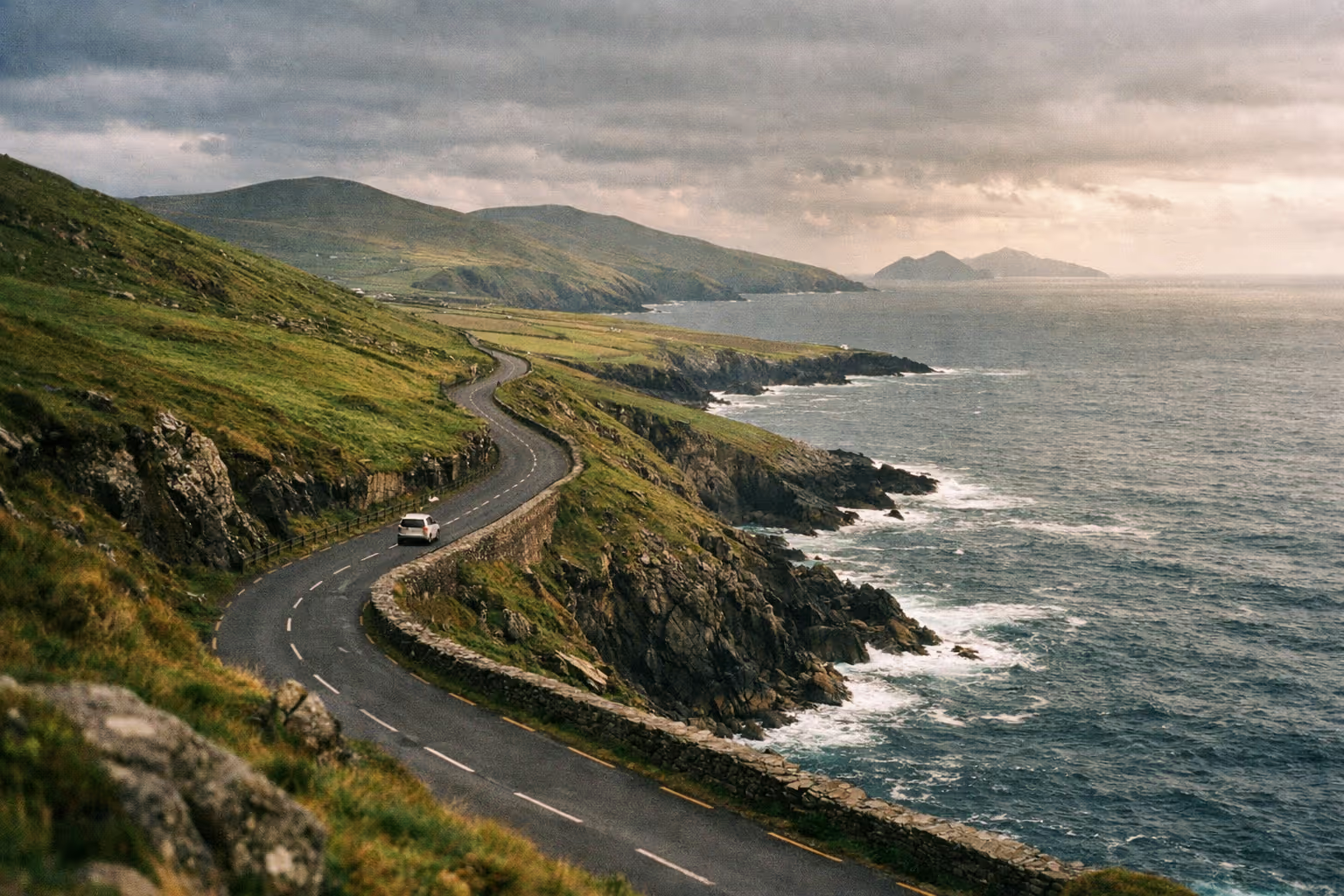
- Flexibility on coastal routes (Ring of Kerry, Slea Head, the Burren) where buses and trains simply don’t go.
- Daily driving legs are short: most under 3 hours of moving time if you plan sensibly.
- The scenic roads are the attraction, not just the transit between stops.
- Easy to adjust pace: add a night somewhere, skip a detour if weather turns.
What doesn’t:
- Left-side driving on narrow rural roads is genuinely stressful for first-timers, especially straight off a long-haul flight.
- Rental cars are mostly manual; automatics cost more and stock is limited, so specify one early.
- Coastal routes take far longer than the map distance suggests: the Ring of Kerry is 179 km but needs a full day.
- Parking at peak-hour viewpoints (Cliffs of Moher, Giant’s Causeway) fills fast in summer.
✓ Pros
- Unmatched flexibility on coastal routes (Ring of Kerry, Slea Head, Burren) where public transport doesn't reach
- Daily driving legs are short: most under 3 hours of moving time
- Scenic roads are the attraction, not just the transit between stops
- Easy to adjust pace: add a night somewhere, skip a detour if weather turns
✗ Cons
- Left-side driving on narrow rural roads is genuinely stressful for first-timers, especially after a long-haul flight
- Rental cars in Ireland are mostly manual; automatics cost more and have limited availability
- Coastal routes (Ring of Kerry, Dingle's Slea Head) take far longer than the map distance suggests
- Parking at peak-hour viewpoints (Cliffs of Moher, Giant's Causeway) fills fast in summer
Before You Drive: Logistics That Affect Every Route
Every ireland road trip in this guide runs on the same four decisions: which airport, which side of the road you’re used to, how many hours you drive per day, and what you book before you leave. Get these right and the itinerary choice becomes easy.
Keep daily moving time to 2 to 3 hours on scenic days. That sounds low until you realise coastal kilometres are nothing like motorway kilometres, more on that below. The other constant: don’t plan a serious drive on arrival day.
Dublin Airport vs. Shannon: Which to Fly Into
Fly into Dublin for any route that loops north and south or includes Northern Ireland. Fly into Shannon for a southwest-only Wild Atlantic Way trip. The trade-off is measurable: the Dublin to Shannon Airport drive is about 214 km and 2 hours 28 minutes, so starting a southwest-focused trip at Shannon saves you a cross-country transfer at each end. For comparison, Dublin to Galway on the M4/M6 runs roughly 2.5 hours without heavy traffic (6), about 221 km: a comfortable motorway day, and the benchmark for what “easy” driving feels like here.
The 14-day loop is the exception: it starts and ends at Dublin regardless, because the route goes north first and comes back through Cork.
What to Book Before You Leave Home
Book time-sensitive activities before you lock the route around them, not after. Two bookings can derail an itinerary if left late:
- Skellig Michael boats from Portmagee run May to September only, with strictly limited daily passenger numbers, and sell out weeks ahead in July and August. If this is on your list, it’s the first thing you reserve.
- Aran Islands ferries in peak season: the Doolin to Inis Mór crossing runs about 35 minutes on the faster boats, but capacity and sea conditions mean services fill up or cancel.
Peak-season accommodation in Galway, Killarney, and Dingle also needs booking 2 to 3 months ahead for July and August weekends, particularly when a festival lands during school holidays.
How to Choose Between 7, 10, and 14 Days in Ireland
Pick your trip length by how many regions you’re willing to do properly, not by how many you can technically reach. Seven days is one region done well. Ten days is the southwest in depth, or the southwest plus a northern add-on. Fourteen days is the full island loop without exhausting yourself.
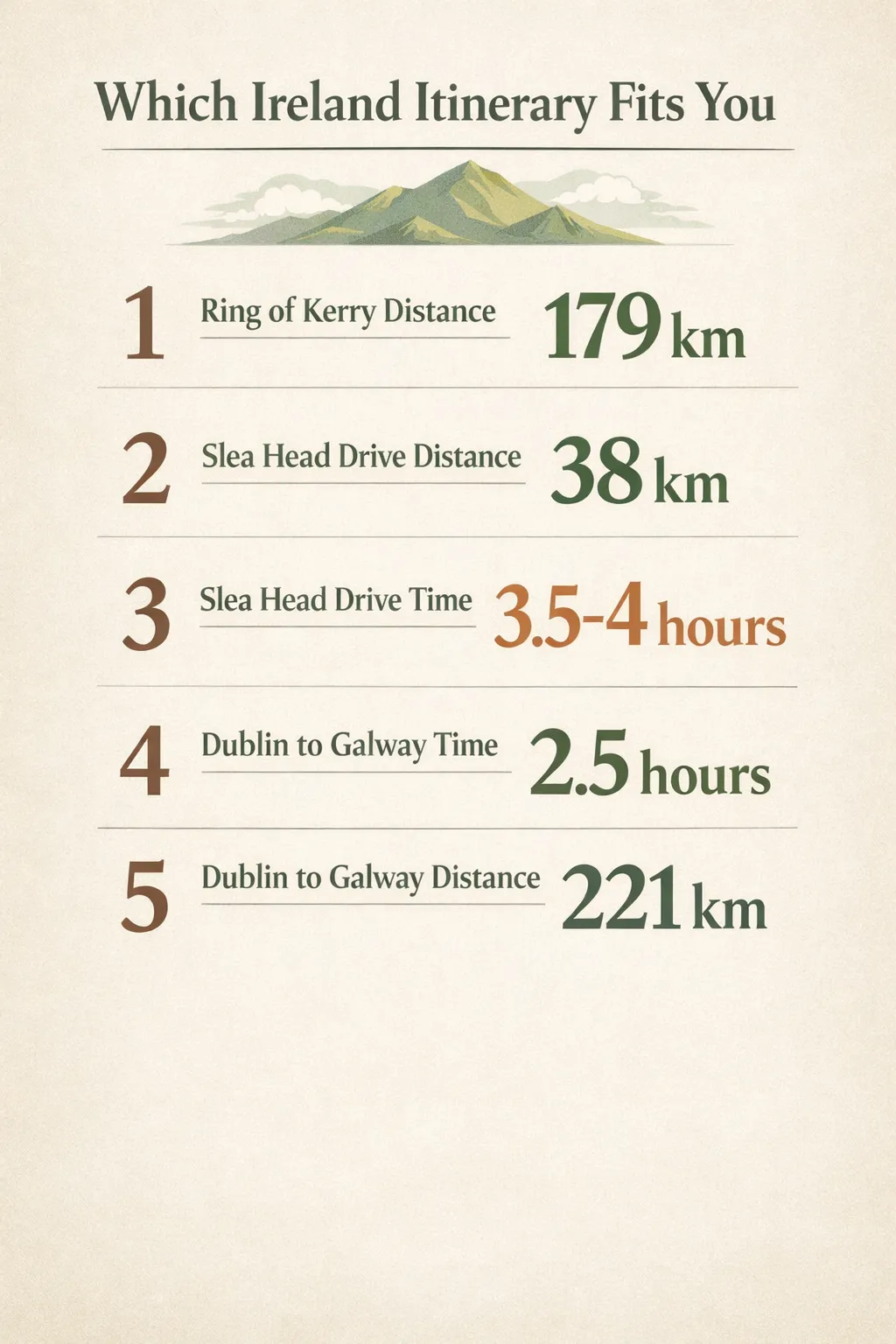 Itineraries differ by region and daily driving time; key figures: Ring of Kerry 179 km, Slea Head Drive 38 km, Dublin-Galway 221 km, with 2.5 hours and 3.5-4 hours drive times.
Here’s the decision, region by region:
- 7 days: one region, committed. Either the southwest (Ring of Kerry, Dingle, Cliffs of Moher, Galway) or the north (Belfast, Giant’s Causeway, Derry with a west-coast segment). You cannot do both in a week without rushing everything.
- 10 days: the Wild Atlantic Way southwest in depth. This adds the Aran Islands, the Burren, and a proper two-day Ring of Kerry. Alternatively, bolt Northern Ireland onto the 7-day southwest loop.
- 14 days: the full loop: Dublin, Northern Ireland, the northwest (Donegal and Connemara), and the entire southwest, with daily drives that stay realistic throughout.
The rule that saves trips: never strand a region. With only 7 days, don’t try to squeeze the Giant’s Causeway and the Ring of Kerry into the same week. According to the Giant’s Causeway visitor information, Dublin is roughly 160 miles (270 km) or about 3 hours’ drive from the Causeway, while Belfast is about 60 miles (100 km), just over an hour away. Linking the Causeway to the far southwest in seven days means stacking multiple 3-hour transfer days: transit, not travel. Northern Ireland earns its place only if you have 10+ days, or if you’re building a deliberately north-focused week.
Here’s how the three lengths compare at a glance:
Which Itinerary Fits Your Trip
| 7 Days | 10 Days | 14 Days | |
|---|---|---|---|
| Best for | First-timers, one strong region | Repeat visitors or WAW focus | Full island loop |
| Regions covered | Southwest OR North | Southwest + North, or deep WAW | All regions |
| Daily driving avg. | 2-3 hrs | 2-3 hrs | 2-3.5 hrs |
| Northern Ireland included? | Optional (north-focused route) | Optional add-on | Yes |
| Skellig Michael possible? | Tight | Yes | Yes |
| Aran Islands possible? | No | Yes | Yes |
| Start/end airport | Dublin or Shannon | Dublin or Shannon | Dublin |
7-Day Ireland Itinerary: Two Routes for One Week
A one-week ireland itinerary works if you pick one region and commit. Route A is the southwest loop, better for first-timers who want coast and landscape. Route B is the northern route, better if Northern Ireland and urban history are your priority. Both keep daily drives under 3 hours, and both use one or two nights per base so you’re not repacking every morning.
Route A: Southwest Loop
Dublin → Kilkenny → Killarney → Dingle → Cliffs of Moher → Galway → Dublin.
- Day 1: Collect the car at Dublin Airport, drive to Kilkenny (about 1.5 hours). A deliberately gentle first day: left-side driving on a straightforward road before you’re anywhere near a single-track coastal lane. The Rock of Cashel is an optional detour if you’re not too tired.
- Day 2: Kilkenny to Killarney, around 204 km and 2 hours 40 minutes of driving, comfortably inside the daily target. Spend the afternoon in Killarney National Park: Torc Waterfall and Muckross House are the easy wins. See the Killarney guide for the full breakdown.
- Day 3: Killarney base, full Ring of Kerry loop. The circuit is 179 km with about 3.5 hours of non-stop driving (9), but plan 8 to 10 hours with stops. Drive clockwise to meet the tour coaches head-on and reach viewpoints before the groups. Details in the Ring of Kerry guide.
- Day 4: Killarney to Dingle, about 1.5 hours, then the Slea Head Drive: a 38 km loop that guides recommend allowing 3.5 to 4 hours for with stops (10). Cross Conor Pass if the weather holds. Overnight in Dingle town.
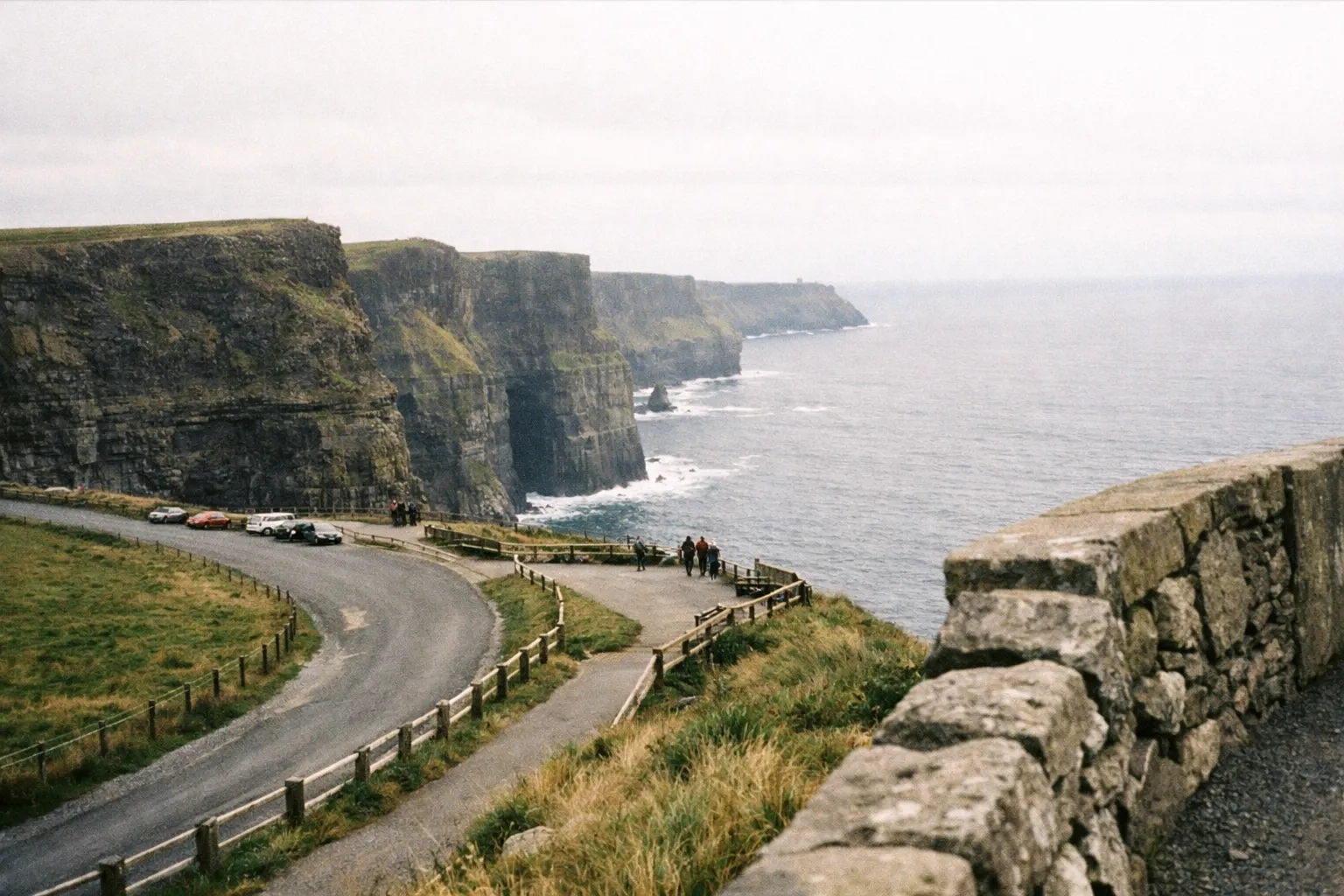
- Day 5: Dingle to Doolin via the coastal road, roughly 3 hours. Hit the Cliffs of Moher in late afternoon or early evening when the coaches have gone; the Cliffs of Moher guide covers timing. Overnight Doolin or Lahinch.
- Day 6: Burren coastal drive, then Galway city for the afternoon and evening. Overnight Galway.
- Day 7: Galway to Dublin Airport, about 2.5 hours, and return the car.
Route B: Northern Ireland Focus
Dublin → Belfast → Giant’s Causeway → Derry → Galway → Dublin.
- Day 1: Dublin city, no driving. Trinity College and the Guinness Storehouse: book timed entry for both.
- Day 2: Dublin to Belfast, roughly 165 km and a clear-run 1 hour 45 minutes. Afternoon in the Titanic Quarter. Overnight Belfast.
- Day 3: Belfast to the Giant’s Causeway, about 1.5 hours along the Causeway Coast. The Game of Thrones Studio Tour is optional. Overnight Bushmills or Ballycastle. See the Giant’s Causeway guide.
- Day 4: Causeway Coast to Derry, about 1 hour. Walk the city walls. Overnight Derry.
- Day 5: Derry to Westport or Galway via the Donegal coast, 3 to 3.5 hours. This is the hardest driving day of the week: scenic, but long. Don’t add major detours.
- Day 6: Galway base. Connemara day loop, or a Cliffs of Moher day trip at roughly 2.5 hours each way: a long day either way.
- Day 7: Galway to Dublin Airport, about 2.5 hours, and return the car.
10-Day: The Wild Atlantic Way Southwest
Ten days is the sweet spot for a Wild Atlantic Way itinerary through the southwest: enough time for Killarney, a two-day Ring of Kerry, Dingle, the Burren, the Cliffs of Moher, and the Aran Islands without a single rushed day. Start at Shannon for the cleanest entry (about 1 hour from the coast), or at Dublin if flights dictate. That adds roughly 2.5 hours at each end.

Days 1-3: Dublin to Killarney via Kinsale and the Coast
- Day 1: Dublin to Kinsale via Cork, on the order of 3 hours. A gentle coastal introduction. Overnight Kinsale.
- Day 2: Kinsale to Killarney via Clonakilty, Skibbereen, and Bantry, about 3.5 hours with stops. Take the secondary coastal roads for the sea views instead of cutting inland. This is the scenic alternative, and it’s the point of the route.
- Day 3: Killarney base. Killarney National Park: Ross Castle, Torc Waterfall, Muckross House. The Killarney guide has the full stop-by-stop.
Days 4-5: Ring of Kerry Over Two Days
- Day 4: The main Ring of Kerry loop from Killarney, driven clockwise, 8 to 10 hours with stops. Full detail in the Ring of Kerry guide.
- Day 5: Gap of Dunloe in the morning, then an afternoon of rest or Kenmare town. This split is exactly what separates a rushed Ring of Kerry from a good one: the loop is 179 km and 3.5 hours of pure driving (9), and cramming the Gap into the same day is where people burn out.
Days 6-7: Dingle Peninsula and Slea Head
- Day 6: Killarney to Dingle town, about 1.5 hours, crossing Conor Pass. Overnight Dingle.
- Day 7: The Slea Head Drive: a 38 km loop from Dingle (10) that fills most of a day once you stop at the Gallarus Oratory and the Blasket Islands viewpoint. Afternoon free in Dingle town.
Days 8-10: Burren, Cliffs of Moher, Aran Islands, and Galway
- Day 8: Dingle to Doolin via the Burren coastal drive, about 3 hours, with the Cliffs of Moher in late afternoon. See the Cliffs of Moher guide. Overnight Doolin.
- Day 9: Aran Islands ferry from Doolin (booked ahead). The Inis Mór crossing runs about 35 minutes on the fast boat, so a full day on the island fits neatly between short transfer days. Dún Aonghasa is the anchor. Return to Doolin or Galway for the night.
- Day 10: Galway in the morning, then drive to Dublin Airport (about 2.5 hours) or Shannon (about 1 hour), and return the car.
14-Day: Full Island Loop
Two weeks is the only length that realistically fits Donegal, Belfast, the Giant’s Causeway, Connemara, the full southwest, and Cork into one driving route. Start and end at Dublin Airport. Go north first, then west, then south. That ordering keeps every daily transfer inside the 2 to 3.5 hour band and avoids doubling back.

Days 1-2: Dublin
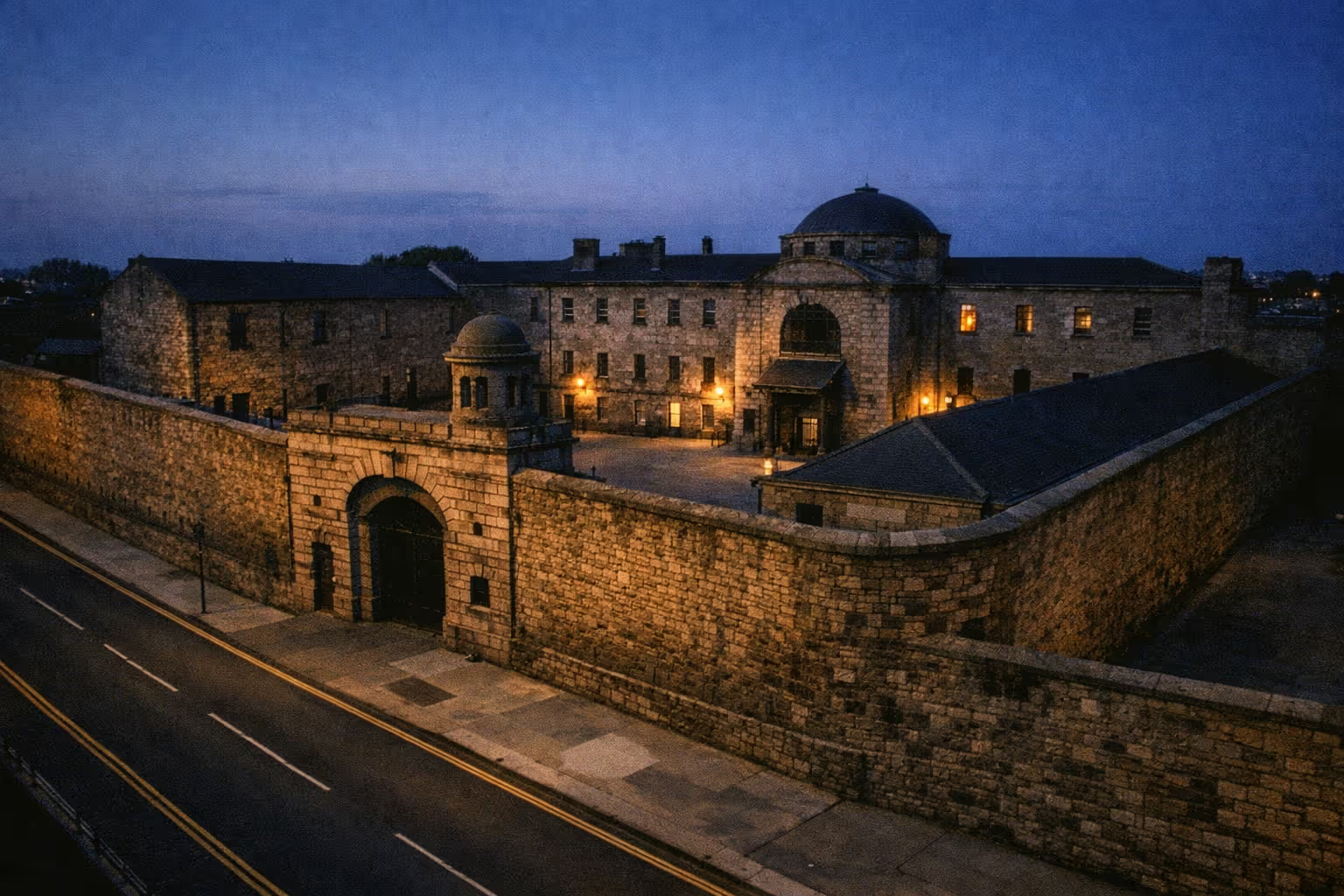
Trinity College and the Book of Kells; the Guinness Storehouse (timed entry); Kilmainham Gaol, which sells out in summer, so book ahead; Phoenix Park. Pick up the rental car on Day 2 afternoon or Day 3 morning.
Do not drive on Day 1 after a long-haul flight. Jet lag plus left-side driving plus narrow roads is a bad combination, and there’s no version of that day that ends well.
Days 3-5: Northern Ireland (Belfast, Causeway Coast, Derry)
- Day 3: Dublin to Belfast, about 2 hours. Titanic Quarter. Overnight Belfast.
- Day 4: Belfast to the Giant’s Causeway, about 1.5 hours, then the Causeway Coast drive. Game of Thrones Studio Tour optional. Overnight Bushmills or Ballycastle. See the Giant’s Causeway guide.
- Day 5: Causeway Coast to Derry, about 1 hour. City walls. Overnight Derry.
Days 6-8: Donegal and the Northwest
Donegal is the region most itineraries skip, and it’s the strongest argument for taking 14 days.
- Day 6: Derry to Donegal Town via the Inishowen Peninsula, about 2.5 hours with the detour. Slieve League cliffs in the afternoon. These sea cliffs reach about 600 metres, more than twice the height of the Cliffs of Moher at roughly 214 metres, and with a fraction of the visitors.
- Day 7: Donegal to Westport via Sligo, about 3 hours, with Ben Bulben en route. Overnight Westport.
- Day 8: Westport base. Connemara loop or Croagh Patrick, plus Kylemore Abbey.
Days 9-11: Galway, Burren, Cliffs of Moher, Aran Islands
- Day 9: Westport to Galway, about 1.5 hours. Galway city for the afternoon and evening.
- Day 10: Aran Islands ferry (booked ahead), a full day on Inis Mór. Overnight Galway or Doolin.
- Day 11: Burren coastal drive, then the Cliffs of Moher. Overnight Doolin or Lahinch. See the Cliffs of Moher guide.
Days 12-14: Kerry, Dingle, and the Southwest
- Day 12: Doolin to Dingle via Killarney, about 3 hours, with the Slea Head Drive in the afternoon.
- Day 13: The full Ring of Kerry loop, driven clockwise. Overnight Killarney or Kenmare. See the Ring of Kerry guide and the Killarney guide.
- Day 14: Killarney to Cork to Dublin Airport, about 4 hours total with a Cork stop. Blarney Castle is optional. Return the car.
Skellig Michael fits this loop best around the Days 12 to 13 window: book the boats from Portmagee well in advance, May to September only, sold out weeks ahead in July and August. Build in one or two flex days: Atlantic storms can close Conor Pass, cancel boat trips, and make the Slea Head Drive miserable.
Ireland Road Trip Tips That Actually Change Your Route
These are the calls that separate a good ireland driving route from a frustrating one: the ones generic “drive on the left” advice skips.
Drive the Ring of Kerry clockwise. Tour coaches run anticlockwise, so going clockwise means you meet them head-on (easier to manage on a narrow road than crawling behind one) and you reach the viewpoints before the groups arrive (9). Start early.
Don’t drive the day you land. Jet lag, left-side driving, and narrow roads make a bad trio. Plan a Dublin or Kilkenny night first. The Dublin to Shannon Airport transfer alone is 214 km and 2 hours 28 minutes: not what you want fresh off a red-eye.
Coastal roads are not motorway kilometres. The Slea Head Drive is 38 km but takes 3.5 to 4 hours with stops (10); the Ring of Kerry is 179 km and needs a full day (9). Google Maps ETAs on these routes are optimistic at best.
Use Kenmare or Killarney as a two-night base for the Ring of Kerry. That lets you add the Gap of Dunloe and Killarney National Park without cramming everything into one long day.
Do the Cliffs of Moher and the Burren on separate days. Trying to combine both with a long transfer to Killarney or Galway in one day is consistently flagged as too ambitious, and I’d agree with that assessment.
Skellig Michael is the one booking that can’t wait. Boats from Portmagee run May to September with strictly limited daily numbers and sell out weeks ahead in July and August. Lock it in before anything else if it’s on your list.
Build in a weather flex day. Atlantic weather can close Conor Pass, cancel Skellig boats, and turn the Slea Head Drive into a wet blur. A buffer day means you reschedule rather than miss.
When to Go: Seasons and What They Mean for Your Route
May to July gives the longest daylight and the most driving flexibility on coastal roads, at the cost of higher accommodation prices and earlier bookings. Average daylight in June runs around 17 hours, easing to roughly 16 to 16.5 hours in July: long windows for the Ring of Kerry and Slea Head Drive. Book Galway, Killarney, Dingle, and Westport 2 to 3 months ahead for peak weekends. For a fuller breakdown of how each season affects costs and crowds, see the best time to visit Ireland guide.
August is the warmest month and the busiest. Skellig Michael boats and Aran Islands ferries are heavily booked, and Galway accommodation pressure peaks. Travelling in July or August means earlier daily starts if you want to beat the coach traffic at Ring of Kerry and Cliffs of Moher viewpoints: the 7-day southwest route especially.
September to October is the shoulder-season sweet spot: fewer crowds, decent daylight, lower rates. Still good for the Ring of Kerry and Dingle, and the Skellig boats run until roughly the end of September. I’d take September over August for the southwest without much hesitation.
November to January is a different trip entirely. Dublin sees only about 7.5 to 8 hours of daylight in December and early January, which limits safe driving time on rural roads. December and January are also among the wettest months, with Dublin’s long-term average monthly rainfall around 65 to 75 mm according to Met Éireann, Ireland’s national meteorological service. Not recommended for first-timers on coastal routes. The Giant’s Causeway and Dublin work year-round; the southwest coastal circuit does not.
Frequently Asked Questions
- Can you do a 7-day Ireland itinerary without a car?
- For a city-focused week, yes. Major cities connect by train and bus, but scenic coastal routes like Ring of Kerry and Slea Head are inaccessible without a car.
- Is 7 days enough for Ireland?
- Yes, if you pick one region. The southwest loop or northern route each work well. Combining both in 7 days means rushing and long transfer days.
- Should I drive the Ring of Kerry clockwise or anticlockwise?
- Clockwise. Tour coaches run anticlockwise, so clockwise driving meets them head-on and reaches viewpoints before groups arrive. Start early.
- Is it worth flying into Shannon instead of Dublin?
- For the 10-day southwest itinerary, yes. Shannon is closer to the Wild Atlantic Way southwest, saving a 2.5-hour drive each end. Dublin suits longer or northern routes.
- How far in advance should I book Skellig Michael?
- Book as soon as dates are fixed. Boats run May-September with limited daily passengers and sell out weeks ahead in July and August.
- What's the hardest driving day on these routes?
- On the 7-day northern route, Derry to Galway is longest (3-3.5 hours). On the 14-day loop, Donegal to Westport is similar. Both are manageable without extra detours.
Where to Start
The modular logic is the whole point: if you have 7 days, pick a route and commit. Don’t strand a region trying to see both coasts. If you have 10, the Wild Atlantic Way southwest is the strongest use of the time. If you have 14, the full island loop is genuinely doable without wearing yourself out, and it’s the only way to fit Donegal and Slieve League.
The detailed stop-by-stop lives in the cluster guides: the Wild Atlantic Way, the Ring of Kerry, the Cliffs of Moher, Killarney, and the Giant’s Causeway. This article is the skeleton; those are the muscle.
One concrete first action: if Skellig Michael is on the list, book the Portmagee boat before anything else, then lock accommodation in Galway or Killarney if you’re travelling in July or August. After that, what actually determines whether the trip works is straightforward: realistic daily driving targets, and not trying to see the whole island in a week.