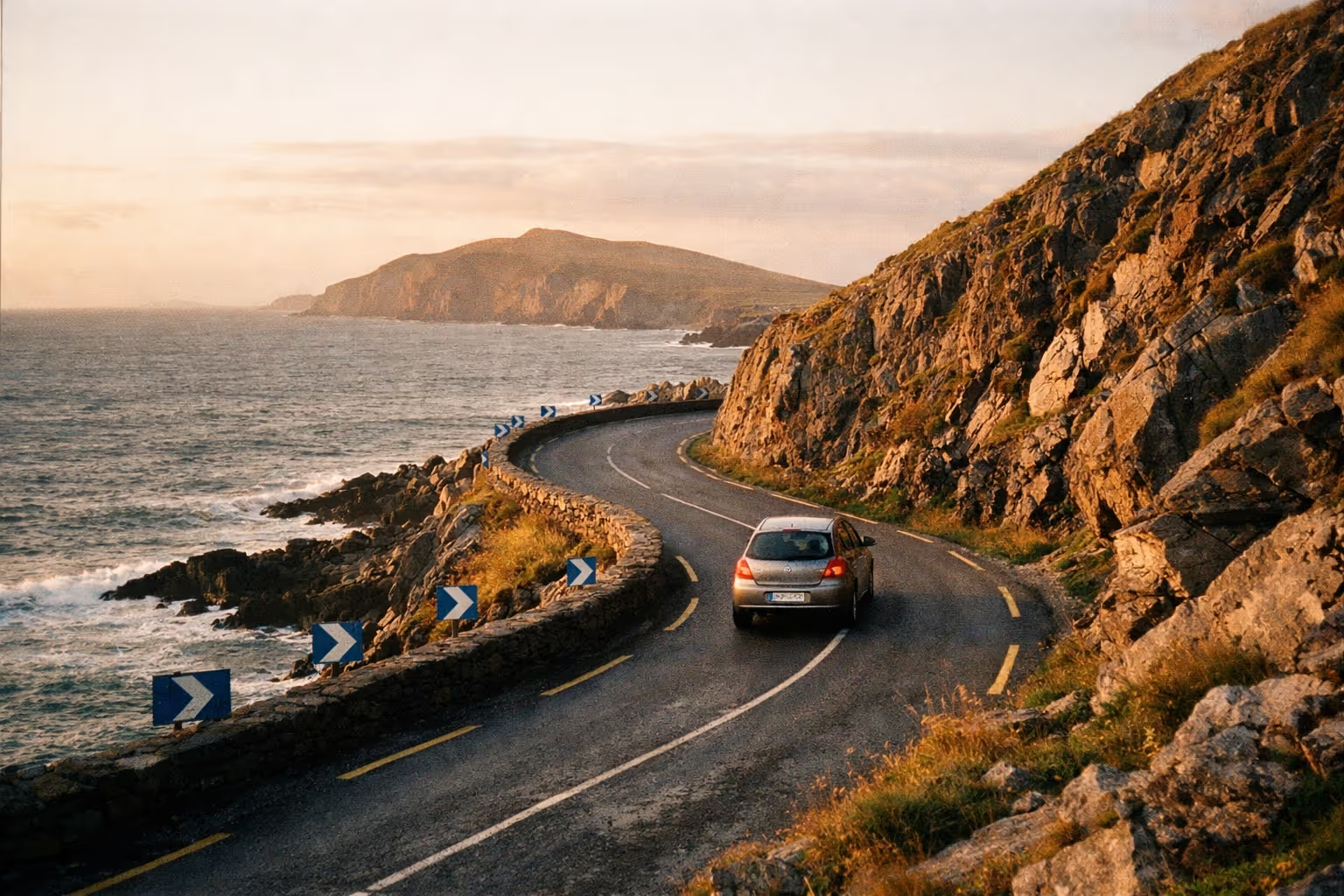
You pull out of the Dublin Airport rental lot, and three things register at once: the steering wheel is on the wrong side, the lane feels tighter than you expected, and the speed sign reads 100. Driving in Ireland means recalibrating all of it: left-side traffic, metric speeds, bilingual signs in English and Irish, and rural roads narrower than a US suburban driveway. None of it is terrifying. All of it is manageable with the right prep. This guide covers exactly what that prep looks like: your rental excess figure, the February 2025 rural speed limit change, five Irish road signs worth memorising, and which roads to start on.
Here’s the honest summary before you commit to self-driving.
✓ Pros
- Only practical way to reach rural and coastal areas
- Flexible pace for scenic routes and stops
- Compact country: most routes are 2-3 hours
- Motorways are wide and well-marked for practice
- Small car classes are affordable and widely available
✗ Cons
- Left-hand driving is disorienting for first-timers
- Narrow rural roads require constant attention
- Rental excess can be €1,500-€2,500 without extra cover
- Bilingual signage can cause hesitation at junctions
- Urban parking is expensive and complex
What Driving in Ireland Actually Involves (The Basics)
Driving in Ireland is doable for any licensed driver willing to spend the first day adjusting: the fundamentals are simple once you name them. Traffic keeps left. You overtake on the right. Roundabouts flow clockwise, and you yield to any vehicle already on the roundabout, which in practice means you look right as you approach, not left. That single habit reversal is where most first-day mistakes happen.
Everything is metric. Speed limits are in km/h, distances in kilometres. If you’re used to mph, a 100 km/h national road reads faster than it feels: 100 km/h is about 62 mph, so recalibrate before you assume the sign means interstate pace. It doesn’t.
A few practical thresholds worth knowing upfront:
- The legal driving age is 17, but rental minimums are higher (more on that below).
- Minimum rental age is typically 21-23, depending on the company, with young-driver surcharges common under 25.
- If your trip is city-only (Dublin, Cork, or Galway with no rural leg), skip the car. All three have dense bus networks, Dublin adds trams, and you’ll spend less time fighting for parking than you would enjoying the drive.
Licence requirements and who can drive
A US citizen needs a valid US driving licence and a passport to drive in Ireland. According to the U.S. Embassy in Ireland, US visitors may drive on a valid US licence for tourist stays of up to 12 months. Beyond that you need an Irish licence: check the RSA’s current rules for your state before you count on an exchange. EU and EEA licences are valid for their full duration. Drivers from some non-EU, non-recognised states may need an International Driving Permit alongside their national licence: check your country’s status before you travel, and carry your passport as photo ID whenever you drive.
One hard line: you need a full valid licence to rent a car. A learner permit won’t get you a rental, and it won’t let you onto a motorway.
Is it difficult for Americans to drive in Ireland?
Yes, the left-hand adjustment is real, but it’s temporary. Most drivers adapt within a day, and the first 30 minutes are the hardest. The highest-risk moment is the first junction after a stop, when muscle memory tries to pull you onto the right. Start on a motorway where lanes are wide and marked, not a country lane. The bigger sustained challenge for most Americans isn’t the driving side at all: it’s the narrow rural roads, which never stop demanding attention no matter how many days you’ve been at it.
Speed Limits, Road Rules, and Recent Changes
Ireland’s default speed limits run 120 km/h on motorways, 100 km/h on national roads, 80 km/h on regional roads, 50 km/h in urban areas, and 30 km/h in some school and residential zones (2). The number that trips up visitors is the rural one, because it changed recently and many older guides and sat-navs still get it wrong.
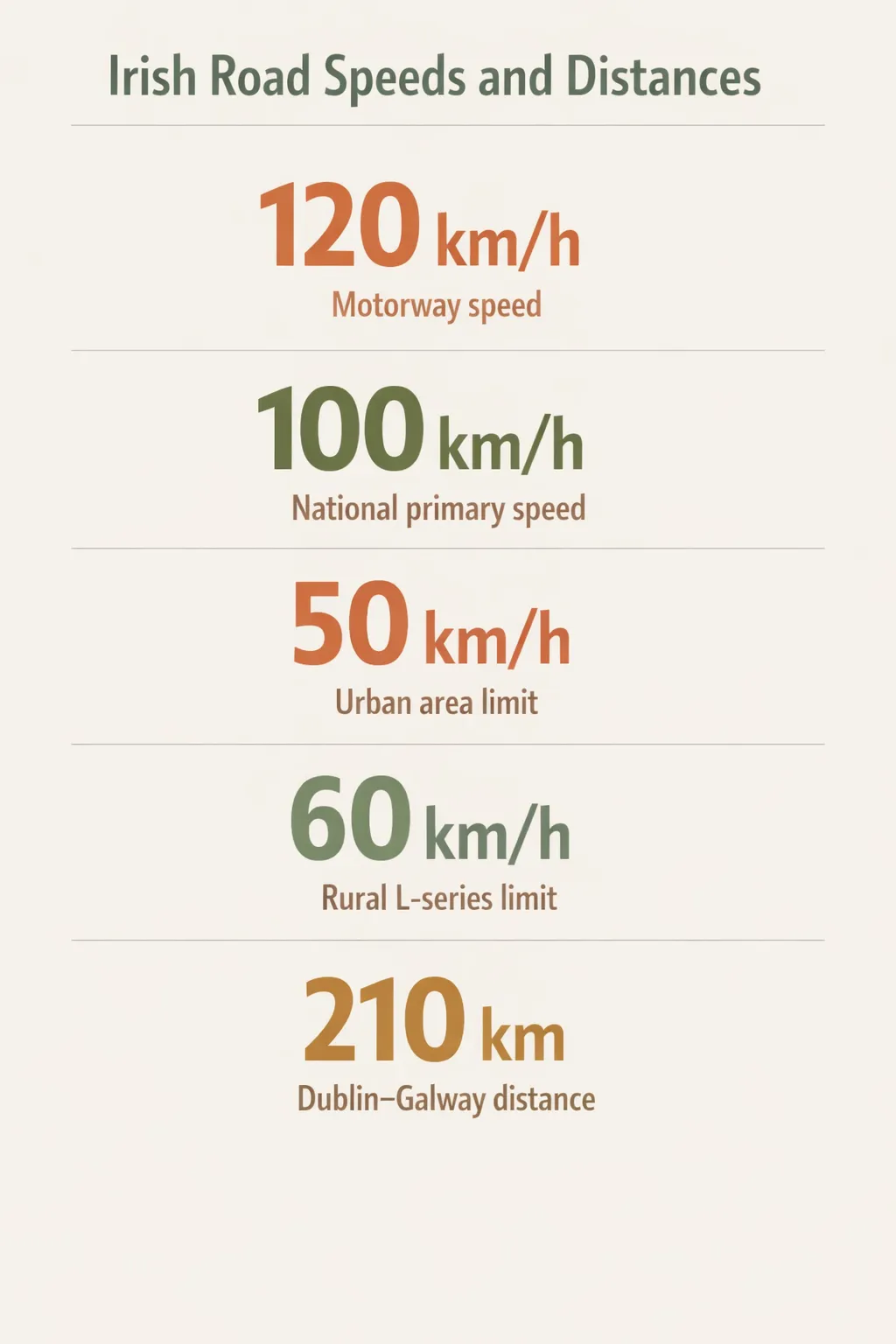 Speed limits by road type in Ireland and the Dublin-Galway distance, reflecting the rural local limit updated to 60 km/h in 2025.

According to Ireland’s Department of Transport, from 7 February 2025 the default speed limit on rural local (L-series) roads dropped from 80 km/h to 60 km/h (12). The traditional rural speed limit sign (a white disc with five diagonal black lines) now means 60 km/h, not 80. If your sat-nav or an older article tells you these roads are 80, it’s out of date. Obey the posted sign, always, over the device.
Further reductions on national secondary roads and urban cores are planned to roll out across 2026-2027, so expect more 30 km/h zones around towns and schools over time. The rule holds: posted signs beat the screen.
A few rules that catch visitors off guard:
- Drink-driving limits are strict. The Road Safety Authority sets the limit at 50 mg of alcohol per 100 ml of blood for fully licensed drivers, and a tighter 20 mg per 100 ml for learner, novice, and professional drivers. That’s lower than many visitors assume: effectively, don’t drink and drive at all.
- Handheld phone use costs a €120 fine and 3 penalty points. Points recorded in Ireland can follow you into future rentals and insurance, so keep the phone in the holder or off.
- The yellow box rule: yellow cross-hatched boxes at junctions mean you must not enter unless your exit is clear, even on a green light. It’s enforced in cities, and it exists to stop drivers blocking the junction.
- Learner permit holders cannot use motorways: relevant only if you’re driving on a foreign learner licence, which you shouldn’t be, since it won’t get you a rental anyway.
- Towing and campervans are capped at 80 km/h regardless of the posted road limit.
Speed limit quick-reference table
Speed Limits by Road Type
| Motorway | National primary road | National secondary road | Regional road | Urban area | School / residential zone | Rural local (L-series), post-Feb 2025 | Towing / campervan | |
|---|---|---|---|---|---|---|---|---|
| Road type | Motorway | National primary road | National secondary road | Regional road | Urban area | School / residential zone | Rural local (L-series), post-Feb 2025 | Towing / campervan |
| Speed limit | 120 km/h | 100 km/h | 100 km/h | 80 km/h | 50 km/h | 30 km/h | 60 km/h | 80 km/h max |
| Sign / identifier | Blue signs, "M" route | Green signs, "N" route | Green signs, "N" route | White signs, "R" route | Built-up areas | Posted zone signs | White disc, five diagonal black lines | N/A |
| Notes | Minimum 50 km/h; no learners; hard shoulder for emergencies only | Wide, well-marked | Further reductions planned 2026-2027 | Retains 80 km/h | Active parking and speed enforcement | Expanding through 2026-2027 | Reduced from 80 km/h in February 2025 | Applies regardless of posted limit |
What the rural speed limit sign actually means now
The white disc with five diagonal black lines is the sign visitors misread most, and since 7 February 2025 it means 60 km/h, not the old 80 km/h. Citizens Information confirms the sign, often paired with a “Go Mall / Slow” plate, now indicates a 60 km/h maximum on rural local roads. This matters on exactly the roads you’ll want to drive: the L-series lanes threading through the Ring of Kerry, the Dingle Peninsula, and stretches of the Wild Atlantic Way. The limit was cut because these roads were never safe at 80. Treat 60 as a ceiling, not a target.
Reading Irish Road Signs (Including the Gaeilge)
Irish road signs are bilingual, showing English and Irish (Gaeilge), and on rural signs the Irish sometimes appears first or, occasionally, alone. That’s the gap most guides skip. A visitor who hesitates at “Géill Slí” on approach to a junction is a hazard. Learn a handful of words and the hesitation disappears.
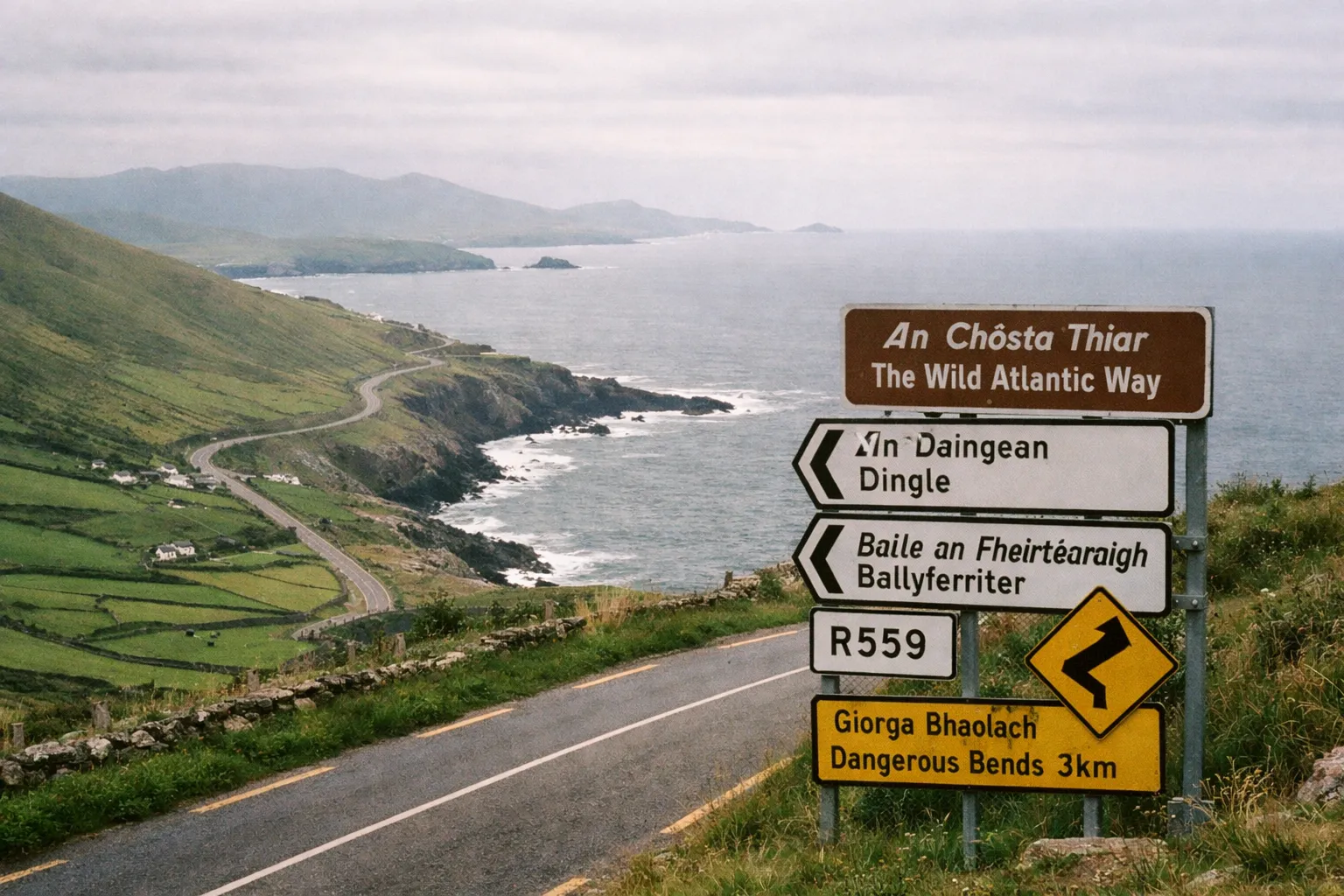
Direction signs follow a consistent colour code you’ll pick up within an hour: green backgrounds for national primary routes, white for regional and local roads, blue for motorways. Speed signs are numeric and need no translation, though the white disc with diagonal lines (now the 60 km/h rural default) is unfamiliar to most visitors and worth committing to memory before you go.
Tolls are their own small trap. The M50 around Dublin uses a barrier-free electronic toll system called eFlow: overhead gantries record your plate and there are no booths to stop at. Rental companies handle this differently, so confirm with your provider before you drive the M50 to avoid a penalty landing on your card weeks later.
One sat-nav warning worth taking seriously: Irish place names in Gaeilge can differ sharply from the anglicised versions. An Daingean for Dingle is the classic example. Download offline maps and verify both spellings of your key destinations before you set off.
A short Gaeilge sign glossary
- Géill Slí: Yield / Give Way
- Stad: Stop
- Lár na Cathrach: City Centre
- Bóthar: Road
- Sráid: Street
- Cosc ar Pháirceáil: No Parking
- Go Mall: Slow
- Aire: Caution
- Bealach Isteach: Entrance / Way In
- Bealach Amach: Exit / Way Out
Learn the first two cold. “Géill Slí” at a junction is not the moment to be translating.
Driving on the Left in Ireland: What the Adjustment Actually Feels Like
Driving on the left in Ireland feels wrong for about an hour and then quietly becomes normal. The cognitive load is real but temporary, and most drivers adapt within a day. The U.S. Embassy in Ireland reminds American visitors that Irish cars are right-hand drive and traffic keeps left, and that extra caution is needed at junctions and turns in the first days. That’s exactly where the risk concentrates.
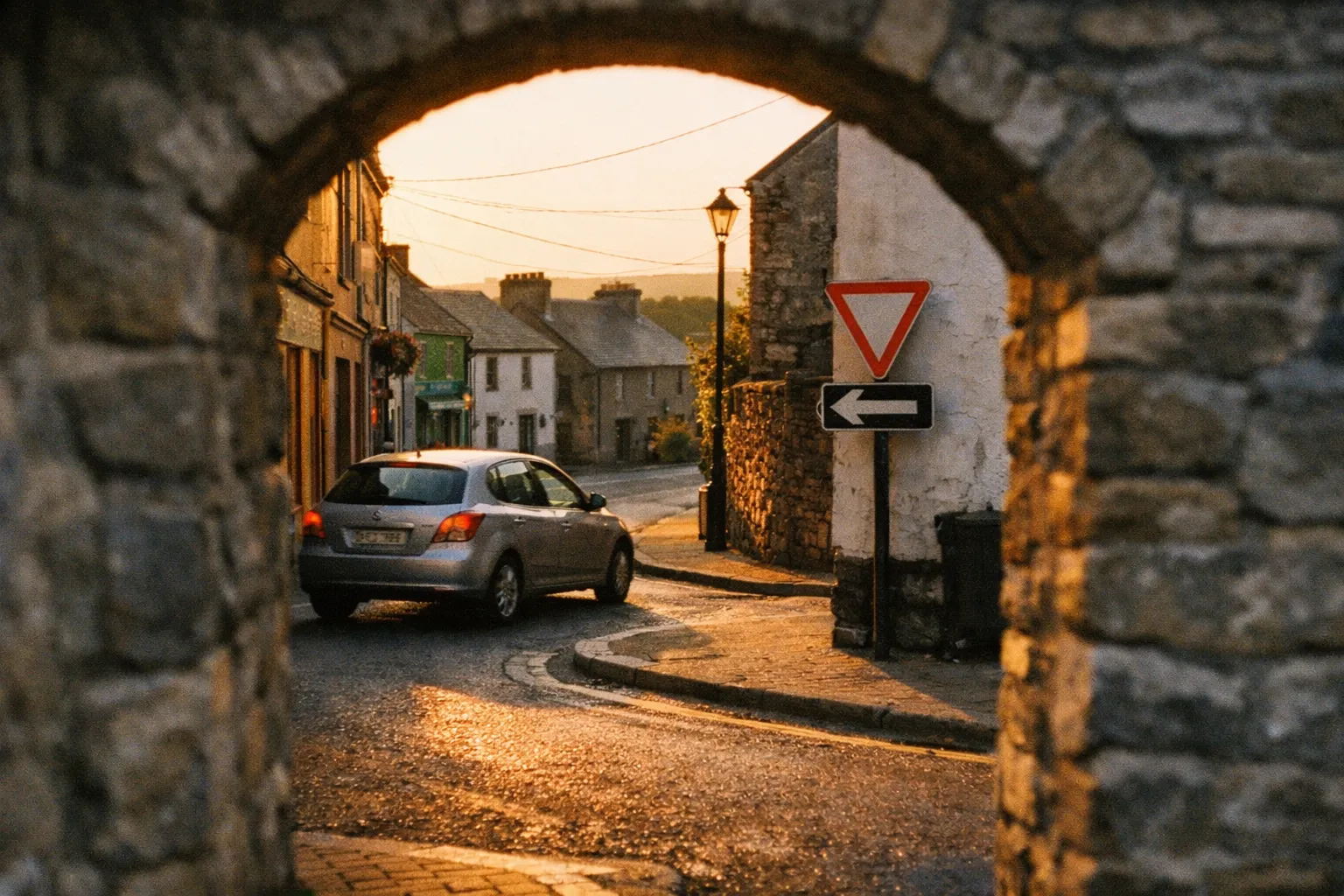
The specific moments where visitors go wrong:
- Pulling out of a petrol station or car park. With no traffic to follow, muscle memory pulls you to the right lane. This is the single most common mistake.
- The first roundabout. More on that below: it trips people up more than the driving side itself.
- Drifting toward the centre line on narrow two-lane roads, because your body wants to sit where a left-hand-drive car would put you.
The strategy is simple: start on a motorway or dual carriageway where the lanes are wide and clearly marked, and avoid L-series local roads on day one. A passenger who calls out “keep left” at junctions and roundabouts is genuinely useful, not patronising: use them. And a sticky note reading “LEFT” on the dashboard for the first day sounds basic and works.
Roundabout priority: the rule visitors get wrong most often
At an Irish roundabout, traffic flows clockwise and you yield to any vehicle already on the roundabout, which means you look to your right before entering. The Rules of the Road specify that drivers yield to traffic already on the roundabout, keep left on entry unless markings say otherwise, and signal left before exiting. Here’s the sequence, step by step:
How to Handle Your First Roundabout in Ireland
5 minutesStep-by-step guide to safely navigating roundabouts in Ireland
- 1
Approach in the correct lane
Use the left lane for the first exit, right lane for later exits, unless road markings direct otherwise.
- 2
Check right for vehicles already on the roundabout
Look to your right to yield to traffic already circulating.
- 3
Yield if traffic is present
Give way to vehicles on the roundabout; they have priority.
- 4
Enter when clear, keeping left
Join the roundabout staying in the left lane unless otherwise marked.
- 5
Signal left before your exit
Indicate your intention to leave the roundabout.
- 6
Exit left, checking your mirror and blind spot
Safely leave the roundabout, watching for other road users.
The reflex to check left instead of right is the error that causes side collisions. Slow right down on your first few roundabouts and check right, deliberately, every time.
Narrow Roads in Ireland: What to Expect and How to Handle Them
Narrow roads in Ireland are the single most underestimated part of the trip. Rural “boreens” and L-series lanes can be under 3 metres wide (less than a standard SUV plus its mirrors), with stone walls and hedges sitting right at the edge and no verge to bail onto. This is the sustained difficulty, not the left-hand driving.

The Department of Transport’s “Slower Speeds, Safer Roads” campaign cut the L-road default to 60 km/h in February 2025 precisely because the previous 80 km/h limit was inappropriate for roads with this geometry. The Road Safety Authority notes that many of these roads have poor alignment and limited forward visibility, and advises treating the signed limit as a maximum, not a target. On a genuinely tight boreen, 60 km/h is often far too fast. Drive to what you can see.
Handling oncoming traffic on single-track sections:
- Pull as far left as you safely can and slow to a near-stop.
- Use passing places where marked. The informal convention is that whichever driver is closer to a passing place reverses to it. It isn’t a written rule, but it’s universally understood.
- Expect to wait behind tractors, farm vehicles, and tour coaches. These are working roads. Build extra time into every rural driving day.
Citizens Information draws a useful line here: regional (R-series) roads keep their 80 km/h limit and are generally wider, while rural local roads dropped to 60 km/h and are often much narrower. When you’re routing, an R-road is the easier drive.
Scenic routes (the Ring of Kerry, Dingle’s Slea Head Drive, sections of the Wild Atlantic Way) include single-track stretches. That’s not a reason to avoid them. It’s a reason to drive them slowly and not at dusk, when depth perception and oncoming headlights make narrow lanes harder to read.
Choosing the right car size for Irish roads
Book the smallest car that fits your bags. A supermini or compact is dramatically easier on tight lanes than an SUV, and it fits village car parks that a larger vehicle simply won’t. Avoid large SUVs and 7-seaters unless you genuinely need the seats: the extra width is a liability, not a comfort, on an L-road with walls on both sides. Campervans face the hardest conditions of all: maximum size on minimum roads, plus the 80 km/h towing-class limit. If you’re set on a campervan, plan routes around the wider regional and national roads and skip the single-track detours.
What not to do on narrow Irish roads
- Don’t speed into blind bends: there may be a tractor, a cyclist, or a coach around it.
- Don’t assume the road widens. It often doesn’t.
- Don’t park on passing places. They exist so two vehicles can get past each other.
- Don’t rely on sat-nav to warn you about width restrictions. It won’t. Your eyes are the only width sensor you have.
Renting a Car in Ireland: What the Paperwork Actually Means
Car rental in Ireland requires a full valid national licence (not a learner permit), a passport, and a credit card in the main driver’s name: debit cards are often refused or trigger a much larger pre-authorisation deposit. Sort those three things before you fly.
The part that catches people out is the excess. A standard rental includes a Collision Damage Waiver (CDW), but the CDW still carries an excess: the amount you’re liable for if the car is damaged, even when the damage isn’t your fault. For a compact car in Ireland, that excess commonly runs €1,500-€2,500, and it rises for higher-risk categories such as young or older drivers. Know your number before you reach the counter.
You have three ways to handle the excess:
- Accept it and hope nothing goes wrong. Cheapest upfront, riskiest.
- Buy the rental company’s counter “super CDW” to reduce or eliminate the excess. Convenient, but expensive per day.
- Buy third-party car hire excess insurance before you travel. Often cheaper overall, but verify that Ireland is covered and that you fall inside the policy’s age band.
A few more contract details that matter:
- Young-driver surcharges are common. Several major Irish brands set the minimum age at 21-23 and add a per-day fee for drivers under 25.
- Fuel policy: the fairest and most common arrangement is full-to-full: you collect it full and return it full. A pre-purchase fuel arrangement usually costs you more. Confirm which you’re signing up for.
- Automatic vs manual: most Irish rental cars are manual. If you need an automatic, specify it at booking: availability is lower and the price is higher. Don’t assume you can swap at the counter.
The excess insurance decision: what actually makes sense
For most drivers aged 21-84, buying third-party car hire excess insurance before you travel is the sensible play: it typically covers an excess in the €1,500-€3,000 range and usually costs less than the rental company’s daily counter product. The catch is the age band. Many of these policies only cover drivers between roughly 21 and 84, which leaves some older drivers outside the standard product: in which case the counter super-CDW or a supplier with inclusive cover becomes the fallback.
Whatever you choose, decide before you get to the desk. The counter is the worst place to make an insurance decision under time pressure.
Senior drivers: which rental companies work and which don’t
Age policies differ markedly by brand, so if you’re over 75 the choice of supplier matters more than anything else. Hertz, Avis, Europcar, and Enterprise generally set no upper age limit, though they may require a medical declaration or a letter of fitness from a doctor for drivers over 70-75. Some regional brands cap out: Dan Dooley at 75, Casey at 80. Book with a no-cap supplier if you’re over 75, and email your medical documentation ahead of arrival so it isn’t a dispute at the desk.
Senior Driver Age Policies by Rental Company
| Hertz | Avis | Europcar | Enterprise | Dan Dooley | Casey | |
|---|---|---|---|---|---|---|
| Company | Hertz | Avis | Europcar | Enterprise | Dan Dooley | Casey |
| Upper age limit | None stated | None stated | None stated | None stated | 75 | 80 |
| Medical declaration required | May be required over 70-75 | May be required over 70-75 | May be required over 70-75 | May be required over 70-75 | Check current policy | Check current policy |
| Notes | Confirm by email before arrival | Confirm by email before arrival | Confirm by email before arrival | Confirm by email before arrival | Book elsewhere if over 75 | Book elsewhere if over 80 |
Fuel, Tolls, and Practical Logistics
Fuel is sold in litres. AA Ireland’s monthly price survey put petrol (unleaded) at €1.84 per litre and diesel at €1.92 in August 2026 (11); it is updated on the second Monday of each month, so check the current figure before you budget. Fill up before heading into rural areas: stations thin out fast in Connemara, Donegal, and the Kerry peninsulas, and a village may have no pump at all.
Distances are short by American standards. Dublin to Galway is about 210 km, roughly 2 to 2.5 hours. Cork to Killarney is around 85 km, under an hour on the N22. The catch is that these national-road times don’t apply once you turn onto L-roads, a point worth factoring in when you plan (more on that in the tips section).
Tolls come in two flavours. The M50 Dublin ring road is barrier-free electronic tolling through eFlow: overhead gantries record your plate, and payment is due by 8 p.m. the following day if the car isn’t on a pre-registered account, or late penalties apply. Most rental companies register the car and pass the toll plus an admin fee to your card, but confirm this before you drive the M50. Other tolled routes (sections of the M1, M4, M7, and the Dublin Port Tunnel) use conventional plazas taking cash or electronic tag, with rates varying by vehicle class.
Parking in cities means metered on-street bays, multi-storey car parks, and disc-parking zones where you buy a paper disc from a newsagent. Urban 30 and 50 km/h zones come with active enforcement, and fines land. For navigation, use an up-to-date app: Google Maps or Maps.me with an offline download. Older sat-nav units may still show the pre-2025 rural limits. Whatever the screen says, obey the posted sign.
Ten Practical Tips for First-Time Drivers in Ireland
These driving in ireland tips are ordered by where they’ll actually save you, not alphabetically, not by category.
-
Start on a motorway. Your first 20 minutes should be on the M1 or M50, not a country lane. Wide lanes, clear markings, no oncoming traffic to misjudge: it’s the gentlest place to reset your instincts to the left.
-
Book the smallest car that fits your bags. A compact beats an SUV on every rural road in Ireland and slots into village car parks a larger vehicle can’t. Width is your enemy on a boreen.
-
Understand your excess before you sign. Know the number: €1,500-€2,500 for a compact, and decide your insurance strategy in advance, not at the counter under pressure.
-
Learn five Irish road signs. Géill Slí (yield), Stad (stop), Lár na Cathrach (city centre), the white rural speed disc (now 60 km/h), and the eFlow toll symbol. That’s enough to remove junction hesitation.
-
Never assume the rural speed limit is 80 km/h. Since February 2025, L-roads default to 60 km/h. The old sign now means a lower number.
-
Give roundabouts full attention. Yield to traffic already on the roundabout, enter slowly, and check right before you move. This trips up more visitors than the driving side does.
-
Leave the phone in the holder or off. A handheld phone is a €120 fine and 3 penalty points, and points can raise insurance and complicate future rentals.
-
Factor in narrow-road time. A 40 km drive on L-roads can take close to an hour once you account for width and the 60 km/h limit (2). Don’t plan rural days on motorway logic.
-
Check your rental company’s age policy before booking. Especially if you’re under 25 or over 70: the difference between suppliers can be a car or no car.
-
Download offline maps. Signal drops in Connemara, Donegal, and parts of Kerry. Don’t rely on live data to find the last petrol station before the coast. If you’re planning a longer trip and want to make the most of the roads once you’re confident, the best time to visit Ireland matters too: summer gives you the longest daylight hours for rural driving days.
Frequently Asked Questions
- Is it difficult for Americans to drive in Ireland?
- The left-hand adjustment is the main challenge; most visitors adapt within a day; narrow rural roads are the sustained difficulty, not the driving side.
- What does a US citizen need to drive in Ireland?
- Valid US licence (up to 12 months), passport, credit card for rental; no International Driving Permit required for most visits.
- What is the yellow box rule in Ireland?
- Cannot enter a yellow box junction unless your exit is clear; applies even if the light is green; enforced in cities.
- What changed about rural speed limits in 2025?
- L-series local roads dropped from 80 km/h to 60 km/h in February 2025; the white disc with diagonal lines now means 60 km/h, not 80.
- Can I use my rental car in Northern Ireland?
- Most Irish rental companies permit it but require advance notification; some charge a cross-border fee; confirm before travel.
- What happens if I get a speeding fine or penalty points in Ireland as a visitor?
- Fines are enforceable; penalty points are recorded and can affect future rentals; rental companies typically pass fines to the driver via the card on file.
What to Actually Do Before You Go
Driving in Ireland is manageable, but “manageable” means doing four specific things, not just feeling reassured. Know your rental excess figure: €1,500-€2,500 for a compact, and sort your cover before you fly, not at the counter. Understand that L-roads dropped to 60 km/h in February 2025. Learn five Irish road signs. Plan your first 20 minutes on a motorway.
The biggest variable isn’t the left-hand driving. Most people have that sorted within an hour.
It’s the two things that determine whether the whole trip runs smoothly: the insurance decision you make before you travel, and the patience you bring to narrow roads once you’re on them. One is a 10-minute task you do at home. The other is a mindset you carry the whole time.
So here’s the actual prep list: book the smallest car that fits your bags, arrange excess cover before you leave home, confirm your rental company’s age and cross-border policies, and add 20 minutes to every rural driving day. Do that, and the rest is just remembering to keep left.