The Book of Kells is a Latin copy of the four Gospels, written close to 800 AD. You see it in the Old Library at Trinity College Dublin on a self-guided ticket priced from €25 (1)(2). The manuscript has been split into four separately bound volumes since 1953, and its folios were severely trimmed and gilded during a 19th-century rebinding. More than 500,000 people a year come to look at the two volumes normally open in the display case (2). This guide covers what the manuscript is, how it got to Dublin, and which of Trinity’s five ticket options fits the time you have.
✓ Pros
- Its significance rests on both the manuscript's survival and the skill visible in its decoration.
- The visit can fit between other central Dublin plans without taking a full day.
- The digital exhibition gives you a closer look than the display case allows.
- A quieter session offers an alternative for visitors who find crowded galleries difficult.
✗ Cons
- The display case offers only a brief, shared look at the open pages.
- The manuscript's rotating display means you cannot choose which decorated folio is open.
- Ticket names make it easy to buy access that excludes the digital exhibition.
The case for going is solid. The historical significance holds up to scrutiny, the standard visit fits into 90 minutes, a free audio guide is included, and there is a low-sensory option for anyone who struggles with noise and crowds (1). The case against is also worth knowing before you pay. Entry is busy, your time at the manuscript case itself is short, and the five ticket tiers are easy to confuse on a first booking.
What Is the Book of Kells?
The Book of Kells is Trinity College Dublin manuscript MS 58. It is an illuminated Latin copy of the four Gospels, written on calfskin vellum and based mainly on St Jerome’s Vulgate (2). It is a working religious text first and an artwork second, even though most visitors come for the art.
That distinction matters because it answers two common questions at once. Yes, the manuscript is about Jesus: the four Gospels are the New Testament accounts of his life, death and resurrection. The book also contains scenes normally interpreted as the Arrest of Christ and his Temptation, along with images of Christ, the Virgin and Child, St Matthew and St John (3). And what makes it special is not the text, which exists in countless copies. It is the way the text was presented.
The Four Gospels in Latin
The Book of Kells text follows the Vulgate, the Latin translation St Jerome completed in 384 AD, mixed with readings from the earlier Old Latin translation (2). That blend tells you something about how scripture circulated in early medieval Ireland and Britain. Monasteries copied from the exemplars they had on hand, and older readings survived alongside the newer standard text.
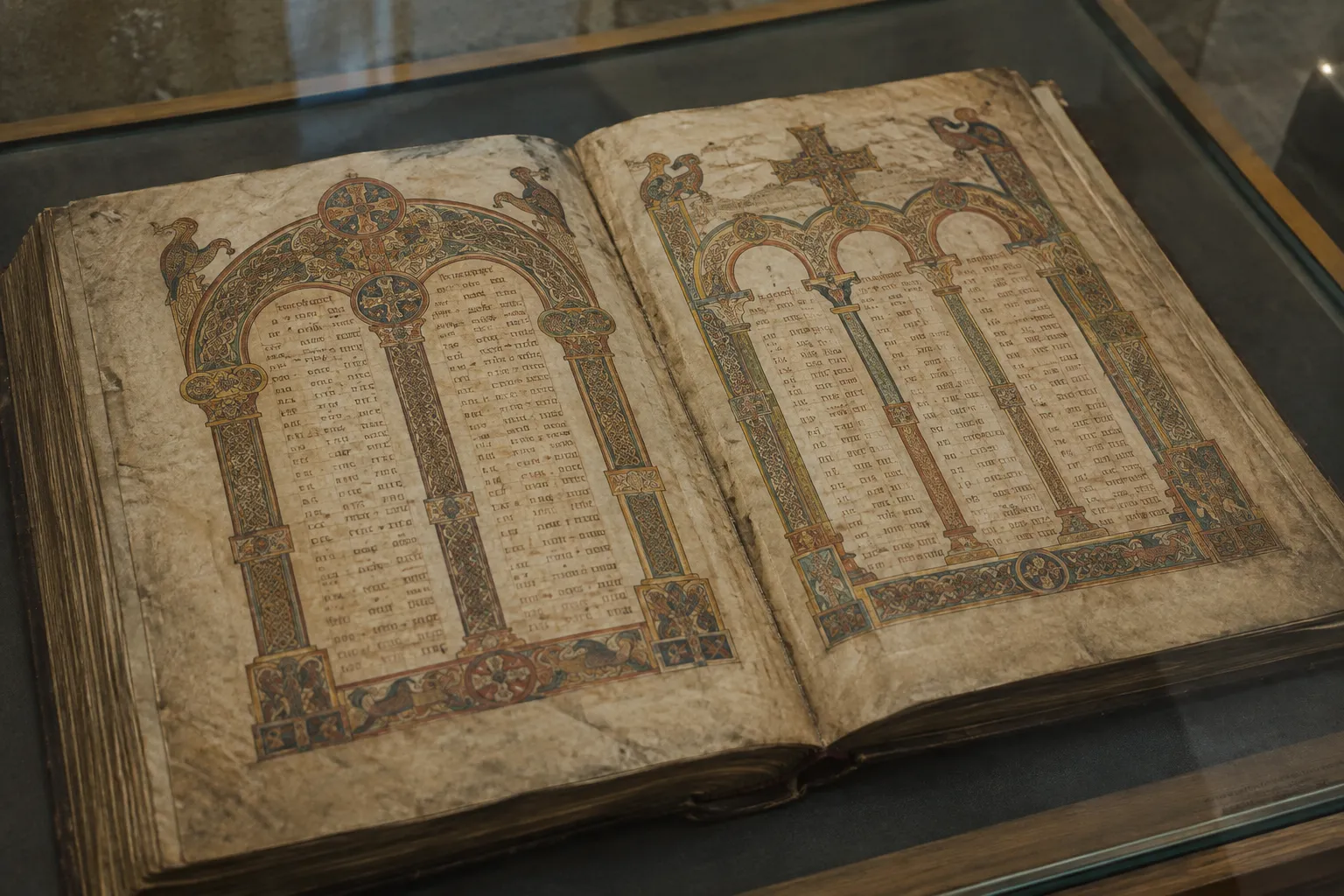
The Gospels do not start on the first page. According to Trinity College Dublin, they are prefaced by other texts, including “canon tables” (2). Canon tables are concordances that line up Gospel passages shared by two or more evangelists. Trinity’s “About” page notes that these concordances were compiled in the fourth century by Eusebius of Caesarea, and that prefaces and summaries of the Gospel narratives also precede the main text (3). In the Book of Kells, the canon tables are framed in decorated arcades, so even the reference apparatus got the full artistic treatment.
The script is insular majuscule. Trinity describes it as a “bold and expert version” of that script, written on vellum, meaning prepared calfskin (2). If you have seen later Gothic manuscripts, insular majuscule will look rounder and more open. It is legible to a modern eye once you know the Latin, which most visitors do not. For you at the case, that means the script pages are about rhythm and craft rather than reading.
The decoration goes beyond the famous full-page images. Trinity’s “About” page describes key words and phrases embellished throughout the text, “an endlessly inventive range of decorated initials,” and small interlinear drawings tucked between lines (3). This is why the plain-text volume in the case still rewards a close look. Scan the margins and line ends for small animals and figures.
The Chi Rho Page: Medieval Art’s Most Famous Folio
Folio 34r is the page most people picture when they hear “Book of Kells.” It introduces Matthew’s account of the Nativity, and Trinity describes it as the most famous page in medieval art (2). That is a strong claim from the institution that owns it. Very few art historians would argue against it hard.
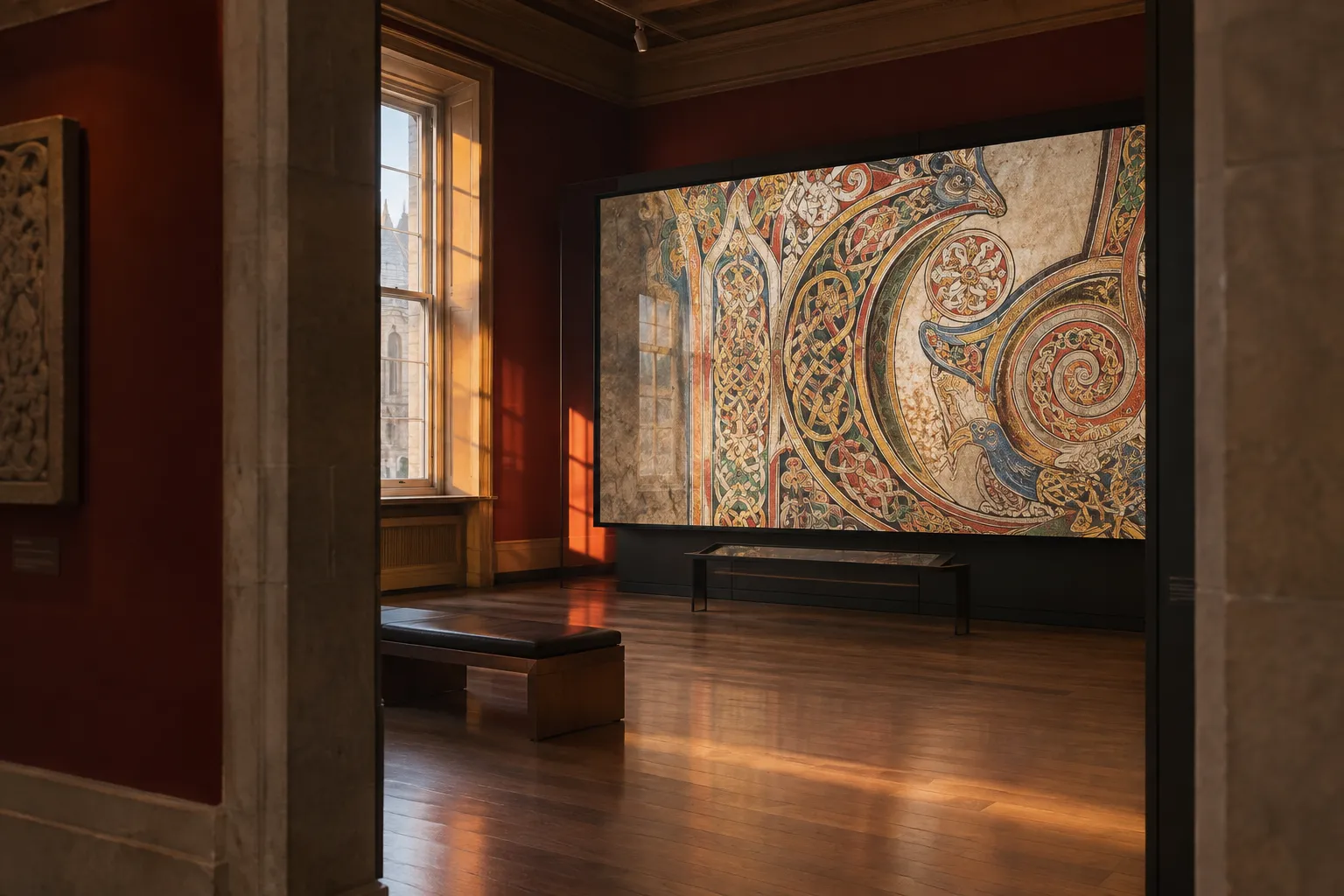
The page is built around the Chi Rho, the monogram formed by the Greek letters chi (X) and rho (P), the first two letters of “Christ” in Greek. In Matthew’s Gospel, this is the point where the narrative of Christ’s birth begins, so the scribes and artists treated it as the most important opening in the book. The X sprawls across most of the page. Every gap is filled with spirals, knotwork and interlace, and small human and animal figures sit inside the ornament if you look long enough.
Do not expect to see the Chi Rho page when you visit. The decorated volume is opened to one major page at a time (2), and Trinity turns the pages several times a year for conservation purposes (4). As of October 2026, the pages on view were folios 7v-8r, from the Gospel of Matthew (4). Which page you get depends on the conservation schedule, not on your ticket. The Red Pavilion, included in the standard ticket, houses three immersive digital exhibitions, including The Book of Kells 360 (4). That is one of the stronger arguments for the full ticket over the cheaper Old Library-only option.
Origins and History: From Iona to Trinity College
The Book of Kells was written close to 800 AD. According to Trinity College Dublin, it cannot be conclusively assigned to Iona, to Kells, or to a combination of both (2). Most popular guides get this point wrong. They present the Iona origin story as settled history, and it is not.
Creation Close to 800 AD
Trinity’s library page dates the manuscript to close to the year 800 (2). That date comes from style and context, not from a signed colophon. The manuscript does not tell you who made it or where.
The two main candidate sites are linked. Iona, a small island off the west coast of Scotland, was home to a monastery founded around 561 by St Colum Cille, also known as St Columba (2). Kells, in County Meath, northwest of Dublin, was a related foundation. Trinity notes that for many years the two monasteries were governed as a single community (2). So when scholars debate “Iona or Kells,” they are debating two houses of the same monastic network. They are not choosing between two unrelated cultures.
The majority academic view attributes production to Iona, although other claims have placed it in Northumbria or in Pictland (2). That is the position you will hear most often, and it is reasonable. Trinity then adds the important caveat: there is no way of knowing whether the book was produced wholly at Iona, wholly at Kells, or partly at each (2). A finished manuscript could have been started on Iona and completed at Kells, and nothing in the evidence rules that out.
The practical point for your visit is simple. When a tour guide, a gift-shop card or a blog tells you the book “was made on Iona and carried to Kells,” treat that as the most popular hypothesis. Trinity itself does not state it as fact.
The 806 Viking Raid and the Move to Kells
The strongest thread connecting the manuscript to both sites is a date: 806. According to Trinity, the Iona monks took refuge at Kells after a Viking raid on Iona in 806, and the manuscript then remained at Kells through the Middle Ages (2).
This is where the “Iona to Kells” theory gets its logic. If the book was begun or finished on Iona around 800, it is plausible that the community brought it with them when they moved to safer ground in Meath. The problem is the word “plausible.” The shared community and the 806 refuge connect the two places, but Trinity says production at either site, or both, cannot be determined (2). The book is named for Kells because that is where it spent the medieval centuries, not because Kells has been proven as its birthplace.
The manuscript did not survive those centuries untouched. The Annals of Ulster, which call it “the chief treasure of the western world”, record that it was stolen in 1006 for its ornamental shrine (2). If you are curious about the town itself, Kells is a feasible day trip from Dublin, but it does not hold the original. We keep this guide focused on Trinity.
Arrival at Trinity College Dublin
The move to Dublin came during the upheaval of the mid-17th century. According to Trinity, around 1653 the manuscript was sent to Dublin for safety, and it later reached Trinity College through Henry Jones (2). The timing coincides with the Cromwellian period in Ireland, when church property in the midlands was at risk.
Trinity’s library page does not give an exact donation date. It says the book reached the college a few years after the move to Dublin, through Henry Jones, when he became Bishop of Meath in 1661 (2).
Once at Trinity, the book eventually went on public view. It has been on display in the Old Library since the mid-19th century (2). That same century brought the rebinding that trimmed and gilded the folios, which is part of why the pages look slightly smaller and cleaner-edged than their medieval makers intended. In 1953 the manuscript was rebound again, this time into four volumes, for conservation reasons (2)(3). Splitting the book spreads the wear of display across volumes and lets conservators rest some sections while others are on view.
The four-volume binding is also why you see two volumes at once in the case. One is opened to a major decorated page and the other to two pages of script (2). You are looking at two of four volumes, and only two openings out of hundreds.
Inside the Manuscript: Folios, Imagery, and What Survives
The Book of Kells contains 340 folios, which Trinity says now measure approximately 330 × 255 mm (about 13 × 10 inches) after 19th-century trimming (2). Around 30 more folios are estimated to have been lost over the centuries (2). Knowing the physical facts helps you make sense of what you see through the glass.
Folios vs Pages: Why the Numbers Differ
You will see two different counts for the manuscript: 340 and 680. Both are correct.
Trinity’s library page counts 340 folios (2). A folio is a single leaf of vellum with two sides, a front (recto) and a back (verso). Trinity’s “About” page gives the same manuscript as 340 folios (680 pages) (3). Double 340 and you get 680. The figures describe the same book in two units, which is why page references use an “r” or “v” suffix. Folio 34r, the Chi Rho page, is the recto (front) of the 34th leaf.
This matters when you read about specific pages before your visit. If a source cites “page 68,” it may be counting sides rather than leaves. Trinity’s own references use folio numbers, so stick with those if you want to cross-check what is on display.
Dimensions and the Missing Folios
The folios now measure approximately 330 × 255 mm (about 13 × 10 inches) (2). That is close to the size of a large coffee-table book. Trinity notes the leaves were severely trimmed, and their edges gilded, during 19th-century rebinding (2). Some of the outer decoration was likely lost to the trimming knife, and the gilded edges are a 19th-century addition, not a medieval feature.
The manuscript is also incomplete. Trinity estimates that around 30 folios went missing during the medieval and early modern periods (2). Some of the losses were single leaves, which Trinity says are presumed to have become detached over time and lost (2). Trinity does not give one definitive cause for all of them. Treat claims that the missing leaves were destroyed by Vikings, or taken in a single event, as speculation.
Some damage is visible in the surviving pages. Trinity reports that copper-green pigment reacted with damp and perforated the vellum on some folios (2). If the decorated page on display has small holes or thinned areas in green passages, that is the reason. The pigment that made the decoration also slowly damaged the material it sat on, so the colors are both the art and a record of what happened to the book.
Evangelist Symbols and Sacred Portraits
The manuscript’s decoration mixes abstract ornament, plant forms, animals and human figures (2). That combination is characteristic of insular art, the style shared by Irish and British monasteries in this period. Nothing is left blank. Trinity’s page describes it as insular majuscule script with elaborate abstract, plant, animal and human decoration (2).
The evangelist symbols are the most useful thing to learn before you go, because they recur across the decorated pages. According to Trinity, they appear as follows (2):
- Matthew: a man
- Mark: a lion
- Luke: a calf
- John: an eagle
These symbols go back to early Christian readings of visions in the books of Ezekiel and Revelation. In the Book of Kells, they sometimes appear together on a single page and sometimes introduce the Gospel they represent. If the decorated volume is open to a page with four creatures arranged around a cross, you are looking at the four evangelists in symbolic form.
The manuscript also contains full-page images of the Virgin and Child and a portrait of Christ (2). The Virgin and Child page is among the earliest surviving depictions of that subject in a Western manuscript. Trinity’s “About” page adds images of St Matthew and St John and narrative scenes such as the Arrest of Christ and his Temptation (3). If you see a crowded composition with small figures around a central one, check the audio guide for which scene it is.
This is the heart of why the Book of Kells is considered special. Many Gospel books survive from the early Middle Ages. Few carry this density of decoration, this range of imagery, and this level of craft in the script itself. Its status as the best-known insular illuminated manuscript rests on that combination.
Seeing the Manuscript: Tickets, Tours, and Opening Hours
The standard Book of Kells Experience is a 90-minute self-guided visit listed from €25 per person (4), covering the Old Library, the Red Pavilion digital exhibition and a free audio guide. Four other ticket types exist. Here is how they differ, so you book the right one before you reach the gate.
Trinity College sits at College Green in central Dublin, within walking distance of Grafton Street and Temple Bar. If you are not on foot, Pearse DART station is beside the east side of campus, and the Luas Green line stops at Trinity on College Street (southbound trams) and at Westmoreland on Westmoreland Street (northbound trams), both a short walk from the main entrance. From Dublin Airport, take an airport bus into the city centre and walk. Nobody should drive to Trinity. Central Dublin parking is expensive, slow and unnecessary for a campus you can reach by rail.
Standard Self-Guided Experience (90 Minutes)
This is the default ticket and the right choice for most visitors. It is listed from €25 per person (4), runs 90 minutes, and includes entry to the Old Library, the digital exhibition in the Red Pavilion, and a free audio guide (1). Trinity labels it a self-guided, two-building experience (1). The Old Library part includes the Long Room, where the Gaia installation now hangs (4). Some 200,000 books have been removed from the Long Room for the Old Library Redevelopment Project, but Trinity says the Old Library and Long Room remain open to visitors until the end of 2027, after which the Book of Kells will be shown in the Printing House (5).
The 90 minutes is not padding. The official listing budgets that time across both buildings (1), and visitor reviews shown on the booking page in October 2026 give the same figure, one of them reading “Self guided. Lots to see. 90 minutes for sure.” (1)
Ranked by what is worth your time inside the standard ticket:
- Worth the detour: the manuscript case in the Old Library. This is the reason you came. You will likely spend a few minutes at the case itself, because the space is shared and there are only two openings to see.
- Worth the detour: the Red Pavilion digital exhibitions. The second building holds three immersive exhibitions, The Book of Kells 360 among them (4), and it is the part of the visit that makes up for the short time at the glass.
- Skip if short on time: the full audio guide track. The free audio guide adds context, but if you are pressed, listen to the manuscript and Chi Rho sections and skip the rest.
Old Library-Only Ticket: What’s Excluded
The cheapest route in is the Book of Kells & Old Library ticket at €19, which covers the manuscript and the Long Room (1). It is listed at 45 minutes (1). It explicitly excludes the Red Pavilion digital exhibition (1).
The trade-off is €6 and 45 minutes. The standard €25 ticket covers both the Old Library and the Red Pavilion. The €19 ticket covers the manuscript and the Old Library only (1). If your whole goal is to say you stood in front of the Book of Kells, the cheaper ticket does that. If you want to understand what you are looking at, the Red Pavilion is where most of that happens, and the €19 ticket cuts it.
For most first-time visitors, pay the extra €6. The exception is a tight schedule: if you have 45 minutes between other bookings and do not mind a brief look, the Old Library-only ticket fits better than rushing the 90-minute experience.
Guided Tours and Trinity Trails Combo
Trinity sells two guided options. They are different products, and the names do not make that obvious.
The Guided Book of Kells Experience is listed from €65 per person (4). It is a 75-minute guided Old Library tour with a maximum group size of 16 (1). Trinity’s ticket page presents this as a new guided Old Library tour (1). The small cap is the selling point: 16 people is small enough to hear the guide and ask questions.
The Trinity Trails & Book of Kells Experience bundle is listed from €37 (1). It adds Trinity Trails, the official guided walking tour of the campus, run by student guides, to the Book of Kells Experience (1). The Trinity Trails portion is a 45-minute English-language tour, taken before your Book of Kells visit, and the bundle as a whole is listed at 120 minutes (1). The walking tour covers the campus, not the manuscript. Once you enter the Old Library you are on the self-guided experience.
How to decide between them:
- Choose the €65 guided tour if you want a guide at the manuscript itself and value a small group.
- Choose the €37 Trinity Trails bundle if you want context on the college and its buildings, and are happy to take the manuscript and exhibition at your own pace.
- Skip both if your Dublin schedule is packed. The audio guide in the €25 ticket covers the essentials.
The bundle is the best value of the guided options. For €12 more than the standard ticket, you get a 45-minute campus tour on top of the full experience (1).
Opening Hours to Check Before You Go
As of October 2026, Trinity’s booking page lists these Book of Kells Experience hours (1):
- Monday to Friday: 9:00 am to 6:00 pm
- Saturday: 9:00 am to 6:30 pm
- Sunday: 9:30 am to 6:00 pm
The Book of Kells Experience page on the same site showed longer hours at the same date: 8:30 am to 6:30 pm Monday to Thursday, 8:30 am to 7:00 pm Friday and Saturday, and 9:00 am to 6:30 pm on Sunday (4). Confirm the times for your date when you book. Special events, exams and conservation work can all affect access on a college campus that is still a working university.
On booking mechanics: entry is timed, online booking is strongly recommended, and tickets are non-refundable once purchased (4). Pick your date and slot carefully before paying, especially if your Dublin plans might shift. Book online in advance rather than turning up. The listings show labels such as “Limited availability” and “Selling fast” for popular options (1), and an attraction drawing more than 500,000 people a year does not leave much slack in peak periods (2).
Compare the five Book of Kells ticket options
| Standard self-guided | Old Library-only | Guided Book of Kells Experience | Trinity Trails and Book of Kells Experience | Low-sensory hour | |
|---|---|---|---|---|---|
| Price (October 2026) | €25 | €19 | €65 | €37 | €21.50 |
| Duration | 90 minutes | 45 minutes | 75 minutes | 120 minutes | 90 minutes |
| What's included | Old Library, Red Pavilion, free audio guide | Old Library; excludes Red Pavilion | Guided Old Library tour | 45-minute campus walking tour plus Book of Kells Experience | Book of Kells Experience with reduced crowds, noise and sensory stimuli |
| Group size or format | Self-guided | Self-guided | Maximum 16 | Student-guided campus tour; manuscript visit self-guided | Reduced-sensory session |
Choosing the Right Visit for You
Most visitors should book the standard €25, 90-minute ticket. The low-sensory hour is the better choice if crowds or noise bother you, and it is cheaper (1). The right pick depends on your time, your tolerance for crowds, and how much context you want.
The Low-Sensory Hour
Trinity lists a low-sensory Book of Kells Experience at €21.50, lasting 90 minutes (1). The page describes it as having fewer people, reduced noise, and reduced sensory stimuli (1).
Look at those numbers against the standard ticket. The low-sensory hour runs the same 90 minutes as the standard visit and costs €3.50 less (1). You get the same time with fewer people around you, which directly addresses the main drawback of the standard visit.
It is designed for visitors who find crowds, noise or intense stimuli difficult, and it should be booked with that purpose respected. If that describes you or someone in your group, it is the clear choice. Availability is likely limited to specific sessions, so check the booking page early.
Mistakes to Avoid When Booking
Most problems with this visit come from booking, not from the manuscript. The common ones:
- Buying the €19 ticket by accident. It is the cheapest option and easy to click first. It excludes the Red Pavilion digital exhibition (1). If you want the full experience, check that your ticket says “two buildings.”
- Confusing the two guided products. The €37 bundle adds a campus walking tour. The €65 option is a guided tour of the Old Library itself, capped at 16 people (1). They are not interchangeable.
- Underestimating the time. The standard ticket is listed at 90 minutes (1). Squeezing it into 45 minutes before a lunch reservation means rushing the Red Pavilion, which is the part that explains what you saw.
- Expecting a specific page. You see two volumes, one opened to a major decorated page and one to two pages of script (2). The Chi Rho page may not be the one on display.
- Booking a slot you might miss. Entry is timed and tickets are non-refundable once purchased (4). Choose a time you can keep.
As for timing, weather is not the constraint here, since the whole experience is indoors. Crowds are. Dublin’s summer months and school holiday periods typically bring the most tourists. A weekday morning between November and February, outside the Christmas weeks, is usually the calmest time to go, and it is a sensible way to spend a cold, wet Dublin day. If you are visiting in summer, book the earliest slot you can get.
Is It Worth the Visit?
Yes, with calibrated expectations. The Book of Kells is one of the most important surviving medieval manuscripts, and seeing the original is different from seeing reproductions. The visit is manageable in 90 minutes and priced from €25 (1). That compares reasonably with major museum tickets in other European capitals.
The honest caveat is that the viewing itself is brief. You get two openings of a book with 340 folios, seen through glass, in a space shared with a steady flow of other visitors (2). If you arrive expecting to leaf through the manuscript, or to spend a long time alone at the case, you will leave disappointed. The Red Pavilion digital exhibition is what makes the ticket feel complete (1).
One more point: the Book of Kells is not the oldest book in the world, and it does not need to be to justify the visit. It dates to close to 800 AD (2). Several complete Bible manuscripts are centuries older, such as the fourth-century Codex Sinaiticus. Its text is also a copy of Jerome’s Vulgate, completed in 384 AD (2). The manuscript’s claim to fame is its decoration, not its age. If “oldest book” comparisons interest you, that topic deserves its own guide.
Frequently Asked Questions
- Why is the Book of Kells considered so special?
- Its distinction is the density and range of its illumination, paired with expertly written insular majuscule; its importance is artistic, not a claim to being the oldest book.
- Is the Book of Kells the oldest book in the world?
- No; it dates to close to 800 AD, while some surviving Bible manuscripts are centuries older.
- Is the Book of Kells about Jesus?
- Yes; it contains the four Latin Gospels, the New Testament accounts of Jesus' life, death and resurrection.
- Can you see the Book of Kells online?
- Yes; Trinity's digital collections portal has digitised images searchable under manuscript MS 58.
- Why are pages missing from the Book of Kells?
- The exact causes are not established; Trinity estimates that about 30 folios were lost across the medieval and early modern periods.
- What was the Book of Kells used for?
- It served a religious purpose as a Gospel book; its scale and decoration point to ceremonial display or special occasions rather than everyday reading.
- Can visitors choose which page is open in the display case?
- No; conservators rotate the displayed pages, so the open folios depend on the conservation schedule rather than the visitor's ticket.
Booking the Right Ticket
The Book of Kells was written close to 800 AD. Where it was made remains open: Trinity reports that most scholars favor Iona but that production at Iona, Kells or both cannot be determined (2). Any guide that tells you otherwise is flattening the scholarship. You will enjoy the manuscript more knowing that its story is partly unresolved.
For the visit itself, match the ticket to your schedule. Book the standard 90-minute experience, listed from €25 (4), if you want the full two-building visit with the audio guide. Choose the guided tour, listed from €65 (4), for a group capped at 16, or the Trinity Trails bundle, listed from €37 (1), for campus context. Pick the low-sensory hour, listed from €21.50 (1), if crowds and noise are a concern. All prices are as of October 2026. Check the opening hours and ticket conditions for your date on Trinity’s booking page, book ahead, and allow the full 90 minutes.