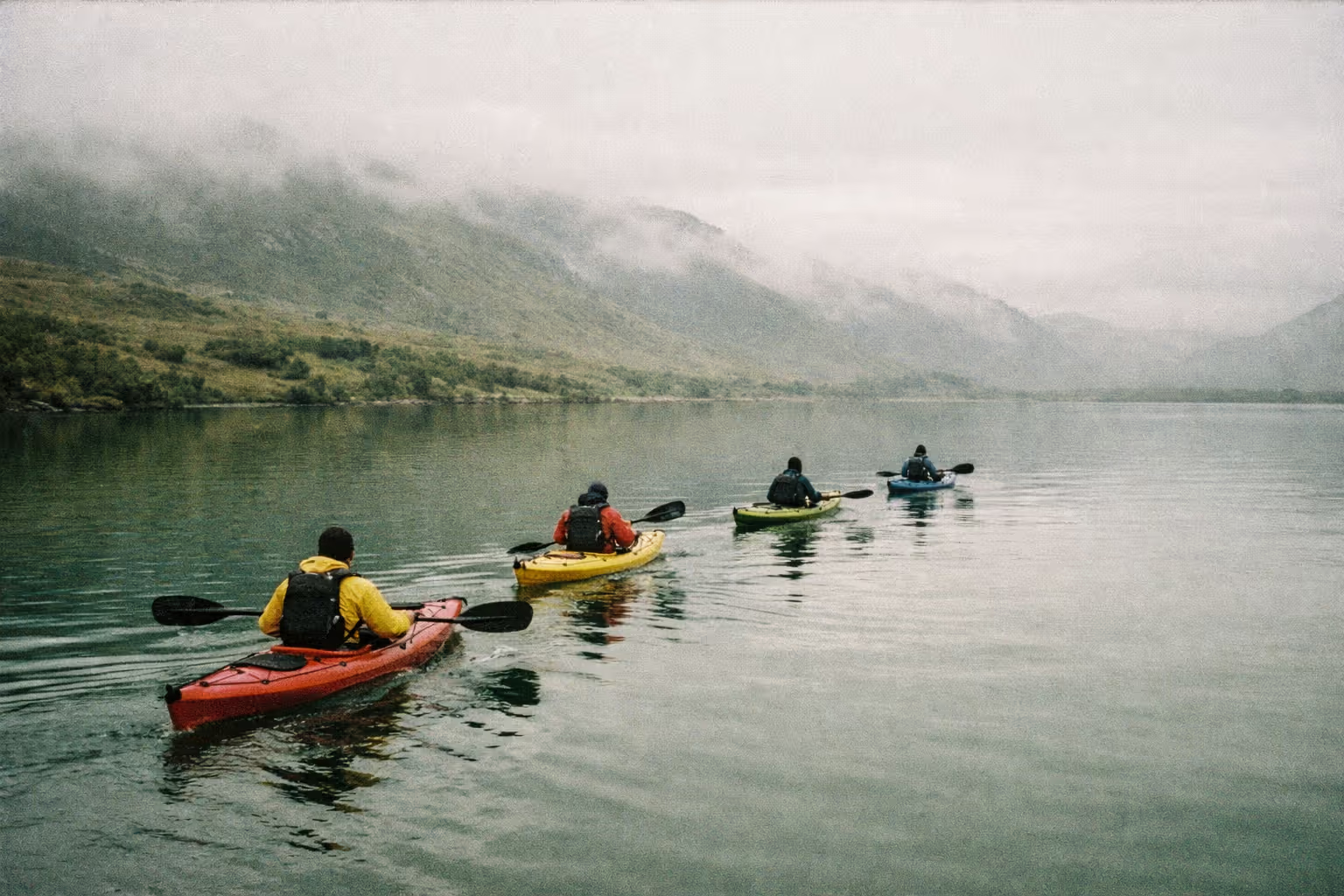
Disciplined backpackers routinely do Ireland on a budget of around €75 a day, which tells you the country’s reputation as an expensive destination is mostly a planning problem, not a hard ceiling. Ireland sits in the pricier tier of European travel (accommodation and food are genuinely at the upper end), but the daily range is wide enough to work with. Careful backpackers keep on-the-ground spend at €70 to €90 per day, while comfortable midrange travel runs €150 to €180 and up.
This guide covers the five levers that actually move the needle: where you sleep, how you get around, what you eat, which activities you pay for, and when you go. Flights are excluded throughout; that’s standard for on-the-ground budget guides, and long-haul airfare can equal one to two weeks of daily spending on its own. Everything below assumes you’re budgeting the trip, not the plane ticket.
Traveling Ireland on a Budget: The Honest Overview
Before the detail, here’s the balanced picture.

What works in your favor:
- An enormous amount of free outdoor scenery (coastal walks, national parks, mountain trails) requires zero admission.
- Multiple national museums in Dublin have free entry year-round.
- Leap Card discounts and daily fare caps make city travel genuinely affordable.
- Guesthouses and B&Bs outside Dublin offer competitive rates, often with breakfast included.
- Shoulder and off-season travel (October to March) cuts accommodation costs significantly.
What works against you:
- Dublin accommodation is among the most expensive in Europe for its tier.
- Pub meals and alcohol add up fast: easy to underestimate by €15 to €30 a day.
- Rural areas are poorly served by public transport, making a car close to necessary for some itineraries.
- Peak summer (July and August) compresses hostel availability and inflates prices across the board.
- Car rental costs (insurance, fuel, tolls, deposits) routinely exceed the quoted daily rate.
✓ Pros
- Enormous amount of free outdoor scenery (coastal walks, national parks, mountain trails) requires zero admission
- Multiple national museums in Dublin have free entry year-round
- Public transport with Leap Card discounts and fare caps makes city travel genuinely affordable
- Guesthouses and B&Bs outside Dublin offer competitive rates, often with breakfast included
- Shoulder and off-season travel (Oct-March) cuts accommodation costs significantly
✗ Cons
- Dublin accommodation is among the most expensive in Europe for its tier
- Pub meals and alcohol add up fast: easy to underestimate by €15-30/day
- Rural areas are poorly served by public transport, making a car almost necessary for some itineraries
- Peak summer (July-August) compresses hostel availability and inflates prices across the board
- Car rental costs (insurance, fuel, tolls, deposits) routinely exceed the quoted daily rate
What a Realistic Daily Budget for Ireland Actually Looks Like
A realistic daily budget for Ireland runs from about €75 for disciplined backpackers to €180 for comfortable midrange travel, with most standard budget travelers landing around €110 per person per day. Those three tiers assume very different choices, and knowing which one you’re actually in prevents the single most common budgeting failure: planning for €75 and spending €130.
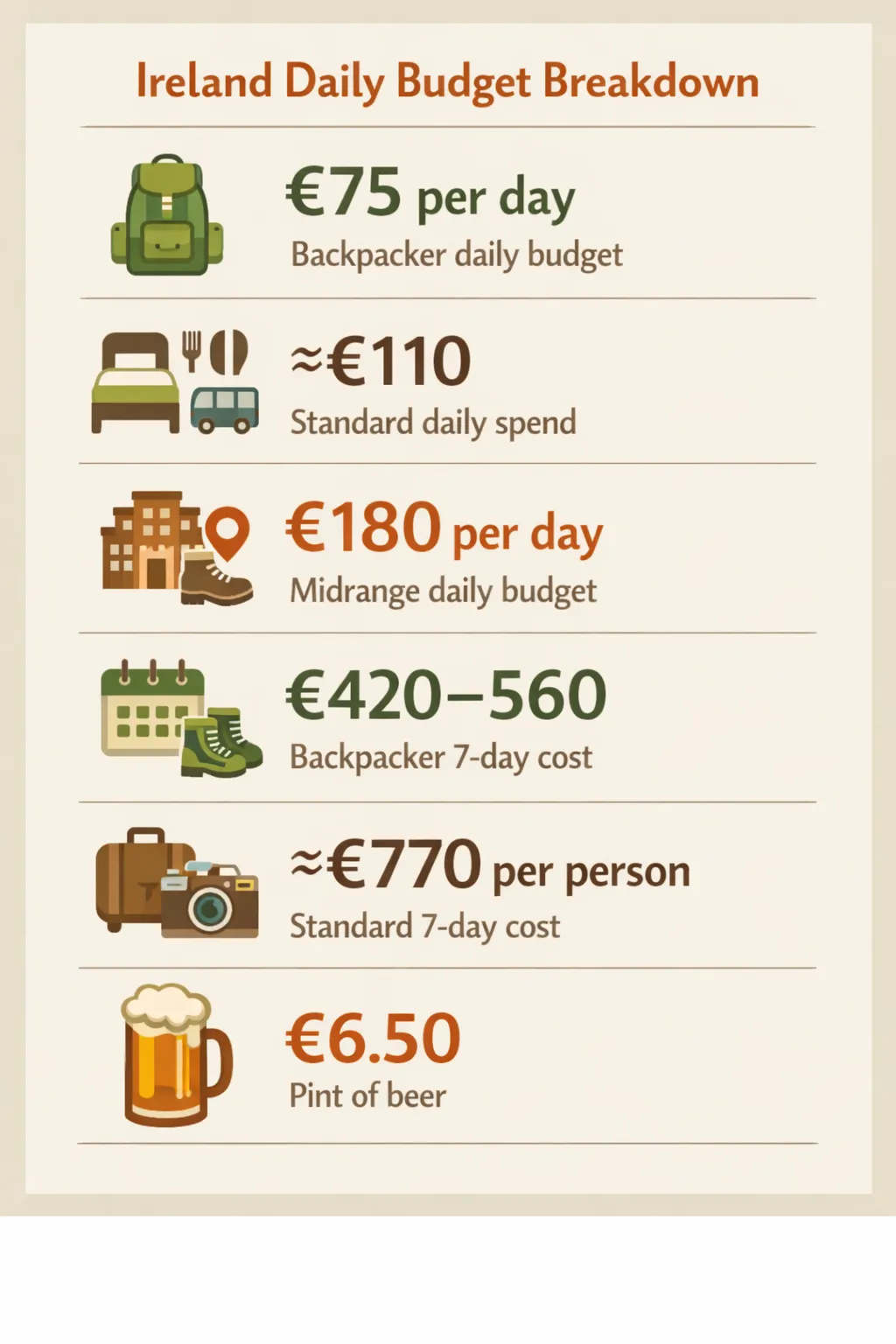 Budget ranges for Ireland: backpacker €75/day, standard ≈€110/day, midrange €180/day; 7-day costs €420-560 (backpacker) and ≈€770 (standard).
At the bottom end, a backpacker budget of about €75 per day (8) covers a hostel dorm, cooking your own meals, public transport, and free or cheap activities like walking tours. Standard budget travel, meaning a mix of dorms and the occasional guesthouse private room, pub lunches, and a few paid attractions, sits around €110 per person per day. Tourlane’s budget tier lands close to that: about $120 per person per day for 2- to 3-star hotels or B&Bs and hearty pub meals (11), roughly €104 at mid-September 2026 exchange rates. Comfortable midrange, with private rooms and eating out for most meals, runs closer to €180 per day (8).
Dublin runs noticeably higher than smaller towns and rural counties, mostly on accommodation. Mixing city and countryside time, with fewer Dublin nights and more time in Galway, Killarney, or smaller regional bases, is a core budget strategy, not an afterthought.
Budget Tier Breakdown at a Glance
Here’s how the three tiers break down by category:
Daily Budget Tiers for Ireland
| Backpacker (€70-90/day) | Standard Budget (€98-150/day) | Midrange (€150-180+/day) | |
|---|---|---|---|
| Accommodation | Hostel dorm (€28-40/night) | Mix of dorms + guesthouse private room | Guesthouse or budget hotel (€95-130) |
| Food Strategy | Self-catering + 1 cheap meal | Supermarket breakfast + pub lunch + 1 restaurant dinner | Café breakfast + 2 restaurant meals |
| Transport | Leap Card + bus/rail | Leap Card + bus/rail + occasional taxi | Bus/rail or car rental |
| Activities | Free museums + outdoor walks | 1-2 paid attractions + free sights | 2-3 paid attractions per day |
| Daily Food Spend | €8-16 | €20-35 | €35-60 |
| Daily Total (approx.) | €70-90 | €98-150 | €150-180+ |
What These Numbers Don’t Include
None of these figures include flights, travel insurance, visa costs for non-EU visitors, or any pre-trip gear you buy before leaving home. Long-haul airfare deserves particular attention: a round-trip from North America or Australia can easily match or exceed a full week of on-the-ground spending, so budget it as a separate line entirely.
On visas: EU/EEA citizens, UK nationals, and travelers from many other countries (including the US, Canada, Australia, and New Zealand) enter the Republic of Ireland visa-free for tourism, which keeps upfront costs down. Non-EU visitors who do need a visa should factor that fixed cost in separately; it doesn’t belong in a daily budget.
Is Ireland cheap for Americans? Not particularly. At mid-September 2026 exchange rates, a €75 backpacker day works out to roughly $87 USD, comparable to a mid-budget day in a US city, not a bargain by Southeast Asia standards. The free outdoor scenery and no-cost national museums genuinely help, but the pain points for American travelers are Dublin accommodation and alcohol.
Where to Sleep Without Wrecking Your Budget: Hostels and Guesthouses in Ireland
Accommodation is the biggest lever in your daily budget, and the spread of hostels and guesthouses in Ireland is wide: dorm beds run €28 to €40 a night in most cities, while Lonely Planet puts a basic room for two outside Dublin at €90 to €110 (7). Get this decision right and the rest of the budget falls into place.
Hostel dorm beds are the backbone of backpacker travel here. Nomadic Matt’s Ireland guide, updated December 2025, puts city dorm beds at €28 to €40 per night (8). Real-world numbers track close: a student budget trip written up in January 2024 paid €30.33 per night for a 12-bed dorm at Abbey Court in Dublin and €34.25 per night for a 6-bed dorm at the Nest Boutique Hostel in Galway (1).
Move up to a private room and the nightly rate climbs: Nomadic Matt lists private hostel rooms at €85 to €120 (8), and rates vary widely by region and season, so check current listings for your dates. Budget hotels run €95 to €130 per night (8). Campsites, for the genuinely committed, sit at €20 to €30 per pitch (8).
Then there’s the Dublin premium. A basic room for two runs €120 to €160 per night in the capital, according to Lonely Planet (7), noticeably above what the same room costs in Galway or Killarney. Spending fewer nights in Dublin and more in smaller towns is the single biggest accommodation saving available to you.
One underrated move: book B&Bs that explicitly include breakfast. A cooked breakfast at restaurant prices would run €10 to €15; folded into the room rate, it effectively shaves that off your daily food budget. The same student trip flagged exactly this: breakfast was included at both Abbey Court and the Nest, and the writer advises checking for it because it takes one meal a day off your costs (1).
Hostels vs. Guesthouses: Which Makes More Sense for Your Trip
For solo travelers, hostel dorms almost always win on price and give you a built-in social scene. There’s no room to split, so a €35 dorm bed is simply cheaper than a €90 private room.
For pairs and small groups, the math flips. A guesthouse private room at €90 to €110 split two ways is €45 to €55 each, often beating two separate dorm beds at €35 apiece once you factor in an included breakfast and the privacy. If you’re traveling as a couple, price the private room before defaulting to dorms.
Location matters as much as room type: building an itinerary around regional bases such as Galway, Killarney, or a smaller Wild Atlantic Way town saves real money over stacking nights in Dublin.
Booking Tips That Actually Save Money
- Pre-book Dublin first. The capital fills fastest and prices climb hardest. Lock it in one to two months ahead for summer travel.
- Filter for included breakfast. It’s the cleanest way to stabilize your daily food spend.
- Avoid one-night stops. Two or more nights per base eliminates repeat booking fees and constant transport churn, cutting your effective per-night cost.
Last-minute peak-season booking is where budgets die. When the dorms sell out, you get forced up into a midrange hotel at double the rate you planned for.
Getting Around Ireland: Public Transport vs. Car Rental
For most city-based itineraries, a solo traveler saves substantially on public transport rather than car rental in Ireland, while a group of three or four covering rural areas often comes out ahead splitting a rental. The honest answer depends entirely on where you’re going and how many of you there are.
Public transport covers the main tourist corridor reliably. In Dublin you’ve got city buses, the Luas tram, and DART rail; between cities, Bus Éireann and Irish Rail handle the Dublin-Galway-Cork-Killarney routes; and regional towns run their own local buses. The whole system got a fare shake-up in June 2024, so make sure any advice you follow is current.
The Leap Card is the mechanism that makes city travel cheap. A short-journey Leap fare on Dublin Bus and Luas is €1.50, up from €1.30, after the June 2024 increase, against a €2.00 cash fare (17). The same flat €1.50 Leap / €2.00 cash structure applies on regional town buses in Athlone, Sligo, Drogheda, and similar towns (17). For intercity rail, an adult online return from Athlone to Galway cost €17.70 after the June 2024 increase (20).
Two features do the heavy lifting. First, the TFI 90 Minute fare: tap onto a second bus, tram, or rail service within 90 minutes of your first tap in Dublin and there’s no extra charge for the transfer: €2.00 for an adult covers the chain (16). Second, the daily cap: Transport for Ireland caps adult Leap spend in Dublin at €6.00 per day, and at €24.00 from Monday to Sunday, after which all further eligible travel is free (16). A full day crisscrossing Dublin costs no more than a single taxi ride from the airport.
Car rental tells a different story. Economy vehicles start at around €95 per day (about $100 USD) for a small economy model, per Tourlane (11), and that headline rate still excludes fuel, insurance, tolls, deposit, and city parking. Ireland’s petrol prices are high, parking in Dublin is expensive and scarce, and the real weekly cost routinely runs hundreds of euro over the quoted daily rate.
When Public Transport Wins
- Solo travelers on the main corridor. Dublin-Galway-Cork or Dublin-Galway-Killarney is well served by bus and rail at reasonable fares.
- City-focused days. The €6.00 Dublin daily cap makes a full day of city travel cheaper than one airport taxi.
- Anyone avoiding fixed car costs. No insurance excess, no fuel, no parking hunt.
When a Rental Car Makes Sense
- Groups of three or four splitting the cost across rural Kerry, Connemara, or Donegal, where a shared rental beats four separate bus fares.
- Itineraries with multiple rural stops per day where no bus service exists: the Dingle Peninsula, the Beara Peninsula, back-road Donegal.
The warning stands: budget for insurance excess, high fuel prices, scarce city parking, and toll roads. The quoted daily rate is rarely the real cost once those extras land.
Leap Card Setup, Step by Step
How to Set Up and Use a TFI Leap Card in Ireland
15 minutesStep-by-step process to purchase, top up, and use the Leap Card for discounted public transport fares.
- 1
Buy a Leap Card
Buy an adult Leap Card from any of the 2,000-plus TFI Leap agents nationwide (all post offices included), at some ticket machines in Dublin Irish Rail stations, or online. The card carries a €5 deposit, which a registered card can get back.
- 2
Top up with credit
Add credit at any retailer displaying the Leap Card logo, or through the TFI Leap app.
- 3
Tap on when boarding
Tap your card on any Dublin Bus, Luas tram, DART, or commuter rail service. The fare is deducted automatically at the discounted Leap rate (€1.50 short journey vs. €2.00 cash).
- 4
Use the TFI 90 Minute fare
Tap onto a second service within 90 minutes of your first tap and no additional adult fare is charged for that transfer. Chain multiple hops across the city for one fare.
- 5
Watch the daily cap
Dublin's adult Leap cap is €6.00 per day; once reached, all further eligible travel that day is free. Check balance and transaction history in the TFI Leap app.
Free and Low-Cost Things to Do Across Ireland
Free things to do in Ireland can genuinely anchor an entire trip. Dublin’s national museums cost nothing, the Howth cliff walk just outside the city is free, and the country’s best coastal walks, park trails, and viewpoints charge only for parking, if that. Plan each day around a single paid attraction at most, fill the rest with no-cost sights, and your activity budget stays near zero.
Dublin’s free cultural offering is the strongest in the country. The National Museum of Ireland charges no admission at any of its sites, per the museum’s own visitor information (25). In Dublin that means Archaeology on Kildare Street and Decorative Arts & History at Collins Barracks; the Natural History Museum on Merrion Street is closed for renovations, with part of its collection now shown in the Dead Zoo Lab at Collins Barracks (25). Entry to the National Gallery of Ireland’s permanent collection is free (26). The Chester Beatty is free too, but it is closed to the public from 15 June to the end of December 2026 (27), so check before building a day around it.
Free walking tours in Dublin and Galway are the other core tactic. They run tip-based (amount at your discretion, no fixed charge) and give you orientation and history without paying museum entry.
Outdoors, the admission-free list is long. Phoenix Park in Dublin encloses 707 hectares of recreational space within an 11 km perimeter wall and is open all year, per Wikipedia (28). Killarney National Park’s trails, including the walk from Muckross House to Torc Waterfall, are free. If you plan to walk the Cliffs of Moher Coastal Walk, check its status first: as of 1 August 2026 the official site lists the southern section from Liscannor as fully closed, and the northern section from Doolin as open only as far as Surfers Path, with no access through to the visitor centre (31). Admission to the Cliffs of Moher Experience itself includes parking, with an adult gate rate of €15 (32). Connemara National Park walks, Wild Atlantic Way viewpoints, and the Glendalough valley in County Wicklow are all free on foot, with parking the only occasional cost. Over the border, St George’s Market in Belfast charges nothing to enter; you pay only for food and drink.
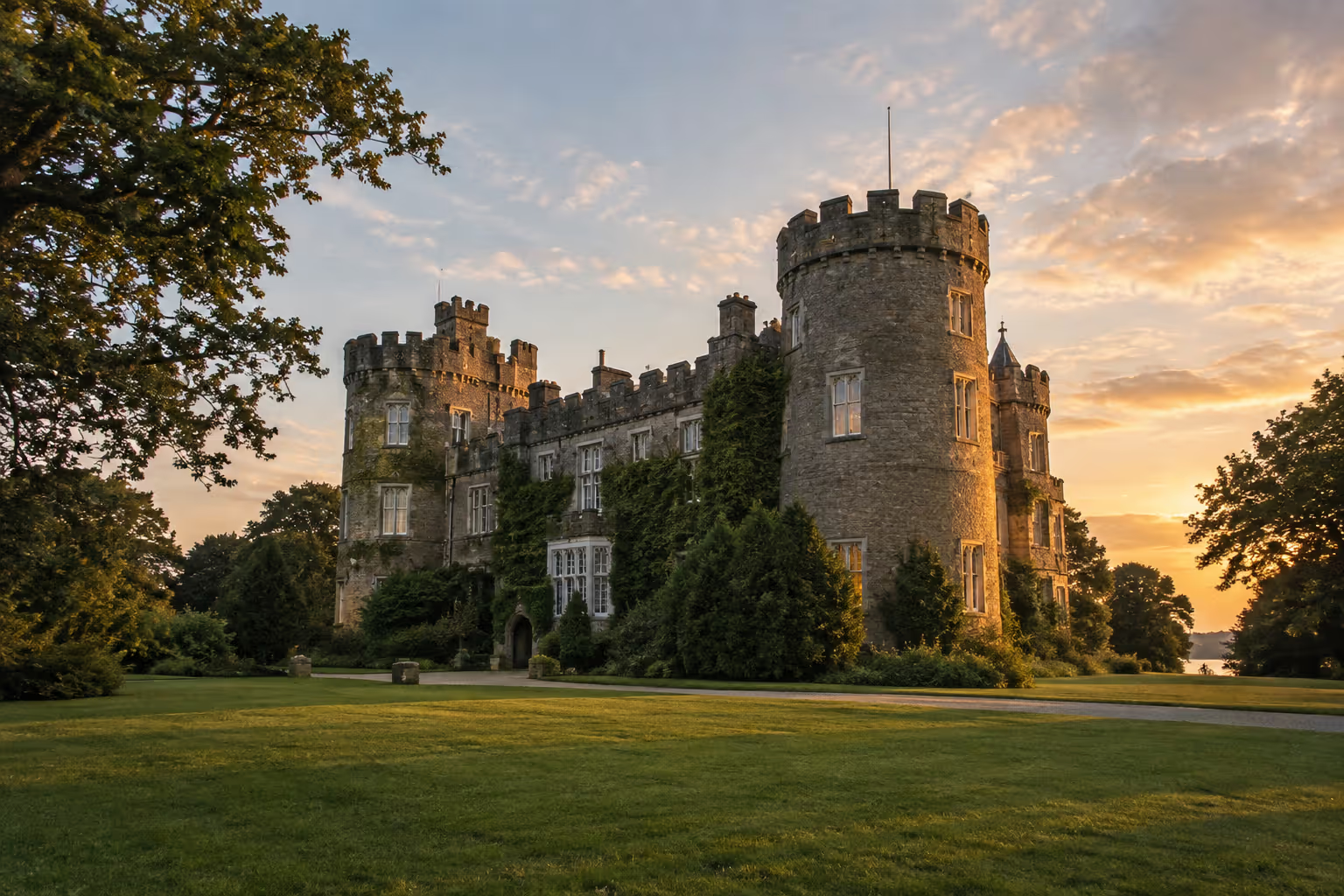
A handful of paid attractions are worth the spend. Blarney Castle & Gardens charges €24 for adult admission, per Blarney Castle & Gardens (29), and the Rock of Cashel runs €8 for adults (30), a much lighter hit on the budget. Treat these as the deliberate exceptions you budget for, not the default.
Free Days in Dublin: A Practical Template
A zero-admission Dublin day is easy to build:
- Morning: National Museum of Ireland (Archaeology), free, about two hours.
- Midday: walk the River Liffey, cross the Ha’penny Bridge, wander the Temple Bar streets, all free.
- Afternoon: the National Gallery, free (the Chester Beatty is closed until the end of 2026).
- Evening: a pub session, where your only cost is one or two drinks rather than a full meal.
Total admission spend: €0.
Free Outdoor Highlights Beyond Dublin
- Killarney National Park: free trail access.
- Connemara National Park: waymarked walks reachable from Galway.
- Wild Atlantic Way viewpoints: many accessible by bus or on foot from regional bases.
- Glendalough valley, County Wicklow: free to walk.
Eating in Ireland Without Spending Like a Tourist
The most reliable cheap eats in Ireland come from supermarkets and pub lunch specials, not restaurants. A self-catered breakfast and lunch plus one cooked meal keeps daily food spend under €20, against about €20 for a single inexpensive restaurant meal. For a deeper look at what to order, see our guide to traditional Irish food.
The restaurant benchmarks set the baseline. An inexpensive restaurant meal averages about €20 per person, and a three-course dinner for two at a midrange spot lands close to €80 before drinks, per Numbeo’s cost-of-living data, updated 15 September 2026 (2). A fast-food combo averages about €11 (2). Those numbers are why eating out for every meal wrecks a budget.
Two strategies fix it. First, the pub lunch: many pubs serve a lunch special (soup and a sandwich, or a hot dish) for noticeably less than the same kitchen’s dinner menu. Second, supermarket self-catering. Tesco, Lidl, and Aldi are the go-to chains, and daily grocery spend for basic self-catering (bread, fruit, yogurt, prepared items) runs €8 to €13 per person, rising to €10 to €16 for slightly better products, per Trek Zone (9). A supermarket breakfast, a supermarket lunch, and one cooked meal a day keeps you under €20 for food.
The alcohol trap is where budgets quietly blow. A draught pint averages about €6 and a cappuccino about €4 (2). Two pints a day alone adds about €12 to your daily spend, and budget guides consistently flag pub drinks as the most common overspend. Nomadic Matt’s guide notes that drinking regularly adds €5 to €15 per day (8). The fix isn’t abstinence; it’s treating pub drinks as a deliberate choice rather than a default. And if your accommodation includes breakfast, skip the café and put that saving toward a proper lunch.
Where to Find Cheap Eats in Ireland by City
- Dublin: grab-and-go from a Tesco Metro near the Grafton Street area, or the covered markets. Avoid sit-down meals in Temple Bar, where pricing is squarely aimed at tourists.
- Galway: the Latin Quarter has options, but walk one street back from the main drag for better value; the Saturday market is worth timing your visit around.
- Cork: the English Market is the best cheap lunch in the country: fresh produce, hot food stalls, and baked goods at market prices.
The general rule holds nationwide: step one street off the main tourist drag and prices drop 20 to 30 percent.
When to Go: Timing Your Trip to Spend Less
The cheapest months to visit Ireland are November through February, when both accommodation and flight prices drop well below summer rates. Cities run fully year-round; the trade-off is short days and some reduced rural hours.
November through February is the clear low-cost window; Tourlane, for its part, points to the shoulder seasons of spring and autumn for the best deals (11). Hostels and guesthouses cut rates, and you won’t compete for beds. Some rural attractions reduce hours or close, but Dublin, Galway, and Cork operate normally.
The shoulder seasons (April to May and September to October) are the value sweet spot: longer days than winter, lower prices than summer, and most attractions open. If you want cheap but fully functional, this is where to aim.
Peak season is July and August, when accommodation prices top out and the popular sites, such as the Cliffs of Moher and Kilmainham Gaol, sell out without advance booking. Budget travelers should either avoid these months or book two to three months ahead. One date to watch: St Patrick’s Day in mid-March spikes Dublin hotel prices sharply against adjacent weeks. Plan well ahead if that’s the draw, otherwise sidestep it.
There’s a practical pairing here. Off-season travel suits a public-transport itinerary anyway, since the car-dependent rural routes are less appealing in short winter daylight, so the cheaper season and the cheaper transport strategy reinforce each other.
How Much Does a 7-Day Ireland Trip Cost? A Realistic Breakdown
A 7-day trip to Ireland costs roughly €420 to €560 per person on a tight backpacker budget and around €770 per person on a standard budget, both excluding flights. The gap comes down to how often you swap a dorm for a private room and a supermarket lunch for a restaurant dinner.
Ultra-budget backpacker (hostel dorms, self-catering, public transport, mostly free sights):
- Accommodation: about €210 to €280 for seven nights at €30 to €40.
- Food: about €100 to €140 at €15 to €20 a day, mixing self-catering with one cheap meal.
- Transport: about €80 to €100: Leap Card plus two or three intercity bus or rail tickets.
- Activities: about €30 to €40 for one or two paid attractions, the rest free.
That lands at roughly €420 to €560 for seven days on the ground, flights excluded.
Standard budget (mix of dorms and guesthouse private rooms, pub lunches, public transport):
- Accommodation: about €350 to €490.
- Food: about €175 to €245 at €25 to €35 a day.
- Transport: about €100 to €130.
- Activities: about €60 to €100.
At Tourlane’s budget tier of about $120 per person per day (11), a seven-day trip works out to roughly $840 per person, about €727 at mid-September 2026 exchange rates, which sits inside that €685 to €965 range.
Both totals exclude flights, travel insurance, and pre-trip costs. Remember the airfare caveat: a long-haul round-trip from North America can match or exceed the entire on-the-ground total.
Sample 7-Day Budget Itinerary by Transport and Base
A budget-friendly seven-day shape that minimizes one-night stops:
- Days 1-2, Dublin: free national museums, one paid attraction (budget €20 to €25), Leap Card for all city transport.
- Days 3-4, Galway: bus from Dublin (book ahead for the cheapest fare), free walking tour, a Connemara day trip by local bus.
- Days 5-6, Killarney: train or bus from Galway, free Killarney National Park walks, one pub dinner.
- Day 7: return to Dublin by train or bus for departure.
Three bases, two nights each, bus and rail throughout: no car, no one-night churn.
Frequently Asked Questions
- What is a good budget for a trip to Ireland?
- Disciplined backpackers can manage €70-90/day using hostel dorms, self-catering, public transport, and free outdoor sights. Standard budget travelers spending on a mix of accommodation types, pub lunches, and a few paid attractions typically land at €98-150/day. Budget €120-150/day as a realistic planning figure if you want some flexibility without going full backpacker mode.
- What is the cheapest month to go to Ireland?
- November through February offers the lowest accommodation and flight prices. January and February are the quietest months: hostels and guesthouses drop rates noticeably, and you won't be competing for beds. The trade-off is short days and some rural closures. If you want cheap but functional, September and October hit the sweet spot.
- How much should a 7-day trip to Ireland cost?
- On a tight backpacker budget: €420-560 for 7 days on the ground (excluding flights). On a standard budget mixing dorms with the occasional private room and pub meals: €685-965. Add flights separately: long-haul from North America or Australia can easily match or exceed the on-the-ground total.
- Is Ireland cheap for Americans?
- Not particularly. At mid-September 2026 exchange rates, €75/day translates to roughly $87 USD, comparable to a mid-budget day in a US city, not a bargain destination. That said, the free outdoor scenery and no-cost national museums mean you can have genuinely full days without spending much on admission. The pain points for Americans are accommodation in Dublin and alcohol.
- Is it worth getting a Leap Card for a short trip?
- Yes, if you're spending more than two days in Dublin or any major Irish city. The €5 card deposit can be refunded on a registered card, and the savings over cash fares add up quickly, especially with the €6.00 daily cap meaning a full day of city travel costs no more than a single taxi fare from the airport to the city center.
- Can you do Ireland without renting a car?
- For a Dublin-Galway-Cork or Dublin-Galway-Killarney itinerary, yes: bus and rail connections are reliable and reasonably priced. For rural areas like Donegal, the Dingle Peninsula, or the Beara Peninsula, a car becomes almost essential unless you're joining a day tour from a city base.
- What's the biggest budget mistake travelers make in Ireland?
- Underestimating food and drink costs, specifically pub meals and alcohol. Two pub dinners and three pints per day can add €30-40 to a daily budget that was planned around €20 for food. The fix: supermarket breakfasts and lunches, one cooked meal per day, and treating pub drinks as a deliberate choice rather than a default.
- Are there free things to do in Ireland worth building a trip around?
- Genuinely, yes. Dublin's National Museum of Ireland sites and the National Gallery are free, and so is the Chester Beatty once it reopens after its closure to the end of 2026. Killarney National Park, Phoenix Park, the Wild Atlantic Way viewpoints, and Glendalough valley cost nothing to walk. A well-planned day in Dublin or Killarney can have zero admission spend.
Where This Leaves Your Planning
Three decisions do most of the work. Where you sleep: hostel dorms or B&Bs with included breakfast outside Dublin, not stacked nights in the capital. How you move: a Leap Card and bus or rail for most itineraries, a shared rental only where rural stops demand it. And how you eat: supermarket for two meals a day, one cooked meal out, and pub drinks as a conscious line item.
The budget range here is genuinely wide: €70 and €150 a day are both “budget travel,” separated mainly by your tolerance for dorm beds and self-catering. Decide your base cities first, book Dublin accommodation four to six weeks ahead for summer travel, and pick up a Leap Card at the airport before you leave arrivals. Sort those three, and the daily numbers largely take care of themselves.