Shannon Ireland is a base, not a sightseeing stop: a planned town of about 10,000 in County Clare, not a historic city, and its value is the airport. Flying into Shannon clears you through U.S. immigration before you board home, and it drops you two hours closer to the west than Dublin does. From there, Bunratty Castle is ten minutes away and the Cliffs of Moher about an hour. Treat it as your launch pad into Clare and the Wild Atlantic Way.
Unveiling the history and development of Shannon Ireland
Shannon’s story is one of deliberate planning rather than organic growth.
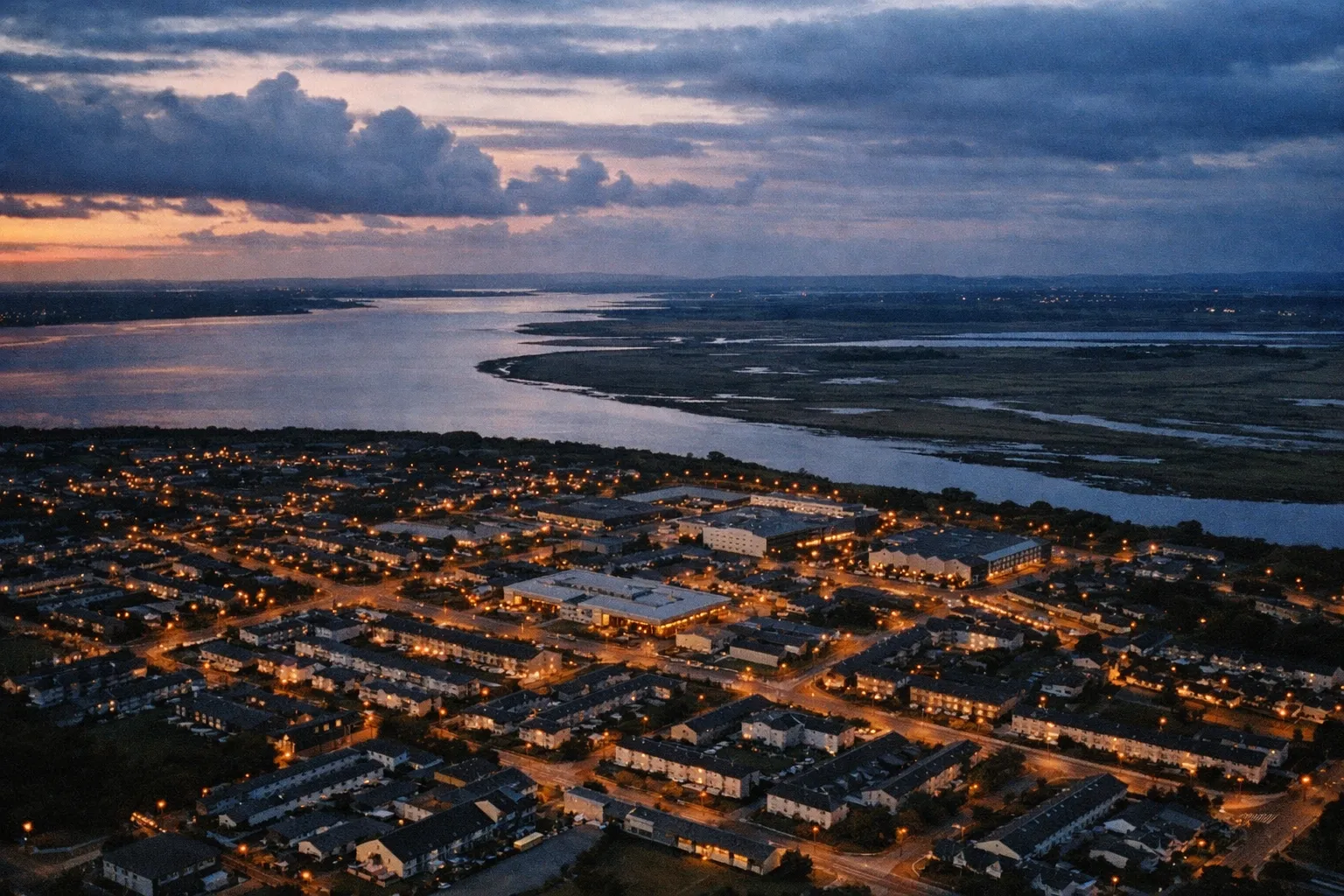
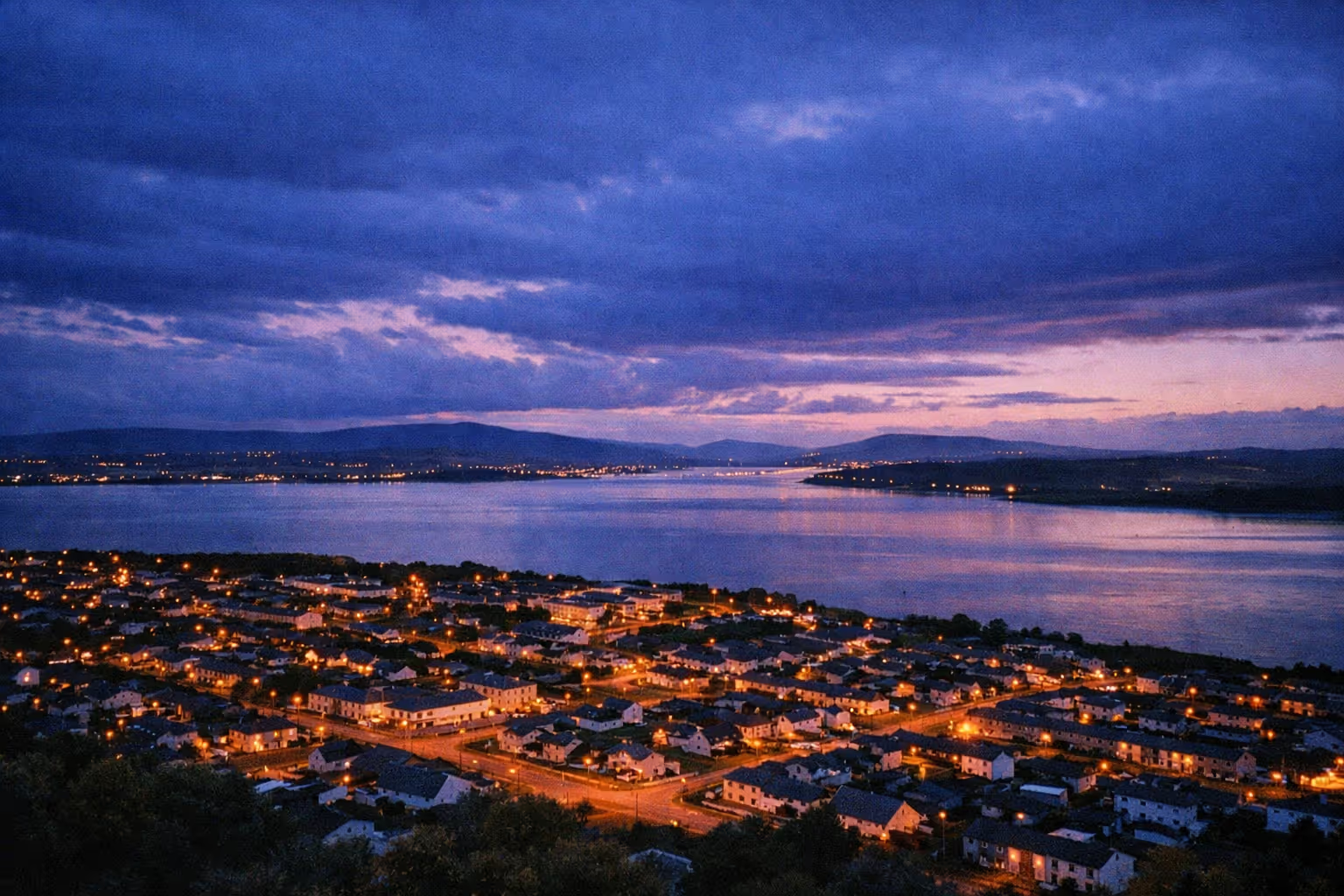
Founded in the 1960s on reclaimed marshland beside the Shannon Estuary, this planned town has grown into a community of over 10,000 residents. It’s hard to believe this area was soggy fields just a few decades ago. I marveled at its modern layout as I wandered through the Ballycasey and Drumgeely neighborhoods - every aspect of Shannon’s development was mapped out on paper before a single house went up, which explains the grid-like feel and the way the residential areas fan out from the industrial zone.
The town officially gained its status as Ireland’s newest town on January 1, 1982.
One of the most interesting threads in Shannon’s history is its close ties to aviation. The town grew up alongside Shannon Airport, which has played a defining role in connecting Ireland to the rest of the world. Shannon Airport offers U.S. Customs and Border Protection Preclearance - meaning you clear U.S. immigration before you board rather than on arrival stateside. No long queues at the far end. If you’re heading to the States after your Ireland trip, this is a genuine convenience worth factoring into your routing. This aviation heritage is also visible in the Shannon Town Park area, where some streets are named after famous pilots and aircraft.
Shannon’s strategic location makes it easy to reach from both Limerick and Ennis. During my stay, I found the surrounding areas convenient to explore - a quick drive took me to Cork in under two hours, though Dublin is a longer haul (more on that below).
Education and economy: The pillars of Shannon’s success

As someone who’s curious about how communities are built rather than just how they look, Shannon fascinated me. It invested heavily in both education and economic infrastructure from the start.
The town has an established network of primary and secondary schools. What caught my attention was the Shannon College of Hotel Management, a well-regarded institution that has long produced hospitality professionals and is now part of the University of Galway.
On the economic front, Shannon punches well above its size. The Shannon Free Zone is one of Ireland’s oldest and largest clusters of North American investment, and the surrounding business parks host major players in technology, aerospace, and manufacturing. As I walked through the industrial park, the contrast between the humming business estate and the quiet residential streets was striking. This is a working town first, a tourist town a distant second.
Overview of Shannon's Economic Landscape
| Shannon | Limerick | |
|---|---|---|
| Major Industries | Aerospace, Technology, Manufacturing | Healthcare, Education, Retail |
| Economic Zone | Shannon Free Zone | Limerick Economic Zone |
| International Connections | Shannon Airport, U.S. Preclearance Facility | Shannon Airport, Limerick Port |
| Key Institution | Shannon College of Hotel Management | University of Limerick |
Is Shannon a big city in Ireland?
Short answer: no. Shannon is a small town, not a city.
The 2022 Census put the town’s population at 10,256, making it the second-largest town in County Clare but still a modest urban center by any standard. The town covers roughly 7.3 km², with a population density around 1,409 people per km².
I mention this because a lot of travelers arrive expecting a compact tourist city with a walkable historic core - restaurants clustered around a square, that sort of thing. That’s not Shannon. The town center is practical: a shopping center, some hotels, residential estates. The good stuff is a short drive away, spread across Clare and Kerry.
So when search results throw around the phrase “city of Shannon Ireland,” treat it loosely. Shannon is administratively a town, not a city, and planning around that reality will save you disappointment. Set your expectations toward “efficient base camp” and you’ll be happy.
Exploring Shannon’s natural wonders and cultural treasures
Shannon’s real value lies in what surrounds it. The town sits at the doorstep of some of Ireland’s most dramatic scenery, and that proximity is the whole reason to base yourself here.
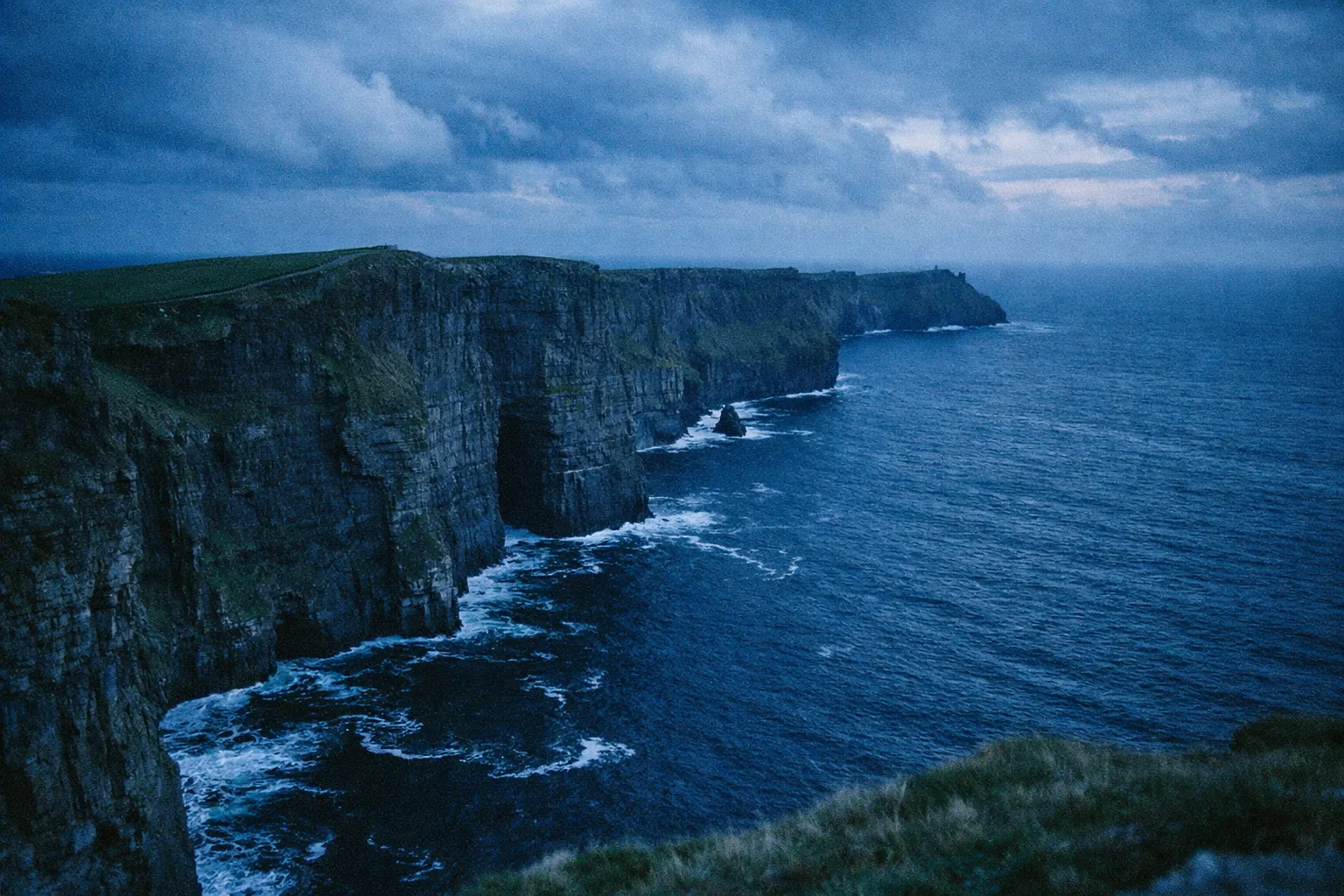
Just a short drive from Shannon, you’ll find the Cliffs of Moher. Standing at the edge of those towering cliffs with the Atlantic crashing below is an experience that stayed with me long after I left. The scale of the place is genuinely hard to convey in writing.
Another destination worth your time is the Burren, a limestone landscape that looks lifted from another planet. When I trekked across its terrain, the contrast between bare grey rock and the green fields elsewhere in Ireland made it feel like a different country entirely. It’s one of those places that photographs well but rewards the walk even more.
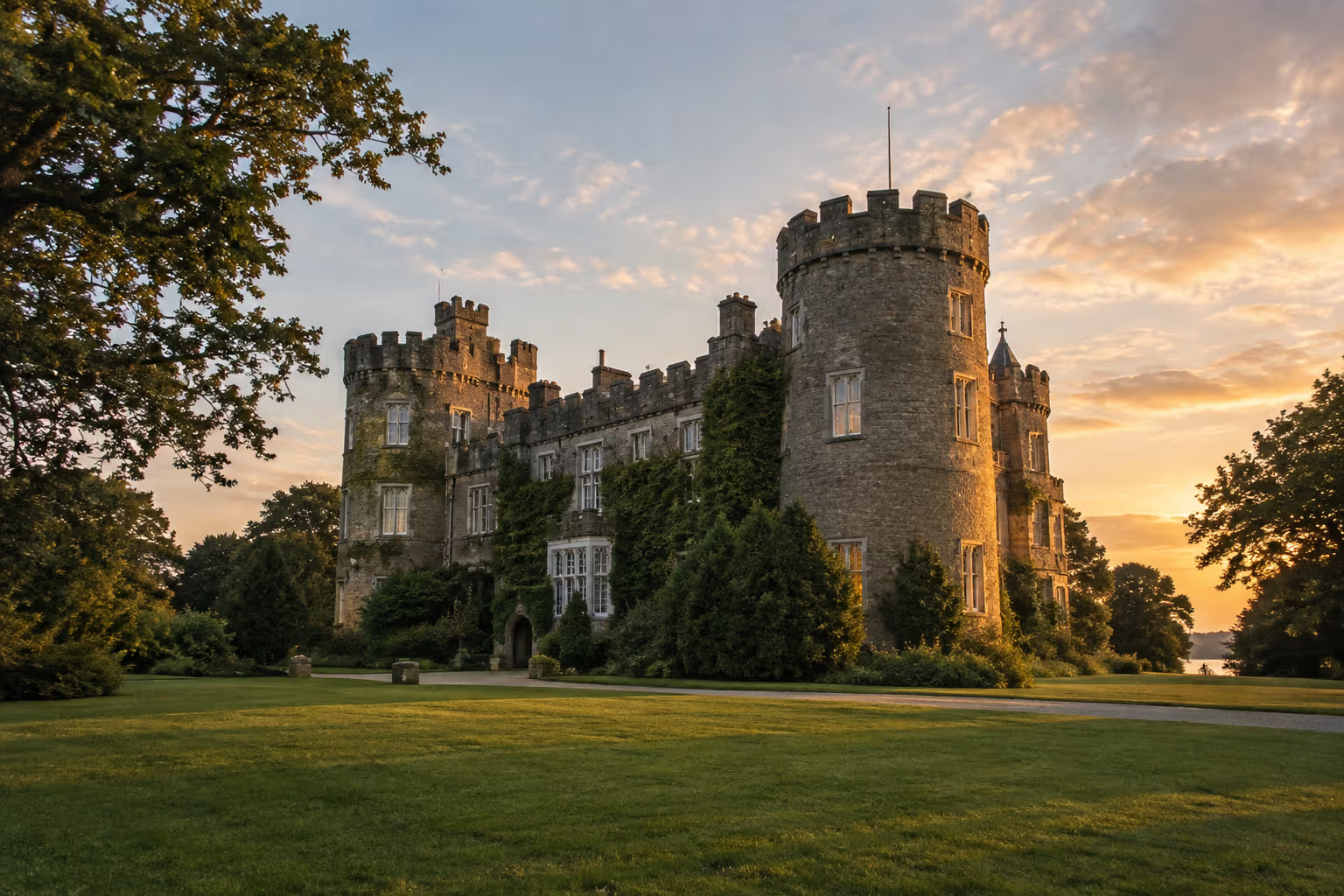
For history, Bunratty Castle is a treat - and it’s remarkably close, sitting roughly 10 to 15 minutes from Shannon Airport (5). This restored 15th-century fortress offers a clear window into medieval Irish life. I spent an afternoon exploring its rooms and stairwells, and the adjoining folk park, which recreates a 19th-century village, is worth the wander. The broader Shannon Heritage portfolio includes seven daytime visitor experiences and four evening entertainments, spanning venues like Bunratty Castle, Knappogue Castle, Craggaunowen, and King John’s Castle over in Limerick (5). The castle banquets - costumed medieval dinners at Bunratty and Knappogue - are touristy but genuinely fun if you’re in the mood.
Natural and cultural attractions worth prioritizing near Shannon:
- Cliffs of Moher: Ireland’s most famous coastal cliffs, about an hour’s drive
- The Burren: Limestone karst landscape with rare flora and a strange, compelling quiet
- Bunratty Castle & Folk Park: Medieval fortress and living-history village, 10-15 minutes away (5)
- Knappogue Castle: 15th-century tower house with banquet experiences (5)
- Shannon Estuary: Scenic stretch of the Wild Atlantic Way
Things to do around Shannon
If you’re staying in town rather than immediately driving off, the pickings are thinner - but there are a couple of standouts, and they lean into Shannon’s aviation identity.
Aviation attractions. The Shannon Aviation Museum and Atlantic Air Adventures are the two town-based draws that guide sites mention consistently (6). Atlantic Air Adventures is a flight-simulation experience where you can sit in a cockpit setup and get a feel for flying - a solid rainy-afternoon option and a genuine hit with kids and aviation enthusiasts. The museum covers Shannon’s outsized role in transatlantic aviation history, which is more interesting than it sounds.
Walks and green space. Shannon Town Park and the walking loops around the estuary give you a place to stretch your legs after a flight, though these are pleasant rather than remarkable.
Practical stuff. The town’s shopping center and hotels make it an easy place to reset, grab supplies, and sleep before an early drive.
Here’s my honest read on things to do in Shannon: don’t build your trip around the town itself. Give it a night, hit the aviation attractions if that’s your interest, and treat everything else as a day-trip radius. The density of nearby sights - Bunratty, the Cliffs of Moher, the Burren, all within 15 to 90 minutes by road - is where your time is best spent.
Etiquette note: tipping in Irish restaurants runs around 10-15% for good table service, but it’s not obligatory the way it is in the US, and rounding up is perfectly acceptable in pubs. Nobody tips at the bar for a pint.
County Clare as a gateway to the Wild Atlantic Way
Shannon County Clare Ireland sits right at the edge of the Wild Atlantic Way, and this is where the town earns its keep as a travel base.
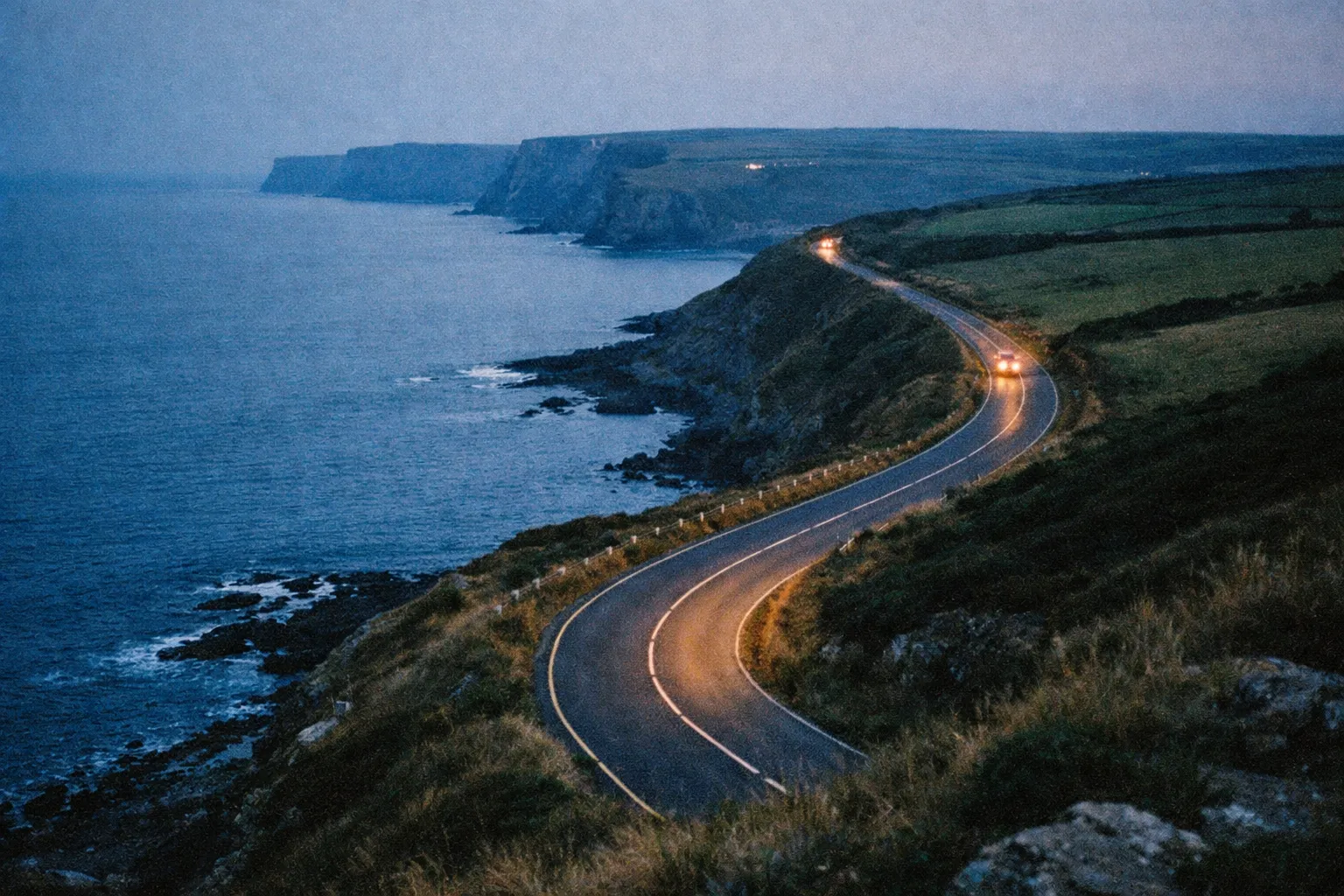
The Wild Atlantic Way is a 2,600 km (1,600 mile) coastal route divided into 14 stages. The section relevant to Shannon is the Shannon Estuary stage, which runs 216 km from Kilkee to Tralee (1). From here you can pick up the route and follow it north into Clare or south toward Kerry.
During my stay, I rented a car and drove for several days along the coastline, stopping at villages like Doolin and pulling over at any beach that looked interesting. The freedom to move at my own pace, with the Atlantic as a constant companion, was the highlight of the whole trip.
Shannon’s climate is mild and oceanic, so expect moderate temperatures year-round - and expect rain. Pack a proper waterproof layer regardless of season. The shifting weather adds to the drama of the coastline more than it detracts from it, but you’ll want to dress for it.
For a first-time west-coast itinerary, I’d suggest pairing Shannon with Bunratty, Doolin, and the Cliffs of Moher rather than spending extra nights in town. That’s a tight, satisfying loop that shows you the best of the region without backtracking.
How close is Shannon to Dublin?
Shannon is on the opposite side of the country from Dublin, and the distance surprises some travelers who assume Ireland is small enough to cross in an hour.
By road, the driving distance is about 210 km (131 miles), with a typical drive time of roughly 2 hours 20 minutes to 2 hours 30 minutes depending on your route and traffic. Shannon Airport to Dublin specifically clocks in at around 214.7 km (133 miles) and about 2h 28m by car.
If you’d rather not drive, bus and train combinations between Dublin and Shannon typically cost around €22-€41 ($24-$45) and take longer - anywhere from about 3h 12m to 4h 18m depending on transfers and connections. Self-driving is faster, but factor in the cost of the rental and fuel.
Either way, budget most of a half-day for the crossing. It’s doable as a one-way transfer, but it’s not a casual day trip.
Is it better to fly to Dublin or Shannon?
This is the decision that actually matters, and the answer depends entirely on where your trip is centered.
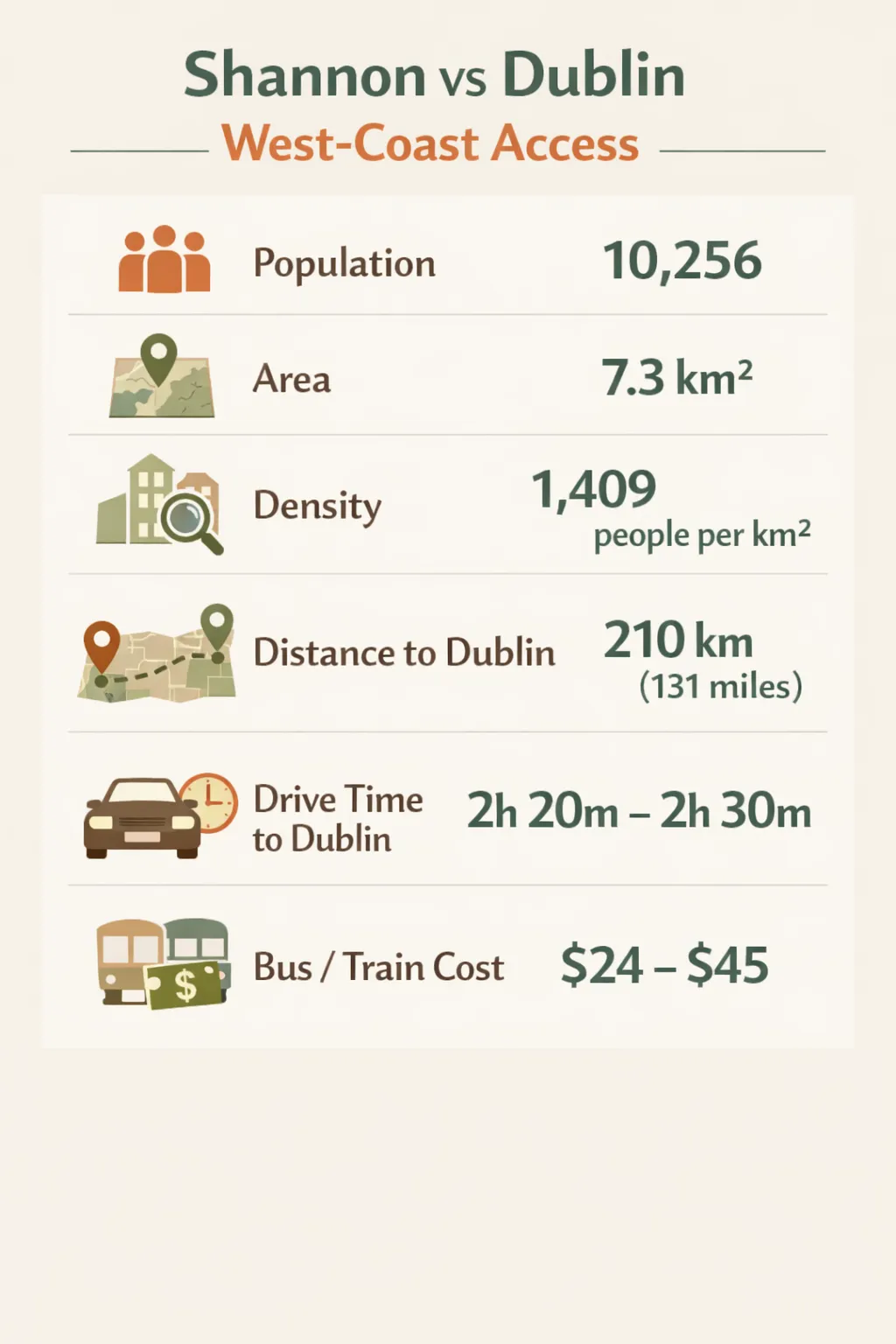 Shannon functions as a practical west-coast gateway with population 10,256; area 7.3 km²; density 1,409 people per km²; 210 km to Dublin; 2h20m–2h30m drive; and bus/train costs $24–$45.
Fly into Shannon if your itinerary focuses on the west and southwest - County Clare, Limerick, Galway, Kerry, and the Wild Atlantic Way. Landing here rather than Dublin saves you roughly two-plus hours of road time on your first day, which is significant on a short trip. You step off the plane, grab a car, and you’re at Bunratty in 15 minutes and the Cliffs of Moher in about an hour.
Fly into Dublin if your trip is east-coast focused - Dublin city itself, Wicklow, the Boyne Valley, or a Belfast add-on. Dublin also has far more international flight options and connections.
Flying into Shannon vs Dublin
| Shannon | Dublin | |
|---|---|---|
| Best for | West/southwest, Wild Atlantic Way | East coast, Dublin city, north |
| Drive to Cliffs of Moher | about 1 hour | about 3 hours |
| Drive to Bunratty Castle | 10-15 min (5) | about 2.5 hours |
| First-day fatigue | Low | Higher for west-coast trips |
| Flight options | Fewer | Many more |
My take: don’t automatically default to Dublin for a west-coast trip. That reflex can add over two hours of driving on day one, which is a lot when your holiday is only a few days long. If the Wild Atlantic Way is your goal, Shannon wins.
Is Shannon in Ireland worth visiting?
Yes - with an honest caveat.
Shannon is worth visiting for its convenience and its position, not for the town itself. If you value short transfers after landing, quick access to Bunratty and the Cliffs of Moher, and a low-stress arrival point for western Ireland, Shannon delivers exactly that.
If you’re expecting a charming town break with a lively center and lots to see on foot, Shannon will underwhelm you. Multiple travel guides are candid about this: the town itself has limited sightseeing, while the surrounding county holds the real appeal.
The way to “get” Shannon is to use it correctly. Land here, spend a night if you arrive late, then move out into Clare and Kerry the next morning. Base yourself here for day trips if you don’t want to keep changing hotels. Just don’t plan to spend three days sightseeing within the town limits.
Plan on at least one full day to make Shannon useful as a base, and two to four days to see the nearby highlights - Bunratty, the Burren, the Cliffs of Moher - without rushing.
✓ Pros
- Strategically located for quick access to major west-coast attractions
- Modern, well-planned town layout eases navigation
- Shannon Airport offers U.S. preclearance, saving time on transatlantic flights
- Strong economic base with major industries and education institutions
✗ Cons
- Limited sightseeing and nightlife within the town itself
- Not a walkable tourist city or historic town center
- Public transport options to/from Dublin are slower and less convenient
- Weather can be rainy and unpredictable year-round
Frequently asked questions
Frequently Asked Questions
- Can I explore Shannon town entirely on foot?
- No, Shannon is spread out with a practical layout; most attractions require a car or short drive.
- Is tipping expected in Shannon pubs and restaurants?
- Tipping 10-15% is customary for table service but not obligatory; rounding up is common in pubs, no tips at the bar.
- Are there direct public transport options from Shannon Airport to the Cliffs of Moher?
- No direct public transport; renting a car is the most efficient way to reach the Cliffs from Shannon.
- What's the best time of year to visit Shannon and the Wild Atlantic Way?
- Summer offers milder weather but expect rain year-round; pack waterproof gear for all seasons.
- Can Shannon serve as a base for exploring both County Clare and Kerry?
- Yes, Shannon's location allows day trips to attractions in Clare and Kerry within 15 to 90 minutes by car.
- Is Shannon Airport better for U.S. travelers than Dublin Airport?
- For west-coast trips, yes - Shannon offers U.S. preclearance and saves significant road time compared to Dublin.
Making Shannon work for your trip
Book a car before you land. Nearly every worthwhile sight near Shannon is 15 to 90 minutes away by road and not walkable from the town center. If you arrive on a late flight, stay one night in town and drive out fresh the next morning. If you’re doing a compact west-coast trip, base yourself in or near Shannon and day-trip to Bunratty, the Burren, and the Cliffs of Moher rather than moving hotels every night.
The mistake to avoid is treating Shannon as a sightseeing destination in its own right. It isn’t one, and the guides that oversell it do travelers a disservice. Treat it as the smart, low-friction door into western Ireland - which is exactly what it was built to be.