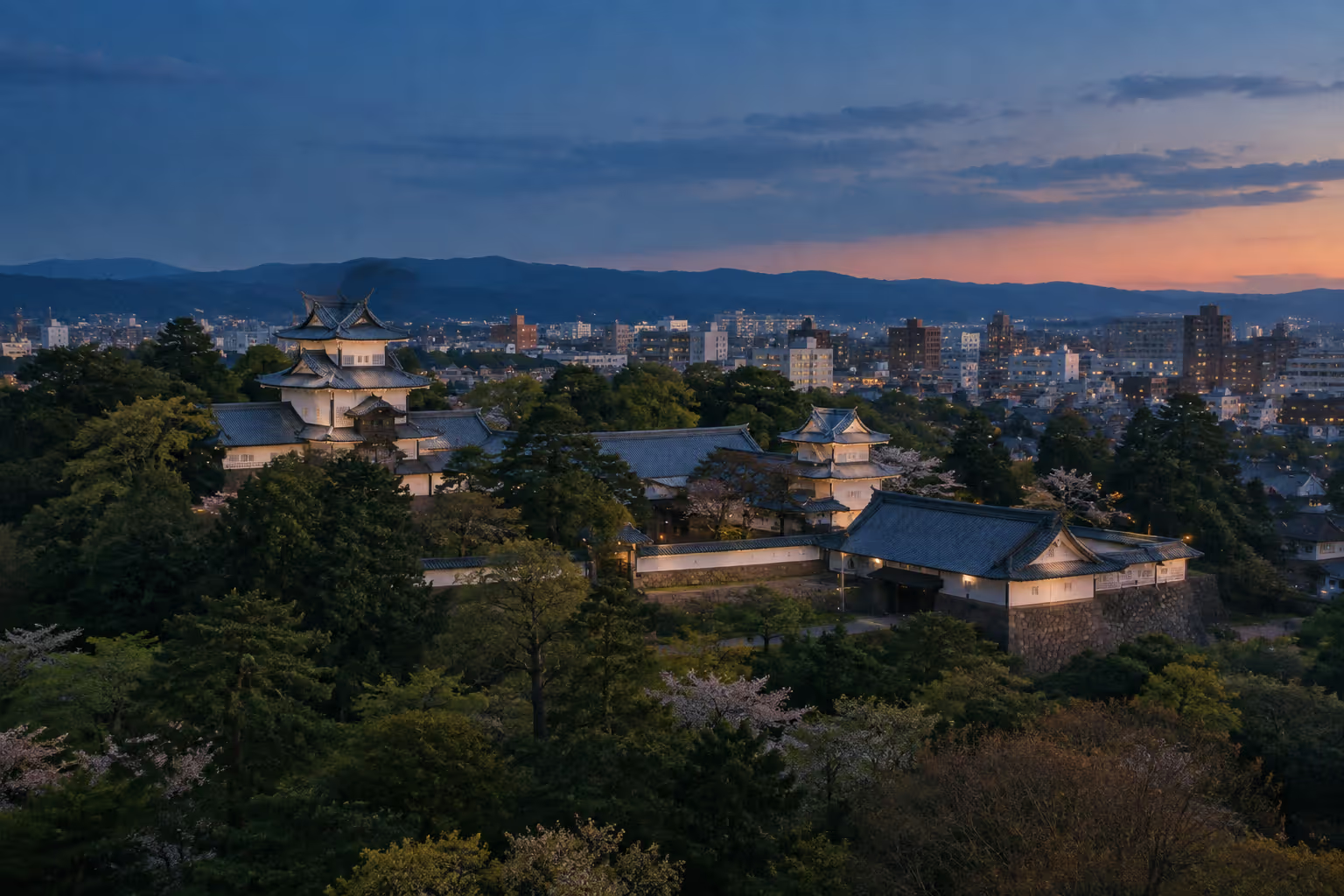
The case for hidden gems in Japan is a crowd math problem: Kanazawa draws about 8 million visitors a year, Kyoto over 50 million, and you feel that gap on every street. Kanazawa is the strongest Kyoto stand-in, just under three hours from Tokyo, with samurai lanes and gold-leaf workshops. For the mountains, Takayama rewards an 8 a.m. arrival at its morning market before the buses. The smart structure is to base in an underrated city like Kanazawa or Matsumoto and day-trip out, instead of repacking every two nights.
Unveiling the Hidden Gems in Japan: Modernity and Heritage Beyond the Metropolis
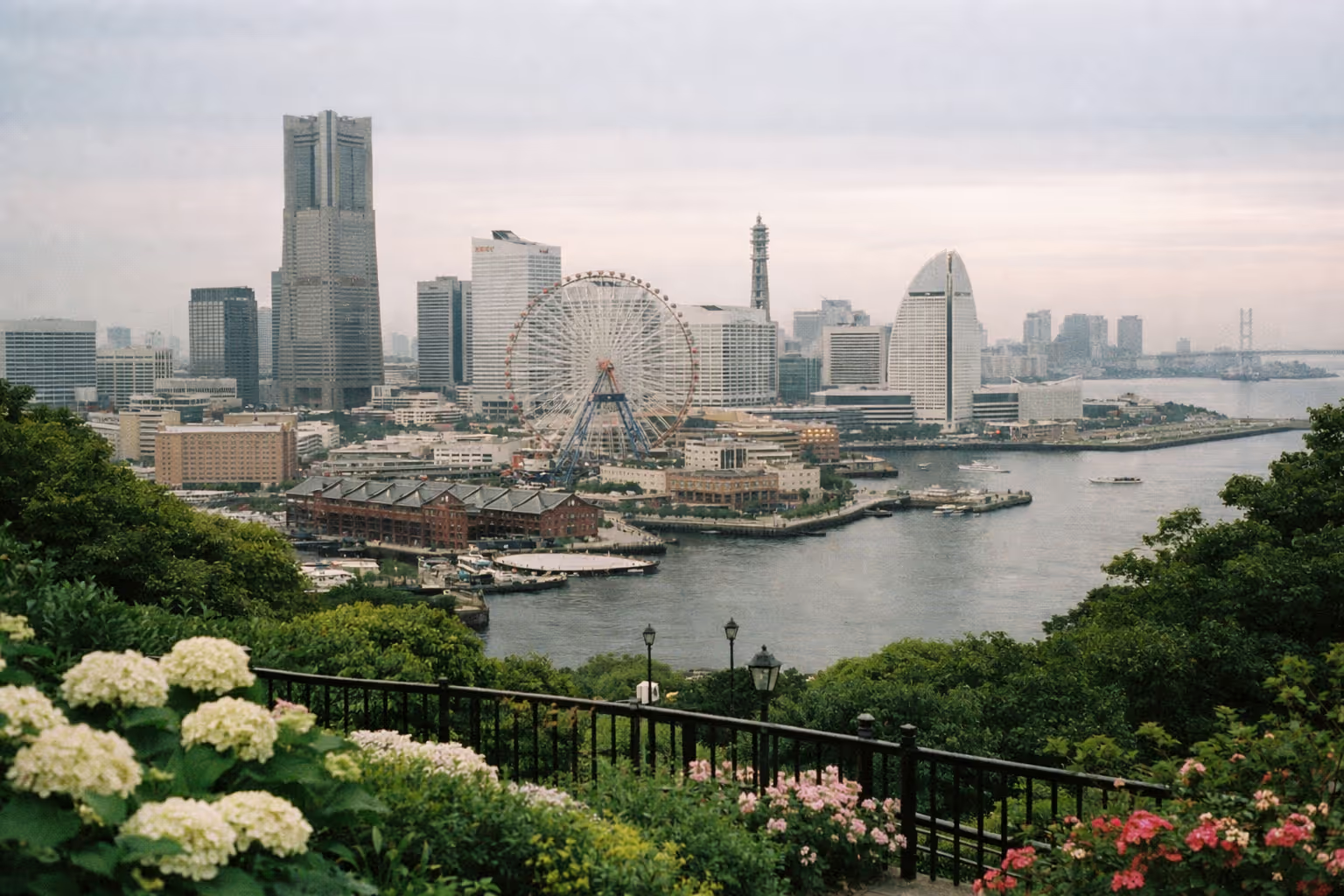
Yokohama is a good place to start exploring some of the hidden gems in Japan. The Minato Mirai waterfront is all glass towers and harbor promenades, while Sankeien Garden, a traditional landscape garden built by a Meiji-era silk merchant, sits in Honmoku on the city’s southern edge. It is not a walk from the waterfront: plan on about 40 minutes by city bus from Yokohama Station, then a 5-minute walk from the Sankeien-iriguchi stop (9), and treat it as its own half-day. Our Yokohama guide covers the bus routes. Glass towers and a Meiji-era garden in the same city isn’t accidental - it’s how Japanese cities tend to work.
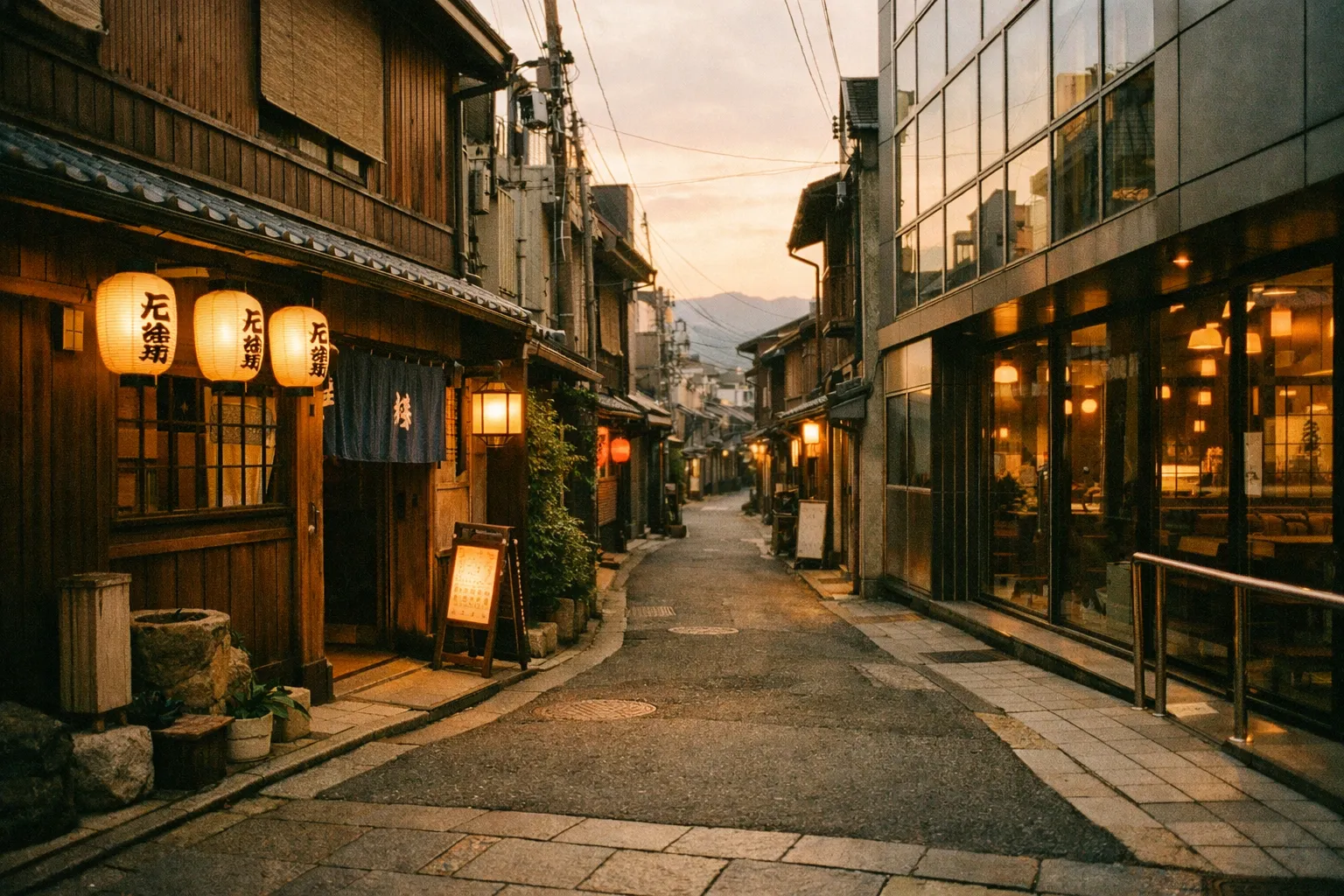
I spent a morning in Sankeien once expecting it to feel like a museum piece, and it didn’t. Families were picnicking, an elderly man was sketching one of the pagodas, and the garden felt genuinely used rather than preserved under glass.
Japanese cities are also shaped by machizukuri (town-making), an urban development approach that emphasizes community involvement in city planning. It’s part of why neighborhoods tend to feel coherent and walkable rather than stitched together by highways.
For travelers drawn to technology, Tokyo and Osaka deliver the obvious: robotics demonstrations in Odaiba, the high-speed Shinkansen (bullet train) connecting distant regions in hours. I’ve used GPS-tracked walking tours and AR-powered museum exhibits in both cities, and they work well. But the cities below are where Japan’s character actually opens up.
Takayama old town: Edo streets in the Gifu mountains
Takayama old town is the easiest “old Japan” town to fall for. The Sanmachi Suji district preserves rows of dark-wood merchant houses from the Edo period, many now functioning as sake breweries, miso shops, and craft stores. You can tell the working breweries by the cedar balls - sugidama - hanging above their doors. Green ones signal that that year’s new sake is ready.
The morning markets are the main reason to set an early alarm. Two of them - Miyagawa, along the river, and Jinya-mae, in front of the old government house - have run for roughly six centuries, selling local produce, pickles, and crafts. I got to Miyagawa around 7:45am on a Tuesday in November 2024 and had the first hour almost entirely to myself before the tour groups arrived. Get there by 8am (5).
Takayama sits in Gifu Prefecture’s mountains, and the regional specialty is Hida beef - marbled, tender, and worth the splurge. A grilled Hida beef skewer from a market stall runs about ¥600-900 (roughly $4-6 USD). A proper sit-down Hida beef course at a restaurant lands closer to ¥4,000-8,000 ($26-52). For something cheaper, the local mitarashi dango (grilled rice dumplings in soy glaze) costs around ¥100 a stick and is genuinely good.
Getting there: Takayama is about 4.5 hours from Tokyo by Shinkansen to Nagoya, then the Hida limited express through the mountains. A direct highway bus takes 5-6 hours and costs less (5). Stay at least one night - the old streets transform after the tour buses leave, and you get the lantern-lit lanes nearly to yourself.
Use Takayama as a hub and you can reach Shirakawa-go’s thatched farmhouses (about 50 minutes by bus) and the Nakasendo post towns of Tsumago and Magome, both of which regularly appear in Japan off the beaten path roundups (5)(7).
Etiquette note: Many old-town shops and the markets are cash-only, and small breweries appreciate you removing your shoes if there’s a raised tatami tasting area. Carry yen - IC cards won’t help you here.
Kanazawa hidden gems: gold leaf, samurai lanes, and a quieter Gion
Kanazawa is the strongest single alternative to Kyoto - it draws roughly 8 million visitors a year compared to Kyoto’s 50 million, which means the same density of preserved districts at a fraction of the crowd pressure - and the standout spots are concentrated in two old quarters that rarely feel as packed as Gion on a busy weekend.
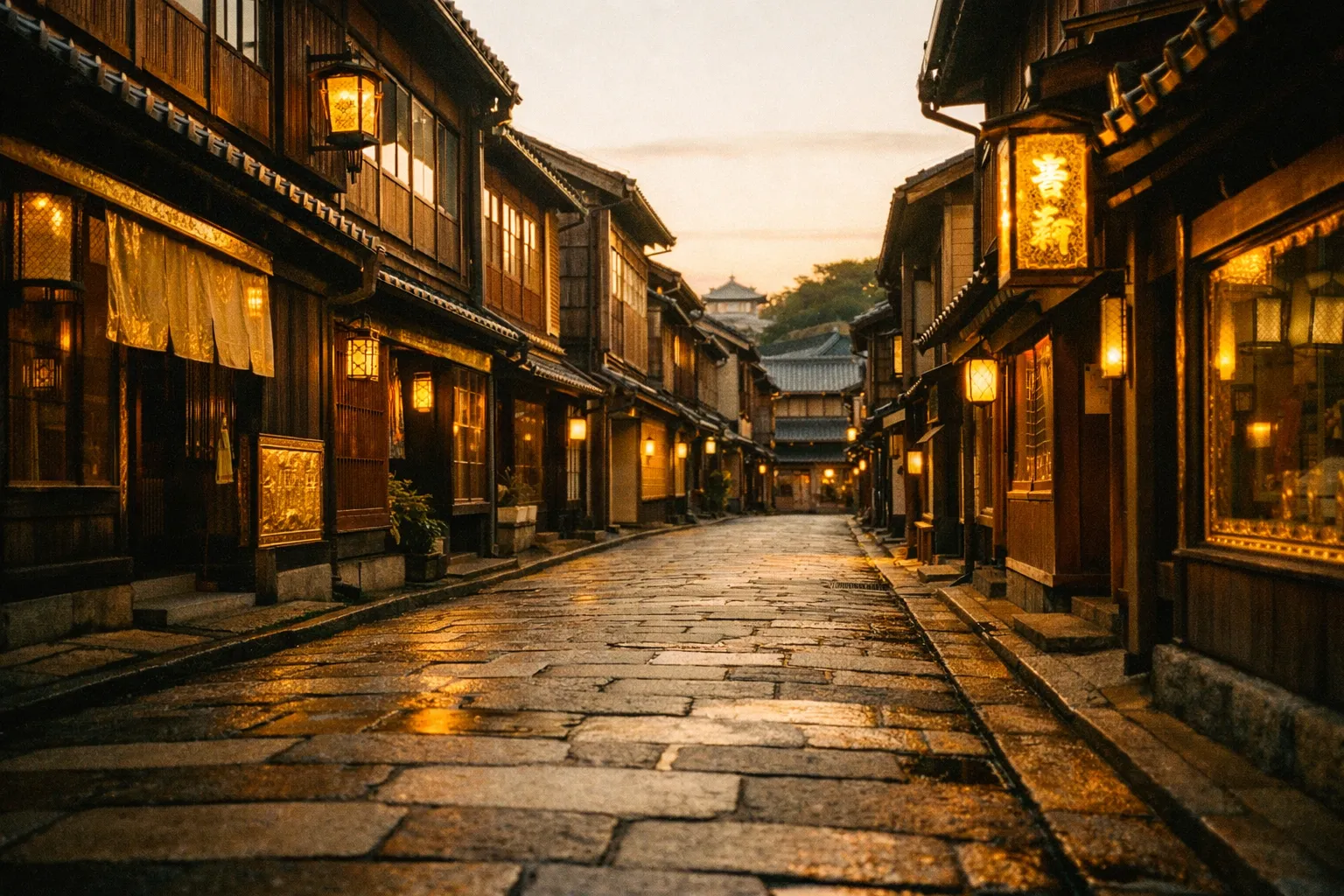
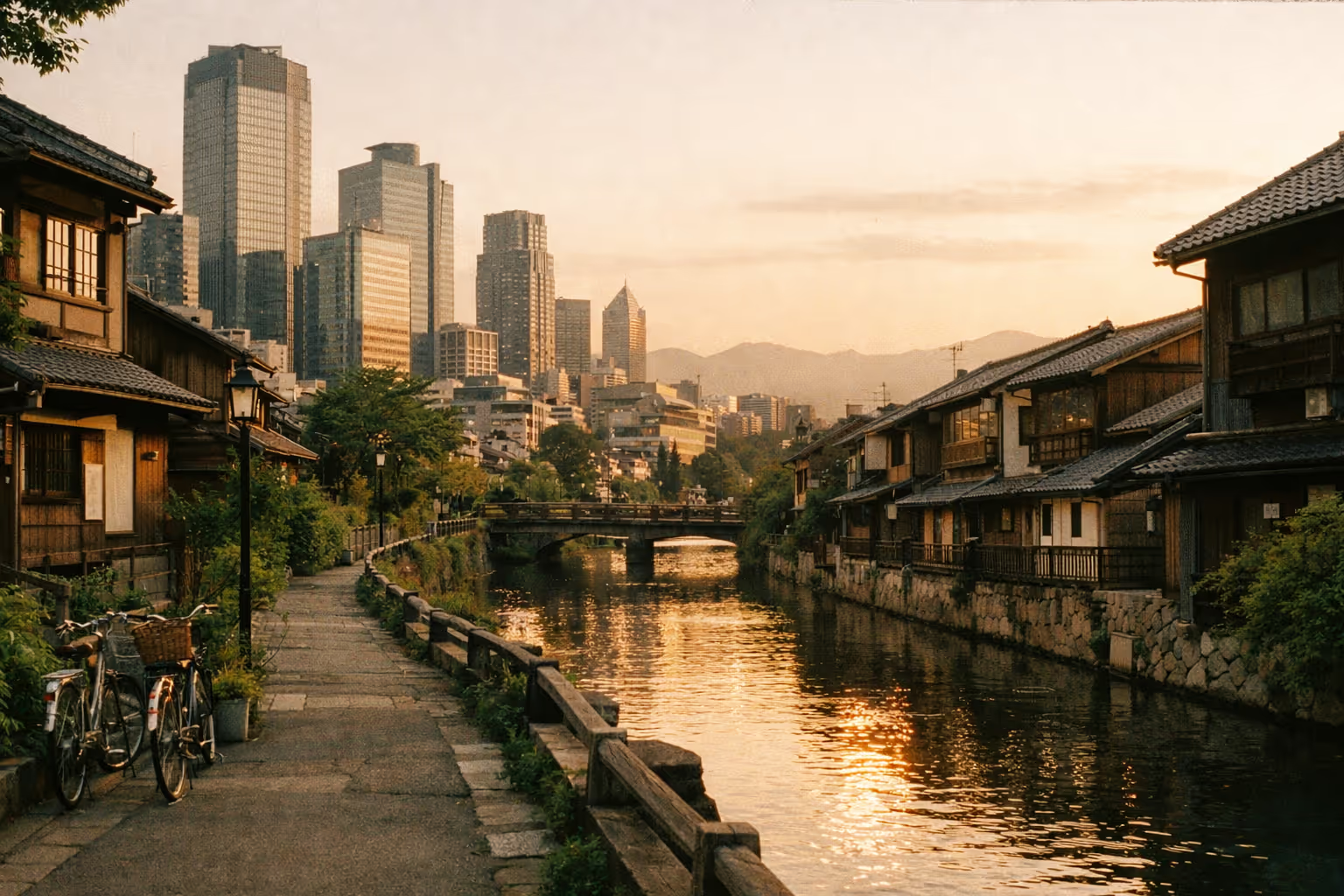
The Higashi Chaya district is a preserved geisha quarter of latticed teahouses, some still operating. A few open their interiors to visitors - Shima and Kaikaro both charge around ¥500-750 ($3-5) to tour the rooms where geisha once entertained merchants. The district also anchors Kanazawa’s gold leaf trade: the city produces nearly all of Japan’s gold leaf, and workshops here let you apply it to chopsticks or small boxes for ¥1,000-2,000 ($7-13). I did this on a rainy afternoon and it’s more absorbing than it sounds.
Nagamachi, the old samurai district, is the other half of the picture - earthen walls, narrow lanes, and the Nomura-ke samurai residence with its compact garden (admission around ¥550). It’s roughly a 15-20 minute walk from Kanazawa Station, or about 10 minutes by bus - which is the thing about Kanazawa: history and everyday city life sit directly on top of each other. If you enjoy exploring Japan’s castle towns, Kanazawa and its surrounding region reward a longer stay.
Don’t skip Kenrokuen, ranked among Japan’s three great gardens, or the Omicho market for sushi and the local cold-water crab in winter.
Getting there: The Hokuriku Shinkansen reaches Kanazawa from Tokyo in about 2.5-3 hours. Recent line extensions have made the whole Hokuriku region more accessible - part of why Kanazawa now shows up so often in lesser-known-city coverage. From here you can push on to Kurobe Gorge and the Noto Peninsula.
Underrated cities in japan worth using as a base
The smartest way to see unique places to visit in Japan is to base yourself in an underrated city and day-trip out, rather than hauling your pack across the country every two nights. A few that consistently earn their place on under-the-radar city lists(3)(5):
Underrated Japanese Cities as Travel Bases
| Nagoya | Matsumoto | Fukuoka | Takamatsu | Aomori and Kakunodate | |
|---|---|---|---|---|---|
| Region | Central Japan | Chubu | Kyushu | Shikoku | Tohoku |
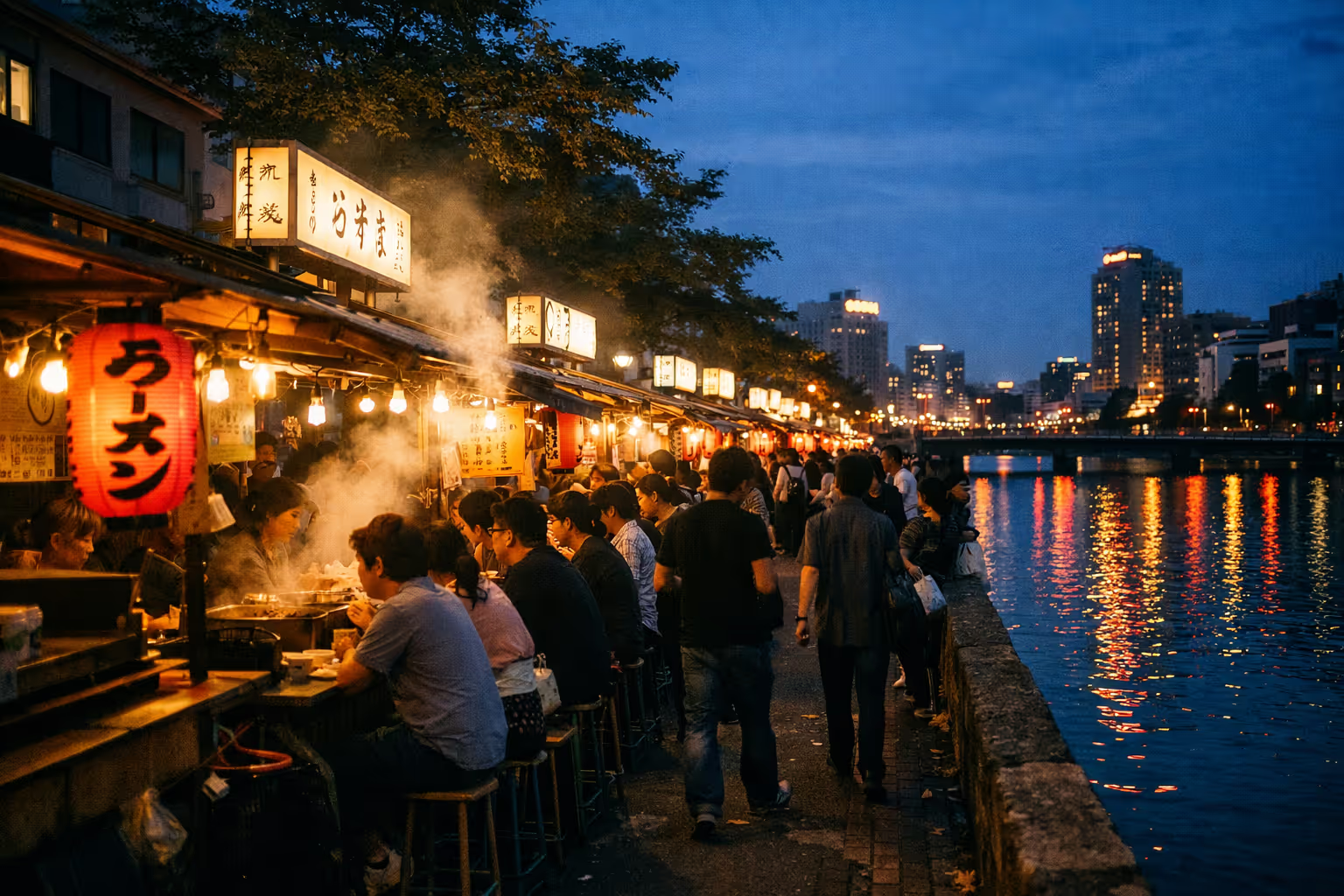
| Key Attractions | Takayama, Shirakawa-go, Ise Grand Shrine, Nakasendo post towns | Black-walled castle, gateway to Japan Alps, Kamikochi hiking | Yatai food stalls, Nakasu riverfront, Yufuin, Nagasaki, Beppu onsen | Ritsurin Garden, Setouchi art islands including Naoshima | Samurai district, weeping cherry trees |
| Food Specialties | Osu shopping district, retro arcades, vintage clothing | Local mountain cuisine | Tonkotsu ramen, grilled skewers | Sanuki udon | Fresh seafood |
| Typical Business Hotel Cost (¥) | ¥9,000 | ¥8,000-10,000 | ¥9,000 | ¥8,000-9,000 | ¥7,000-9,000 |
Basing in these cities also stretches your budget considerably. Skip a ¥25,000-a-night Kyoto ryokan, sleep in a ¥9,000 business hotel in Nagoya or Fukuoka, and put the savings toward one standout stay later in the trip.
Okinawa: Japan’s southern islands beyond the mainland
Okinawa earns its place on any hidden gems in japan list for reasons that have nothing to do with being overlooked - it’s simply a different country within a country, with Ryukyuan heritage, coral reefs, and a food culture that has almost nothing to do with mainland Japan. The prefecture spans more than 160 islands (2)(8), and the things to do in Okinawa change completely depending on which island group you pick.
Here’s how to think about it by region:
- Okinawa main island (Naha and the north): Naha is the gateway - Kokusai-dori is touristy, but the back-lane Tsuboya pottery district and Makishi public market are worth your time. The real payoff is driving north to Nago, Motobu, and Cape Manzamo, away from the resort strip. Renting a car (¥4,000-7,000 / $26-45 a day plus fuel) is close to essential.
- The Kerama Islands: A 30-60 minute ferry from Naha, Zamami and Aka offer some of Japan’s clearest water for diving and snorkeling. Humpback whales pass through in winter.
- Miyako and Ishigaki: Reached by a short domestic flight, these are the beach islands. Miyako’s Yonaha Maehama is regularly ranked among Japan’s best beaches. Ishigaki is the hub for the even quieter Yaeyama islands like Taketomi.
- Amami Oshima: Technically Kagoshima Prefecture, but it functions as a calmer alternative to Okinawa proper.
Okinawan food is the cultural anchor: goya champuru (bitter melon stir-fry), Okinawa soba (thick wheat noodles, not buckwheat), and rafute (braised pork belly). Seek these out in neighborhood joints rather than resort restaurants - better flavor, lower prices, and you’ll actually be eating what locals eat.
Practical warnings: Typhoon season runs roughly August through October and routinely cancels ferries and flights to the outer islands. Build in buffer days. On smaller islands, bring cash, your own snorkel gear, and reef-safe sunscreen, since options are limited and pricey. In village areas, keep your speed under 40 km/h - the roads are narrow and locally patrolled.
Getting there: Naha is about a 2.5-3 hour flight from Tokyo. Outer islands add another 30-60 minute flight or a 1-3 hour ferry. Late May to early July tends to give you warm water with fewer typhoons and smaller crowds than the August Obon peak.
Nature escapes: valleys, forests, and gorges
Beyond the towns, Japan’s wilderness rewards the effort to reach it - but that effort is real:
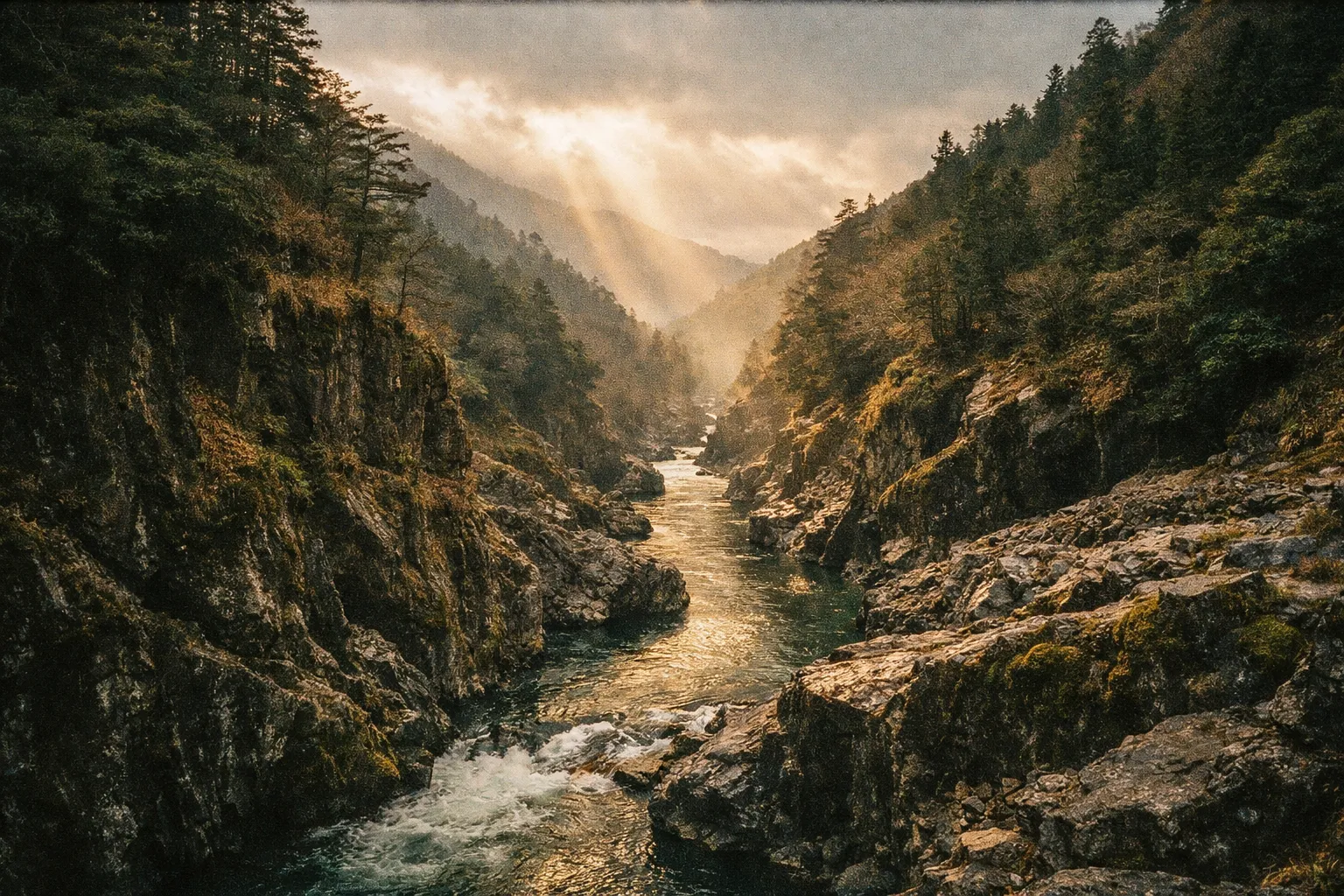
- Iya Valley (Shikoku): Vine bridges over a green river gorge, remote onsen, and near-zero crowds. Reach Tokushima or Kochi by train, then 1-2 hours by local bus or car into the valley (1)(3). An onsen ryokan here runs $180-300 per person with meals.
- Yakushima (Kagoshima): Ancient cedar forests that helped inspire Princess Mononoke. A 40-minute flight or 2-4 hour ferry/hydrofoil from Kagoshima (1). UNESCO-listed, mossy, and wet - bring rain gear regardless of season.
- Kurobe Gorge: A narrow-gauge scenic railway through the Northern Alps. Closes in winter, so check the season before you plan around it.
- Oirase Keiryu (Aomori): A streamside walking trail that’s at its best during autumn foliage.
Reaching any of these can eat half a day each way. Don’t try to cram more than one or two remote escapes into a 7-10 day trip - the math doesn’t work, and you’ll spend your time on buses instead of on trails. For those who want to Climb Mount Fuji, ski the Japanese Alps, raft the Yoshino River and experience Japan’s more adventurous side, building extra days into your itinerary is equally important.
Embracing the festive spirit of Japan’s city life
Festivals - matsuri - are a cornerstone of Japanese culture and offer a direct window into the country’s spiritual and social life. Attending one shifts your understanding of a place in a way that no museum quite replicates.
During a springtime stay in Kyoto, I was there for the Hanami festival, when viewing the cherry blossoms turns into a city-wide event. Parks fill with families, colleagues, and strangers sharing food under the trees. It’s less about the blossoms and more about the collective exhale after winter.
Each city has its own. In Osaka, the Tenjin Matsuri features traditional boat parades and street dances. Takayama’s spring and autumn festivals, with their elaborate floats (yatai), are among the most celebrated in the country and pair perfectly with a stay in the old town - you’re already there, so you don’t have to day-trip in and fight the crowds.
These festivals connect the present to the past in a way that’s hard to manufacture. They’re worth planning around.
Why Gen Z is so drawn to Japan
A noticeable share of newer travelers - and most of the content I see online - skews young, and there’s a clear set of reasons. Japan ranks near the top of international destinations in Gen Z travel-intention surveys - a pattern documented by the Japan Tourism Agency’s 2023 visitor-profile research - and the drivers cluster around a few things:
- Pop culture as a gateway. Anime, manga, J-pop, and Japanese games create a sense of familiarity before anyone arrives. A lot of younger travelers use anime and game locations as entry points to rural towns that also happen to offer genuine local life - a smart way to disperse beyond Tokyo (1).
- Aesthetics and “Showa retro.” Vintage shopping streets, kissaten (old-school coffee shops), and Showa-era neighborhoods are heavily featured on TikTok and Instagram, pulling interest toward backstreets and smaller cities rather than just Shibuya.
- Safety and value. Japan reads as safe and, with the weak yen (around ¥155-160 to the dollar in 2024-2025), surprisingly affordable for North American and European visitors.
If you fit this profile, the practical move is to chase the aesthetic into actual geography: a kissaten in a Nagoya back-lane, a vintage arcade in Osu, or a Showa-era shotengai in a mid-size city, rather than queueing for the same Tokyo photo everyone already has. Travelers who want broader context before they go will also find it useful to discover astonishing facts about Japan that go well beyond the usual tourist highlights.
What hidden-gem travel in Japan actually costs
Budgeting honestly is half the planning, especially since less-touristy areas usually cost less than the Golden Route. Rough per-person, per-day ranges (early 2025):
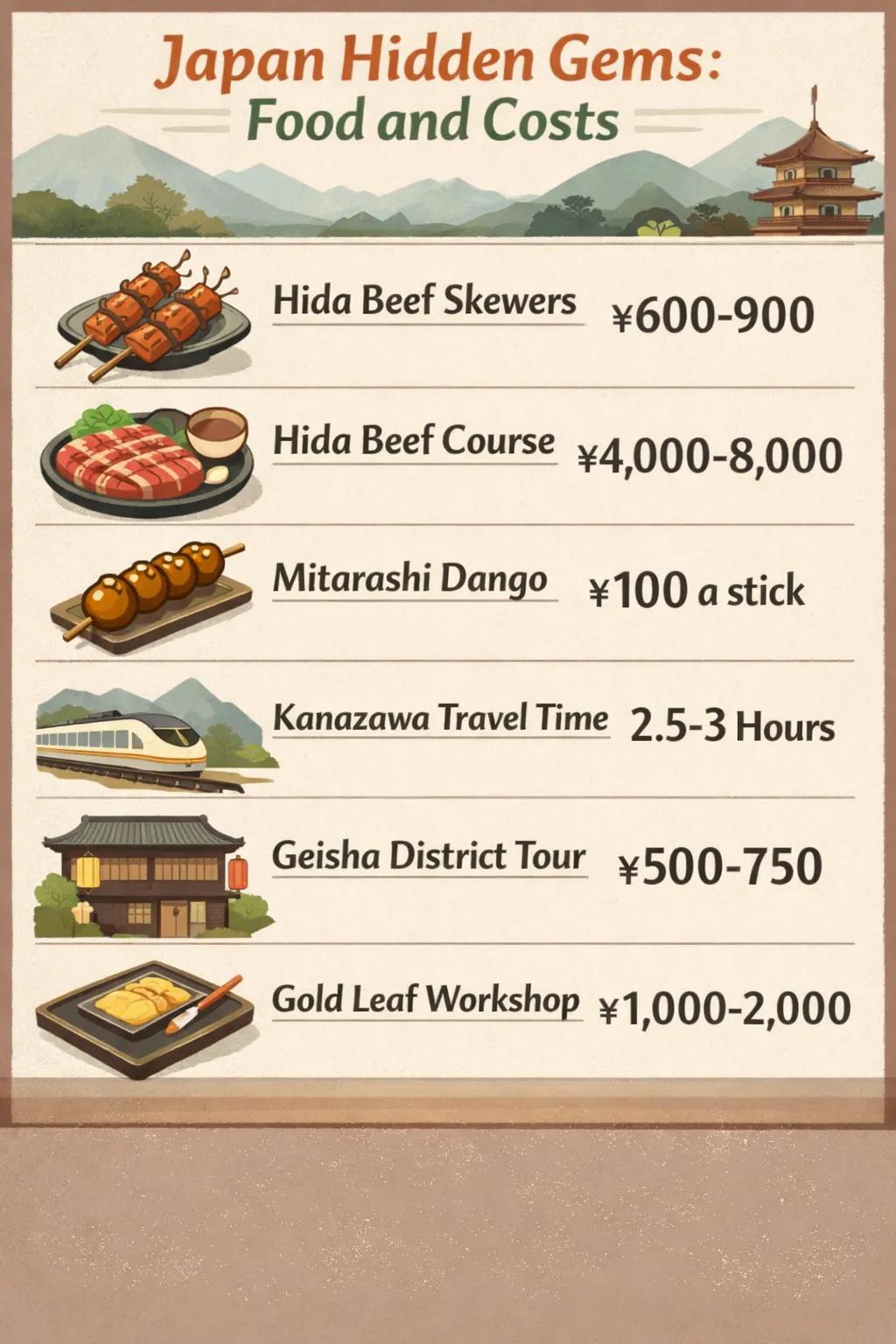 Prices and travel times for Japan’s hidden gems: Hida skewers ¥600-900, course ¥4,000-8,000, dango ¥100 a stick, Kanazawa travel time 2.5-3 hours, geisha tour ¥500-750, gold leaf workshop ¥1,000-2,000.
- Shoestring backpacker (small cities, countryside): $60-90. Hostels $20-40, konbini and local meals $10-20, local trains $10-20, simple attractions $10 (5).
- Mid-range traveler: $120-200. Business hotel or small ryokan $60-110, local restaurants $25-50, regional transit $20-40, admissions $10-20.
- Upscale ryokan or remote island: $250-400+. Onsen ryokan with kaiseki in places like Iya Valley or Yakushima often $180-300 per person, meals included (1).
Passes save real money. For multi-region trips, regional rail passes (Hokuriku Arch, JR East Tohoku, All Shikoku Rail Pass) often pay off after just 2-3 longer journeys and frequently beat the nationwide JR Pass now that its price has risen. A regional pass typically runs $100-250 for 3-5 days. Car rental in Okinawa and rural Shikoku runs $40-70 a day plus fuel and tolls, and it’s essential for the quieter beaches and valleys. Pairing smart pass choices with shoulder seasons and free gems can meaningfully reduce what you spend without cutting into the quality of the trip.
Connectivity: An eSIM or pocket Wi-Fi (about $3-7 a day) is worth it. Signal gets patchy on islands and in mountains, and English signage thins out fast outside major cities.
Frequently Asked Questions
- Can I visit multiple remote nature escapes in one short trip?
- Trying to visit more than one or two remote wilderness areas like Iya Valley or Yakushima in a 7-10 day trip is usually too rushed. Travel times are long, and you risk spending most of your trip on buses rather than enjoying the sites.
- What should I know about transportation passes for regional travel?
- Regional rail passes often provide better value than the nationwide JR Pass for trips focused on specific areas. They typically cover 3-5 days and pay off after 2-3 longer journeys, helping you save on expensive bullet train fares.
- Are there any special considerations for visiting Okinawa's outer islands?
- Yes. Typhoon season from August to October frequently cancels ferries and flights, so build in buffer days. Also, cash is essential on smaller islands, and bringing your own snorkel gear and reef-safe sunscreen is recommended due to limited rental options.
- How do I experience Japan's festival culture without the crowds?
- Staying overnight in festival towns like Takayama during spring or autumn matsuri lets you enjoy the celebrations without day-trip crowds. Smaller city festivals also tend to be less packed than major city events.
- Is it practical for tourists to buy abandoned houses in Japan?
- While some rural municipalities offer abandoned houses (akiya) for very low prices, these usually require costly renovations and a long-term presence. For visitors, staying in a minshuku or rural ryokan is a more realistic way to experience countryside life.
- What local etiquette should I keep in mind when visiting traditional towns?
- Many shops and markets in old towns are cash-only, and some sake breweries with tatami tasting areas expect visitors to remove shoes. Carry yen and be prepared for limited IC card acceptance.
- Why is Japan especially appealing to Gen Z travelers?
- Gen Z travelers are drawn by pop culture familiarity, the aesthetic appeal of Showa-era neighborhoods and vintage shops, and Japan's reputation for safety combined with favorable exchange rates, making longer trips affordable.