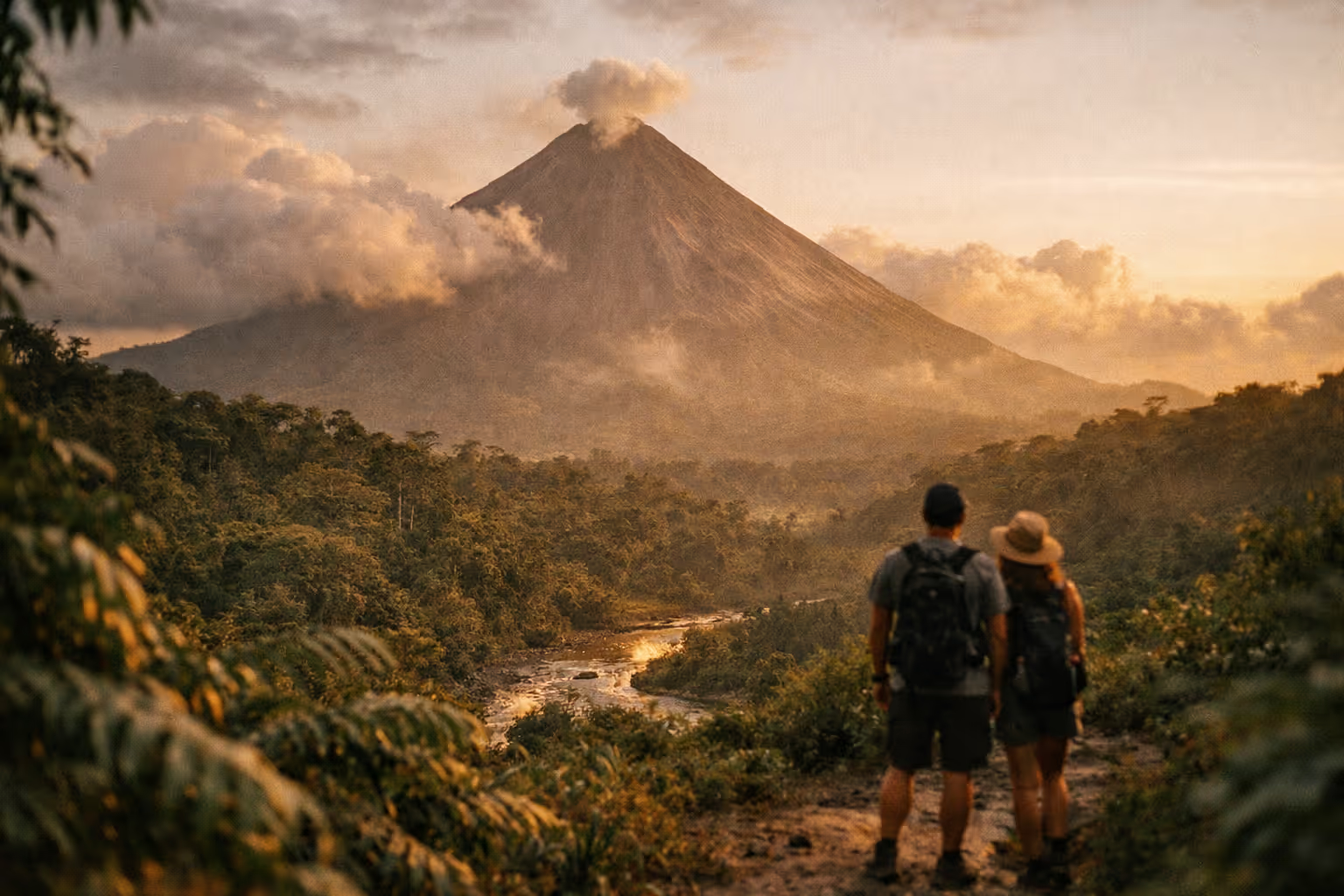
Arenal Volcano Costa Rica tours still get sold on a promise the mountain stopped keeping in 2010, when its last sustained lava flows went quiet. What you actually get now is that perfect cone, the hardened 1968-2010 lava fields underfoot, hot springs, and rainforest trails, and it is easily worth three nights in La Fortuna. The catch is planning around the weather and a park that closes by 4 p.m. Here is how I would budget, time, and book the trip.
Overview: Arenal Volcano Costa Rica Tours - What the National Park Actually Is
Arenal Volcano National Park, a highlight of Arenal Volcano Costa Rica tours, sits in Costa Rica’s Northern Zone, about 90 km (56 mi) northwest of San José and 15 km (9 mi) west of La Fortuna. The park covers 29,692 acres (12,016 ha) inside the larger 504,094-acre (204,000 ha) Arenal Conservation Area (1). The centerpiece is the 5,357 ft (1,633 m) Arenal Volcano, with the dormant 3,740 ft (1,140 m) Cerro Chato sitting next door (3).
Here’s what most guides get wrong: active lava is not part of the modern experience. Arenal was Costa Rica’s most active volcano from its July 29, 1968 eruption through the late 2000s, but sustained eruptive activity ceased around 2010 (3). The volcano is dormant, not extinct - there are still fumaroles and gas vents, but no regular lava flows visible on any tour. What you see today is the cone itself, old lava fields you can walk across, and the rainforest slowly reclaiming them. The geothermal hot springs around the base still work because residual heat in the system has nothing to do with whether the surface is erupting.
That single fact reshapes the entire trip. You’re not coming for fireworks. You’re coming for a near-perfect volcanic cone, easy-to-moderate hikes, Lake Arenal views, and a genuinely absurd density of hot spring resorts. Plenty of people decide that’s still worth the flight.
✓ Pros
- Dense cluster of adventure tours and hot springs within 30 minutes of La Fortuna
- Walkable lava fields and intact volcanic cone for hiking and photography
- Good infrastructure with hotels, restaurants, and tour operators
- Accessible for families and casual hikers with easy to moderate trails
✗ Cons
- No active lava flows since around 2010; no night lava tours inside the park
- Park closes early with no night access or crater hikes
- Weather can obscure volcano views; requires multiple days to improve odds
- No chain hotels at Arenal itself, limiting loyalty program options
Is it worth going to Arenal Volcano?
Short answer: yes, if you adjust expectations. The park makes the most sense as one node in a 2-4 night Arenal/La Fortuna stay rather than a single-purpose destination.
Worth the detour for:
- First-time Costa Rica visitors who want one classic volcano view
- Travelers combining the park with hot springs, waterfalls, and adventure tours
- Photographers - the cone is genuinely photogenic when clouds cooperate
- Families and casual hikers; trails are short and easy to moderate
Skip if short on time:
- You’ve already seen active volcanoes elsewhere (Hawaii, Guatemala, Indonesia)
- You only have a week in Costa Rica and want beaches plus Monteverde - Arenal can be cut
- You’re expecting visible lava; that experience is gone
Arenal consistently ranks among the top 2-3 destinations in Costa Rica because of the concentration of activities within 30 minutes of La Fortuna, not because the volcano itself does anything dramatic anymore. If you want one base where you can hike, raft, zipline, soak, and eat well, this is it.
What is the closest city to Arenal Volcano?
La Fortuna de San Carlos - population about 15,000 - is the closest town and the entire region’s tourism hub. It sits about 15-16 km from the main park entrance, a 25-30 minute drive on paved roads. Despite being called a city in most guides, La Fortuna is a walkable town: a central church, a square, a few blocks of restaurants and tour operators, and lodgings scattered along the road toward the volcano.
San José, the capital, is the closest major city at 3-3.5 hours by car. Liberia, with the other international airport (LIR), is 3-4 hours away. For most trips, you fly into San José (SJO) or Liberia (LIR), then drive or shuttle to La Fortuna - that’s where you sleep, eat, and base every excursion.
How to get to Arenal Volcano National Park
From San José (SJO): Rent a compact SUV for $40-70/day plus $10-20/day mandatory insurance, and drive 3-3.5 hours via Route 1 and Route 702. Roads are paved and in good condition.
From Liberia (LIR): 3-4 hours via Cañas and Tilarán around Lake Arenal - a scenic route worth doing in daylight.
Shared shuttles: $55-65 per person each way between San José and La Fortuna. Less flexible than a rental car but cheaper for solo travelers.
Private transfers: $160-220 per vehicle one way. Worth it for families of 4+ or anyone arriving late.
Taxi from La Fortuna to the park entrance: About $35 USD each way. Reasonable if you’re doing one self-guided visit and skipping a rental altogether.
Public buses: From San José, expect 4-6 hours with transfers and limited daily departures. Fine for a long stay, a real waste of time for a 3-night trip.
I drove the San José-La Fortuna route in October - the last 20 minutes after Ciudad Quesada had heavy afternoon rain and reduced visibility. Plan to arrive by 4 p.m. if you can.
How to Get to Arenal Volcano National Park
About 3-3.5 hoursOptions for reaching the park from major airports and towns.
- 1
Drive from San José
Rent a compact SUV ($40-70/day plus insurance) and drive 3-3.5 hours via Route 1 and Route 702 on paved roads.
- 2
Drive from Liberia
Take a scenic 3-4 hour drive via Cañas and Tilarán around Lake Arenal.
- 3
Shared shuttle
Book a shared shuttle for $55-65 per person each way between San José and La Fortuna.
- 4
Private transfer
Hire a private transfer for $160-220 per vehicle one way - best for families or late arrivals.
- 5
Taxi from La Fortuna
Take a taxi for about $35 USD each way from La Fortuna to the park entrance.
- 6
Public bus
Use public buses from San José with transfers; expect 4-6 hours travel time and limited schedules.
Park hours, fees, and tickets
- Hours: 8:00 a.m. to 4:00 p.m. daily, with last admission around 2:00 p.m. in the main sector
- Foreign adult entry: $16.95 USD (tax included)
- Foreign child entry: $5.65 USD
- Costa Rican/resident adult: ₡1,130; child ₡565
- Payment: Credit card only at the entrance - no cash accepted
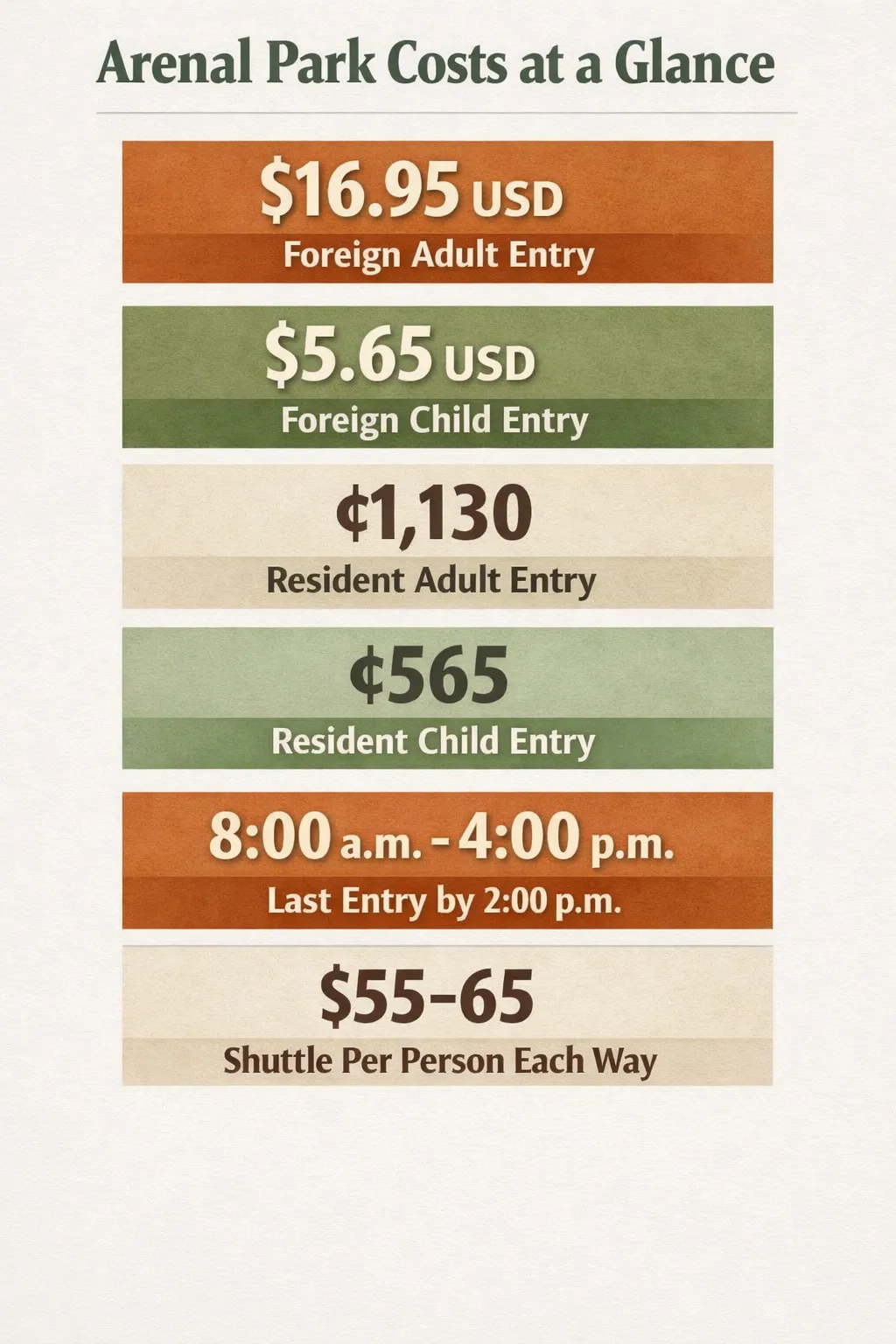 Park entry prices and transport costs for Arenal Volcano National Park (2026).
One ticket covers both the Volcano sector and the Peninsula sector on the same day. Visit them in different sessions and you pay twice. The park closes before sunset, which means no in-park night access, no nighttime lava tours, no crater hikes. Anything advertised as a “night lava tour” is either marketing fluff (sunset viewpoints) or operates outside the official park.
Do I need a tour for Arenal Volcano?
Legally, no. You can self-drive or taxi to the official park gate, pay the $16.95 entry, and hike the marked trails without a guide. The park is well signposted and the loops are hard to get lost on.
You do need a tour in these cases:
- You’re day-tripping from Guanacaste or San José without a rental car. Day-trip combos run $250 per person for a full-day Guanacaste-based tour (14 hours including 3-4 hours of driving each way, with hanging bridges, boat ride, hot springs, lunch, and dinner included) (5).
- You want access to private reserves. The hanging bridges circuits and several lava-field viewpoints sit on private land with $26-40 entry that’s usually bundled into a tour.
- You want wildlife. A naturalist guide with a spotting scope multiplies sloth, toucan, and monkey sightings dramatically. The park’s own trails are scenic but light on wildlife without one.
- You want logistics solved. Hotel pickup, bilingual guide, hot springs access, and meals in one transaction.
For a self-driving traveler staying in La Fortuna, a half-day guided volcano hike runs $40-70 per person (6). A full-day combo with waterfall, volcano, and hot springs runs $110-160 per person including lunch(8). Combo prices have climbed roughly 25-35% over the last few years - what was $90-120 not long ago is now firmly in the $120-160 band.
Arenal Volcano Hike in Costa Rica: Trails and What to Expect
The park has two sectors, both worth seeing if you have a full day. The arenal volcano hike Costa Rica visitors actually do is on the lower slopes - summit attempts are illegal.
Volcano sector (main)
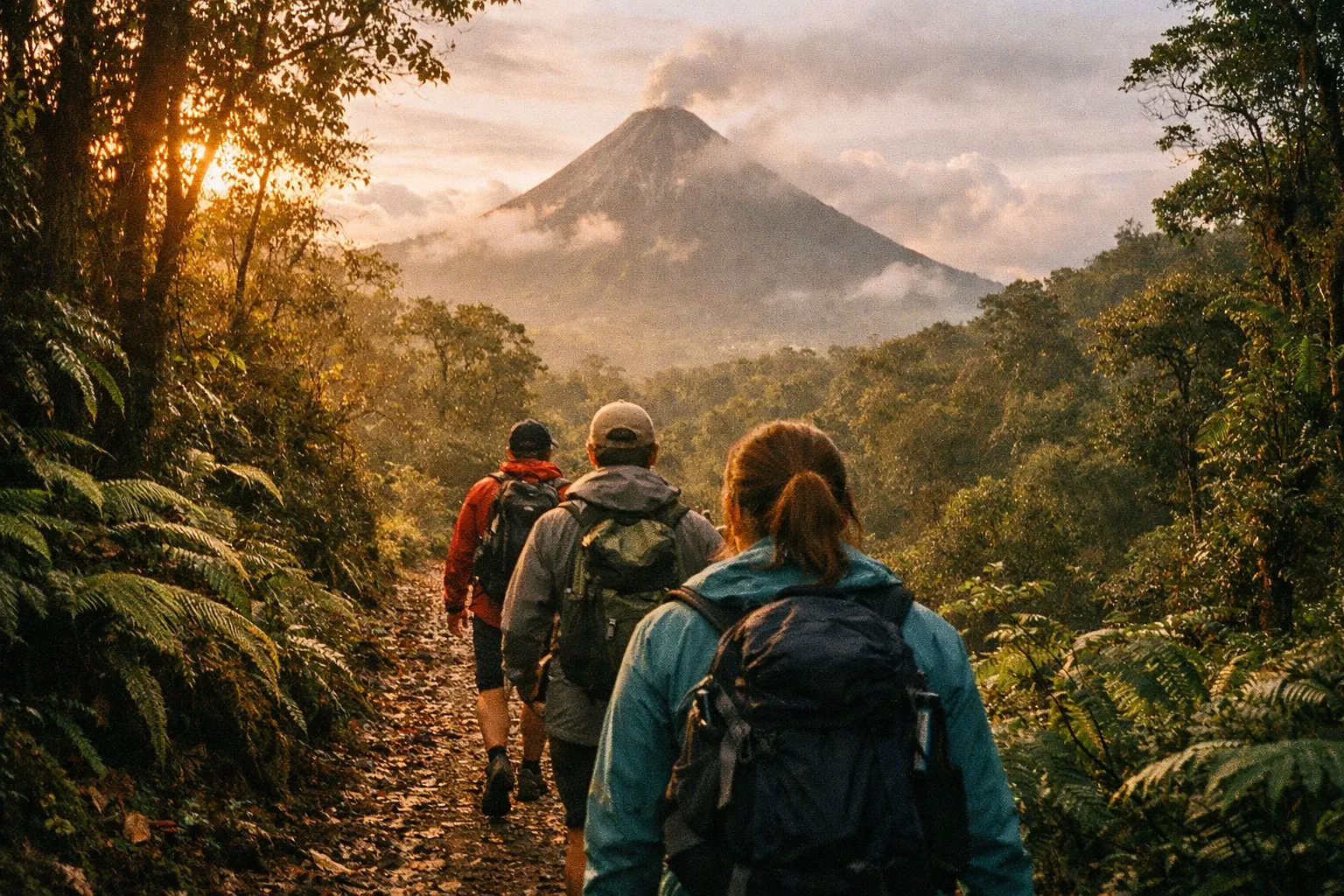
This is where most visitors go. Trails wind through secondary forest and across the 1968 lava fields. The three main routes - Heliconias, Coladas, and Tucanes - each run 2-3.4 km and connect into longer loops. You can combine them for a 3-5 km circuit that takes about 3 hours, including viewpoint stops.
The Coladas trail crosses the actual lava field: black volcanic rock, scrubby vegetation reclaiming the surface, and on a clear day, the cone rising directly above you. Footing is uneven and the rock is sharp where it hasn’t weathered down. Closed-toe hiking shoes are not optional here.
Peninsula sector
Quieter, with boardwalks and lookouts over Lake Arenal. Better for birding and easier walking. Open 8 a.m. to 5 p.m. with last entry around 4 p.m. If you’re traveling with kids or anyone who finds the lava field rough going, prioritize this side.
What’s banned
Hiking to the crater or summit of Arenal is illegal and dangerous. Every legal trail stays on the lower slopes. If a tour operator offers a “summit hike,” walk away - they’re either lying or breaking the law.
The 1968 Eruption and Costa Rica’s Arenal Volcano History: What to Know Before You Go
The Costa Rica Arenal volcano eruption that put this place on the map happened on July 29, 1968. Three craters opened on the western flank, destroying the villages of Tabacón, Pueblo Nuevo, and San Luis, and killing around 87 people. Before that morning, Arenal had been considered an extinct mountain - locals farmed its slopes.
From 1968 through the 2000s, Arenal was Costa Rica’s most active volcano. Continuous eruptive activity migrated to Crater C in 1973 and produced andesite-basalt lava flows, pyroclastic material, and near-daily explosions for nearly four decades. This is the period that filled travel magazines with photos of glowing lava rivers visible from hotel pools.
Around 2010, activity wound down. The volcano entered what geologists call a resting phase: still classified as active in the long-term sense, with fumaroles and gas emissions, but no sustained eruptions. There has been no major eruptive crisis affecting tourism in recent years, and current tour operators have shifted their marketing toward geology and history rather than live lava.
What this means for your visit:
- The lava fields you walk on are real and recent (1968-2010) - that’s a geological window most volcanoes don’t offer
- The cone shape is intact and dramatic
- The hot springs work - geothermal heat persists for decades after surface activity stops
- The glowing-lava photos you’ve seen online are pre-2010 archives
If a glowing-lava image is what brought you here, manage expectations now. The rest of the package still holds up.
Arenal volcano lava viewing: what’s actually possible
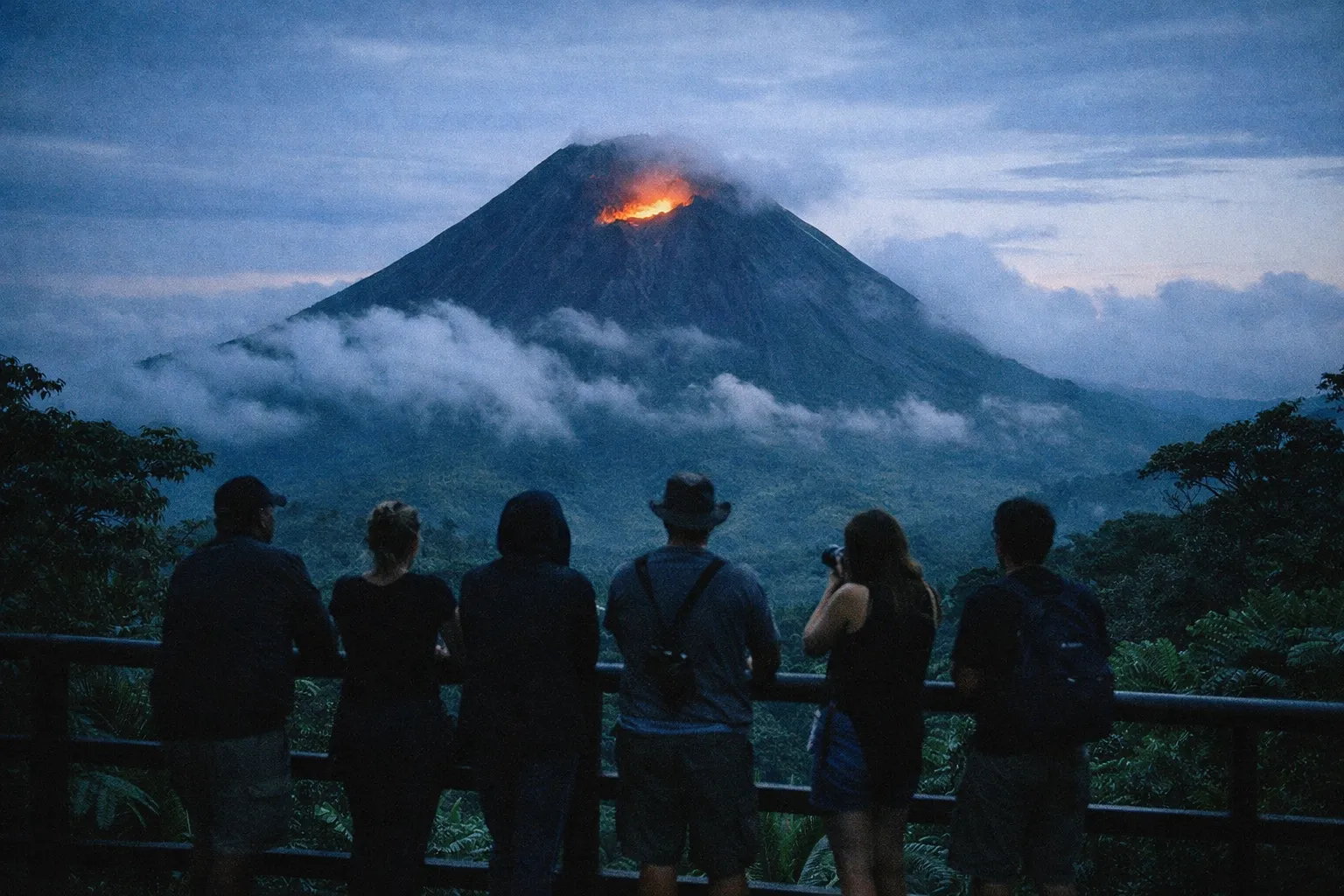
This is the section every other guide skirts around. Lava viewing in the active red-river sense is no longer a real experience. The volcano is dormant. Sunset and night tours that use “lava” in the marketing copy are showing you the silhouette of the cone, not flowing lava.
What you can still see:
- Solidified lava fields from the 1968-2010 eruptive period, walkable on the Coladas trail
- The cone itself, especially at sunset, from west-facing viewpoints
- Steam vents on the upper slopes, occasionally visible after rain
- Night sky over the silhouette from hotel pools and properties facing the volcano
I watched the cone at dusk from a property on the south flank - it’s a genuinely good image, just not the one tour operators use in their ads. If you want a dramatic night shot, book a hotel with a west-facing volcano-view pool and minimal light pollution. Arenal Observatory Lodge and several properties along the south flank are well-positioned for this.
Arenal Volcano Weather in Costa Rica: Planning Around the Single Biggest Variable
Arenal volcano Costa Rica weather is the single biggest variable in trip planning. Park temperatures sit at 21-27.5 °C (70-82 °F) year-round, but annual rainfall hits 3,500-5,000 mm (138-197 inches) - one of the wetter zones in the country.
Month-by-month breakdown:
- February-April (dry season): Driest, clearest views, also the most crowded and expensive. Average temps 24-27 °C. Best statistical odds for a clear cone.
- May-early August: Wet but with morning clearings. Good value. Greener landscape.
- September-October: Wettest months. Lowest prices. Plan strictly around morning activities.
- November: Still wet early, drying by late November. Shoulder pricing.
- Late November-early December: Solid window - mostly dry, fewer crowds than the Christmas peak.
- Mid-December-early January: Peak crowds, peak prices, frequently cloudy.
If you want one answer: March. Long days, statistically dry, still lush, and the highest probability of a multi-day clear window. Early December is the runner-up if you can dodge the holiday rush.
One thing to know: even in the dry season, mornings tend to be clearer than afternoons. Schedule volcano-view activities before noon. Cloud cover can sit on the cone for 36+ hours - staying 2-3 nights dramatically improves your odds of catching a clear window.
How many days do you need at Arenal Volcano?
Inside the park itself: 2-4 hours for trails and viewpoints. That covers a self-guided or guided half-day visit comfortably.
In the wider Arenal/La Fortuna area, the math looks like this:
- 1 night: Bare minimum. Half-day park visit, one evening at hot springs. You’ll feel rushed and a cloudy day means zero volcano views.
- 2 nights / 1 full day: Workable. Park in the morning, La Fortuna Waterfall or hot springs in the afternoon. Still risky for weather.
- 3 nights / 2 full days: The sweet spot. Park, waterfall, hot springs, and one adventure tour (zipline or rafting). Enough buffer for one rained-out day.
- 4-5 nights: For slower travelers, birders, or anyone combining wellness (multiple hot springs, spa) with adventure. Adds room for Río Celeste, sloth tours, or Caño Negro.
If you’re being honest with yourself about how much driving and how many activity-heavy days you can stack, 3 nights is the answer for most people.
Things to do at Arenal: a worth-the-detour ranking
Beyond the park, the La Fortuna area has more activities than you can fit in a week. Here’s what’s actually worth your time:
Worth the detour:
- La Fortuna Waterfall - $18 entry, 500 steps down to a 70 m waterfall with a swimmable pool at the base. Go early; the steps are brutal after 10 a.m. heat.
- Hot springs (evening session) - non-negotiable. Pick one resort and commit a full evening.
- Whitewater rafting on the Balsa or Sarapiquí - $70-95 with lunch and transport. Class II-III for families, III-IV for thrill seekers.
Worth it if you have time: 4. Canopy zipline tours - $60-90 for 2-3 hours. Fun but generic; you can zipline anywhere in Costa Rica. 5. Arenal Observatory Lodge day pass - separate $10-20 entry for 11+ km of trails with arguably better volcano views than the official park. 6. Hanging bridges - $40-85 for a 2-3 hour guided walk on private reserves. Better for wildlife than the park’s own trails. 7. Sloth-spotting tours - guided walks at private reserves; high success rate but feels staged.
Skip if short on time: 8. Generic “Lake Arenal boat tours” without a specific purpose 9. Anything billed as a “night lava tour”
Arenal volcano hot springs: budget vs mid-range vs luxury
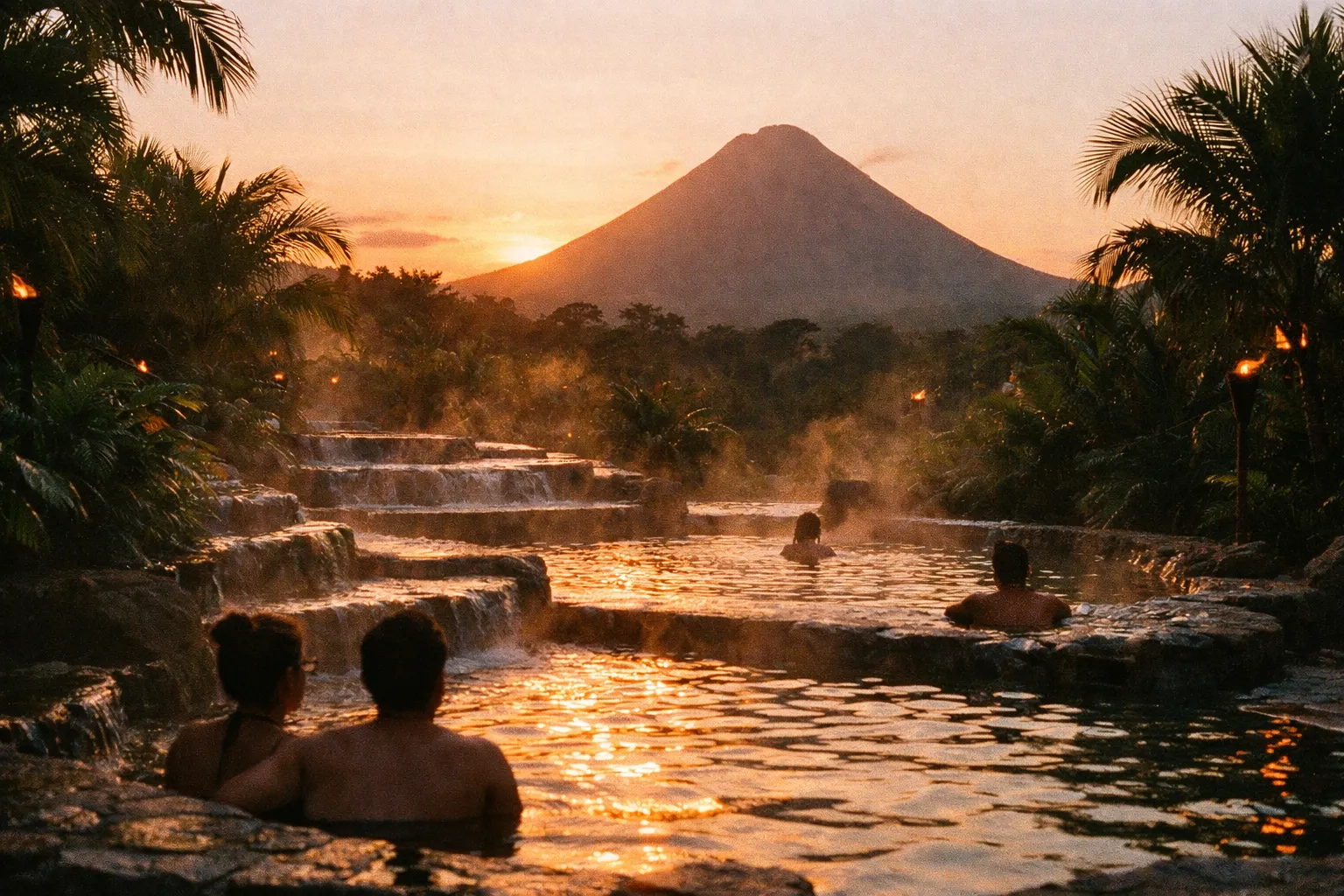
The hot springs around Arenal run on residual geothermal heat from the volcano. The range of options is wider than most guides admit, and the quality gap between tiers is real.
Budget ($10-20 per adult)
Local-style pools without resort amenities. Río Chollín (free, public, riverside) and a handful of small operators along Route 142. Bring your own towel. The atmosphere is laid-back and Tico, not curated.
Mid-range ($40-70 per adult)
Day or evening passes at properties like Baldí Hot Springs or Los Lagos. Multiple pool temperatures, snack bars, lockers usually included. Common packages add a buffet dinner for $60-90 total. This is where most travelers should aim.
Luxury ($80-120+ per adult, or $350-700+/night as a hotel guest)
Tabacón Thermal Resort, The Springs Resort & Spa, and Eco Termales are the headline names. Tabacón’s pools are built into a natural thermal river running through landscaped gardens - genuinely impressive even if you’re not staying overnight. Eco Termales caps capacity strictly, so reservations are mandatory in high season - showing up at the gate during December-April peak often means no entry.
Evening passes typically include dinner. As a hotel guest, you get unlimited access and the best volcano-view sunrises.
Hidden costs to check before booking:
- Towel rental: $3-8
- Locker rental: $3-10
- Whether dinner is buffet or à la carte
- Day pass vs evening pass (evening is usually better - cooler temps make the hot water feel right)
Book luxury resorts well in advance during December-April peak season.
Where to Stay Near Arenal Volcano: Hotels and What Each Tier Actually Gets You
The hotels near Arenal Volcano Costa Rica market is wide - over 100 properties from $15 hostels to $700+ luxury resorts. The right answer depends on what you’re optimizing for.
Budget ($15-40/night):
- Hostels in central La Fortuna (Selina, Arenal Backpackers Resort). Walking distance to restaurants and tour booking offices. No volcano view from most rooms - you’ll need to walk to a viewpoint.
Mid-range ($100-200/night):
- Properties in the hot-springs corridor between La Fortuna and the park entrance. Many include small on-site thermal pools, which saves you a $40-90 hot springs day pass.
- Look for “volcano view” in recent reviews, not just listing photos - some properties have view rooms and view-blocked rooms at the same price tier.
Luxury ($350-700+/night):
- Tabacón Thermal Resort, The Springs Resort & Spa, Arenal Kioro, Nayara - the headline names. Private hot springs access, dedicated volcano-view rooms, on-site dining.
- Arenal Observatory Lodge sits closest to the cone with the most direct sightlines and its own trail network - better for hikers than spa-seekers.
A note on chain loyalty: There is no Marriott Bonvoy, Hyatt, or Hilton property at Arenal itself. The closest Bonvoy options are the Costa Rica Marriott Hacienda Belén near San José (2.5-3 hours away) and the Westin Reserva Conchal in Guanacaste (3+ hours). If you’re points-driven, the smart play is: cash for Arenal nights, points for your beach or city nights. Trying to base entirely in a Bonvoy property and “pop over” to Arenal means very long day trips you’ll regret.
Where to base by priority:
- Closest volcano views: Hot-springs corridor or Observatory Lodge area
- Walking-distance dining: Central La Fortuna
- Multiple tours daily: Hot-springs corridor (10-15 min transfers vs 30-40 from town)
Sample 3-night itinerary and budget
Trip duration: 3 nights / 2 full days in La Fortuna
Estimated total cost for two people (mid-range): $1,000-1,400 excluding flights and rental car
Day 1 - Arrival
Drive from San José (3-3.5 hours). Lunch in La Fortuna. Afternoon at La Fortuna Waterfall ($18). Evening at mid-range hot springs ($50-70/person with dinner).
Day 2 - National park day
Arrive at the park by 8:30 a.m. Hike the Coladas/Tucanes loop, 3 hours. Lunch back in La Fortuna. Afternoon at Arenal Observatory Lodge for alternative viewpoints ($15). Light dinner in town.
Day 3 - Adventure day
Morning whitewater rafting ($80/person) or zipline ($70/person). Afternoon at the Peninsula sector if you have park ticket buffer, or a second hot springs session at a different property.
Day 4 - Departure
Drive back to San José or continue to Monteverde (3 hours via Tilarán) or the Pacific coast (3.5-4 hours).
Sample 3-Night Itinerary at Arenal Volcano
3 daysA practical day-by-day plan combining hiking, waterfalls, hot springs, and adventure.
- 1
Day 1 - Arrival and Waterfall
Drive from San José, have lunch in La Fortuna, visit La Fortuna Waterfall, and relax at a mid-range hot spring in the evening.
- 2
Day 2 - Volcano Park and Observatory
Early park arrival for a 3-hour hike on the Coladas/Tucanes loop, lunch in town, then visit Arenal Observatory Lodge for views.
- 3
Day 3 - Adventure and Peninsula
Choose whitewater rafting or zipline in the morning, then visit the Peninsula sector or enjoy a second hot springs session.
What to pack for the park
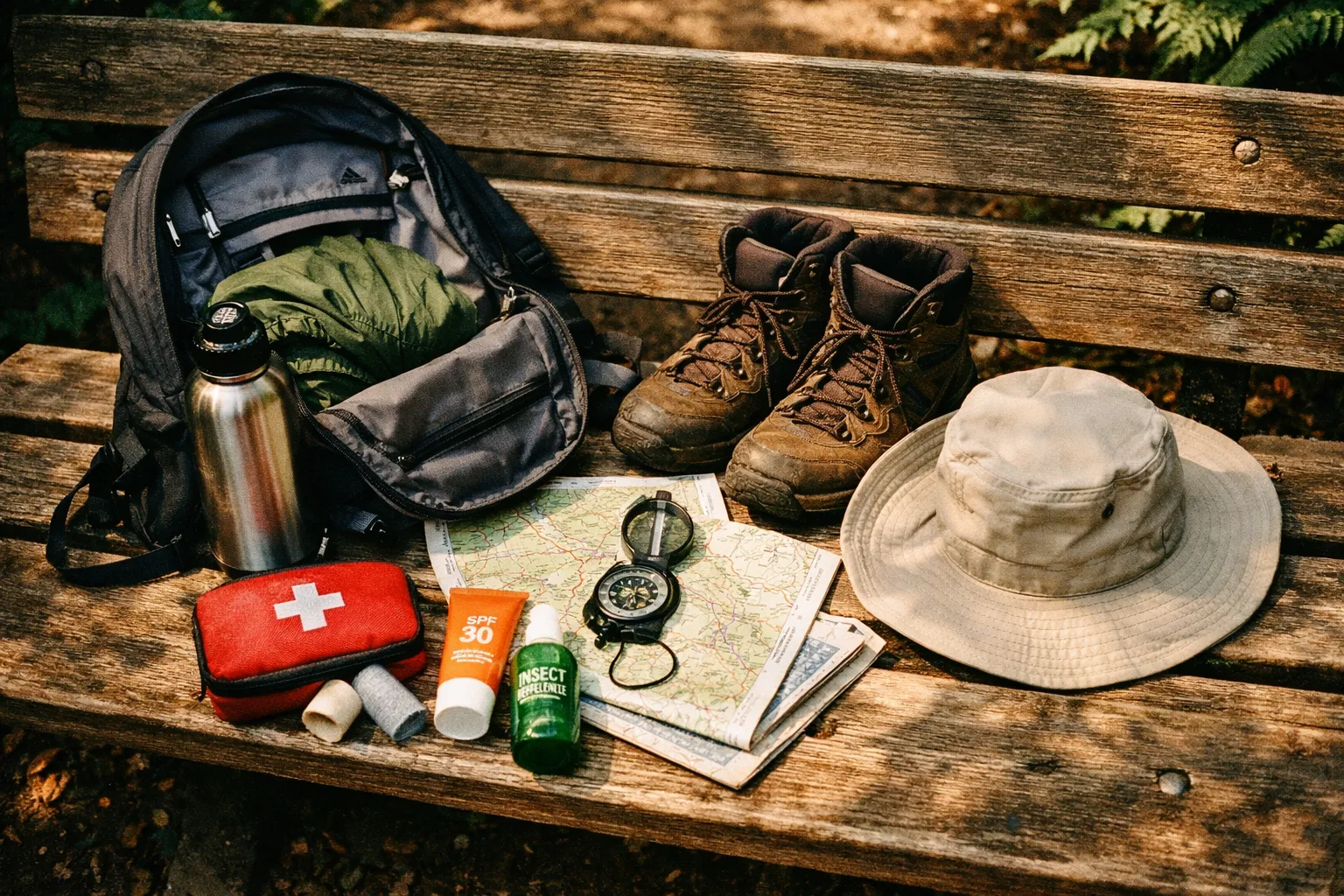
- Closed-toe hiking shoes with real tread - lava rock is sharp and slippery when wet
- Lightweight rain jacket - rain happens fast, any month
- 1-2 L water per person - no refill stations on most trails
- Insect repellent - mosquitoes near forest sections
- Sun protection - open lava fields have zero shade
- Swimsuit, sandals, dry change of clothes for the hot springs afterward
- Small binoculars (8x or 10x) if wildlife matters to you - most group tours have one shared scope
- Cash for tips and small purchases; credit cards for park entry and most resorts
Common mistakes to avoid
Expecting active lava. Worth repeating. The eruptive phase ended around 2010. Plan around dormant-cone views, hot springs, and adventure tours.
Arriving at the park too late. Last entry is 2 p.m. in the main sector. Roll up at 3 p.m. and you’ve lost the day.
Skipping the buffer day. Cloud cover can sit on the cone for 36+ hours. A two-night trip with one bad-weather day means zero volcano views.
Wrong footwear. Sandals on lava rock end trips early. Wear hiking shoes.
Booking blind. Hot spring packages vary wildly. Confirm whether your pass includes towel, locker, dinner, and how long you can stay before you pay.
Not reserving Eco Termales in high season. Capacity is capped. Walk-ups get turned away from December through April.
Stacking too much into one day. A 500-step waterfall, a 3-hour volcano hike, and late-night hot springs adds up to 7-8 hours of physical activity in heat and humidity. Split it across two days.
Driving at night in heavy rain. Windy roads, low visibility, no shoulder. A 3-3.5 hour drive can stretch past 4.5 if you start at 6 p.m. in October.
Public bus from San José for a short trip. It eats 4-6 hours each way. Use a shuttle or rental car if you have under 4 nights.
When a Costa Rica concierge or design service makes sense
For most independent travelers, La Fortuna is easy to DIY: rent a car, book a hotel, walk into any tour operator on the main street the day before. You genuinely don’t need a planner.
A concierge or trip-design service starts paying off when:
- You’re traveling December-March or over Christmas/Easter and luxury resorts and Eco Termales are booking out weeks in advance
- You’re combining Arenal with two or more other regions (Monteverde, Pacific coast, Caribbean) and need linked transfers
- You’re celebrating a honeymoon or milestone and want curated logistics rather than browsing options at 9 p.m. after a long drive
- You want private guides with spotting scopes focused on birding or photography rather than mass-market group tours - these typically add $20-40 per person over standard group rates for parties of 4-6
- You’re chain-loyal (Marriott Bonvoy, Hyatt) and want to integrate Arenal - where no chain hotels exist - into a points-leveraged itinerary that uses chain properties for beach and city nights
For a standalone 3-night Arenal trip in shoulder season, save the markup and book direct.
Frequently Asked Questions
- Do I need a tour for Arenal Volcano?
- Not legally. You can self-drive to the park gate, pay the $16.95 entry, and hike marked trails on your own. A tour makes sense if you're day-tripping from Guanacaste or San José without a car, want access to private hanging-bridge reserves, want a naturalist guide for wildlife spotting, or prefer bundled logistics (transport, meals, hot springs).
- What is the best month to visit Arenal, Costa Rica?
- March offers the best balance: statistically dry, long days, still green, and the highest probability of multi-day clear cone views. February through April overall is the driest period. Early December is a strong runner-up if you can avoid the Christmas crowds. September through November is the wettest stretch but offers the lowest prices.
- Is it worth going to Arenal Volcano?
- Yes for most first-time Costa Rica visitors. The cone is photogenic, the density of adventure tours and hot springs within 30 minutes of La Fortuna is unmatched in the country, and the infrastructure (hotels, restaurants, operators) is well-developed. Skip it if you're expecting visible lava (the eruptive phase ended around 2010), have under a week in Costa Rica and want beaches plus Monteverde, or have already seen active volcanoes elsewhere.
- How many days do you need at Arenal Volcano?
- Three nights is the sweet spot. That gives you two full days for the park, waterfall, hot springs, and one adventure tour, plus a weather buffer for cloudy days. Two nights is workable but risky if a cloudy day hides the cone. Four to five nights makes sense if you want to add Río Celeste, wildlife refuges, or multiple hot spring properties.
- Can I see lava at Arenal Volcano?
- No. Sustained lava activity ended around 2010 and the volcano is in a dormant resting phase with only fumaroles and gas vents. You can walk on solidified lava fields from the 1968-2010 eruptive period, but no tour shows flowing lava. Operators advertising 'night lava tours' are selling sunset silhouette views, not lava.
- Can I hike to the summit of Arenal Volcano?
- No. Hiking to the crater or summit is illegal and dangerous. All legal trails stay on the lower slopes. Any operator offering a 'summit hike' is breaking the law.
- What should I check before booking hot spring passes?
- Confirm whether towel and locker rentals are included, whether dinner is buffet or à la carte, day pass vs evening pass timing, and - critically for Eco Termales and other capacity-capped properties - whether you have a confirmed reservation. In high season (December-April), walk-ups at top resorts get turned away.