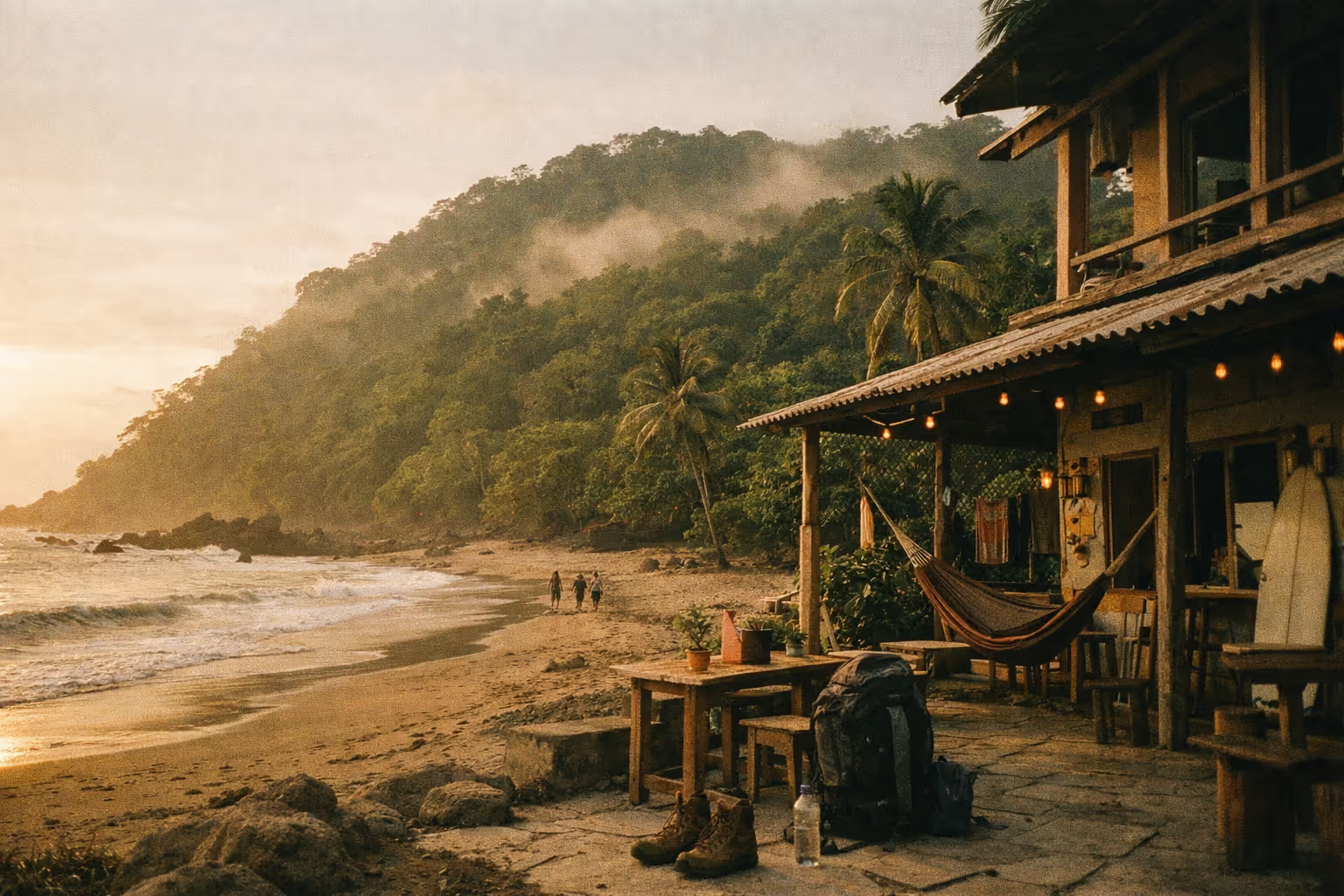
Budget travel Costa Rica starts with a single decision most people get backwards: when to go. Everyone books the December-to-April dry season, which is exactly why it costs the most; May, September, and October pair low-season lodging discounts with the year’s cheapest flights into San Jose. On the ground, the difference between a 10 dollar local bus and a 55 dollar shuttle adds up fast over a week. Skip the dry-season reflex and the same trip gets a lot cheaper.
Budget Travel in Costa Rica: When to Go for the Cheapest Months
Costa Rica has two seasons that matter for your wallet: dry (December-April) and green/rainy (May-mid-December). The dry season is when everyone wants to come, and prices reflect that. Christmas, New Year, and Easter weeks are the worst offenders - mid-range rooms regularly top $150/night and shuttle seats sell out a month in advance.

The cheapest months to go to Costa Rica are May, September, and October. September and October sit at the heart of the rainy season - hotels run promotions, car rentals drop, and you’ll often have national park trails close to yourself. May is the sweet spot if you want lower prices but slightly drier mornings: the rains are just starting, so afternoon showers are common but mornings tend to hold.
One thing most budget guides get wrong: they tell you to “avoid the rainy season.” That’s backwards. You want the rainy season - you just need to book activities in the morning and accept that afternoons may be wet (4). I rafted the Pacuare in October and the river was actually better - higher water, bigger rapids, and the lodge was running a 30% discount.
Worth knowing: flight prices to Costa Rica often hit their lowest point in May and September from U.S. hubs, aligning with on-the-ground low season (1)(6). That’s a rare double discount - cheaper to fly there and cheaper once you land.
Is $1,000 enough for a week in Costa Rica?
Short answer: yes, if you exclude flights and travel cheap. No, if flights are included and you want comfort.
Here’s the math:
- Backpacker week, excluding flights: At $60/day, seven days runs $420. That leaves $580 for two or three signature tours (ziplining ~$75, a national park day tour ~$80) or nicer dinners. $1,000 per person works comfortably.
- Backpacker week, flights included from U.S.: Round-trip airfare from major U.S. hubs lands at $300-$400 on sale (6). That leaves $600-$700 for seven days on the ground, or about $85-$100/day. Doable if you stick to hostels and buses.
- Mid-range week, flights included: Not realistic. The 2025 mid-range benchmark is $74.50/day on the ground (3), plus $400 in airfare, puts you at $920 before tours. Add 2-3 paid activities and you’re over $1,200 per person.
Costa Rica travel forums consistently flag that expecting an all-inclusive week for $1,000 including flights is unrealistic in 2025-2026 (6). Plan for $1,200-$1,500 per person if you want hotels, a few tours, and flights in the same number.
How to score cheap flights to Costa Rica
Flight pricing to San José (SJO) and Liberia (LIR) is one of the easier wins on this whole trip. Forecasters expect Costa Rica to be one of the cheapest international destinations to fly to from the U.S. in 2026 (6), and the cheapest fare months align with the green season anyway.
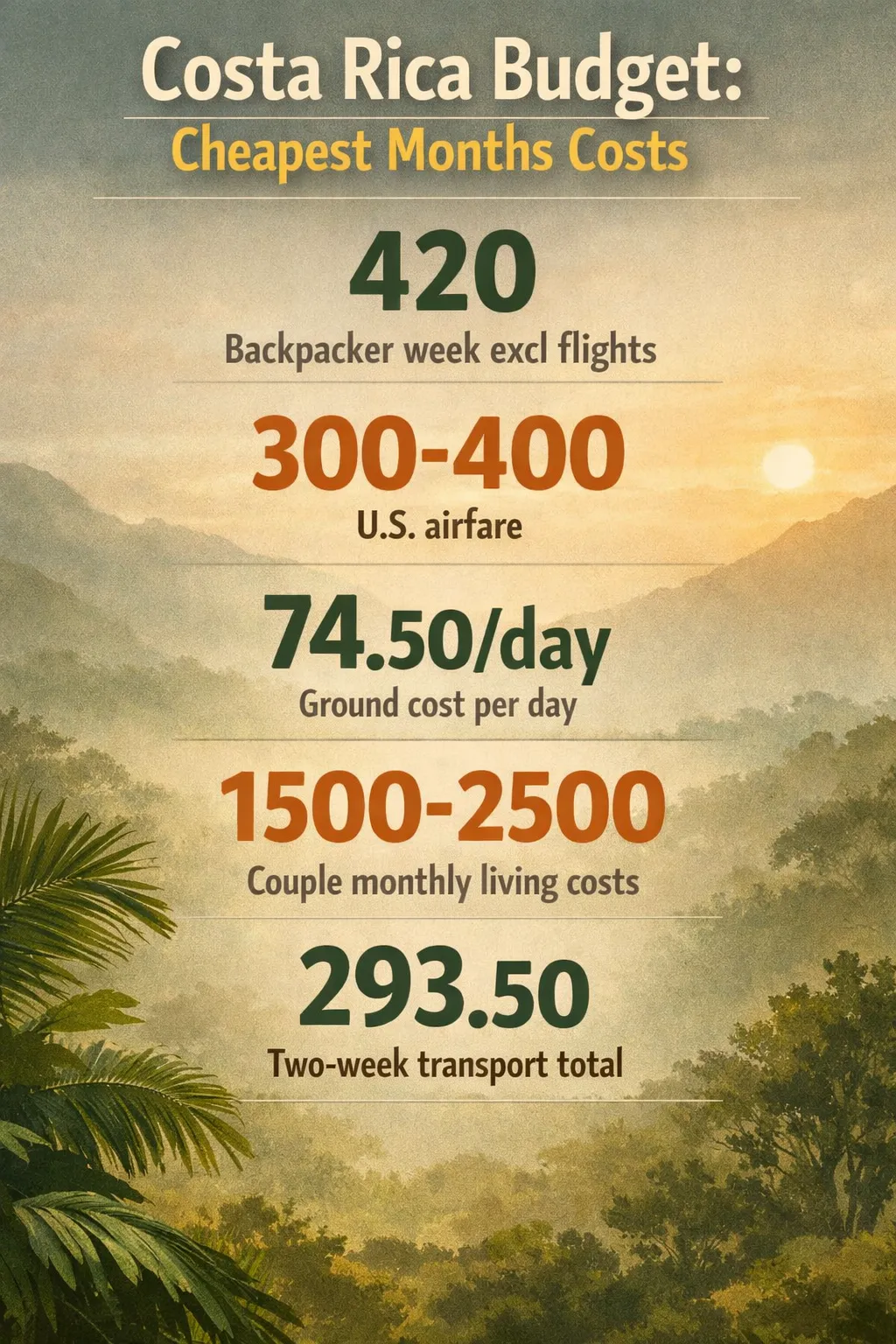 Cheapest months are May, September, and October; backpacker week excluding flights is $420, ground costs around $74.50/day, and a couple’s monthly living costs run $1,500-$2,500.

Tactics that actually work:
- Set alerts on Google Flights and Going (formerly Scott’s Cheap Flights) for both SJO and LIR. Liberia is often cheaper if you’re heading to Guanacaste beaches or Monteverde - and it shaves three hours of driving off the start of your trip.
- Fly Tuesday or Wednesday. Weekend departures from the U.S. carry a $50-$120 premium.
- Use the shoulder weeks. First two weeks of May, all of September, and the first three weeks of October consistently show the lowest fares.
- Skip the checked bag. Spirit, Frontier, and JetBlue Basic all run cheap fares to Costa Rica but charge $50-$75 per checked bag each way. A 40L carry-on pack covers a 10-day trip easily.
Worth the detour: if you live near a smaller airport, check positioning fares to Miami, Houston, or Fort Lauderdale. The leg from those hubs to Costa Rica is often $150 cheaper than a direct from a non-hub city.
Accommodation: where to actually sleep on a budget
This is where the 2025 price jump hit hardest. Mid-range hotels that were $80/night in 2022 are routinely $120-$150 now. The detailed 2025 breakdown puts mid-range accommodation at $32.37 per person per day, or roughly $65/night for a couple sharing a room.

Realistic nightly targets by tier:
| Tier | Green season | Dry season |
|---|---|---|
| Hostel dorm | $15-$25 | $20-$35 |
| Basic private room / guesthouse | $40-$55 | $55-$80 |
| Mid-range hotel | $70-$110 | $110-$160 |
| Family room (sleeps 4) | $80-$120 | $130-$180 |
| Standout lodge studio | $120-$150 | $180+ |
A 6-day Costa Rica trip can come in under $650 per person excluding flights by mixing nights - for example, a Radisson San José stay at $95.69/night for the city portion, paired with cheaper guesthouses in La Fortuna and on the coast (4).
Booking mechanics that save money:
- Book Christmas, New Year, and Easter 3-6 months ahead. Prices on these weeks don’t drop closer to the date - they climb.
- Book green-season stays last-minute. May, September, and October properties run last-minute promos when occupancy is low.
- Prioritize properties with breakfast included. That’s effectively $5-$10/day saved on food per person.
- Get a kitchenette where possible. Cooking two meals a day instead of three drops your food spend by roughly a third.
Where to actually base yourself:
- La Fortuna for Arenal access - basic guesthouses around $45-$60, plenty of free hot springs (skip the $40 resort entry; the Rio Chollín off the highway is free).
- Monteverde/Santa Elena for cloud forest - hostels at $20, family rooms at $80.
- Manuel Antonio/Quepos for jungle-meets-beach - sleep in Quepos, not Manuel Antonio proper. The price gap is $50+/night for the same beach access.
- Caribbean coast (Puerto Viejo, Cahuita) - the underrated budget play. Rooms run 20-30% cheaper than equivalent Pacific-side stays, and Cahuita National Park has free entry via the southern entrance (donation-based).
Food: where the budget either holds or breaks
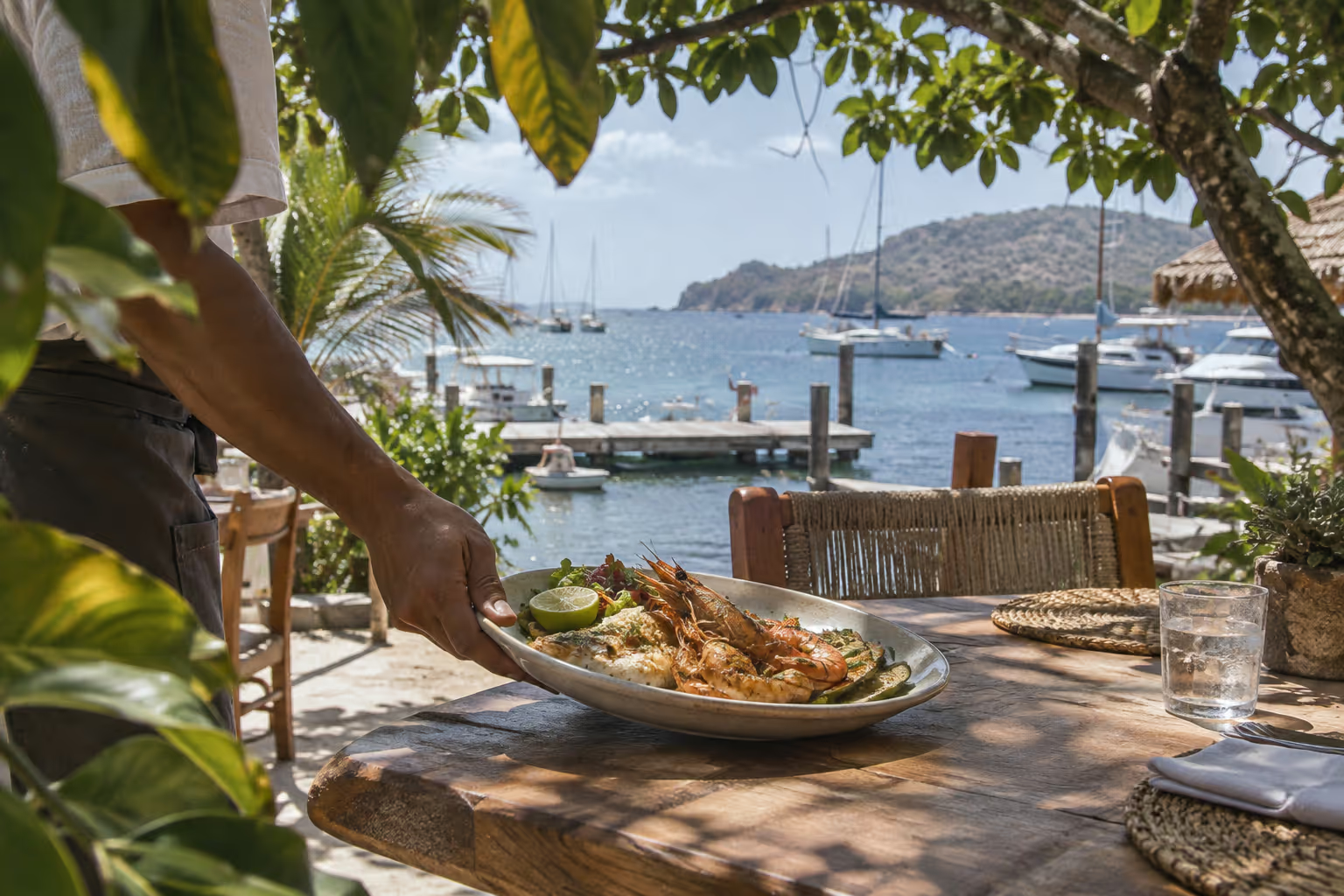
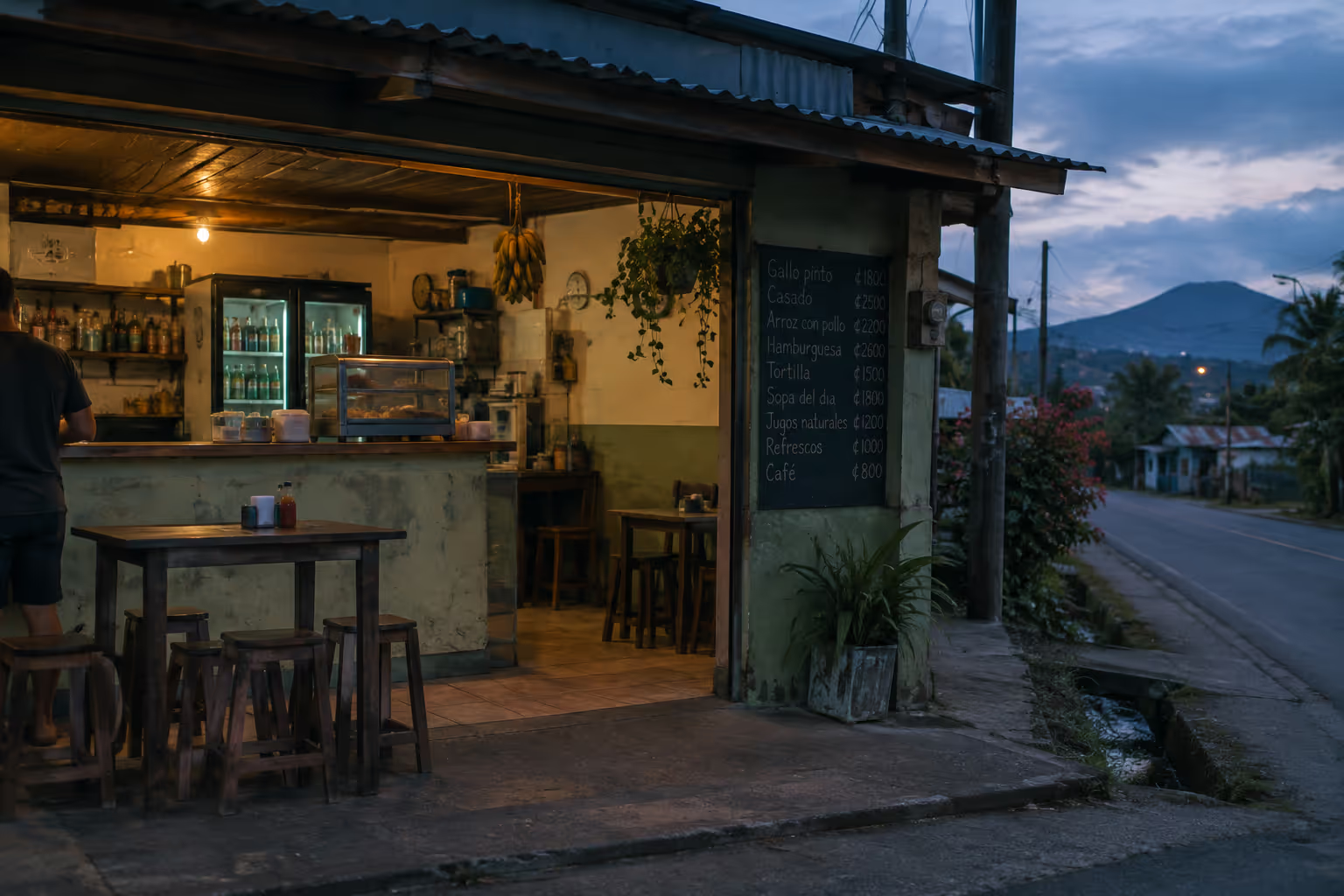
The single biggest budget mistake is eating at hotel restaurants and tourist-strip spots. The 2025 breakdown shows two people can eat well on $24.50/day combined - about $12.25 per person including drinks - by using local sodas (3).
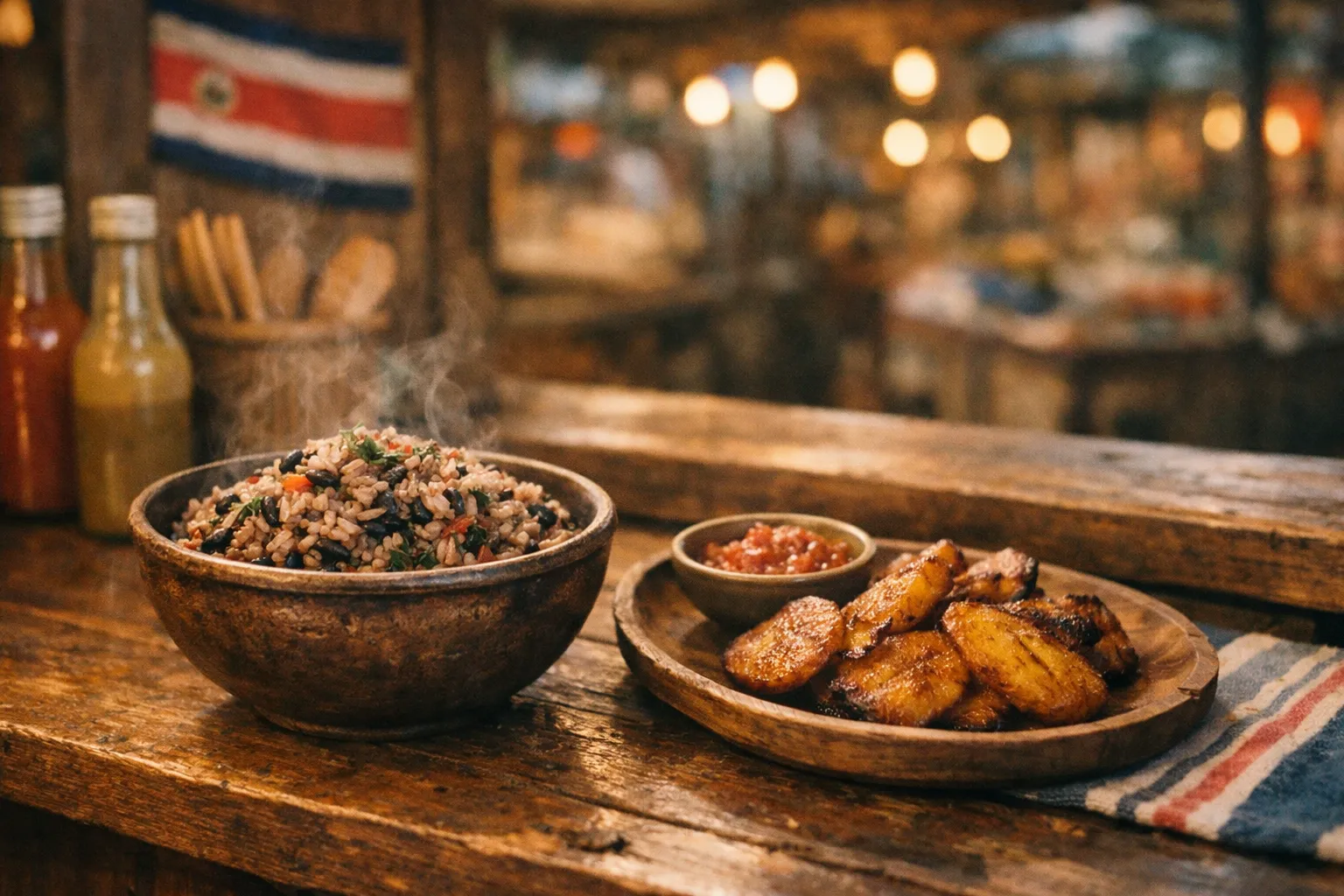
What a soda is and why you want them: small, often open-air family restaurants serving the casado - a plate with rice, beans, plantains, salad, and your choice of protein. Casados run $5-$8. The same plate at a tourist restaurant is $15-$22.
Specific food tactics:
- Eat your big meal at lunch. Sodas run lunch specials ($5-$7) that are often half the price of dinner portions.
- Shop ferias on weekends. Farmer’s markets (most towns have one Saturday or Sunday morning) sell produce noticeably cheaper than supermarkets. Plantains, pineapple, papaya, and avocados are absurdly cheap in season.
- Buy alcohol at airport duty-free on arrival. It’s cheaper than supermarkets and far cheaper than bars. A bottle of Centenario rum is roughly half the bar price.
- Skip bottled water. Costa Rica’s tap water is potable across most of the country. A reusable bottle saves $3-$5/day per person.
- Hit the supermarket once. Automercado and Mas x Menos carry breakfast staples - eggs, bread, fruit, coffee, yogurt - for a fraction of cafe prices.
Foodie spots worth the splurge:
- Sarchí for chifrijo at any roadside soda - Costa Rican pork-and-bean bowl, $4.
- Puerto Viejo for Caribbean rice and beans (cooked in coconut milk) - try Soda Lidia’s or any beachfront stand.
- Mercado Central in San José - sit-down sodas inside the market serving locals, $5 lunches.
- Monteverde for cheese - the Quaker community has been making it for 70 years; buy a wedge at the factory store for under $8.
Average daily drink spend in the 2025 sample was $5.50 for two, or $2.75 each (3). Imperial and Pilsen beers run $1.50-$2.50 at sodas, $5+ at tourist bars.
Activities: what’s worth paying for, what’s free
This is where Costa Rica gets expensive fast. A full-day Tortuguero National Park tour runs $80 per person. A turtle-watching evening tour is around $30. Canopy and combo day tours typically land at $55-$100. National park entries are $10-$15 per person (5) - innocuous until a family of four does three parks in a week ($180+ in entries alone).
Worth the detour:
- Arenal Volcano hike + free hot springs (Rio Chollín, free, just off Route 142 - bring water shoes, the rocks are slick)
- Manuel Antonio National Park ($18 entry, advance online reservation required - book at sinac.go.cr at least 24 hours ahead; this trips up a lot of visitors)
- Tortuguero turtle nesting tour (July-October, ~$30, only doable with a licensed guide by law)
- Cahuita National Park (donation-based southern entrance - easily the best price-to-experience ratio in the country)
- Whitewater rafting the Pacuare ($90-$110 - yes it’s expensive, but it’s the marquee Costa Rica experience)
Skip if short on time / overrated:
- Tabacón Hot Springs resort ($90/person - same water as the free river)
- Jaguar Rescue Center photo ops at peak hours (overcrowded; the morning tour is the only one worth it)
- Sky Tram Monteverde (the cloud forest itself is the attraction; the tram is a $50 add-on for what hiking gives you free)
- Most catamaran “sunset cruises” in Tamarindo/Jacó (crowded, generic, $75)
Free or near-free anchors:
- All beaches. Costa Rican beaches are legally public unless inside a national park (2). Playa Conchal (white sand from crushed shells), Playa Manuel Antonio (inside the park, but the beach itself is the prize), Playa Cocles, Punta Uva - all free.
- Self-guided cloud forest walks on community trails outside Monteverde proper ($5-$8 vs $25 at the main reserve).
- Local festivals. Most towns run a fiesta cívica annually with free music, food stalls, and rodeo events. Ask at your guesthouse.
- Coffee farm visits. Many small farms outside San José offer tours by donation if you skip the big-brand operations.
The PAA wildcard - what’s the top predator in Costa Rica? The jaguar is the apex land predator (5). You’re extremely unlikely to see one - they’re nocturnal and concentrated in Corcovado on the Osa Peninsula. The budget angle here is real: a 2-day Corcovado expedition runs $250-$400, while a $15 entry to Manuel Antonio gets you white-faced capuchins, sloths, and coatis without the price tag.
The most affordable way to travel within Costa Rica
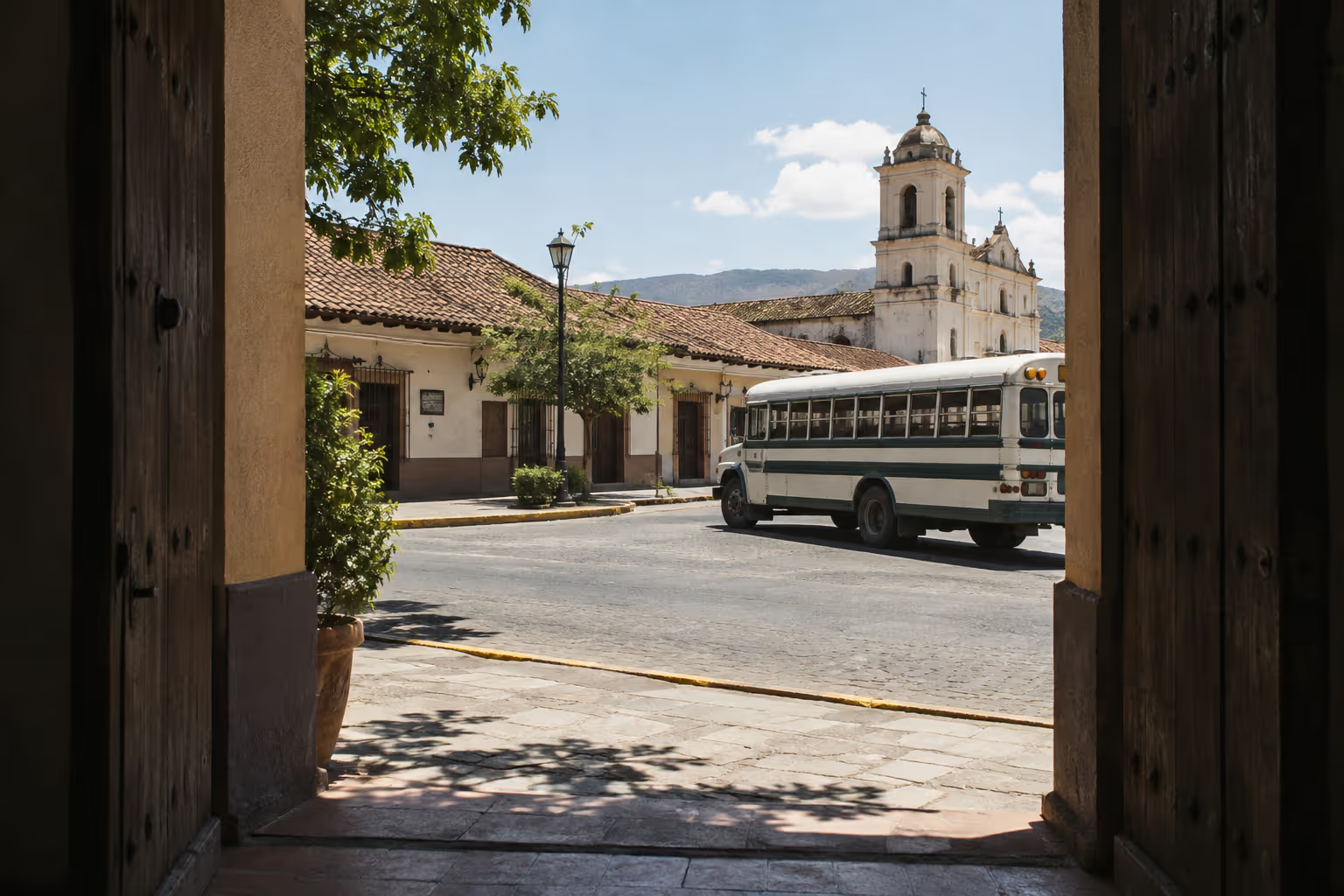
Local buses are the most affordable way to travel in Costa Rica, full stop. A bus from San José airport to downtown costs $0.75. Most intercity routes - San José to La Fortuna, San José to Monteverde, San José to Manuel Antonio - run $5-$10 per person. The same legs by shared shuttle cost $50-$60. Over two weeks, the savings compound to several hundred dollars per person.
How the math actually works: the 2-week sample trip in the 2025 breakdown logged just $293.50 in total transport for two people - $19.56/day - by mixing buses for long hauls with the occasional shuttle for awkward connections (3).
When to take the bus:
- San José to/from La Fortuna, Monteverde, Quepos/Manuel Antonio, Puerto Viejo, Tamarindo (all straightforward, 4-6 hour routes)
- Anything along the Pacific or Caribbean coastal corridors
When the shuttle is worth it:
- La Fortuna to Monteverde (the “jeep-boat-jeep” shuttle is $30-$35 and saves 6 hours over the bus route via San Ramón)
- Manuel Antonio to Monteverde (no direct bus exists)
- Anywhere with luggage and tight connections
Renting a car: a budget rental runs $40-$60/day in green season, $70-$100 in dry season, plus mandatory liability insurance (often $15-$25/day) that the booking sites don’t show until checkout. For a couple doing a 7-day loop, the math sometimes pencils out - but for solo travelers and groups using mostly buses, it rarely does.
One booking-mechanics note worth flagging: Costa Rica’s rural roads are rough. If you rent, get 4WD for anything off the Pan-American Highway. I drove from Uvita to the Nauyaca Waterfalls trailhead in August 2024 and the last 3km were so rutted a sedan would’ve bottomed out twice.
Traveling Costa Rica on a Budget With Family
This is where most guides fail - they quote per-person numbers and let parents do the math. Here’s what costa rica on a budget with family actually looks like:
Realistic daily target for a family of four: $220-$320 total.
| Category | Daily target |
|---|---|
| Family room (sleeps 4) | $80-$120 |
| Food (sodas + groceries) | $50-$80 |
| Transport (bus or shared rental) | $25-$50 |
| One paid activity ($10-$15 park entry × 4) | $40-$60 |
| Misc | $25-$30 |
Family-specific budget rules:
- Pick 1-2 bases, not 5. Moving with kids every two days kills both budget and morale. La Fortuna plus a Pacific beach town (Sámara or Manuel Antonio area) covers volcano, jungle, and beach in two stops.
- Family rooms beat two doubles. Many basic hotels offer rooms sleeping 4 for $80-$120 - that’s half the cost of two separate rooms.
- Limit paid park days. Four park entries at $15 each = $60 before you even buy lunch. Pick the two parks worth it (Manuel Antonio, Arenal/Mistico Hanging Bridges) and use beaches and free trails for other days.
- Eat lunch as the big meal. Lunch casados at sodas run $5-$7. Same food at dinner: $12-$15. Over a week, the savings for four people is $150+.
- Skip the catamaran and zipline-for-everyone packages. Pick one signature activity per kid for the trip, not per day.
A family of four on the above plan can do 8 days in Costa Rica on the ground for $1,800-$2,500 plus airfare. That’s well below most “family Costa Rica” estimates and entirely realistic in green season.
Is Costa Rica cheap to live? (For long-stays and digital nomads)
This question comes up constantly, and the honest answer separates Costa Rica vacation costs from actual cost of living. Costa Rica is not cheap to live by Central American standards. A couple living in non-luxury comfort in the Central Valley - Atenas, Grecia, San Ramón - typically reports monthly budgets of $1,500-$2,500, with beach towns running higher.
Why on-the-ground costs feel high:
- Most consumer goods are imported and carry steep duties.
- Electricity is expensive, especially with A/C in coastal areas - $100-$200/month is normal.
- Healthy and imported food (cheese, wine, anything not local produce) costs roughly U.S. prices or more.
- Gas runs above U.S. averages.
Where it does work out cheaper than the U.S.:
- Local produce, beans, rice, eggs, chicken
- Healthcare (the public CAJA system, once you qualify as a resident)
- Property taxes
- Domestic labor
For a digital nomad on a 3-month stay, expect to spend $1,800-$2,800/month per person for a basic apartment in a non-touristy town, fast internet, eating mostly local food, and using buses. That’s cheaper than most U.S. cities, but it’s not Vietnam or Mexico cheap.
The Tips That Actually Move the Needle on Your Costa Rica Trip
The costa rica budget travel tips that actually move the needle:
- Pay in cash (colones) when possible. Many small businesses give a discount for cash or charge a 3-5% surcharge on cards.
- Withdraw colones from BCR or BAC ATMs, not airport currency desks. Use a debit card with no foreign transaction fees.
- Skip the souvenir shops; buy at the supermarket. Coffee, chocolate, and Salsa Lizano (the iconic local condiment) cost 50-70% less at Automercado than at Mercado Artesanal.
- Get a local SIM (Kölbi or Claro) for $10-$15. Way cheaper than U.S. roaming.
- Travel insurance: get one that covers adventure sports. Costa Rica requires it for ziplining, rafting, and ATVs at most operators. Budget $5-$10/day.
- Book activities directly with operators, not through your hotel. Hotels typically add a 15-20% commission.
- Bring quick-dry clothing and a rain jacket. Green season showers are guaranteed. Buying these locally costs 2-3x U.S. prices.
- Use WhatsApp. Every business in Costa Rica communicates by WhatsApp - bookings, confirmations, last-minute deal alerts.
Frequently Asked Questions
- Is $1,000 enough for a week in Costa Rica?
- It works for backpackers excluding flights, but unrealistic for comfort travel including airfare. Budget $1,200-$1,500 per person for a balanced trip.
- What is the cheapest month to go to Costa Rica?
- May, September, and October offer the best deals, with September and October deep in green season discounts and May providing drier mornings.
- What is the most affordable way to travel in Costa Rica?
- Local buses are cheapest, costing $5-$10 for intercity routes versus $50-$60 for shuttles, but take longer and may require transfers.
- What is the top predator in Costa Rica?
- The jaguar is the apex predator but extremely rare and nocturnal. Budget travelers are more likely to see monkeys, sloths, and coatis.
- Is Costa Rica cheap to live?
- No, monthly costs for a couple in comfort range $1,500-$2,500, driven by imported goods and utilities, though cheaper than many U.S. cities.
- Can I drink the tap water?
- Yes in most places except some remote Caribbean and Nicoya Peninsula towns. Using a reusable bottle is recommended.
- Do I need to book national parks in advance?
- Only Manuel Antonio and Corcovado require advance booking or guided entry. Other parks accept walk-up visitors.