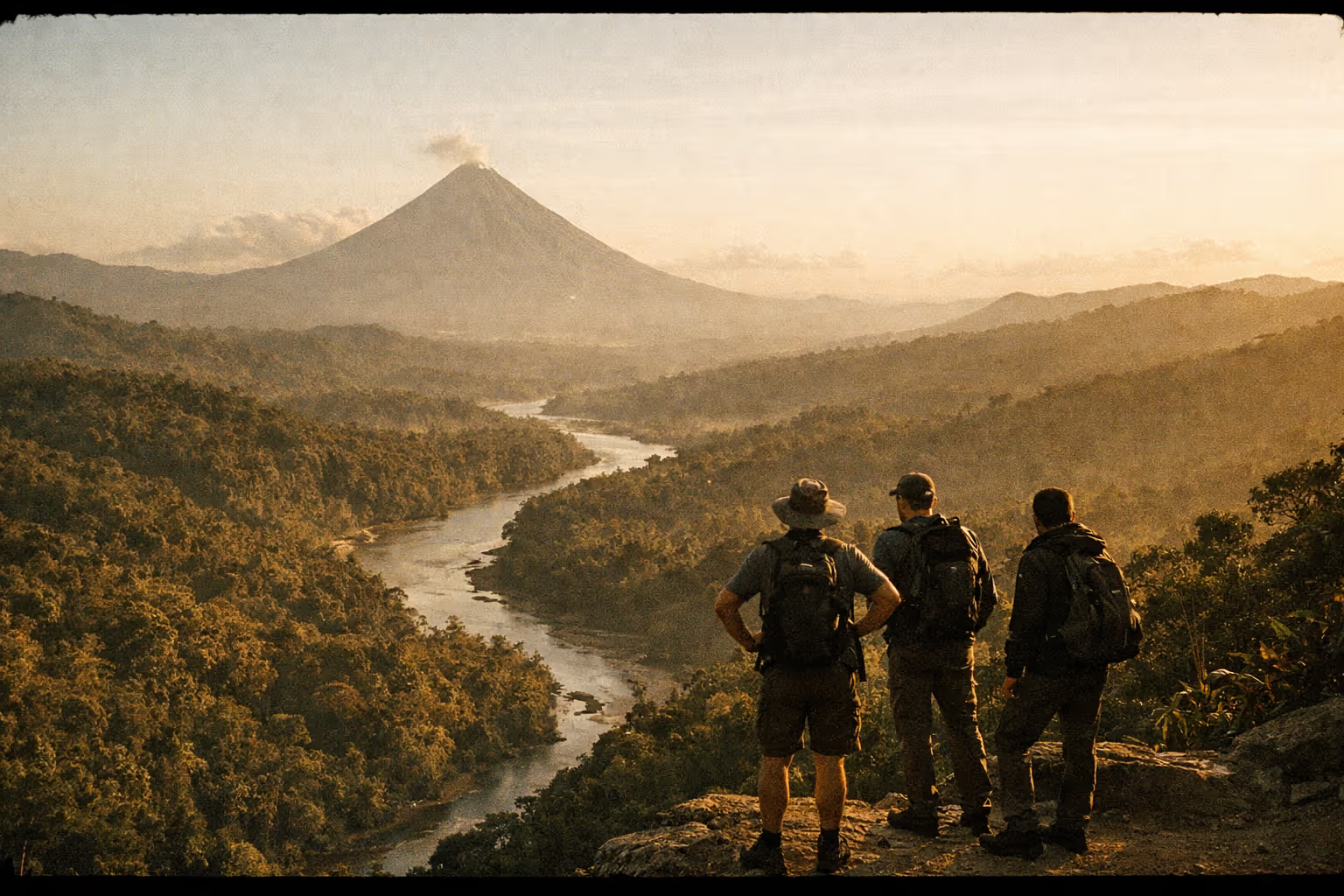
The best Costa Rica adventure tours in the northern volcano belt run out of Bijagua, not La Fortuna; basing there cuts two hours of daily driving and opens night walks the bigger town cannot match. A Bijagua and Rio Celeste tour runs $70 to $120 with the park fee and lunch folded in. Know the catch: you cannot swim inside Tenorio National Park or reach the crater, so the famous tubing happens downstream on mild rapids. Budget roughly $1,800 to $2,400 a person for a full ten-day loop.
Discover the Biodiversity of Bijagua and Rio Celeste on Costa Rica Adventure Tours
Bijagua and Rio Celeste sit tucked between the Miravalles and Tenorio volcanoes, about 3.5-4.5 hours by road from San José or 1.5-2 hours from La Fortuna. These destinations are highlights on many Costa Rica adventure tours because the wildlife corridor here is genuinely different from anywhere else in the country - species from both the Pacific and Caribbean slopes overlap in the same patch of forest.
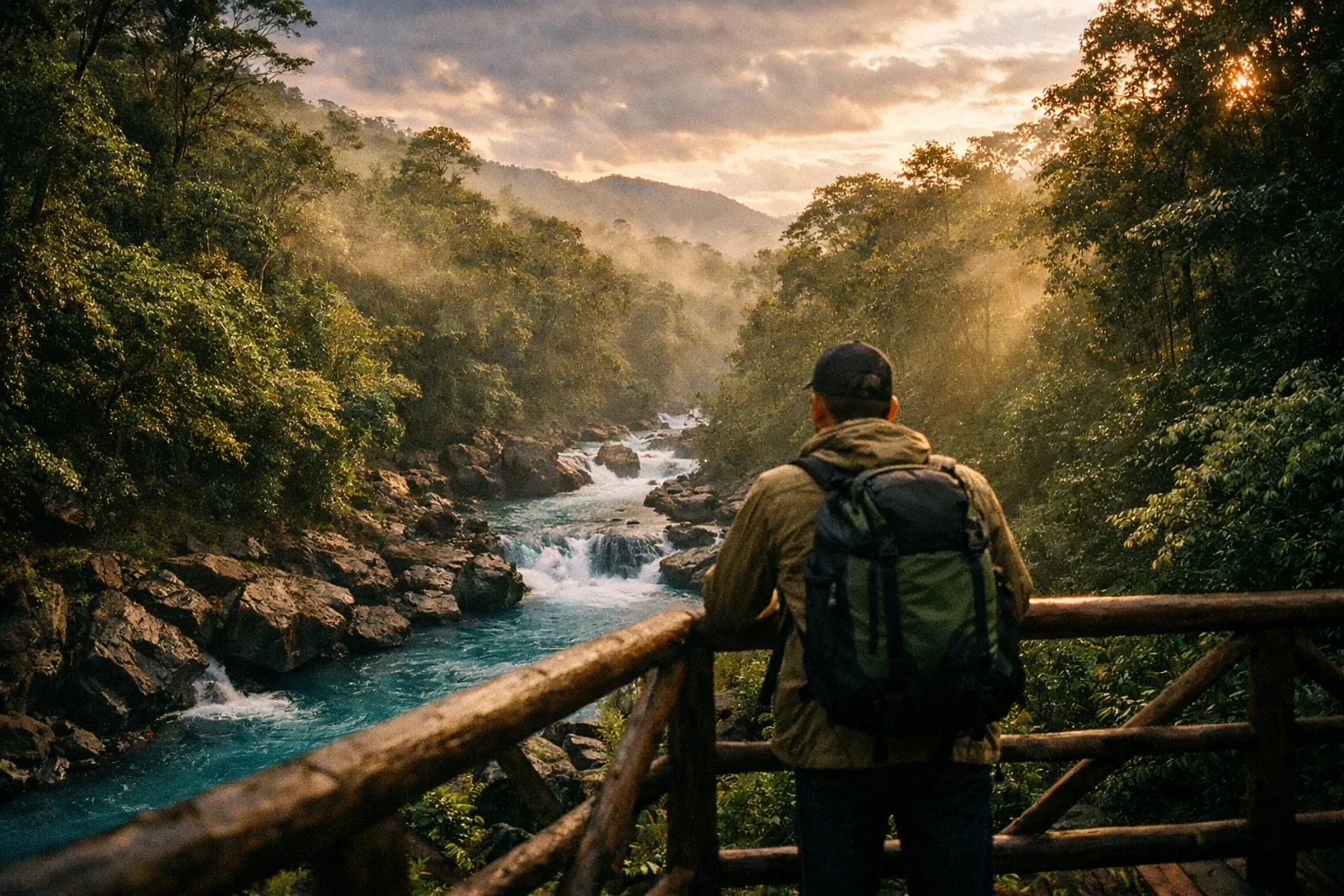
The drive up is its own orientation. Temperature, humidity, and vegetation shift noticeably as you climb into the rainforest belt. By the time you reach Bijagua de Upala, you’re at the edge of one of the country’s most productive wildlife corridors.
A Bijagua Rio Celeste tour typically pairs the Tenorio Volcano National Park hike with one of three add-ons: river tubing, a chocolate or coffee farm visit, or a guided wildlife night walk. Most cost $70-$120 per person including park fee, guide, and lunch, departing from La Fortuna or directly from Bijagua. If you’re building your own day, base yourself in Bijagua rather than La Fortuna - you’ll cut two hours of round-trip driving and gain access to night walks and rural community experiences La Fortuna can’t match.
Worth the detour: the Teñideros confluence, where two clear streams meet and chemically transform into the famous sky-blue water. Skip if short on time: the optional hot springs tacked onto some Bijagua tours - Arenal’s are better.
What the Hike Actually Involves at Tenorio Volcano National Park
Tenorio Volcano National Park covers about 12,870 acres (5,205 ha), with the main trail running 3-5 miles (5-8 km) round-trip from the ranger station to the waterfall and on to the Teñideros (2)(3). It’s graded easy-to-moderate - elevation gain is around 300 m, but the back half can be slick after rain.
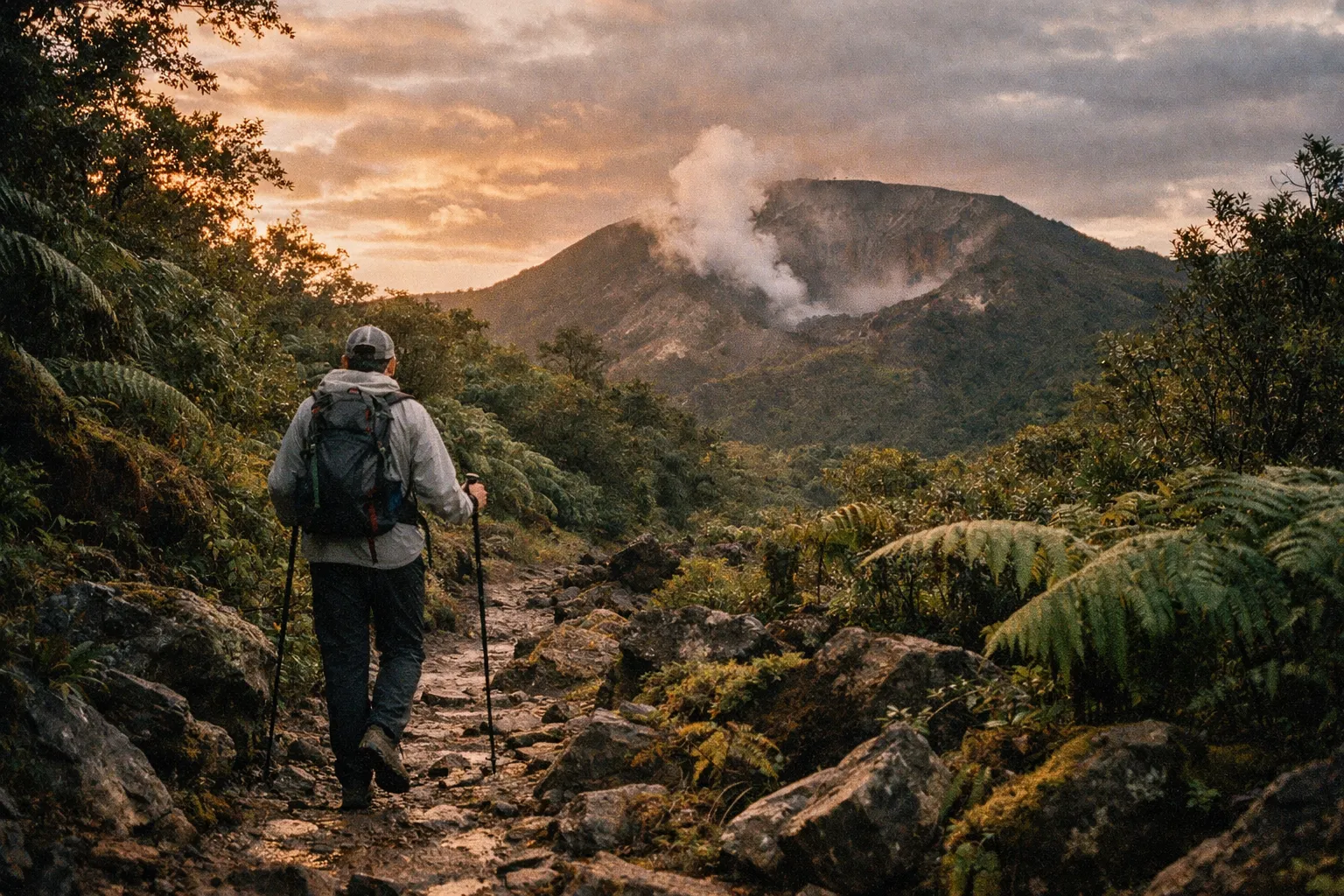
Entrance is roughly $12-$15 for non-resident adults. Confirm at the gate; park fees have been creeping up. The park opens at 8:00 am, and getting there at opening matters more here than at most parks: the turquoise color shows best in direct sunlight before midday clouds roll in, and the trail thins out before the 10 am tour-bus wave.
A few things most Costa Rica volcano hiking tours guides get wrong about Rio Celeste:
- You cannot swim inside the park. Swimming has been prohibited in the river within Tenorio NP for years, both for conservation and because rangers actively enforce it. Tubing and swimming happen downstream, outside park boundaries, with licensed operators.
- You won’t reach the crater. Like Arenal and Poás, public access stops well below the active zone (5). The “volcano hike” is a rainforest hike on the volcano’s flank, not a summit.
- The blue can disappear. Heavy rain churns sediment and the river goes brown or milky for a day or two. There’s no refund - build a backup day into your itinerary if Rio Celeste is the main draw.
For Costa Rica volcano hiking tours more broadly, the rotation most adventure itineraries cover is Arenal (lava trails and hanging bridges, $60-$90 half-day from La Fortuna), Tenorio (Rio Celeste, $70-$120), Poás (crater viewpoint, currently operating under timed entry), and Rincón de la Vieja (longer, more strenuous, fewer crowds).
Rapids Tubing on Rio Celeste: an Unmatched Water Adventure
Rio Celeste tubing runs on the section of river just outside the national park boundary, where Class I and II rapids alternate with deep blue pools. The trip lasts 2-3 hours on the water, costs $45-$75 per person with gear, and most operators set a minimum age of 8-12 depending on water level.
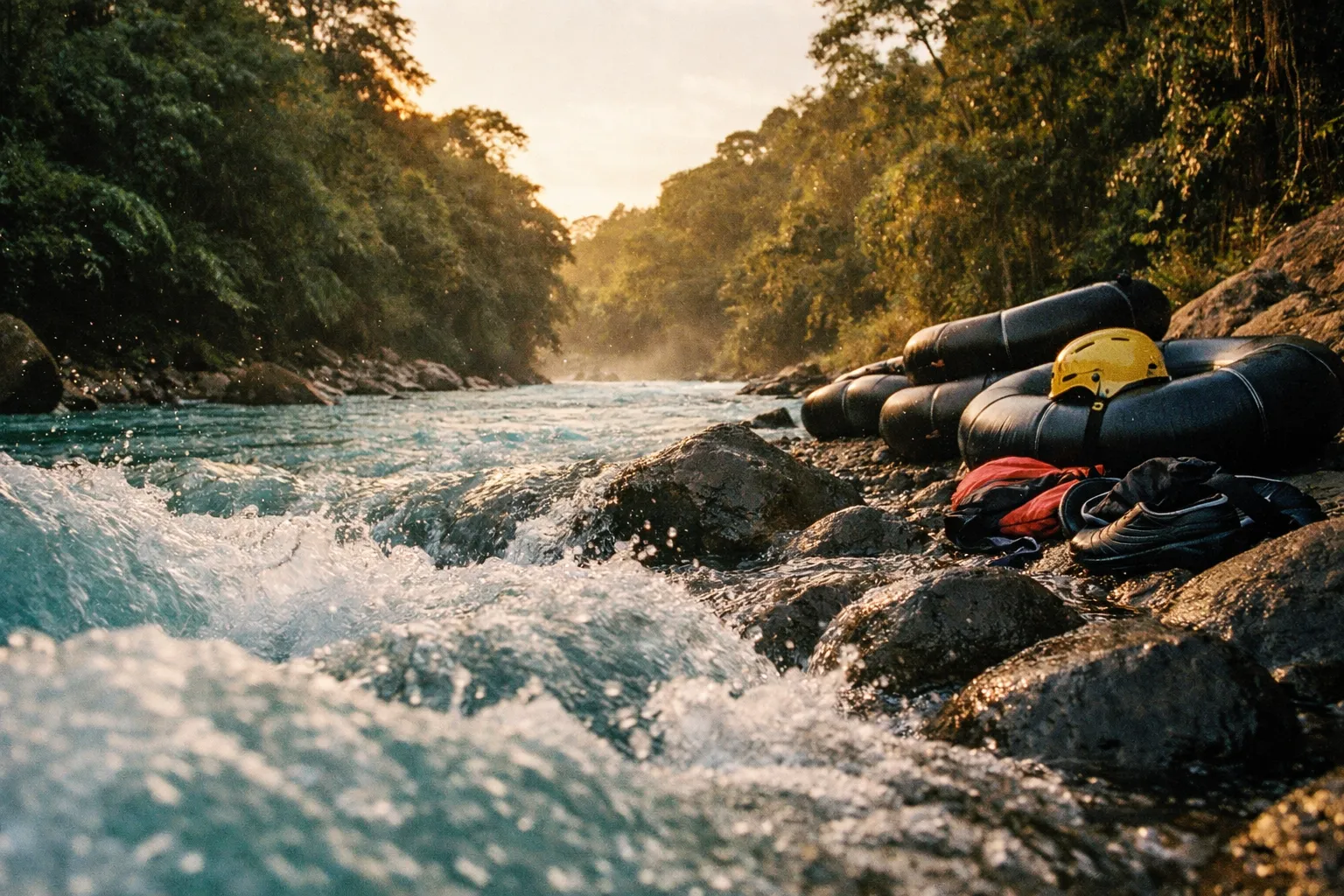
It’s not a knuckle-whitener - Class I-II is family-grade - but it puts you in the river color you can only photograph from the bank inside the park. Clad in helmet and life vest, you drift through aquamarine sections, paddle through small rapids, and stop at swimming pools where the bottom glows blue.
Most outfitters bundle a Jungle Tarzan swing and a volcanic mud skin treatment into the same morning. Skip the mud if you’re tight on time; the swing is genuinely fun.
Booking note: in dry season (Dec-April) water levels sometimes drop too low to run, and operators may switch you to a different river or refund the difference. Green season has stronger flows but afternoon rain can cancel afternoon departures. Book morning slots.
Getting Your Money’s Worth with Guided Wildlife Tours in Costa Rica
Hiring a naturalist is the single biggest upgrade you can make to a Costa Rica trip. Without one, you’ll walk past 80% of what’s around you. With one - especially one carrying a spotting scope - you’ll see sloths, eyelash vipers, dart frogs, owls, and motmots on a single 2-hour walk.
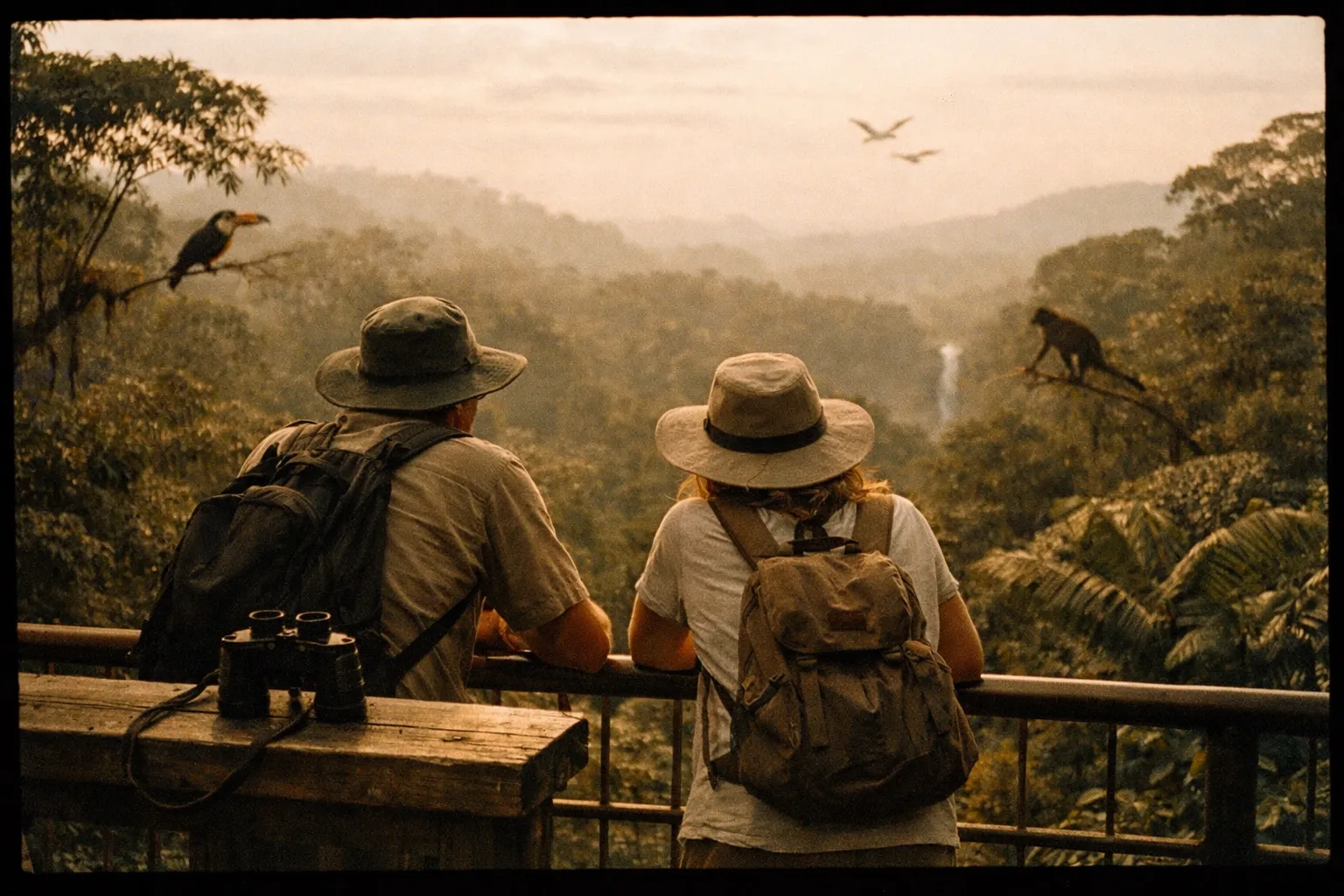
Guided wildlife tours Costa Rica operators run in every major hub. Pricing is consistent:
- Night walks (Monteverde, La Fortuna, Bijagua): $30-$50 for 2-3 hours
- Early morning birding walks: $45-$70 for 3 hours
- Full-day naturalist tour in a national park: $90-$150 including transport and lunch
- Boat-based wildlife tours (Tortuguero, Caño Negro): $60-$120
A few rules I’ve stress-tested over multiple trips:
- Do one night walk and one early morning walk per location. Mammals and amphibians are crepuscular or nocturnal. A single daytime hike misses most of the cast.
- Ask if the guide carries a Swarovski or similar spotting scope. This isn’t snobbery - the scope is how you actually see the resplendent quetzal at 40 m or the sleeping sloth at the top of a 30 m cecropia.
- Tortuguero green turtle nesting peaks July-October. If turtles matter to you, your itinerary is built around those months, not around dry season.
- Tapirs and big cats are rare. Anyone promising sightings is overselling. Tenorio and Corcovado give you the best odds; both still require luck.
I ran the Bijagua night walk circuit in 2024 and we logged three sloths, a Baird’s tapir at a salt lick, two species of dart frog, and a kinkajou in about 2.5 hours. That’s a high-water mark, not a baseline - but it’s the kind of return that’s possible with the right guide in the right corridor.
Cultural Tours: Spending Time with Costa Rican Traditions
The adrenaline side of Costa Rica gets most of the attention, but the cultural experiences in places like Bijagua are worth building into your itinerary. Traditional fishing techniques, cooking classes built around the day’s market run, pottery sessions with families who’ve worked the same clay for generations - these aren’t packaged for tourists in the way you’d find in more developed destinations.
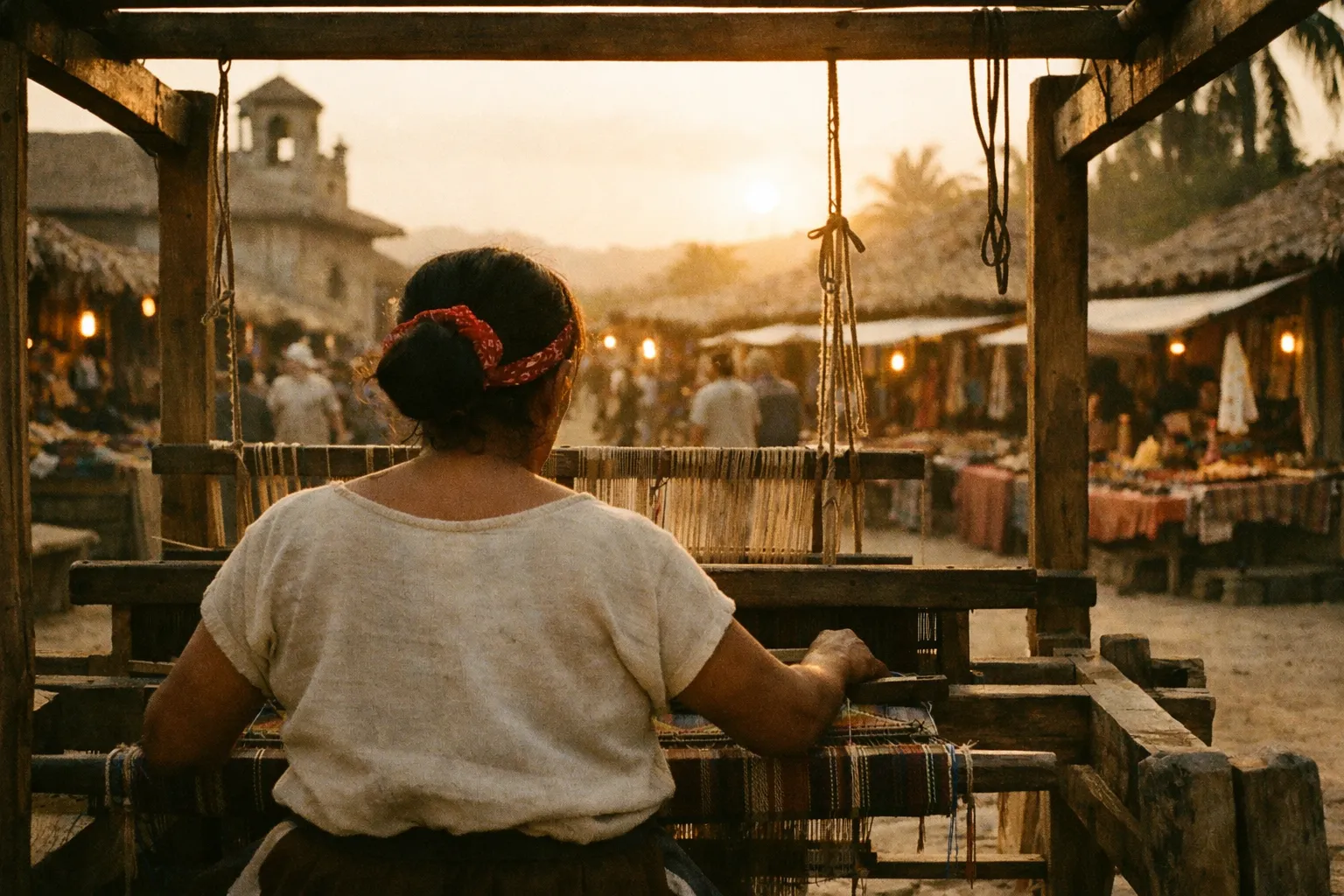
The best cultural add-ons to look for:
- Coffee or chocolate farm visits in the Central Valley, Bijagua, or near La Fortuna - usually $30-$55 for 2-3 hours
- Rural cooking classes in Bijagua and Sarapiquí - $40-$70 with a full meal
- Bribri Indigenous community visits in the Talamanca region - community-run tourism projects that route money directly to households
- Afro-Caribbean culture on the Caribbean coast (Puerto Viejo, Cahuita) - food, music, and a markedly different rhythm than the Pacific side
Pick one or two cultural experiences in a 10-day trip. More than that and you’re padding; fewer than that and the trip starts feeling like a checklist of natural sights.
Best Month to Visit Costa Rica for Adventure Tours
The honest answer depends on what you came for.
December through April (dry season) delivers the most reliable conditions for volcano hiking, the clearest Rio Celeste color, and the lowest cancellation rates on ziplining and rafting. Trade-offs: prices peak, popular tours sell out 2-3 months ahead, and crowds in Arenal, Manuel Antonio, and Monteverde are noticeable.
May through November (green season) brings afternoon rain, fuller rivers (better rafting and tubing flows), 10-30% lower lodging rates, and far fewer people on the trails. Trade-offs: cloud cover at volcano viewpoints, occasional road washouts in the south, and shorter daylight windows for activities.
Sweet spots most travelers miss:
- Mid-May to mid-June: green-season prices, fresh landscape, mornings often clear
- Late November to early December: dry season has arrived, holiday crowds haven’t
- September-October: very wet on the Pacific, but the Caribbean (Tortuguero, Puerto Viejo) is at its best - counter-intuitive but real
For Rio Celeste tubing specifically, target April-June for the best balance of water level and weather. For volcano viewpoints, January-March. For turtle nesting at Tortuguero, July-October.
Is $1,000 Enough for a Week in Costa Rica?
For one person, excluding international flights - yes, with trade-offs.
$1,000 / 7 days = ~$143/day. That lands you squarely in mid-range adventure territory:
- Lodging: $50-$80/night at simple hotels or B&Bs in Bijagua, La Fortuna, or Monteverde
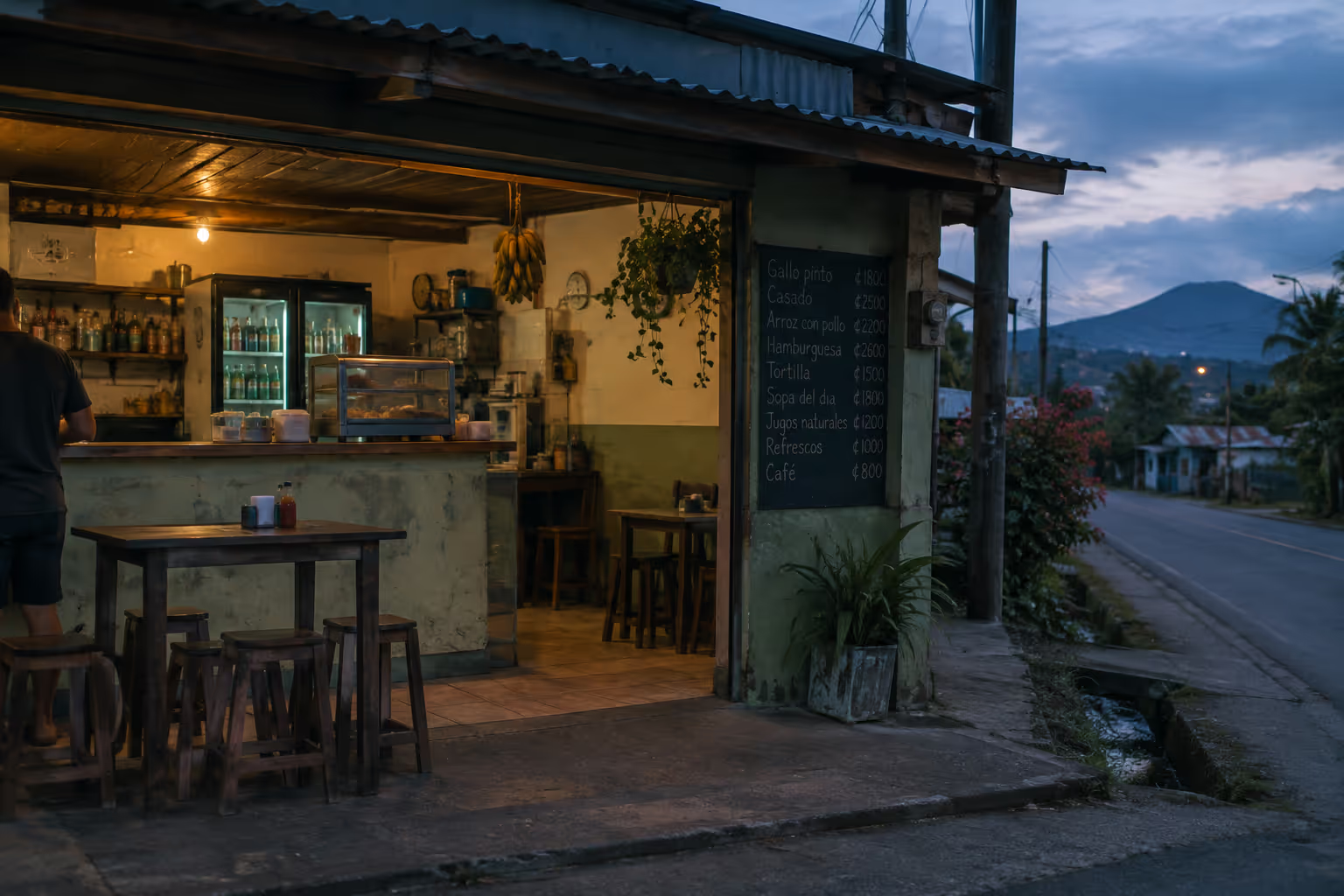
- Food: $25-$40/day eating mostly at sodas (local diners) with one nicer dinner
- Transport: $40-$65 per leg in shared shuttles; rental car is $40-$80/day plus mandatory insurance of $10-$20/day
- Activities: 2-4 paid tours over the week ($45-$120 each)
You’ll have to pick your activities rather than book one every day. A reasonable allocation: one Rio Celeste day tour, one night walk, one volcano-and-hot-springs combo, one zipline or rafting day.
For two people sharing $1,000 total, that’s about $71/day for the pair - only workable with hostels, public buses (which cover most routes for $3-$10 per leg), and limiting paid tours to 1-2 marquee experiences. Doable, but it stops being a Costa Rica adventure tours trip and starts being a backpacking trip.
Honest brackets:
- Budget backpacker: $50-$70/day (hostels, buses, occasional tour) (7)
- Mid-range adventure: $120-$200/day (3-star hotels, one guided activity per day) (8)
- Group multi-day tours: $250-$450/day effective spend once everything is included
What is the Best Tour Company for Costa Rica?
There’s no single answer - the right operator depends on your age bracket, budget, and how much hand-holding you want. The names that consistently surface across review aggregators:
- G Adventures - their 16-day “Costa Rica Adventure” runs about $1,799-$2,499 per person and covers transport, some meals, and guided activities. Good for solo travelers and small groups.
- EF Ultimate Break - 10-12 day “Costa Rica Adventure” from about $2,200-$2,800 excluding flights, aimed at the 18-35 crowd.
- Intrepid Travel - similar small-group format to G Adventures, slightly more activity-dense itineraries.
- Backroads - premium family multi-adventure tours at $3,800-$4,800+ per adult for 6-7 days; minimum ages around 6-8.
- TourRadar marketplace - useful for comparing 7-15 day Costa Rica tours starting around $1,375-$1,800 per person across dozens of operators.
- Local operators booked through TripAdvisor - top-rated multi-day operators consistently score 4.5-5.0/5 across hundreds to thousands of reviews and are typically the best value if you’re willing to coordinate logistics yourself.
My rule: if you want a no-decisions, flight-in-fly-out package, pick G Adventures or EF. If you want flexibility and lower cost, book lodging and shuttles yourself and add local day tours through a Bijagua or La Fortuna-based operator. The local operators are who the big brands subcontract to anyway.
Best Costa Rica Adventure Tours, Ranked by Worth the Detour
Ranked by whether they justify the time and money - not as an equal-weight list:
- Tenorio Volcano NP + Rio Celeste hike - distinctive, photogenic, moderate effort. Worth a full day and a Bijagua base.
- Pacuare River rafting (Class III-IV) - the best single-day adrenaline experience in the country; $100-$130, two-day overnights available.
- Arenal volcano hike + hot springs combo - solid even if Arenal is crowded; book the combo for $80-$130 rather than separately.
- Monteverde cloud forest + night walk - go for the night walk specifically; daytime hikes can be quiet.
- Rio Celeste rapids tubing - $45-$75, 2-3 hours, family-friendly. Pair with the park hike.
- Tortuguero canal wildlife boat tour - high wildlife density; essential July-October for turtle nesting.
- Manuel Antonio NP guided wildlife tour - pre-book entry; the park caps daily visitors.
- Corcovado day or overnight trek - the country’s best chance at tapir, scarlet macaws, and (with luck) puma sign. Logistically heavier - only worth it if you have 10+ days.
Skip if short on time: generic ATV tours, beach-town catamaran “sunset cruises” that are essentially booze cruises, and the smaller zipline parks. If you’re going to zipline, go to Monteverde or Arenal.
Sample 10-Day Costa Rica Adventure Itinerary
Duration: 10 days. Total cost estimate (mid-range, per person excluding flights): $1,800-$2,400.
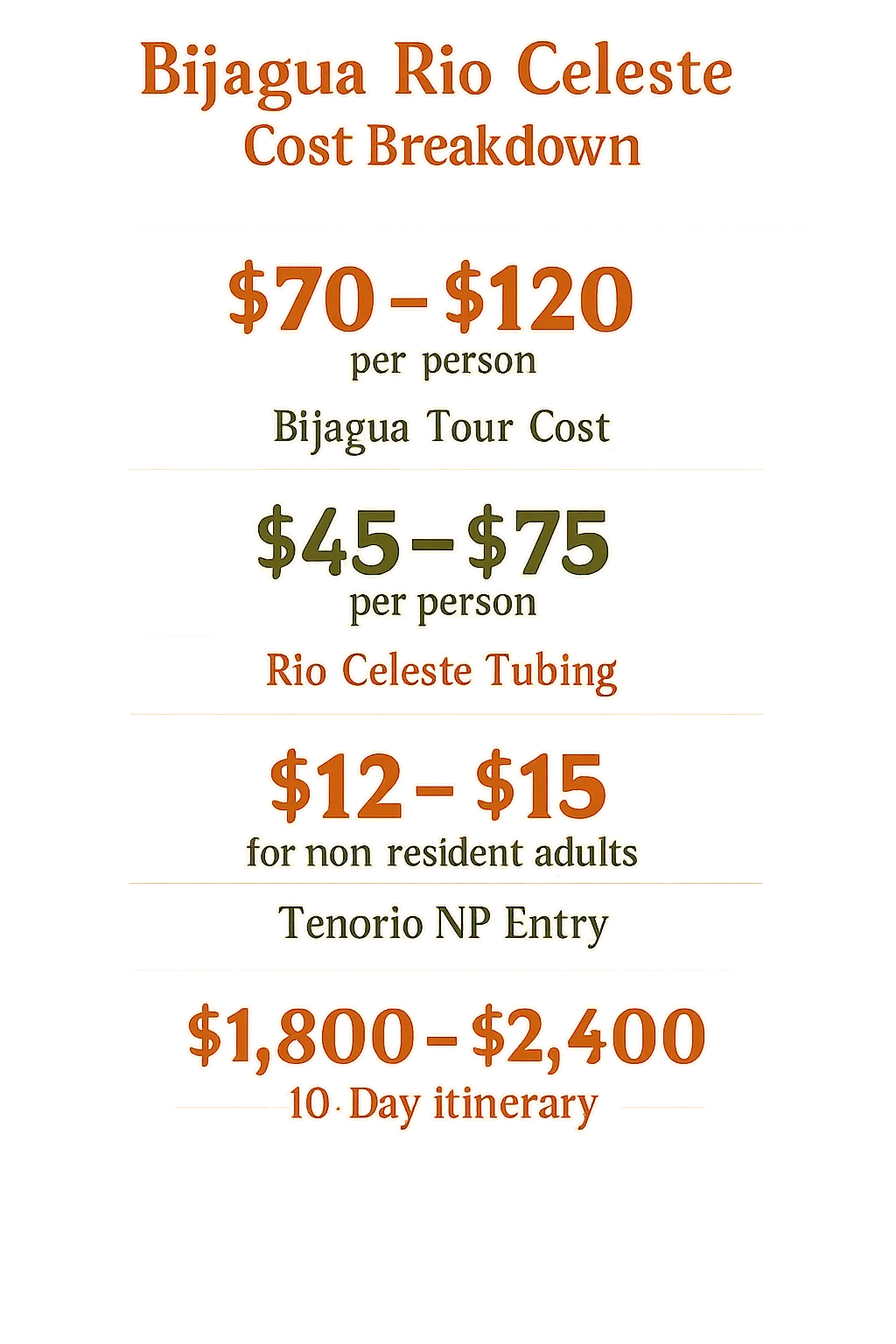 Costs for Bijagua Rio Celeste adventures, Tenorio NP entry, Rio Celeste tubing, and a typical 10-day itinerary: $70-$120 per person, $12-$15 for non-resident adults, $45-$75 per person, and $1,800-$2,400 respectively.
- Day 1: Arrive San José. Overnight near airport. ($90)
- Day 2: Shuttle to La Fortuna (3.5 hours, $55). Hanging bridges in the afternoon. ($180 day total)
- Day 3: Arenal volcano hike + hot springs combo. ($220 day total with lodging)
- Day 4: Shuttle to Bijagua (2 hours, $45). Afternoon chocolate farm. ($180)
- Day 5: Tenorio NP and Rio Celeste hike, full day. ($220)
- Day 6: Rio Celeste tubing morning, night wildlife walk. ($220)
- Day 7: Shuttle to Monteverde (4 hours, $60). Afternoon arrival. ($200)
- Day 8: Cloud forest morning, zipline afternoon. ($240)
- Day 9: Shuttle to Manuel Antonio (4.5 hours, $65). ($210)
- Day 10: Guided wildlife tour Manuel Antonio NP. Evening shuttle to San José or fly out from Quepos. ($220)
This skips Tortuguero and the Caribbean coast. Adding those needs 12-14 days.
Sample 10-Day Costa Rica Adventure Itinerary
10 daysA practical day-by-day plan with approximate costs for a mid-range traveler.
- 1
Day 1: Arrival in San José
Overnight near the airport. Budget around $90.
- 2
Day 2: Transfer to La Fortuna
3.5-hour shuttle ($55). Afternoon hanging bridges visit. Total day cost ~$180.
- 3
Day 3: Arenal Volcano Hike + Hot Springs
Full day with lodging, approximately $220.
- 4
Day 4: Shuttle to Bijagua
2-hour shuttle ($45). Afternoon chocolate farm visit. Day total ~$180.
- 5
Day 5: Tenorio NP and Rio Celeste Hike
Full day hiking, around $220 total.
- 6
Day 6: Rio Celeste Tubing and Night Wildlife Walk
Morning tubing, evening guided walk. Day cost ~$220.
- 7
Day 7: Shuttle to Monteverde
4-hour shuttle ($60). Afternoon arrival, $200 day total.
- 8
Day 8: Cloud Forest and Zipline
Morning cloud forest hike, afternoon zipline. Around $240.
- 9
Day 9: Shuttle to Manuel Antonio
4.5-hour shuttle ($65). Day cost $210.
- 10
Day 10: Guided Wildlife Tour Manuel Antonio NP
Tour plus evening shuttle to San José or flight from Quepos. Approx $220.
Booking Mechanics and What to Lock In Early
- Manuel Antonio NP uses online reservations with daily caps. Book at least a week ahead in dry season; Saturdays sell out first. The park is closed Tuesdays.
- Pacuare rafting overnight lodges book 2-3 months ahead in high season.
- Rio Celeste day tours sell out 1-2 weeks ahead during Christmas-Easter and U.S. spring break.
- Shuttles between hubs (La Fortuna to Monteverde, La Fortuna to Bijagua, anywhere to Manuel Antonio) run $40-$65 per leg and can be booked 24-48 hours ahead in shoulder season - but lock them in earlier for peak weeks.
- Rental cars: book 1-2 months ahead in dry season. Confirm mandatory insurance pricing in writing - the headline rate online often excludes the obligatory local liability insurance, and the airport counter total can be 50-80% higher than the quote.
- National park fees are typically $15-$18 per non-resident adult; Tenorio is currently in the $12-$15 range. Bring cash colones or USD; not all gates accept cards.
Common Mistakes to Avoid
Too many location changes. Three hours of driving on a Costa Rica road eats half a day. Two bases in a week, three in 10 days, four in 14 - that’s the limit before you’re driving instead of touring.
Underestimating rain. Even January-March, afternoon showers in cloud forests are routine. Pack a real rain jacket, not a windbreaker.
Assuming you can swim in Rio Celeste inside the park. You can’t. Tubing happens outside the park, with operators.
Booking volcano hikes expecting crater access. Public access at Arenal and Poás stops well below the crater. The view is from below.
Skimping on guides. A $40 night walk doubles your wildlife count. The math always works.
Mis-timing turtle nesting. Tortuguero green turtles peak July-October. Showing up in February for “turtles” leaves you with canals, not turtles.
Private Transportation: Why It Matters
After a long day on the trails, the last thing you want is a 4 pm public bus connection. Private shuttles or door-to-door transfers with English-speaking drivers cost $80-$180 per leg for up to four people - split between two couples, that’s roughly the price of shared shuttle seats with the added benefit of door-to-door service, your own schedule, and a driver who knows where the howler monkeys cross the road at 5:30 pm.
For solo travelers, shared shuttles ($40-$65 per leg) are the right call. For two or more, do the math on private - it’s often within 20% of the shared total and saves two hours per transfer day.
A practical hybrid: shared shuttles between the big hubs (San José to La Fortuna to Monteverde), and a private driver for the tricky legs - anything involving Bijagua or unpaved Nicoya roads.
Frequently Asked Questions
- What is the best tour company for Costa Rica?
- There isn't a single best company; options range from budget to premium. G Adventures and EF Ultimate Break lead fixed-itinerary markets, while Backroads offers premium family tours. Local operators often provide the best value if you coordinate logistics yourself.
- What's the best month to visit Costa Rica?
- January through April offers the most reliable weather and clear views. May-June and late November provide fewer crowds and lower prices. July-October is best for turtle nesting at Tortuguero.
- Is $1,000 enough for a week in Costa Rica?
- For one person excluding flights, yes, with mid-range lodging and a few paid tours. For two sharing $1,000, it's backpacker-level budgeting with limited tours and public transport.
- Do I need a guide for Tenorio Volcano National Park?
- No, the trail is well-marked and accessible independently. However, a naturalist guide enhances wildlife spotting and often offers better value when bundled with transport and meals.
- Can I combine Rio Celeste with La Fortuna in one trip?
- Yes, but staying in Bijagua is better if Rio Celeste is a priority, as it offers night walks and farm visits not easily accessible from La Fortuna.
- Is Costa Rica safe for adventure tours?
- Generally yes, with well-developed tourism infrastructure. Main risks include road conditions during rain, river safety without guides, and petty theft from rental cars. Use licensed operators and stay vigilant.
- What are common mistakes travelers make in Costa Rica?
- Over-scheduling locations, underestimating rain, expecting to swim inside Rio Celeste park, assuming crater access on volcano hikes, skimping on guides, and mistiming turtle nesting seasons.