A Costa Rica travel guide is really a guide to two decisions: which season and how much driving you can stomach. The dry months from December to April buy you reliable Pacific sun but cost 20 to 40 percent more, and even then, San Jose to La Fortuna is 130 kilometers that eats three and a half hours on the road. Safety sits at the same advisory level as France. Get the season and the drive times right, and a first trip mostly plans itself.
Your Costa Rica Travel Guide Starts Here: When to Visit and How to Plan a First Time Trip
This comprehensive Costa Rica travel guide will help you decide the most important factor for your trip: when to go. Costa Rica has two distinct seasons that offer very different experiences:
- Dry season (December-April): Pacific coast and Central Valley get mostly sun. Hotel rates run 20-40% higher than green season, Manuel Antonio and Arenal get crowded, and park slots can sell out days in advance. Worth it for anyone with limited PTO who can’t afford a washout day.
- Green season (May-November): Afternoon rain most days, mornings often clear. Prices drop, wildlife is more active, waterfalls run full. The Caribbean side flips the script - September and October are often its driest stretch (7). Skip if you’re trying to drive remote mountain roads (landslides are frequent) or you need guaranteed beach weather.
Best month to visit, if I had to pick one: late February. Dry season is locked in, holiday surge prices have eased, and the Pacific is at its driest.
What most guides get wrong: they tell you to “see it all” in a week. Don’t. Costa Rica is small on a map and enormous in practice. Pick two regions per week, max.
Entry rules
Most U.S. and Canadian passport holders get 90 days visa-free for tourism; EU nationals should verify by country, as entry terms vary. Proof of onward travel is required across the board. Costa Rica officially requires only one day of passport validity beyond your stay, but airlines often enforce 3-6 months at check-in - renew before you go if you’re close.
Getting around Costa Rica
Getting around Costa Rica is where itineraries succeed or fall apart. Distances look short; drive times don’t cooperate. San José to La Fortuna is 130 km but realistically 3.5 hours. La Fortuna to Monteverde is 100 km and takes 4 hours - or 3 hours if you take the jeep-boat-jeep transfer across Lake Arenal.
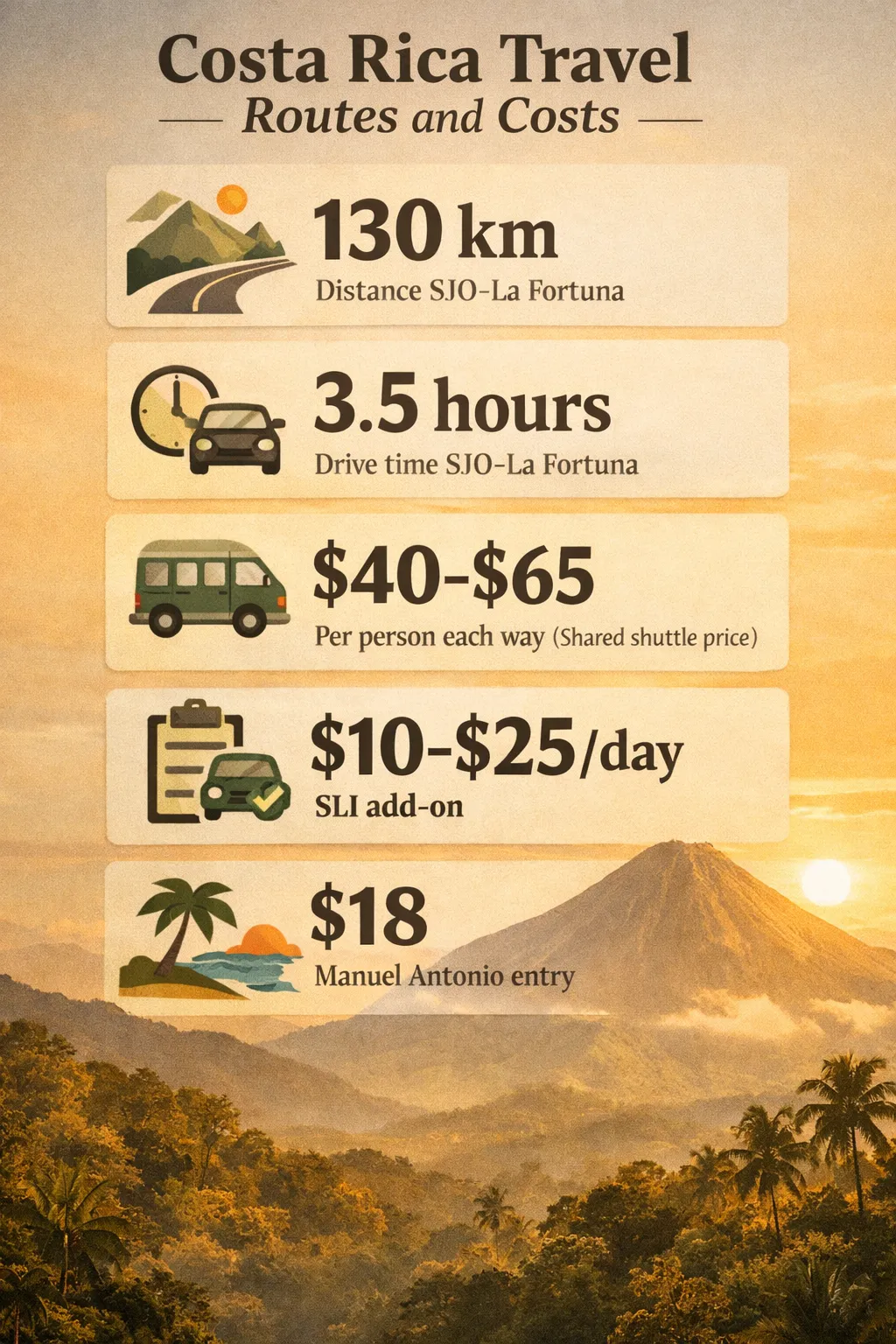 SJO to La Fortuna covers 130 km in about 3.5 hours; shared shuttles run $40-$65 per person each way; rental car insurance adds $10-$25/day; Manuel Antonio National Park entry is $18.
Your four real options, ranked by what most travelers should actually pick:
1. Shared shuttles (best for most first-timers). Door-to-door minivans on common routes - SJO airport to La Fortuna, La Fortuna to Monteverde, Monteverde to Manuel Antonio - run $40-$65 per person each way. Book a day or two ahead through Interbus, Caribe Shuttle, or your hotel. You give up flexibility; you gain a nap.
2. Rental car. Best if you want lesser-known waterfalls, remote beaches, or anything beyond the standard loop. Economy automatic with basic insurance averages $35-$60/day in green season and $60-$90/day in dry season. The catch: Costa Rica requires you to buy local mandatory liability insurance (SLI) on top of the rental, adding $10-$25/day that’s rarely shown in the online quote. Plan for the quoted base price to roughly double. Get a 4×4 - not optional for Monteverde, Nosara, Santa Teresa, or anything in rainy season.
3. Public buses. Cheapest by far: intercity legs run $3-$15, San José city buses are under $1.50. Slower, requires transfers through San José for most cross-country routes, and luggage is your problem. Workable for backpackers; painful with kids.
4. Domestic flights. Sansa flies SJO to Quepos, Tamarindo, Drake Bay, Tortuguero, and Liberia for $60-$150 one-way. Worth it if you’re heading to the Osa Peninsula - otherwise an 8-hour drive - or if you’re genuinely short on time.
I drove the Nicoya backroads in October 2024 in a Suzuki Jimny. The road between Santa Teresa and Montezuma - 11 km on the map - took 50 minutes and would have been impossible without 4×4. Anyone who tells you a sedan is fine for the peninsula in green season has not been there in green season.
Best places to visit in Costa Rica
The best places to visit Costa Rica split into two tiers: the classic loop everyone does, and the quieter alternatives that deliver more for less. I’ll rank them by worth-the-detour rather than pretending they’re all equal.
The classic loop (worth it, but plan around the crowds)
Arenal / La Fortuna - Worth the detour. The volcano is dormant but still photogenic, and the area packs hot springs, waterfalls, hanging bridges, and ziplines into a 20-minute radius. Tabacón and Baldi run $40-$80 for full day passes; cheaper evening passes after 5 pm drop to $20-$35. National park entry is $15-$18.
Monteverde Cloud Forest - Worth the detour for the ecosystem; skip if you’ve already done another cloud forest this trip. Entry is $26 to the reserve, $25 to Santa Elena reserve next door. Hire a naturalist guide ($25-$45/person in groups) - sightings roughly triple.
Manuel Antonio National Park - Crowded but legitimate. Sloths, capuchins, and beaches inside one park. Critical booking-mechanics note: you must book entry online in advance during dry season. Daily caps sell out. Entry is $18. Don’t show up at the gate assuming you’ll get in.
Tamarindo - Skip if short on time. Good surf, decent nightlife, but it’s been overdeveloped and prices reflect it. Nosara or Santa Teresa give you better beaches with less concrete.
The quieter alternatives (where I’d actually send a return visitor)
Bajos del Toro - A cloud-forest valley north of San José with waterfalls dropping 90-120 meters (1)(3). Catarata del Toro and Tesoro Escondido sit on private farms charging $8-$15 entry. Arrive at 8 am and you’ll have the trails to yourself (1)(3).
Uvita and Nauyaca Falls - Southern Pacific. Nauyaca Falls is a 61-meter two-tier waterfall; entry is $10-$12, or take the pickup-truck shuttle round-trip with entry for $32-$40 (3). Horseback tour runs $80-$90. Uvita’s Whale Tail beach - the sandbar actually shaped like one - is genuinely unusual and worth the stop.
Orosi Valley - Colonial-era town an hour southeast of San José, with coffee farms running $10-$25 tours that are noticeably less commercial than the big-name estates (5). Easy day trip, and underrated for a quiet first or last night before a flight.
Santa Teresa and Montezuma - Nicoya Peninsula surf towns. Santa Teresa has become a digital-nomad magnet and rents have climbed, but the beaches are still long, uncrowded, and the sunsets justify the bumpy drive in. Montezuma is smaller and weirder - a 24-meter waterfall you can hike to in 20 minutes from town.
Rincón de la Vieja and Rio Negro hot springs - A 34,000-acre national park in Guanacaste (4) with active fumaroles, mud pots, and natural hot springs. Day passes to the developed Rio Negro springs run $30-$40 (4). Far less crowded than Arenal’s commercial complexes, and the landscape is legitimately strange.
Puerto Viejo de Talamanca - Caribbean side. Different country, basically: Afro-Caribbean culture, rice and beans cooked in coconut milk, a calmer pace. Pair with Cahuita National Park (sloths, monkeys, a snorkeling reef) and Manzanillo for empty beaches.
San Gerardo de Dota - High-altitude cloud forest in the Talamanca mountains, the most reliable place in the country to spot the resplendent quetzal between January and May.
Costa Rica food and drink
The food rewards travelers who skip the resort buffet and eat where workers eat.
Sodas - small family-run lunch counters - serve a casado (rice, beans, plantains, salad, your choice of protein) for $5-$8. Look for the busiest one at noon. Gallo pinto is the breakfast version: rice and beans with Lizano sauce, usually with eggs and tortillas, $4-$6.
Mid-range sit-down dinner runs $12-$25 for a main. A domestic beer (Imperial or Pilsen) is $2-$4. Coffee at a café is $2-$4 - the country grows excellent arabica and most of the good stuff stays in-country now, which wasn’t always the case.
Worth ordering:
- Ceviche - usually corvina or tilapia, marinated in lime, served with saltines.
- Chifrijo - rice, beans, chicharrón, pico, avocado, chips. Bar food at its best.
- Olla de carne - beef and root-vegetable stew, lunch portion under $10.
- Chiliguaro - a fiery shot of Cacique guaro with tomato juice, hot sauce, lime. Two and you’re done.
Farmer’s markets (ferias) run Saturday mornings in most towns. Guanabana, mamón chino (rambutan), and pejibaye (peach palm fruit, boiled, served with mayo) are worth trying if you see them.
Is Costa Rica safe?
Is Costa Rica safe is the question that drives the most search traffic to guides like this one, so let’s answer it with numbers rather than vibes.
The U.S. State Department currently rates Costa Rica at Level 2: Exercise Increased Caution - the same level as France, the UK, and Spain. Costa Rica’s 2023 homicide rate was around 17-18 per 100,000, driven primarily by gang and drug-trafficking violence concentrated in specific neighborhoods of Limón, Puntarenas, and parts of San José. Tourists are rarely targets of violent crime. The realistic risk is petty theft - phones from beach towels, bags from parked rental cars, day packs from restaurant chairs.
Is it still safe for Americans to travel to Costa Rica?
Yes, with normal urban precautions. Costa Rica remains one of the safest destinations in Central America for American travelers, with over a million U.S. visitors in 2023. The State Department’s Level 2 advisory is the same tier applied to most of Western Europe. Practical risks to plan around:
- Theft from rental cars. Never leave anything visible. Trailhead and beach parking are the worst spots.
- Rip currents. Both coasts have them. Many beaches have no lifeguards. Ask locally before swimming somewhere unfamiliar.
- Nighttime urban travel. Use Uber or licensed taxis (red, with yellow triangle) in San José after dark. Avoid central Limón and the southern Puntarenas docks at night.
- ATV accidents. Common in Nicoya. Wear the helmet; don’t ride dusty roads after dark.
The pura vida thing is real - locals are quick to help, give directions, flag a problem. Engage with that and you’ll get warnings you’d never find online.
How much does a week in Costa Rica cost?
Daily costs in 2024-2025 run roughly: $50-$70/day for backpackers, $80-$150/day for mid-range, $150-$250+/day for comfort travelers. For a deeper breakdown by season and travel style, the costa rica on a budget numbers are worth checking before you finalise your itinerary.
Is $1,000 enough for a week in Costa Rica?
For one person, yes - $1,000 over 7 days works out to $143/day, comfortably in the mid-range. Realistic breakdown:
- Lodging: $50-$80/night at a guesthouse or budget hotel with breakfast
- Food: $30-$40/day mixing sodas for lunch and a mid-range dinner
- Transport: shared shuttles between two regions ($80-$130 total) plus local buses
- Activities: 2-3 paid tours or park entries (zipline $50-$80, park entries $15-$18)
For two people sharing, $1,000 (so $71/day for both) means hostels or budget guesthouses with private rooms, public buses instead of shuttles, mostly soda meals, and limited paid activities. Doable for backpackers; tight for anyone over 30 who wants a real bed.
Is $500 enough for a week in Costa Rica?
For a solo backpacker, $500 (about $71/day) is workable but requires discipline:
- Hostel dorms: $10-$25/night
- Public buses only: intercity legs $3-$15
- Eat at sodas and supermarkets
- Stick to free activities: beaches, hiking trails outside paid parks, town wandering
- One paid activity for the week, max
For two people, $500 for a week is not realistic without camping, work-exchange, or having flights and lodging already covered.
What inflates budgets fast: rental car ($50-$110/day all-in with insurance), high-end hot springs ($60-$80), guided tours ($50-$100+), and resort drinks ($8-$12 each).
What I wish I knew before going to Costa Rica
These Costa Rica travel tips are the list every travel guide should lead with:
- Drive times are roughly 1.5× what Google Maps says. Mountains, slow trucks, construction, weather. Plan accordingly.
- Rental car insurance is mandatory and not included in the online quote. Budget +$15-$25/day on top of the base rate.
- Manuel Antonio requires advance online booking in high season. Don’t show up at the gate.
- USD is widely accepted but you get worse exchange rates than paying in colones. Withdraw colones from an ATM (BAC, BCR) for sodas, buses, and small purchases. The rate has floated around ₡525-₡550 per $1 in 2024-2025.
- Tipping isn’t mandatory - restaurants add a 10% service charge automatically. Extra is appreciated for good service but not expected.
- Tap water is safe to drink in San José, most of the Central Valley, La Fortuna, Monteverde, and Manuel Antonio. Coastal and remote areas: filter or buy bottled.
- Buy a local SIM at the airport - Kolbi, Claro, or Movistar, $5-$15 for a few GB. Coverage drops in deep jungle but is generally solid.
- Pack a real rain jacket and closed-toe hiking shoes. Both cost more locally than at home.
- Don’t leave anything in your rental car. Ever. Not in the trunk, not under a towel.
- Single-use plastic bans and drone restrictions are actively enforced in parks now. Check rules before flying anything.
- The digital nomad visa (launched 2022, requires $3,000/month proven income, $4,000 for families) has driven up rental prices in Tamarindo, Nosara, Santa Teresa, and Puerto Viejo - book accommodation early in those towns.
A practical 10-day Costa Rica first time itinerary
Duration: 10 days. Total cost estimate: ~$1,800-$2,400 per person mid-range, excluding international flights.
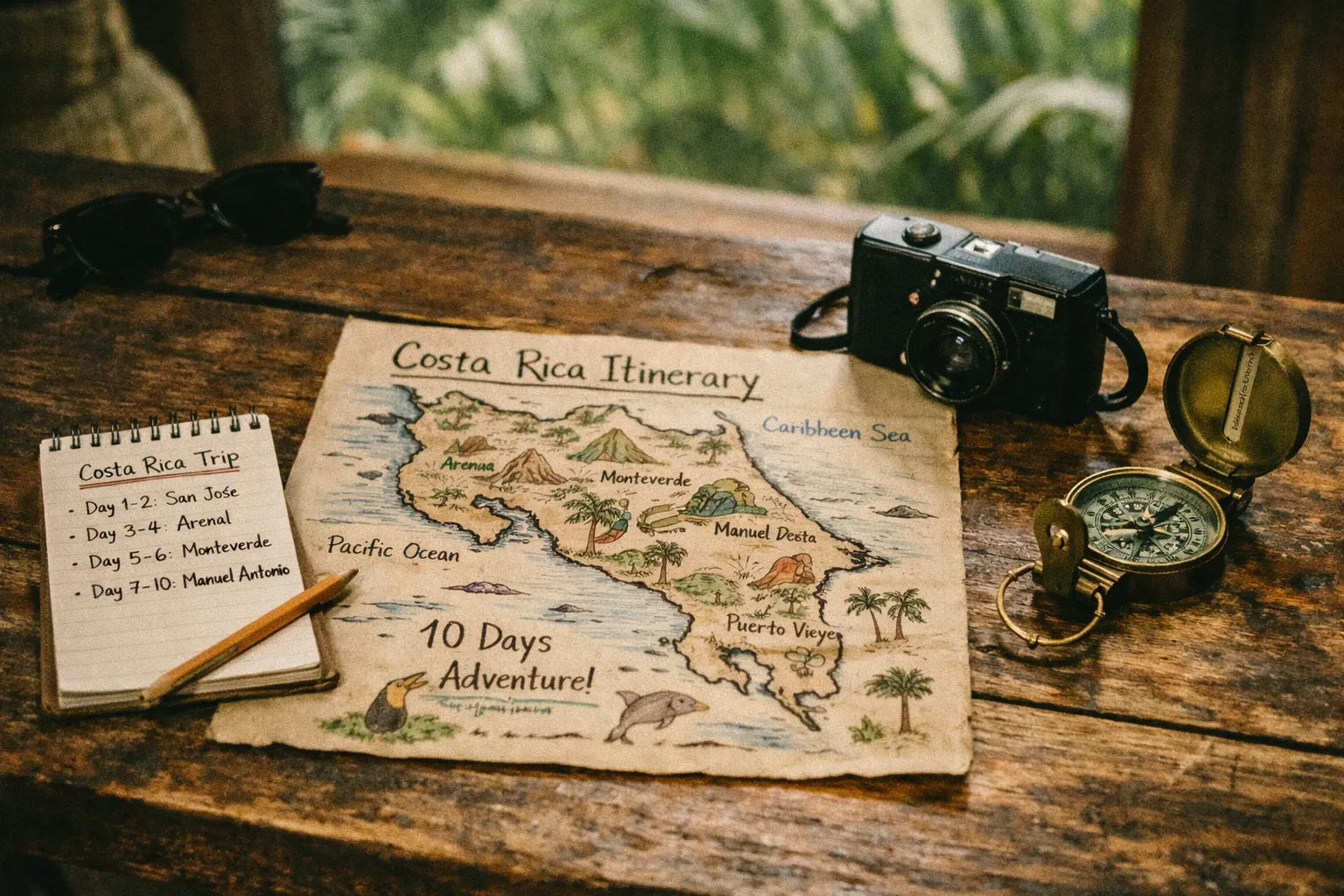
- Days 1-2: Arrive SJO, overnight in Alajuela (closer to the airport than San José). Day 2: drive or shuttle to La Fortuna (3.5 hours).
- Days 3-4: La Fortuna - volcano hike, hot springs (do an evening pass to save money), Río Celeste day trip if you have a 4×4.
- Day 5: Jeep-boat-jeep transfer to Monteverde (~$30, 3 hours).
- Days 6-7: Monteverde - cloud forest with a guide, hanging bridges, one zipline.
- Day 8: Shuttle to Manuel Antonio (4 hours) or Uvita (5 hours) if you want the quieter option.
- Days 9-10: Beach, park visit, fly or shuttle back to SJO.
Skip if short on time: trying to add the Caribbean side or the Osa Peninsula. Both need their own trip.
10-Day Costa Rica First-Timer Itinerary
10 daysA practical day-by-day plan for a 10-day mid-range trip covering key highlights.
- 1
Days 1-2: Arrival and La Fortuna
Arrive at SJO, stay overnight in Alajuela. On day 2, drive or shuttle to La Fortuna (3.5 hours).
- 2
Days 3-4: Explore La Fortuna
Hike the volcano, visit hot springs (evening passes save money), and take a Río Celeste day trip if you have a 4×4.
- 3
Day 5: Transfer to Monteverde
Jeep-boat-jeep transfer (~$30, 3 hours) across Lake Arenal.
- 4
Days 6-7: Monteverde Cloud Forest
Explore the cloud forest with a guide, walk hanging bridges, and try one zipline.
- 5
Day 8: Travel to Manuel Antonio or Uvita
Shuttle to Manuel Antonio (4 hours) or Uvita (5 hours) for a quieter beach option.
- 6
Days 9-10: Beach and Departure
Relax on the beach, visit the park, then fly or shuttle back to SJO.
Frequently Asked Questions
- Can I use a regular car for all of Costa Rica?
- Regular cars work for the classic loop in dry season but are not suitable for Nicoya Peninsula, Osa Peninsula, or green season travel. A 4×4 is essential for rough roads and rainy conditions.
- How far in advance should I book Manuel Antonio National Park?
- During dry season, book your entry online several days in advance to secure a spot, as daily visitor caps sell out quickly.
- Are shared shuttles flexible for last-minute itinerary changes?
- Shared shuttles require booking a day or two ahead and follow fixed routes and schedules, so they offer limited flexibility compared to rental cars.
- Is it worth flying domestically within Costa Rica?
- Domestic flights are worth it mainly if you're short on time or heading to the Osa Peninsula, which is an 8-hour drive otherwise.
- What's the best way to handle money and payments?
- Use ATMs to withdraw colones for better exchange rates. USD is accepted but often at worse rates. Carry small bills for sodas and buses.
- How reliable is cell coverage in remote areas?
- Coverage is generally solid with local SIMs but drops significantly in deep jungle and some remote mountain areas.