Costa Rica wildlife safety is about habits, not fear, and the animal likeliest to ruin your day is a mosquito, not a jaguar. The venomous snakes deserve respect: never grab a branch or vine, where the eyelash viper coils, and watch the leaf litter for the fer-de-lance. If you meet a big cat, do not run, make yourself large and back away with an escape route. And skip river mouths and estuaries for swimming, that is crocodile country. The bigger risk is night driving on rural roads.
Costa Rica wildlife safety: what you actually need to know
Costa Rica wildlife safety comes down to a handful of habits, not a fear of the forest. The country has more than 20 venomous snake species (1), plus crocodiles, big cats, scorpions, and the mosquitoes that will bother you far more than any jaguar ever will. The actual risk to a careful visitor is low. Stay on marked trails, keep your distance, and don’t reach into spaces you can’t see - that covers most of it. This guide walks through the animals worth knowing about, what to do if you see a wild animal Costa Rica throws in your path, and how to travel in a way that protects both you and the wildlife.
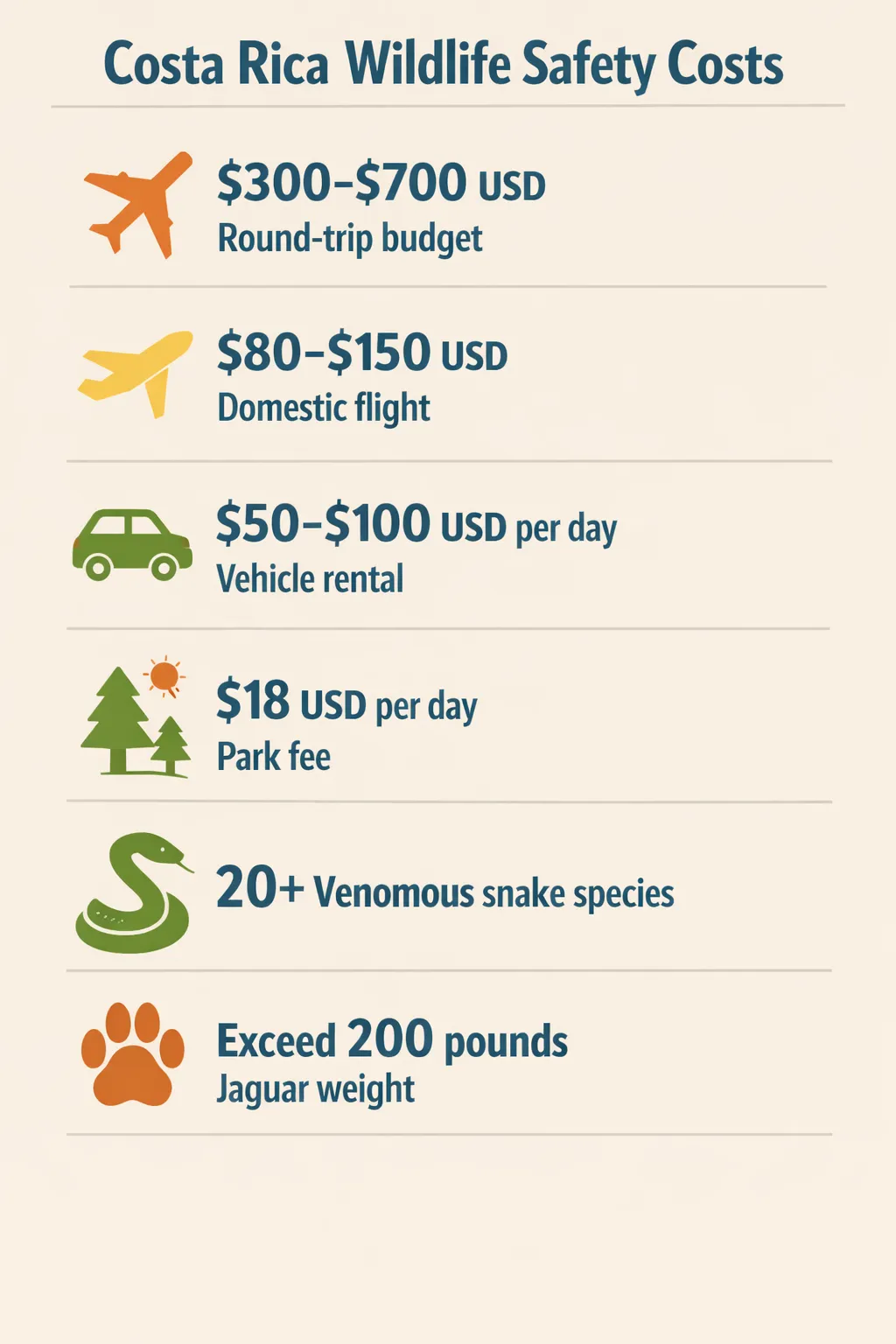 Costs for a 10-day Costa Rica wildlife trip range from $1,500-$3,500 per person, including round-trip flights, park fees, and essential safety gear.
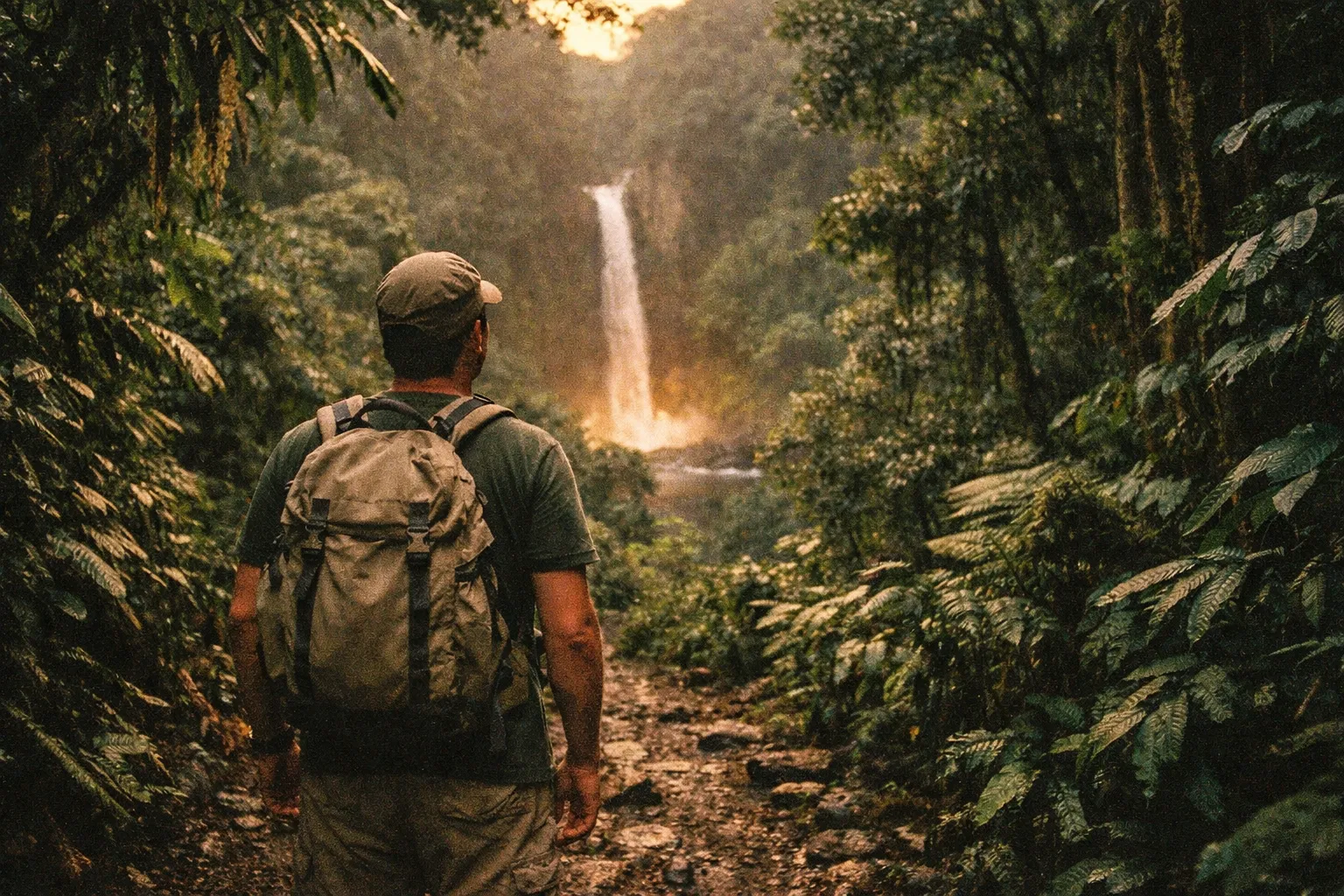
I’ve worked my way through dense forests and along rugged coastlines across this country enough times to know which warnings are real and which are noise. What follows is the practical version - the stuff that keeps an encounter from becoming an incident.
Getting there: Most international flights land at Juan Santamaria International Airport (SJO) in San Jose, with direct service from major US hubs. Budget $300-$700 USD round-trip from the US East Coast, more from the West Coast depending on season. Domestic flights (Sansa, Skyway) connect San Jose to regional hubs like Puerto Jimenez (Osa) and Quepos (Manuel Antonio) for $80-$150 USD each way - worth it if you’re short on time. Renting a 4WD is the standard move for park access; expect $50-$100 USD per day including basic insurance. Total trip cost for 10 days covering two or three parks runs $1,500-$3,500 USD per person depending on lodge tier and how much you fly vs. drive.
Best month to visit: December through April (dry season) is the practical choice for wildlife safety and trail access. Trails are drier, river crossings are lower, and the risk of being stranded by a washed-out road drops significantly. February and March hit the sweet spot - dry enough to hike comfortably, before the peak-season crowds of December and January thin out. If you’re targeting Corcovado specifically, note that the park closes some ranger station routes during the wettest weeks of September and October.
Booking mechanics: Corcovado National Park requires advance reservations through SINAC (Costa Rica’s national park system) - walk-in entry is not guaranteed and is often unavailable during high season (December-April). Book ranger-guided entry at least 2-4 weeks ahead. The Sirena station, the most wildlife-dense zone, fills fastest. Park entry fees run $18 USD per day for foreign visitors. Manuel Antonio and Tortuguero also cap daily visitor numbers, so booking ahead matters.
What most guides get wrong: They treat the wet season as a deterrent. It isn’t - it’s a trade-off. Wet season (May-November) means fewer tourists, lower prices, and lush forest, but also higher snake activity on trails, more mosquitoes, and real road-closure risk in remote areas. The Osa Peninsula in particular becomes genuinely difficult to navigate after heavy rain. That’s not a reason to avoid it - it’s a reason to plan around it with a local operator who knows current conditions.
✓ Pros
- Clear, actionable safety habits reduce risk significantly
- Local knowledge and guides improve safety and experience
- Focus on coexistence protects both visitors and wildlife
✗ Cons
- Venomous snakes and crocodiles require vigilance
- Night driving and off-trail hiking increase risk
- Feeding wildlife causes dangerous habituation

Drake Bay: Corcovado National Park Sirena Station Tour
For Corcovado specifically, the Sirena station day tour from Drake Bay covers the ranger-guided entry described above, the part that has to be arranged in advance rather than at the gate.
Check availabilityCosta Rica snakes safety: the three to know
Snakes are the single biggest wildlife concern for hikers, and the math behind that is simple: Costa Rica has 20+ venomous species. The good news is that most bites happen because someone stepped on or reached toward a snake they never saw. Awareness solves the majority of the problem. According to Costa Rica’s Caja Costarricense de Seguro Social (CCSS), snakebite incidents are concentrated in agricultural and forest-edge zones - the same terrain hikers cross when they leave marked trails.
Three species come up again and again in local safety guidance (5):
Fer-de-lance (terciopelo) - This is the one to respect most. It’s responsible for the largest share of serious snakebites in the region, partly because it’s common in agricultural and forest-edge areas, and partly because its coloring blends into leaf litter almost perfectly. It’s a pit viper, often a couple of feet long or more, and it doesn’t always flee when approached.
Eyelash viper - A small, often bright-yellow (sometimes green or brown) viper with raised scales over the eyes that look like lashes. It coils in low vegetation, vines, and on tree trunks - which is exactly why “don’t grab branches blindly” is a real rule, not just caution-tape language.
Coral snake - Brightly banded in red, black, and yellow. Its venom is potent, but bites are uncommon because coral snakes are reclusive and have small mouths. The old rhyme about band order is unreliable with Costa Rica’s species, so the practical rule is simpler: don’t handle any banded snake.
For Costa Rica snakes Safety, the prevention advice is consistent across every reliable source:
- Look where you step and where you put your hands.
- Wear closed-toe shoes and long pants on rainforest trails.
- Never reach into logs, rock crevices, leaf litter, or dark gaps.
- Treat every snake as potentially venomous until you’ve backed away and identified it from a distance.
If you do see one, stop, back away slowly, and give it room. Sudden movement is what triggers a defensive strike. Don’t try to move it, photograph it up close, or shoo it off the trail. Just wait, or find another way around.
Spiders, scorpions, and other arthropods
These get more attention than they deserve. The risk is almost always accidental contact, not aggression - you put a hand or foot where a spider or scorpion was already sitting.
Most scorpion species in Costa Rica have mild venom and aren’t a serious threat to a healthy adult (1). A sting feels roughly like a bad wasp sting. Dangerous arachnid encounters are rare in general - the risk comes from accidental contact, not aggression, and applies to several species rather than any single one. Tourists who aren’t poking around woodpiles and dark corners are unlikely to have a problem.
The fix is a single habit you adopt the first night in any rustic or beach lodging: shake out your shoes, clothing, and bedding before using them (1)(4). Scorpions and spiders like to tuck into footwear and folded fabric. Thirty seconds of shaking handles the entire category of risk.
Mosquitoes and other insects
The animals most likely to affect your trip aren’t apex predators. They’re insects.
Mosquitoes are the day-to-day nuisance and the real disease vector, carrying dengue in particular during the wet season. Pack accordingly:
- Insect repellent is non-negotiable in humid and forested areas (3). Budget $10-$30 USD for a repellent and sunscreen kit before you hit coastal parks or trails.
- A mosquito net is worth $0-$50 USD if your lodging doesn’t already provide one, especially at lower-cost eco-lodges and jungle stays (3).
- Long sleeves and pants at dawn and dusk cut bites significantly.
Costa Rica’s tourism board advises travelers to be current on hepatitis A, hepatitis B, rabies, and tetanus vaccines before arrival (6). That’s standard pre-travel readiness, not a red flag - sort it out a few weeks ahead with a travel clinic.
Pumas, jaguars, and other wild cats
Attacks by big cats are extremely rare (3). You can spend years hiking Costa Rican parks and never see a puma or jaguar - most travelers who do are thrilled, because a sighting is genuinely uncommon. Still, these are apex predators, and a defensive encounter can escalate fast.
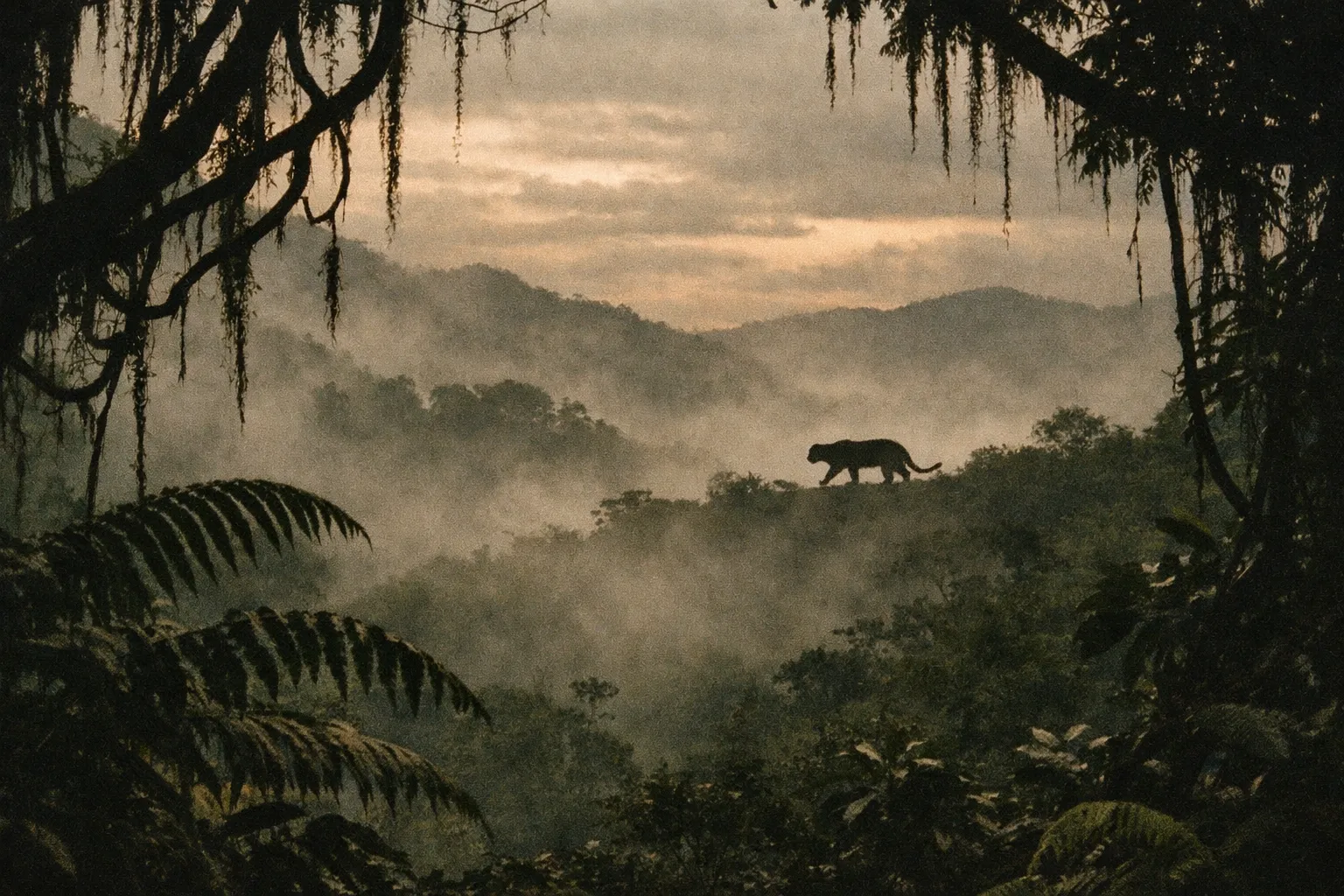
The single best deterrent is noise. On forest trails, talk, keep your voice at a normal volume, and let animals hear you coming (1). Wildcats almost always avoid humans when they detect them early - the dangerous scenario is surprising one at close range. Hiking in a group beats hiking solo for exactly this reason: larger animals are more likely to give a group a wide berth (1).
If you do encounter a big cat:
- Do not run. Running can trigger a chase response.
- Make yourself look large - raise your arms, open your jacket.
- Back away slowly while facing the animal. Don’t turn your back, and don’t crouch.
- Never approach or corner one. Leave it a clear escape route.
What is the biggest predator in Costa Rica?
The jaguar holds that title - the largest cat in the Americas and one of Costa Rica’s main apex predators in forested areas (5). Adults can exceed 200 pounds and have the strongest bite-force-to-size ratio of any big cat. They’re concentrated in remote, well-protected areas like Corcovado on the Osa Peninsula, which is part of why sightings are so rare.
In the water, the American crocodile is the predator that demands real respect (5). Crocodiles inhabit river mouths, mangroves, and estuaries along both coasts - the Tárcoles River is famous for them. The practical takeaway: do not swim in mangroves or estuaries, and ask local guides or lodge staff exactly where it’s safe to enter the water before you do (1). Don’t rely on luck or the absence of a warning sign.
I drove the Osa loop in October 2023 and stopped at a river crossing that looked calm from the road. The lodge owner I’d stayed with the night before had specifically told me which crossings were croc-active that time of year. That kind of local knowledge isn’t in any app.
How to avoid dangerous animals in Costa Rica
Most of the real dangerous animals in Costa Rica are avoidable with the same short list of behaviors. These cover snakes, big cats, crocodiles, and arthropods at once:
- Stay on marked trails. Risk rises sharply the moment you leave them (2)(4). Off-trail is where you step on what you can’t see.
- Don’t reach into the unseen. Logs, leaf litter, woodpiles, rock crevices, shoes, packs - look first (1)(4).
- Keep your distance. Several meters, minimum, from any animal, with a clear escape route left open for it (2).
- Don’t feed wildlife. Feeding habituates animals to people and directly increases risky encounters - it’s one of the worst things a tourist can do (1).
- Avoid mangroves and estuaries for swimming. Crocodile territory (4).
- Hike in a group, make noise. Lets bigger animals avoid you before you surprise them (1).
- Shake out shoes, clothing, and bedding in rustic stays (1)(4).
- Travel by daylight in rural areas. Local guidance warns against night driving - roads and signage are difficult after dark, which compounds wildlife and accident risk.
The simplest safety upgrade of all is a guided wildlife walk. Local guides know the terrain, the species, and where the animals actually are. If you want higher confidence, choose certified operators with strong reviews over the cheapest option (4). The price difference is usually small and the knowledge gap is not.

La Fortuna: Arenal Volcano Night Wildlife Walk
A night walk is that upgrade in its most useful form: the snakes and frogs you would never spot yourself are the whole point, and someone who knows the trail is the one finding them.
Check availabilityOn the trail in Costa Rica’s national parks: what to do if you see a wild animal
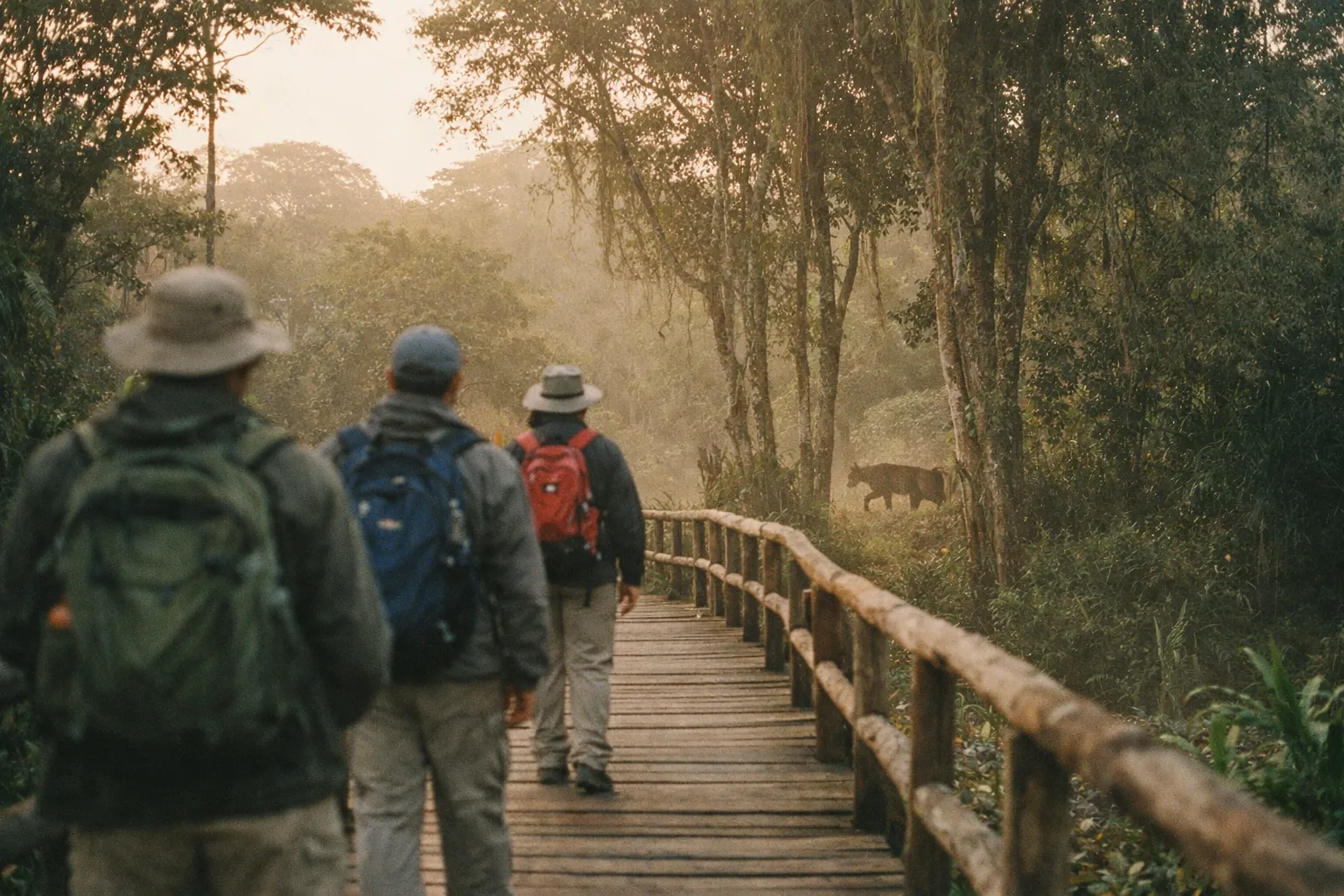
Costa Rica National park Safety is mostly a matter of following posted rules and using a clear set of responses depending on what you encounter. Here’s the practical breakdown for what to do if you see a wild Animal Costa Rica presents on the trail:
- Snake: Stop. Back away slowly. Give it space. Don’t move it or photograph it up close.
- Big cat: Don’t run. Make yourself big, back away facing it, leave an escape route (3).
- Crocodile (near water): Move away from the bank. Never swim where crocs are present or possible (4).
- Monkeys, coatis, raccoons: Do not feed them, even if they approach you. Habituated animals can bite and steal, and feeding them harms their long-term survival.
- Any animal blocking the trail: Wait. Give it time and room to move on its own rather than forcing past.
The universal rules across every species: do not approach, do not feed, do not block escape routes, and do not crowd in for a close photo (2). Use a zoom lens, not your feet.
For families, keep it concrete: avoid solo swims, skip night road transfers, and keep kids close on trails and beaches. Prioritize short, well-trafficked trails over remote routes.
Responsible wildlife tourism Costa Rica: doing it right
The way you travel shapes whether your trip helps or harms the ecosystems you came to see. Responsible wildlife tourism in Costa Rica starts with refusing the behaviors that habituate and endanger animals - feeding, touching, baiting for photos, and crowding nesting or resting sites.
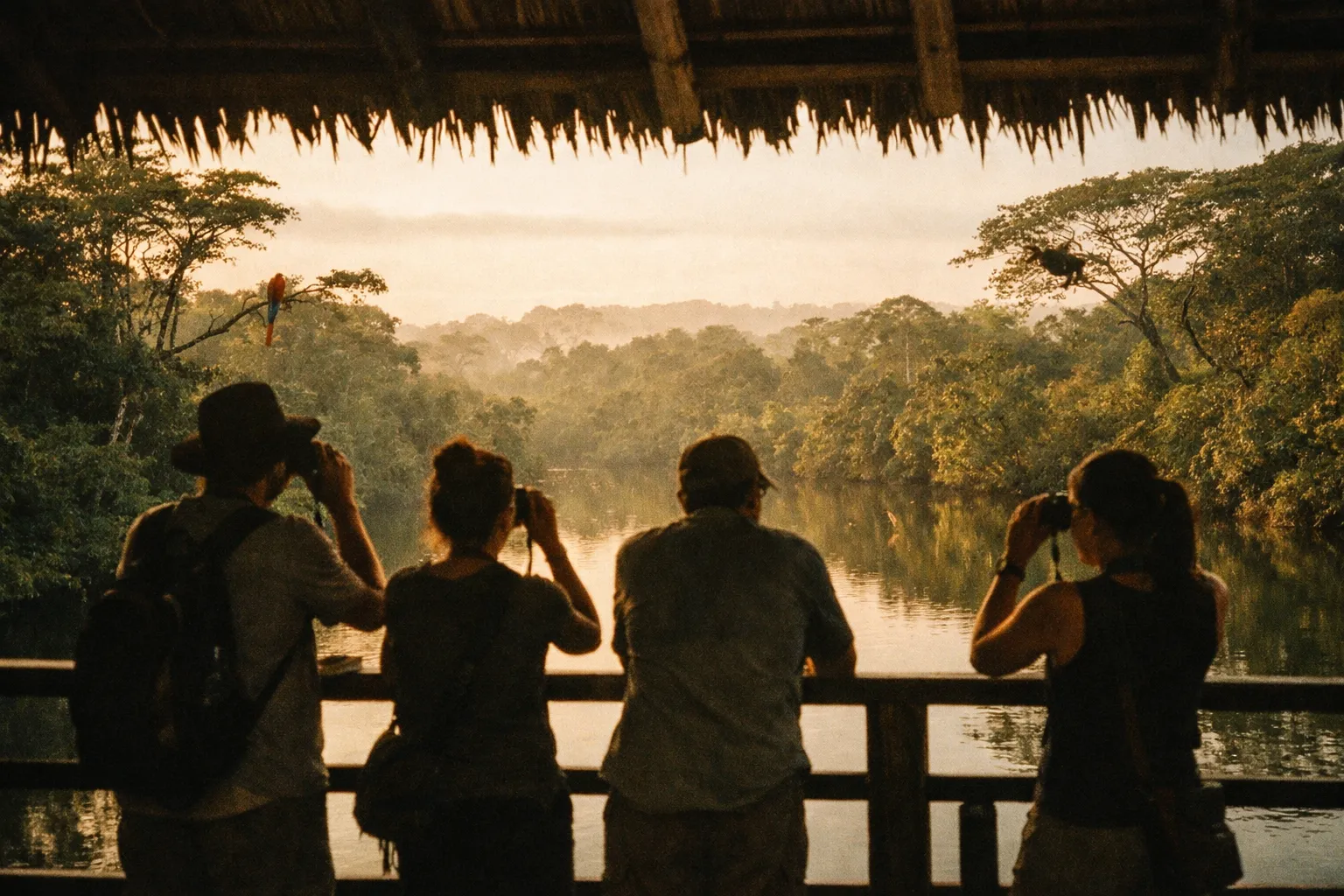
A few decisions raise your standard meaningfully:
- Choose certified operators. Look for outfitters with conservation certifications, professional guides, and consistent reviews rather than the lowest price (4).
- Skip “animal interaction” attractions that let you hold or pose with wildlife. Legitimate rescue and sanctuary operations don’t offer hands-on photo ops.
- Stay at lodges with screened rooms and sealed doors - better for you against mosquitoes and arthropods, and it keeps animals out of human food and trash.
- Pack out your trash and keep food sealed. Accessible food is the fastest route to habituated, aggressive wildlife.
Supporting organizations doing this work matters too. According to the International Fund for Animal Welfare (IFAW), community-based conflict reduction is one of the most effective tools for protecting both people and wildlife long-term. Their use of beehives to deter elephants from farmland in Africa is a useful example of reducing conflict without harming either side. The same principle applies here: small, deliberate choices keep the balance intact.
What are some causes of human-wildlife conflict?
Maintaining a respectful distance from wildlife isn’t only for your safety - it’s for the animals’ well-being too. I’ve watched Costa Rica wildlife encounters tip into conflict in ways that were entirely preventable, and the pattern is usually the same.
Several factors drive the increasing overlap between humans and wild animals. Expanding human populations and encroachment into natural habitats push animals out of their traditional ranges, producing closer and more frequent encounters. Agricultural expansion makes it worse, as animals with shrinking territory venture into settlements looking for food. Climate change also shifts habitats and food sources, forcing wildlife into closer quarters with people.
In Costa Rica, the national parks and protected areas aren’t only tourist destinations - they’re also where this growing conflict plays out. The balance between supporting local communities and protecting wildlife is fragile, and what we do as visitors directly influences it.
How does human-wildlife conflict harm animals?
The damage goes well beyond the immediate danger of a confrontation. The long-term impact on animal populations can be severe.
In Costa Rica, where biodiversity is among the richest in the world, these conflicts can drive down animal numbers - especially for endangered species. Animals that grow accustomed to human presence or come to depend on human food suffer malnutrition, lose their natural foraging and hunting skills, and become more vulnerable to predators and other dangers.
Conflicts also trigger human retaliation - trapping, relocation, or lethal control - which puts populations under further pressure. That cycle ripples outward, disrupting whole ecosystems and affecting not just the targeted species but the plants and animals around them.
During an early visit to a remote Costa Rican village, I saw the aftermath of exactly this kind of conflict. It made the case for coexistence concrete: education and prevention beat retaliation every time.
Frequently Asked Questions
- What is the number one cause of death in Costa Rica?
- While wildlife is not the leading risk for travelers, road travel and accidents are far more common causes of death. Managing transport carefully is more important than worrying about animals.
- Is it safe for Americans to go to Costa Rica now?
- Wildlife risks are manageable with basic precautions. Most visitors have no dangerous animal encounters. Check official travel advisories and ensure vaccines are current.
- Are snakes a big problem for hikers in Costa Rica?
- Snakes pose a manageable risk. Most bites occur from accidental contact. Wearing closed-toe shoes, long pants, and staying on trails minimizes danger.
- Do I need a guide to visit the national parks safely?
- Guides are not mandatory but greatly improve safety and experience. Independent hikers should stick to marked trails, hike in groups, and make noise to alert animals.
- Why should I avoid feeding wildlife in Costa Rica?
- Feeding wildlife habituates animals to humans, increasing risky encounters and harming their long-term survival. It also disrupts natural behaviors and ecosystems.
- What local knowledge is important for wildlife safety?
- Local guides and lodge staff provide critical updates on animal activity, such as crocodile presence at river crossings, which is not available in apps or maps.
- How can I reduce mosquito bites effectively?
- Use insect repellent, wear long sleeves and pants at dawn and dusk, and consider a mosquito net if your lodging doesn't provide one.