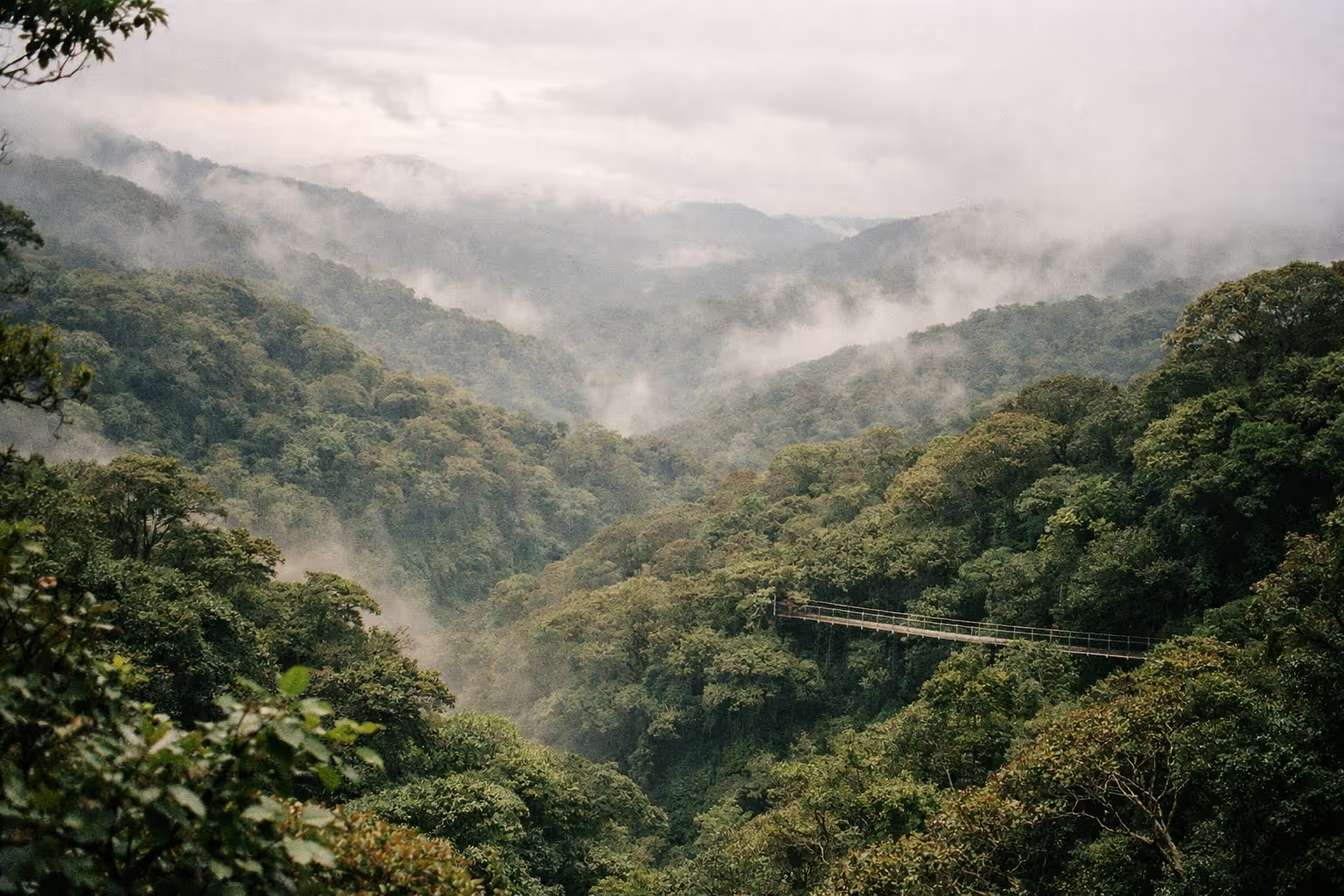
Step off the shuttle at 1,400 m (4,600 ft) and the first thing you notice is the temperature drop. Mist condenses on your jacket before you’ve reached the reserve gate, and if you packed only shorts and a thin tee for Monteverde, Costa Rica, you already made the region’s most common mistake. This is a cloud forest, not a beach town - cool, wet, and around 6 to 10°C colder than the coast most of the year. The draw here is threefold: hiking through one of the planet’s most intact tropical cloud forests, zip lines strung across misty canyons, and hanging bridges that put you at canopy level. This guide covers which reserve suits which traveler, how many nights to allocate, how to get there, and what to bring so you don’t cut your trip short shivering.
✓ Pros
- One of the most intact tropical cloud forests on Earth - the reserve complex protects roughly 27,500 hectares, and the flagship reserve alone is 90% primary forest.
- Extraordinary biodiversity on short, accessible trails: over 400 bird species and 450-plus orchid species (10).
- Three distinct activity types (hiking, zip lines, hanging bridges) cover a wide fitness range.
- Cool temperatures, typically 14-25°C (57-77°F), make sustained physical activity comfortable.
- Multiple reserves let you spread visits across two or three days without covering the same ground.
✗ Cons
- The weather is genuinely cold and wet; under-prepared visitors bail early.
- Road access from San José still means slow mountain roads, 3.5-4.5 hours.
- Daily visitor caps mean popular tours sell out in high season without advance booking.
- Midday wildlife activity drops off sharply - late arrivals miss the best sightings.
- Altitude over 1,400 m causes noticeable fatigue, especially straight after a beach stint.
What Makes Monteverde, Costa Rica Worth the Trip
Monteverde protects one of Earth’s rarest ecosystems - a tropical cloud forest that, globally, covers only about 0.26% of the planet’s land surface (2). The district sits at an average elevation of roughly 1,330 m in the Tilarán Mountain Range, with the flagship Monteverde Cloud Forest Biological Reserve spanning about 10,500 hectares (26,000 acres) along the Continental Divide.
That Continental Divide position is the whole reason the place works the way it does. Rain falling on one slope drains to the Pacific, rain on the other to the Caribbean, and the constant collision of moist air masses over the ridge generates the near-permanent mist. The canopy itself captures up to 3,000 mm of water a year through cloud interception, feeding watersheds on both coasts (2). You’re not walking through scenery - you’re walking through a functioning climate system.
The biodiversity numbers only make sense in that context. Monteverde supports more than 3,000 plant species, including 450 to 500-plus orchids - among the highest orchid diversities anywhere - plus over 400 bird species, roughly 100 to 120 mammals, and well over 100 reptile and amphibian species (10). The headline animals are the resplendent quetzal, the three-wattled bellbird, and all six of Costa Rica’s wildcat species. Realistic expectation: quetzals and bellbirds are genuine sighting possibilities with a dawn guide in the right season. The cats are effectively never seen by day visitors.
Is it too crowded to bother? The reserve went from 431 visitors in 1975 to around 70,000 a year today, with the broader region hosting roughly 250,000 annually. Midday at the main reserve gate in February, it feels like every one of them showed up. But the crowds concentrate in time and space. Arrive at opening, book a dawn guided walk, or choose Santa Elena or the Children’s Eternal Rainforest, and you can still have long stretches of trail entirely to yourself.
The Three Reserves: Which One Is Right for You
Monteverde is not one reserve but a complex of several, and choosing the right one for your travel style matters more than most guides let on. All three main options fall within the same protected complex and can be combined across multiple days.
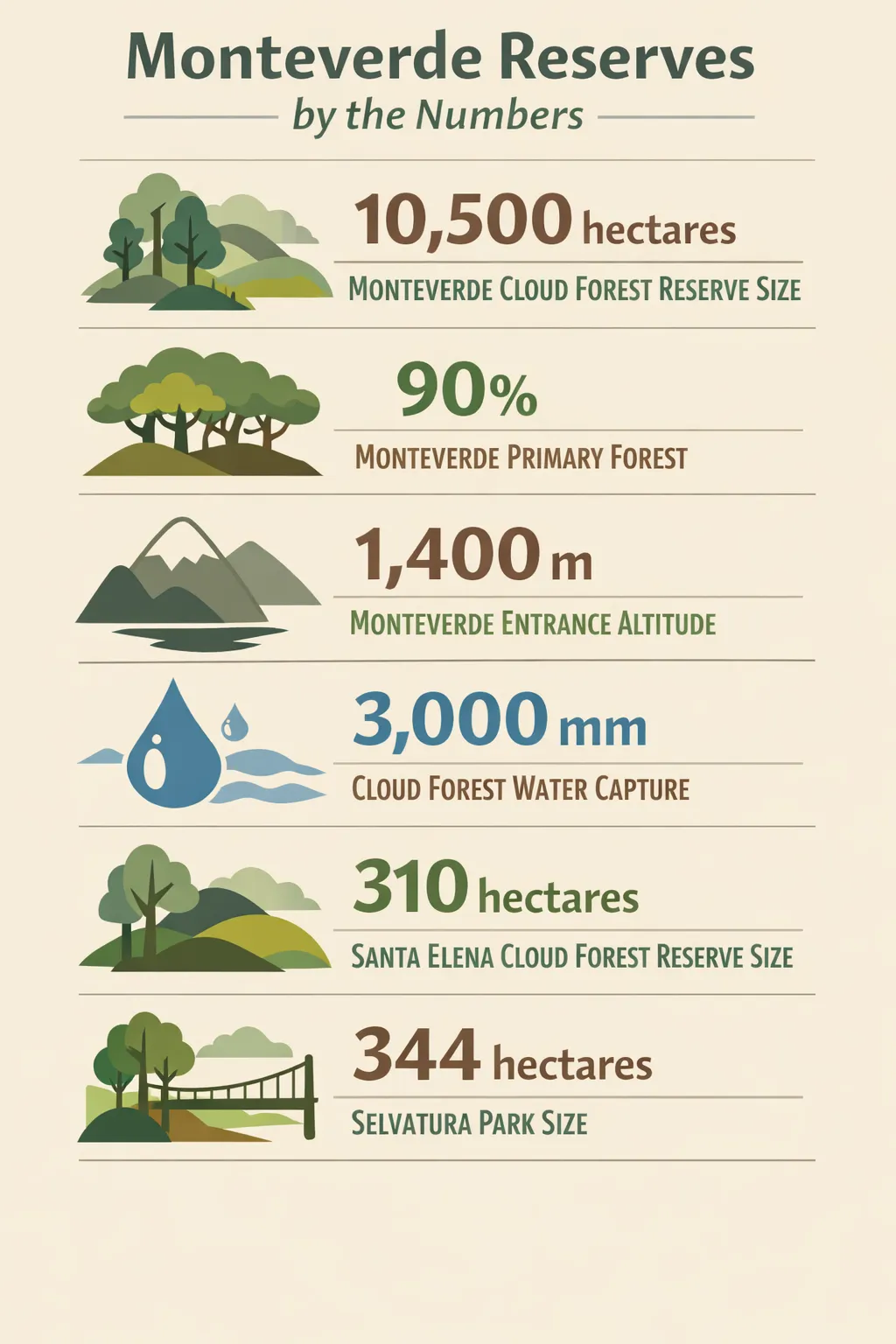 Monteverde reserve sizes, forest composition, altitude, and canopy figures show how the three reserves differ for varied travelers.
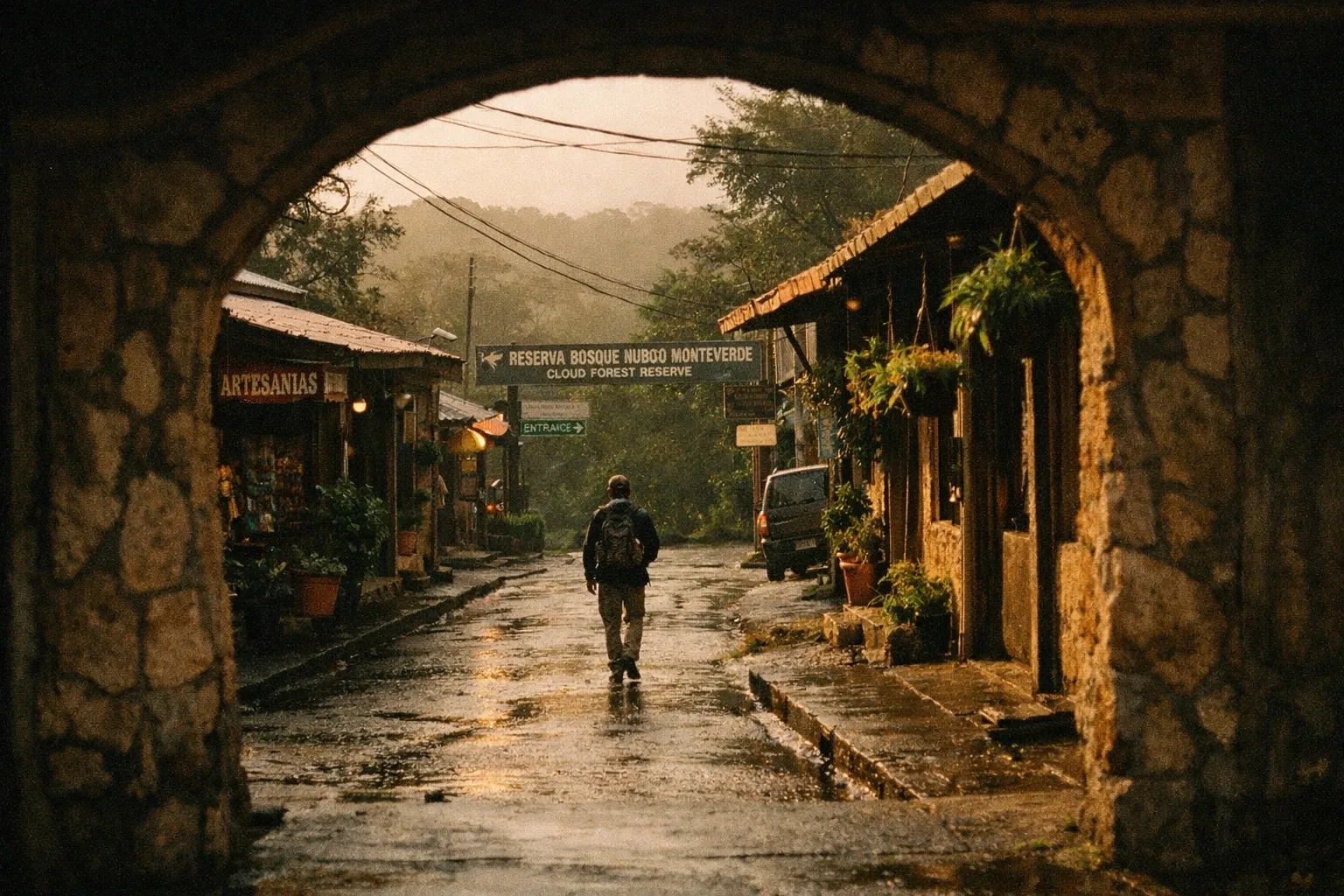
Monteverde Cloud Forest Biological Reserve
The flagship reserve covers about 10,500 hectares across six to eight life zones, with roughly 90% primary forest (7). Pick this one if it’s your first cloud-forest visit: well-marked trails, the region’s best naturalist guides, an iconic suspension bridge on the trail network, and the highest chance of a quetzal sighting with a scope-carrying guide. The trade-off is volume - this reserve sees the most foot traffic, so book guided walks ahead and arrive at the 7:00 a.m. opening.
Santa Elena Cloud Forest Reserve
State-run and much smaller - about 310 hectares (765 acres) - Santa Elena sits at slightly higher elevation and typically draws fewer crowds. According to The Costa Rica News, it offers biodiversity comparable to the main reserve with lower visitor density, which makes it a strong pick for intermediate hikers and birders. The higher elevation can mean better views on clear days and good odds for the three-wattled bellbird. It works either as an alternative to the main reserve or as a solid second day.
Children’s Eternal Rainforest
The Children’s Eternal Rainforest (Bosque Eterno de los Niños) is the giant of the group - around 22,600 to 23,000 hectares, the largest private reserve in Costa Rica, per the Monteverde Conservation League. Its trails are more remote and visitor density far lower, which makes it the right call for serious birders, photographers, and anyone who wants solitude over infrastructure. The Bajo del Tigre section is a well-regarded night-walk venue.
Put simply: families and first-timers should default to the Monteverde Cloud Forest Biological Reserve; intermediate hikers and birders will get more out of Santa Elena Cloud Forest Reserve; multi-day, wildlife-focused visitors should build in the Children’s Eternal Rainforest. The main reserve is the largest developed option - highest crowds, best guided infrastructure. Santa Elena is compact, coverable in a single day, quieter, and sits a touch higher. The Children’s Eternal Rainforest is by far the largest area, the least crowded, and the most demanding to explore properly.
Comparison of Monteverde Reserves
| Monteverde Cloud Forest Biological Reserve | Santa Elena Cloud Forest Reserve | Children's Eternal Rainforest | |
|---|---|---|---|
| Size (hectares) | 10,500+ | 310 | 22,600+ |
| Crowd Level | High | Moderate | Low |
| Best For | Families, First-timers | Intermediate hikers, birders | Serious birders, photographers |
| Trail Length Range | Short to moderate | Short loops | Long, remote trails |
| Standout Wildlife | Quetzal, Bellbird | Bellbird | Diverse, nocturnal species |
| Guided vs. Self-Guided | Strong guided infrastructure | Guided and self-guided | Limited guided options |
Hiking the Cloud Forest: Trails, Wildlife, and What to Expect
Trail circuits at the main reserve run from short loops to several kilometers, and a full visit typically takes 3 to 5 hours (4). The reserve opens at 7:00 a.m. with last circuit starts around 2:45 p.m., so a genuine full circuit needs a morning commitment, not a lunchtime drop-in. Terrain is honest work: steep in sections, muddy year-round, slippery after rain, with real elevation change. I hiked the main reserve loops in the green season and the descents past the divide were slick enough that I was glad for poles.
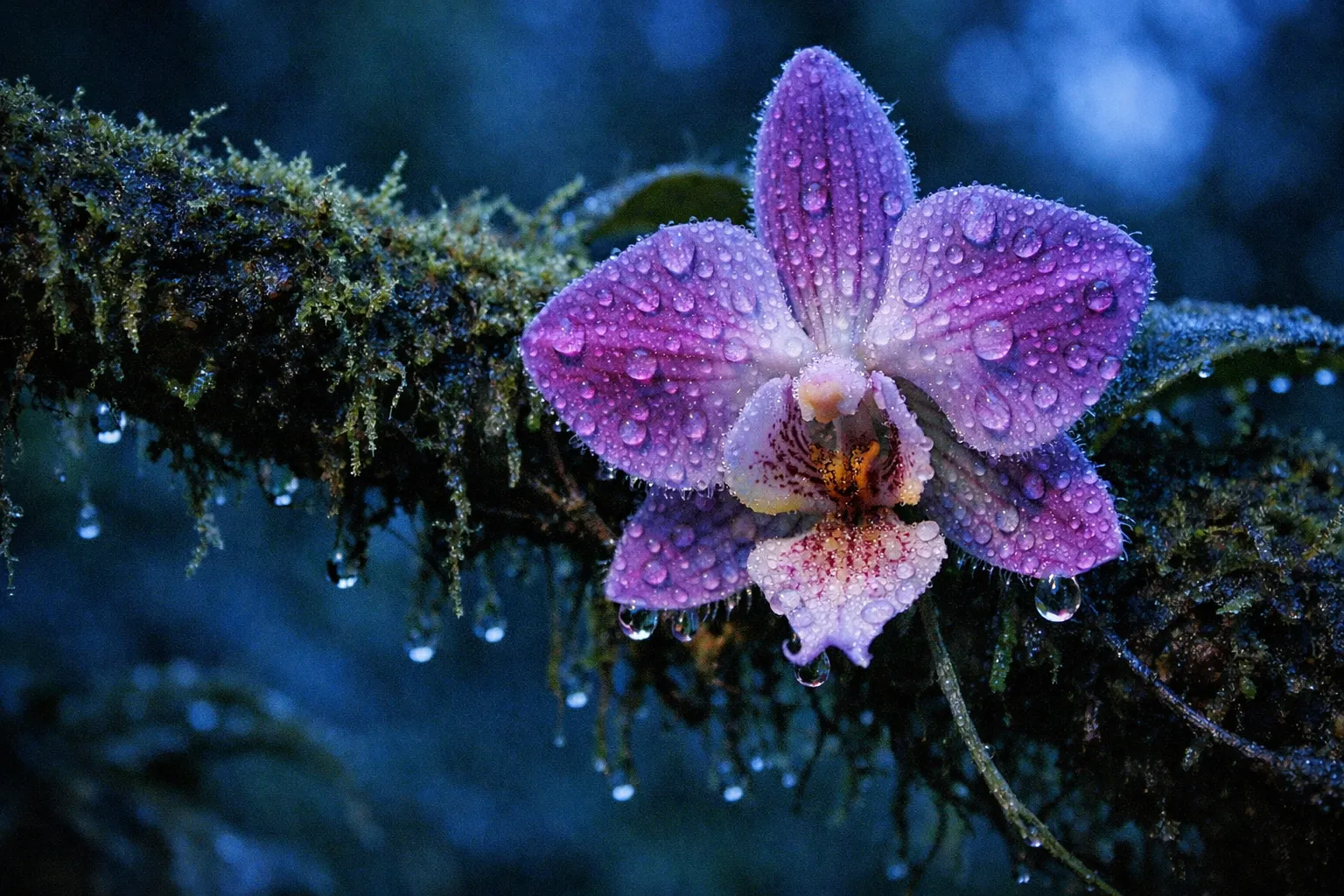
Dawn vs. Midday: When to Go for Wildlife
Wildlife viewing here is almost entirely a function of timing. Resplendent quetzals are most reliably seen between December and April, and dawn outings around 6:00 to 7:00 a.m. deliver dramatically higher odds than midday walks. By late morning, bird and mammal activity drops and the trails fill with day-trippers. One piece of advice from this section: be at the gate when it opens, not after breakfast.
Guided Walks vs. Self-Guided: The Honest Trade-off
You can hike the reserves self-guided, and plenty of people do. Standard guided naturalist walks run about 2 to 3 hours and come with a decisive advantage: guides carry 8-10x binoculars and 20-60x spotting scopes, and they know exactly which fruiting tree a quetzal has been favoring this week (4). Self-guided, you’ll enjoy the forest and see far fewer animals. Guided, you’ll spend more and see considerably more. For a first visit built around wildlife, the guide is worth it.
Night Walks in the Cloud Forest
Night walks are a separate experience worth scheduling on their own, with departures generally between 5:30 and 7:30 p.m. The nocturnal cast is completely different: frogs, stick insects, kinkajous, sleeping birds, and the occasional snake (4). Budget 2 to 3 hours and wear closed-toe shoes - the trails are the same muddy surfaces, just darker.
One fitness note that catches people off guard: at 1,400-plus m, visitors arriving straight from sea-level beach towns feel the elevation on steeper climbs. If your cardio is a question mark, pick the shorter loops and don’t stack a hard hike onto a zip-line day. For more on hiking in Costa Rica - footwear choices, hydration, and trail navigation - the fundamentals apply here as much as anywhere in the country.
Zip Lines Over the Canopy: What the Experience Actually Involves
A typical Monteverde canopy tour runs 2 to 3 hours across 8 to 15 cables, with total line lengths of several kilometers and, at some parks, a Tarzan swing or a long “Superman” cable. The cloud-forest setting - mist drifting between cables - is what separates ziplining here from La Fortuna’s version. Three operators dominate.
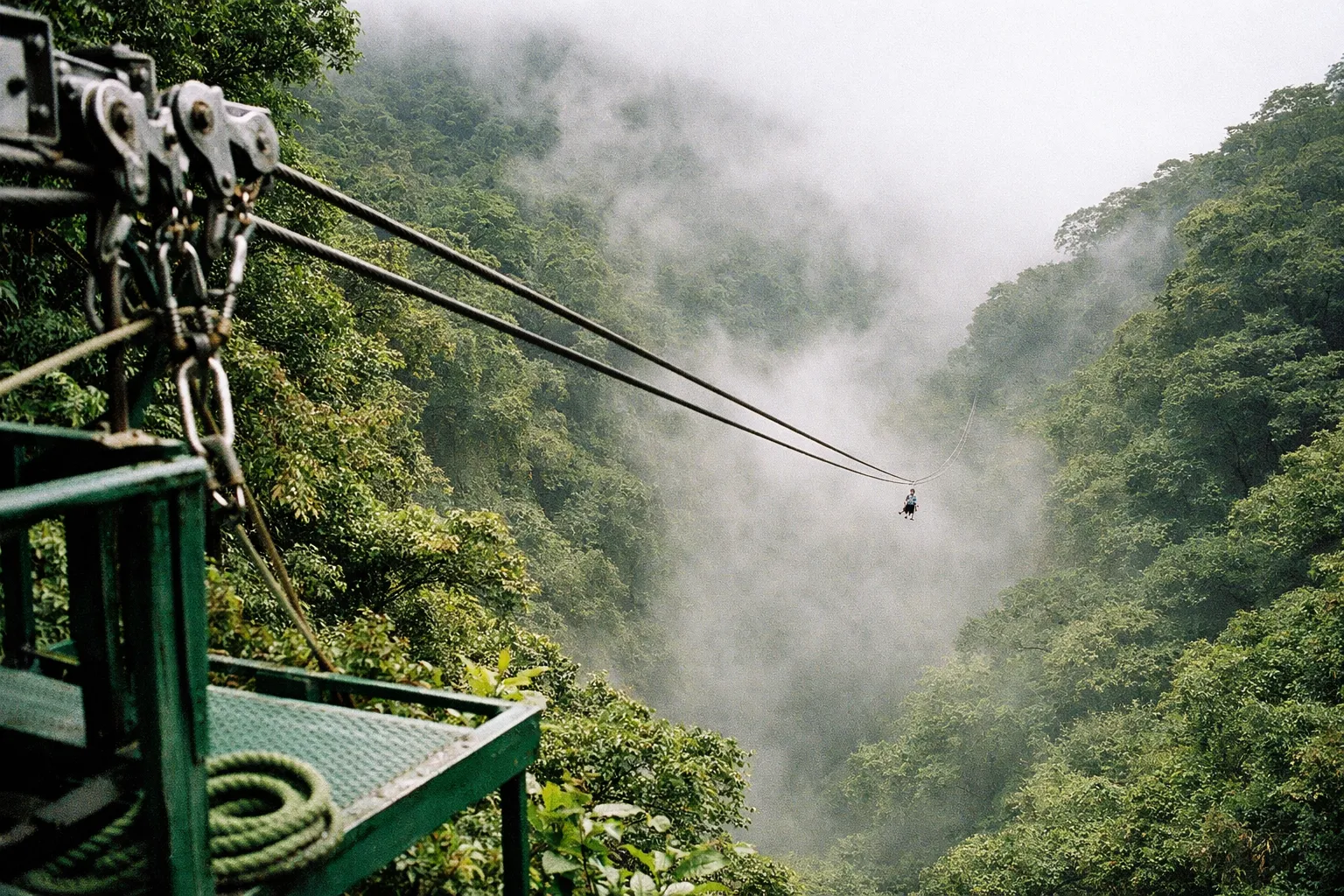
Sky Adventures Monteverde (Sky Trek + Sky Tram)
Sky Adventures Monteverde is known for long, high-speed cables and sells packages that bundle the Sky Trek zip line with the Sky Walk hanging bridges and the Sky Tram gondola. It’s the convenient one-stop option if you want to combine speed and bridges in a single visit without switching venues.
Selvatura Park Canopy Tour
Selvatura Park sits at nearly 1,600 m (5,250 ft) across about 344 hectares (850 acres) and runs one of Costa Rica’s longer canopy circuits (per Vamos Rent-a-Car’s guide). The zip-line tour averages roughly two hours, and Selvatura leans into combos: you can pair the cables with its extensive hanging bridges plus butterfly and reptile exhibits in one ticket (per the Official Costa Rica Travel Blog).
100% Aventura: Longest Line in Latin America
100% Aventura is the adrenaline pick, built around a “Superman” cable of about 1,590 m (1.59 km), promoted as the longest zip line in Latin America, plus a large Tarzan swing and additional lines in a standard 2-to-3-hour tour.
On safety: closed-toe shoes are required at every operator, and all enforce per-harness weight limits - check yours before you book. Verify the operator holds ICT (Instituto Costarricense de Turismo) certification as a baseline insurance and safety standard. Split your zip-line day from any long cloud-forest hike; stacking both at altitude is how people end a Monteverde trip exhausted rather than satisfied.
Hanging Bridges: A Quieter Way to Read the Forest
Hanging bridge tours are the slow, low-adrenaline counterpart to ziplining, and for wildlife watchers they’re often the better call. A typical circuit covers six to eight bridges at heights up to 60-70 m over the canopy, with individual spans running 150-250 m, for a total walk of about 2 to 3 hours.
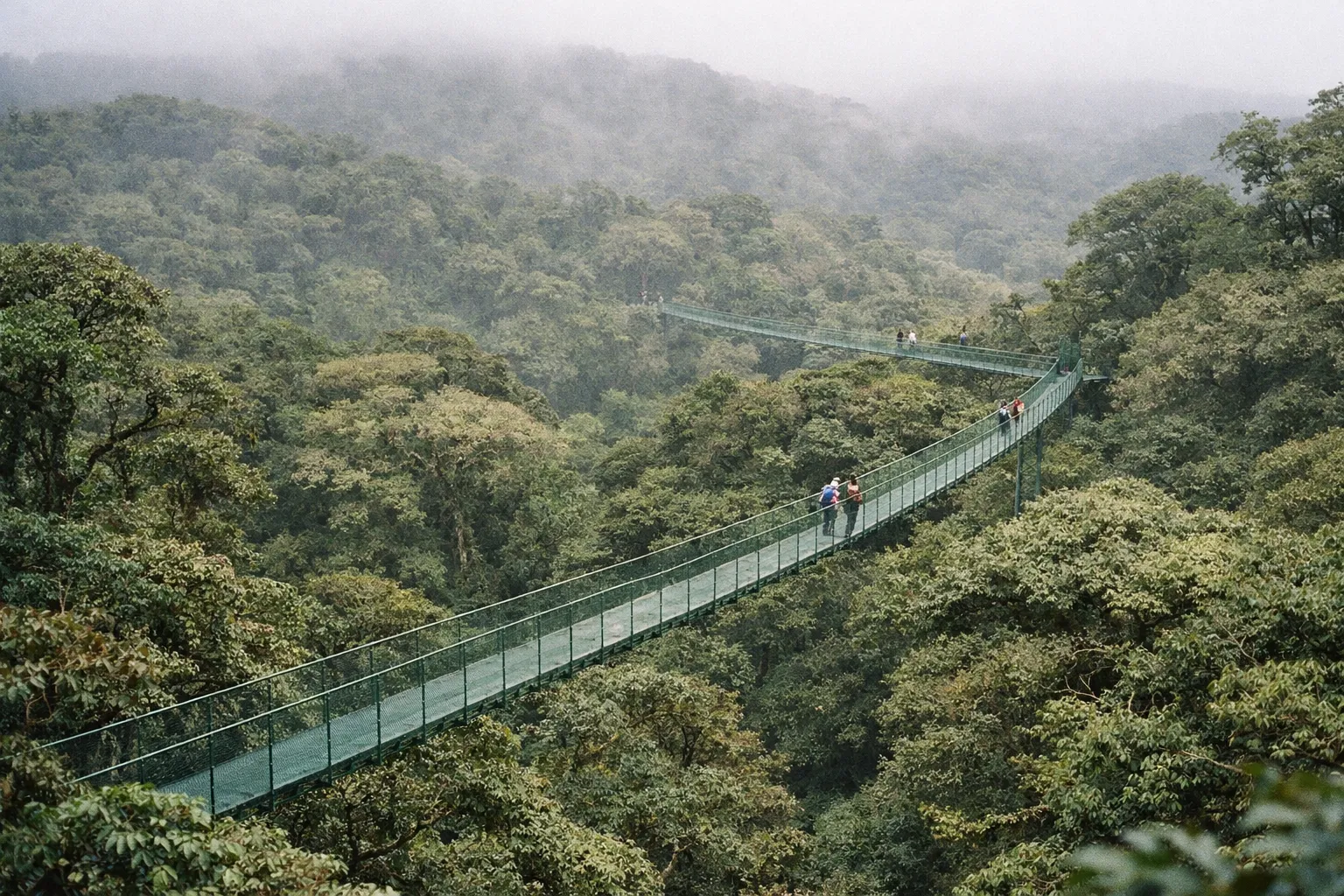
Sky Walk, part of Sky Adventures, threads suspension bridges through forest trails and integrates with the Sky Tram gondola - a good fit for families and anyone who wants canopy-level views without the speed of a cable. Selvatura Park’s bridge network sits at about 1,600 m, where visitors are, as Vamos Rent-a-Car puts it, literally walking through clouds, and the system spans much of the 344-hectare property. You can do the bridges independently or combine them with Selvatura’s canopy tour.
The practical tip that changes your experience: go early. Operators consistently recommend starting at opening, because by mid-morning larger tour groups and zip-line activity raise noise levels and thin out the wildlife you might otherwise spot from the bridges. Walking the bridges at 7:30 a.m. versus 10:30 a.m. is a genuinely different experience.
Who this suits: families with kids, travelers with a fear of heights who still want canopy access (the platforms are stable with proper handrails), photographers doing macro and epiphyte work, and anyone who’d rather move slowly and actually notice the forest than clip into a cable and blur past it.
Monteverde vs. La Fortuna: Choosing Between Costa Rica’s Two Big Inland Stops
If you can only do one inland stop, the choice comes down to climate and what you want to see. La Fortuna, at the base of Arenal Volcano, sits around 500 m elevation, while Monteverde averages about 1,330 m - which is why La Fortuna feels warm and lowland and Monteverde feels cool and misty (per Wikipedia’s figures for both). La Fortuna’s daytime temperatures often run in the mid-20s to low-30s °C, against Monteverde’s yearly mean near 18°C (64°F), a consistent gap of roughly 6-10°C.
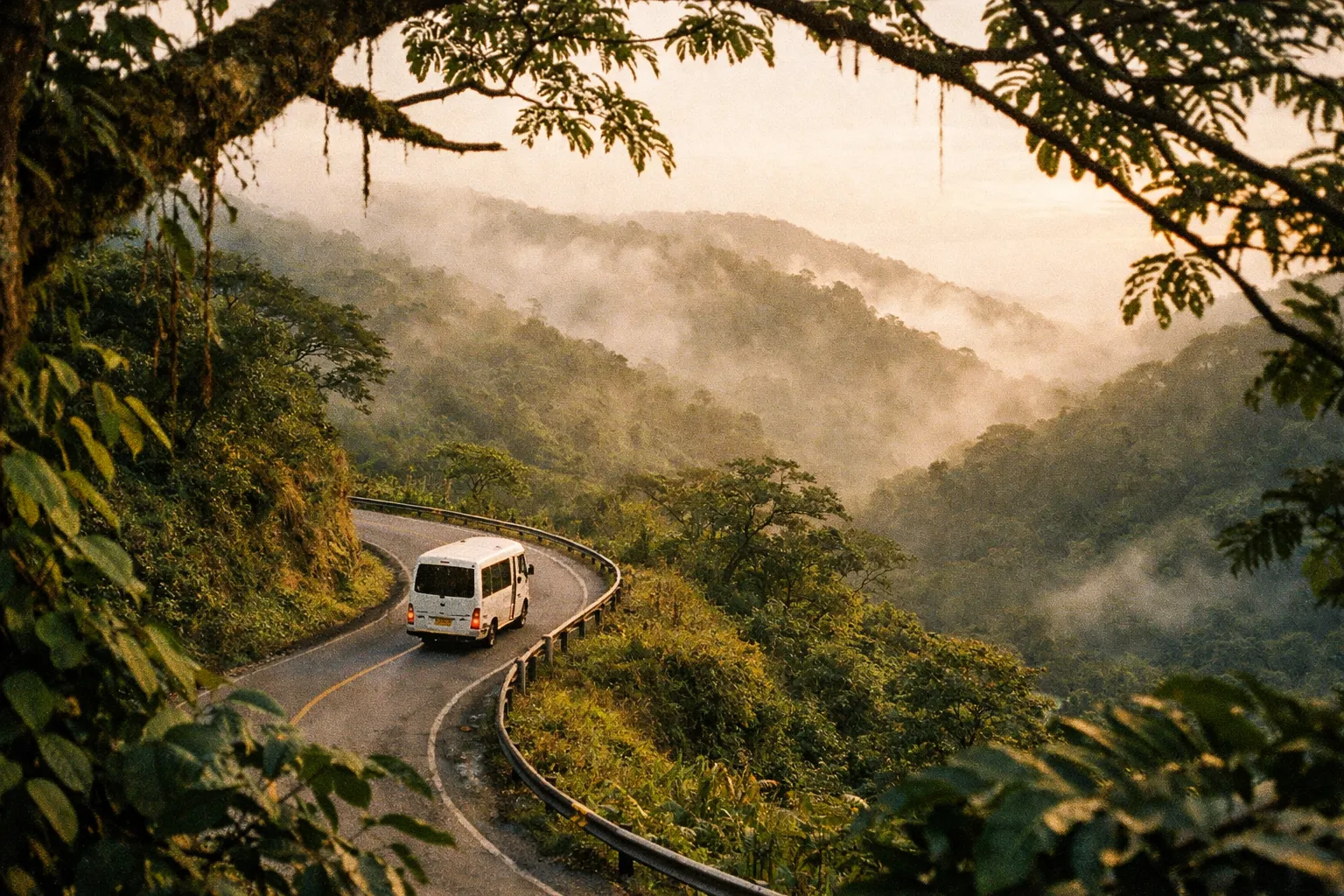
La Fortuna is the pick for volcano scenery, hot springs, and a broad adventure menu - rafting, canyoning, waterfall hikes - and it carries that warmer, more family-friendly feel. Monteverde is the pick for a specialized cloud-forest experience: quetzals, orchids, zip lines strung through mist, and hanging bridges over the canopy. The honest catch is that Monteverde asks more of you - colder, harder to reach, more planning, layered clothing - but delivers a more singular ecosystem in return.
Most 7-to-10-day Costa Rica itineraries include both, and they pair naturally. The smart way to connect them is the jeep-boat-jeep transfer across Lake Arenal: about 3 to 3.5 hours, versus 4 to 5 hours by road alone, with the added bonus of a scenic lake crossing. MonteTours quotes US$35-50 per person for the shared transfer; Aventuras El Lago puts the range at US$33-40 per person - book either a day ahead. Book it a day ahead.
La Fortuna wins on elevation-driven warmth, hot springs, volcano views, and adventure-sport variety - it’s the easier family base. Monteverde wins on cloud-forest wildlife, misty canopy activities, and ecological singularity, at the cost of more effort and colder weather. From San José, La Fortuna runs about 3 to 3.5 hours; Monteverde is typically 3.5 to 5 hours, depending on road conditions and the season. If your trip is wildlife- and adventure-led, weight it toward Monteverde. If it’s about relaxation, soaking, and volcano scenery, weight it toward La Fortuna.
Monteverde vs. La Fortuna
| Monteverde | La Fortuna | |
|---|---|---|
| Elevation (m) | 1,330 | 500 |
| Average Temperature (°C) | 14-25 | 20-32 |
| Primary Draw | Cloud forest ecosystem | Volcano, hot springs |
| Best Activities | Hiking, zip lines, hanging bridges | Rafting, canyoning, hot springs |
| Travel Time from San José | 3.5-4.5 hours | 3-4.5 hours |
| Crowd Level | Moderate | Higher |
| Best For | Wildlife-focused, adventure travelers | Families, variety seekers |
Getting to Monteverde: Road Conditions, Shuttles, and Transit Times
Monteverde sits about 140 km by road from San José, but plan for 3.5 to 4.5 hours - the winding mountain approach means driving takes far longer than the distance suggests. Google Maps consistently underestimates this stretch; add a 30% buffer, and more in the wet season.
From San José
The standard route combines Route 27 and Route 606, with the final mountain segment historically part-unpaved and improving through ongoing road projects. Three ways to make the trip:
- Public bus: 1 to 2 daily departures from San José, roughly 4 to 5 hours with stops - the cheapest but slowest and least flexible option. Schedules shift seasonally, so verify close to your travel date (per Two Weeks in Costa Rica).
- Shared shuttle: typically US$60-70 per person for door-to-door service in about 3.5 to 4 hours, with comfort stops and English-speaking drivers, per Costa Rica Vibes. This is the sensible default for first-timers.
- Self-drive: a 4x4 is strongly recommended, especially in the green season. Download offline maps for the Tilarán-to-Santa Elena stretch, where signal drops, and never drive the mountain road after dark. I ran that Tilarán-to-Santa Elena section in the rain and it was rough enough to slow a standard car to a crawl.
From La Fortuna (Jeep-Boat-Jeep)
Coming from La Fortuna, skip the long road and take the jeep-boat-jeep across Lake Arenal: about 3 hours total, avoiding the rougher mountain segments and doubling as a scenic ride. Shared transfers run US$33-50 per person depending on the operator - MonteTours and Aventuras El Lago are the two most-cited options. Book a day ahead; these fill in high season. If you’re planning a broader Costa Rica itinerary that strings together multiple regions, this transfer is one of the most efficient links in the chain.
When to Go: Cloud Forest Seasons and What They Mean for Your Trip
Monteverde’s temperatures run 14-25°C (57-77°F) year-round with a mean near 18°C - daytime highs regularly reach the mid-20s, but the cool, misty baseline is constant, not seasonal. Do not expect coastal warmth at any point on the calendar.
The dry season, December through April, is the prime window. It coincides with resplendent quetzal nesting and peak activity, brings clearer skies and firmer trails, and draws the highest crowds and prices - so book well ahead. The green season, May through November, brings afternoon showers that usually roll in around 1:00 p.m., muddier trails, and the lushest forest, alongside fewer crowds and lower lodging rates. It’s very doable with the right gear.
The wettest months are September and October, when rain is heaviest and road and trail conditions are at their worst - not the window for a first visit. For most travelers, January through March is the sweet spot, balancing peak quetzal activity, relatively stable weather, and good trail conditions (per Two Weeks in Costa Rica). Late April into early May makes a solid shoulder option: fewer people, rising but manageable rain.
How to Plan Your Time: 1, 2, and 3-Night Itineraries
Most activities here run 2 to 3 hours, which makes time-boxing straightforward once you accept one rule: never combine a full cloud-forest hike and a zip-line tour on the same day. Altitude fatigue at 1,400-plus m is real, and ignoring it turns a great trip into a slog by afternoon.
One Night: The Minimum Viable Visit
One night buys an afternoon arrival, an evening night walk (roughly 5:30 to 7:30 p.m.), and a single guided cloud-forest hike the next morning before you leave. It covers the essentials but leaves no room for zip lines or hanging bridges. Treat it as a taste, not a proper visit.
Two Nights: The Standard Trip
Two nights is the recommended minimum. It lets you spread the high-energy activities across separate days and still fit the core three experiences.
How to Structure Two Days in Monteverde
2 daysStep-by-step itinerary for a balanced two-day visit
- 1
Day 1: Arrival and Hanging Bridges
Arrive in Santa Elena by early afternoon, check in, and walk the hanging bridges at Sky Walk or Selvatura. Book an evening night walk to see nocturnal wildlife.
- 2
Day 2 Morning: Dawn Guided Cloud Forest Hike
Be at the Monteverde Cloud Forest Biological Reserve for the 7:00 a.m. opening with a naturalist guide to maximize wildlife sightings.
- 3
Day 2 Afternoon: Zip-Line Tour
Take a zip-line tour at Sky Trek, Selvatura, or 100% Aventura after resting over lunch to avoid altitude fatigue.
- 4
Day 3 Morning: Departure or Santa Elena Loop
Leave in the morning or squeeze in a shorter Santa Elena reserve hike before departing.
Three Nights: For Wildlife Watchers and Photographers
Three nights is the full experience. It adds a second reserve - Santa Elena or the Children’s Eternal Rainforest - a dedicated dawn birding walk, and an unhurried night walk without schedule pressure. This is the itinerary for serious birders and photographers who want time to sit with the forest rather than tick it off.
On booking: operators cap guided groups at roughly 8 to 12 people, and prime slots sell out days to weeks ahead in December-April and July-August (per Two Weeks in Costa Rica). Reserve your guided hikes, canopy tours, and bridge walks before you arrive. Same-day availability is unreliable in peak periods.
What to Pack and How to Prepare for the Cloud Forest
The single most common Monteverde mistake is arriving dressed for the beach. With temperatures in the mid-teens °C and steady mist, the right layers aren’t optional - they’re what keeps you on the trail instead of retreating to a café.
Pack this:
- Closed-toe shoes - mandatory for every reserve and every canopy tour, no exceptions.
- Waterproof hiking boots or trail runners over sneakers; the trails are muddy and slippery, and wet feet end hikes early.
- A light fleece or mid-layer for the baseline cool temperatures.
- A waterproof rain shell - not a fashion jacket, an actual shell that sheds mist and sudden rain.
- Trekking poles if you have them; steep, slick descents are where they earn their keep.
- A dry sack or waterproof bag for camera and phone - near-100% humidity and persistent mist fog lenses and can damage electronics (per Vamos Rent-a-Car). Pack a lens cloth too.
- Binoculars if you own them; 8-10x is the standard for forest birding, and personal glass beats waiting for the guide’s scope (per Two Weeks in Costa Rica).
What gets people into trouble: sandals or flip-flops, shorts as your only lower layer, and a single thin jacket standing in for real rain protection. Leave those out of the pack and swap in the layers above.
Frequently Asked Questions
- What is special about Monteverde, Costa Rica?
- Monteverde protects one of the world's rarest ecosystems - a tropical cloud forest covering only 0.26% of Earth's land surface. The reserve complex holds 3,000+ plant species, 400+ bird species, and all six Costa Rican wildcat species within a single mountain range. It also sits on the Continental Divide, making it a critical watershed for both coasts.
- Is Monteverde, Costa Rica worth visiting?
- Yes, if you go prepared. The cloud forest is genuinely unlike anything else in Costa Rica - cooler, mistier, and more ecologically dense than lowland rainforests. The zip lines and hanging bridges are world-class. The trade-off is that it requires more planning, warmer clothing, and a longer drive than most beach destinations. Two nights is the minimum to make the trip worthwhile.
- Is it better to stay in Monteverde or La Fortuna?
- Depends on what you want. La Fortuna offers volcano scenery, hot springs, and warmer temperatures - better for families and those wanting variety. Monteverde delivers a more specialized cloud-forest experience with quetzals, zip lines in the mist, and hanging bridges over the canopy. Most 7-10 day Costa Rica itineraries include both; the jeep-boat-jeep transfer between them takes about 3 hours.
- What is the prettiest town in Costa Rica?
- Santa Elena is the functional hub of the Monteverde region - a small, cool-climate mountain town with restaurants, hostels, and tour operators within walking distance. It's not a colonial showpiece, but the setting (mist-draped hills, cloud-forest views) makes it one of the most atmospheric towns in the country. For colonial architecture, Cartago or Grecia are the usual comparisons.
- When is the best time to visit Monteverde for quetzal sightings?
- December through April, with January-March as the peak window. Quetzals are most active during nesting season and are easiest to spot at dawn (around 06:00-07:00) near fruiting trees. A local naturalist guide with a spotting scope dramatically improves your chances. Midday visits in any season are the least productive for quetzal sightings.
- How long does it take to get from San José to Monteverde?
- Plan for 3.5-4.5 hours by car or shared shuttle. The distance is only about 140 km, but the final mountain segment is slow and winding - Google Maps consistently underestimates the time. Add a 30% buffer in wet season. Public buses take 4-5 hours with stops. From La Fortuna, the jeep-boat-jeep transfer across Lake Arenal is about 3 hours.
- Do I need to book Monteverde tours in advance?
- Yes, especially December-April and July-August. The Monteverde Cloud Forest Reserve and major canopy parks cap group sizes at 8-12 people per guide, and popular time slots fill days or weeks ahead in high season. Book guided hikes, zip-line tours, and hanging bridge sessions before you arrive - same-day availability is unreliable during peak periods.
Bottom Line
Treat Monteverde as a logistics problem and it rewards you. Allocate at least two nights, split your high-energy activities across separate days so altitude doesn’t flatten you, book guided hikes and canopy tours before you arrive, and pack real layers plus a rain shell - the cold catches more visitors off guard than anything else. Pick your reserve to match your style: the main reserve for first-timers, Santa Elena for quieter birding, the Children’s Eternal Rainforest for solitude. If you do only one thing, make it the dawn guided walk at the Monteverde Cloud Forest Biological Reserve. That single morning - scope on a quetzal, mist moving through primary forest - is what justifies the drive. Everything else is a worthwhile addition to it.