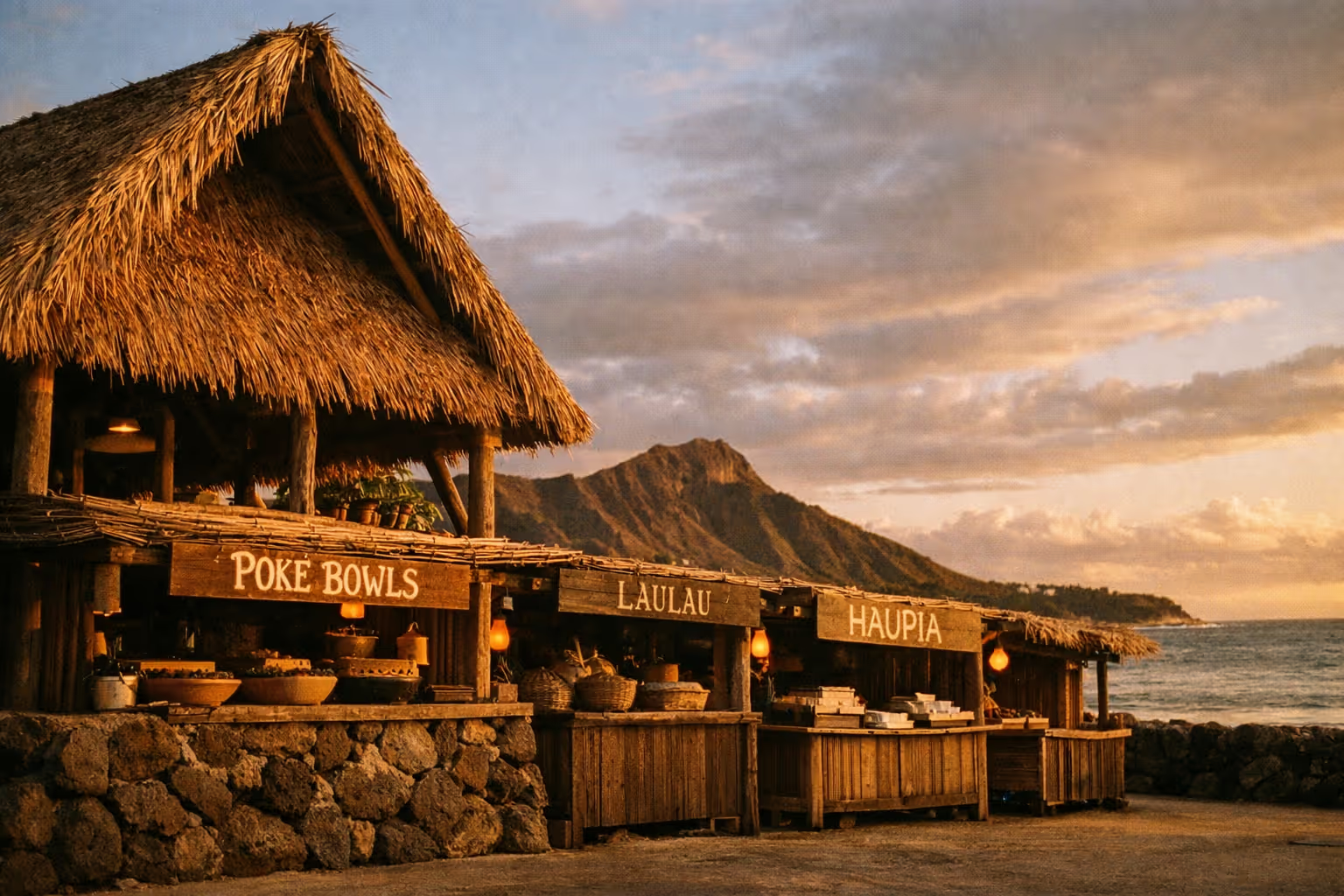
Traditional Hawaiian food is a specific set of dishes, not everything sold as island food. The heritage plate is five things: poi, kalua pig, laulau, lomi salmon, and haupia, with the poi eaten alongside the pork, not alone. At a commercial luau, ask whether the pig actually cooks in an imu, the underground oven, since many cater it in. A heritage sampler from a plate-lunch counter covers more ground for under $30. And know that poke and Spam musubi, however good, are modern local food, not pre-contact cuisine.
What is Traditional Hawaiian Food, Really?
Traditional Hawaiian food is the cuisine of the Native Hawaiian people, built on ingredients the islands could grow or catch: taro (turned into poi), ‘ulu (breadfruit), sweet potato, fish, and pork cooked in an imu - an underground oven lined with hot stones (2)(10). Foods were seasoned simply: Hawaiian sea salt, seaweed, kukui nut. Cooking meant steaming, roasting in the imu, or eating raw.
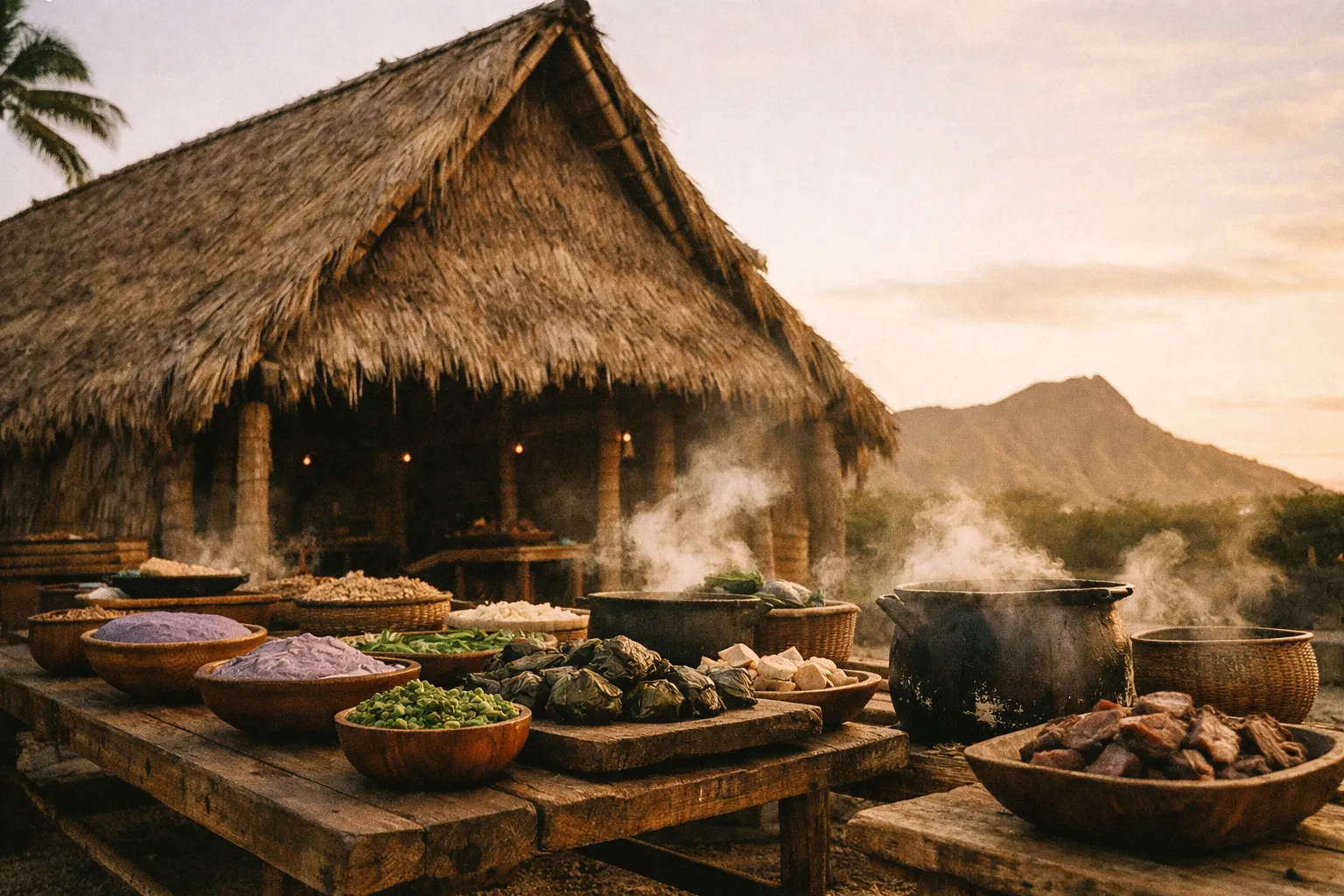
Here’s the distinction that trips up most visitors. The dishes you’ll see labeled “Hawaiian” at a food truck - poke, plate lunch, mac salad - are culturally important but not all pre-contact Native Hawaiian foods (3)(10). Poke as we know it leans on soy sauce and sesame oil, both Asian imports. Spam musubi is a 20th-century invention. When someone asks for classic hawaiian food, they usually mean the heritage set: poi, kalua pig, laulau, lomi salmon, and haupia. That’s the core of a real luau plate, and it’s where this guide starts. Most food guides skip the logistics: the best places to eat traditional Hawaiian food are not the resort luaus but the plate-lunch counters and family-run shops that locals actually use - and those are open daily, no reservation required.
What is the national dish of Hawaii?
Hawaii has no officially designated national dish the way some countries do. But in cultural and culinary writing, poi is the dish most often treated as the emblematic traditional staple (2)(5). It was the foundation of the Native Hawaiian diet for centuries, and it carries spiritual weight tied to the god Kāne. If you want a single food that represents Hawaii’s heritage rather than its tourism industry, poi is the honest answer.
The rich flavors of traditional Hawaiian food
Poke
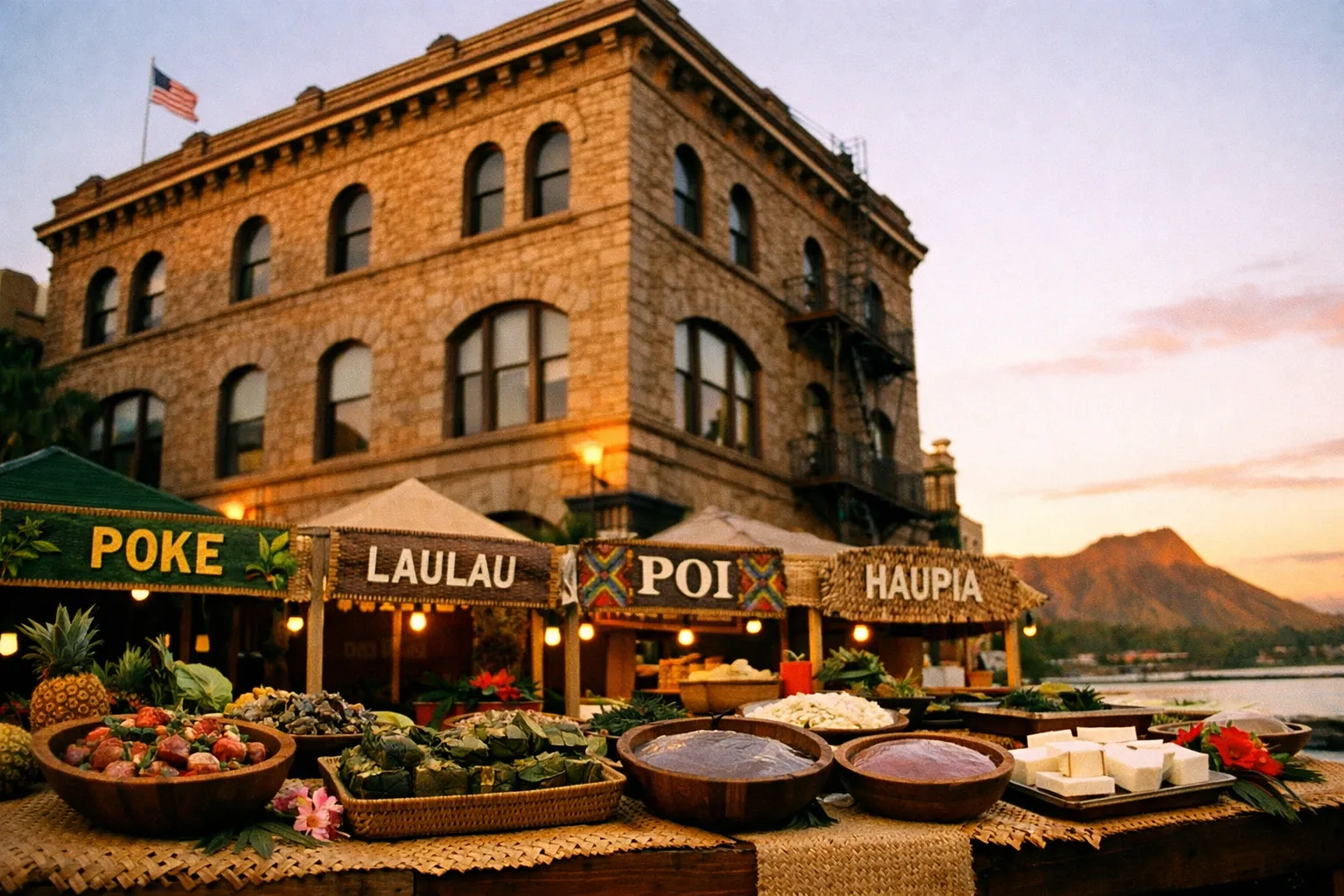
Traditionally made with cubed ahi tuna, soy sauce, sea salt, inamona (roasted crushed kukui nut), seaweed, and green onions, poke reflects Hawaii’s deep-rooted connection with the sea. I had my first proper bowl at a small local counter just off the coast of the Big Island - the kind of place with a whiteboard menu and a line of locals at noon. It’s worth understanding that modern poke - the soy-and-sesame version in every grocery deli - is a fusion evolution. The pre-contact version was closer to raw fish with salt and limu (seaweed), which is a noticeably different dish.
Worth the detour. A good poke bowl runs $12-$18 at a counter or grocery deli, and it’s the easiest traditional-adjacent dish to find fresh anywhere on the islands.
Kalua Pork
This dish uses the Hawaiian cooking technique called “kalua,” which involves slow-cooking a whole pig in an imu, the underground oven. The pig is seasoned with Hawaiian sea salt, wrapped in ti and banana leaves, and cooked for several hours over hot stones (1)(2)(10). The result is tender, smoky pork that pulls apart with a fork - nothing complicated, just technique and time.
Kalua pork is a centerpiece at Hawaiian gatherings and luaus, and the communal table context is part of what makes it work. Sitting with a group and passing the pork around, you get a quick read on what ohana actually means in practice.
Worth the detour - but check the method. Recent luau coverage has pushed operators to disclose whether the pig is actually cooked in an imu or just oven-roasted (1)(7). If authenticity matters to you, ask before you book.
Poi
Made from the taro plant, poi is a staple in Hawaiian cuisine and the truest expression of poi hawaiian food traditions. The taro corm is steamed and pounded with water into a sticky paste, eaten fresh or left to ferment slightly, which gives it a mild sourness (2)(5)(10). My first encounter with it was not a success - the texture and taste are genuinely not what most first-timers expect, and eating it plain doesn’t help anyone’s impression.
Here’s the fix most guides skip: poi is not a stand-alone sweet pudding, and it’s not a novelty to survive on a dare. It’s a starch base, smooth and sticky, meant to be eaten alongside salty dishes. Scoop it with a bite of kalua pig or lomi salmon and the contrast makes sense (2)(5)(10). Treated that way, poi stops being a curiosity and becomes the anchor of the meal it was always meant to be.
It also carries real cultural weight - a spiritual connection to the land and a revered link to the god Kāne. That context doesn’t change the flavor, but it does change how you approach it. Understanding that Hawaii’s rich history shapes everything from its spiritual traditions to its food helps frame why poi is treated as more than just a side dish.
Laulau
Laulau is pork, fish, or chicken wrapped in taro leaves and ti leaves, then steamed or baked for hours until everything goes tender (1)(4)(10). The taro leaves cook down into something spinach-like around the meat. It’s rich, savory, and one of the most genuinely traditional dishes you can order outside a luau.
One practical note: ask what’s inside. Fillings vary by shop and by price tier - some use pork, some fish, some a mix (4). A laulau plate at a local spot typically runs $12-$16.
Lomi Salmon
Also called lomi-lomi salmon, this is a cold side of salted salmon diced with tomato and onion - almost a salsa in texture. It arrived with 19th-century whalers and traders and got absorbed into the traditional plate. On a luau spread it plays the role of the bright, acidic counterpoint to all that smoky pork. Order it alongside poi and kalua pig and you’ll understand why the classic combination works.
The top 10 Hawaiian foods to try
If you want a single answer to “what are the top 10 Hawaiian food items,” here it is - split so you can see what’s heritage and what’s a modern island favorite (6)(8).
Heritage dishes (traditional Native Hawaiian):
- Poi - the taro staple, the closest thing to a national dish
- Kalua pig - imu-roasted, smoky, the luau centerpiece
- Laulau - meat steamed in taro and ti leaves
- Lomi salmon - salted salmon with tomato and onion
- Haupia - coconut milk dessert (more below)
Modern island staples (local, not pre-contact):
- Poke - cubed raw fish, soy and sesame
- Spam musubi - grilled Spam and rice wrapped in nori
- Malasadas - Portuguese fried dough, no hole, sugar-coated
- Shave ice - finely shaved ice with syrup, often over ice cream
- Loco moco - rice, hamburger patty, fried egg, brown gravy
Order at least three from the top group and three from the bottom, and you’ll cover both what Hawaii inherited and what it invented (6)(8).
What is the most common food eaten in Hawaii?
Day to day, the most common meal in Hawaii isn’t a heritage dish - it’s the plate lunch. The standard serving pairs two scoops of rice, one scoop of macaroni salad, and a protein (3). A more traditional Hawaiian plate swaps in or adds poi and lomi salmon alongside kalua pig or laulau (9)(10).
Spam is also genuinely everywhere. According to Hormel, Hawaii consumes more Spam per capita than any other US state - roughly 7 million cans a year for a population of 1.4 million - a habit that traces to WWII rationing when fresh meat was scarce on the islands (3). That’s why Spam musubi shows up at every convenience store and gas station. It’s the snack you grab mid-drive: salty, portable, and better than it sounds.
Hawaiian food for luau: what to expect on the plate
A luau meal usually runs 2 to 4 hours with entertainment, and the food is a set piece more than an à la carte choice (7). The classic core - the essential hawaiian food for luau spreads - is:
- Kalua pig (the imu-cooked centerpiece)
- Poi
- Laulau
- Lomi salmon
- Haupia
Many venues add chicken long rice, squid luau, or mac salad, but those are optional extras, not the traditional backbone (7). Don’t judge a luau by the length of the buffet. Judge it by whether that core five is done right.
Booking mechanics. Commercial luaus commonly run $100+ per adult, and popular ones sell out days ahead in peak season - buy in advance. The Polynesian Cultural Center on Oʻahu and Old Lahaina Luau on Maui are two of the most frequently cited for imu authenticity, but both require reservations weeks out in summer. When comparing tickets, check what’s bundled: a $120 ticket that includes transportation, open bar, and buffet access can easily beat a $90 ticket with none of that. Ask specifically whether the kalua pig is cooked in an imu on-site, since some operators cater it in (1)(7).
Hawaiian breakfast food: what mornings actually look like
There’s no ancient Native Hawaiian breakfast tradition in the way there’s a luau tradition. What people mean by hawaiian breakfast food is a modern, local mix (8):

- Spam musubi or Spam with eggs and rice
- Malasadas and other Portuguese-style pastries
- Loco moco - filling enough to be breakfast, lunch, or a hangover cure
- Leftover saimin or plate lunch from the night before
- Portuguese sausage with eggs and rice, a diner standard
Walk into a local spot expecting a heritage breakfast plate and you’ll be recalibrating fast. The morning menu here is island-local, not pre-contact.
Hawaiian comfort food: saimin, mochi, and the everyday stuff
Hawaiian comfort food is the everyday, been-eating-it-since-childhood category, and it overlaps almost entirely with the local (not traditional) side of the spectrum. The dishes worth knowing:
- Saimin - a noodle soup born from Chinese, Japanese, and Filipino influences, often loaded with Spam, egg, green onion, and fishcake. This is the local cold-weather-that-doesn’t-exist bowl.
- Butter mochi - a chewy, sweet baked square made with mochiko (glutinous rice flour) and coconut milk. Ubiquitous at potlucks.
- Manapua - Hawaii’s take on Chinese char siu bao, a steamed or baked bun stuffed with sweet pork.
- Beef stew - plate-lunch comfort, served over rice.
None of these are traditional in the pre-contact sense, but they’re what a lot of locals actually crave. Knowing the difference keeps your expectations - and your food vocabulary - accurate.
Hawaiian food desserts: haupia and beyond
The strongest traditional-adjacent dessert is haupia, a firm coconut milk pudding cut into squares and served at nearly every luau (6). I learned to make it from scratch in a family kitchen on Oʻahu - the technique is simple, but the ratio of coconut milk to starch is where most people go wrong. It’s mild, clean, and the natural closer to a salty-smoky meal.
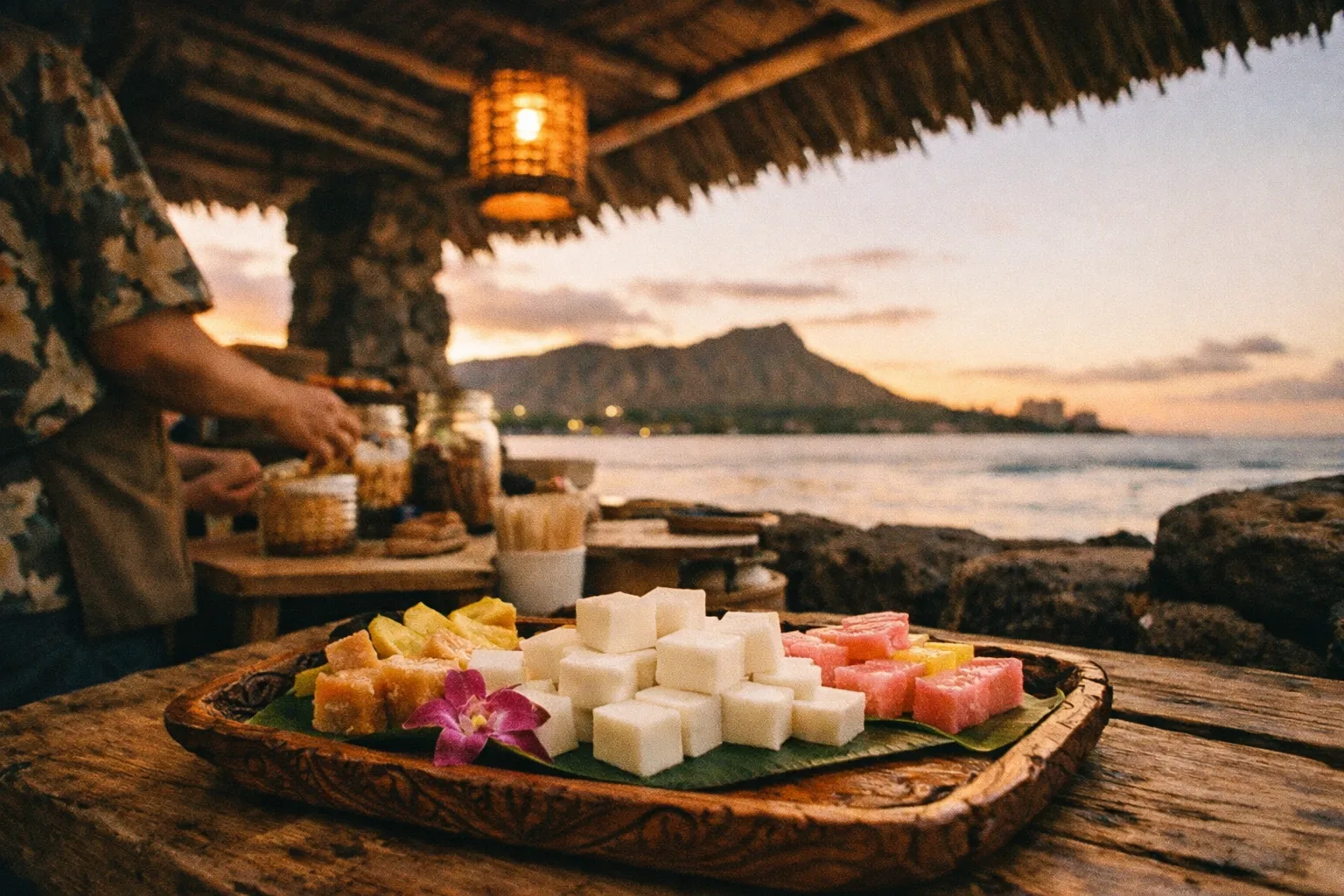
Beyond haupia, the hawaiian food desserts worth your calories:
- Malasadas - order them hot; Leonard’s on Oʻahu is the benchmark, and the line moves fast
- Shave ice - get it with a scoop of ice cream and sweet azuki beans hidden at the bottom
- Butter mochi - the chewy coconut square from the comfort-food list, doubles as dessert
- Coconut or taro-based sweets - the heritage end of the spectrum
Dessert runs cheap: $6-$12 for most of these at a bakery or shave-ice stand.
Getting There, When to Go, and What Most Guides Get Wrong
How to get there. All major Hawaiian islands are served by direct flights from the US mainland. Honolulu (OGG for Maui, KOA for the Big Island) is the main hub. Round-trip fares from the West Coast run $300-$600; from the East Coast, $500-$900. Inter-island flights on Hawaiian Airlines or Mokulele add $60-$150 per leg. If your food itinerary spans multiple islands, budget for at least one inter-island hop.
Best month to visit. April or May. Crowds thin out after spring break, prices drop from peak-winter rates, and the weather is stable - low humidity, minimal rain on the leeward sides. Summer (June-August) is busy and expensive. December through February is peak season for mainland visitors, which means luau tickets sell out faster and plate-lunch counters run longer lines.
One thing most guides get wrong. They treat the luau as the definitive Hawaiian food experience and leave it at that. The luau is a useful sampler, but the real range of traditional Hawaiian food - poi eaten alongside kalua pig at a local plate-lunch counter, laulau from a family-run shop, fresh poke from a grocery deli - is accessible any day of the week without a $120 ticket. Start with the everyday spots; use the luau as a capstone, not an introduction. If you want to go deeper than the tourist trail, choosing tours that respect and contribute to local communities is one of the most meaningful ways to engage with Hawaiian food culture on its own terms.
How much it costs to try Hawaiian food in 2026
Prices swing by island, operator, and season, so treat these as planning ranges and verify at booking. Rates shift year to year and no single market-wide figure covers the range - luau and restaurant pricing varies too much to pin down a single number.
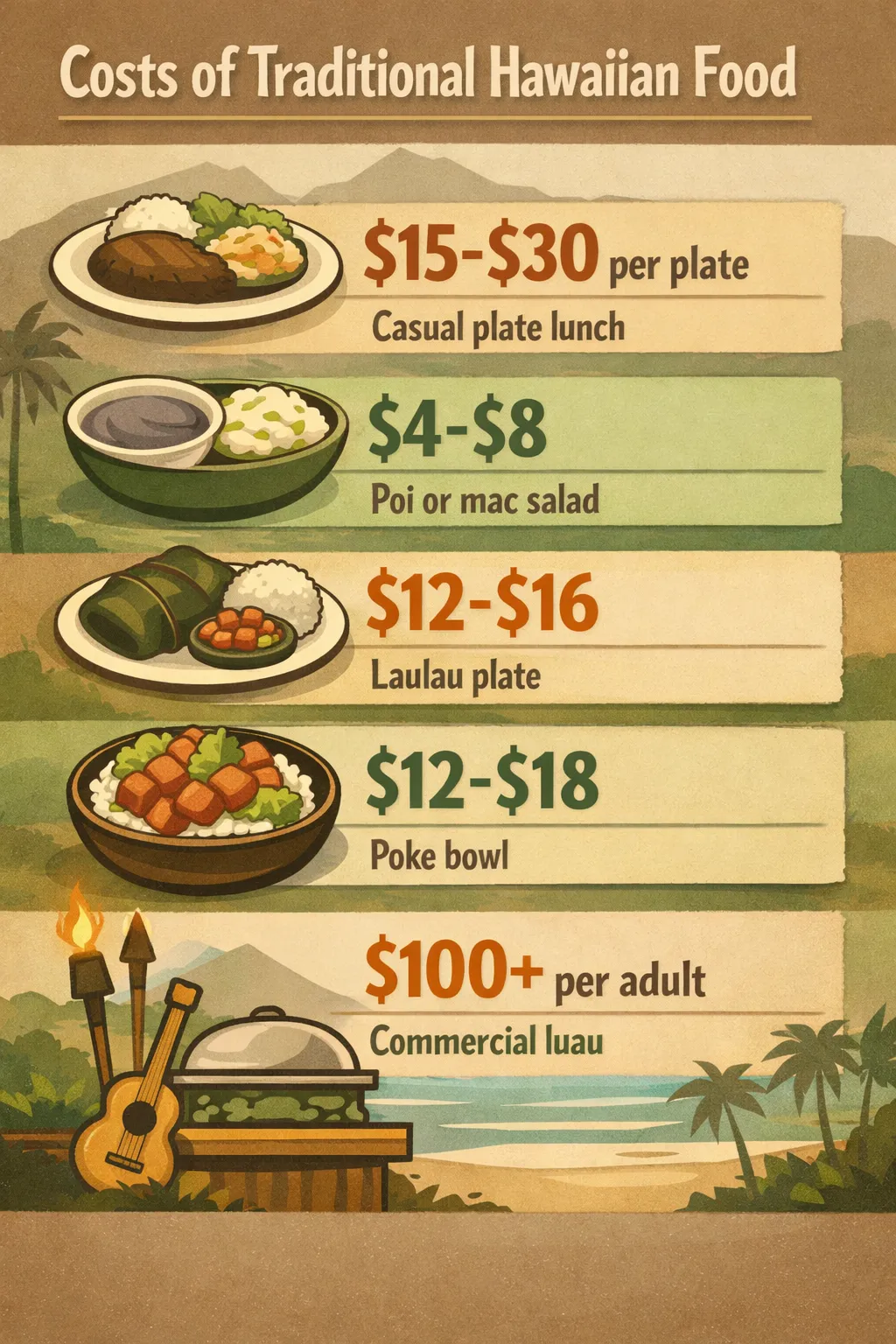 Infographic highlights typical Hawaii dining costs for heritage and luau options in 2026: casual plate lunch ($15-$30), poi or mac salad ($4-$8), laulau plate ($12-$16), poke bowl ($12-$18), commercial luau ($100+ per adult).
- Casual plate lunch: $15-$30 per plate in Honolulu-area spots
- Side of poi or mac salad: $4-$8
- Laulau plate: $12-$16
- Poke bowl: $12-$18
- Dessert (haupia, malasadas, shave ice): $6-$12
- Commercial luau: $100+ per adult, usually requiring advance purchase
A budget-conscious sampler works like this: hit a bakery for malasadas, a plate-lunch shop for kalua pig and rice, and a grocery deli for poke, and you can cover multiple categories for under $30. A full luau is the premium route - you’re paying for the imu, the show, and the setting as much as the food.
✓ Pros
- Clear distinction between traditional Native Hawaiian dishes and modern island favorites
- Practical advice on what to order and how to approach unfamiliar foods like poi
- Includes price ranges and booking tips for luaus
- Covers a wide range of dishes from heritage staples to everyday comfort food
✗ Cons
- Some traditional dishes can be an acquired taste for first-timers
- Authenticity of imu cooking varies among luaus, requiring advance inquiry
- Prices vary widely by island and operator, complicating budgeting
What to actually order
If you have one meal to spend on heritage food, get a traditional Hawaiian plate: kalua pig, laulau, poi, lomi salmon, and haupia on one tray. Eat the poi with the salty pork, not on its own. If you have one splurge, book a luau where the pig is genuinely cooked in an imu, and buy the ticket before you land. If you’re just grazing between beaches, a poke bowl and a Spam musubi will do the job - just know you’re eating local Hawaii, not the food of the old islands. The distinction is the whole point, and now you know which is which.
Frequently Asked Questions
- Can I find authentic imu-cooked kalua pig at every luau?
- No, not all luaus cook the pig in an imu; some use oven roasting or cater-in options, so ask before booking.
- Is poi meant to be eaten plain as a dessert?
- Poi is a starch base meant to be eaten with salty dishes, not as a sweet or standalone dessert.
- Are poke bowls traditional Native Hawaiian food?
- Poke bowls as commonly served are a fusion dish with Asian influences, not pre-contact Native Hawaiian cuisine.
- When is the best time to book a luau?
- Book luaus days or weeks in advance during peak tourist seasons to secure spots and better prices.
- What is the price range for a casual Hawaiian plate lunch?
- Casual plate lunches typically cost between $15 and $30 in Honolulu-area eateries.
- Is Spam musubi really popular locally or just a tourist snack?
- Spam musubi is a genuine local staple and common grab-and-go snack throughout Hawaii.