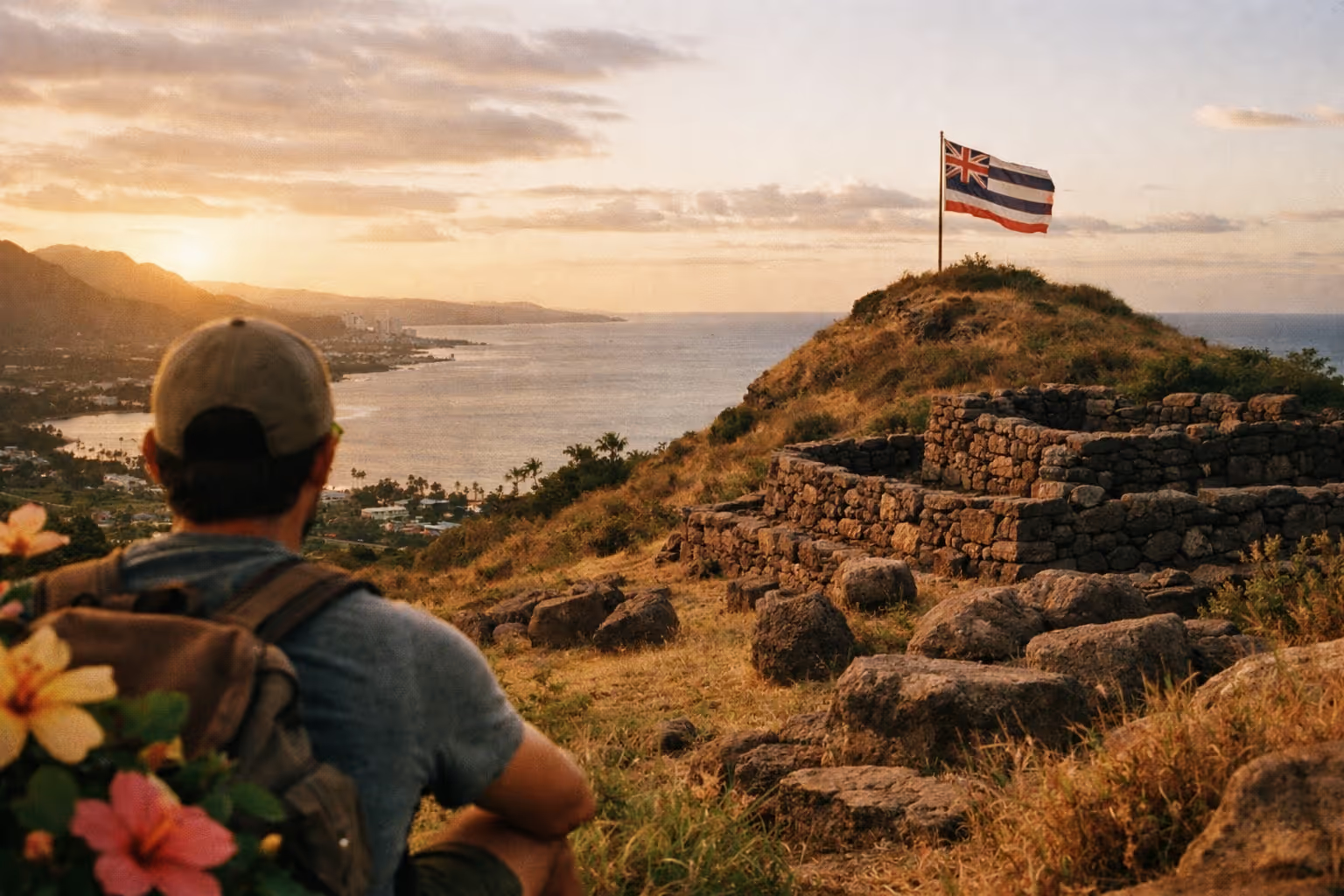
The Hawaii flag surprises people the first time they notice the Union Jack in its corner, since the islands were never a British colony. It flies as a mark of friendship, dating to gifts King Kamehameha received before he unified the islands in 1810, and its eight stripes stand for the eight main islands. The design has outlasted the kingdom, the overthrow, and statehood unchanged. The same story runs through the state symbols, the nene goose and the yellow hibiscus, both native species now leaning on conservation to survive.
Exploring Hawaii’s layered history
The first settlers made an impressive journey of about 2,000 miles across the Pacific from the Marquesas Islands roughly 1,500 years ago. Navigating double-hulled canoes without instruments, they settled what would become Hawaii - the start of a history stretching well beyond a millennium. The Hawaii flag, a symbol deeply tied to this rich past, reflects the islands’ unique cultural and political heritage.
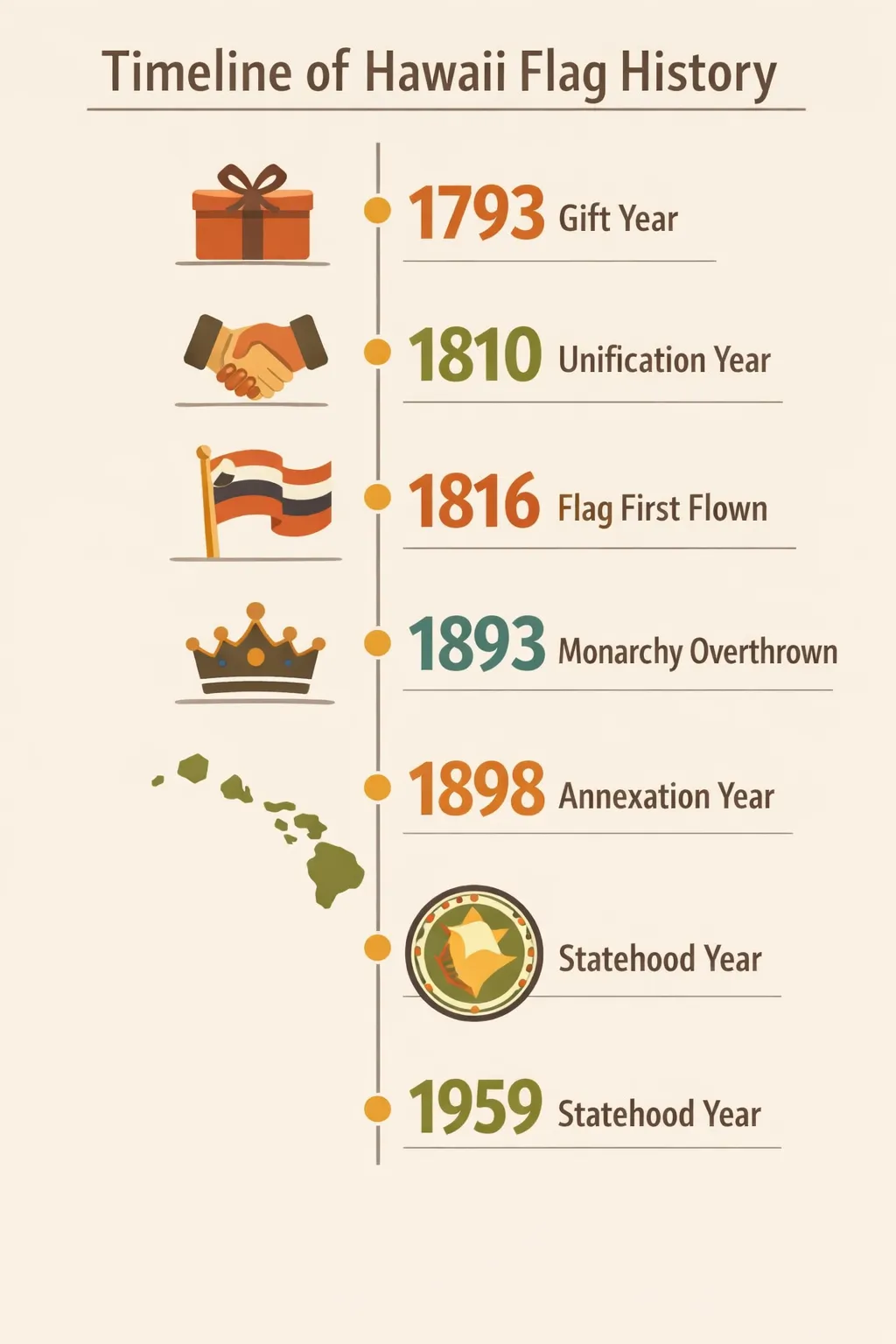 Timeline of Hawaii’s political milestones alongside the Hawaii flag, with dates 1793, 1810, 1816, 1893, 1898, and 1959.

About 500 years later, Tahitian arrivals added new customs to the mix. Surfing, hula, and the tradition of exchanging leis all come from this blend of Polynesian cultures.
The major turning point came in 1810, when King Kamehameha I unified the islands. That ended generations of inter-island conflict and formed a single kingdom that lasted until the late 19th century, with the royal seat eventually centered at Iolani Palace in Honolulu.
After that, history moves quickly:
- 1793 - Captain George Vancouver gifts a Union Jack to Kamehameha I
- 1810 - Kamehameha unifies the Hawaiian Islands
- 1816 - The Hawaiian flag, mixing stripes and the Union Jack, is first flown (8)
- 1893 - The monarchy is overthrown
- 1894-1898 - Republic of Hawaii
- 1898 - Annexation by the United States (8)
- 1900-1959 - Territory of Hawaii
- 1959 - Hawaii becomes the 50th state; the flag remains unchanged (8)
If you find yourself in Honolulu, a visit to Iolani Palace is worth carving out time. It’s the only official royal residence on U.S. soil, and the room-by-room tour gives a clear sense of Hawaii’s transition from kingdom to territory. Guided tours run about $30 for adults; check schedules ahead since docent-led tours fill up fast. The self-guided audio option is cheaper but misses some rooms that remain closed.
The Hawaii Flag: Meaning Behind the Design
The Hawaii flag was created at King Kamehameha I’s request and first raised around 1816. Its design has two parts that seem to clash at first glance, which is exactly why it grabs your attention.
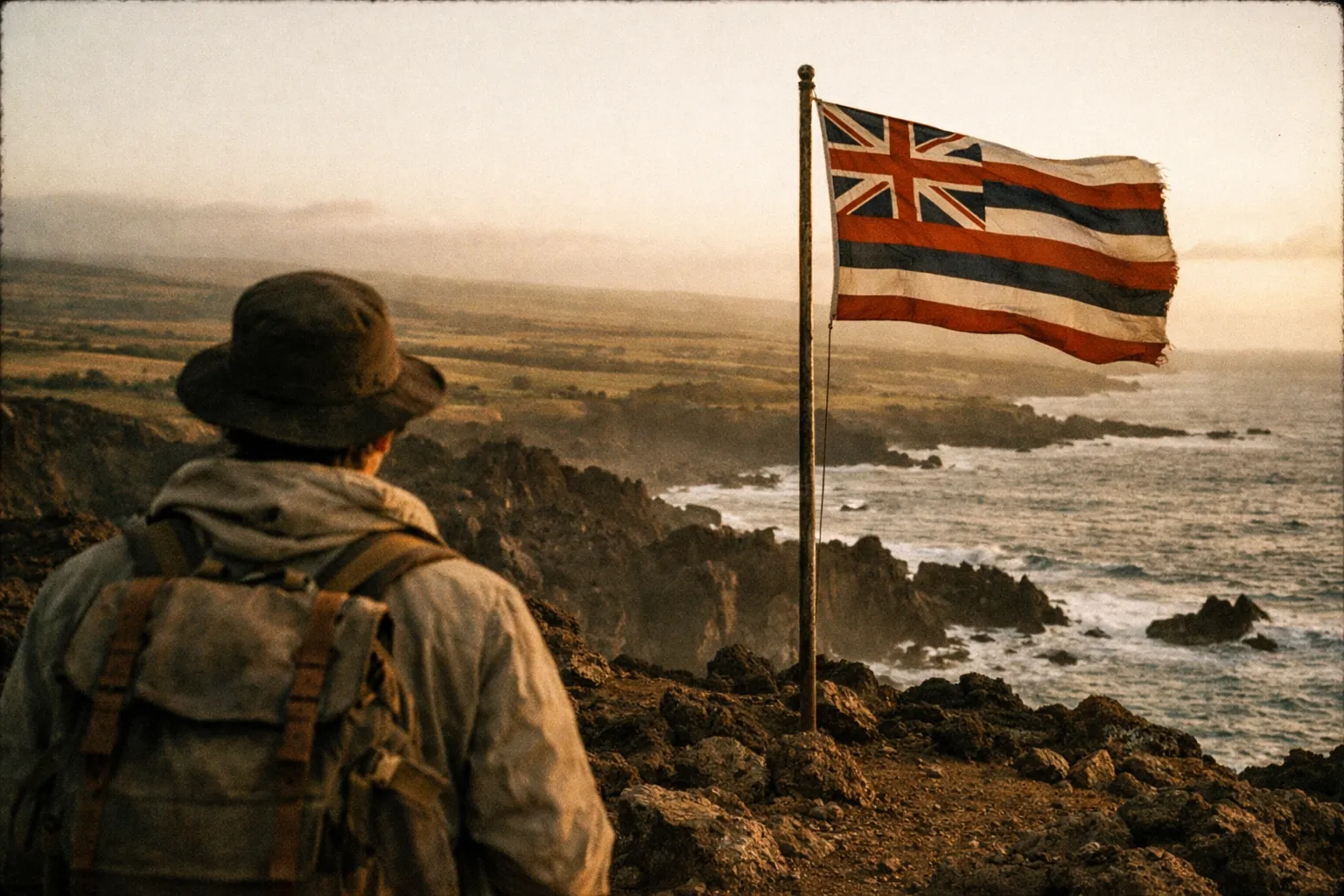
Eight horizontal stripes run the length of the flag, alternating white, red, and blue, starting with white at the top. Each stripe represents one of the eight main Hawaiian islands (8)(9):
- Hawaiʻi
- Maui
- Kaho’olawe
- Lānaʻi
- Molokaʻi
- Oʻahu
- Kauaʻi
- Ni’ihau
Here’s where most guides get it wrong: they assign symbolic meanings to the colors - red for courage, blue for the ocean, and so on. The law assigns no official meaning to the colors. The palette probably reflects the flags of naval powers visiting Hawaii in the early 1800s rather than any coded message. If you come across a source confidently explaining “what the red stands for,” take it with a grain of salt.
The Union Jack sits in the canton - the upper-left corner near the hoist. Hawaii Revised Statutes Chapter 5 spells out the flag’s exact proportions (3): the fly (length) is twice the hoist (width), the Union Jack canton is half the hoist in breadth and 7/16 of the fly, and the embedded Union Jack itself follows a 4:7 ratio (3)(8). If you’re making an official flag or a design project, these measurements are your go-to - generic UK flag sizes won’t line up properly.
Remarkably, the flag has outlasted every political shift since its creation. It flew over the Kingdom, was kept by the Republic, adopted by the Territory, and stayed unchanged when Hawaii became a state in 1959 (8). Few flags survive the governments that create them, but this one did.
Why Does Hawaii’s Flag Have the Union Jack?
This is the question most people have when they first see the flag, so let’s address it head-on.
The Union Jack represents the friendship and alliance between King Kamehameha I and Great Britain (1). In 1793, British Captain George Vancouver gave Kamehameha a Union Jack as a diplomatic gift, and pro-British sentiment ran strong at the Hawaiian court in the following years. When Kamehameha commissioned a flag for his unified kingdom around 1816, including the Union Jack was a clear signal of that alliance to every foreign ship in the harbor.
The nuance matters: Hawaii operated something like a British protectorate in practice - Kamehameha admired British naval power and fostered the relationship - but the kingdom was never formally part of the British Empire (1)(4)(8).
Was Hawaii originally British?
No. Despite the Union Jack on the flag, Hawaii was never a British colony or an official part of the British Empire (1)(4)(8). The relationship was diplomatic and strategic, not colonial. The closest it came was a brief episode in 1843 when a rogue British naval officer, Lord George Paulet, occupied the islands for about five months before the British government disavowed the act and restored Hawaiian sovereignty - the incident behind Lā Hae Hawaiʻi, discussed below.
Bottom line: the Union Jack on the Hawaii flag marks friendship, not conquest.
Lā Hae Hawaiʻi: a holiday for the flag
Lā Hae Hawaiʻi - Hawaiian Flag Day - marks the 1843 restoration of Hawaiian sovereignty after the Paulet Affair. When Rear Admiral Richard Thomas arrived and returned control to Kamehameha III, the king spoke words that became the state motto: Ua mau ke ea o ka ‘āina i ka pono (“The life of the land is perpetuated in righteousness”).
Hawaiian language is allowed on state symbols, including the flag, under Chapter 5 of the Hawaii Revised Statutes (3). Lā hae Hawaiʻi is the native term for the flag itself, carrying weight the English phrase doesn’t - framing the flag as an object of the Hawaiian nation, not just a state emblem.
The day is observed on July 31 in some traditions, tied to the 1843 restoration. It’s a quieter observance than you might expect, mostly marked at cultural sites and by sovereignty-minded communities rather than on the tourist calendar.
Other flags: the Kanaka Maoli flag
The state flag isn’t the only banner tied to Hawaiian identity. The Kanaka Maoli flag - with green, red, and yellow colors, a shield, kāhili (a royal feather standard), and crossed paddles - is used by many Native Hawaiian sovereignty activists. It’s not codified in Chapter 5 and has no official status (3), but you’ll see it at cultural gatherings and protests.
You might also spot the official state flag flown upside down. In sovereignty protests, this signals the Hawaiian nation’s distress (1) - the same signal used with the U.S. flag to indicate emergency. It’s a deliberate political statement, not a mistake or disrespect, and worth knowing if you see it during your visit.
We cover the sovereignty movement and its symbols more fully elsewhere; here the point is that the flag you see flying is just one of several meaningful banners to Hawaiians.
Hawaii symbols: the state flower and state bird
The flag is the most visible of Hawaii’s emblems, but it’s part of a larger set of Hawaii symbols formalized mostly at and after statehood.
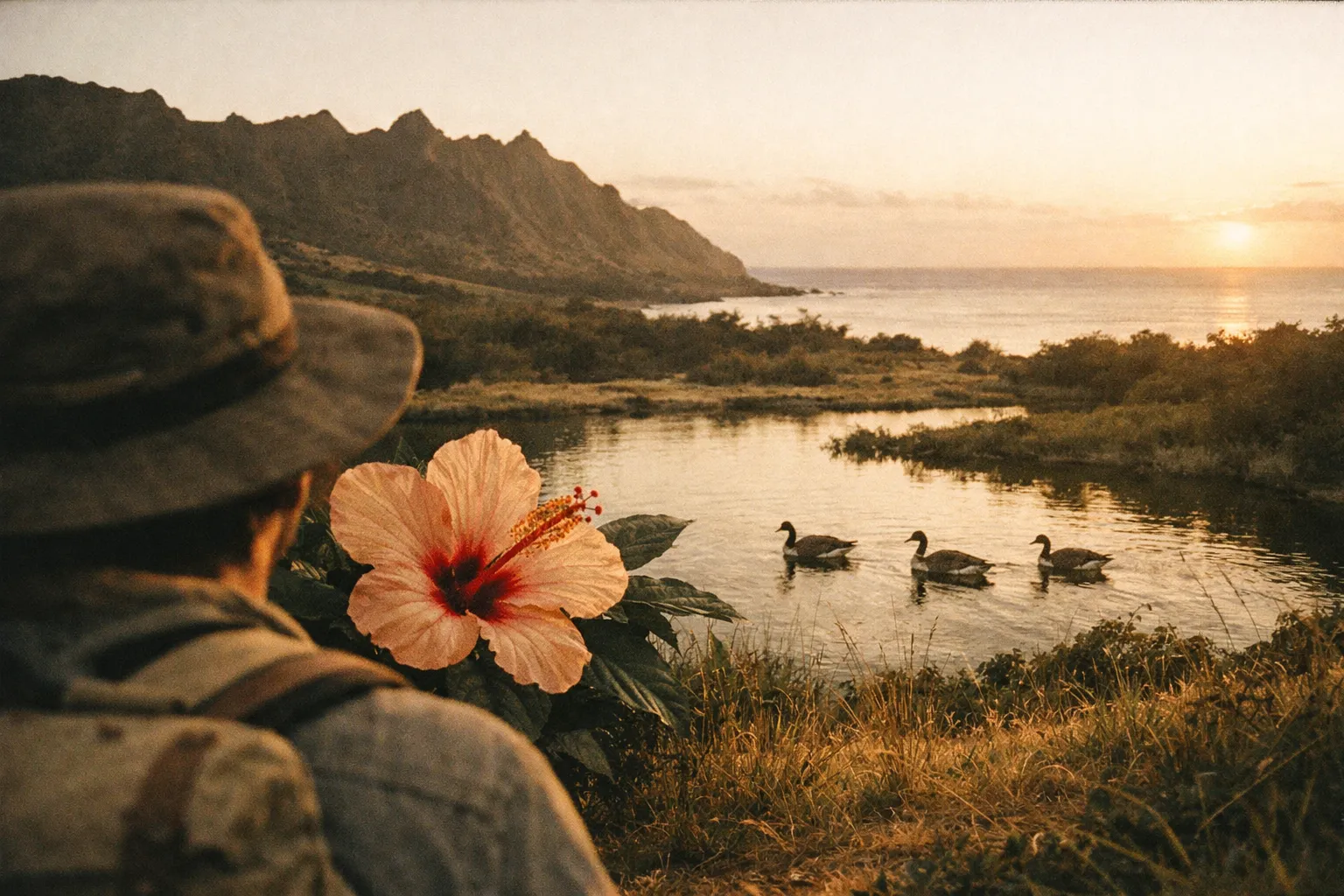
Hawaii state bird: the nēnē
The Hawaii state bird is the nēnē (Hawaiian goose, Branta sandvicensis), designated around statehood in 1959. The nēnē evolved from the Canada goose, which likely reached Hawaii about 500,000 years ago and adapted to the islands’ terrain - its feet are less webbed than its mainland ancestor’s, better suited to walking on lava fields than swimming.
It’s as much a conservation story as a symbol. The nēnē was pushed close to extinction and remains federally protected as endangered. You have a good chance of spotting one in the wild at Haleakalā National Park on Maui or Hawaiʻi Volcanoes National Park on the Big Island. I saw a pair near the Haleakalā summit road just before dawn - they weren’t bothered by cars and strolled across the pavement at their own pace, so drive slowly. Don’t feed them; getting used to human food is one of the threats keeping them endangered.
Hawaii state flower: the yellow hibiscus
The Hawaii state flower is the yellow hibiscus (Hibiscus brackenridgei), officially adopted in 1988 (9). While hibiscus flowers had symbolized Hawaii informally since 1959, it took nearly 30 years to select this specific yellow species - a reminder that state symbols evolve over time. The yellow hibiscus, known locally as ma’o hau hele, is itself endangered in the wild, linking it thematically to the nēnē: both signal the fragility of native Hawaiian ecosystems.
When explaining these symbols together, note the staggered timeline - the flag dates to 1816, was carried into statehood in 1959, the bird was designated around 1959, and the flower only became official in 1988 (9).
The Aloha State: culture, community, and conservation
Hawaii’s nickname, “The Aloha State,” reflects more than a slogan. Aloha means far more than hello or goodbye - it carries love, peace, and compassion. You notice the difference from the transactional interactions common in many tourist spots. Experiencing the Aloha spirit is the part of a Hawaii trip that doesn’t show up in photos but stays with you.
Conservation goes hand in hand with that ethic. From the volcanic activity at Kīlauea to the humpback whales wintering in island channels, the state actively manages its natural assets rather than letting tourism pressure take over. Humpback season runs roughly December through April; if you want to see breaches from shore, the Maui coastline between Kīhei and Lāhainā is your best bet - no boat needed. For more on activities and adventures, check out Things to Do in Hawaii: Ranked by Worth-the-Detour.
What Hawaii’s symbols cost you as a traveler
Learning about the symbols costs nothing; being in Hawaii to see them does. This is where most cultural guides leave you hanging, so here are some numbers.
Hawaii’s composite cost-of-living index is 183.9 compared to a U.S. average of 100, meaning daily expenses run about 84% higher than the mainland (5). Average rent in 2025 was about $1,816 per month, compared to the national average of $1,639 - an 11% premium that spikes on Oʻahu and in resort areas. For visitors, that translates to food, transport, and souvenirs running 20-80% above mainland prices depending on what you’re buying (5).
Budget guide for a symbols-focused trip:
- Museum admission (Iolani Palace, Bishop Museum): around $25-$30 for adults, $15-$20 for kids
- A quality outdoor Hawaii flag (3×5 ft nylon or polyester): $20-$40 at specialty shops; $60-$100+ for 5×8 ft or heavy-duty versions
- Flag apparel and souvenirs: $10-$80 depending on size and quality
- Souvenir budget for a trip centered on symbols: $50-$150 per person
Best month for this kind of trip: April. Whale season is winding down but not over, the Haleakalā summit where you might spot nēnē is accessible, spring shoulder-season pricing has kicked in before summer crowds, and afternoon rain on windward sides is lighter than in deep winter. For tips on travel logistics and gear, see Hawaii Travel Tips: Hostels, Gear, Airports, Budget.
✓ Pros
- The flag uniquely reflects Hawaii's complex history and diplomatic ties.
- Symbols like the nēnē and yellow hibiscus highlight conservation efforts.
- Iolani Palace offers a rare glimpse into American royal history.
- April offers good weather and fewer crowds for symbol-focused visits.
✗ Cons
- Hawaii's high cost of living and visitor prices can strain budgets.
- Some symbolic meanings commonly cited are inaccurate or overstated.
- Sovereignty issues and flag variations may confuse casual visitors.
Frequently asked questions
Frequently Asked Questions
- Can I buy an official Hawaii flag with exact proportions?
- Yes, specialty shops sell flags matching Hawaii Revised Statutes proportions, but generic UK flag sizes won't align properly.
- Are there guided tours available at Iolani Palace year-round?
- Guided tours run regularly but fill quickly; booking ahead is essential, especially in peak seasons.
- Why do some Hawaiian flags fly upside down?
- Flying the flag upside down signals distress and is used in sovereignty protests, not as a mistake.
- Is the Kanaka Maoli flag legally recognized in Hawaii?
- No, the Kanaka Maoli flag has no official status but is widely used by sovereignty activists.
- When is the best time to spot the nēnē in the wild?
- Early mornings near Haleakalā or Hawaiʻi Volcanoes National Park offer the best chances to see nēnē.
- How does Hawaii's cost of living affect visitors?
- Visitors pay 20-80% more for food, transport, and souvenirs compared to the mainland due to import costs.
Before you go
The Hawaii flag is the most direct way into the state’s history you’ll find - one glance at the Union Jack and eight stripes opens the story from Kamehameha’s unification through statehood. Read the flag right (friendship with Britain, not conquest; eight islands, not hidden color meanings), and you’ll understand more of what you’re seeing than most visitors.
If you’re building a trip around these symbols, prioritize Iolani Palace in Honolulu for royal history and either Haleakalā or Hawaiʻi Volcanoes National Park for a real chance to spot the nēnē in the wild. Budget for Hawaii’s roughly 84%-above-mainland cost of living (5), aim for April, and drive summit roads slowly - the state bird crosses on its own schedule. For a deeper dive into sustainable travel and local culture, consider Hawaii: Sustainable Travel & Immersion.