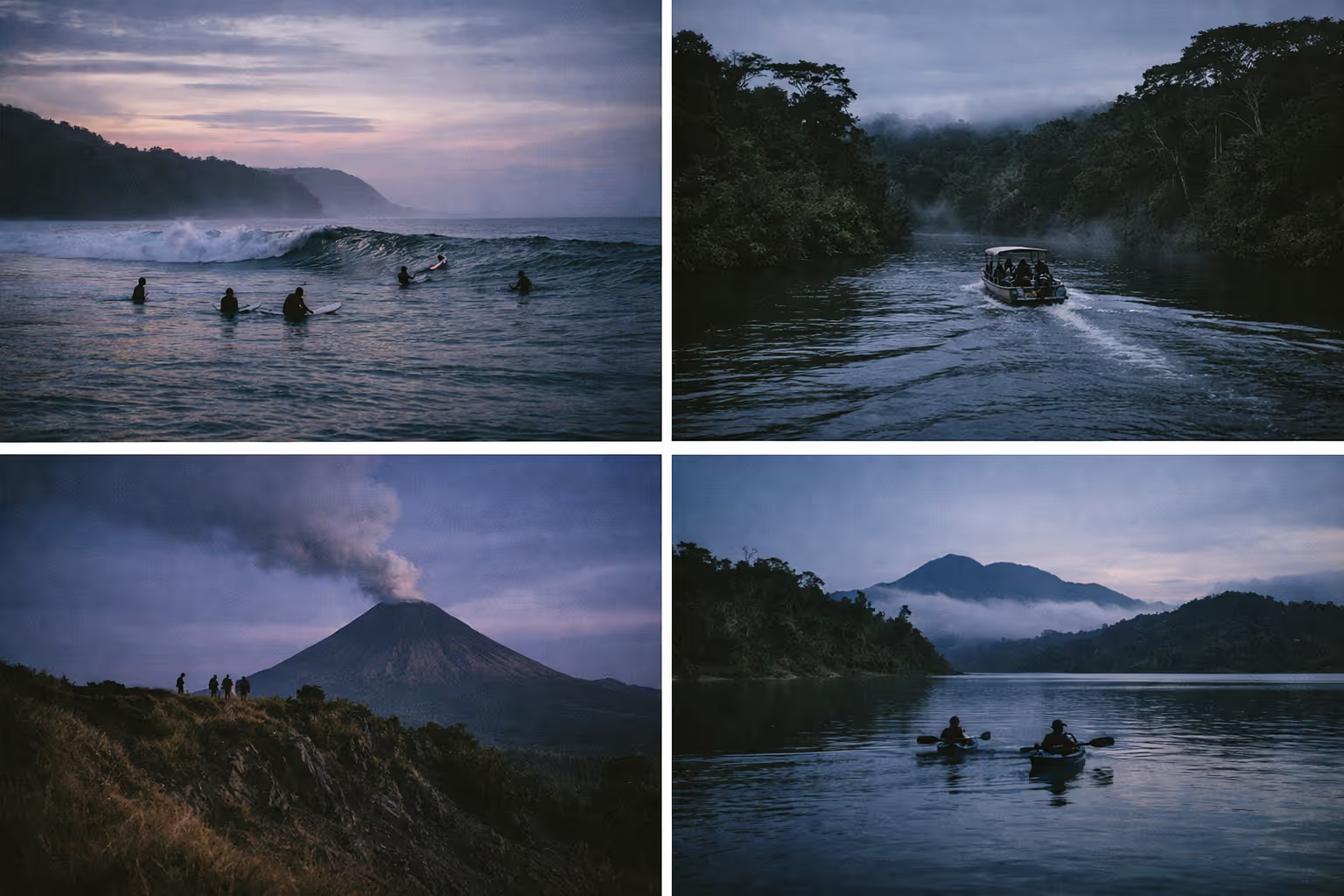
Costa Rica has 28 national parks, but most trips only have room for a couple that truly fit your route. The trick with Costa Rica national parks is matching the park to your time, your tolerance for logistics, and what you actually want to see, not trying to “do them all.” Some parks are compact, high-payoff day trips; others are multi-day commitments where the transit and booking mechanics are the whole game.
Costa Rica’s park system is managed by SINAC (under the environment ministry), and more than 25% of the country is protected for conservation. That’s why parks feel “central” here. It’s also why you can waste days if you choose parks based on popularity instead of fit.
Below is a decision guide: parks by traveler type, then the booking and season rules that make or break your plan.
Visiting Costa Rica's National Parks: The Honest Overview
- Do Costa Rica national parks require advance booking?
- The flagship parks do. Manuel Antonio and Poás use timed-entry online tickets with daily caps. Corcovado requires a licensed guide and caps daily visitors by sector. Carara is no longer a walk-up park: since September 1, 2023, its tickets are sold only online. Parks like Cahuita still allow walk-up entry in most cases, but check the SINAC portal before you assume.
- How much does it cost to enter Costa Rica national parks?
- Fees vary by park and residency status. Manuel Antonio charges $18.08 for nonresident adults and $5.65 for nonresident children, per SINAC. Poás charges $15.00 for nonresident adults and $5.00 for children. Cahuita's Kelly Creek entrance operates on a suggested donation of $5-$10 per person. Always verify current fees on the official SINAC portal before your visit, as the tariff document is actively maintained.
✓ Pros
- Biodiversity is concentrated in protected areas that are generally well-managed, with reliable wildlife sightings in the top parks.
- The range of park types is wide (volcanoes, canals, beaches, rainforest), so most travel styles have a good match.
- SINAC's online system makes advance planning straightforward for parks that require tickets or time slots.
- In the right parks, wildlife isn't a lottery. It's a matter of being there early and using a guide when it helps.
✗ Cons
- The popular parks now lean heavily on advance online tickets and timed entry. Walk-up access is increasingly unrealistic at the flagships.
- Remote parks like Corcovado and Tortuguero require multi-day planning and are logistically expensive in time, even before you talk money.
- Visitor caps mean peak-season slots can sell out ahead of your dates, especially weekends and holidays.
- SINAC maintains an official tariff document, which is your cue that rules and fees change and older guides can be stale.
- Fees are set per park and residency status with no multi-park pass available, so budgeting requires checking each park individually on the SINAC portal.
What Costa Rica’s National Parks Actually Look Like as a System
Costa Rica’s national park system includes 28 national parks managed by SINAC within a much larger protected-area network, not just “parks with trails.” SINAC (Sistema Nacional de Áreas de Conservación) sits under the environment ministry and oversees national parks plus wildlife refuges, forest reserves, and other protected categories, which is why a “park” day can mean anything from a crater viewpoint to a boat-only canal system.
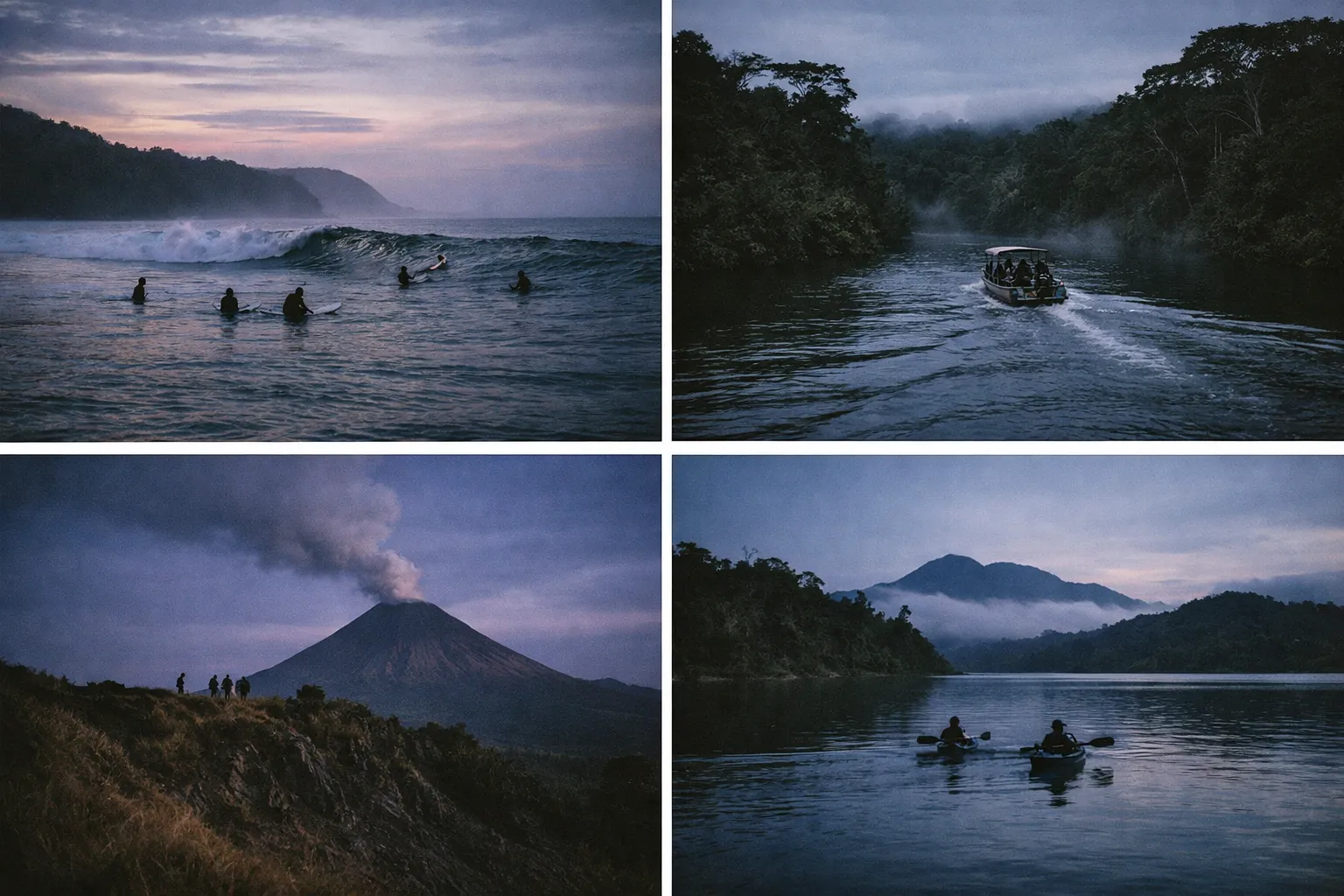
A key context piece: according to Visit Costa Rica, more than 25% of the country’s territory is reserved for conservation. That’s one reason Costa Rica can deliver so much wildlife within a week-long itinerary. The other reason is that ecosystems change fast as you move around: active volcano zones, Pacific rainforest, Caribbean wetlands, coral reef, and tropical dry forest all exist in a country you can cross in a day if you do it inefficiently.
The parks are not interchangeable, and the visitor data makes that obvious. Manuel Antonio alone recorded over 4.38 million visitors from 2012 to 2022 in a commonly cited dataset. Meanwhile, plenty of parks get a tiny fraction of that traffic, usually because access is slower, the experience is niche, or the logistics are higher friction.
Booking mechanics are now part of the system, not an add-on. SINAC has moved more parks toward advance online purchase, with rules and fees actively maintained in the official tariff document. Translation: if a blog tells you “just show up,” verify it on the official portal before you build a route around it.
The Parks Worth Prioritizing (and Why)
The parks “worth it” in Costa Rica are the ones that match your travel style and time budget, not the ones that win a generic top-10 list. A practical planning framework that works for most people is a two-tier shortlist: pick one easy park near a base you’re already using, then pick one signature park that’s worth extra effort. Trying to collect multiple parks in the same region usually dilutes the trip with drive time and duplicate wildlife.
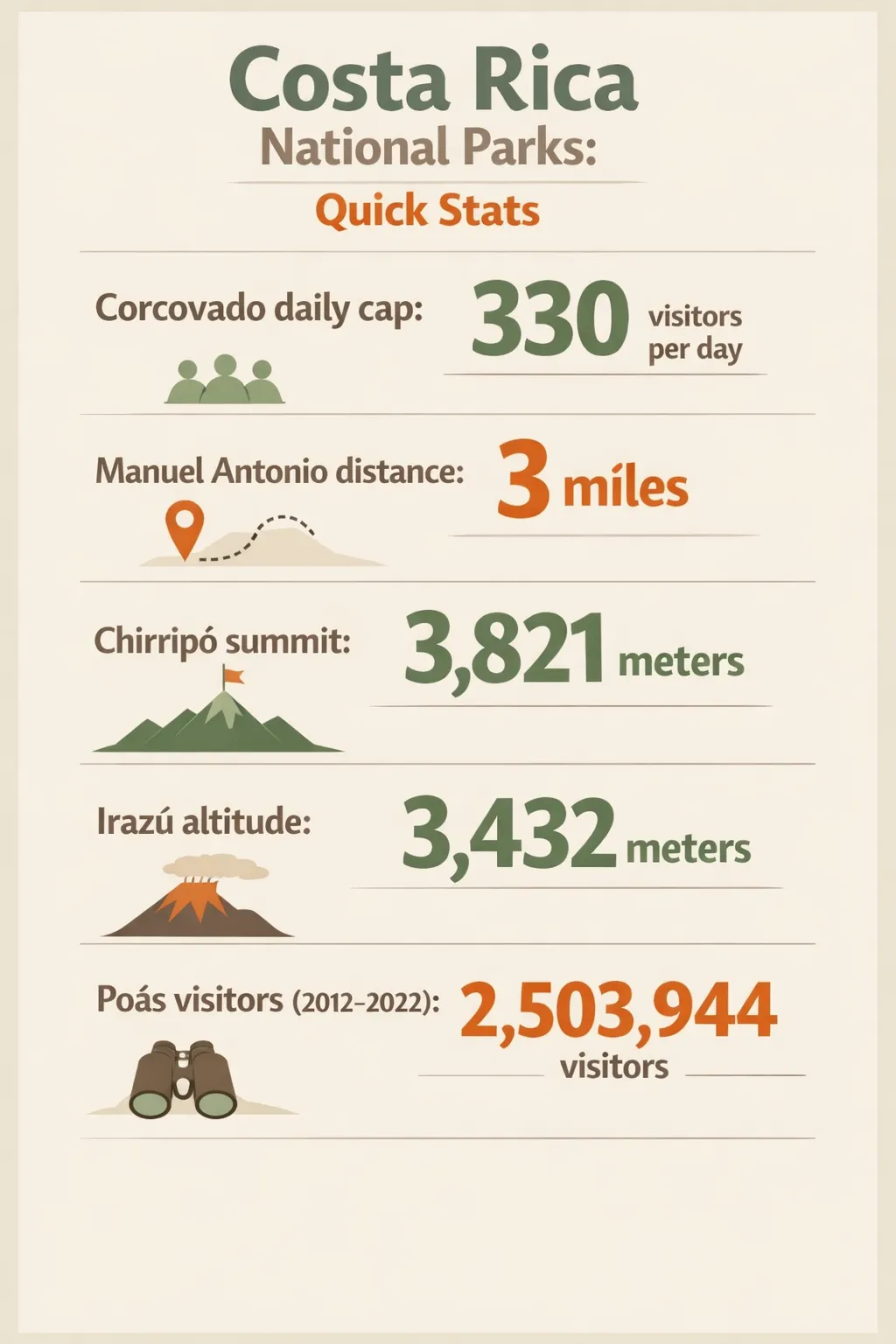 Key park metrics: Corcovado 330 per day; Manuel Antonio 3 miles from Quepos; Chirripó 3,821 meters; Irazú 3,432 meters; Poás 2,503,944 visitors (2012-2022).
Here’s the decision logic I use when routing friends’ trips:
- First-timers who want a high payoff day: compact, accessible parks where you can see wildlife quickly and still hit a beach or town.
- Wildlife-first travelers: parks where habitat is dense and access rules keep things functional (often guided, often capped).
- Volcano seekers: crater-and-lava landscapes with a big payoff for relatively little hiking.
- Active / trekking travelers: parks where the point is the trail itself, not a quick wildlife loop.
The names you see repeatedly in guide lists (Manuel Antonio, Corcovado, Tortuguero, Poás, Irazú, Rincón de la Vieja, Carara, Cahuita, Marino Ballena) show up for a reason: they combine distinctive scenery or wildlife with workable visitor logistics. The other parks aren’t “bad.” They’re just harder to fit into a normal one- or two-week loop.
Before you dive into individual parks, use the table below as your quick filter.
Costa Rica National Parks Quick Reference
| Manuel Antonio | Corcovado | Tortuguero | Poás Volcano | Irazú Volcano | Rincón de la Vieja | Carara | Cahuita | Chirripó | Marino Ballena | |
|---|---|---|---|---|---|---|---|---|---|---|
| Best For | First-timers, beach + wildlife | Serious wildlife | Turtles, canals | Crater day trip | Crater day trip, Central Valley | Active travelers, hot springs | Macaws, lower crowds | Caribbean wildlife, reef | Serious trekking | Whale watching, beach |
| Effort Level | Low | High | Medium | Low | Low | Medium | Low | Low | High | Low |
| Days Needed | 1 | 2-4 | 2-3 | 1 | 1 | 1-2 | 1 | 1 | 3-5 | 1 |
| Advance Booking Required? | Yes (online only, timed entry) (1) | Yes (daily caps per sector) | Recommended | Yes (timed slots) | Recommended | Recommended | No | No | Yes (permit required) (9) | No |
| Crowds | High | Low-Medium | Medium | High | Medium-High | Low-Medium | Low | Low | Low | Low-Medium |
Manuel Antonio: The Right Park for Most First-Time Visitors
Manuel Antonio National Park is Costa Rica’s most visited park because it’s compact, close to amenities, and combines beach time with reliable wildlife. In a dataset commonly cited in travel coverage based on SINAC figures, Manuel Antonio recorded over 4.38 million visitors from 2012 to 2022, the highest total in the country. That number is about access as much as it’s about ecology.
How to get there
Manuel Antonio sits about 3 miles (5 km) from Quepos. From San José, it’s roughly a 3-hour drive in normal conditions (1), or you can use a domestic flight to Quepos (XQP) and then a short taxi to the entrance. It’s one of the few parks where you can sleep in a real town with lots of dining, then be at the gate early without a major transfer.
What you’ll actually see (and what you won’t)
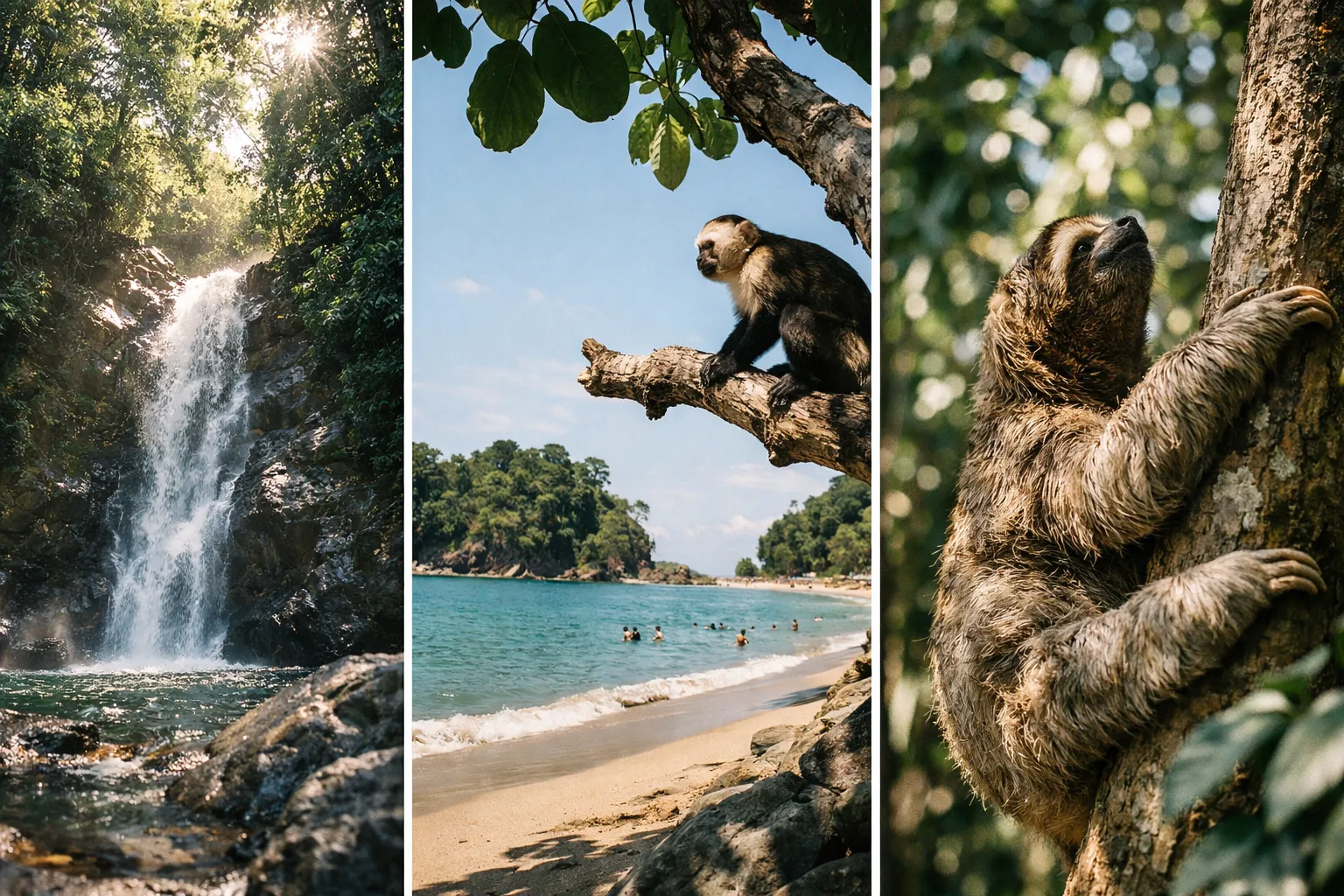
The “sell” is simple: short trails through coastal forest, plus swimmable beaches inside the park boundary. Expect white-faced capuchins, sloths (both two-toed and three-toed), squirrel monkeys, and a lot of birds. You’re not hiking for hours to get the payoff. That’s why families love it.
The honest caveat: if your only goal is maximum wildlife density per quiet hour, Manuel Antonio gets outperformed by Corcovado and Tortuguero. It’s busy by Costa Rica standards, and animals don’t always cooperate when the trails are full.
One lived-experience anchor: I tested Manuel Antonio’s entry flow most recently in October 2024, and the tightened online reservation system was already changing the whole feel of the morning rush. If you arrive thinking you’ll buy tickets at the gate, you’re playing the trip on hard mode.
Costs (only what’s sourced)
According to SINAC’s official Manuel Antonio page, nonresident adult admission is $18.08 and nonresident child admission is $5.65 (1). Guides are optional but often worth it for sightings, especially sloths.
Best month to visit (with reason)
December to April is the easiest window for weather and trail conditions on the Central Pacific, but it’s also when the park sells out fastest. If you’re flexible, shoulder season can be a sweet spot: you’ll trade some rain for fewer crowds.
One thing most guides get wrong
Most guides imply Manuel Antonio is “the best park.” It’s the most accessible high-payoff park. That’s different. If you come expecting Corcovado-level wilderness and solitude, you’ll be annoyed. If you come expecting a smooth park morning followed by an afternoon swim, it delivers.
Booking Manuel Antonio: What the Ticketing System Actually Requires
Manuel Antonio’s ticketing system requires online purchase with timed entry, and the park is closed Tuesdays year-round. According to SINAC, the park is open Wednesday to Monday from 7:00 a.m. to 3:00 p.m., and Tuesday is closed (3). Tickets are sold only online through the official system, not at the gate, and the park operates with a 1,120-person daily limit (1).
Practical booking mechanics that matter:
- Book first if your trip is in peak season. Weekends can sell out well in advance.
- Pick an early slot if wildlife is the priority. Trails heat up and crowds build as the day goes on.
- Build Tuesday into your route. If you’re doing a Quepos base, don’t accidentally schedule your park day on the one guaranteed closure.
Corcovado: The Park That Justifies the Extra Logistics
Corcovado National Park is the top choice for serious wildlife because it compresses huge biodiversity into dense rainforest with strict access controls. According to detailed Corcovado planning coverage, the park receives more than 500 cm of rain per year, which drives the lush conditions and also the mud after May (7). If you want the “why does everyone hype this place” answer, it’s that combination of moisture, intact habitat, and limited access.
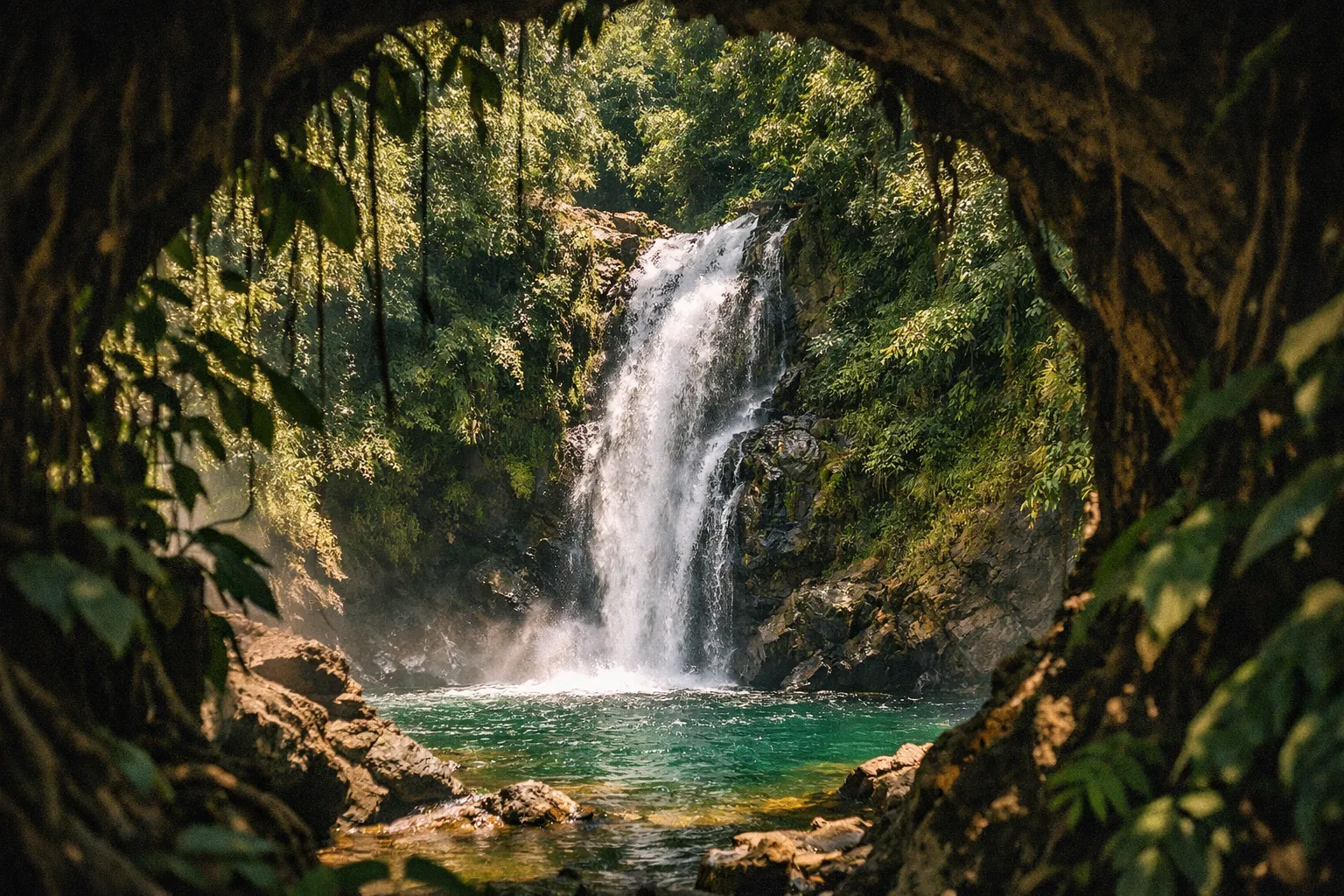
How to get there
Corcovado sits on the Osa Peninsula, and you don’t casually tack it onto a beach loop. Access usually means either:
- A domestic flight to Drake Bay or Puerto Jiménez, or
- A long overland drive plus a boat transfer, depending on your entry sector (7).
If you have fewer than 10 days total, flying is often the difference between “worth it” and “we spent two full days in transit.”
What it costs (sourced)
This is not a cheap park day. Tour and flight costs for Corcovado are not trivially sourced - operators set their own rates and prices shift seasonally. For current pricing, check directly with licensed operators in Drake Bay or Puerto Jiménez, and request quotes from at least two before committing. What is consistent across planning coverage: guided access is mandatory, and the combination of transport, guide fees, and park entry makes this one of the more expensive park days in Costa Rica.
What you’ll see (realistically)
Corcovado’s species numbers are part of the story: over 500 bird species, 140 mammal species, and 116 reptile and amphibian species are cited in the same planning coverage (7). In practical terms, you’re looking for tapirs, scarlet macaws, all four Costa Rican monkey species, peccaries, and constant bird activity.
Big cats are the most common misconception. You might see tracks. You might not. Treat jaguar or puma sightings as a bonus, not a target, and ignore any operator implying guarantees.
Booking mechanics you cannot ignore
Corcovado caps daily visitors sector by sector, and guided access has been mandatory since 2014 according to widely referenced trip planning coverage. Those caps are the whole reason the experience still works.
Plan like this:
- Day trips: book early in high season.
- Sirena overnights: plan further ahead and treat your dates as fixed. The overnight side is the constrained resource.
Best month to visit (with reason)
December through April is the favored window because trails are more passable and cancellations are less likely. After May, the mud and heavy rains are a real factor (7).
One thing most guides get wrong
Many guides make Corcovado sound like a hard-but-simple add-on. It isn’t. It’s a sub-trip with its own base, its own bookings, and enough weather risk that you should build buffer days. The logistics are not “extra details.” They’re the product.
Drake Bay vs. Puerto Jiménez: Choosing Your Corcovado Base
Drake Bay is usually the more atmospheric base for tours, while Puerto Jiménez offers more services and easier self-logistics. That’s the trade: Drake Bay feels closer to the forest and tour flow; Puerto Jiménez is more practical if you want shops, rentals, and more flexible planning (7).
My routing rule:
- Pick Drake Bay if your plan is “do guided Corcovado days, then leave.”
- Pick Puerto Jiménez if you want a more service-heavy base and you’re comfortable managing moving parts.
One lived-experience anchor: I drove the Osa approach in wet-season conditions once and watched a “short” transfer turn into an all-day problem. If your schedule is tight, fly.
Tortuguero: A Canal System, Not a Hiking Park
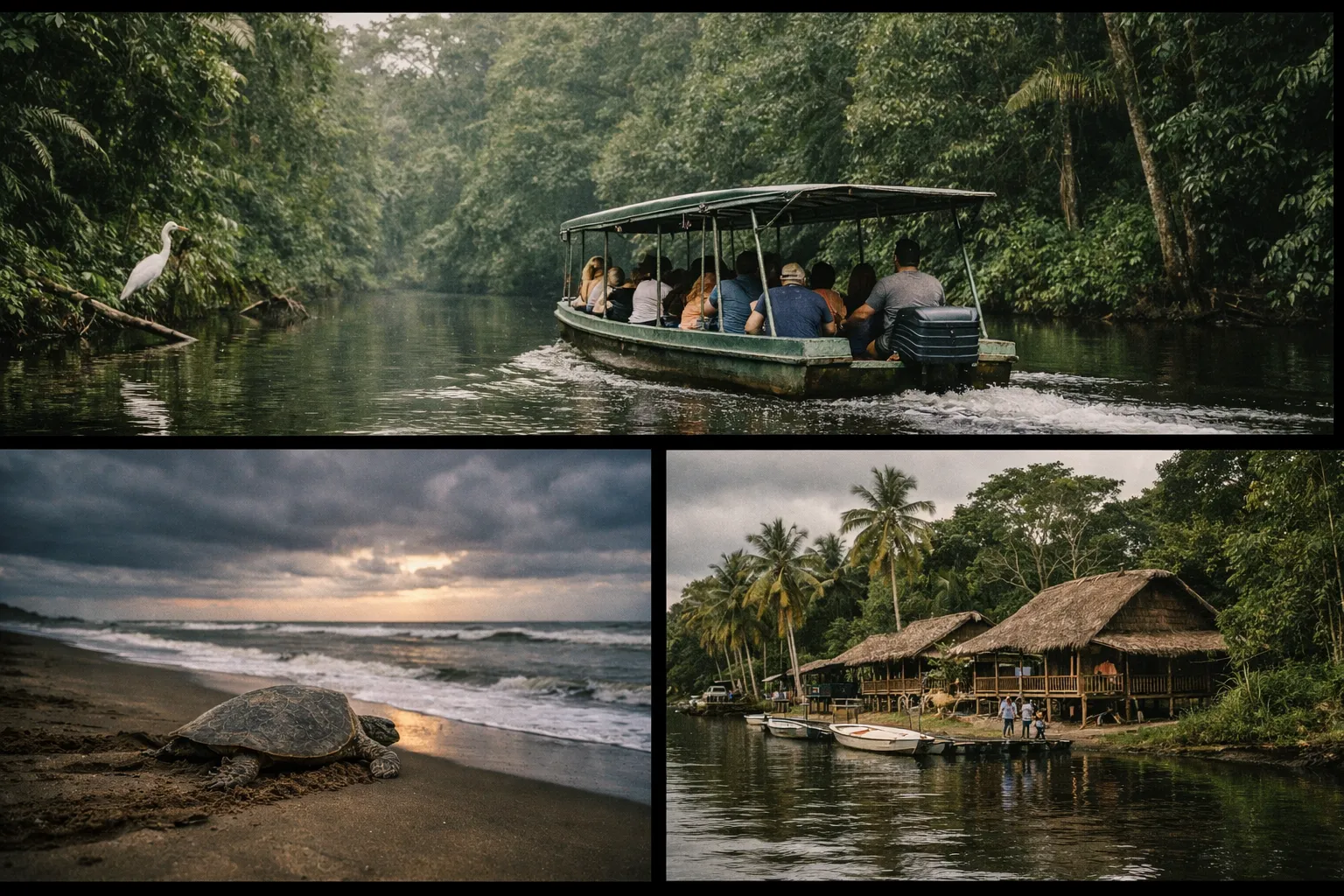
Tortuguero National Park is worth prioritizing when you want boat-based wildlife viewing and turtle nesting, not a self-guided hiking network. It’s one of the most distinct park formats in Costa Rica: no road access, canals instead of trail loops, and a village-and-lodge ecosystem that most visitors use as the base.
How to get there
You reach Tortuguero by boat (common routes from the mainland docks) or by small plane, then you move around by boat and on foot in the village. The access friction is real, but it filters out casual day-trippers.
Visitor hours you should plan around
According to SINAC, Tortuguero’s visiting hours are 6:00 a.m. to 12:00 m.d. and 1:00 p.m. to 4:00 p.m. (8). That midday break matters if you’re trying to stack tours and park entry in the same day.
Why people come: turtles, canals, and “close range” wildlife
According to Visit Costa Rica, green sea turtles nest mainly July to October, with a peak in August to September. That’s the headline. But Tortuguero is still strong outside nesting season: you’re looking for caimans, waterbirds, and other canal wildlife year-round.
Turtle tours have strict rules for a reason. During nesting season, night and dawn walks are guided, controlled, and light-restricted. For a full breakdown of best beaches in Costa Rica for wildlife including turtle nesting rules and timing, that guide covers the lighting restrictions and seasonal windows in detail.
What it costs
Tortuguero runs a wide price range depending on how you do it. High-end all-inclusive lodges are the dominant model and carry premium rates - check lodge websites directly for current pricing, as packages vary significantly by season and inclusions. Budget travelers can find cheaper guesthouses in the village, but the logistics still add up once you factor in boat transfers. For turtle nesting tours, verify current guided tour rates with your lodge or a licensed local operator; prices are set per season and are not standardized across providers.
Best month to visit (with reason)
If turtles are your why, target August or September for the peak of green turtle nesting. If you’re trying to avoid Pacific rain, Tortuguero also has a useful planning quirk: the Caribbean’s drier rhythm doesn’t match the Pacific (more on that in the season section).
One thing most guides get wrong
A lot of guides talk about Tortuguero like it’s a normal national park with a trail system and a main entrance road. It’s not. Your “park day” is really a set of boat excursions and timed wildlife windows, and you should plan for 2-3 nights so the transit overhead doesn’t eat the experience.
Poás and Irazú: Volcano Day Trips That Actually Deliver
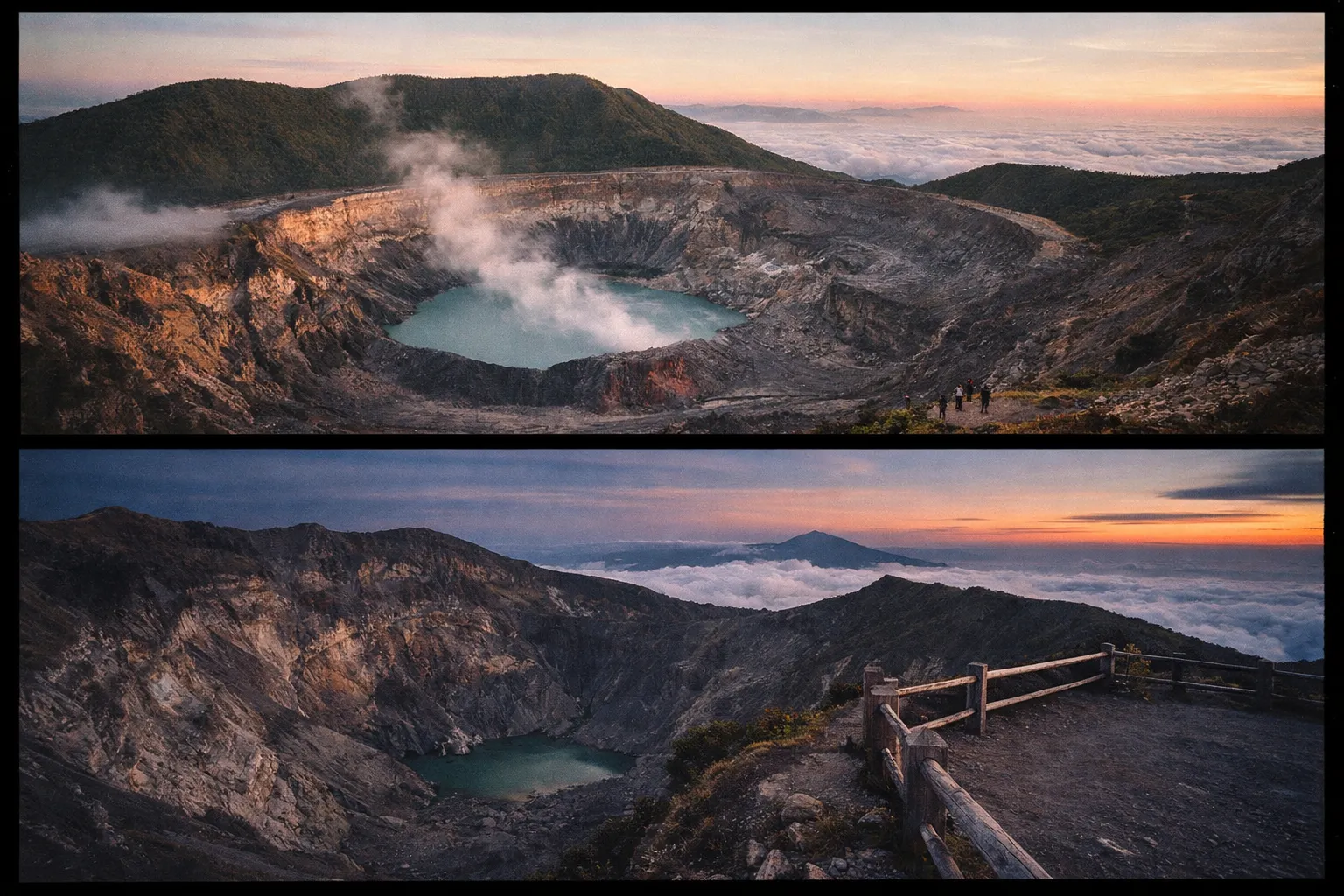
Poás Volcano and Irazú Volcano are the two volcano parks that make the most sense as Central Valley day trips because the payoff-to-effort ratio is high. In the same visitor dataset commonly cited in travel coverage, Irazú logged 2,732,394 visitors and Poás logged 2,503,944 between 2012 and 2022, making them the #2 and #3 most visited parks after Manuel Antonio. That’s not an accident. They fit real itineraries.
How to get there
Both parks are commonly visited from San José and the Central Valley.
- Poás: According to official guidance, it’s about 1.5 hours from San José, and the visit is managed with specific time slots.
- Irazú: It’s also a realistic day trip from San José or Cartago. The big planning lever here is timing, not distance.
What you’ll see
These are crater landscapes, not multi-day volcano treks. You’re there for the geology: crater rims, mineral colors, and the “standing at altitude looking into a volcanic basin” sensation without technical hiking.
- Poás is known for its active crater and acidic crater lake, when conditions allow viewing.
- Irazú is cited as the highest active volcano in Costa Rica at about 3,432 meters (11,260 ft). At that elevation, weather changes fast and mornings tend to be clearer.
Booking mechanics
Poás is the stricter one. According to SINAC’s official guidance, Poás requires advance reservation with timed entry through the online system. It can also close temporarily during volcanic activity, so don’t book it as your one immovable day without checking status close to arrival.
Irazú is often less complicated, but it still rewards early arrival. According to travel guidance, mornings are best for crater visibility because cloud cover builds later in the day.
Best month to visit (with reason)
Dry season (December to April) is the most reliable window for clear views and easier road conditions on the Central Valley side. If you’re visiting in green season, you can still win, but you’re aiming for early morning gaps.
One thing most guides get wrong
A lot of itineraries suggest doing Poás and Irazú in one “double volcano day.” It sounds efficient. It usually isn’t. The altitude, driving time, and timing needs make it more tiring than it looks. Treat each as its own half-day anchor and pair it with a nearby town, coffee region stop, or Cartago.
Poás vs. Irazú: Which Volcano to Prioritize If You Only Have One Day
Poás is the better pick for a tightly managed active crater-lake viewpoint, while Irazú is the better pick for high-altitude crater scenery and clearer morning odds. Poás uses timed reservation windows and is more strictly controlled (6), while Irazú’s key tactic is arriving early to beat cloud buildup.
My simple filter:
- Choose Poás if you want the “big crater viewpoint” experience and you can commit to a time slot.
- Choose Irazú if you’re okay with a slightly more weather-dependent view but want altitude and a less structured visit.
For travelers also considering Costa Rica volcanoes cloud forest and beaches as a combined itinerary, that guide covers how to sequence volcano visits alongside cloud forest stops and hot springs without backtracking.
Lower-Crowd Alternatives Worth Knowing About
Carara, Cahuita, Rincón de la Vieja, Marino Ballena, and Chirripó are not fallback parks; they’re smart first choices for the right trip style. If you’re trying to avoid the “flagship park crush” or you’re building a route that doesn’t touch the standard circuit, these are the names that keep your itinerary efficient.
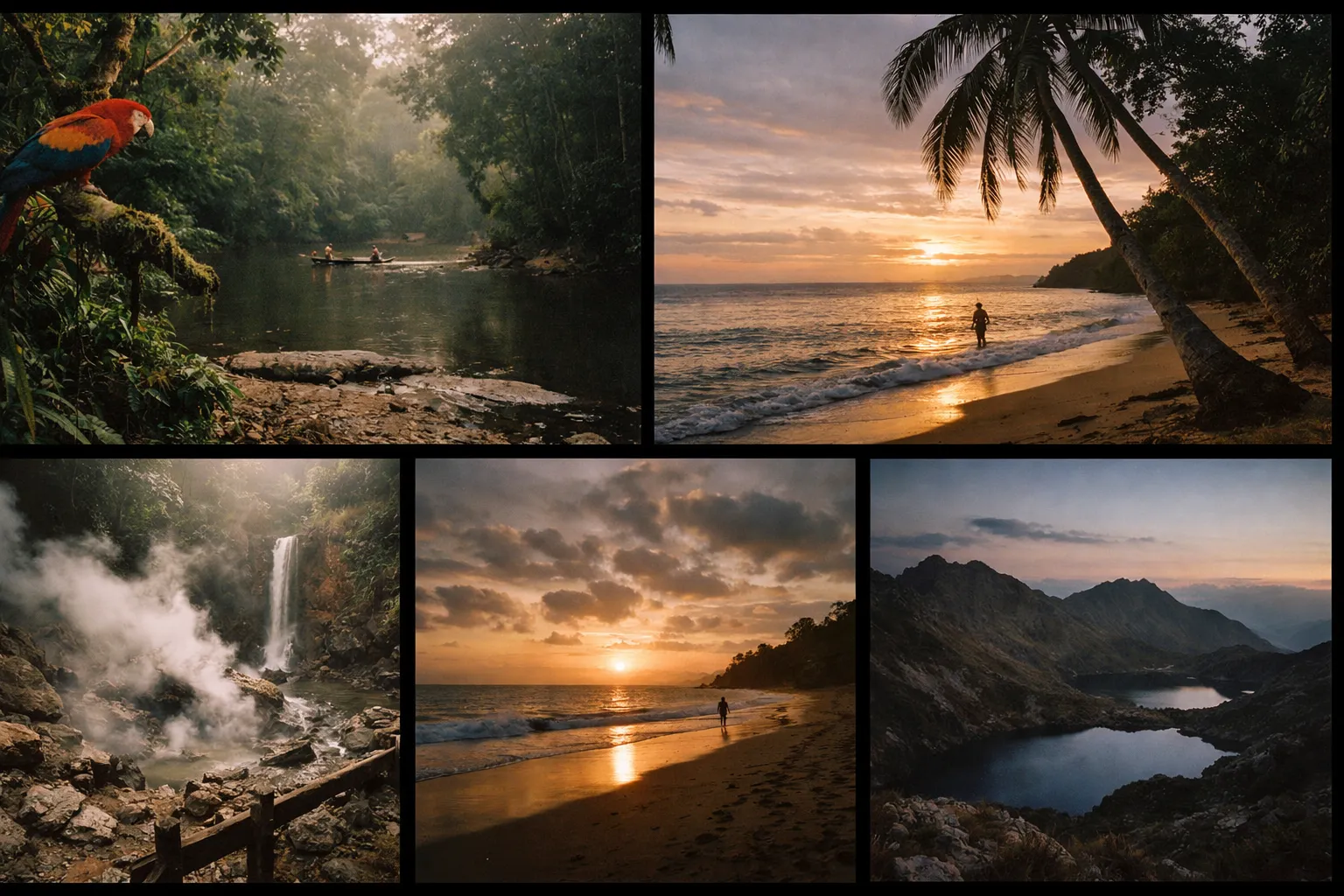
Here’s how to think about each, ranked by “worth the detour” vs “skip if short on time.”
Worth the detour
- Rincón de la Vieja National Park (Guanacaste): Rincón de la Vieja is a better fit than Poás or Irazú if you want an active volcanic landscape plus real trails, with mud pots, fumaroles, waterfalls, and hot-spring zones. SINAC’s park guidance indicates it’s among parks moving toward advance reservation rather than purely walk-up entry. Plan 1-2 days so you can hike and still have time for a soak.
- Cahuita National Park (Caribbean): Cahuita’s format is relaxed and practical: a coastal trail with frequent wildlife (sloths, monkeys, snakes) and access to coral reef snorkeling on calmer days. The Kelly Creek entrance operates on a suggested donation of $5-$10 per person, per park practice summarized by Toorizta’s Cahuita guide. The Puerto Vargas sector charges a set entrance fee - check the SINAC portal for the current amount before you go. If you want a low-stress park day where you can move at your own pace, Cahuita is hard to beat.
- Chirripó National Park: Chirripó is for serious trekkers, not casual hikers. The summit is 3,821 meters (12,536 ft), the highest point in Costa Rica, and it requires permits and planning (9). If your trip goal includes a high-altitude, multi-day trek, Chirripó is the park that makes Costa Rica feel like a mountain country.
Worth doing if you’re already nearby
- Carara National Park (Central Pacific): Carara is a transition forest between dry and humid ecosystems and is well known for scarlet macaws. It’s an easy day trip from Jacó or the Central Pacific corridor and often delivers better “quiet trail time” than Manuel Antonio. If you’re already planning things to do in Jaco Costa Rica, Carara fits naturally as a half-day add-on before or after your Jacó base.
- Marino Ballena National Park (Southern Pacific): Marino Ballena is most worth it if whales are in your window. Visit Costa Rica notes whale season mainly July-November and December-March. Outside that, it’s still a solid beach-and-coastline park, but it becomes more of an add-on than a centerpiece.
One thing most guides get wrong
Guides often frame these parks as “alternatives” in a way that implies they’re second-rate. The real mistake is choosing them as last-minute substitutes instead of building your route around them intentionally. Cahuita and Rincón de la Vieja, in particular, can be the best park day of a trip if your goal is lower crowds and a looser schedule.
Booking, Tickets, and What’s Changed in 2026
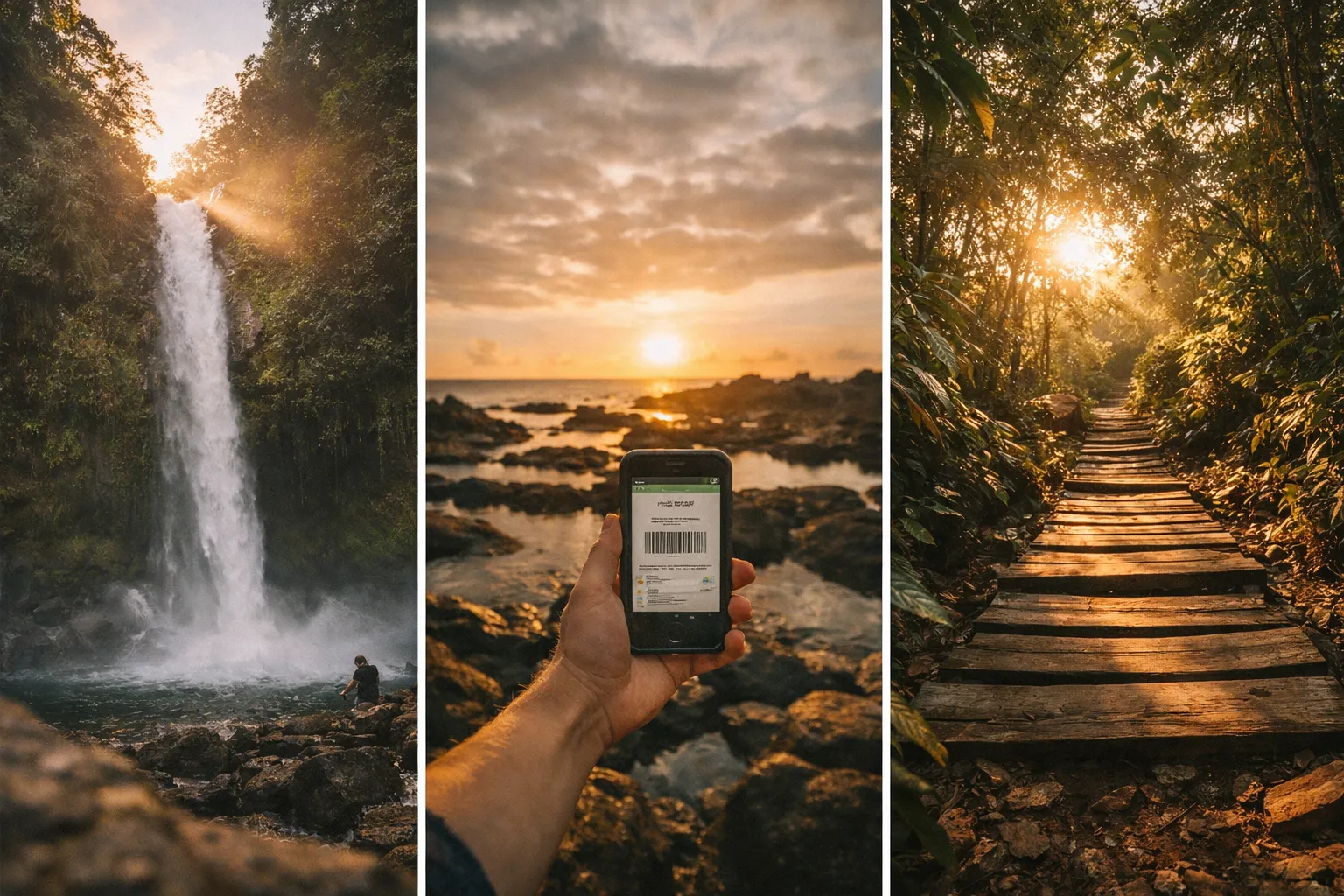
Costa Rica’s flagship parks increasingly require online tickets and timed entry through SINAC, so booking is now itinerary-critical, not optional. According to SINAC, the official online reservation system is the standard purchase channel for parks that require advance booking, and the official tariff document is actively maintained, signaling ongoing policy and fee changes.
How the SINAC system works (in practice)
You buy tickets through the official SINAC portal, then show up with the reservation aligned to that park’s rules. The key complication is that rules vary by protected area:
- Some parks use timed entry windows (Poás and Manuel Antonio are the obvious examples) (1, 3).
- Some parks are constrained by daily visitor caps (Manuel Antonio at 1,120 per day (1); Corcovado sector by sector).
- Some parks still function as walk-up entry in practice, but that list is shrinking and can change.
The safest approach is to treat every park as “check the official rules,” even if a friend visited last year and winged it.
The caps and constraints that actually shape your itinerary
- Manuel Antonio: 1,120 daily visitors, timed entry, online only, closed Tuesdays (1).
- Corcovado: daily caps per sector, guided access required, and the multi-day sectors book out.
- Poás: timed reservations through the online system.
- Chirripó: permits and advance reservation are part of the deal (9).
Carara is not one of them: since September 1, 2023, its tickets are sold only online. For parks like Cahuita, Marino Ballena, and many others, walk-up entry can still be normal, but “normal” in Costa Rica can still mean long lines if you arrive late in peak season.
Booking mechanics note you should actually use
Book the date-constraining parks first, then build the rest of your loop around them. If you lock Corcovado and Manuel Antonio, most of the rest can flex. If you don’t, you risk building a route that collapses because the one park you cared about is sold out.
A Note on Park Fines and Rules
Costa Rica’s parks enforce rules around trails, wildlife distance, and light use, and fines are real even if they’re not consistently described in blog posts. Visit Costa Rica and SINAC guidance emphasize basic standards: stay on marked trails, don’t feed wildlife, and don’t use flash or white lights in turtle zones. Rules and restrictions vary by protected area, so always read the park-specific guidance in the reservation system before you show up.
When to Go: Seasons, Crowds, and What They Mean for Each Park Type
Costa Rica’s best time to visit depends on which coast and park type you’re prioritizing, because the Pacific and Caribbean run on different rhythms. Visit Costa Rica describes the dry season as roughly December to April and the green season as May to November, with September and October generally the wettest months. That’s broadly true, but the useful planning is in the exceptions.
Dry season (December to April)
This is the easiest window for:
- Pacific-side parks (Manuel Antonio, Marino Ballena, Corcovado access logistics)
- Volcano day trips (Poás, Irazú visibility odds)
- Road reliability for self-drivers
It’s also when the most popular parks feel most saturated. If you hate crowds, don’t schedule Manuel Antonio, Poás, or Irazú on a holiday week.
Green season (May to November)
Green season is often a better deal for:
- Lower crowds
- Lusher forests
- Waterfalls and rivers (more flow, more drama)
But the trade is real: afternoon rain is common, and remote access can become fragile. Corcovado planning guidance notes trails get worse after May because of rainfall and mud (7). If you’re targeting Osa in the wettest stretch, build buffer days. Travelers who want to see Costa Rica waterfalls at their most dramatic should note that green season delivers the highest flow and most impressive drops at La Fortuna and other top-ranked falls.
The Caribbean wildcard: Tortuguero and Cahuita
The Caribbean coast has a different seasonal pattern. Visit Costa Rica notes that Caribbean-side parks such as Tortuguero and Cahuita can have their driest stretch around September to October, which is often peak wet season on the Pacific side. That’s not trivia. It’s a routing advantage.
If you want a two-coast trip without rolling dice on weather every day, consider:
- Pacific highlights earlier in your trip, then
- Caribbean parks in September or October when they’re relatively drier.
Turtle timing that actually matters
- Tortuguero green sea turtles: mainly July to October, peak August to September.
- Marino Ballena whales: mainly July-November and December-March.
Shoulder windows worth targeting
If you want fewer crowds without committing to the wettest stretch, aim for:
- Mid-May to early June
- Late October to mid-November
And if you can avoid them, skip mid-December to early January and Easter week. You’ll spend more time in lines and less time on trails.
What to Watch Out For in the Parks
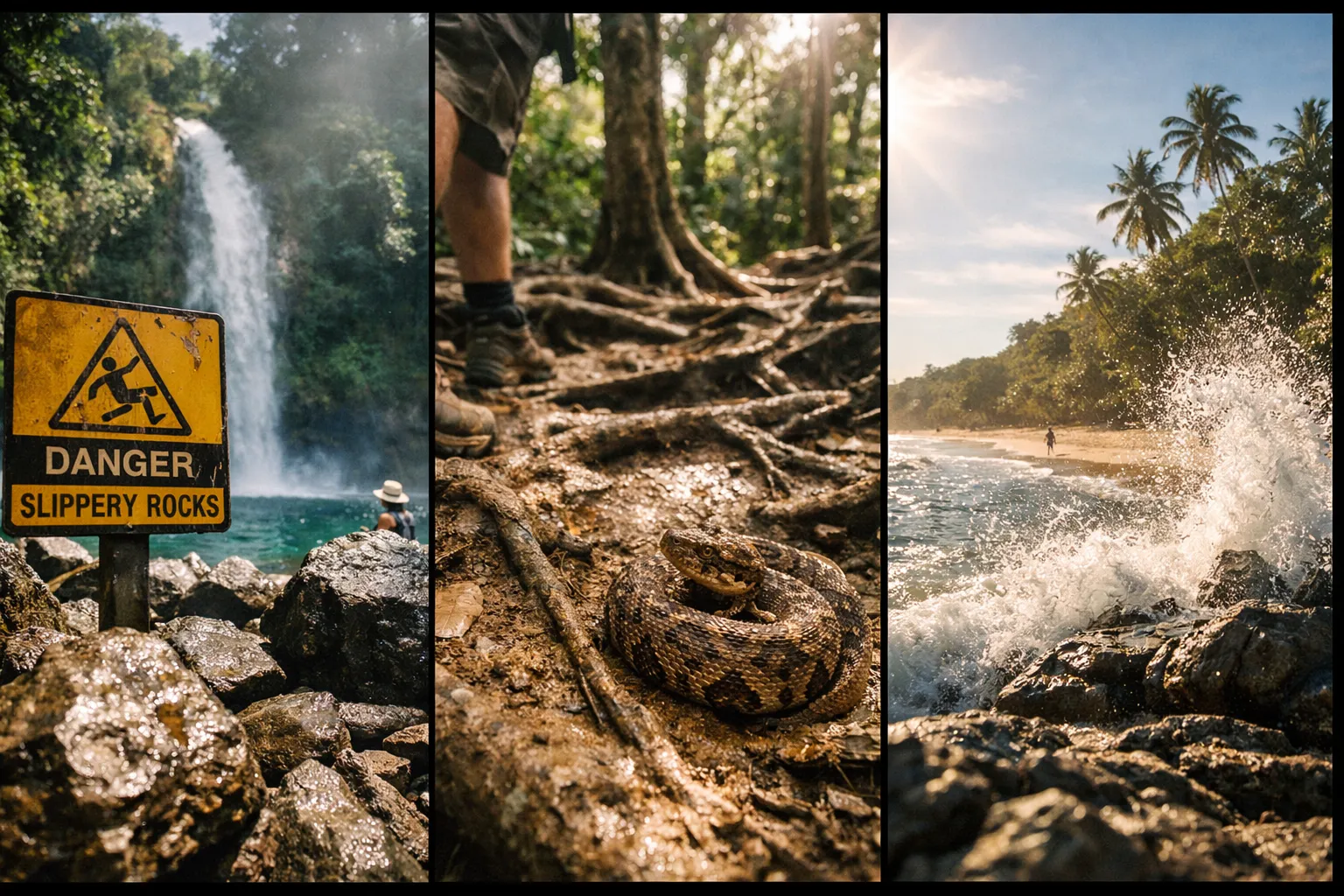
Costa Rica’s national parks are generally safe and well-run, but the real risks are predictable and avoidable if you plan like an adult. Visit Costa Rica’s park guidance highlights several practical hazards and common issues that show up repeatedly for visitors.
Rip currents at park beaches
Beaches inside parks like Manuel Antonio, Cahuita, and Marino Ballena can have rip currents, and the danger gets underestimated because the water looks calm from shore. Check posted flags, ask a ranger about conditions, and if you get caught, swim parallel to shore rather than trying to fight straight back in.
Wildlife interaction (and the guides who push it)
SINAC rules prohibit feeding wildlife and encourage distance and respectful viewing. Any operator who encourages touching, feeding, or staged animal photos is not credible. Besides the ethical side, it’s also how you get fined or removed from a protected area.
Road and trail reality in remote parks
Corcovado and other remote parks get more difficult fast in heavy rain, and planning coverage emphasizes how weather can derail tight schedules (7). Don’t underestimate drive times, and don’t assume a “short distance” on a map means a short transfer in reality. Hikers heading into any of these parks should review hiking in Costa Rica footwear, water, and maps guidance before departure - the section on photographing trail maps at ranger stations and afternoon rain patterns is directly applicable.
One lived-experience anchor: I’ve routed Costa Rica loops multiple times since 2022, and the single most consistent mistake I see is people stacking too many regions and then driving exhausted at the end of the day. Which leads to the next point.
Overestimating what one day covers
Corcovado and Tortuguero are poor fits for rushed day trips because the transit overhead eats the day (7). If you can’t give either park at least 2 nights, pick a different signature park and save them for a trip where you can commit.
Petty theft at trailheads and beaches
Petty theft is a realistic risk, especially from parked cars near popular entrances. Don’t leave anything visible. Don’t stash valuables under a seat and assume tint will save you. Carry what you need, lock up the rest, and use hotel safes for passports when you’re not in transit.
The big planning mistake: “most visited” equals “best”
Manuel Antonio’s visitor numbers reflect accessibility as much as ecological value. If wildlife is your main goal, Corcovado and Tortuguero usually outperform it. If ease and a beach are your goal, Manuel Antonio wins. Decide what you’re optimizing.
Frequently Asked Questions
- Which national park in Costa Rica is the best?
- Depends entirely on what you're after. Manuel Antonio suits first-timers; Corcovado is unmatched for serious wildlife but needs planning.
- What is the most visited national park in Costa Rica?
- Manuel Antonio leads with over 4.38 million visitors (2012-2022). Irazú and Poás follow. High numbers reflect accessibility, not ecological value.
- Do I need to book Costa Rica national park tickets in advance?
- Yes for flagship parks like Manuel Antonio, Poás, and Corcovado. Carara too: its tickets have been online-only since September 2023. Others, like Cahuita, still allow walk-up entry, but check current rules.
- How many days do you need for Costa Rica's parks?
- One day suffices for Manuel Antonio, Poás, Irazú; Tortuguero and Corcovado need 2-3 nights minimum; Chirripó requires 3-5 days with permits.
- Is Corcovado worth the effort?
- Yes for wildlife-focused travelers. It offers exceptional biodiversity but demands planning and budget for guides and access.
- What should you be cautious of in Costa Rica's national parks?
- Rip currents, wildlife feeding prohibitions, remote park trail conditions, and petty theft at parking areas are key cautions.
- Is there a national parks pass for Costa Rica?
- No single multi-park pass covers all of Costa Rica's national parks. Each park requires its own ticket purchased through SINAC or, in some cases, paid at the gate. Some parks collect fees locally rather than through the online system, so the process varies - check each park's entry rules on the SINAC portal before you visit.
How to Build a Park-Focused Itinerary Without Wasting Days
A park-focused Costa Rica itinerary works best when you lock your hardest-to-book park days first, then group everything else by region. This is the step most people skip, then they wonder why they’re backtracking across the country or staring at a sold-out time slot for the one park they actually cared about.
How to Sequence Costa Rica Parks Without Backtracking
4 hoursStep-by-step guide to efficiently plan your Costa Rica national parks itinerary.
- 1
Anchor on your hardest-to-book park first
Corcovado and Manuel Antonio have strict caps and booking rules. Lock these dates before committing to other hotels or activities.
- 2
Group parks by region
Cluster parks to minimize travel time: Central Pacific (Manuel Antonio + Carara), Central Valley (Poás + Irazú), Guanacaste (Rincón de la Vieja), Caribbean (Tortuguero + Cahuita), Osa Peninsula (Corcovado).
- 3
Assign effort tiers
Schedule high-effort parks (Corcovado, Tortuguero, Chirripó) mid-trip when rested; use low-effort day trips (Poás, Irazú, Carara) as bookends.
- 4
Use the two-tier shortlist rule
Pick one easy park near your base and one signature park worth extra logistics per region. Avoid trying to visit too many parks in one area.
- 5
Check SINAC booking rules per park
Booking rules vary: some parks use timed entry, others have visitor caps. Set calendar reminders to book as soon as your dates are confirmed.
- 6
Build buffer days near remote parks
Expect delays from weather, boat cancellations, and road conditions. Avoid tight one-night schedules in Tortuguero or Osa Peninsula.
A practical transport note: if Corcovado is on your plan and you have fewer than 10 days total, domestic flights can save you a full day each way. Check current fares with SANSA or Green Airways when your dates are set - Osa routes vary by season and availability. Travelers managing the full loop on a budget should also check public transport Costa Rica routes, fares, and parks - the guide covers bus connections to Quepos, Jacó, and other park-adjacent towns that can cut transfer costs significantly.
Finally, don’t drive at night. Visit Costa Rica’s guidance flags night driving risk due to unlit roads and hazards like livestock and motorcycles. That’s not fear-mongering. It’s what keeps a clean itinerary from turning into a stressful one.
Costa Rica’s parks are “worth it” when you treat them like trip-defining logistics decisions, not interchangeable attractions. Manuel Antonio is the best default choice for first-timers because it’s compact and easy, but it won’t match Corcovado for wildlife density. Corcovado is absolutely worth prioritizing for serious wildlife travelers, but only if you plan far enough ahead to beat caps and guided-access constraints.
Before you book, check the official SINAC reservation portal and the current rules close to your travel dates. The official tariff document is your reminder that pricing and access policies are actively maintained, and what worked for someone last year might not be true for your trip.