The two Costa Rica airports that matter are SJO and LIR, and which you pick comes down to where you are headed, not which is bigger. Fly into Liberia (LIR) for the Guanacaste beaches, Tamarindo and Papagayo, saving three or four hours of driving. Fly into San Jose (SJO) for Arenal, Monteverde, Manuel Antonio, or any multi-region trip; it is the bigger hub, 25-plus airlines. For a trip on both coasts over eight days, book open-jaw, into SJO and out of LIR, to skip a backtrack day.
Costa Rica Airports: SJO vs LIR and the International Options
Costa Rica has two international airports that handle essentially all foreign arrivals:
- Juan Santamaría International Airport (SJO) - in Alajuela, about 20 minutes from downtown San José
- Daniel Oduber Quirós International Airport (LIR) - just outside Liberia in Guanacaste
That’s it. Every other airport in the country is a domestic strip served by small aircraft - though a handful can receive private or charter international arrivals under the right conditions.
SJO is the main airport in Costa Rica. It moves roughly 5-6 million passengers a year against LIR’s ~2 million, hosts 25+ airlines compared with LIR’s 14, and serves as the connecting hub for nearly every domestic flight in the country (1)(5). In 2026 it was named Best Regional Airport in Central America and the Caribbean in the Skytrax World Airport Awards (3) - not a vanity stat if you’ve ever spent three hours in immigration somewhere worse.
LIR is smaller, simpler, and faster to walk through. If your trip is Guanacaste-focused, that simplicity is the entire point.
Costa Rica airports codes (quick reference)
| Airport | IATA | ICAO | City |
|---|---|---|---|
| Juan Santamaría International | SJO | MROC | Alajuela / San José |
| Daniel Oduber Quirós International | LIR | MRLB | Liberia |
| Tamarindo | TNO | MRTM | Tamarindo |
| Nosara | NOB | MRNS | Nosara |
| Quepos La Managua | XQP | MRQP | Quepos (Manuel Antonio) |
| Drake Bay | DRK | MRDK | Drake Bay |
| Tortuguero | TTQ | MRSV | Tortuguero |
| Tambor | TMU | MRBC | Tambor (Nicoya) |
| Puerto Jiménez | PJM | MRPJ | Osa Peninsula |
The two codes that actually matter when booking: SJO and LIR. Everything else flows from one of those two.
Is it better to fly into SJO or LIR?
Depends entirely on where you’re sleeping. Here’s the honest breakdown:
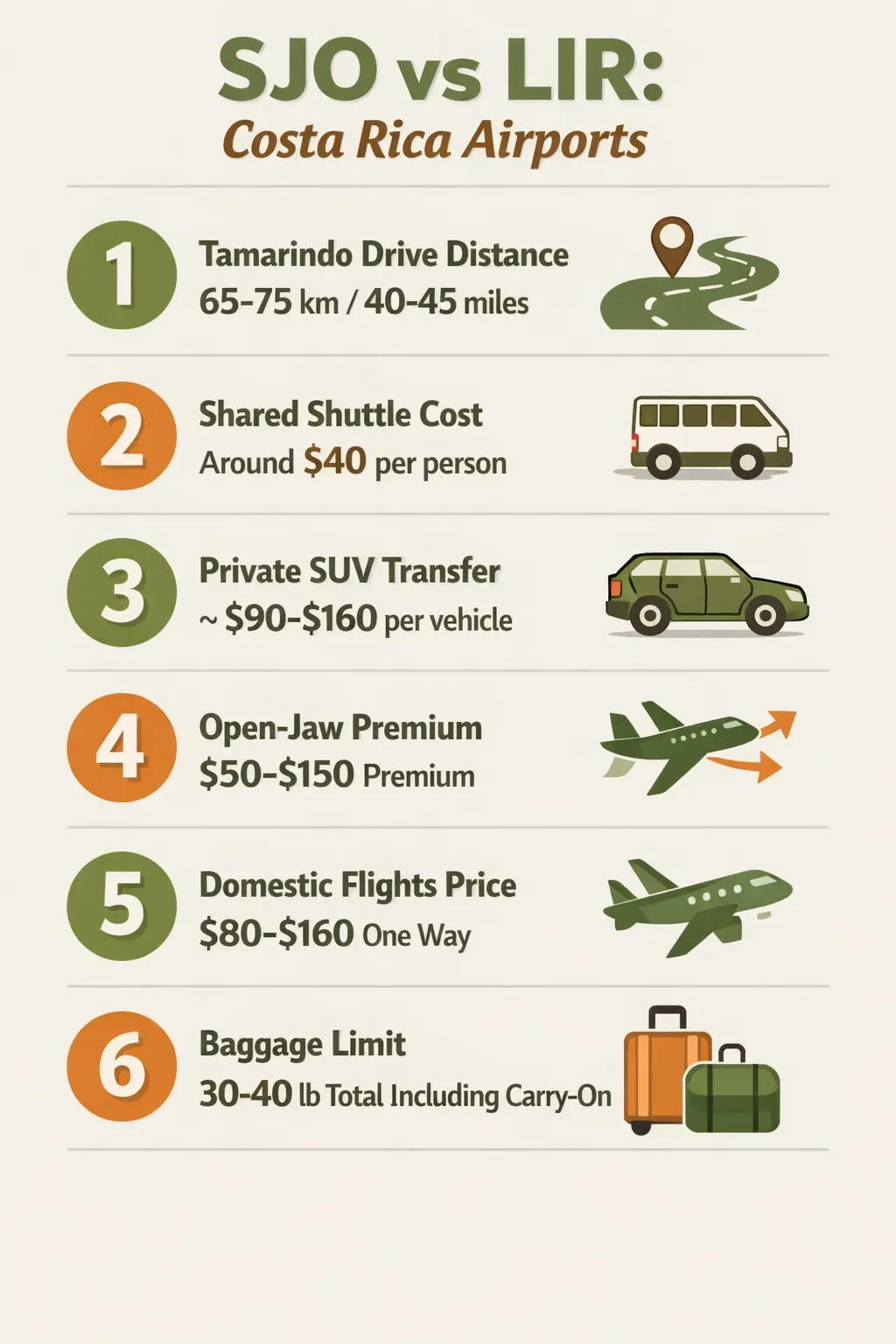 SJO handles 25+ airlines versus LIR’s 14, and Tamarindo access is quicker from LIR; Tamarindo is 65-75 km from LIR, with shared shuttles around $40 per person and private transfers $90-$160; domestic flights cost $80-$160 one way; baggage limits are 30-40 lb total including carry-on.
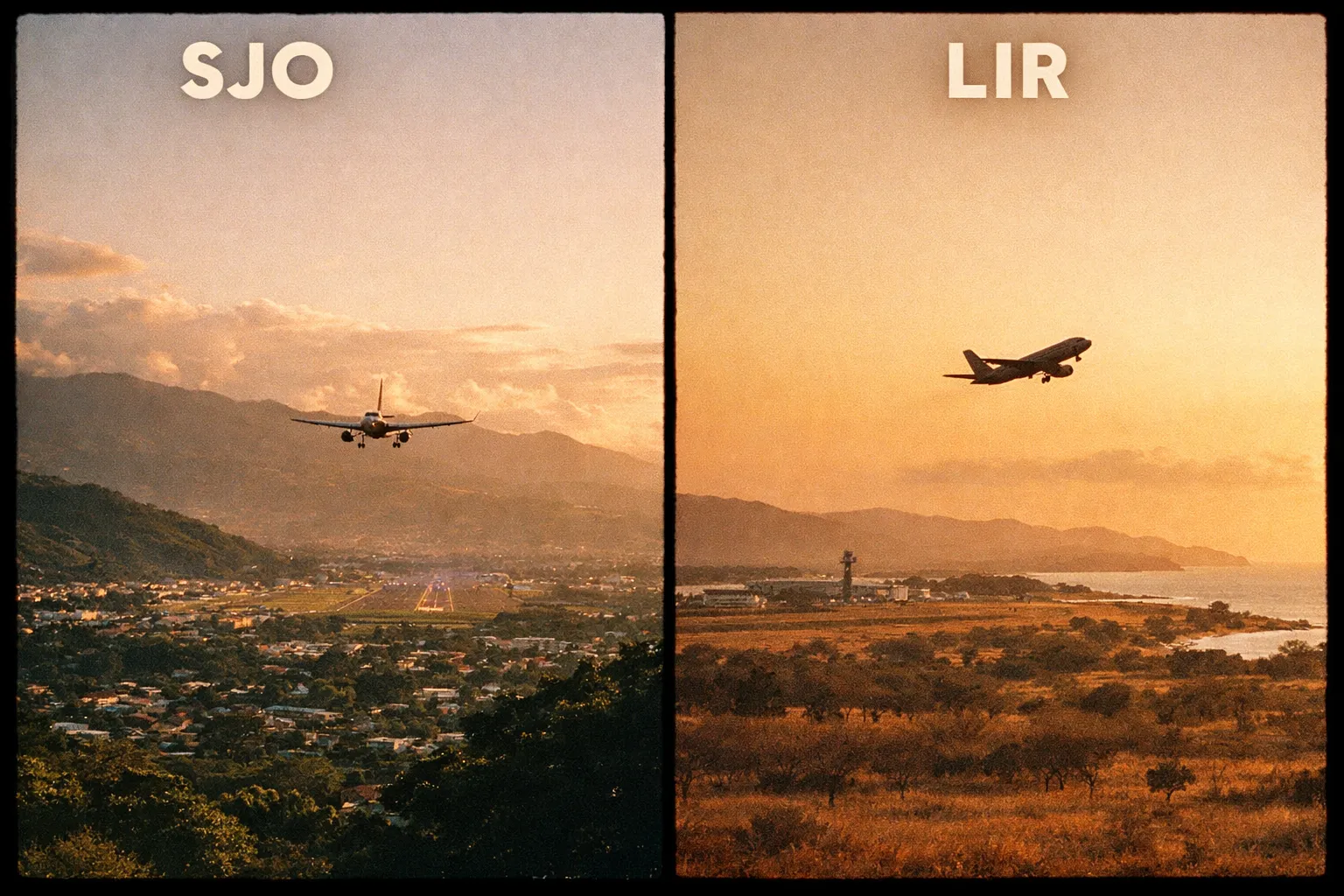
Fly into SJO if your trip includes:
- Arenal / La Fortuna (volcano, hot springs)
- Monteverde (cloud forest)
- Manuel Antonio, Jacó, Dominical, Uvita (central/south Pacific)
- Osa Peninsula / Drake Bay / Corcovado
- Tortuguero or Puerto Viejo (Caribbean coast)
- Any multi-region itinerary
Fly into LIR if your trip is:
- Tamarindo, Nosara, Playa Flamingo, Playas del Coco
- Papagayo Peninsula resorts (Four Seasons, Andaz, Westin)
- Rincón de la Vieja
- Anything in northern Guanacaste, full stop
The cost of getting it wrong is concrete: routing through SJO to a Tamarindo hotel adds 3-4 hours of driving each way versus arriving at LIR (1)(5). On a 7-day trip, that’s a full vacation day donated to a rental car.
The reverse is equally painful. I once watched a couple at LIR realize their Manuel Antonio hotel was a 5.5-hour drive away because the booking site had pushed cheap LIR flights without flagging the distance. They paid $280 for a private transfer. SJO would have been 2.5 hours.
Worth knowing: the open-jaw move
For trips longer than 8-10 days that span both coasts, book SJO in, LIR out (or vice versa). You’ll usually pay $50-$150 more than a round-trip but save a full backtrack day. Most concierge planners default to this on cross-country itineraries.
Where do most tourists fly into in Costa Rica?
Most arrive through SJO. The numbers explain why: more airlines, more routes, more frequencies, and typically lower fares thanks to competition (1). SJO connects to most major North American hubs, several European cities (Madrid, Frankfurt, Paris seasonally), and the rest of Latin America via Copa, Avianca, and LATAM.
LIR’s traffic is heavily weighted toward US and Canadian leisure flights - American, United, Delta, Southwest, JetBlue, Alaska, Air Canada, WestJet - and the schedule is thinner. In high season (December-April), LIR fares often run higher than SJO on the same routes because there’s less supply (1).
What guides get wrong about SJO
The persistent myth is that SJO is “dangerous” or “chaotic.” It isn’t. It’s a mid-sized international airport with normal facilities, jet bridges, on-airport car rental, and a Skytrax #1 regional ranking (3). Arrival traffic into San José city can be ugly at rush hour, but the airport itself is straightforward. Don’t let outdated forum threads push you to LIR if your itinerary actually points to SJO.
LIR: What Daniel Oduber Quirós International Actually Offers
Daniel Oduber Quirós International Airport (LIR) is the kind of airport people describe with the word “easy.” Single terminal, short walks, immigration that rarely takes more than 30 minutes, baggage that shows up promptly. After a 5-hour flight, that matters.
What you’ll find at LIR:
- On-airport car rental (Vamos, Adobe, Budget, Alamo, Hertz, and others - most with small shuttles to nearby lots)
- Standard dining and duty-free
- Currency exchange and ATMs (USD is accepted virtually everywhere in Guanacaste anyway)
- Pre-arranged shuttle desks for Tamarindo, Coco, Papagayo, and points north
Transfer costs from LIR run in predictable ranges:
- Shared shuttle to Tamarindo, Coco, or Flamingo: ~$35-$50 per person
- Private SUV transfer to Papagayo or Tamarindo: ~$90-$160 per vehicle
- Private luxury transfer to a Four Seasons or Andaz: $150-$300 (often included in resort packages)
LIR’s growth since the pandemic has been steady. Annual passenger volume has settled around 2 million, and seasonal North American capacity keeps expanding as Guanacaste resort inventory grows (1)(5).
Getting to Tamarindo: Your Airport Options
This is one of the most-asked airport questions in the country, so the answer matters.
LIR is the airport for Tamarindo. It’s about 65-75 km / 40-45 miles by road - typically 1.5 to 2 hours depending on traffic and which route you take through Belén. Shared shuttle from LIR runs around $40 per person; a private transfer for 1-4 passengers is usually $90-$130.
The alternative is Tamarindo Airport (TNO) itself - a small airstrip primarily served by Sansa from SJO; Green Airways has operated this route previously but current TNO service should be verified before booking. A typical itinerary using TNO looks like this:
- Fly into SJO international
- Transfer 5 minutes to SJO’s adjacent domestic terminal
- 45-60 minute hop to TNO on a Cessna Caravan
- 10 minutes by car to your hotel
That works well in two situations: you’re already routing through SJO for the rest of your trip, or your hotel is providing the connection as part of a package. Otherwise, fly LIR and drive.
A few things I’ve learned the hard way:
- Surfboards on domestic flights: confirm the airline’s board policy before booking. Sansa and Green Airways have strict size and weight limits on small aircraft, and oversized boards either get refused or charged punitively.
- Same-day connections: leave at least 2-3 hours between an international arrival at SJO and a domestic flight from the adjacent terminal. Customs lines can eat your buffer.
- Avoid arriving after dark if you’re driving from LIR to Nosara or further south. The road past Nicoya gets dark, winding, and unlit fast.
Guanacaste Airport Coverage: What LIR Serves
Guanacaste province spans the entire northwest of the country, from Rincón de la Vieja down through the Nicoya Peninsula. LIR is the only major scheduled commercial international airport serving the region - private and charter international arrivals can use smaller airfields, but for scheduled commercial service there’s no second option, despite occasional speculation about future expansion (5).
Within Guanacaste, the domestic strips that actually matter:
- Tamarindo (TNO) - Sansa and Green Airways, primarily from SJO
- Nosara (NOB) - small but well-used by the wellness/yoga crowd; SJO connections
- Tambor (TMU) - south Nicoya Peninsula, gateway to Santa Teresa and Montezuma
- Punta Islita (PBP) - limited service, mostly for the resort there
For practical planning, treat LIR as the entry point and use these strips only if (a) your hotel arranged the connection, (b) you’re saving more than 3 hours of drive time, or (c) you’re flying in from somewhere other than the airport you arrived at internationally.
Driving times from LIR to give you scale:
| Destination | Approx. drive |
|---|---|
| Playas del Coco | 25 min |
| Papagayo Peninsula | 30 min |
| Playa Flamingo | 1 hr |
| Tamarindo | 1.5-2 hr |
| Rincón de la Vieja | 1 hr |
| Nosara | 2.5-3 hr |
| Santa Teresa | 4.5-5 hr |
| Monteverde | 3 hr |
Domestic Airports and the Regional Network
Costa Rica’s domestic air network is one of the most underused tools in trip planning. The two carriers - Sansa and Green Airways - operate small aircraft (mostly Cessna Caravans, 12 passengers) that connect SJO’s domestic terminal to roughly a dozen regional strips.
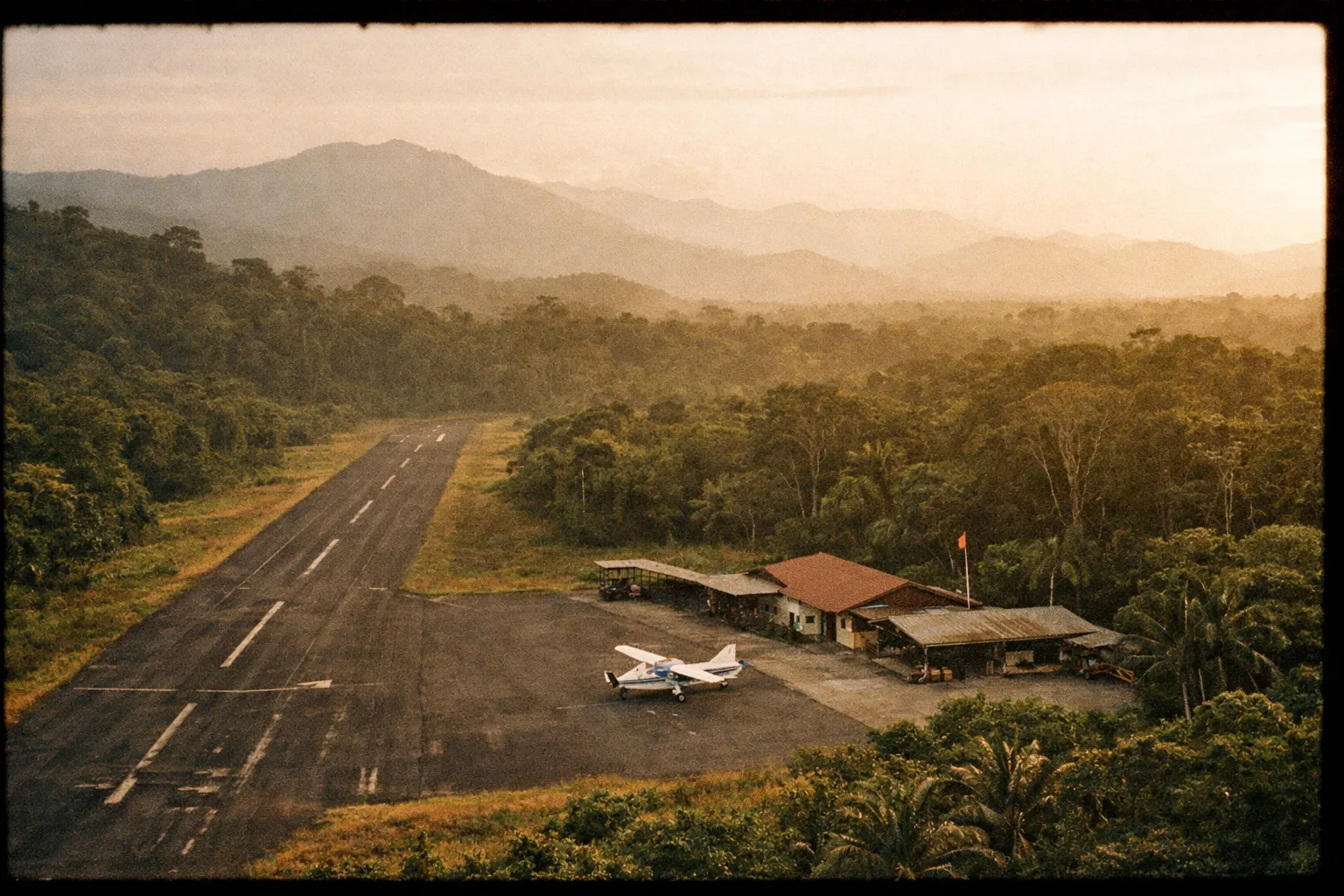
Where it makes sense to fly instead of drive:
- SJO → Drake Bay (DRK): 50 minutes vs. ~8 hours by road (including the boat crossing from Sierpe). Easy call.
- SJO → Tortuguero (TTQ): 35 minutes vs. a full-day combination of driving and boating. Easy call.
- SJO → Puerto Jiménez (PJM): 1 hour vs. 7+ hours. Easy call.
- SJO → Nosara or Tamarindo: 45-60 minutes vs. 4.5-5 hours. Worth it if you’re staying 4+ nights.
I flew SJO to Drake Bay last October - the strip at DRK is a packed-gravel runway carved out of the jungle, and the approach drops you through cloud cover into what’s essentially a clearing. The plane parks next to a small shelter and someone from your lodge meets you in a 4x4. From Cessna door to lodge cocktail: 40 minutes. The equivalent drive would have been a full lost day plus a boat charter from Sierpe.
Booking mechanics worth knowing:
- Domestic flights typically run $80-$160 one way depending on route and season
- Baggage limit is usually 30-40 lb total including carry-on - pay attention to this
- Book at least 2 months out in high season (Dec-April) - small aircraft sell out fast
- Always allow a 2-3 hour buffer between an international arrival and a domestic departure
How to choose your Costa Rica airport: a working framework
Choosing the Right Costa Rica Airport
10 minutesA step-by-step framework to pick the best airport for your itinerary
- 1
Map your nights
Plot where you will be sleeping each night on a mental map of Costa Rica.
- 2
Identify your weight
Determine which region holds more than 50% of your nights; this is your anchor region.
- 3
Apply the rule
If anchored in Guanacaste/northern Nicoya, choose LIR. If anchored elsewhere or split evenly, choose SJO. For trips spanning two opposite regions over 8+ days, book an open-jaw (SJO in / LIR out).
- 4
Sanity-check drive times
If your first night requires more than 3 hours of driving from your chosen airport, either arrive earlier in the day or book a night near the airport.
- 5
Price both options
Compare fares at both airports for your dates before committing, as LIR sometimes offers competitive deals.

Best month to visit (and what it does to airfare)
Costa Rica has two seasons: dry (mid-December to April) and green/wet (May to mid-November). Airfare and resort prices peak from late December through early March, with a smaller bump around Easter and US summer vacation in July.
Best value windows:
- Mid-May to mid-June: the rains are still light, prices drop sharply, and the country is green and quiet
- Mid-September to mid-November: wettest period, lowest prices - only viable if you’re focused on the Caribbean coast (which is dry then) or you genuinely don’t mind afternoon rain
For Guanacaste specifically, January and February are the most reliable for sun, but LIR fares are highest then. Late April delivers near-equivalent weather at meaningfully lower prices.
Insider-led concierge and design-forward planning
Higher-end Costa Rica trips - Papagayo resorts, Nicoya wellness retreats, Osa eco-lodges - typically stitch airports together differently than DIY itineraries. The patterns worth knowing, whether you’re booking through a concierge or just want to think like one:
- Open-jaw as default. Almost every multi-region luxury itinerary starts at SJO (volcano, cloud forest, central Pacific) and ends at LIR (beach finale). The airfare premium is small; the experience improvement is real.
- Private charter from SJO’s domestic terminal. For lodges in Osa, Tortuguero, or remote Nicoya, charter aircraft (typically Cessna Caravans seating 8-12) can be booked directly to lodge airstrips, bypassing both road and scheduled-flight constraints. Costs run $1,500-$3,500 per leg depending on distance and aircraft.
- Airport meet-and-greet at SJO or LIR. Fast-tracks immigration and baggage; usually $50-$120 per person. Worth it after a redeye.
- Private SUV transfers rather than shared shuttles. Adds flexibility for stops, food, and timing - typically $150-$300 from LIR to Papagayo or Tamarindo.
This is also where the insider-led Costa Rica design & concierge model genuinely earns its keep: matching aircraft type to airstrip, coordinating arrival timing with resort staff, and routing around weather windows that DIY planning can’t anticipate. For a 5-night Papagayo stay, it’s overkill. For a 12-night cross-country itinerary with three lodges in remote areas, it pays for itself in saved hours and avoided logistics failures.
Frequently Asked Questions
- Can I use Tamarindo Airport (TNO) as my main entry point?
- TNO is a small domestic airstrip mainly served by Sansa and Green Airways from SJO. It's practical only if your itinerary already includes San José or your hotel arranges the connection. Otherwise, flying into LIR and driving is simpler and often cheaper.
- How strict are baggage limits on domestic flights in Costa Rica?
- Domestic carriers like Sansa and Green Airways have strict size and weight limits (usually 30-40 lb total including carry-on). Oversized items like surfboards may be refused or incur high fees, so confirm policies before booking.
- Is it worth booking a private charter flight to remote lodges?
- For remote areas like Osa Peninsula or Tortuguero, private charters can save significant time and hassle, though costs range from $1,500 to $3,500 per leg. This option is best for luxury travelers or those with tight schedules.
- What is the best way to handle airport transfers in Guanacaste?
- Shared shuttles from LIR to popular destinations cost $35-$50 per person, while private SUVs offer more flexibility for $90-$300 depending on destination and vehicle type. Booking private transfers is recommended for convenience and timing control.
- How far in advance should I book domestic flights?
- Domestic flights sell out quickly during high season (December-April). Booking at least two months in advance is advisable to secure your preferred schedule.
- Are there any risks driving from LIR to southern Nicoya after dark?
- Yes. Roads past Nicoya are dark, winding, and unlit. Avoid driving this route after dark to reduce risk and discomfort.