Earthquake safety in Japan for tourists is less scary than it sounds: the country is among the best-prepared on Earth, and most of what matters you decide before you fly. When the ground moves, Drop, Cover, and Hold On under sturdy furniture; the shaking usually lasts about ten seconds, so stay put, not out into falling glass. Near the coast, treat strong shaking as its own tsunami warning and head inland and uphill at once. And confirm before you buy that your travel insurance names earthquakes and evacuation specifically.
Earthquake Safety in Japan for Tourists: Why the Ground Moves So Often
Understanding earthquake safety in Japan for tourists is essential because the country sits along the Pacific Ring of Fire, where the Pacific, Philippine Sea, Eurasian, and North American plates grind against each other. That collision builds and releases pressure constantly, which is why the archipelago records thousands of tremors a year - far more than almost anywhere else on Earth.
This is also why Japan is one of the best-prepared places in the world to be when a quake hits. Building codes have been progressively tightened since the 1981 standards overhaul, and Japan’s travel safety guidance notes that most modern buildings are fairly resistant to earthquakes, which sharply reduces collapse risk - the World Bank has ranked Japan’s seismic preparedness among the highest globally (3)(4). The real hazards for a tourist are rarely the building itself - they’re falling objects, shattering glass, and secondary fires.
Understanding this matters because it reframes the risk. You’re not visiting a country waiting to crumble. You’re visiting one that has engineered, drilled, and signposted its way to one of the most survivable earthquake environments anywhere, provided you know how to use it.
✓ Pros
- Japan has some of the strictest earthquake-resistant building codes worldwide.
- Clear evacuation routes and signage are common in tourist areas.
- Frequent drills and public education make the population well-prepared.
- Modern infrastructure reduces the risk of building collapse.
✗ Cons
- Secondary hazards like falling objects and fires remain significant risks.
- Aftershocks can prolong danger and require ongoing vigilance.
- Coastal areas carry tsunami risk after strong quakes.
- Power and communication outages are common during major events.
Understanding earthquake protocols in Japan
The first move during shaking is always the same: Drop, Cover, Hold On. Get low so you don’t get knocked off your feet, get under sturdy furniture like a table or desk to shield against falling debris, and hold on so your cover doesn’t slide away from you. Most quakes last only around 10 seconds, though larger ones can run for minutes (5), so the instinct to ride it out under cover usually serves you well.
Japan’s buildings are engineered to withstand seismic activity, so trust the infrastructure and follow instructions from your accommodation or local authorities (4). After the shaking stops, evacuate only if the building is visibly damaged or if you’re told to. Japan has designated evacuation zones and routes that are clearly marked and easy to follow, often with English signage in tourist areas.
I’ve learned to read these signs and understand the local announcements, even with my limited Japanese. Aftershocks are common, so stay attentive and ready to move again.
| Tip | Description |
|---|---|
| Seek immediate cover | Use sturdy furniture like a table to shield against falling debris. |
| Stay indoors if it’s safe | Exiting mid-quake can expose you to falling glass and masonry near doors. |
| Use stairs, never elevators | Aftershocks and power loss can trap you in an elevator(5). |
| Address fire sources | Secondary fires are the most dangerous follow-on hazard - kill flames and gas (4). |
| Be ready for aftershocks | Have a plan for the next shock before it comes. |
What is the 20-second rule for earthquakes?
You’ll see references to a “20-second rule,” and it’s worth clarifying because it’s often misunderstood. The idea is that the first 20 seconds after you feel shaking are when you secure your own safety - drop, take cover, and protect your head - rather than doing anything else. It is not a countdown to run outside. The window exists so you act decisively in the moment instead of freezing. In practice, treat it as: the second you feel the ground move, get under cover and stay there until the shaking stops.
What to do during an earthquake: scenario guide
Where you are when the ground moves changes your best response. Here’s the decision tree I wish someone had handed me in that Kyoto hostel.
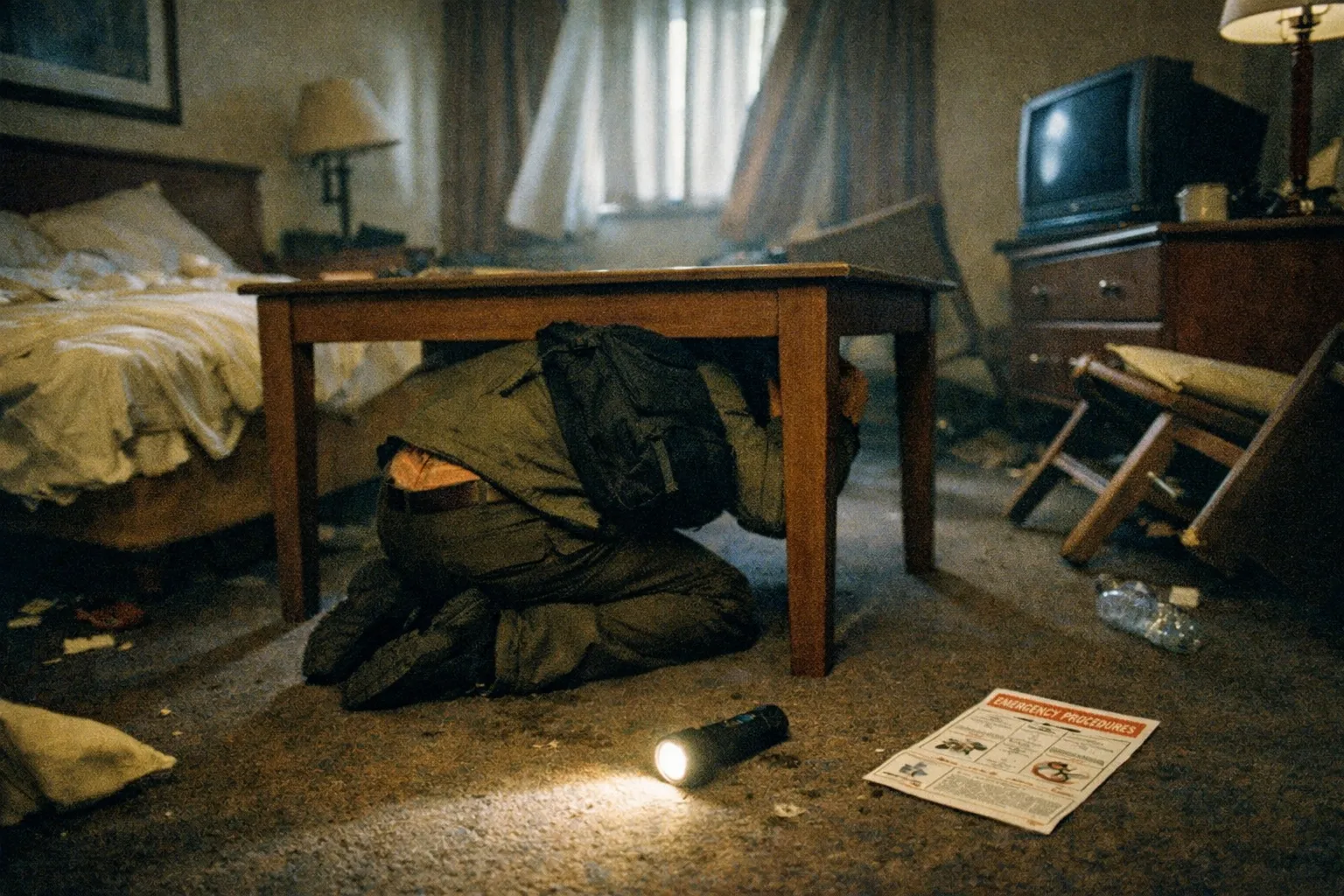
In a hotel or indoors. Drop, cover, and hold on under a sturdy table, away from windows and tall furniture (1)(2). Don’t bolt for the door - doorways, stairwells, and exits collect falling debris and panicking people. Once shaking stops, check for the evacuation route you noted at check-in and take the stairs down. Never the elevator.
On a train or subway. Stay seated, or hold a strap or pole firmly if you’re standing. Don’t try to move between carriages. Japan’s rail network uses seismic braking that can stop a train between stations, so expect a sudden halt and follow the crew’s announcements (1)(2). Crews are trained for this; let them direct the evacuation.
On the street. Move away from buildings, glass storefronts, vending machines, utility poles, and overhead wires. Open ground is your friend. Cover your head with a bag or your arms and wait for the shaking to pass before moving.
In a car. Pull over immediately, away from overpasses, bridges, poles, and buildings (5). Stay inside with your seatbelt on until the shaking ends, then listen for radio or app updates before driving on. Don’t try to power through a tremor.
Near the coast. This is the scenario with the least margin for error. If you feel strong shaking near the sea, don’t wait for an official tsunami order - move inland and uphill immediately, and don’t return until tsunami warnings are formally canceled (1)(4). Acting on the assumption of tsunami risk after a strong quake is the safest default.
Japan earthquake evacuation procedures
A few years back, exploring the outskirts of Tokyo, I lived through a moderate quake. The shaking was alarming. The organized evacuation that followed was the part that impressed me.
Evacuation zones are typically open spaces - parks, schoolyards, designated plazas - set away from tall structures to minimize injury from falling debris. They’re marked with standardized signage, and the JNTO recommends you double-check your hotel’s evacuation route at check-in rather than working it out mid-emergency (4). That five-minute habit is the single most useful piece of prep you can do on arrival.
Transportation may be disrupted, so be prepared to walk to a safer location. Keep your phone fully charged, because power and connectivity often fail right when you need them (4). Have a prearranged meeting point with your travel companions in case communication lines go down.
The official channel for alerts is the JNTO Safety tips app, which pushes earthquake early warnings, tsunami warnings, and weather warnings without you having to go looking for information (8). Download it before you travel - JNTO describes it as the go-to alert tool for visitors in their current official guidance (8). I also carry a whistle, a habit I picked up from a friend in Japan, since it lets you signal for help if you’re trapped and your voice gives out.
What to do in an emergency: numbers to save
Save these before you need them. Japan’s general police emergency number is 110, and the fire and ambulance line is 119. For English-language guidance, call the general police line at 110 and ask for an interpreter, or contact JNTO’s visitor hotline - current multilingual support options are listed on the JNTO website (4). If you’re not a Japanese citizen, register with your embassy before or soon after arrival so they can reach you during a major event (5) - the U.S. Embassy maintains an emergency preparedness program for exactly this (6). Keep at least two contacts saved on both your phone and on paper: your hotel and your embassy or consulate (5).
Earthquake emergency kit travel essentials
You don’t need a survivalist setup. A workable earthquake emergency kit travel configuration costs roughly 0-4,500 JPY (around $0-$30 USD) if you already own a phone and just pick up a few basics, and full compact travel kits run higher depending on brand and capacity. Building it takes about 15 minutes.
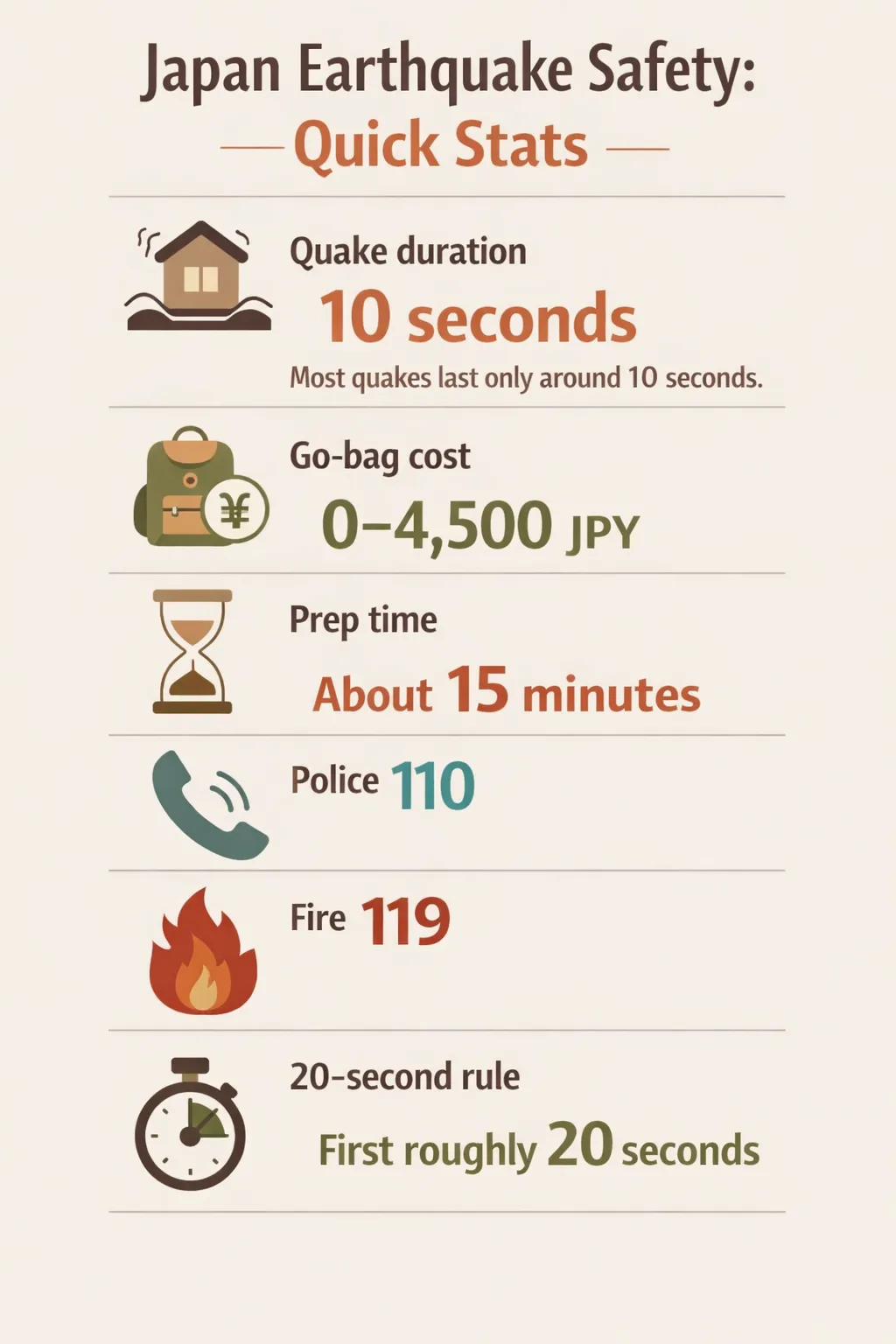 Key safety figures for travelers in Japan: quake duration, go-bag cost, prep time, and emergency numbers (110, 119).
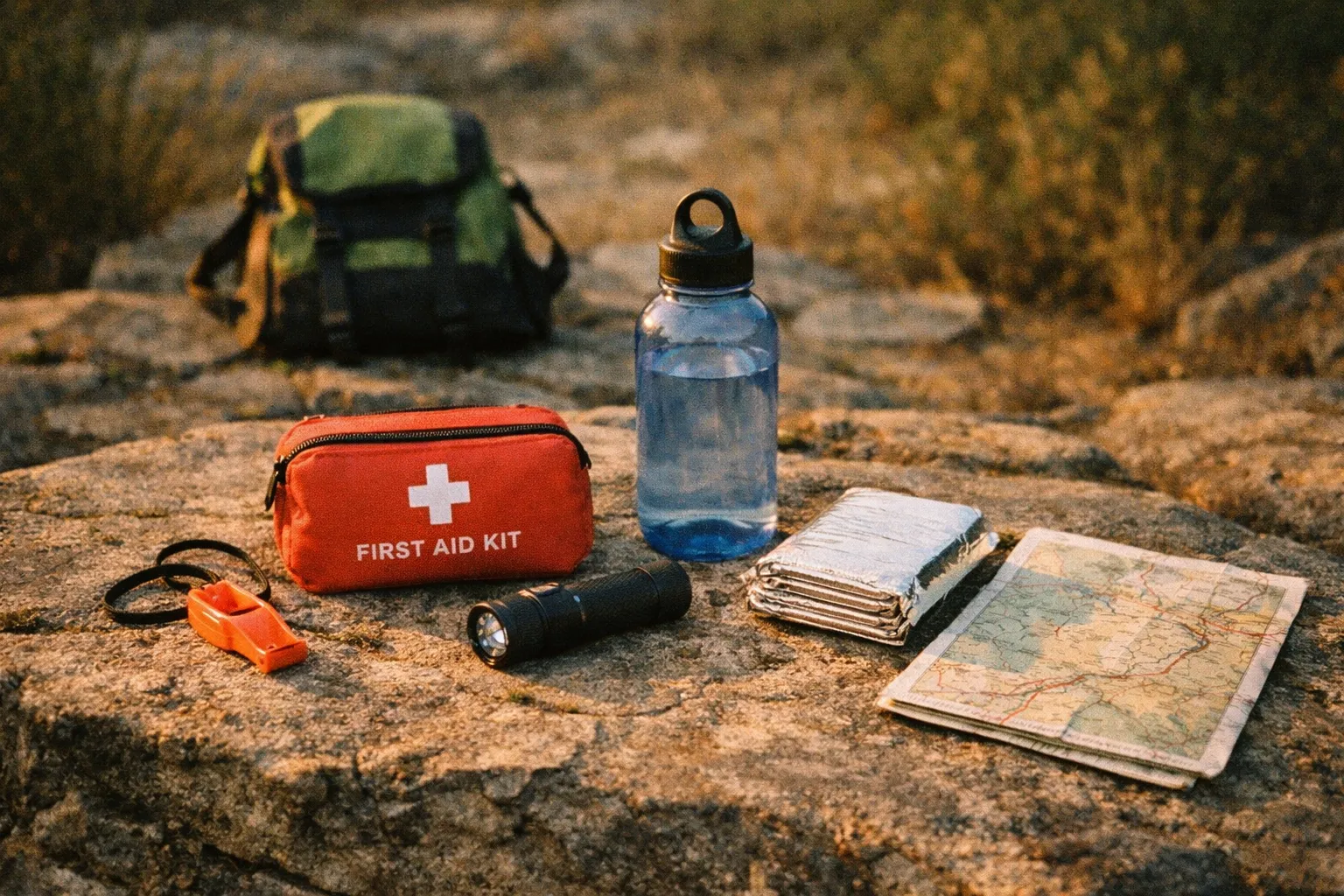
Pack a small go-bag you can grab in the dark:
- Flashlight - kept by the bed, not buried in checked luggage, because quakes often trigger power cuts and dark stairwells(5)
- Power bank - to keep your phone alive when outlets fail
- Bottled water and a few snacks
- Basic first-aid supplies
- A whistle for signaling if trapped
- Cash in yen - ATMs and card systems can go down after a major quake (5)
- Copies of your passport, insurance, and embassy details - printed and saved offline
- A portable radio for updates when mobile networks are jammed
Offline readiness is the overlooked part. Download your hotel’s location map, screenshot transit and hotel evacuation instructions, and save embassy contacts so they work without a signal (5). Apps and internet are the first things to buckle during disruption - don’t build your whole plan around live connectivity.
What are the 5 things not to do during an earthquake?
The mistakes tourists make are predictable, which makes them avoidable. Here are the five worth burning into memory:
- Don’t run outside during the shaking. Falling debris near entrances, walls, and stairwells is often more dangerous than staying low under cover indoors (1)(2).
- Don’t use the elevator during or after a quake. Aftershocks and power loss can trap you between floors - take the stairs(5).
- Don’t wait for an official tsunami warning if you’re on the coast and feel strong shaking. Move uphill immediately (1)(4).
- Don’t ignore fire and gas sources. Secondary fires are the most dangerous follow-on disaster, so put out flames and shut off gas as soon as the shaking stops (4).
- Don’t rely on live internet alone. Charge your devices and keep evacuation details saved offline, because networks fail exactly when demand spikes (4)(5).
Travel insurance natural disaster Japan coverage
Never underestimate good travel insurance. An unexpected extended stay in Japan drove that home for me in a way no travel article ever had.
Before your trip, confirm your policy actually covers natural disasters, including earthquakes and aftershocks. Not all of them do, and the fine print is where the gaps hide.
A proper insurance check takes 10-15 minutes. Confirm coverage for:
- Natural disasters (earthquake and tsunami specifically named)
- Trip interruption and cancellation
- Emergency evacuation
- Unexpected accommodation and hotel rebooking
- Medical treatment for injuries sustained during an evacuation
- Personal effects lost or damaged during a disaster - relevant if, like me, you travel with gadgets
After the quake I lived through, while some travelers scrambled with unplanned expenses, my policy covered medical attention for a minor injury, plus extra accommodation and meals until I could fly home. That’s the difference comprehensive coverage buys: you focus on safety, not the bill.
If you’re leaning on credit card travel insurance, understand the limits. A friend who relied solely on his card’s benefits found it didn’t cover the full aftermath of the quake. Read what’s actually included and buy a dedicated policy if there are gaps.
General safety tips for travellers
Beyond the protocols, a few habits make Japan’s earthquake risk genuinely manageable:
- Note your hotel’s exits at check-in. JNTO specifically recommends this, and it’s the prep step travelers skip most often (4).
- Keep your phone charged and a power bank in your day bag.
- Carry cash, since electronic payment systems may be disrupted (5).
- Stay away from windows and tall furniture when you settle into a hotel room - pick a spot you could drop and cover quickly (1)(2).
- If you’re trapped, conserve energy. Text instead of shouting, and tap rhythmically on a pipe or wall to signal rescuers (5).
One etiquette note: in an evacuation, the Japanese norm is calm, orderly, single-file movement. Don’t push, don’t rush ahead, and follow staff and crew direction. The system works because everyone trusts it. Falling in line isn’t just polite - it’s the fastest way out. Understanding broader cultural differences between Japan and the USA can also help you anticipate how locals behave in high-stress situations like these.
Which part of Japan is safest from earthquakes?
No region of Japan is earthquake-free - the whole archipelago sits on active plate boundaries (1)(4). When people ask about the “safest” area, what they usually mean is lower tsunami exposure and newer building stock, not zero quake risk.
Inland areas away from the coast carry less tsunami risk by definition, and cities with denser modern construction tend to ride out shaking better than older or soft-soil neighborhoods, which are more prone to liquefaction. Coastal stays - think Sendai’s Arahama district, the Shizuoka coastline around Shimizu, Hiroshima’s Ujina waterfront, or Okinawa’s Naha ferry terminal area - warrant extra attention to high-ground evacuation routes (4). But “safer” is a spectrum here, not a guarantee. Wherever you go, the protocol is the same.
When to not visit Japan in 2026?
There’s no earthquake season. Quakes don’t follow a calendar, so you can’t time a trip to avoid them. The core tourist safety procedure has remained stable into 2026, with official guidance still centered on the JNTO Safety tips app, hotel evacuation checks, and tsunami evacuation to high ground (3)(4)(8).
If you’re weighing timing, the more relevant factors are typhoon season (roughly June through October, peaking in late summer) and heavy winter snow in northern regions, both of which can disrupt travel independently of seismic activity. For earthquakes specifically, no month is meaningfully safer than another. Don’t let quake anxiety reshape your calendar - let it shape your packing list and your check-in routine instead.
Frequently Asked Questions
- What is the 20-second rule for earthquakes?
- It refers to using the first roughly 20 seconds of shaking to secure your own safety - drop, take cover, and protect your head - rather than trying to flee. It's a prompt to act immediately under cover, not a signal to run outside.
- What are the 5 things not to do during an earthquake?
- Don't run outside mid-shake, don't use elevators, don't wait for an official order before evacuating uphill if you're coastal, don't ignore fire and gas sources, and don't depend on live internet for alerts (1)(2)(4)(5).
- Which part of Japan is safest from earthquakes?
- None are risk-free. Inland areas with modern construction generally have lower tsunami and liquefaction exposure, but every part of Japan can experience strong shaking (4).
- When should I not visit Japan in 2026?
- There's no earthquake season to avoid. Weather - typhoons from roughly June to October, heavy northern snow in winter - is a bigger seasonal consideration than seismic risk, which doesn't follow a calendar.
- Does travel insurance cover earthquakes in Japan?
- Only if the policy specifically includes natural disasters. Check that earthquakes, trip interruption, evacuation, and hotel rebooking are named, and don't assume credit card coverage is enough.
Before you go: the 30-minute prep checklist
Earthquake safety in Japan for tourists isn’t about fear. It’s about a short list of decisions made in advance so you don’t have to improvise mid-tremor. Spend 15 to 30 minutes before departure doing exactly this:
- Download the JNTO Safety tips app for push alerts (8)
- Save 110, 119, and your embassy’s number to your phone and a paper card (4)(6)
- Confirm your travel insurance names natural disasters, evacuation, and rebooking
- Pack a small go-bag: flashlight, power bank, water, cash, document copies (5)
- On arrival, check your hotel’s evacuation route and nearest assembly point at check-in (4)
Do those five things and you’ve handled the parts that actually matter. The rest is muscle memory: feel the shaking, drop, cover, hold on, then move to high ground if you’re near the coast. Japan has built one of the most survivable earthquake environments on the planet. Your job is simply to know how to use it.