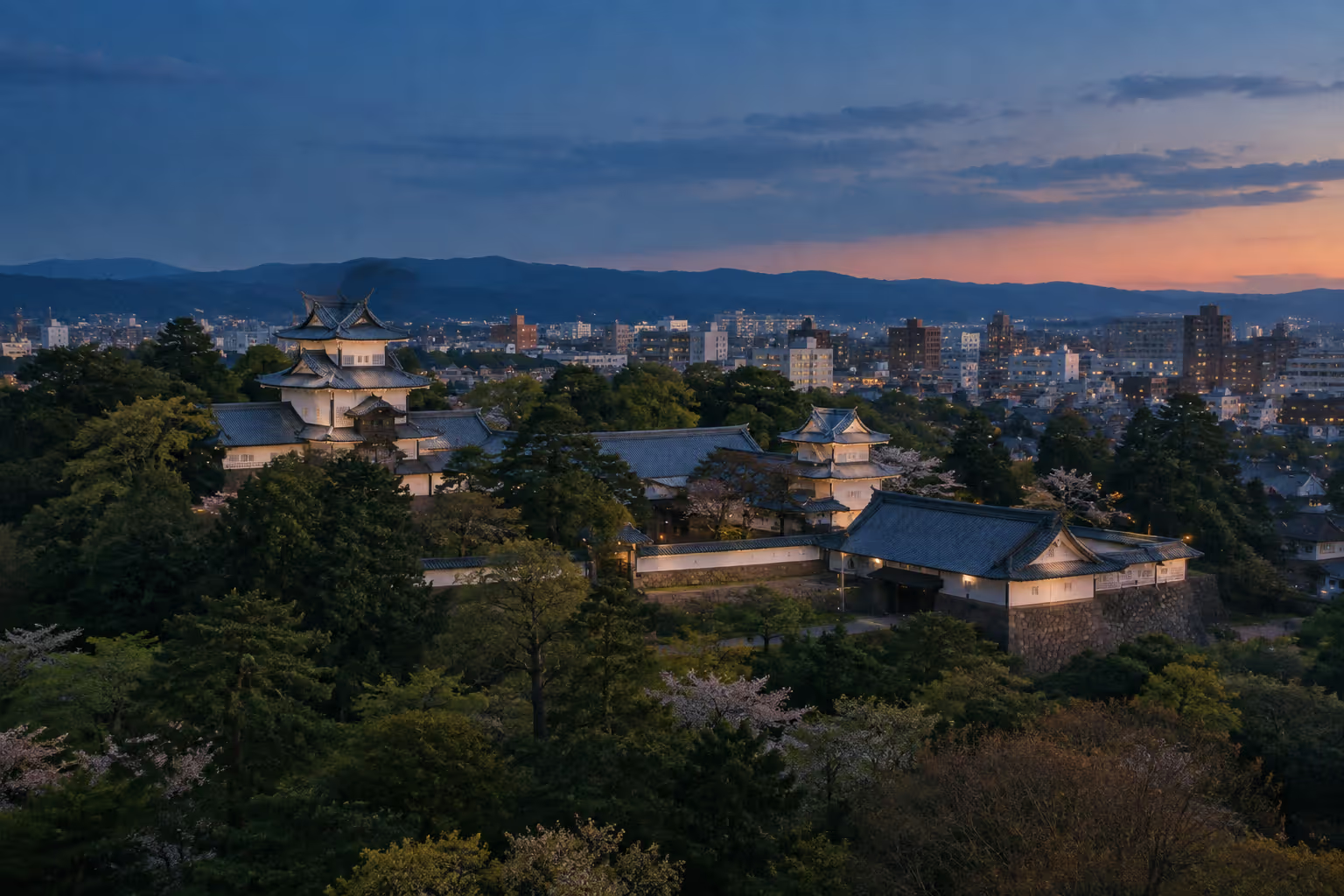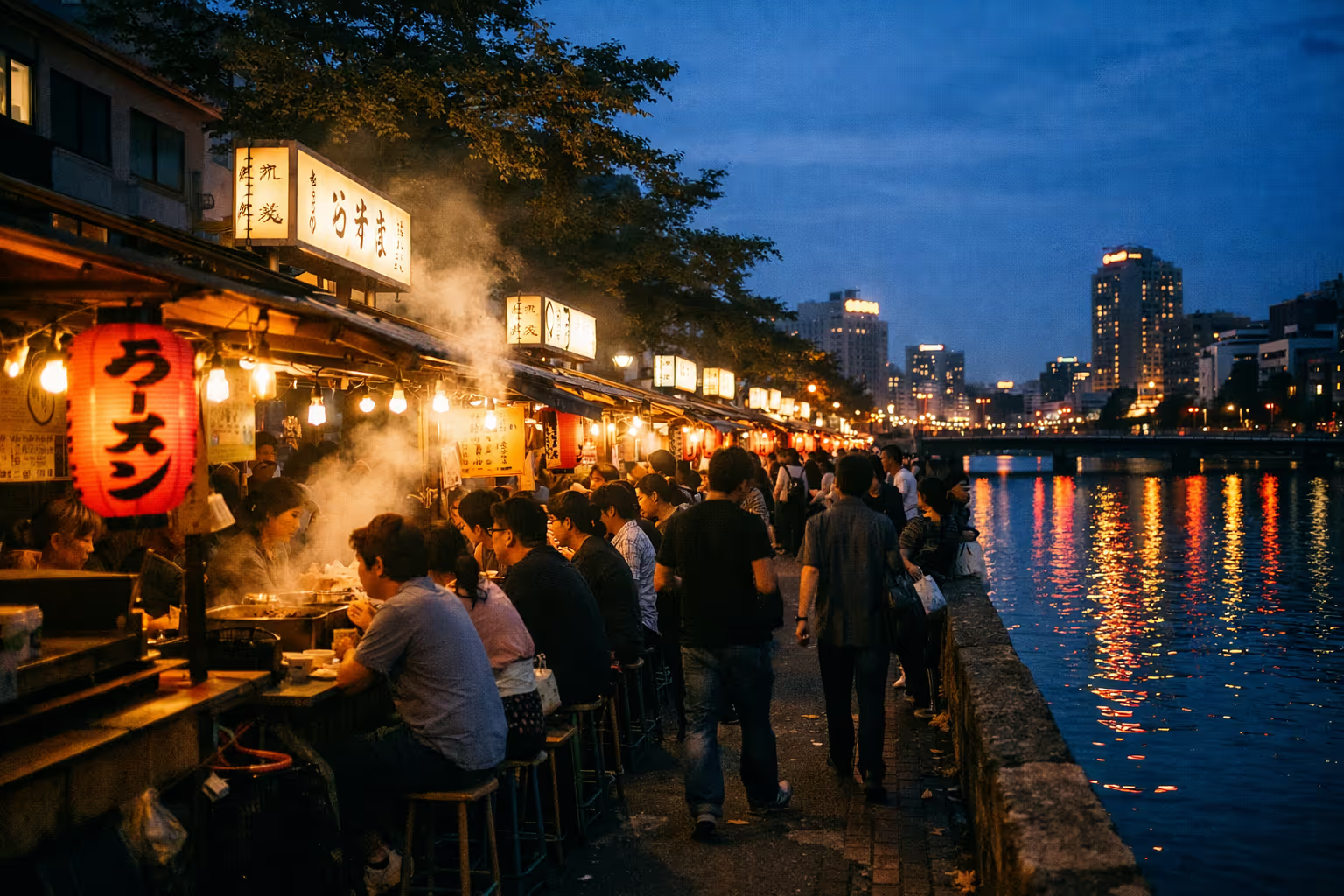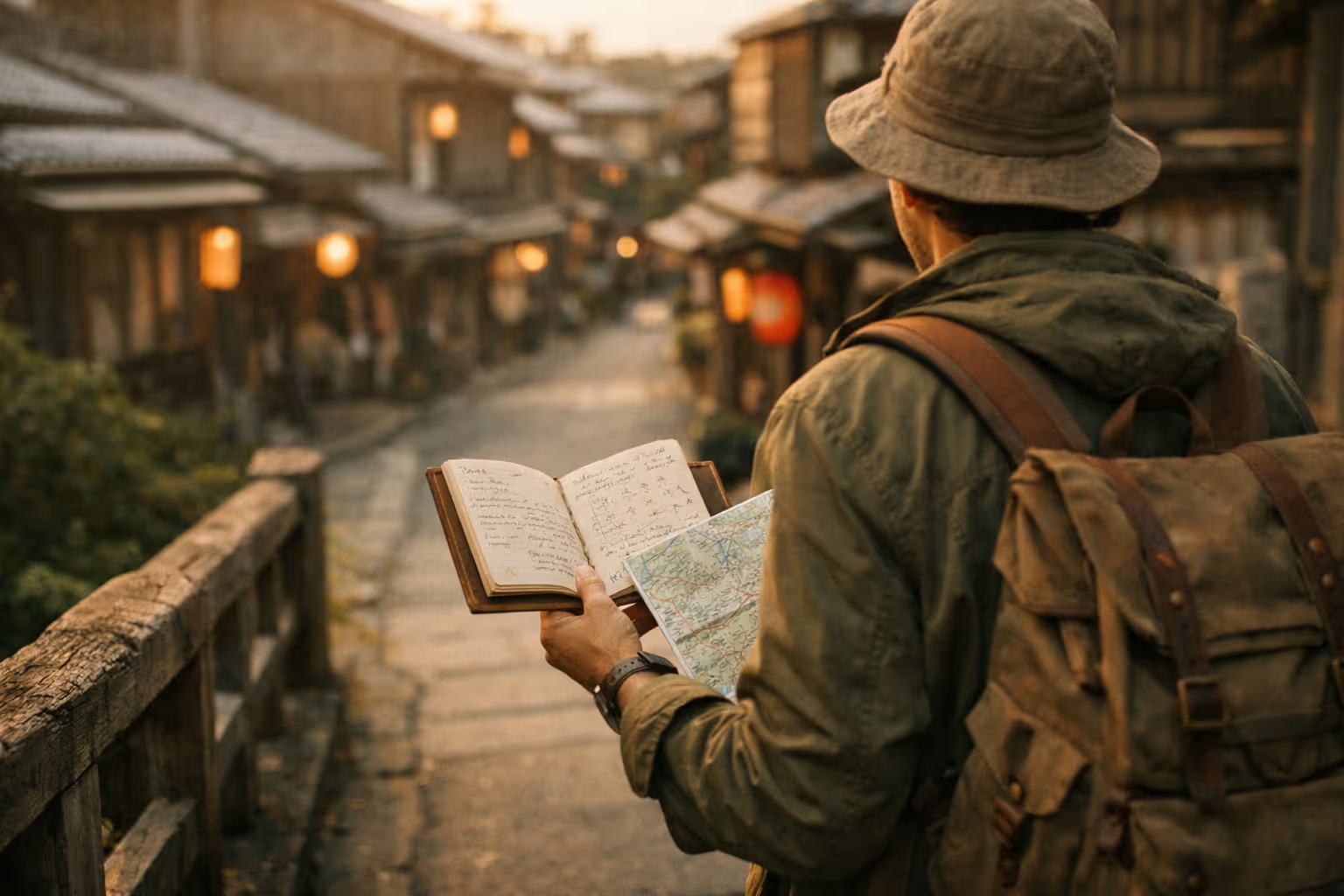
A few basic Japanese phrases smooth the whole trip more than fluency would, and one word does the heavy lifting: sumimasen. It covers excuse me, sorry, and thanks for the trouble all at once, so save gomen nasai for real apologies. Learn twenty to thirty lines with audio, download Google Translate’s offline pack, and let an app handle the rest. And memorize two numbers before you go: 119 for an ambulance, 110 for police.
Do I need to speak Japanese to visit Japan?
Short answer: no, but a little goes a long way.
Japan reopened to independent tourists in late 2022, and by early 2024 monthly visitor numbers surpassed 3 million, approaching pre-pandemic record highs according to the Japan National Tourism Organization. More visitors means more crowded trains, fuller restaurants, and longer queues at the spots everyone wants to see. In that environment, even a handful of phrases smooths things out considerably.
Here’s how far English actually gets you:
- Tokyo, Osaka, Kyoto city centers: JR and metro lines have English signage and announcements. Major attractions, big hotels, and chain restaurants usually have English menus or staff who can manage basic exchanges.
- Smaller cities, izakaya (Japanese pubs), family-run shops, rural ryokan (traditional inns): Often little to no English. Picture menus help, but you’ll do better with a few spoken phrases.
Most short-term tourists can get by with translation apps plus 20-30 phrases. Google Translate’s offline Japanese pack is free and downloads in around 50-100 MB - worth setting up before you fly. A prepaid SIM or eSIM with 3-10 GB of data runs roughly ¥2,200-6,000 (about $15-$40) for 7-30 days, which covers on-the-go lookups. But apps fail at the worst moments, and a phrase said out loud earns a warmth that a screen never will.
Why learn these essential Japanese phrases for your trip?
The math is favorable. Learning 30-40 useful phrases with correct pronunciation through an audio course takes about 5-10 hours of focused study spread over a week or two. For that small investment you get noticeably better service, faster help when you’re lost, and fewer moments of friction.
Walking through Asakusa one afternoon, I understood exactly how much these phrases mattered. A simple “Sumimasen, toire wa doko desu ka?” got me to the nearest restroom without any pantomiming, and “Kore wa ikura desu ka?” let me buy a handmade fan from a stall where no one spoke English. Minor exchanges on their own - but they stacked up into a trip that felt like participation rather than spectating.
There’s also an etiquette payoff worth mentioning. Japanese service culture runs on politeness, and meeting it even partway - a sumimasen before you flag down staff, an arigatou gozaimasu on the way out - reads as respect. You don’t need fluency to signal that you’re trying, and people notice.
The basics: common Japanese words and phrases
Start with the lines you’ll use ten or more times a day. These are the basic Japanese words and phrases that do the heaviest lifting.
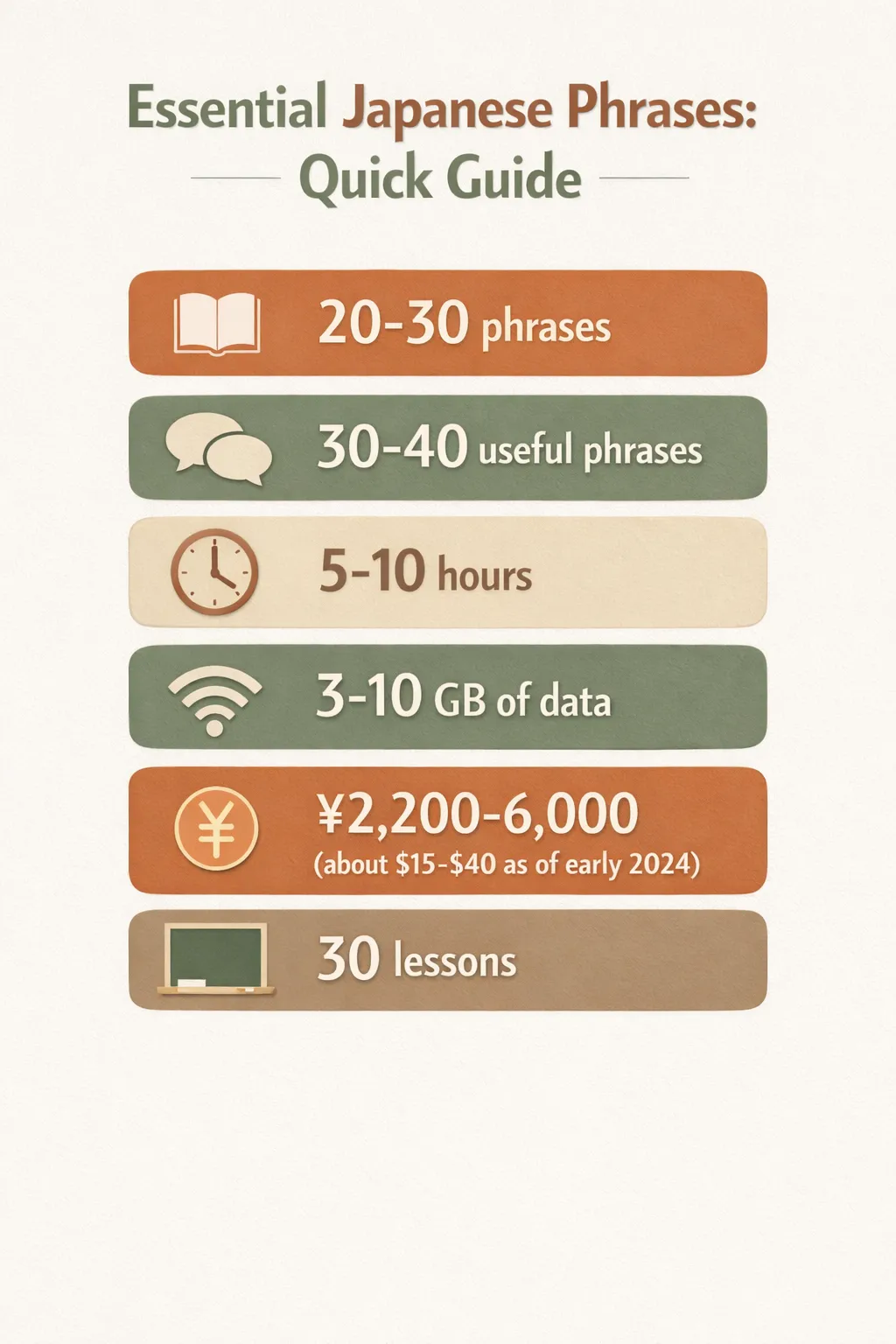 Infographic highlights: 20-30 phrases, 30-40 useful phrases, 5-10 hours to learn, 3-10 GB of data, ¥2,200-6,000 (about $15-$40) for data, and 30 lessons of Pimsleur.
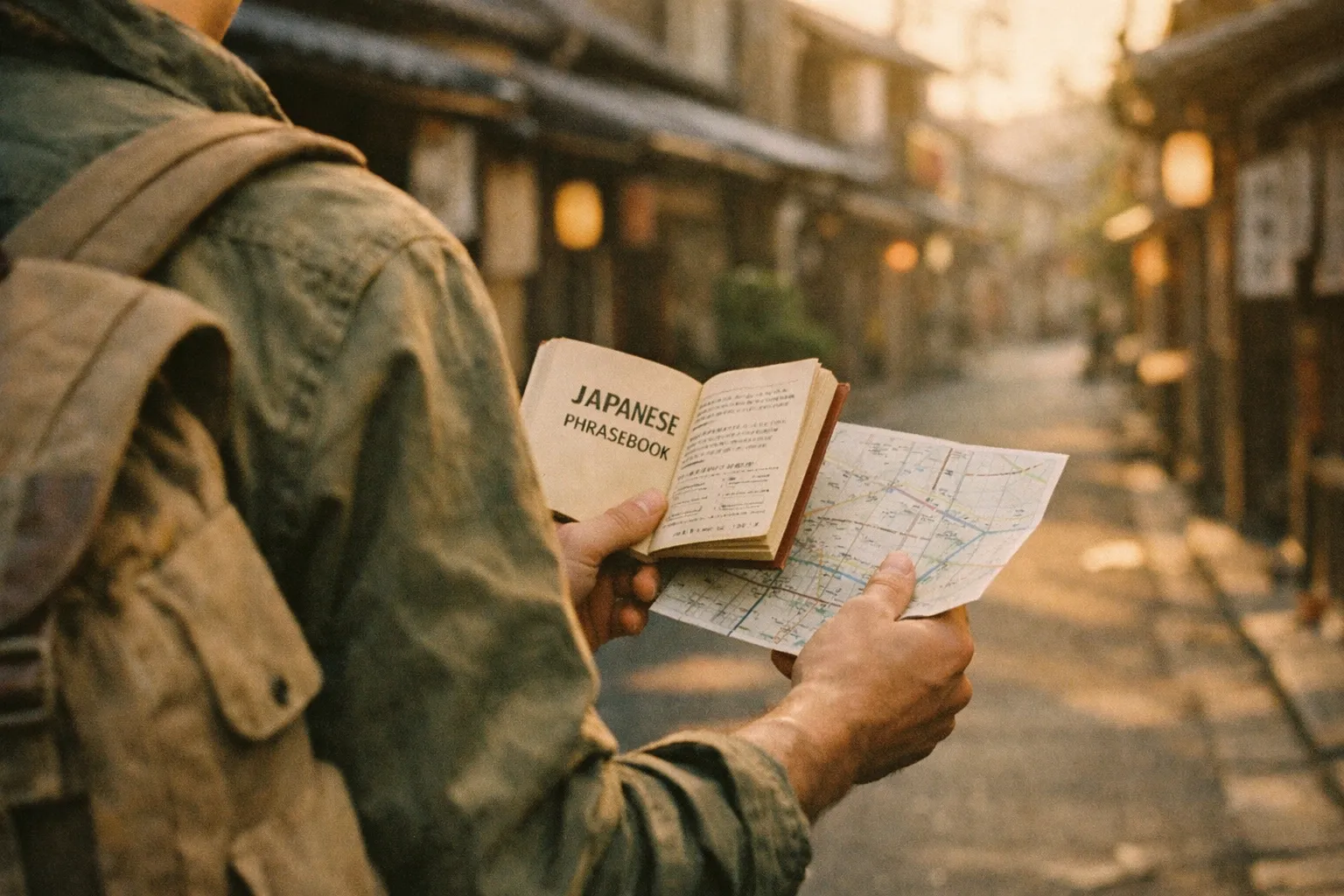
Greetings:
| Phrase | Romaji | English |
|---|---|---|
| こんにちは | Konnichiwa | Hello / Good afternoon(2) |
| おはようございます | Ohayou gozaimasu | Good morning (1)(2) |
| こんばんは | Konbanwa | Good evening (1)(2) |
| ありがとうございます | Arigatou gozaimasu | Thank you (very much) (2)(3) |
| すみません | Sumimasen | Excuse me / Sorry / Thanks for the trouble (2)(3)(7) |
Sumimasen is the single most useful word on this list. It works as “excuse me” to get attention, “sorry” for a small bump, and “thank you” for someone’s trouble. Beginners often reach for gomen nasai (ごめんなさい, “I’m really sorry”) for minor things - save that for genuine apologies and let sumimasen cover the everyday.
Yes, no, and understanding:
| Phrase | Romaji | English |
|---|---|---|
| はい | Hai | Yes (2)(3) |
| いいえ | Iie | No (2)(3) |
| 分かりません | Wakarimasen | I don’t understand (3)(6) |
| 大丈夫です | Daijoubu desu | I’m fine / No thanks / It’s OK |
| ちょっと待ってください | Chotto matte kudasai | Please wait a moment |
Daijoubu desu is another multitasker - it politely declines a plastic bag, confirms you’re alright, or waves off an offer you don’t need. Learning a few flexible phrases like this and sumimasen covers more ground than memorizing thirty narrow ones (2)(3)(7).
Counting 1 to 10 in Japanese
Numbers come up constantly - prices, train platforms, hotel floors, the number of people in your party. Here’s 1 through 10 (1)(9):
| Number | Japanese | Romaji |
|---|---|---|
| 1 | いち | ichi |
| 2 | に | ni |
| 3 | さん | san |
| 4 | よん/し | yon / shi |
| 5 | ご | go |
| 6 | ろく | roku |
| 7 | なな/しち | nana / shichi |
| 8 | はち | hachi |
| 9 | きゅう/く | kyuu / ku |
| 10 | じゅう | juu |
Note that 4 and 7 have two readings each; yon and nana are the safer everyday choices. One pronunciation note that trips people up: Japanese vowel length matters. Obāsan (grandmother) and oba-san (aunt) differ only in a stretched vowel. Listeners usually figure it out from context, but it’s worth knowing why some words sound longer than they look on the page.
Food and drinks: how to order and appreciate food in Japanese
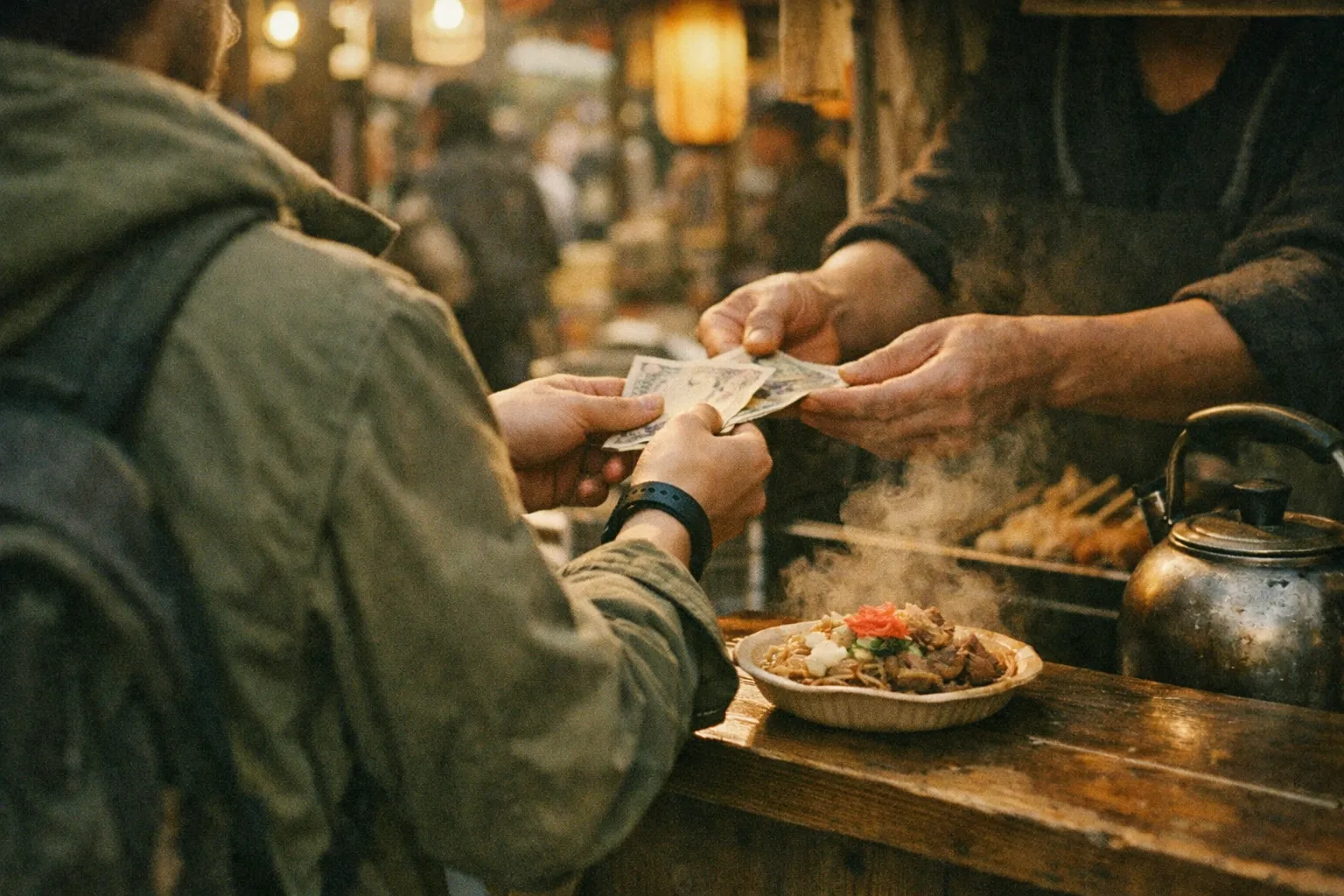
Restaurants are where a few phrases pay off fastest, and where etiquette and language overlap most visibly.
| Phrase | Romaji | English |
|---|---|---|
| いただきます | Itadakimasu | (said before eating) |
| ごちそうさまでした | Gochisousama deshita | Thank you for the meal (said after) (7) |
| すみません、注文をお願いします | Sumimasen, chuumon o onegaishimasu | Excuse me, I’d like to order |
| これお願いします | Kore onegaishimasu | This, please (7) |
| おすすめは何ですか? | Osusume wa nan desu ka? | What do you recommend? |
| 英語のメニューはありますか? | Eigo no menyuu wa arimasu ka? | Do you have an English menu? (7) |
| お会計をお願いします | O kaikei o onegaishimasu | The check, please (7) |
The rhythm in most casual spots: catch a server’s eye with sumimasen, then order with kore onegaishimasu while pointing, or ask osusume wa nan desu ka? if you want their pick. Say itadakimasu before your first bite - quietly, to yourself, is fine - and gochisousama deshita when you’re done, which also signals you’re ready for the bill (7).
Since 2022, more urban restaurants have added QR-code and picture menus to handle foreign demand, so pointing genuinely works. But staff still tend to respond in simple Japanese, which is why eigo no menyuu wa arimasu ka? has become more useful than ever.
One evening in a small izakaya in Kyoto’s Gion district, I stumbled through an order with the owner - a man in his late fifties who had zero interest in switching to English. He corrected each misstep patiently, then started explaining the stories behind certain phrases. That conversation only happened because I’d walked in able to say a few things. Worth more than any phrase app. If you’re planning time in the city, the things to do in Kyoto guide breaks the sightseeing into manageable zones and is worth reading before you arrive.
Useful phrases to use when shopping in Japan
From convenience stores (konbini) to department stores, these handle most purchases.
| Phrase | Romaji | English |
|---|---|---|
| いくらですか? | Ikura desu ka? | How much is it? (6) |
| 〜はありますか? | ~ wa arimasu ka? | Do you have ~? (3) |
| 試着してもいいですか? | Shichaku shite mo ii desu ka? | Can I try this on? |
| 免税できますか? | Menzei dekimasu ka? | Can I get this tax-free? |
| カードで払えますか? | Kaado de haraemasu ka? | Can I pay by card? |
| 袋はいりません | Fukuro wa irimasen | I don’t need a bag |
Tax-free shopping is common for tourists spending over ¥5,000 at participating stores - menzei dekimasu ka? asks if a shop offers it. Bring your passport, since you’ll usually need it for the discount. And while Japan has gone far more cashless since the pandemic, smaller shops and some restaurants are still cash-only, so kaado de haraemasu ka? is a genuinely useful question before you commit to a purchase.
This is also where your numbers earn their keep. A clerk saying “san-byaku en” (300 yen) means nothing if san and byaku (hundred) don’t register.
Etiquette note: Tipping is not practiced in Japan and can actually cause awkwardness - don’t leave cash on the table or hand money back to a server expecting a gratuity. Exceptional service is simply how things are done; acknowledging it with arigatou gozaimasu and gochisousama deshita is the right move.
Asking directions and getting around in Japan
Trains, stations, and the constant small navigation of a Japan trip call for their own set of phrases.
| Phrase | Romaji | English |
|---|---|---|
| 〜はどこですか? | ~ wa doko desu ka? | Where is ~? (3)(5) |
| 駅はどこですか? | Eki wa doko desu ka? | Where is the station? |
| トイレはどこですか? | Toire wa doko desu ka? | Where is the toilet? |
| 〜に行きたいです | ~ ni ikitai desu | I want to go to ~ |
| 道に迷いました | Michi ni mayoi mashita | I’m lost |
| 英語が話せますか? | Eigo ga hanasemasu ka? | Do you speak English? (3) |
The pattern ~ wa doko desu ka? plugs in any place name - eki (station), toire (toilet), or the name of a temple. Pair it with ~ ni ikitai desu (“I want to go to ~”) and you can ask almost anyone for help reaching a specific spot. Police boxes (kouban), small staffed stations on many street corners, are reliable places to ask when you’re turned around - I’ve used them more than once in Kyoto’s backstreets and they’re consistently helpful.
If you’re doing bike tours around Kyoto or Tokyo - a practical way to cover ground between temples and neighborhoods - these direction phrases matter even more, since you’re off the train network and relying on people you pass on the street. Practice michi ni mayoi mashita and ~ ni ikitai desu before you set out. The same navigation instincts apply when you venture into hidden gems in Japan: cities beyond Tokyo and Kyoto, where English signage thins out considerably.
Emergencies and assistance: how to ask for help in Japanese
Most travelers memorize greetings and restaurant lines and skip this section entirely.

Don’t.
These phrases are short, and you’ll be very glad to have them if something goes wrong.
| Phrase | Romaji | English |
|---|---|---|
| 助けて! | Tasukete! | Help! |
| 病院はどこですか? | Byouin wa doko desu ka? | Where is the hospital? |
| 交番はどこですか? | Kouban wa doko desu ka? | Where is the police box? |
| 救急車を呼んでください | Kyuukyuusha o yonde kudasai | Please call an ambulance |
| すみません、日本語が話せません | Sumimasen, Nihongo ga hanasemasen | I’m sorry, I don’t speak Japanese (1)(6) |
That last line - Sumimasen, Nihongo ga hanasemasen - is one of the most practical things you can learn. It’s polite, it sets expectations immediately, and it tends to prompt people to slow down, switch to gestures, or find someone who speaks English. Japan’s emergency number is 119 for ambulance and fire, 110 for police; you can dial those and say tasukete or your location even with minimal Japanese.
How to learn basic Japanese phrases before you go
You don’t need a fluency plan. You need retention of a small, high-value set. A few approaches, depending on how much time you have:
- Survival set (1-2 hours): For trips of three or four days, or guided tours. Greetings, arigatou gozaimasu, sumimasen, eigo ga hanasemasu ka?, wakarimasen, ikura desu ka?. Drill pronunciation from free YouTube phrase videos (6).
- Core travel toolkit (5-10 hours over 1-2 weeks): For independent 7-14 day trips. Add numbers 1-10, restaurant phrases, shopping questions, directions, and emergencies (2)(6)(8).
- The “100 phrases” goal (15-20 min/day for 4-6 weeks): Layers in casual words like sugoi (amazing) and daijoubu, plus simple sentence patterns like ~ ni ikitai desu. Guides such as StoryLearning and Preply publish 70-100+ phrase lists at this level (1)(2).
Whatever the scale, listen to real audio rather than only reading romaji. Many phrase lists are text-only; pairing them with spoken examples fixes your rhythm and intonation. Fifteen minutes a day of listening does more for your accent than hours of silent reading.
For retention, an SRS (spaced-repetition system) app like iKnow! locks phrases in with daily review and native audio, typically $5-$15/month. Avoid cramming 100+ phrases the week before you fly - consistent short reviews beat one panicked session, a point Tofugu’s learning guide makes repeatedly (4)(9).
If you want structured spoken practice, audio courses like Pimsleur Japanese Level 1 (30 lessons) emphasize pronunciation and politeness levels, drilling phrases in context across about 15 hours of guided listening. It retails for roughly $150-$170 (approximately ¥22,000-¥25,000) as a one-time purchase, or around $14-$20/month by subscription. For reference recognition of signs and menus, learning hiragana and katakana (about 92 characters total) takes most people 7-14 days with flashcards and lets you decode loanwords like resutoran (restaurant) and konbini (convenience store). Those skills become especially rewarding when you explore things to do in Osaka, where navigating street food stalls and local markets puts every phrase to immediate use.
Frequently Asked Questions
- What are common Japanese phrases?
- Core phrases include greetings like 'konnichiwa', polite thanks 'arigatou gozaimasu', 'sumimasen' for excuse me or sorry, yes/no words, and key questions for shopping and directions.
- What do we say 1 to 10 in Japanese?
- 'Ichi', 'ni', 'san', 'yon' or 'shi', 'go', 'roku', 'nana' or 'shichi', 'hachi', 'kyuu' or 'ku', and 'juu'. 'Yon' and 'nana' are preferred for clarity.
- How do I say 'I'm sorry I don't speak Japanese'?
- Use 'Sumimasen, Nihongo ga hanasemasen' to politely signal language limitations and prompt patience or help.
- What are the 100 most common Japanese phrases with meanings?
- While no official list exists, beginner guides converge on greetings, yes/no, thanks, numbers, question words, restaurant and shopping lines, and simple home phrases.
- How can I improve my Japanese pronunciation and retention?
- Listening to real audio, using spaced repetition apps like iKnow!, and practicing consistently over weeks is more effective than cramming.
- Is tipping expected in Japan?
- No. Tipping is not practiced and can cause awkwardness. Exceptional service is standard; polite thanks are the right way to show appreciation.
- Are translation apps enough for traveling in Japan?
- Apps help but can fail at crucial moments. Knowing a few spoken phrases adds warmth and smooths interactions, especially outside major cities.