Oahu hiking trails are mostly short. Diamond Head, Mānoa Falls and the Makapu’u Point Lighthouse Trail each run between 1.6 and 2.0 miles (2.6-3.2 km) round trip, yet the three feel nothing alike. One is a 560-foot (171 m) climb through stairs and a tunnel, one is a muddy rainforest walk to a waterfall, and one is a paved coastal route. Distance tells you very little here. Footing, elevation gain, reservations and parking decide whether your morning goes well.
✓ Pros
- Several worthwhile routes fit into a half-day rather than taking over a full vacation day.
- Hikes range from paved climbs to muddy rainforest paths, so you can match terrain to your group.
- A trail can pair easily with a Honolulu or North Shore day, depending on where you stay.
✗ Cons
- The same mileage can demand very different effort, making a distance-only plan unreliable.
- Access rules are trail-specific; one island-wide checklist will miss important requirements.
- A plan built around a single trail can unravel if weather, maintenance or a closure changes access.
Oahu hiking has clear upsides. The iconic hikes are short and close to Honolulu, the crater and ocean views reward modest effort, and the island covers every fitness level. The downsides are mostly logistics: Diamond Head requires reservations for nonresidents, some trailheads have little or no parking, flash floods and closures can shut trails without much warning, and sunrise spots get crowded.
Oahu Hiking Trails: Easy, Moderate and Strenuous Picks
The best hikes on Oahu for first-time visitors fall into three tiers: Mānoa Falls is the easiest, Makapu’u Point and Lanikai Pillbox are moderate, and Diamond Head and the Koko Head stairs are the steepest climbs.
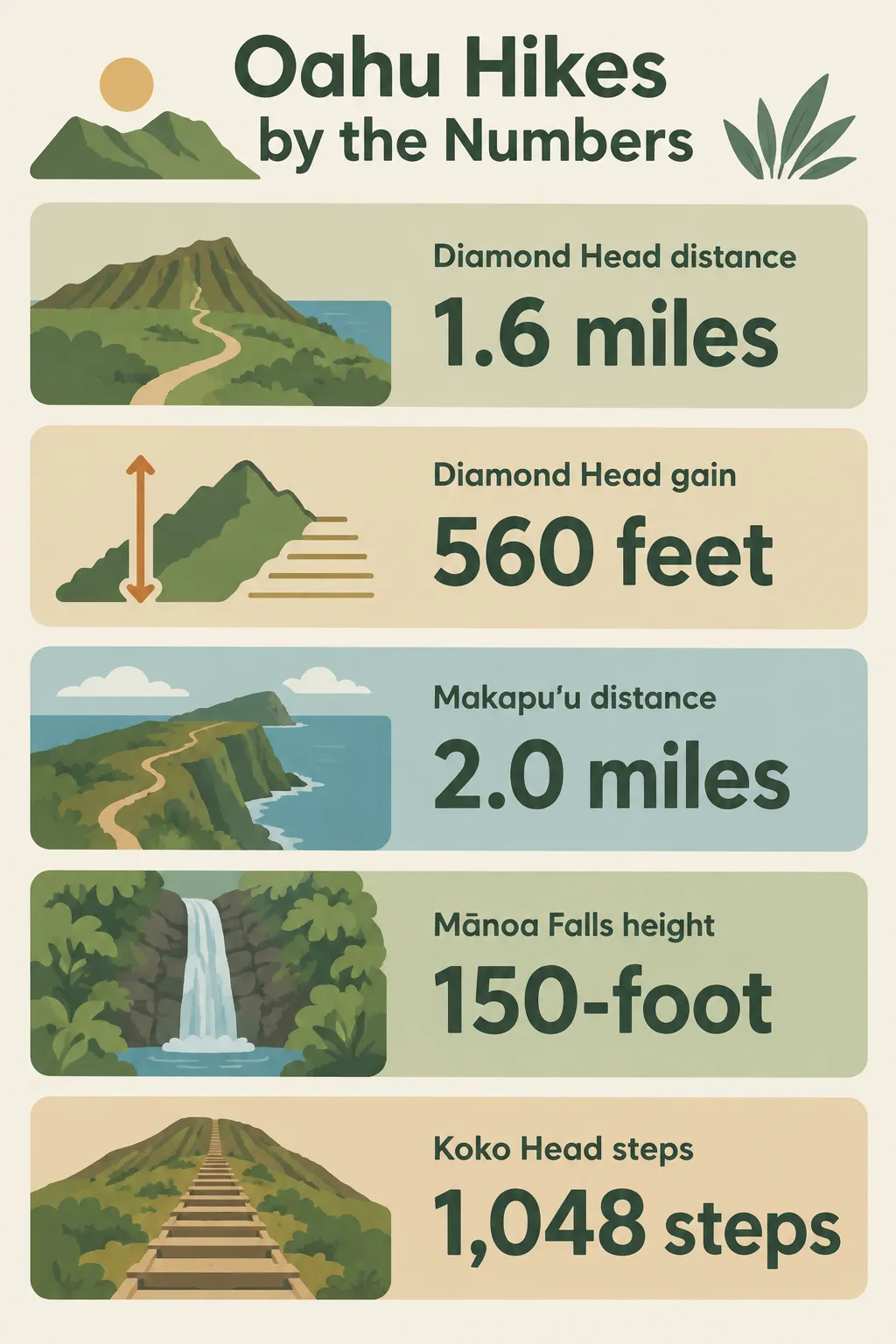 Oahu’s short hikes vary widely: Diamond Head climbs 560 feet over 1.6 miles, Makapu’u is 2.0 miles, Mānoa Falls reaches a 150-foot waterfall, and Koko Head climbs 1,048 steps.
Diamond Head is one of the most popular hikes on Oahu, and it took first place in Hawaiʻi Magazine’s 2026 Readers’ Choice Awards (14). Popular does not mean easy, though. Diamond Head, Mānoa Falls, and the Makapu’u Point Lighthouse Trail are nearly identical in length (1.6, 1.6, and 2.0 miles round trip) (4)(7)(6), but they differ enormously in difficulty: Diamond Head climbs 560 feet via steep stairs and a tunnel, Mānoa Falls is an easy-to-moderate rainforest walk to a waterfall (7), and Makapu’u is a paved coastal route (14). Pick based on fitness and footing preference, not distance alone. The other short routes compare to it like this:
- Diamond Head: 1.6 miles (2.6 km) round trip with 560 ft (171 m) of gain (4)(1). It requires a reservation and fees for nonresidents, and parking is limited and booked by time slot (3).
- Mānoa Falls: 1.6 miles round trip to a 150-foot (46 m) waterfall (7)(12). The trail is easy to moderate when wet (7).
- Makapu’u Point Lighthouse Trail: 2.0 miles (3.2 km) round trip (6) on a paved route (14). It still climbs 500 ft (152 m) (6).
- Lanikai Pillbox: about 1.8 miles (2.9 km) round trip with a steep start (9). There is no trailhead lot.
- Koko Head stairs: 1,048 steps straight up an old tramway (14).
How difficulty ratings work on these trails
Ratings vary by source, so read the terrain notes rather than the label. DLNR rates the Diamond Head Summit Trail “moderate” on its trail page (4), but the same agency’s monument page calls the climb steep and strenuous (1). DLNR rates Makapu’u “moderate” too (6), despite the pavement. It is a steady uphill on hot, dry slopes.
If you are short on time, prioritize Diamond Head and Makapu’u, which are both worth the detour. Mānoa Falls is the pick on a hot day. Koko Head is optional unless you want the workout.
Diamond Head Hike: Stairs, Tunnel and Entry Reservations
The Diamond Head hike is a 1.6-mile round trip (4). As of October 2026, nonresidents must book entry and parking online, with reservations open up to 30 days ahead (3).
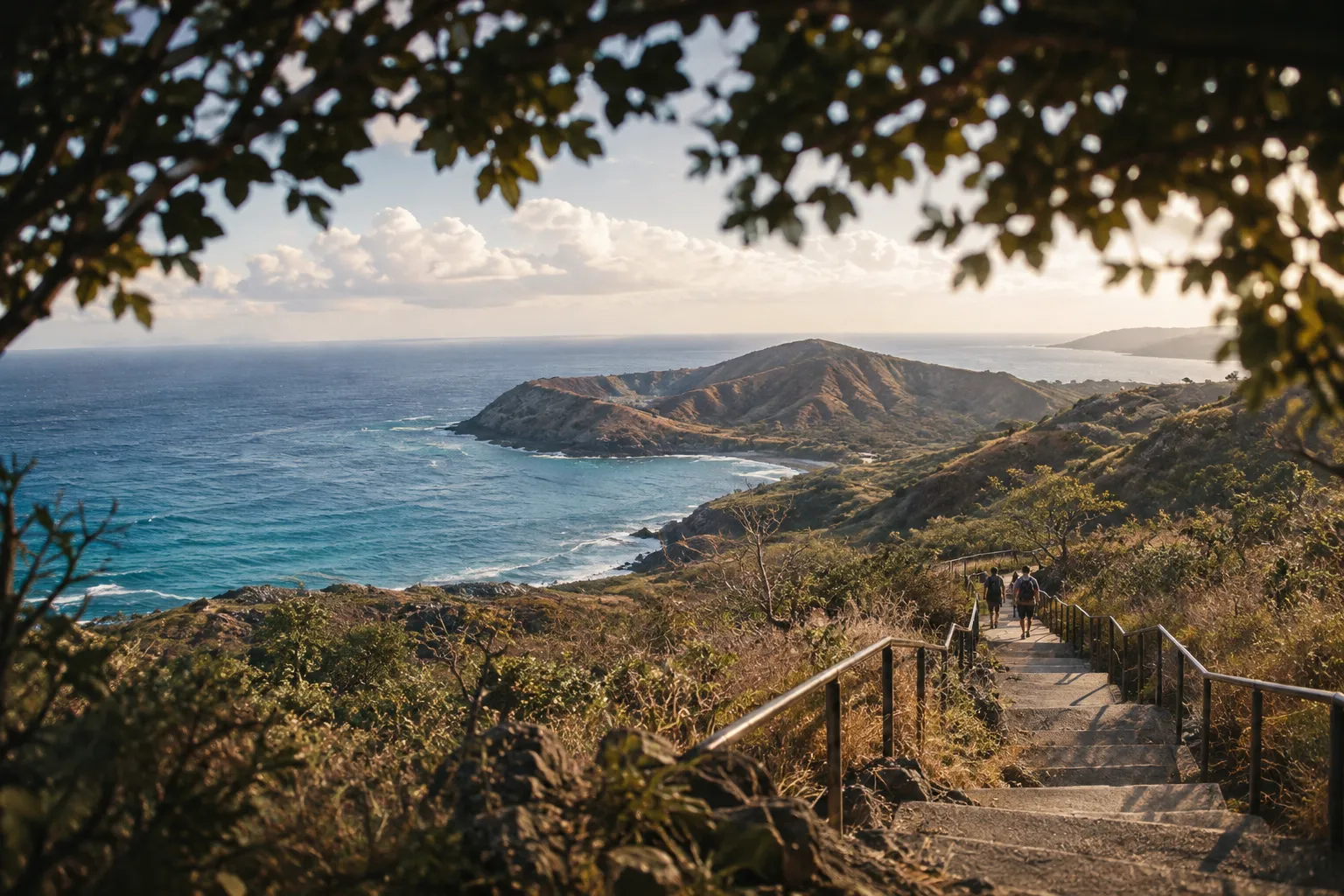
Most of the trail is natural tuff with many switchbacks up the inside of the crater wall. It then climbs steep stairs and passes through a lighted 225-foot (69 m) tunnel (4). The summit has bunkers on the crater rim and a view of a navigational lighthouse built in 1917. The shoreline view runs from Koko Head to Wai’anae (4). Diamond Head sits in the Waikiki and Honolulu area (2), so it is the easiest of these trailheads to reach from most hotels.
Booking your entry and parking slot
As of October 2026, DLNR lists the park as open from 6:00 a.m. to 6:00 p.m. daily and closed on Christmas and New Year’s (1). The last hiking reservation is 4:00 p.m., with last entry at 4:30 p.m. (1).
You need to arrive within the first 30 minutes of your slot, or you may be turned away without a refund. If you booked parking, you must leave by the end of your reservation period (3). Refunds are allowed up to 3 days before your date (3).
The hike takes 1.5 to 2 hours (1). A 4:00 p.m. slot leaves you almost no buffer before the 6:00 p.m. gate closure. Book early to mid-afternoon at the latest, and morning if you can.
What to pack for the steep final stretch
DLNR lists the terrain as hot, dry slopes (4). Bring water, a hat, sunscreen and good walking shoes (1). The last tenth of a mile (160 m) is all stairs and especially steep (1). The route is not ADA accessible (1).
Koko Head Stairs: Oahu’s Toughest Short Climb
The Koko Head stairs are 1,048 steps up the Pu’u Mai summit of Koko Crater, following an abandoned railroad track the U.S. Army built in 1942 (14).
The climb takes about half an hour, and Hawaiʻi Magazine describes the workout as intense (14). There is no switchback relief. Every step is uphill, and the descent is hard on knees.
The City and County of Honolulu manages this route, not DLNR (13). That means DLNR notices won’t cover it, so check the city’s information instead. Sunrise draws the biggest crowds. A weekday mid-morning start is a reasonable trade if you can tolerate the heat.
Skip Koko Head if you only have time for one climb. Diamond Head delivers more history and a comparable view for less pain.
Family-Friendly Picks: Mānoa Falls and Makapu’u Point
Mānoa Falls and the Makapu’u Point Lighthouse Trail are the two best-known family options on Oahu. Both are 2.0 miles (3.2 km) round trip or shorter.
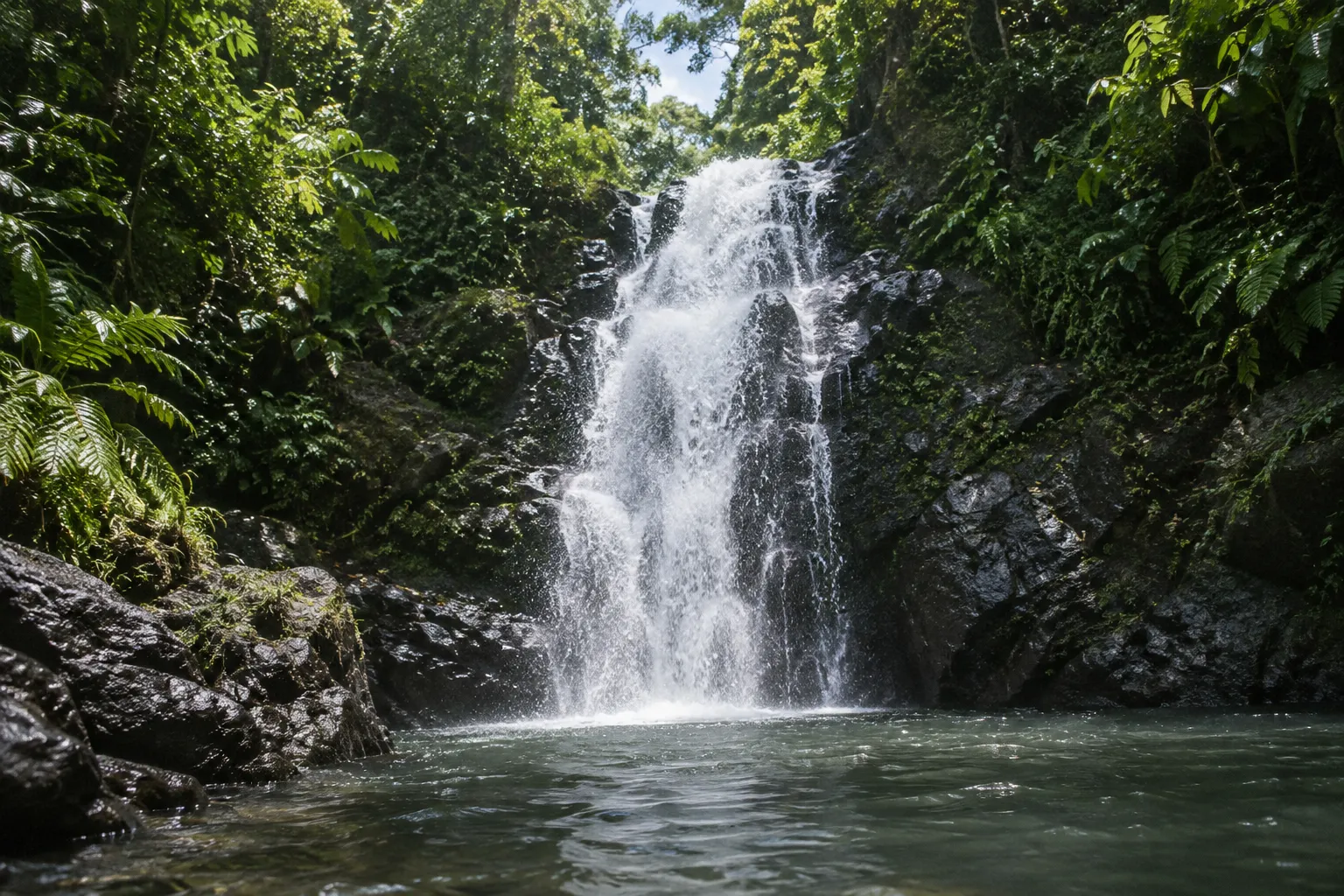
Mānoa Falls: an easy rainforest walk to a 150-foot waterfall
Mānoa Falls is a 1.6-mile round trip to a 150-foot waterfall, about 36 minutes from the airport (12). The valley is consistently wet. DLNR cites erosion and slippery conditions as recurring maintenance issues (5), so wear shoes that can get muddy. At the end of the trail, signs warn hikers away from the base pool because of landslides and falling rocks, and swimming there is prohibited (7).
People often ask whether Mānoa Falls or Waimea Falls is better. They are different kinds of outing. Waimea Falls is on the North Shore, inside a botanical garden with paid entry, so it is a garden walk rather than a free trail hike (12). Choose Mānoa if you want a trail near Honolulu. Choose Waimea if you are already driving the North Shore and want a gentler, landscaped path.
Makapu’u Point Lighthouse Trail: paved coastal views
The Makapu’u trail runs 2.0 miles round trip with views of Koko Head and Koko Crater. From the top you can see the windward coast, offshore seabird islets and the red-roofed 1909 lighthouse, which is off-limits (6). On clear days, Molokaʻi and Lānaʻi are visible (6).
Go early in the morning, because DLNR lists the terrain as hot and dry (6). From November through May, the humpback whale season, the trail is an excellent place to watch for whales, and DLNR suggests bringing binoculars (6).
Lanikai Pillbox and the Parking Problem
The Lanikai Pillbox hike has no formal trailhead parking lot, so legal street spaces or public transit are your only acceptable options (9)(8).
The trail begins inside a residential neighborhood above Lanikai Beach, about 43 minutes from the airport (12). Do not park in the Mid-Pacific Country Club lot. Do not circle residential streets hoping a space opens up (9). Hawaii-Guide’s trail page warns against both (9), and both strain a neighborhood that never asked to be a trailhead.
Plan your parking or bus route before you drive in, and check current public transportation information (9). The climb itself has a steep start and is suited to older kids rather than small children (9). Allow 1.5 to 2 hours (9).
Safety on this ridge is not a formality. The trail carries a lot of slippery gravel (9). Honolulu Fire Department crews respond to rescues on it, there have been fatal falls, and the drop behind the second pillbox is sheer, so stay back from the roof edges (8).
Permits, Day-Use Passes and Fees by Trail
Oahu has no single hiking fee or permit system. Diamond Head charges nonresidents gate fees, while a few DLNR forestry areas require separate online day-use permits (1)(13).
As of October 2026, Diamond Head charges nonresidents $5 per person for entry and $10 per vehicle for parking, credit card only. Hawaiʻi residents enter free with ID, as do children 3 and under (1). A cancellation fee of $5 can apply to changes and refunds (3).
Day-use permits for Kuaokalā, Lulumahu and Poamoho
DLNR’s forestry division says in its Oahu FAQ that hikers can apply online for Kuaokalā and Lulumahu day permits (13); as of October 2026, the permit portal lists only the restricted watershed at Lulumahu Falls (15). Each permit bought through the portal carries a $2.50 processing fee, and that fee is non-refundable even if an emergency closure cancels your trip (15). You must print the permit, carry it, and display a second copy on your dashboard (15).
Poamoho requires a permit and a 4×4 vehicle to drive past the gate to the trailhead (13). A standard rental car won’t get you there.
Mānoa Falls needs no ticket, reservation or permit, though the Paradise Park lot near the trailhead charges for parking (7). DLNR’s Makapu’u trail page lists no permit or fee (6).
Closures, Weather and Safety Checks Before You Go
Oahu trail closures change often, so check DLNR’s park notices on the morning of your hike (11)(10).
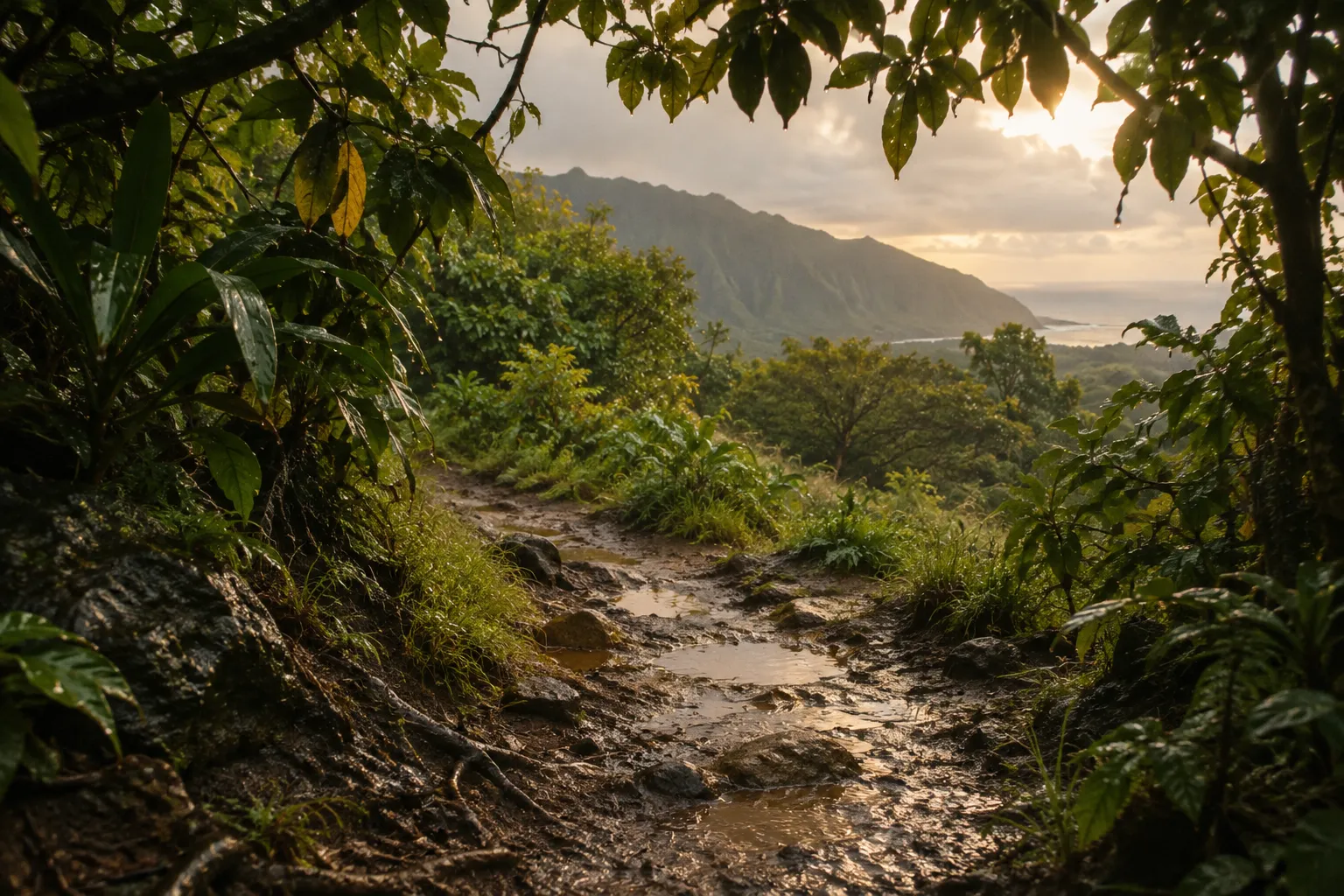
Why appearing on a trail list doesn’t mean a trail is open
DLNR’s official Oahu list still includes Ka’ena Point (2), yet the agency’s October 23, 2026 notice on recovery from Hurricanes Nolo and Lowell, while reporting that vehicle access to Ka’ena Point State Park had reopened, kept the Keawa’ula Trail closed and restricted vehicles past the restroom parking lot because of storm damage to the road (11). The same notice closes the upper viewing area at Makapu’u Lookout for repairs from October 21 to November 4, 2026, with the area closed all day on weekends and holidays, though the Makapu’u Lighthouse Trail stays open (11). On the forestry side, which includes the Mānoa Falls Trail (13), DLNR’s September 30 release said all forestry and wildlife lands on Oahu had reopened after Hurricane Nolo (18).
After heavy rains in April 2026, DLNR’s April 11 update reopened most state-run Oahu parks, trails and camping areas. Its exceptions included the Mākua-Keawa’ula sections of Ka’ena Point and the Wahiawā Freshwater State Recreation Area, the latter closed because of saturation and a risk of falling trees (10). Mānoa Falls also ran modified weekday hours during maintenance that spring (5).
Two common questions involve trails that are off the table for different reasons:
- The Haiku Stairs (Stairway to Heaven): You cannot legally hike them. They have been closed to the public since 1987, the city began removing them in 2024, and police have arrested and cited people for trespassing on them (17). Ignore any guide that describes a “sneak-in” route.
- The Kalalau Trail: This trail is not on Oahu. It runs along Kauaʻi’s Nā Pali Coast. Its first 2 miles, from Hāʻena State Park to Hanakāpīʻai Beach, make a popular day hike that requires Hāʻena entry and parking reservations; DLNR suggests allowing 3 to 4 hours round trip and warns that swimming at Hanakāpīʻai is dangerous (16). DLNR’s October 23, 2026 notice lists Hāʻena State Park as reopened on October 15, while all other Kauaʻi state parks except partial openings at Wailua River and the Waimea Canyon Lookout, and all Kauaʻi camping, remain closed after the hurricanes (16).
Checking conditions the morning of your hike
DLNR warns that clear mornings can turn rainy and windy, and that flash floods can develop in narrow gulches (11). Check the forecast and DLNR’s notices before you leave, and check again after any storm. Reopenings can reverse when another band of rain moves in (10).
Frequently Asked Questions
- What is the most popular hike on Oahu?
- Diamond Head is one of the most popular, and it topped Hawaiʻi Magazine's 2026 Readers' Choice list of Oahu hikes; nonresidents need an advance entry reservation.
- Can you still hike the Stairway to Heaven in Oahu?
- No, the Haiku Stairs are closed to public hiking, and entering them is trespassing; choose a maintained, legal trail instead.
- How difficult is the first 2 miles of the Kalalau Trail?
- DLNR describes the first 2 miles, from Hāʻena State Park to Hanakāpīʻai Beach, as a popular day hike for able-bodied hikers that takes 3 to 4 hours round trip; it is on Kauaʻi and requires Hāʻena entry and parking reservations.
- Is Mānoa Falls or Waimea Falls better?
- Choose Mānoa for a forest trail experience and Waimea for a managed botanical-garden visit; they are different outings rather than interchangeable waterfall hikes.
- How long is the Diamond Head hike?
- The trail is 1.6 miles round trip with 560 feet of gain, and DLNR suggests allowing 1.5 to 2 hours for the hike itself.
- What can you see from the top of Diamond Head?
- Diamond Head's summit combines crater-rim military structures with a broad view of Oahu's southeastern shoreline, making it more than a viewpoint stop.
- When is the best time to hike the Makapu'u Lighthouse Trail?
- Early morning is the best time for Makapu'u if you want to limit exposure on its open, sun-baked climb; November through May adds whale-watching potential.
Before You Lace Up
On Oahu, mileage tells you almost nothing about difficulty. A 1.6-mile trail can mean a gentle waterfall walk or 560 feet of stairs, so pick by gain and footing. Two planning mistakes are easy to avoid: booking Diamond Head’s last entry slot and driving into Lanikai without a legal parking plan. Book Diamond Head up to 30 days out and aim for a morning slot (3). Map your Lanikai parking or bus route the night before. On the morning of your hike, open DLNR’s notice page before you get in the car (11).