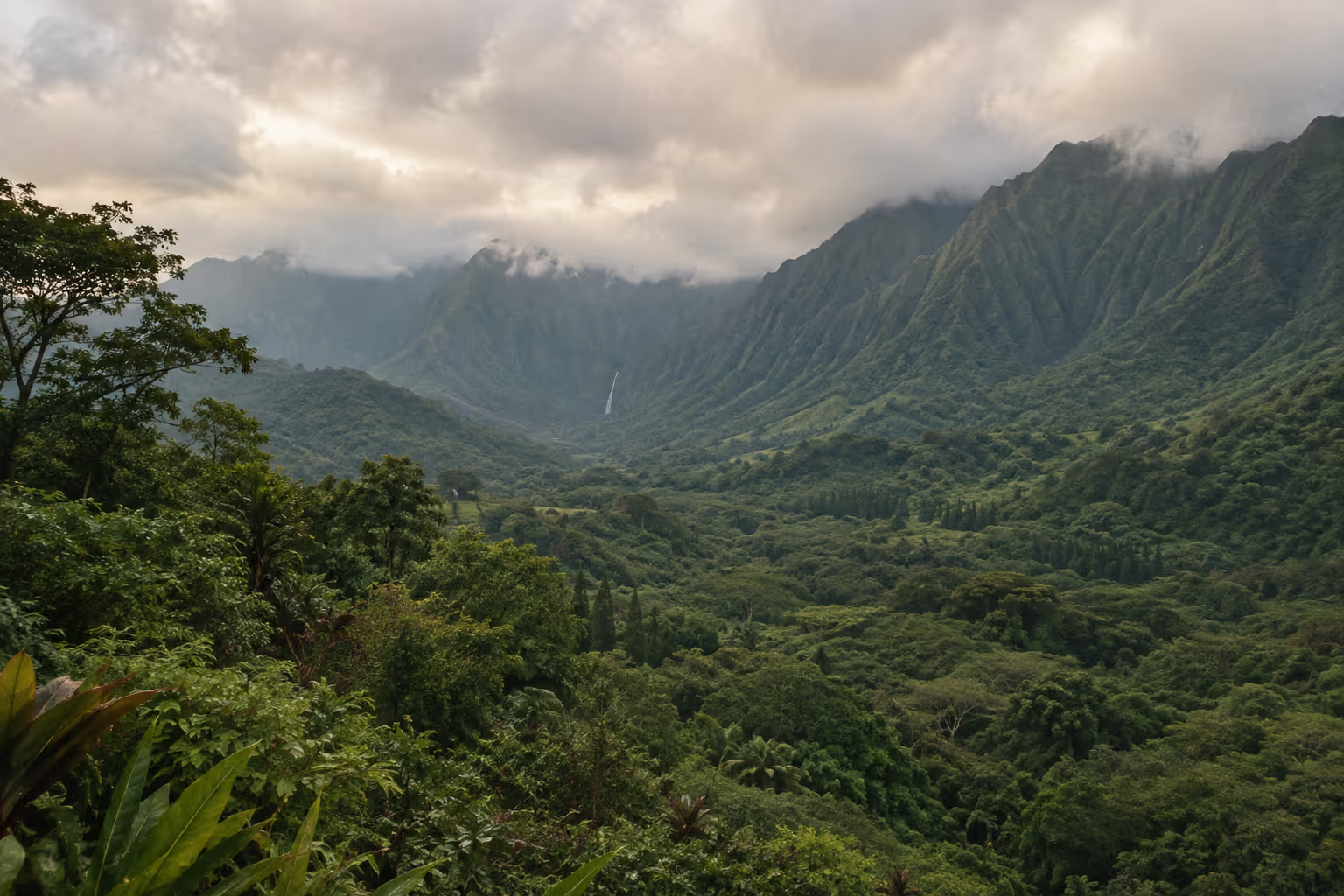
The Manoa Falls Trail is a 1.6-mile (2.6 km) round trip to a 150-foot (46 m) waterfall at the back of Manoa Valley, rated easy to moderate (3)(4). The rating describes the distance, not the footing. The state’s own March 2026 trail notice says the valley’s wet climate, heavy foot traffic and recent storms cause erosion and slippery conditions (6). Plan for mud and wet rock, and the hike is easy to schedule.
Manoa Falls Trail Overview: Distance, Difficulty, and the Waterfall
The Manoa Falls Trail runs 0.8 miles (1.3 km) each way, gains about 800 feet (244 m), and ends at a 150-foot (46 m) waterfall in Honolulu’s Manoa Valley (3)(4). It starts at the end of Manoa Road, a short drive from Waikiki, and stays under rainforest canopy most of the way.
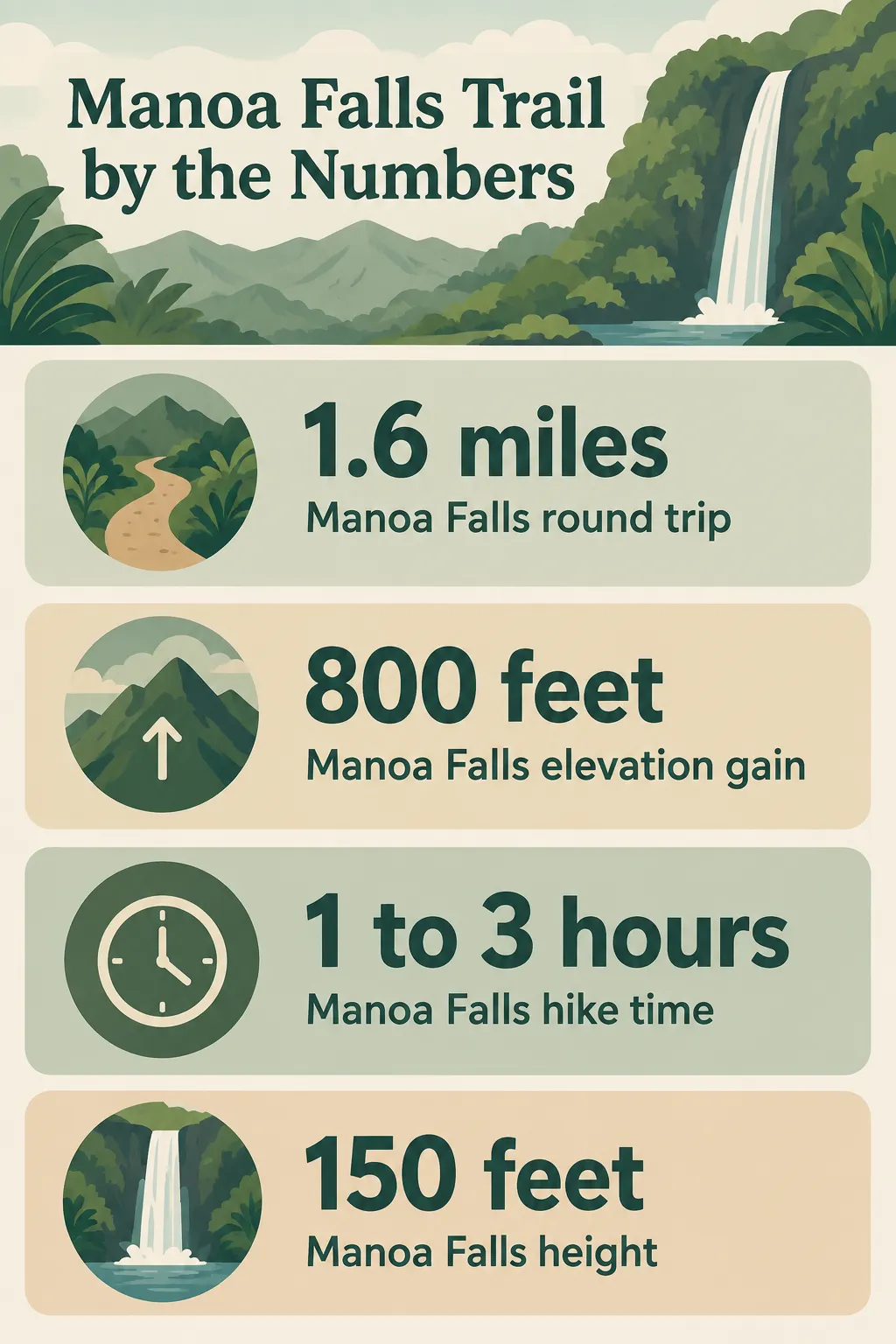 The Manoa Falls Trail covers 1.6 miles round trip with 800 feet of elevation gain, takes 1 to 3 hours, and ends at a 150-foot waterfall.
Trail Distance, Elevation Gain, and Difficulty Rating
The published figures are:
- Distance: 1.6 miles (2.6 km) round trip (3)
- Elevation gain: about 800 feet (244 m), including some steps (3)
- Difficulty: easy to moderate (3)
- Waterfall height: 150 feet (46 m) (4)
- Trailhead address: 3860 Manoa Road, Honolulu, HI 96822 (3)
The trail is listed as suitable for kids, families, seniors and leashed dogs (3). That is fair on a dry day. On a wet one, the same 800 feet (244 m) of climbing happens on slick roots, rocks and steps, and the descent is where most people slow down. To see how it compares with Diamond Head, Makapu’u and Koko Head, read our guide to Oahu hiking trails.
Rainforest Scenery Along the Way
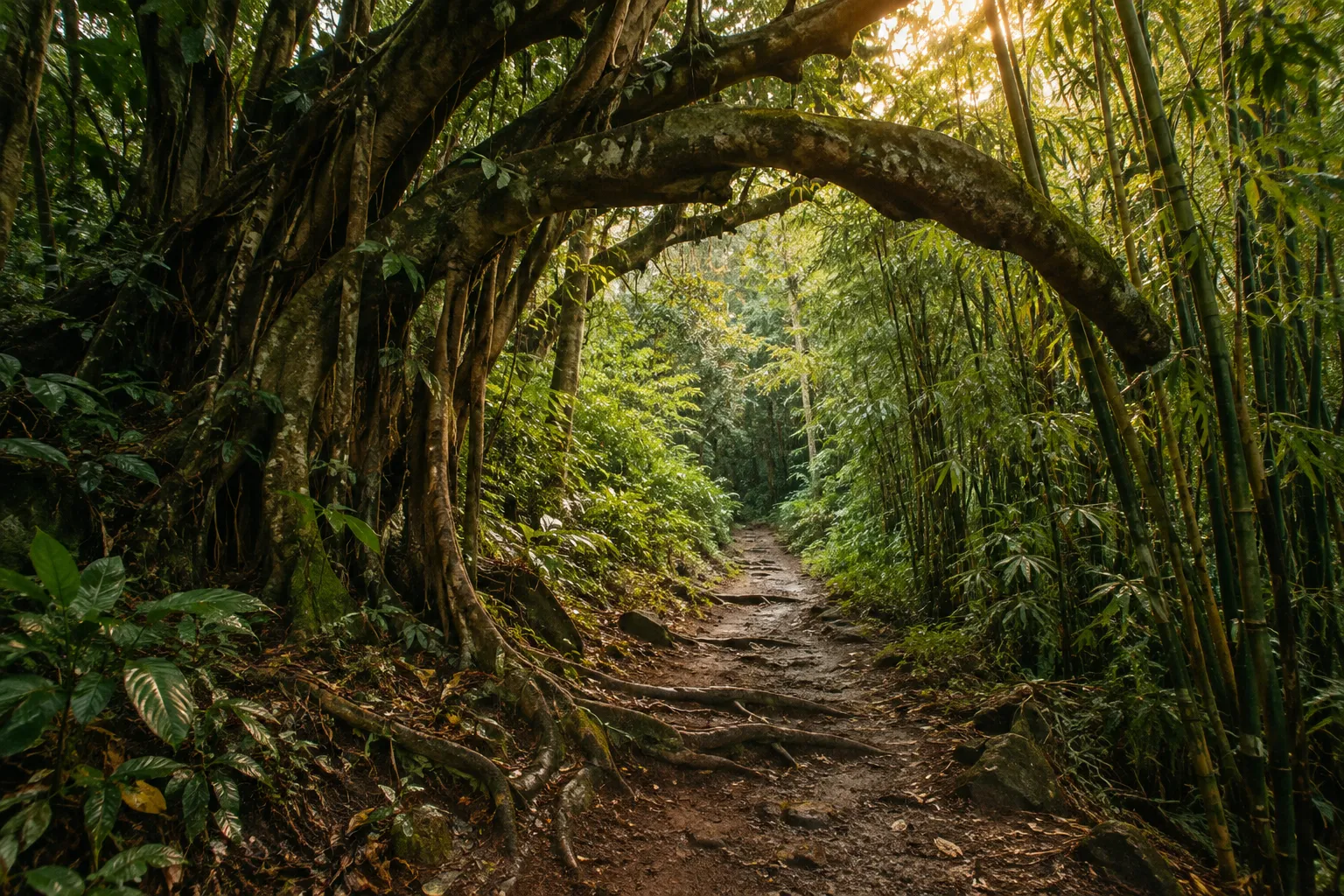
You walk through a dense bamboo forest with tall green stalks closing in on both sides, and past a banyan tree that forms a natural arch over the trail (4). The canopy keeps the trail shaded and humid. That shade is pleasant at midday, but it also keeps the ground from drying out after rain. Film crews have used the valley too: the trail’s Wikipedia entry lists Jurassic Park and Catching Fire among the films shot at Manoa Falls (15).
The trade-offs are clear. On the plus side, the trail is short, shaded, free to walk and close to Waikiki. On the minus side, it carries heavy foot traffic (6), it turns muddy after rain, the closest lot charges a fee, and you cannot swim at the falls.
✓ Pros
- Published distance and elevation figures make it straightforward to judge the route before you leave.
- The trail's short out-and-back format makes it easier to fit into a half-day than a long valley hike.
✗ Cons
- The damp canopy can leave footing slick even when the weather looks settled at the trailhead.
- Parking and trail access run on separate rules, so a valid parking plan does not guarantee the trail is open.
How Long the Manoa Falls Hike Takes
The Manoa Falls hike takes 1 to 3 hours round trip, according to the published estimate for the 1.6-mile (2.6 km) route (3). The spread is wide because pace on this trail depends almost entirely on ground conditions and how long you stand at the falls.
Fit hikers on a dry morning will land near the low end. Families with small kids, anyone stopping for photos in the bamboo, or anyone picking their way down wet steps should budget the full 3 hours. Add travel and parking time, and the trip fills a comfortable half-day.
The trail is open from sunrise to sunset, and a sign at the trailhead recommends not starting after 5:30 p.m. (2). If you park in the paid lot, the lot closing time is the deadline that matters. Pack a headlamp or flashlight anyway, as the trail guide advises, in case you are still under the canopy at dusk (2).
The trail guide names early morning as the best time to go (3).
Manoa Falls Parking: Fees, Hours, and Free Alternatives
Manoa Falls parking costs $7 per vehicle at the Paradise Park lot, while the trail itself has no entrance fee (1)(4). You cannot drive to the falls, so what you are looking for is trailhead parking. The old trailhead lot is listed as closed because of vehicle break-ins and thefts (1).
Paradise Park Lot: Fees and Hours
The Paradise Park lot sits at 3737 Manoa Road, Honolulu (1). As of November 2026 the trail guide lists it at $7 per vehicle, open 8 a.m. to 6 p.m. daily (1), and Lyon Arboretum’s parking page gives the same $7 general fee with $5 for kama’aina and military (12). The 8 a.m. opening matters more than the fee. If you want a sunrise start, the lot won’t be open yet, so you’ll need the street-parking option below.
Time your return as well. A slow 3-hour hike started at 3 p.m. leaves no margin before the 6 p.m. close (2)(3).
Free Street Parking Farther Down Manoa Road
You can hike Manoa Falls entirely for free by parking on residential streets in Lower Manoa and walking up. The trail guide’s parking page puts that at about a 10-minute walk to the trailhead (1). Follow every posted sign. These are neighborhood streets with residents who need their driveways, and towing is a more expensive lesson than $7.
The choice comes down to time against money. The paid lot is closest and has fixed hours. The street option costs nothing and has no lot closing time, but it adds roughly 20 minutes of road walking to the round trip. If you’re arriving before 8 a.m., the street is your only option. Don’t leave valuables visible in the car either way, given the break-in history that closed the old lot (1).
Manoa Falls Parking Options
| Paradise Park lot | Lower Manoa street parking | |
|---|---|---|
| Cost | $7 per vehicle; $5 for kama'aina and military (November 2026) | Free |
| Hours | 8 a.m.-6 p.m. daily | No lot closing time |
| Walk to trailhead | Closest option | About 10 minutes |
| Practical tradeoff | Paid parking with a fixed closing time | Legal spaces only; adds road walking |
Mud, Rain, and What to Bring
The Manoa Falls Trail stays wet for much of the year: the state notice cites heavy foot traffic, the valley’s consistently wet climate, and recent storms as causes of erosion, trail degradation and slippery conditions (6). “Easy to moderate” describes a short distance. It does not describe dry or smooth ground.
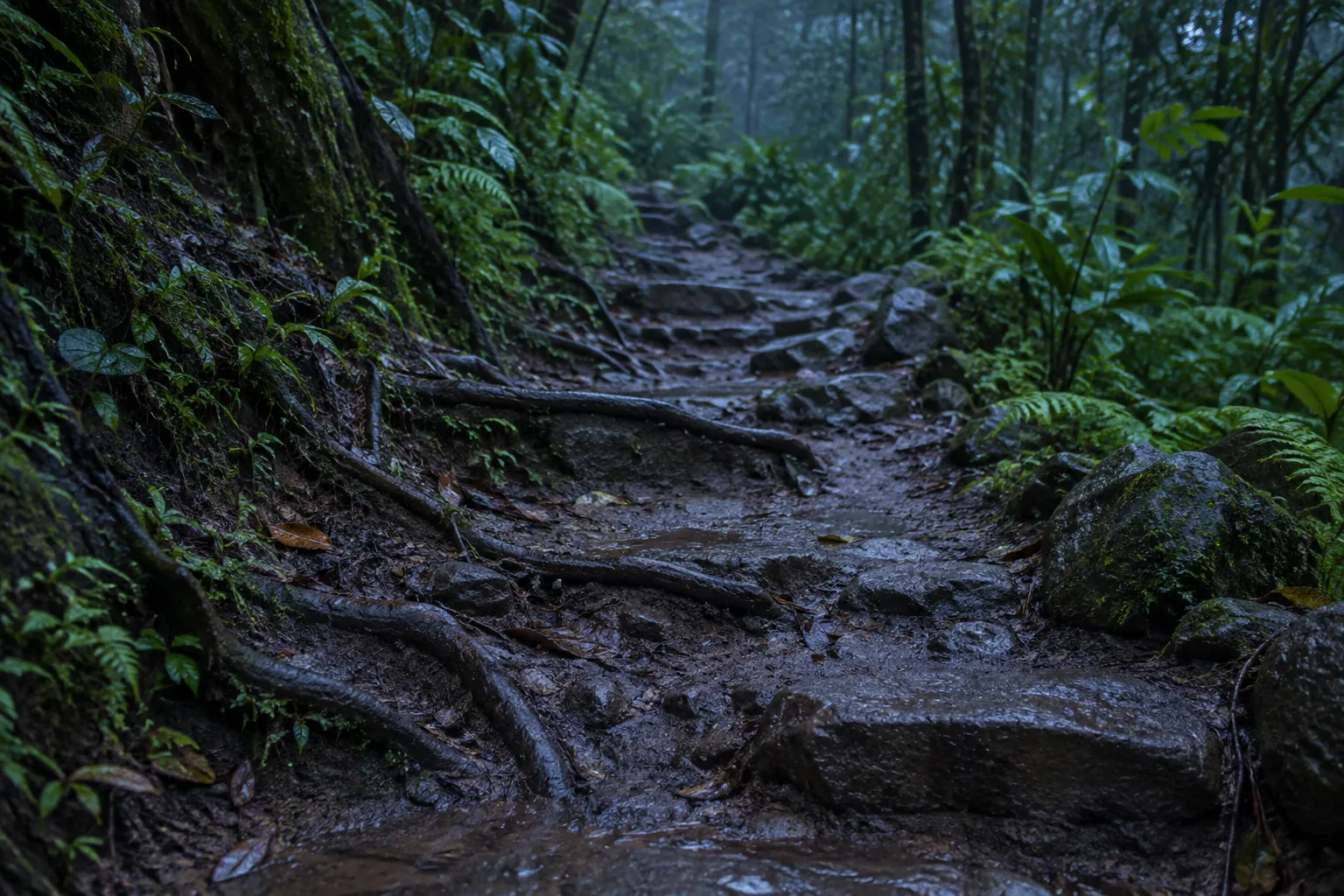
Honolulu Magazine’s family test of the reopened trail in July 2021 described noticeably less mud than before the closure (5). Less mud is still mud. Expect rocky, slick sections, especially on the steps and on the walk down.
Footwear and Gear for Mud
Skip the slippers and smooth-soled sneakers. You want a shoe with deep, widely spaced lugs that shed mud instead of packing with it. The Salomon Speedcross 6 is built for this: its aggressive lugs grip soft ground where a road shoe slides. If you’d rather have a boot, the Merrell Moab 3 Waterproof prevents soaked socks on a short, wet hike. Plan on your shoes getting dirty either way.
Bring:
- Insect repellent and sunscreen, the two items Honolulu Magazine’s group applied before starting (5)
- Water, at least 1 liter (34 oz) per person, all of it carried in: the runoff in the pool at the falls is often contaminated with leptospirosis bacteria (9)
- A light rain shell, since showers move through the valley fast
- A headlamp for late starts (2)
- A towel and a spare pair of socks left in the car
Waterfall Flow in Dry vs. Wet Conditions
Best flow comes after rain (3). That puts you in a trade-off: the days the falls look most impressive are the days the trail is muddiest. After a dry spell, expect a thinner stream down the 150-foot (46 m) face and firmer footing. If you care more about the waterfall, go once a wet spell has passed, never during heavy rain: flash floods can arrive with little warning (9), and our guide to hiking safety in Hawaii’s flash-flood valleys explains how long streams stay dangerous after a storm. If you care more about footing, go after a dry week.
What the 2021 Repairs Fixed and What the 2026 Maintenance Hours Mean
The Manoa Falls Trail went through a major reconstruction that ended with a mid-2021 reopening, while the 2026 changes were only temporary maintenance hours (5)(6). People mix the two up, and they shouldn’t. One permanently changed the trail. The other changed when you could walk it for two weeks.
2021 Repairs: Wider Tread, Steps, and Erosion Controls
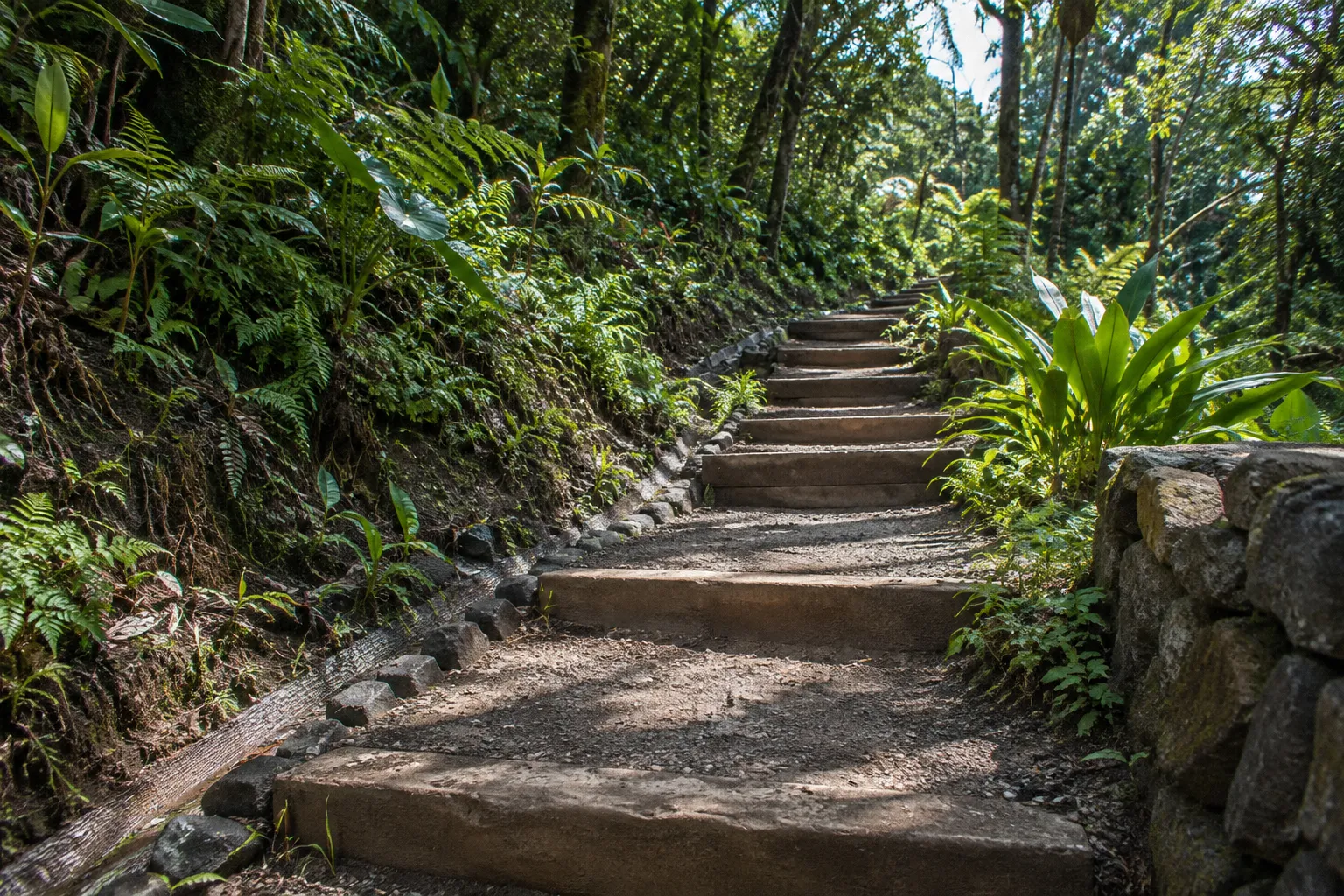
The trail closed in July 2019 for the installation of a rockfall hazard mitigation fence next to the falls and reopened on June 5, 2021 (13). DLNR lists the improvements made during the closure (13):
- Widened tread for two-way foot traffic
- Resurfacing
- New steps
- Trailside plantings
- Erosion and runoff controls
- Benches and interpretive signs
- A new rock wall around the waterfall viewing area (5)
These are permanent. If you hiked Manoa before 2019 and remember a single-file mud chute, the trail is wider and better drained now.
2026 Maintenance Hours: Dates and What Resumes April 11
On March 23, 2026, DLNR announced modified access for trail maintenance (6):
- Monday, March 30 to Thursday, April 2: closed 6 a.m. to 2 p.m., open 2 p.m. to sunset
- Friday, April 3 to Sunday, April 5 (Good Friday holiday weekend): open 6 a.m. to sunset
- Monday, April 6 to Friday, April 10: closed 6 a.m. to 2 p.m., open 2 p.m. to sunset
Regular hours were set to return by April 11, 2026 (6). The work addressed erosion, trail degradation, heavy vegetation growth and storm damage. The release presents this as work the wet valley needs every year (6). During the window, DLNR pointed hikers to Pu’u Pia Trail and Makiki Valley Loop as nearby alternatives (6).
The practical lesson: DLNR adjusts hours for maintenance, and posted lot hours won’t tell you that. Storms close the trail too. After Hurricane Nolo, DLNR’s September 30, 2026 release listed all forestry and wildlife lands on O’ahu as open again, while warning that unidentified and unmitigated hazards may still exist (14). Check the DLNR trail notices before you drive out.
Waterfall Safety: Viewing Area vs. Swimming Restrictions
The Manoa Falls Trail has two separate hazards: slippery footing along the route after rain (6), and a far more dangerous zone at the base of the falls, where swimming is prohibited (9). Most people only think about the first one.
The Designated Viewing Area and Rock Wall
The 2021 work added a rock wall around the viewing area at the end of the trail, which keeps visitors back from the pool (5). Stay behind it.
Why Swimming at the Base Is Off-Limits
Swimming in the pool at the base of Manoa Falls is prohibited, and ticketing visitors who ignore the posted signs is not uncommon (9). The runoff water is often contaminated with leptospirosis bacteria, which can cause high fever, muscle aches and vomiting (9). The rocks around the pool are slippery, and rocks falling from the cliff above can cause serious injuries (9). Flash floods can arrive with little warning and can be deadly (9). Other visitors standing in the pool are not evidence that it’s safe. If you have open cuts, keep them away from the water entirely.
Lyon Arboretum and Other Nearby Stops
Lyon Arboretum is a separate University of Hawaii botanical garden near the Manoa Falls trailhead, and its official site says reservations are not required to visit (11). It is open Monday through Friday, 9 a.m. to 3 p.m., closed weekends and state and federal holidays, and construction has closed it intermittently (11). It is not part of the waterfall hike, and walking the Manoa Falls Trail does not include arboretum entry.
All visitors must sign in at the Visitors Center, where you can pick up trail, bird and garden guides for a self-guided visit (11). If you’re asking which birds live in the valley, those guides are your best tool. Docent-led tours for families and individuals need no reservation: if a volunteer docent is available that day, you sign up at the Gift Shop on arrival, and the tour costs $15 per person, free for children 12 and under (11). Organized groups of 8 or more must coordinate in advance through the Education Department (11).
Admission policies change, so check the arboretum homepage or call the Visitors Center at 808-988-0456 before you go (11). The arboretum’s free lot is for arboretum visitors and has a limited number of stalls (12), and the trail guide discourages parking there just to hike the falls (1).
Frequently Asked Questions
- How much time should you leave for the Manoa Falls hike?
- Allow up to three hours if you are hiking with children, taking photo stops, or descending wet steps; the route's published estimate is a planning range, not a pace guarantee.
- Can you avoid paying to park for Manoa Falls?
- Yes; choose a legal Lower Manoa street space and walk to the trailhead, but check signs carefully and do not block residents' driveways.
- Does a reservation guarantee access to the falls trail?
- No reservation is required for the trail, and a reservation elsewhere does not override DLNR maintenance closures; check the current trail notice before setting out.
- What movies were filmed at Manoa Falls?
- The trail's Wikipedia entry lists Jurassic Park and Catching Fire among the films shot at Manoa Falls, along with scenes for the TV series Lost and Hawaii Five-0.
- Is the trail a good choice for young children?
- It can suit families, but wet steps call for close supervision on the descent, and children should stay behind the viewing-area wall.
- How should you plan a visit after rain?
- Expect slicker footing after rain, even if the waterfall flow is stronger; choose footwear with lugged soles and allow extra time for the descent.
- Can you swim at the waterfall if other visitors are in the pool?
- No; swimming is prohibited, and other visitors in the pool do not make the area safe from contaminated water, falling rocks, or flash floods.
Before You Drive Out
Here’s what to plan around: 1.6 miles (2.6 km) round trip, about 800 feet (244 m) of gain, 1 to 3 hours on the trail, and a 150-foot (46 m) waterfall you view but don’t swim under (3)(4)(9). Parking is $7 at Paradise Park, or $5 for kama’aina and military, between 8 a.m. and 6 p.m. as of November 2026, or free on Lower Manoa streets if you don’t mind the extra walk (1)(12). The 2021 repairs permanently widened and drained the trail. The 2026 hour changes were temporary maintenance that ended by April 11 (6), and DLNR listed O’ahu’s forestry lands open again after Hurricane Nolo on September 30, 2026 (14).
Wear lugged shoes, bring repellent and a headlamp, and check the current DLNR notice the morning you go. If you have time left, visit Lyon Arboretum as a separate stop and sign in at its Visitors Center (11). For more ways to fill out the day, see our roundup of things to do in Honolulu.