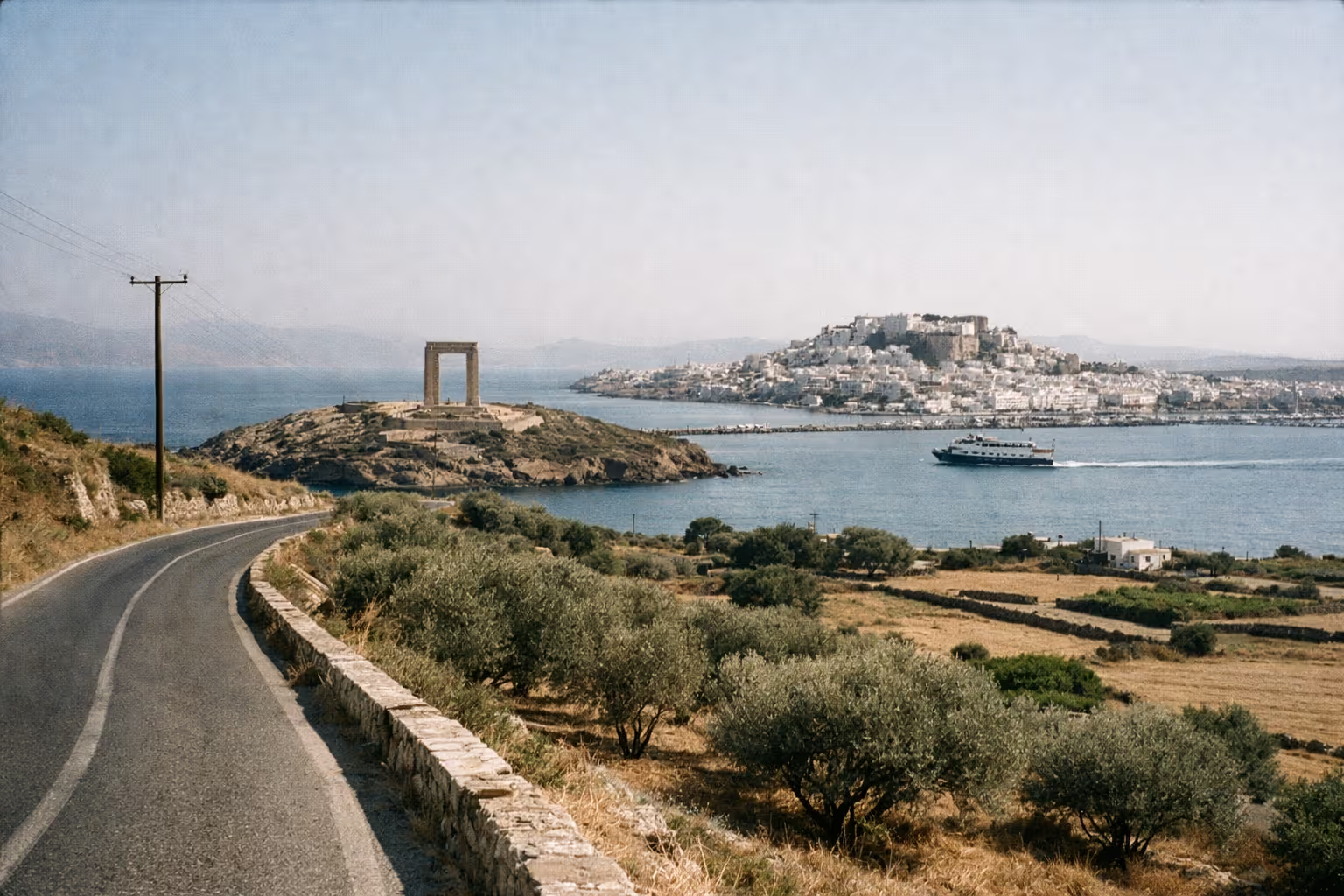
At dusk on the islet of Palatia, a single marble doorway stands against the Aegean, framing the sea and the town of Naxos behind it. No temple ever rose around it. That gateway - the Portara - is the emblem of Naxos, the largest and most self-sufficient island in the Cyclades, and it sets the tone for the whole place: a Cyclades island that started big things and never quite finished them, and is more interesting for it.
Naxos farms its own potatoes, quarries its own marble, and makes cheese good enough to top a global ranking. It doesn’t need you to show up, which is exactly why it feels like a real place rather than a stage set. This guide covers the Portara, the long west-coast beaches, the mountain villages of the interior, the food, and the ferry logistics that make Naxos easy to combine with Paros or Santorini. It’s built for families, first-timers to the Cyclades, and anyone who wants more than a sun-lounger. Plan on three to seven days depending on how deep you want to go.
✓ Pros
- Largest island in the Cyclades - more to explore, less crowded inland
- West-coast beaches consistently rank among the best family beaches in the region
- Strong local food identity (PGI potatoes, graviera, citron liqueur) - not just tourist tavernas
- Short ferry hop from Paros (about 25 min) makes it easy to combine with other islands
- Mount Zas hike and Tragaea valley give the island genuine depth beyond the beach
- More self-sufficient and less tourism-dependent than Mykonos or Santorini
✗ Cons
- Bigger than it looks - underestimating driving times between beaches, villages, and hikes is a common mistake
- High season (July-August) is increasingly crowded; air arrivals rose 30.9% in 2025
- Fewer iconic "postcard" moments than Santorini - the appeal is cumulative, not instant
- Mountain villages require a car or organized tour; public buses don't reach them reliably
- Booking ahead in peak season is now essential, not optional
What Makes Naxos Stand Out Among the Greek Islands of the Cyclades
Naxos is the largest island in the Cyclades, covering roughly 429 km² - more than twice the size of neighboring Paros - and that scale gives it an agricultural, self-sufficient character no other island in the group can match. About 40 km long by 30 km wide, it has room for landscapes that simply don’t exist elsewhere in the archipelago: a fertile mountain interior sitting right alongside the coast (2).
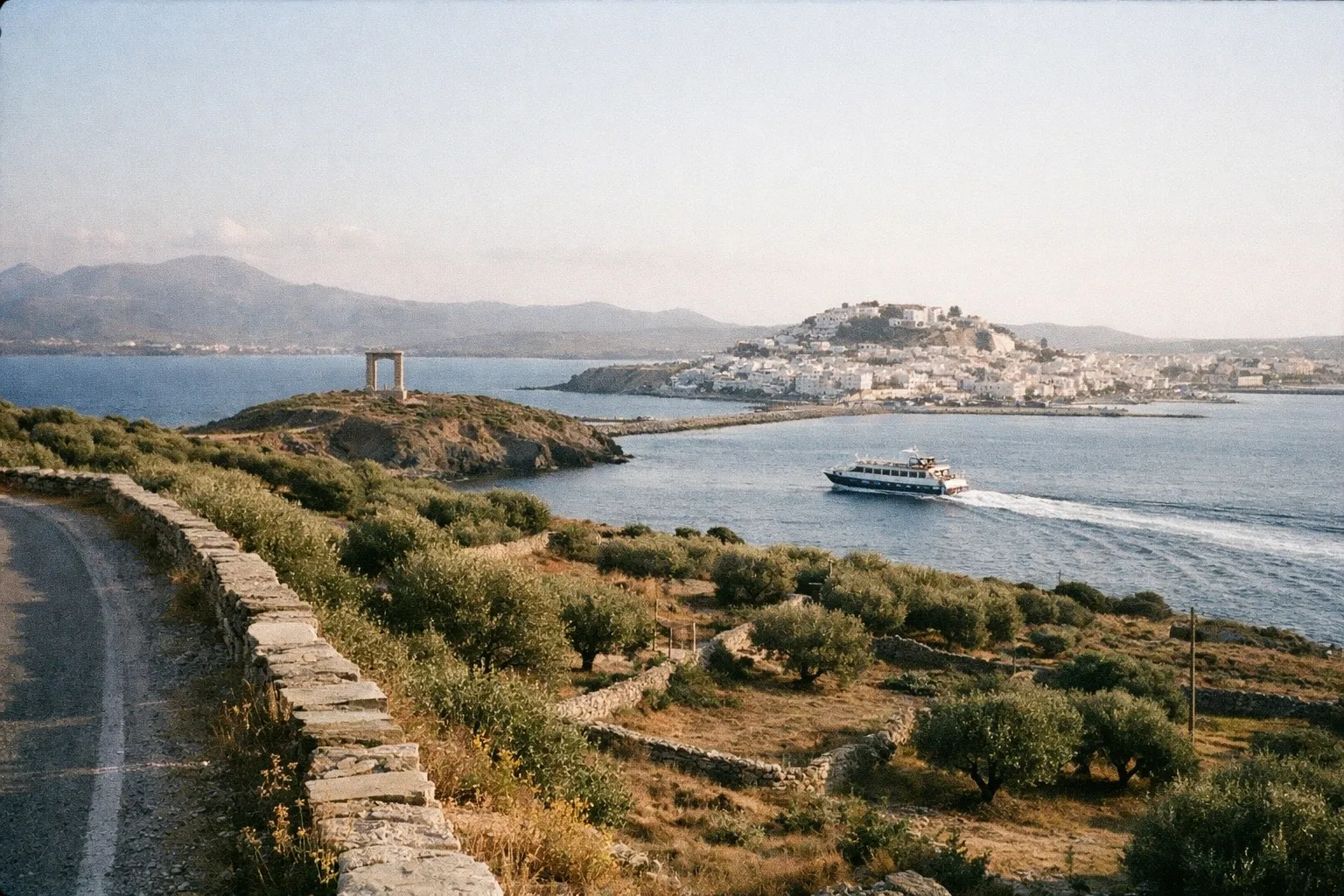
That scale is the whole point. Most Cycladic islands do one thing well - Santorini its caldera, Mykonos its nightlife. Naxos gives you three distinct layers. There’s the coast, with the Portara and the long sandy beaches south of town. There’s the interior, with stone villages, the Tragaea valley, and Mount Zas. And there’s the table, built on products the rest of the Cyclades imports. According to Greek Trip Planner, Naxos combines the region’s longest sandy beaches, its highest peak, and a genuine agricultural economy of PGI potatoes, Graviera Naxou cheese, and kitron liqueur.
Word is getting out. According to the Greek newspaper To Vima’s 2026 tourism report, air arrivals to Naxos jumped 30.9% in 2025, with ferry traffic up 5.8% (9). That means booking transport and rooms earlier for July and August, and it means the beaches fill faster than they used to.
Naxos rewards five to seven days - enough time to spread out beach days, dedicate a full day to the interior, and hike Zas without ticking boxes. Three to four days still works if you’re disciplined about not trying to do everything.
The Portara - Naxos’s Unfinished Temple of Apollo
The Portara is a marble gateway - its exact dimensions are debated among archaeologists, but standing inside it you understand the scale immediately - all that remains of a Temple of Apollo begun in the late 6th century BC and never completed. Built from four massive marble blocks about 1.3 m thick, each lintel weighing around 20 tons, it survived precisely because the stone was too heavy to haul away for reuse (1).
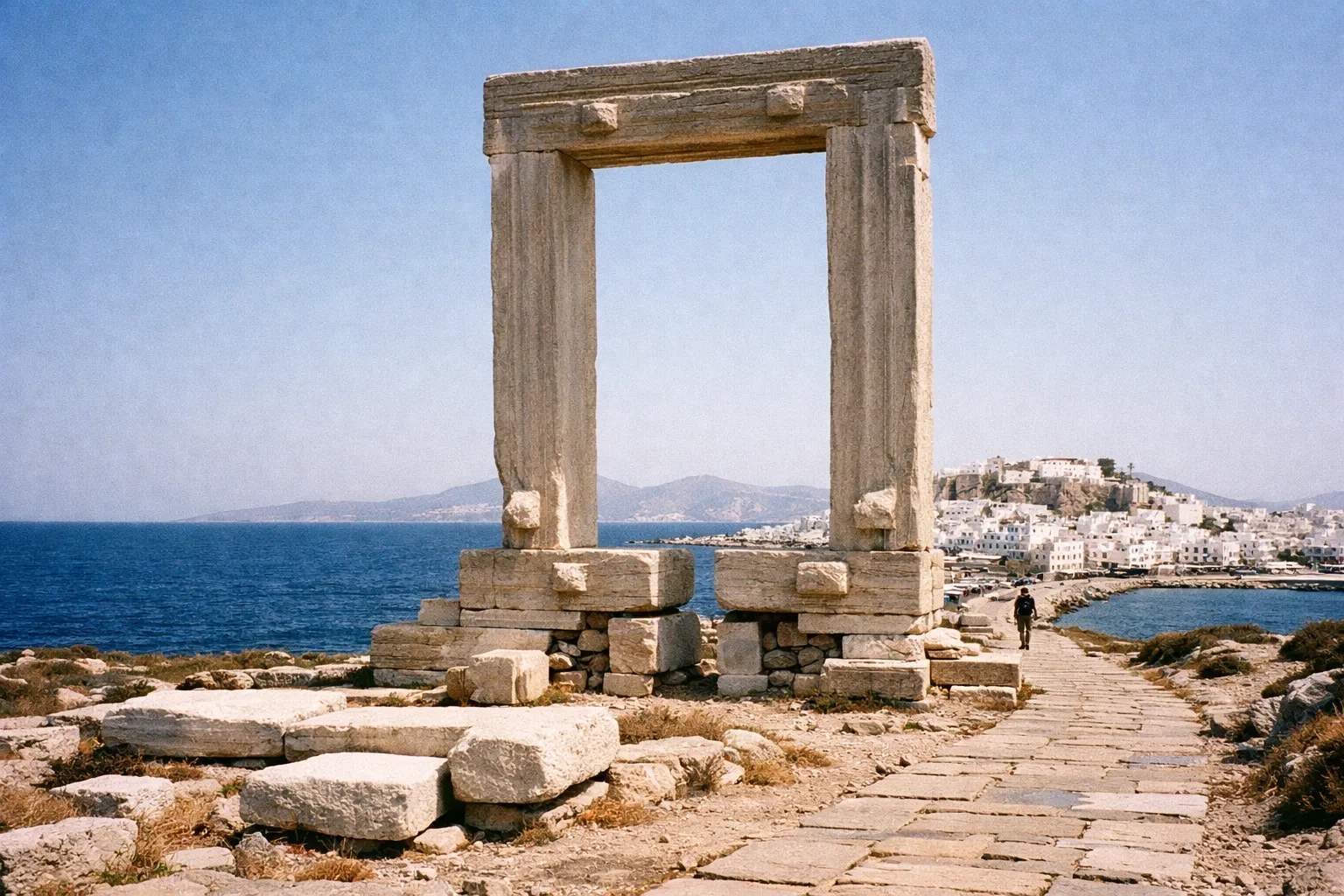
The temple it was meant to anchor would have been enormous. Planned in the Ionic style, it was designed to measure about 54 m long and 28 m wide, with a peristyle of 6 by 12 columns - a scale comparable to the great temples of the ancient Greek world (1). The tyrant Lygdamis started it, then fell from power, and the ambition collapsed with him. What’s left is a doorway to nothing, which is either a failure or the most honest monument in the Cyclades, depending on your mood.
The gateway sits on the islet of Palatia, linked to Naxos Town by a paved causeway. From the harbor front, the walk takes roughly 5 to 10 minutes, and the site is open and unfenced - no gate, no ticket booth (1). Stand inside the frame and you’re looking back at the Hora (Naxos Town’s old town and port quarter), the water, and on clear days the outlines of other Cyclades floating on the horizon.
The move is to visit twice. Go once in daylight to read the archaeology and understand what you’re standing in. Then come back in the hour before sunset, when the low light warms the marble and the whole town glows behind the gate. Photographers and everyone with a phone converge here in the evening, and it earns the reputation.
Visiting the Portara - Timing, Access, and What to Expect
The paved footpath from the harbor suits most visitors, including families with kids. There’s no entry fee - the Portara is an open site with no ticketed access (1). Sunset timing shifts by season, so check the day’s sunset and arrive 30 to 40 minutes early in July and August when the causeway gets crowded and good spots on the islet go fast. Bring water and comfortable shoes, and expect wind: Palatia is exposed on all sides, and the breeze off the Aegean can be sharp even on a warm evening.
Naxos Beaches - The West Coast’s Long Sandy Run
The best beaches on Naxos form a near-continuous sandy strip running south from Naxos Town, with Agios Prokopios, Agia Anna, and Plaka as the main stops. According to Greek Trip Planner, Plaka, Agios Prokopios, and Agia Anna together make up the longest sandy beaches in the Cyclades, an almost unbroken golden coastline on the island’s southwest.
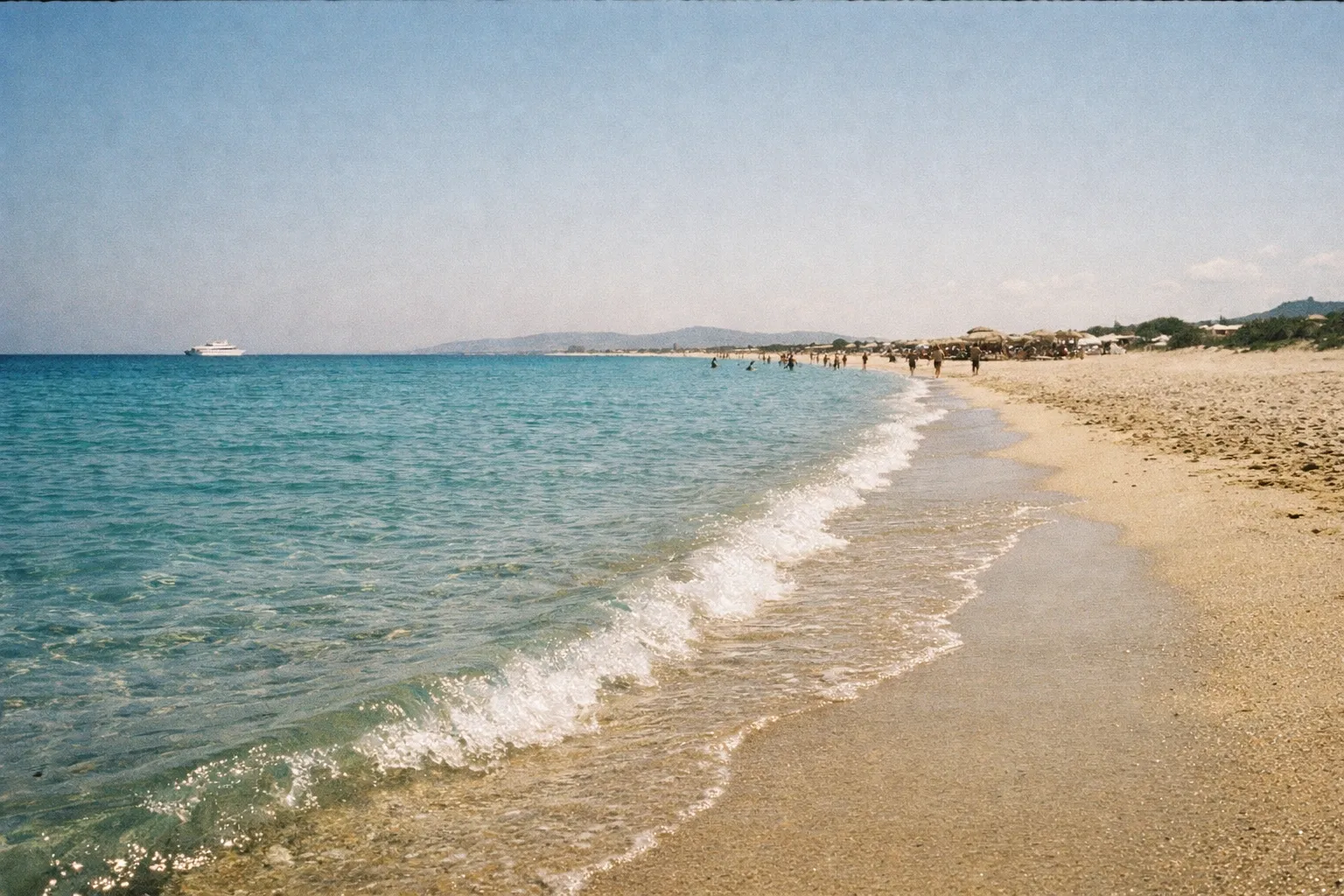
This is where Naxos outperforms most of its neighbors for families. The water shelves gently, the waves are usually mild, and the sand runs long enough that you can always find space if you walk a bit. Amenities cluster where the crowds are and thin out as you head south, so you can dial in exactly how developed you want your beach day to be.
Getting there is straightforward. Agios Prokopios sits about 5.7 km from Naxos Town, just past Saint George Beach, which puts it under 15 minutes by car or a short local bus ride away (naxos.net). The KTEL bus network serves all three main beaches, so a car isn’t strictly necessary for a beach-focused trip - though it opens up the quieter northern stretches. The line 1 bus between Agia Anna and Plaka takes about 14 minutes and costs €1 to €2, which tells you how tightly these beaches are linked (rome2rio).
One honest note on crowds: these beaches are more popular every year, and by mid-morning in high summer the central sections fill up. Arrive early or drift toward northern Plaka for room.
Agios Prokopios - Best All-Round Family Beach
Agios Prokopios is the strongest family pick on Naxos, with gently shelving sand, calm water, and facilities within easy reach. TripAdvisor reviewers describe it as a very family-friendly beach with clean water and several attached restaurants, and it holds a rating above 4.5 out of 5 from thousands of reviews (tripadvisor). It’s not a party beach - the beach clubs and tavernas here lean toward long lunches rather than late nights. In July and August it’s busy by mid-morning, so plan to arrive before 10am or after 5pm if you want space to spread out.
Agia Anna and Plaka - Quieter Stretches South
Agia Anna keeps a small fishing-village feel, with a working harbor and a slightly more residential atmosphere than Agios Prokopios next door. It’s an easy walk or short bus ride from its neighbor, so you can sample both in a day. Plaka runs longer and less developed - the right choice if you want sand without rows of sunbeds. The northern section of Plaka is the quietest stretch of the whole west coast, worth the extra few minutes of driving, and a reliable bet for families who want calm water without the crowds.
The Mountain Villages and the Tragaea Valley
The Tragaea (the island’s broad inland plateau) is the single feature that most separates Naxos from Paros: a fertile valley of olive groves and stone villages with nothing comparable anywhere else in the Cyclades. The valley is dotted with Byzantine churches - local guides count dozens of significant ones, many holding rare frescoes, inscriptions, and sculptures - and in an archipelago defined by dry, treeless islands, a green valley full of chapels is genuinely startling.
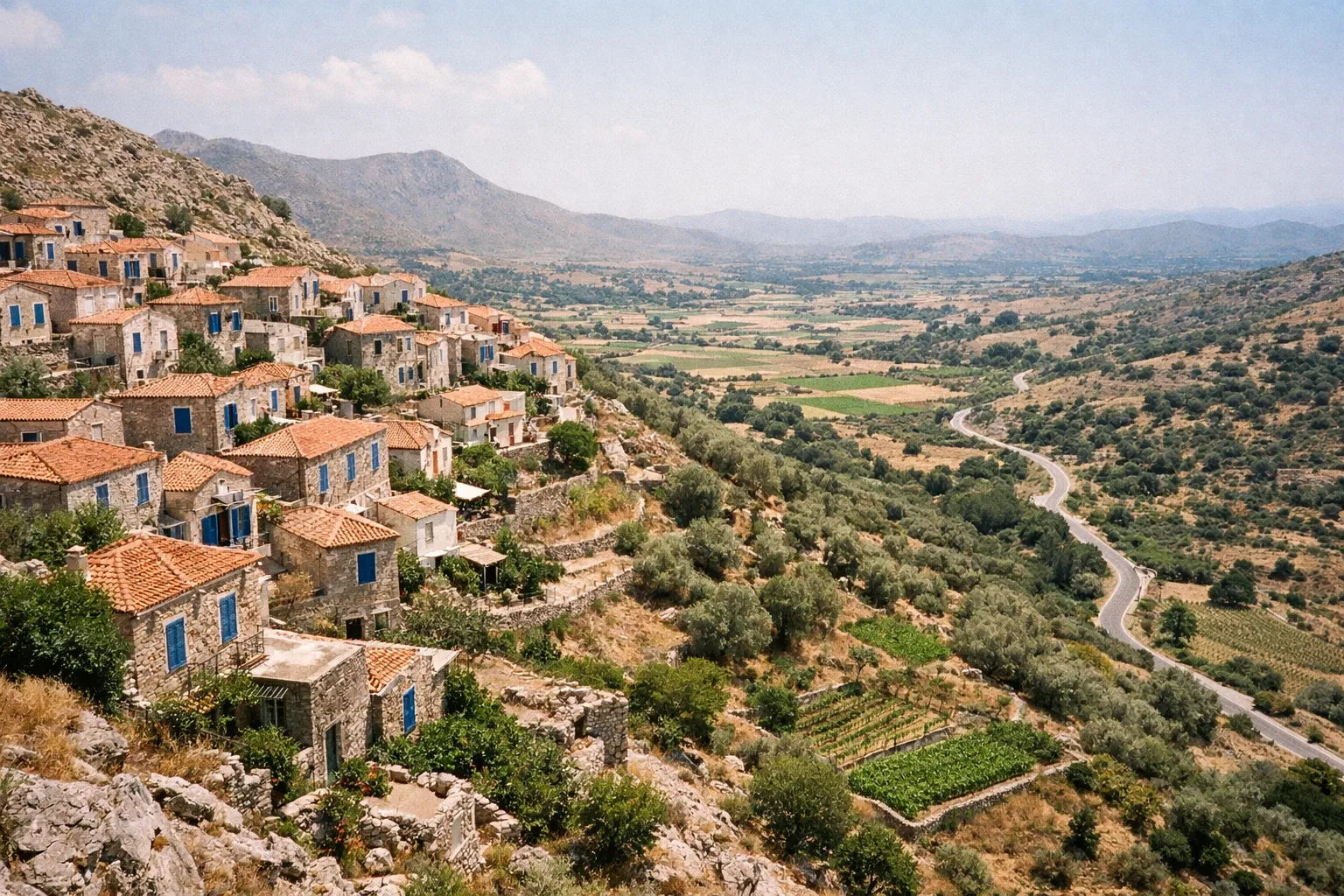
The interior is where the argument that Naxos is a “real place” stops being abstract. This is where the potatoes grow, where the herds graze, where the citron gets distilled. You need a car to reach it properly - inland roads climb from Naxos Town into the hills - though some organized day tours combine both main villages with a swing through the valley. What it adds to a trip is a sense that the island has an economy and a culture that would carry on just fine without visitors.
Halki - Citron, Byzantine Chapels, and the Valley Floor
Halki (also spelled Chalki) is the historic commercial center of the Tragaea and the natural base for exploring the valley. The main square - Plateia Protodikeiou, shaded by a large plane tree - is where you want to anchor a slow lunch, with olive groves and Byzantine chapels reachable on short walks from there. Halki is also the home of kitron (Naxos’s citron liqueur), distilled at the Vallindras Distillery on the village’s main lane, which offers tastings and has long made the spirit from the leaves of the citron tree.
Nearby, a short drive toward the village of Moni, sits Panagia Drosiani - considered one of the oldest Christian churches in Greece, with early Byzantine architecture and interiors covered in frescoes that predate the iconoclasm. It’s a small, quiet building in a field, and that understatement is part of the point.
Apeiranthos - Naxos’s Most Preserved Stone Village
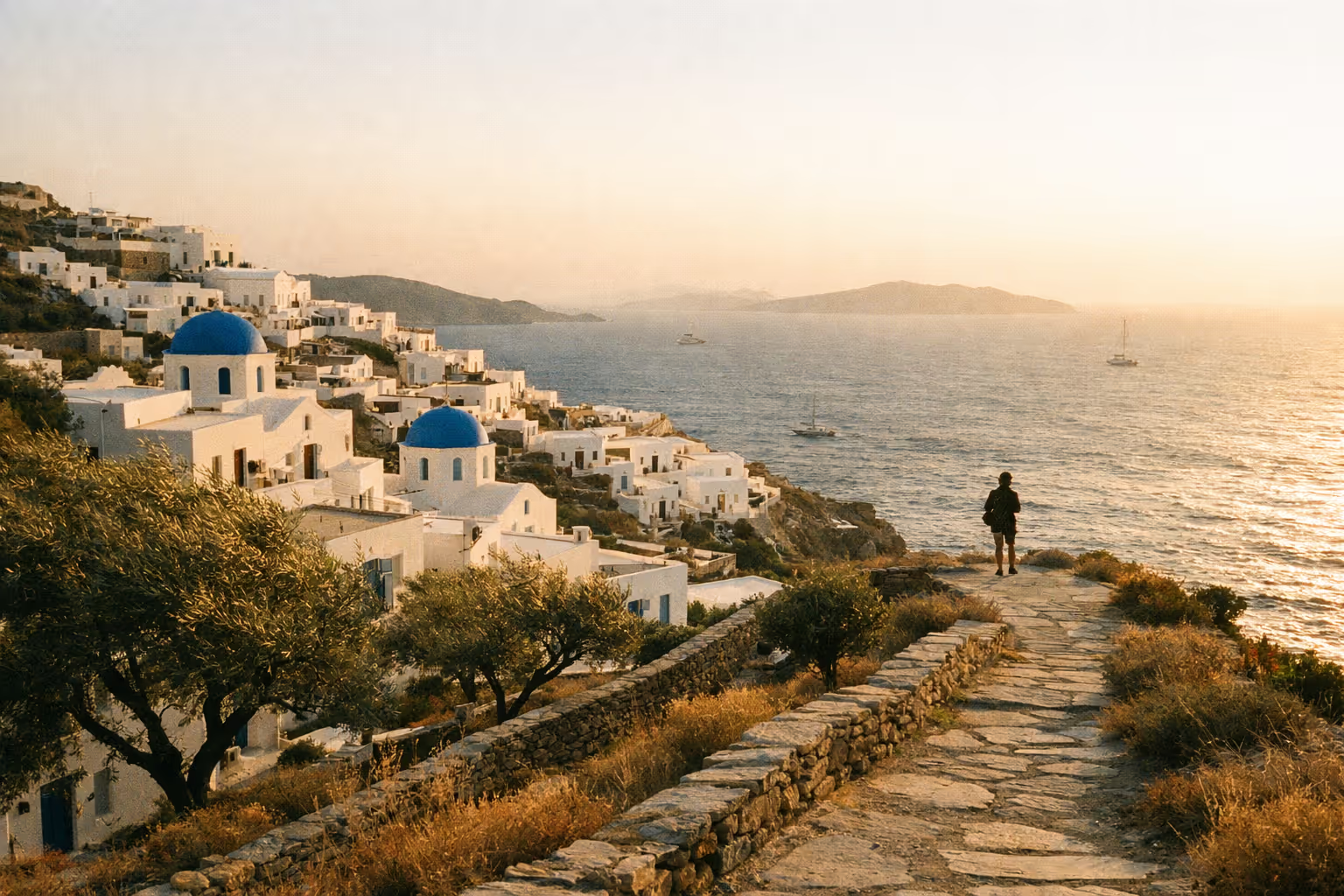
Apeiranthos is Naxos’s most beautifully preserved village, a marble-paved settlement of narrow lanes, Venetian-era towers, and a distinct local identity with a dialect shaped by Cretan settlers. You park at the lower lot near the main road and walk up into the village from there - the lanes are too narrow for cars, and the climb takes about five minutes. The main marble-flagged street, lined with kafeneions (traditional Greek coffee houses) and small shops, runs the length of the village and is where most of the life happens.
The village holds several small museums covering archaeology, natural history, and folklore - all clustered within a short walk of each other along that central lane. None are large, figure about 20 minutes each, but together they make Apeiranthos an ideal half-day walk-and-museum circuit. Pair it with a coffee at one of the kafeneions overlooking the valley and you understand why this village keeps getting singled out over the coastal resorts.
Hiking Mount Zas - The Highest Peak in the Cyclades
Mount Zas, also called Zeus, reaches 1,004 m, making it the highest peak in the entire Cyclades. The name alone gives the climb a certain weight - this is the mountain where, by legend, Zeus was raised - and the summit view is the practical payoff.

The standard route runs from the Zas Cave trailhead near the village of Filoti, a half-day hike of roughly 3 to 4 hours round trip for fit walkers, with moderate elevation gain and long exposed sections. The trailhead sits about a 30 to 40 minute drive from Naxos Town, so an early morning start is easy. Bring more water than you think you’ll need, real sun protection, and trail shoes rather than sandals - the exposed stretches offer no shade and the footing is rocky.
Going independently is entirely doable with a good map or GPS, and the route is reasonably well trodden. Guided hikes add context about the mythology, the geology, and the farming landscape you pass through, which some walkers find worth the cost. On a clear day the summit opens onto much of the central Cyclades - Paros, Ios, Amorgos, and sometimes Santorini on the far horizon. Wide-open views across most of the archipelago, and there’s no cable car or crowd of day-trippers at the top - just whoever earned it.
Naxian Food - What to Eat and Why It Matters
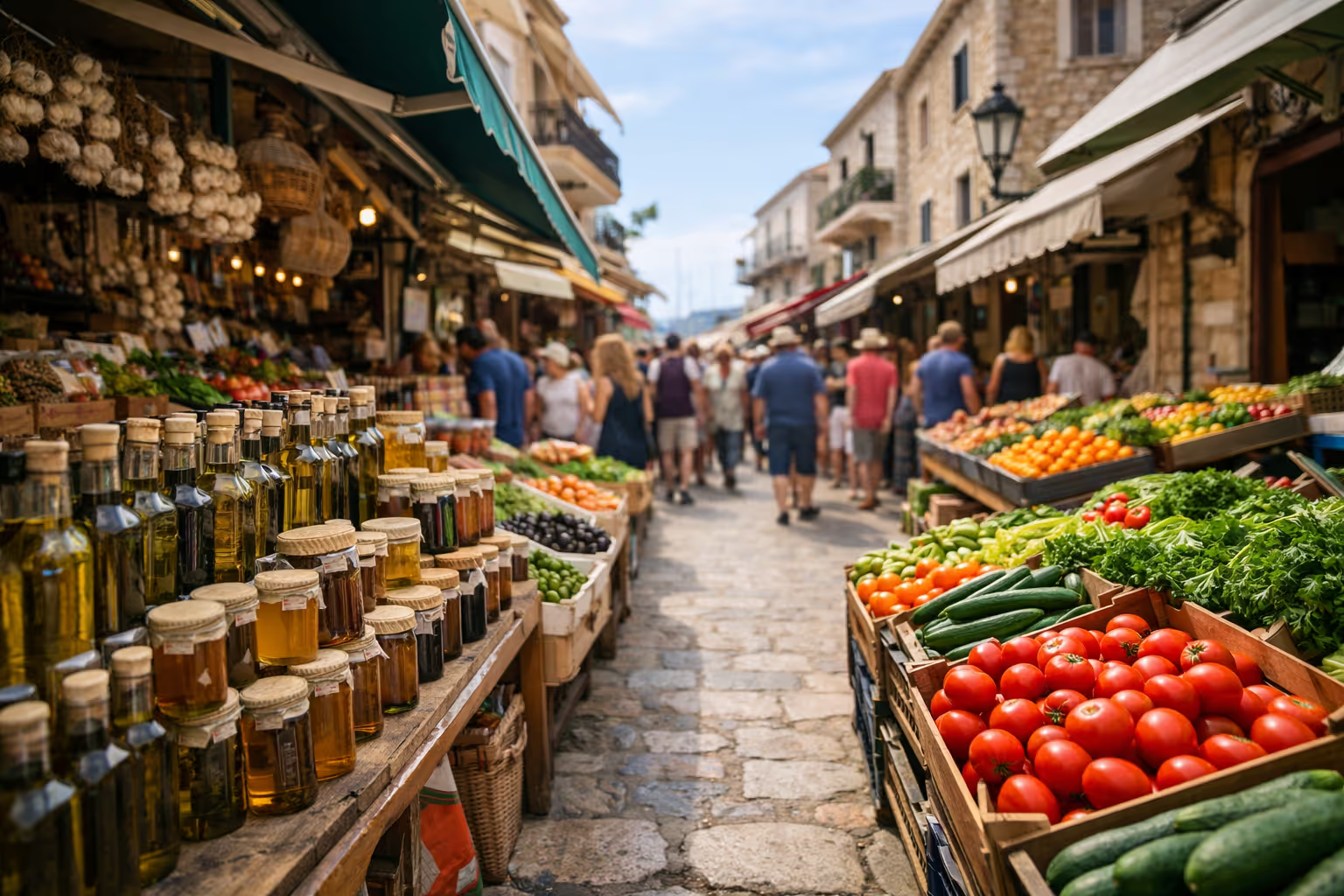
Naxos has a stronger local food identity than almost any other Cycladic island, and the products are real and EU-protected rather than clever menu language. The HALA Naxos guide describes the island’s cooking as land-driven, not just sea-driven, built on a year-round agricultural base of potato fields, grazing herds, and protected local products (hala-studio).
Start with Naxos graviera, a sweet, buttery cheese made primarily from cow’s milk and carrying PDO (Protected Designation of Origin) protection at EU level (hala-studio). This isn’t a minor local curiosity: Graviera Naxou was ranked the world’s best cheese by TasteAtlas in December 2025, according to Greek Trip Planner. Eat it fried as saganaki (pan-fried cheese), grated over pasta, or plain with bread and a glass of local wine.
Then the Naxian potatoes. They hold PGI status, grown in the island’s fertile interior, and they’re noticeably better than the standard-issue Greek taverna potato (hala-studio). Order them roasted or fried wherever a menu lists them as local - the difference is real.
Finally, kitron - the citron liqueur made from the leaves of the citron tree, produced traditionally in Halki at the Vallindras Distillery (naxos-hotel). It’s uniquely Naxian and rarely found on other Cycladic islands. Try it at the distillery or as a digestif after dinner.
For eating, Naxos Town (the Hora) has the widest range of restaurants. The village tavernas in Halki and Apeiranthos reward a long lunch, and while the beach tavernas at Agia Anna are perfectly fine, they aren’t the reason you came.
Naxos vs Paros - How to Choose Between the Two
The Naxos vs Paros decision comes down to size and character: Paros covers around 196 km² to Naxos’s 429 km², making Naxos more than twice the size, with correspondingly longer drives and more days needed to cover it (6). The two islands sit about 25 minutes apart by fast ferry, with 8 to 12 crossings a day in high season on Blue Star Ferries, Seajets, and others, so this doesn’t have to be an either-or (9).
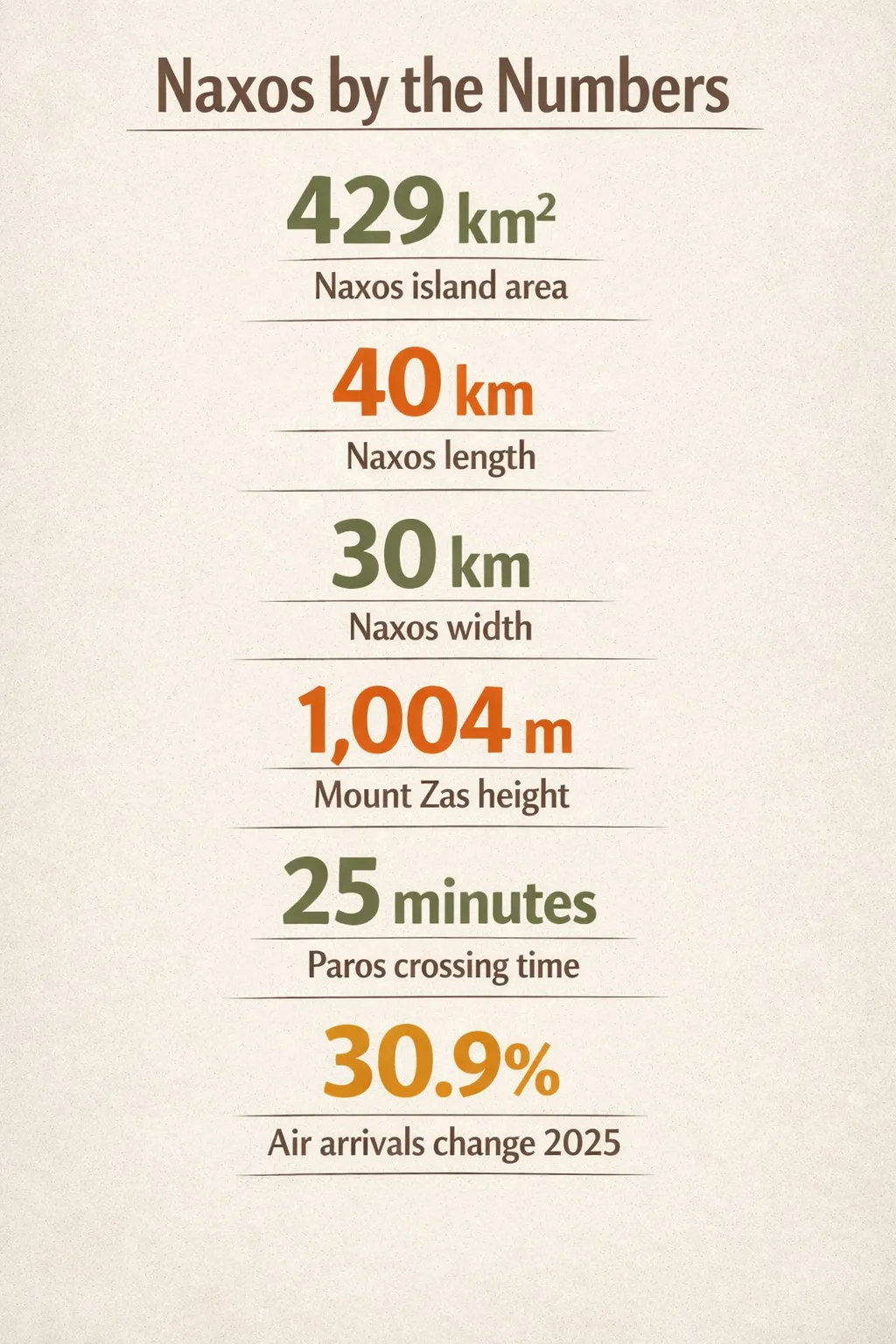 Naxos is larger and higher than Paros on several metrics, including 429 km² area, 40 km length, 30 km width, Mount Zas at 1,004 m, a 25-minute Paros crossing, and a 30.9% rise in air arrivals in 2025.
Paros does several things better. Its towns are prettier and more photogenic - Naoussa in particular, with its polished harbor - and the evening scene is livelier. Being smaller, it’s easier to cover in a short trip without much driving.
Naxos wins on the things that take longer to appreciate. The beaches are longer and sandier. The mountain interior and the Tragaea valley have no equivalent on Paros. The local food is stronger, and there’s simply more room to breathe. Greek Trip Planner frames Naxos as the choice for variety and Paros as the choice for classic village aesthetics over a shorter stay.
Choose Naxos if you’re traveling with family, want more than a beach, are staying five or more days, or want to feel like you’re somewhere real. Choose Paros for a shorter trip built around the classic Cycladic look, nightlife, and boutique hotels without long drives. Travel guides commonly suggest Naxos suits trips of five-plus days while Paros can be broadly covered in three to four (6).
The honest answer: if you have time, do both. The crossing is trivially short.
Naxos vs Paros Side by Side
| Naxos | Paros | |
|---|---|---|
| Island Size | about 429 km² | about 196 km² |
| Best Beaches | Long, sandy, family-friendly west coast | Good but shorter; more varied |
| Town Character | Hora: working port town with Venetian kastro | Naoussa: polished, photogenic harbor |
| Interior | Tragaea valley, mountain villages, Mount Zas | Lefkes village; less dramatic |
| Local Food Identity | Strong (graviera, potatoes, citron) | Moderate |
| Nightlife | Moderate | Livelier (Naoussa) |
| Best For | Families, longer stays, authenticity seekers | Short trips, Cycladic aesthetics, nightlife |
| Ferry Connection | 25 min from Paros | 25 min from Naxos |
Where to Stay in Naxos - Choosing Your Base
The best place to stay in Naxos for most first-timers is Naxos Town, the Hora - a substantial port town of nearly 21,000 year-round residents that puts you within walking distance of the Portara, the harbor, the Venetian kastro (the medieval hilltop fortress quarter), and Saint George Beach (2). One etiquette note worth knowing before you explore: dress modestly when entering Byzantine churches and the kastro’s Catholic cathedral - shoulders and knees covered is the standard expectation, and it’s respected rather than enforced. Photography inside the smaller chapels in the Tragaea is generally fine, but ask first if a service is in progress. St. George is right on the edge of town, a decent swim without going anywhere, and the bus stop for the west-coast beaches is central. This is the practical default if you’re relying on buses.
For a beach-holiday base, look at Agios Prokopios or Agia Anna, around 5 to 7 km southwest of town and connected by frequent buses that reach the Hora in 10 to 15 minutes for dinner (naxos.net). Current 2026 guides specifically recommend these two for families who want to be directly on the sand with prettier water and a dedicated beach feel.
Plaka sits farther down the same strip and is less developed, with hotels more spread out along the sand. Staying here means a quieter, more rural setting but typically requires a car or scooter to reach town and the interior (2). It suits travelers who want to wake up near the beach without resort-strip energy.
The interior villages - Halki, Apeiranthos - have small guesthouses for travelers who want the mountains rather than the coast. It’s a niche choice and it requires a car. Whichever base you pick, book two to three months ahead for July and August. The accommodation market is broad, but it’s filling faster as arrival numbers climb.
Getting to Naxos and Moving Around the Island
Naxos sits almost in the center of the Cyclades and is served by frequent ferries from Piraeus (Athens) and neighboring islands, with ferry traffic up 5.8% in 2025 (2, 9). The Paros crossing takes about 25 minutes with 8 to 12 daily sailings in high season on Blue Star Ferries, Seajets, and others, and high-speed connections from Santorini make multi-island itineraries straightforward (9).
By air, Naxos Island National Airport takes domestic flights, primarily from Athens. Air arrivals grew 30.9% in 2025, so peak-season seats need booking well ahead (9).
Once you’re on the island, the KTEL bus network connects Naxos Town with the main west-coast beaches - Agios Prokopios, Agia Anna, Plaka - and some inland villages (7). That’s adequate for a beach-only trip. For the mountain villages, the Tragaea valley, or the Mount Zas trailhead, a rental car or scooter is strongly recommended, because bus frequency to the interior is limited.
Naxos is bigger than it looks. The island measures about 40 km by 30 km, and driving end to end takes roughly 90 minutes; the run from Naxos Town to Apeiranthos is around 40 to 45 minutes one way (2). Factor that into your day planning, and don’t try to combine the beaches, the villages, and the Zas hike in a single day. It’s a large island, and treating it like a compact one is the fastest way to spend your holiday in a rental car.
How Many Days in Naxos - A Practical Time Plan
Three to four days is the realistic minimum for the Portara, one full beach day, and one interior excursion - doable but rushed. Santorini Dave’s guide identifies five to seven days as the sweet spot, enough for multiple beach days, a proper day inland, the Mount Zas hike, and time to eat well without ticking boxes (2). Given the drive times - 5.7 km to Agios Prokopios but 40 to 45 minutes to the mountain villages - it’s unrealistic to fold every inland activity into a three-day beach trip (naxos.net, 2).
For a multi-island trip, Naxos pairs naturally with Paros 25 minutes away and can be combined with Santorini. Greek Trip Planner suggests a roughly 10-day Cyclades itinerary with four to five nights on Naxos, treating it as a major stop rather than a quick stopover.
How to Structure Your Time in Naxos
Up to 7 daysA practical 3-7 day itinerary to balance beaches, villages, and hiking.
- 1
Day 1 - Arrive, orient, Portara at sunset.
Check in to Naxos Town. Walk the Hora, find the harbor, and follow the causeway out to the Portara in the late afternoon. Stay for sunset, then eat in town.
- 2
Day 2 - West-coast beach day.
Bus or drive to Agios Prokopios and hit the sand before the beach clubs fill. Lunch at a taverna, then move to Agia Anna or walk north along Plaka for quiet.
- 3
Day 3 - Tragaea valley and mountain villages.
Drive or join a tour to Halki and Apeiranthos. Stop at the Vallindras Distillery for kitron, take a slow lunch in a village square, and return through the valley.
- 4
Day 4 - Mount Zas hike.
Early start from the Zas Cave trailhead near Filoti. Half-day up and back, then a recovery swim at whichever beach you skipped.
- 5
Days 5-7 (if you have them).
A second beach day at Plaka, the Venetian kastro and Archaeological Museum in town, and a day trip to Paros if the ferry schedule cooperates.
Frequently Asked Questions
Frequently Asked Questions
- Is Naxos a good island for a first trip to Greece?
- Yes, Naxos offers beaches, a real mountain interior, strong food, and easy ferry links, making it forgiving for families and rewarding for variety seekers.
- Is Naxos an expensive island?
- No, Naxos is noticeably cheaper than Santorini or Mykonos across accommodation, food, and activities, though prices rise in peak summer.
- Is Naxos better than Santorini?
- Naxos has better beaches, more activities for longer stays, and lower costs; Santorini offers dramatic caldera views and suits short, high-impact trips.
- How long does the ferry from Paros to Naxos take?
- The fast ferry takes about 25 minutes, with up to 8-12 daily crossings in high season, making it one of the easiest inter-island hops.
- Do I need a car in Naxos?
- No for beaches, as buses serve main coastal areas; yes for mountain villages, Tragaea valley, and Mount Zas due to limited public transport.
- When is the best time to visit Naxos?
- June and September offer warm water and manageable crowds; July-August are peak with busy beaches and booking pressure; most tourist services close by November.
- What exactly is the Portara?
- The Portara is a marble gateway from an unfinished 6th-century BC Temple of Apollo on Palatia islet, 5-10 minutes walk from Naxos harbor along a paved causeway.
Naxos in the Cyclades: The Practical Bottom Line
Naxos is the Cyclades island that gives you the most variety - coast, interior, food, and history in one place - without Santorini prices or Mykonos crowds. It’s the largest island in the group, with the region’s longest sandy beaches, its highest peak, and a genuine agricultural economy behind its cheese, potatoes, and citron. That combination is rare, and it’s why the island keeps climbing the destination lists.
A few things that actually determine how the trip goes: book two to three months ahead for July and August, since arrivals are rising fast (9). Rent a car if you’re going inland - the interior is the whole difference between Naxos and Paros, and buses won’t get you there. Visit the Portara twice, once by daylight and once at sunset. And don’t sacrifice a mountain-village day for a third beach day; the villages are what you’ll remember.
If you’re planning a wider trip, the neighboring Cyclades guides to Paros, Santorini, and Mykonos are the natural next steps, alongside our Greek islands overview. Three days is enough to see Naxos. Five days is enough to understand it.