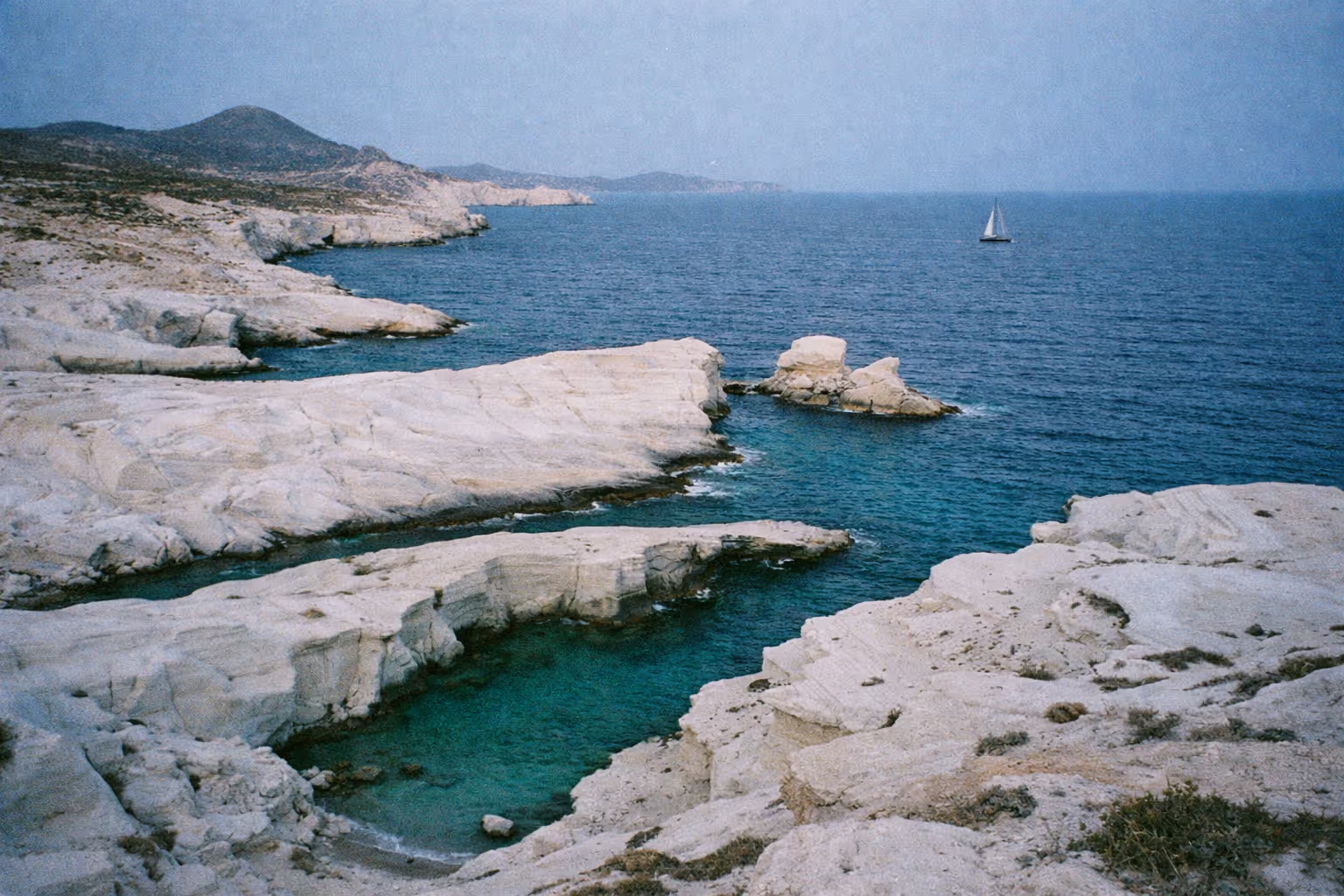
The white rock at Sarakiniko doesn’t feel like a beach when you first walk onto it. It feels like a set piece: wind-smoothed pumice that curves and folds in a way you associate with photographs of the moon, not the Aegean. That single formation is why most people book the trip, but it undersells what makes the greek islands milos worth the effort. This is a volcanic island in the southwest Aegean with roughly 70 beaches (10), and the point isn’t the count - it’s that almost none of them look alike. One is dark volcanic sand, the next is a white slot canyon you swim through, the next a sheltered south-coast bay with thermal springs bubbling under the pebbles.
Milos is the island people reach after they’ve done Santorini and Mykonos, or the one they choose specifically to skip those entirely. It has less infrastructure and no cable cars or party strip. What it has instead is geological variety and a wind that decides your day for you. If you want a self-directed beach trip and you’re willing to rent a car, the answer to “is Milos worth it” is a concrete yes.
What Makes Milos, Greek Islands Standout, Different from Other Cyclades
Among the Greek Islands, Milos stands out as a volcanic island whose entire coastline was shaped by submarine eruptions - which is why it has more beaches, and more geologically distinct ones, than any other island in the Cyclades. The coastline runs roughly 120 km, and erosion of the different volcanic materials has carved everything from white tuff amphitheaters to narrow sea canyons. The number people quote is 70 to 75-plus beaches (10), but the useful takeaway is variety: you’re not choosing between 70 versions of the same sandy stretch, you’re choosing between genuinely different rock, color, and water.
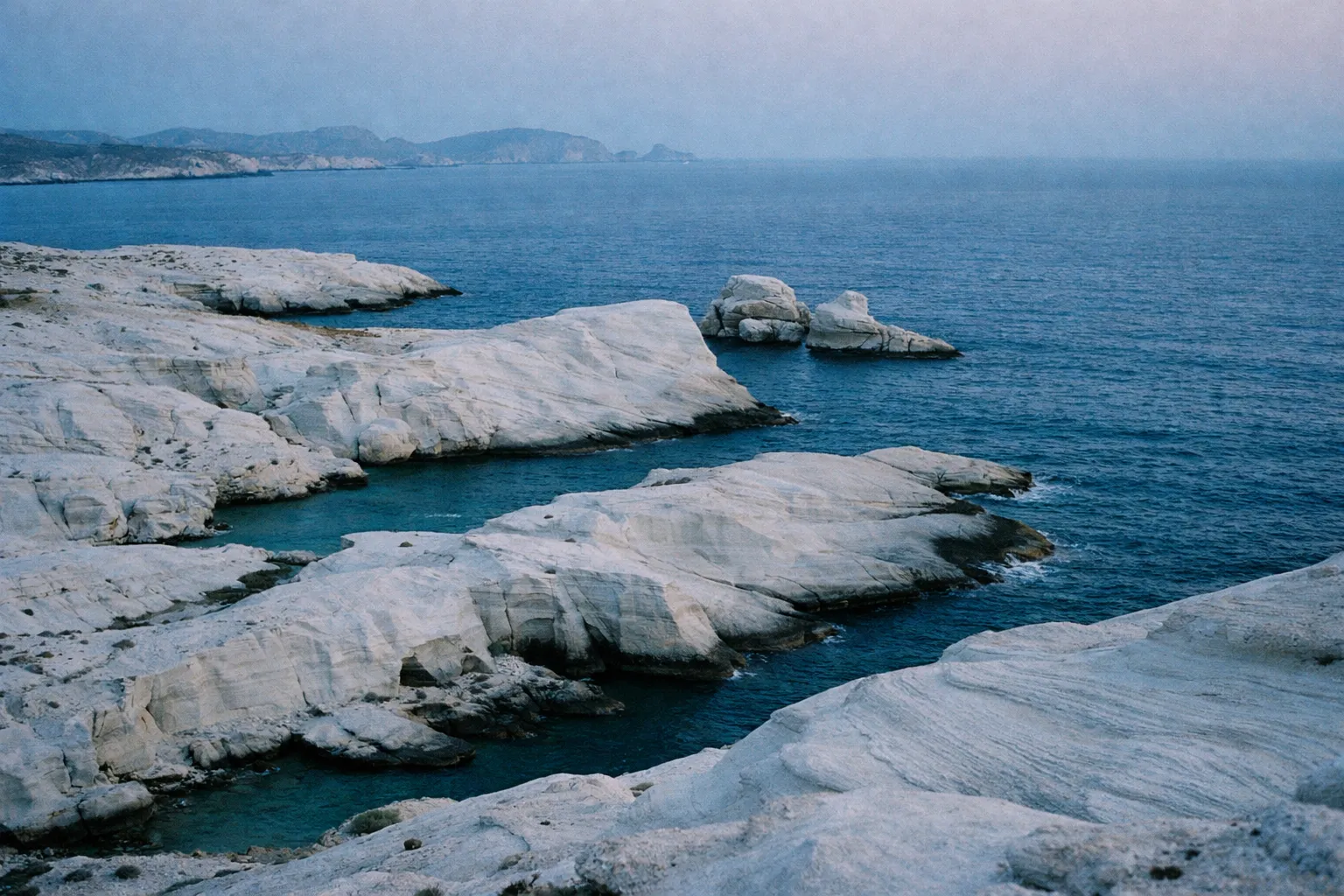
Set against its neighbors, Milos suits a different traveler. Mykonos gives you beach clubs, nightlife, and a high-energy social scene. Santorini gives you the caldera and luxury hotels. Milos gives you fewer of all three and more coastline to explore on your own terms. Evenings are quieter, there’s no party strip, and the luxury accommodation pool is thinner. If that reads as a downside, this probably isn’t your island. If it reads as a relief, it’s exactly right.
The other defining trait is the wind. The Meltemi - a north wind that peaks in July and August - means that on any given summer day one side of the island is calm and swimmable while the other gets sand-blasted. On most Aegean islands a couple of famous beaches dominate and you go where the crowd goes. On Milos, locals pick a coast by the wind, and adopting that habit is the single biggest upgrade to your trip.
There’s a cultural layer too, for travelers who want more than swimming. The Catacombs of Milos hold 291 arcosolia and floor tombs, with more than 2,000 early Christians buried there, making them one of the most significant early Christian sites in Greece - figures documented by the Greek Ministry of Culture. The island’s Archaeological Museum holds a replica of the Venus de Milo, unearthed here in 1820; the original sits in the Louvre.
Etiquette note: Inside the Catacombs of Milos, photography is not permitted - the site is an active religious monument, not a tourist attraction, and the restriction is enforced. At Sarakiniko and other beaches, topless sunbathing is common and generally accepted; nudity is not. In village churches and the kastro at Plaka, covered shoulders and knees are expected.
Sarakiniko - the lunar landscape that defines the island
Sarakiniko is a bay of white volcanic tuff and pumice, formed by submarine eruptions and sculpted by wind and waves over millions of years into what looks like a lunar amphitheater (1). It’s one of the most photographed beaches in Greece, and in March 2025 a geoscience article flagged it as a globally significant geoheritage site under threat - valuable enough that researchers use it as a stand-in for planetary terrain (9).
Go early morning or late afternoon. There is no shade at all, the rock surface turns slippery where the water hits it, and midday in July and August brings both crushing sun and crowds. Once you’re there, the appeal is active: cliff jumping into the deep blue channels, scrambling over the ridges, swimming through the eroded inlets between the white walls. Bring water shoes and more water than you think you need - there are no facilities.
Kleftiko - the sea caves you can only reach by boat
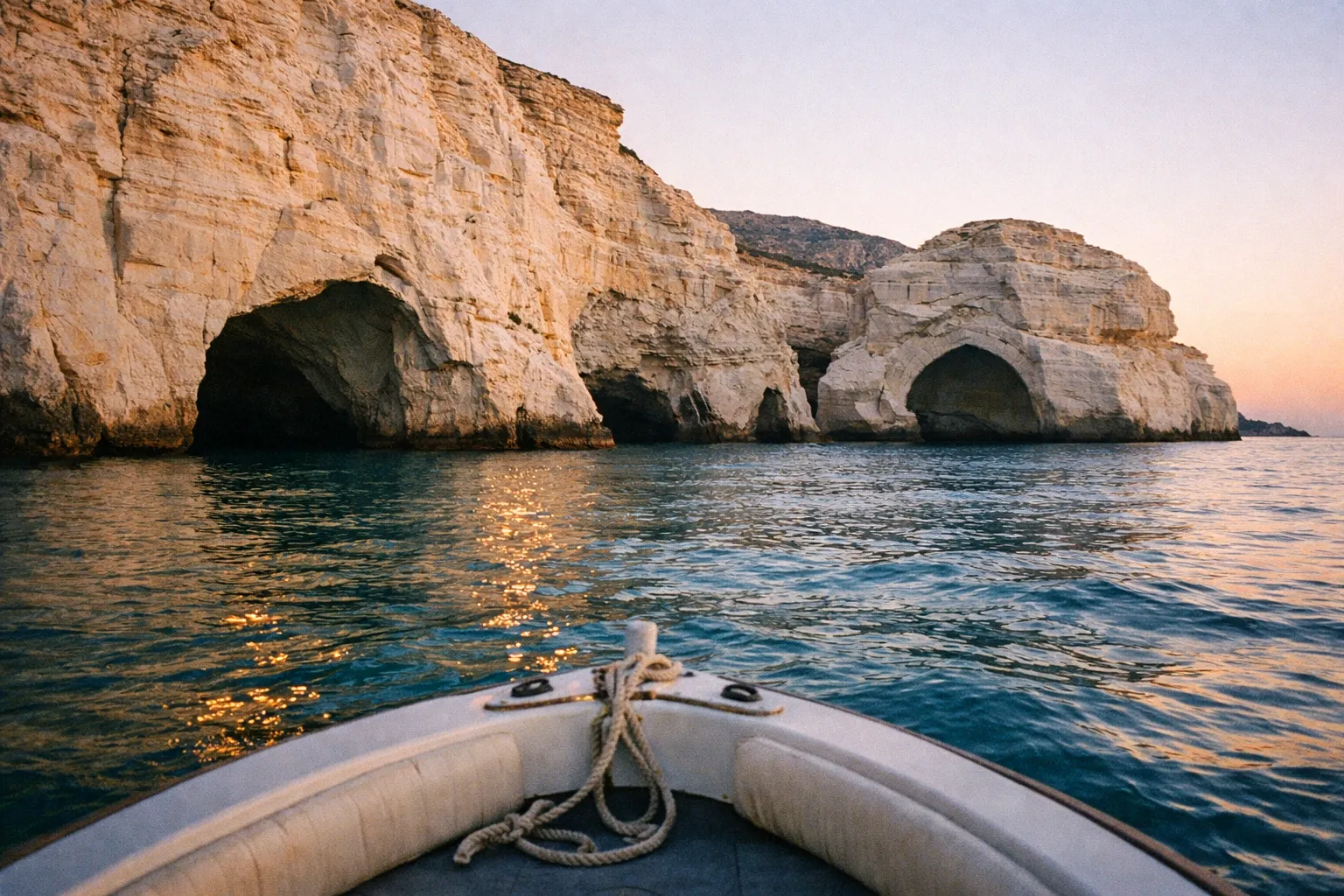
Kleftiko is a cluster of white volcanic rock formations and sea caves on the southwest coast, reachable only by boat, and historically used as a pirate hideout. You get there by day cruise, catamaran, sailing boat, or RIB out of Adamas, and every option is a half-day commitment at minimum with fixed departure and return times. The draw is swimming and snorkeling in and around the caves, in water that shifts from turquoise to deep blue against the white rock. Book it early in July and August - the better-reviewed operators sell out, and last-minute booking leaves you with poor departure times or nothing at all.
✓ Pros
- More than 70 beaches with more geological variety than any other Cycladic island
- Quieter than Santorini or Mykonos, with calm evenings and no party strip
- Sarakiniko and Kleftiko are genuinely singular - nothing else in the Cyclades looks like them
- Good ferry and flight access from Athens; works standalone or as an island-hop stop
- Rewards photographers, geology enthusiasts, and serious beach-hoppers
✗ Cons
- Meltemi winds can make north-coast beaches unswimmable for days at a time in summer
- The best beaches need a rental car or ATV - buses don't reach many of them
- Kleftiko boat tours sell out in peak season and require advance planning
- Fewer luxury accommodation options than Santorini or Mykonos
- Sarakiniko has no shade and gets crowded midday in July and August
How to Get to Milos - Ferry from Piraeus vs. Domestic Flight
You reach Milos two ways: a ferry from Piraeus, the port of Athens, or a non-stop domestic flight from Athens (ATH) to Milos (MLO) that takes about 40 minutes. Piraeus-Milos crossings run up to seven sailings a day in high season, with durations ranging from roughly 2.5 hours on a fast ferry to 7 hours on a conventional vessel. The flight is the fastest point-to-point option and the safer bet if you’re prone to seasickness, but seats are limited and fill up fast in July through September.
Which ferry you pick shapes the arrival more than you’d expect. A high-speed SeaJets crossing gets you there in about 2 hours 30 minutes, enclosed and efficient. A conventional ferry runs slower with open decks and a genuinely different pace across the Aegean - and if you catch an early sailing, your first sight of Milos is the bay opening up as the boat rounds the headland into Adamas. The fast ferry trades that away for time.
If you’re coming from other Cyclades, Milos connects well by inter-island ferry to Sifnos, Folegandros, and Paros, and by short domestic hops from Santorini. It slots naturally into a multi-island route through the western Cyclades rather than being a dead-end you have to backtrack from.
Book everything ahead in peak season. Greece recorded 37.98 million international visitors in 2025, a national record according to the Greek Tourism Confederation (SETE) (8), and both ferries and the limited daily flights fill up on popular Cyclades routes.
Fast ferry vs. conventional ferry - what the difference actually means
The fast ferry suits time-constrained travelers, anyone combining Milos with business in Athens, and people prone to seasickness who want the shortest crossing. It’s enclosed, quick, and no-nonsense. The conventional ferry suits budget-minded travelers and anyone who wants deck access and the slow Aegean experience; the larger vessels also tend to ride rough seas more steadily than the fast boats, which can get bounced around when the Meltemi is up. If the wind is forecast strong on your travel day, the bigger conventional ship is often the more comfortable choice despite the longer duration.
Arriving at Adamas port - first steps off the boat
The ferry drops you at Adamas, the main port, and everything you need in the first hour is within walking distance. Car rental offices, tour booking desks for Kleftiko, and cafés cluster around the waterfront. If you’ve booked a rental, this is where you collect it or confirm pickup for the next morning. From here you either settle into Adamas itself or drive onward - about 10 minutes up to Plaka, or roughly 20 minutes across to Pollonia.
Getting Around Milos - Why You Need to Rent a Car or ATV
Renting a car or ATV on Milos isn’t optional if you plan to see the beaches, because public buses cover only a handful of trunk routes and miss most of the coastline worth visiting. The KTEL bus network runs mainly from Adamas to Plaka, Pollonia, Paliochori, Achivadolimni, Provatas, and Sarakiniko - useful for the port-to-village runs, but not for Fyriplaka, Tsigrado, Papafragas, or the smaller west-side coves. Travelers who rely on buses alone consistently underestimate the constraint and miss half the island.
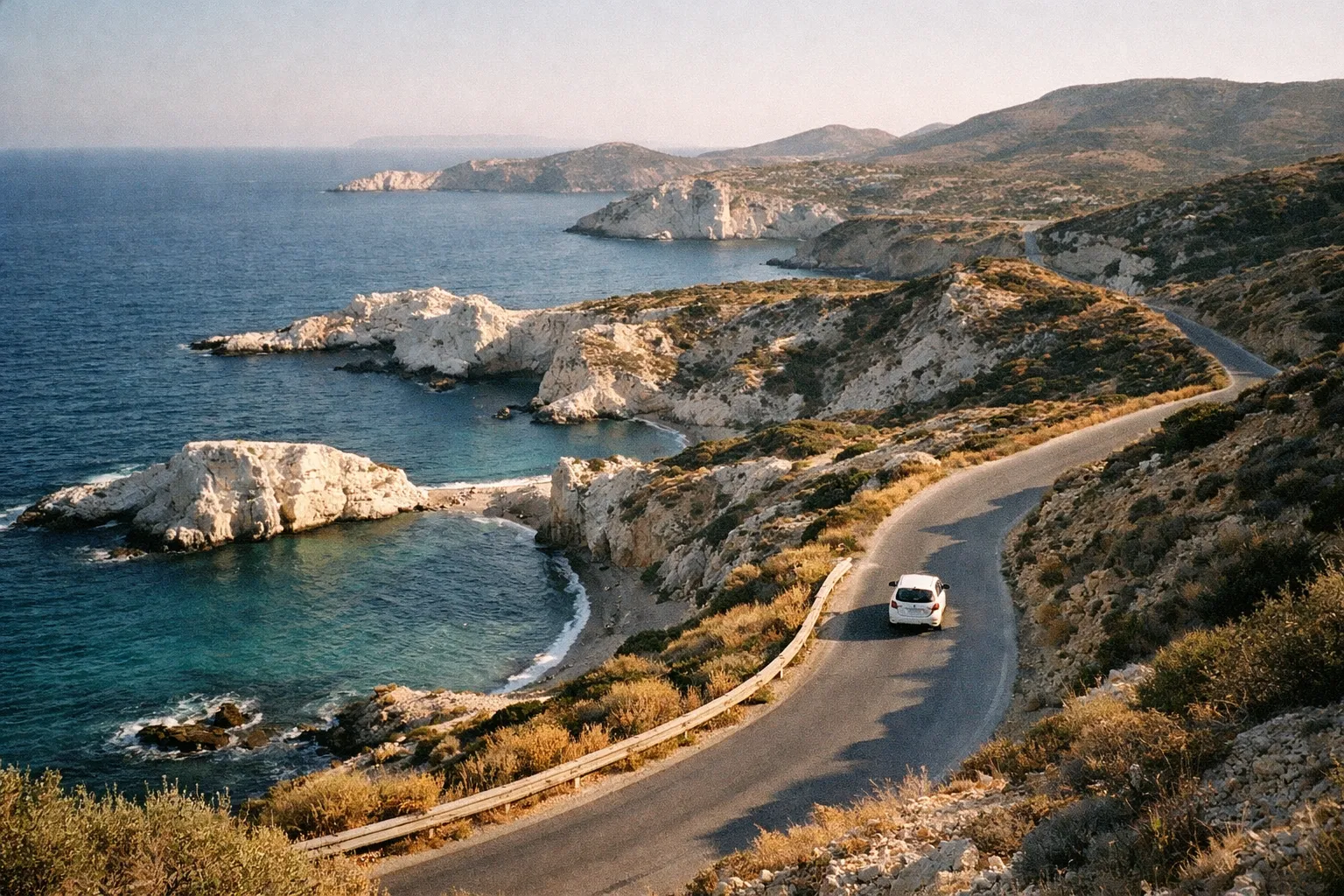
Between a car and an ATV, the decision comes down to your group and the roads. Cars are better for groups, luggage, and the unpaved access tracks to remote beaches - many notable beaches sit off smaller roads, and Paliochori alone is around 10 km from Adamas. ATVs work for solo travelers or pairs sticking to paved and light-gravel routes, but they’re not appropriate for every rough beach track. A small car handles most of what the island throws at you; check road conditions before you take an ATV down anything unpaved and steep.
Rental offices cluster in Adamas, and you should book ahead in July and August. Pick up the vehicle the afternoon you arrive or the next morning, then plan multi-beach loops rather than driving back to the port between every stop. Taxis exist but are limited and impractical for a day of beach-hopping.
The Best Beaches in Milos - 70 Options, Where to Start
The milos best beaches sarakiniko headline undersells the range: the island’s 75-plus beaches (10) differ in sand color, pebble size, rock formation, water depth, and exposure, so the real skill is matching the beach to the day’s wind. This is where the Meltemi principle earns its keep. North-coast beaches, including the Sarakiniko area, get wind-blasted when the north wind blows hard; south and west bays like Fyriplaka and Agia Kyriaki stay sheltered. Locals flip between coasts daily, and so should you.
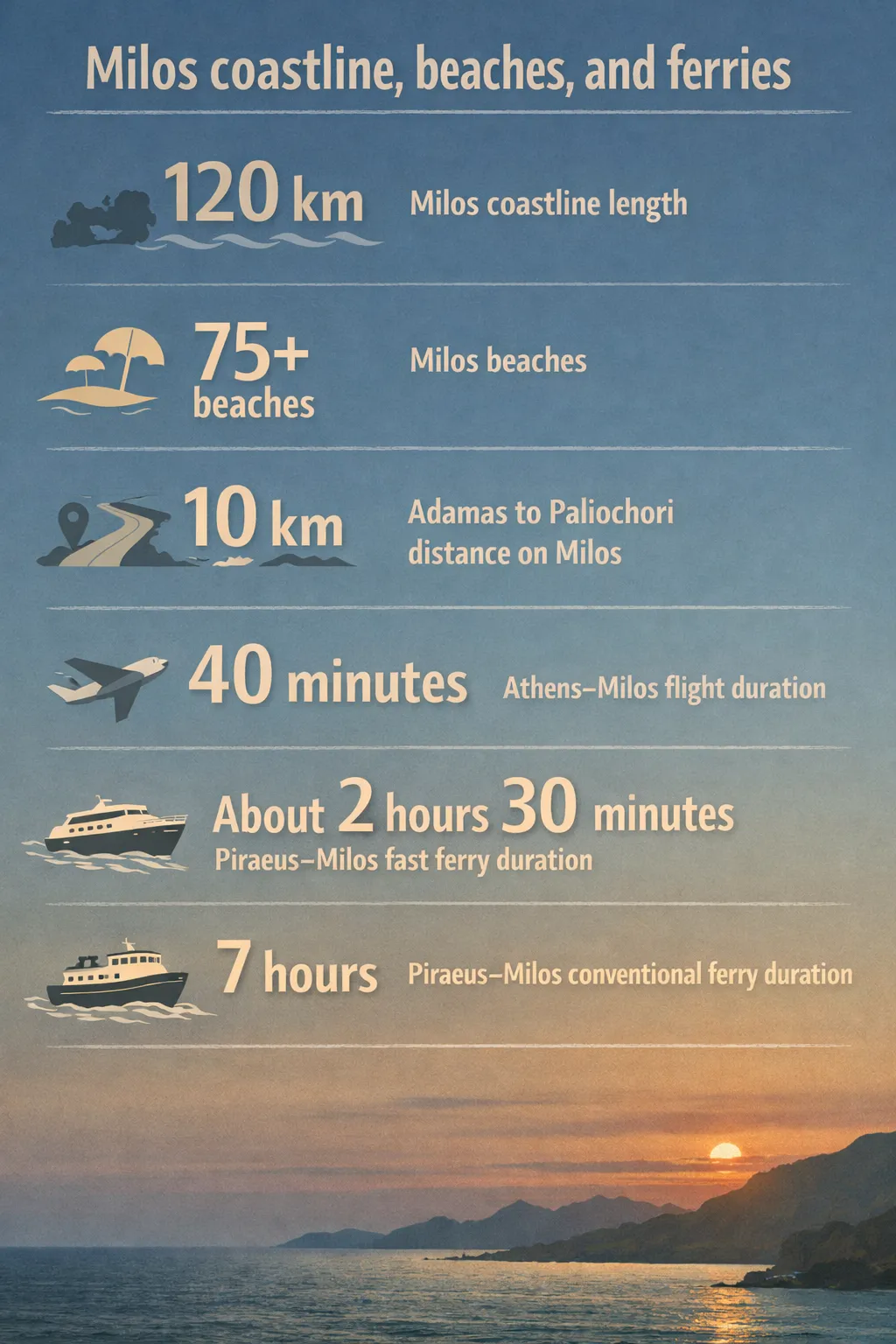 Milos offers a 120 km coastline and 75-plus beaches, with a 40-minute Athens flight and ferries ranging from about 2 hours 30 minutes to 7 hours to plan your island hop.
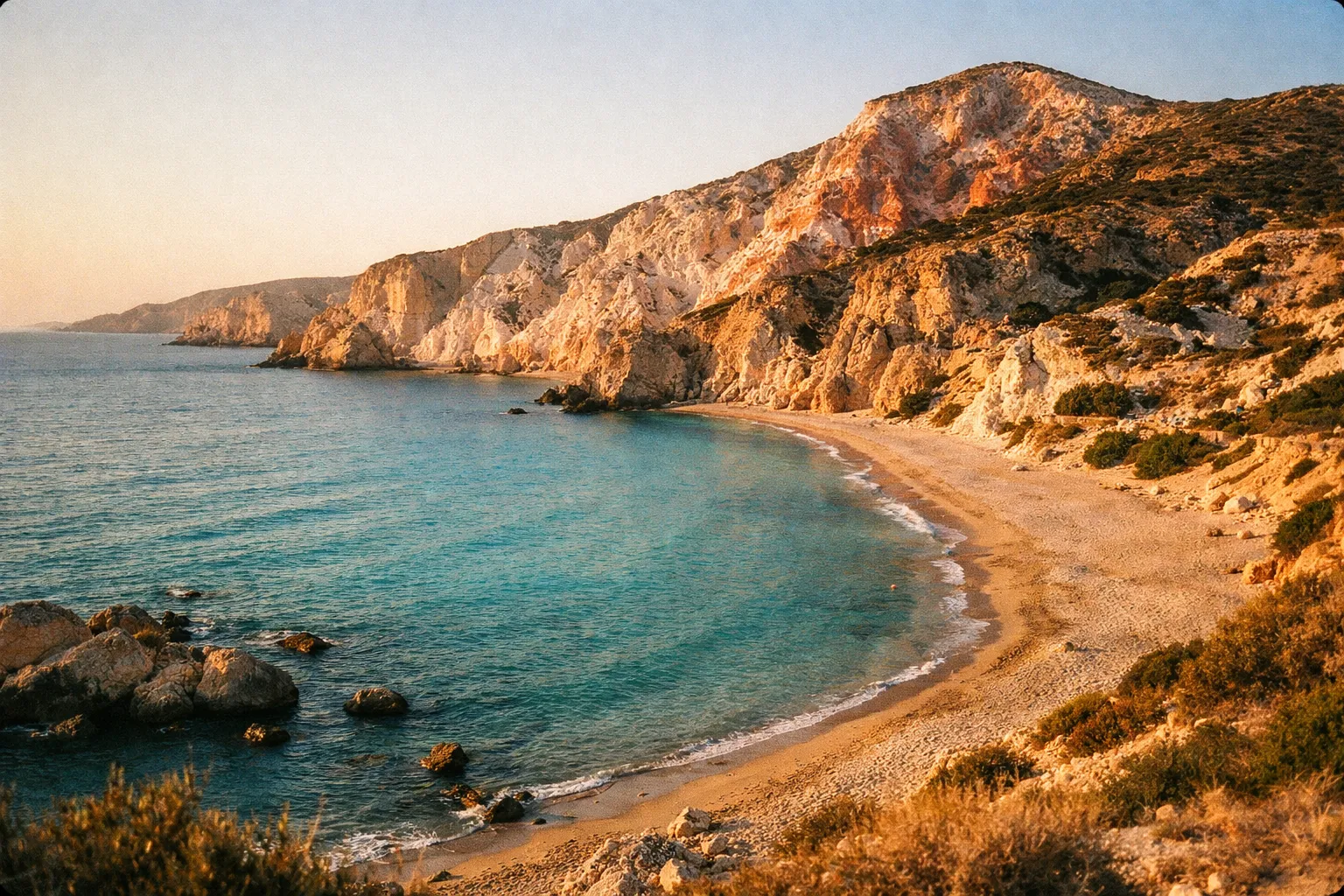
A realistic sampling of the variety takes 4 to 5 full beach days. A 2-day visit sees Sarakiniko and one boat trip and calls it a trip - which misses the point of the island.
South coast beaches - the sheltered side
The south coast is where you go when the Meltemi is up. Fyriplaka is an ample sandy beach backed by colored volcanic rocks and dramatic dark cliffs, sheltered from the north wind and reachable by car. Right next door, Tsigrado is small, secluded, and reached by a rope-and-ladder descent down a narrow cliff gap - which keeps the crowds thin and rules it out for anyone uneasy on rough scrambles. Because Fyriplaka and Tsigrado sit within a 10 km radius of Adamas, you can pair them in a single beach day without much backtracking.
Agia Kyriaki rounds out the cluster: sandy, calmer water, good for families. Worth adding to the south-coast loop is Paliochori, roughly 10 km from Adamas, one of the island’s more interesting beaches for its small pebbles and hot spots where thermal water warms the sand from below.
North coast formations - Sarakiniko and beyond
The north coast is for calm days, and it delivers the island’s strangest landscapes. Sarakiniko is the headliner, but Papafragas nearby is barely a beach at all - a tiny sandy pocket where the sea funnels into a narrow canyon between tall white walls, more of a swim-through slot than an open bay. Mandrakia and the fishing hamlets around it give you the harbor-and-syrmata scenery rather than sunbathing. Because these sit relatively close together on the north side, you can string Sarakiniko, Papafragas, and a couple of coves into one car loop - just save it for a day the wind lies down.
When to Visit Milos - Seasons, Wind, and the Meltemi
The best time to visit Milos is late May to mid-June or September, when the water is warm, the Meltemi is milder than in high summer, crowds thin out, and advance booking matters less. The sea stays warm through September and October, which makes early autumn a genuinely good swimming window rather than a consolation prize.
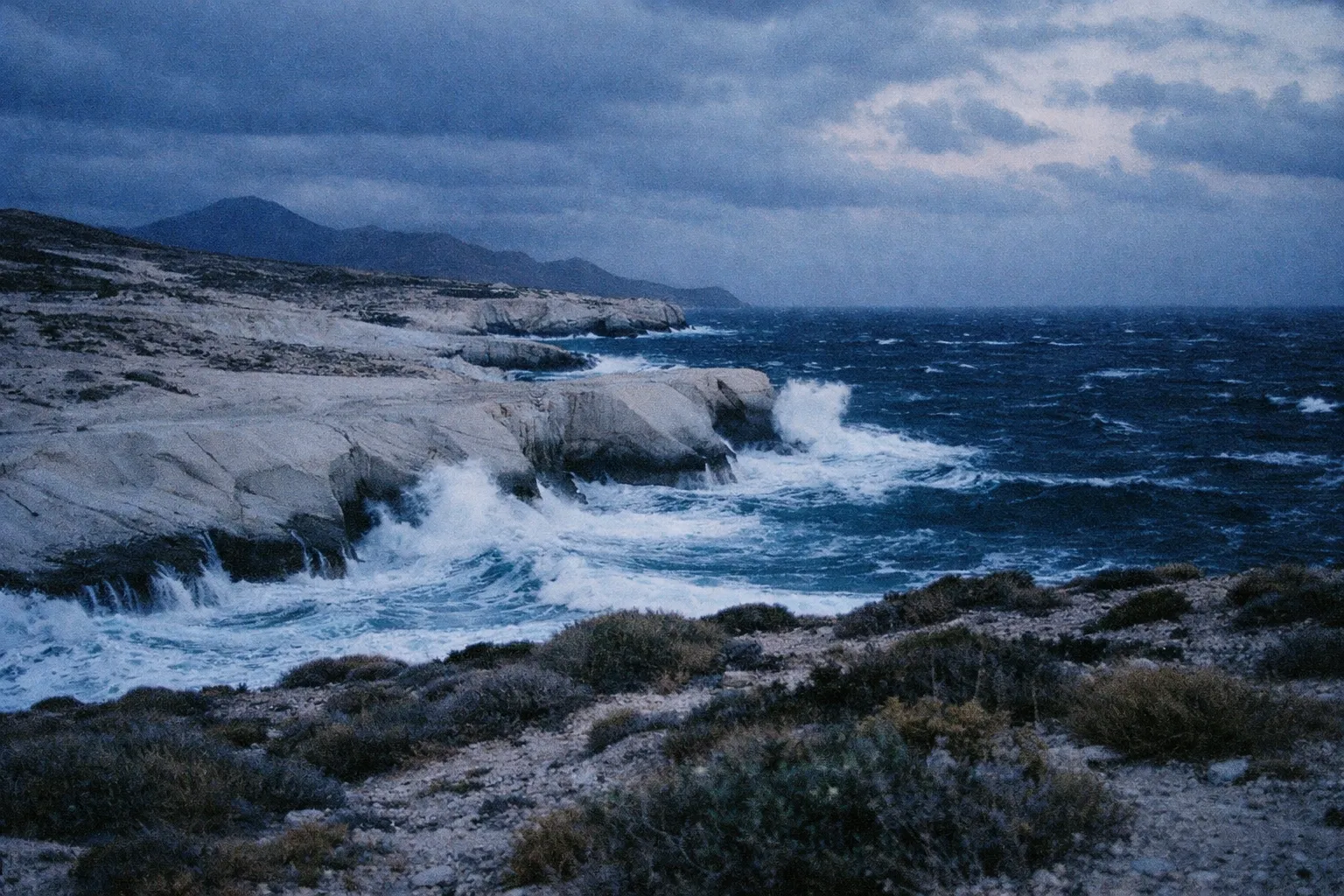
July and August are peak season: the most ferries, the most flights, and the most reliable swimming weather - alongside the strongest winds and the highest demand. Sarakiniko gets crowded midday, Kleftiko boat tours sell out, and accommodation fills. It’s still a fine time to come; you just have to plan around the pressure and the wind.
The Meltemi deserves its own paragraph because it defines the summer experience. It’s predominantly a north wind, it peaks in August and starts calming down after, and it can blow for several days straight. When it’s up, north-coast beaches turn rough and unpleasant; south and west bays stay swimmable. This is not a reason to avoid Milos in summer - it’s a reason to understand the island’s geography before you arrive, so a windy morning becomes a beach-selection decision rather than a ruined day.
Shoulder months on either end - April and May, or October - bring fewer visitors and cooler but swimmable water in May and October, ideal for photography and village walks, though some boat tours run reduced schedules. From November through March most island accommodation closes, and it’s not a practical window for most travelers.
If you’re set on July or August, book ferries, flights, Kleftiko tours, and accommodation well ahead. With Greece at a record 37.98 million visitors in 2025 per SETE data (8), demand on popular Cyclades islands keeps climbing.
Where to Stay in Milos - Adamas, Plaka, or Pollonia
Where to stay in Milos has real consequences because the island requires driving, so your base determines how far you travel to the port, the beaches, and your boat tour each day. The three sensible options are Adamas, Plaka, and Pollonia - and they’re distinct bases rather than interchangeable villages.
Adamas - the practical port base
Adamas is the main port town, with the ferry terminal, car-rental offices, and tour operators all within walking distance. That makes it the most efficient base for first-time visitors and short 3 to 4 day stays - you can arrive, rent a car, and book Kleftiko without moving your bags twice. It’s flat, it’s lively in the evenings, and the restaurant and café scene is solid. What it isn’t is especially scenic; you trade atmosphere for convenience.
Plaka - hilltop Chora for sunsets and atmosphere
Plaka is the Chora, a hilltop village of narrow Cycladic lanes with sunset views over the bay - the most photogenic place to stay on the island. The trade-off is terrain and logistics: the steep alleys make luggage handling genuinely awkward, and you drive about 10 minutes down to Adamas for ferries and car rentals. Plaka suits travelers who prioritize evening ambiance and are fine with the daily drive to the port.
Pollonia - the quieter northeast option
Pollonia is a low-key village on the northeast coast, quieter than both alternatives, with easy access to northern and eastern beaches and a more relaxed evening scene. It sits roughly a 20-minute drive from the ferry port at Adamas but stays within reasonable reach of Sarakiniko. It suits travelers who want a village feel without Plaka’s steep terrain, and it’s the launch point for the short ferry hop to tiny Kimolos.
Where to Stay in Milos: Adamas vs. Plaka vs. Pollonia
| Practical Base Adamas | Plaka | Pollonia | |
|---|---|---|---|
| Distance to ferry port | Walking distance | about 10 min drive | about 20 min drive |
| Terrain | Flat port town | Steep hilltop lanes | Flat village |
| Best for | First-timers, short stays | Photographers, atmosphere | Quiet base, north beaches |
| Car rental access | On-site | Drive to Adamas | Drive to Adamas |
| Evening vibe | Lively, practical | Traditional, scenic | Low-key, local |
| Luggage handling | Easy | Difficult (steep alleys) | Easy |
No sourced hotel rates are available for this guide, but advance booking in July and August is essential across all three.
Things to Do in Milos Beyond the Beaches
Beyond swimming, the essential Milos experience is the Kleftiko boat tour, followed by village walks, archaeological sites, and the syrmata harbors that make the island’s coast so distinctive. The Kleftiko day cruise or RIB out of Adamas - swimming and snorkeling through the sea caves - is the one activity that genuinely demands advance planning, since it’s a half-day minimum and the good operators sell out in peak season.
Plaka is worth an evening regardless of where you sleep: wander the Cycladic streets up to the kastro viewpoint and watch the sun drop over the bay. For the cultural layer, the Catacombs of Milos are the standout - 291 arcosolia and floor tombs with more than 2,000 early Christians buried there, one of the most important early Christian sites in Greece. The Catacombs, the ancient theater at Klima, and nearby archaeological remains all sit within a short drive of Adamas, so you can combine them into a single cultural half-day. The Archaeological Museum of Milos holds a replica of the Venus de Milo, the original of which now lives in the Louvre.
Don’t skip Klima, a fishing village 10 minutes from Adamas where colorful syrmata - boat garages built into the rock at water level - line the shore, one of the most distinctive villages in the Cyclades. Firopotamos offers a similar small-bay, fishermen’s-houses scene, while Papakikinò beach near Adamas is tree-shaded and shallow, easy for small children.
A practical half-day worth building in: combine Sarakiniko with the nearby north-coast coves in one car loop, mixing cliff jumping, rock scrambling, and swimming across the different volcanic micro-landscapes rather than treating the main beach as a single stop.
For island-hopping, Milos connects well to Sifnos and Folegandros, and to Kimolos - a tiny island reachable by a short ferry from Pollonia and worth a full day.
Practical Tips - Meltemi, Booking Timing, and Common Mistakes
Check the wind direction every morning and pick the sheltered coast. This is how locals operate on Milos, and it’s the single most useful habit you can adopt. When the north wind is strong, head south to Fyriplaka or Agia Kyriaki; when it lies down, take the north-coast loop.
A Sarakiniko reality check: there’s no shade, the rock gets slippery, and the midday sun and crowds in July and August are brutal. Go at sunrise or late afternoon, and bring water shoes, sunscreen, and your own water - there are no facilities.
Don’t underestimate Kleftiko. It’s a half-day at absolute minimum, so don’t book it for a morning when you also have an early ferry out. And book it early in peak season; the better operators sell out.
Get your vehicle on the first full day, not the morning you leave. Many of the beaches you came for require it from day one, and the rental offices in Adamas thin out fast in August.
Don’t try to “do Milos in 2 days” as an add-on after Santorini and Mykonos. Compressed like that, you’ll see Sarakiniko and one boat trip and nothing else - the variety needs 4 to 5 days to register.
Match your base to your actual priorities. Staying in Plaka and expecting flat, easy port access is a common frustration; staying in Adamas and expecting quiet, scenic sunsets is another. Neither base is wrong - the mismatch is.
Finally, book everything early for July and August. With Greece setting a national tourism record of 37.98 million visitors in 2025 (8), the pressure on ferries, flights, Kleftiko tours, and accommodation only increases.
Sample Itineraries - 3, 5, and 7 Days in Milos
Every itinerary here hinges on two things: your arrival time, which swings widely depending on whether you took the 2.5-hour fast ferry or a 7-hour conventional one, and getting your rental vehicle sorted as the first logistical move.
3-Day Milos Itinerary
3 daysA practical step-by-step plan for a short Milos visit
- 1
Day 1 - Arrive and settle
Land at Adamas, collect your rental car from an office near the port, drop your bags, and drive out to Sarakiniko for the late afternoon light and a first swim in the eroded channels.
- 2
Day 2 - Kleftiko and Plaka
Take your pre-booked Kleftiko boat tour out of Adamas (a half-day minimum), then drive up to Plaka in the evening for the kastro viewpoint and sunset over the bay.
- 3
Day 3 - South coast and depart
Spend the morning on the sheltered south coast, pairing Fyriplaka and Tsigrado since they're neighbors within a short drive, then return the car and catch your ferry or flight.
The 5-day version adds room to breathe. Keep the first three days, then add a north-coast loop taking in Papafragas and the coves around Sarakiniko on a calm day, a cultural half-day combining the Catacombs of Milos and the ancient theater at Klima, and a second sheltered south-coast beach day - which one you pick depends on the Meltemi that morning. Fit Klima village into an evening.
The 7-day trip is where the island opens up. You get full beach variety across both coasts, a day trip by ferry to Kimolos from Pollonia, unhurried Plaka evenings, the archaeological sites at a relaxed pace, and - crucially - a buffer day for when the wind cancels your plans. Build that flexibility in rather than locking every beach to a fixed date; check the wind each morning and adjust.
Frequently Asked Questions
Frequently Asked Questions
- Is Milos, Greece worth visiting?
- Yes, specifically for travelers who want beach variety and volcanic geology rather than nightlife or luxury infrastructure. Rent a vehicle, stay 4-5 days, and let the wind guide your beach choices.
- How do I get to Milos Island in Greece?
- Take a ferry from Piraeus (2.5-7 hours depending on type) or a 40-minute domestic flight from Athens. Book early in July-August. Milos also connects by ferry to Sifnos, Folegandros, and Paros.
- Which is better, Mykonos or Milos?
- Mykonos suits nightlife and luxury; Milos suits quieter, self-directed beach exploration with geological variety. Milos rewards travelers who rent a car and book a boat tour.
- Is Milos a cheap island?
- Relative to Santorini and Mykonos, yes, due to fewer luxury hotels and clubs. It's not budget-level by Greek standards; peak-season costs add up. Shoulder seasons are noticeably cheaper.
- When is the best time to visit Milos?
- Late May to mid-June and September offer warm water, milder winds, and fewer crowds. July-August is peak season with strong winds and high demand. Avoid November-March.
- Do you need to rent a car in Milos?
- Yes, to access most beaches beyond main villages. Buses cover only main routes. Small cars handle most roads; ATVs suit paved/light-gravel routes but not all tracks.
Before You Book
The quality of a Milos trip comes down to two decisions you make before you arrive: rent a vehicle, and give yourself enough days. The island punishes under-planning - no car, two days, one beach - and rewards the traveler who shows up with a rental confirmed, a Kleftiko tour reserved, and four or five days to let the Meltemi decide which coast to swim on. Get those right and the rest sorts itself out.
For broader island-hopping context, see our Greek islands guide, and if you’re building a route through the western Cyclades, Sifnos and Folegandros pair naturally with Milos by inter-island ferry.