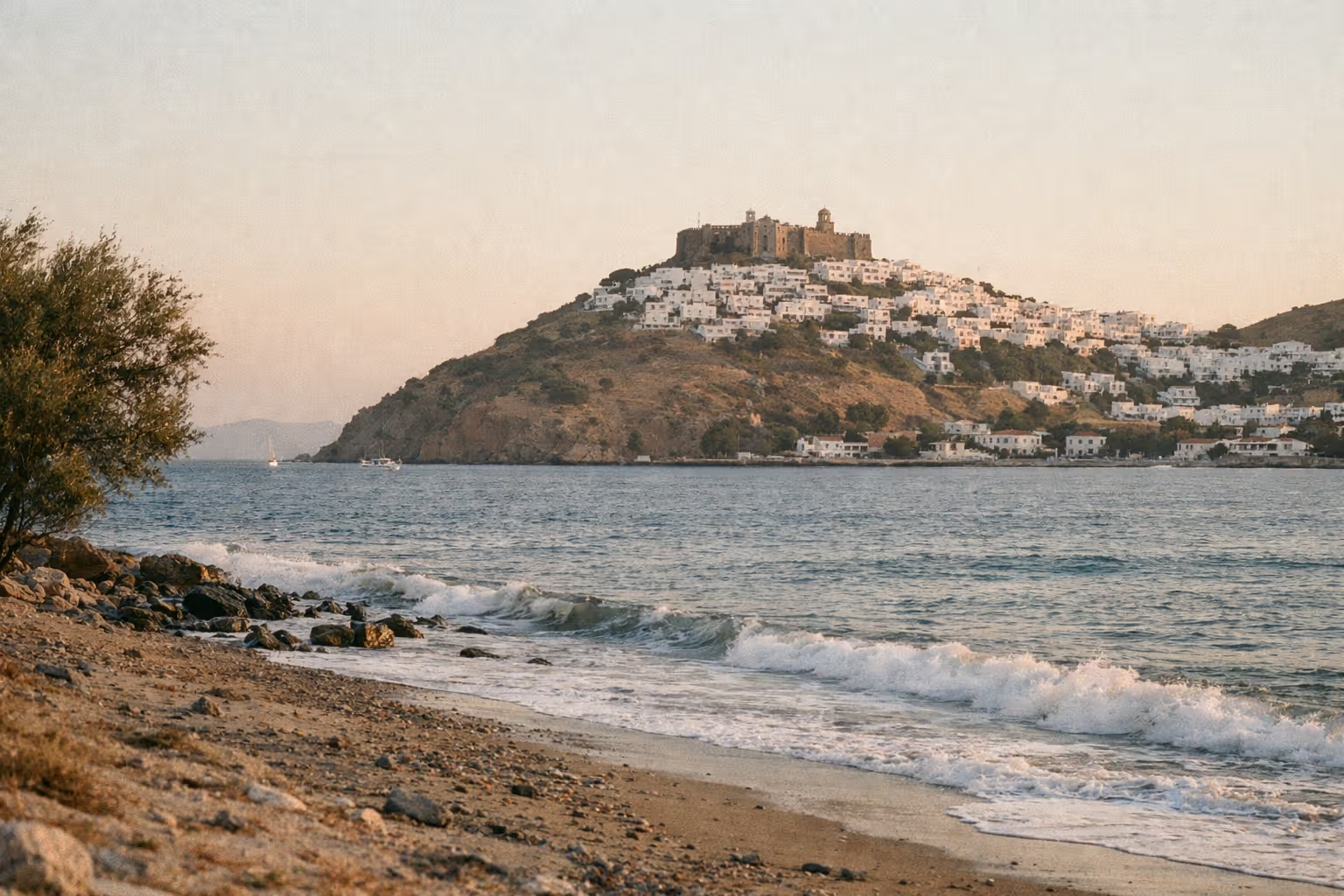
Around 95 AD, an exiled prophet named John dictated the Book of Revelation from a rock fissure on a small Aegean island. That cave is still there, still active as a pilgrimage site, and still reachable only by a ferry that takes the better part of a day from Athens. Of all the greek islands Patmos is the one where that access friction has become the whole point. There is no airport. There is no highway of tour buses. What there is: two UNESCO-listed sacred sites, a whitewashed hilltop town where people actually live, and a coastline that stays quiet because getting here takes commitment.
Patmos is a small Dodecanese island in the South Aegean, home to around 3,283 residents spread along roughly 63 km of coastline. Its historic core - Chora, the fortified Monastery of Saint John the Theologian, and the Cave of the Apocalypse - was inscribed as a single UNESCO World Heritage Site in 1999 (1). This guide covers what you actually see at both sacred sites, how Chora and the port town of Skala work, which beaches are worth the effort, and the ferry logistics that shape any trip here.
✓ Pros
- UNESCO-listed sites with genuine historical and religious weight
- Genuinely uncrowded compared to major Aegean islands
- Varied beaches (sand, pebbles, accessible by foot or boat)
- Chora is a lived-in hilltop town, not a tourist stage set
- Works well as part of a Dodecanese multi-island itinerary
✗ Cons
- No airport - ferry from Piraeus is 7-8 hours
- Limited ferry departures (4-7 per week) reduce flexibility
- No nightlife to speak of - wrong island if that's the goal
- Dress code at the monastery and cave is non-negotiable; arriving unprepared causes problems
- Small island: limited dining and accommodation variety compared to larger islands
What Makes Patmos One of the Most Significant Greek Islands Patmos
Patmos matters because it is where Christian tradition places the writing of the Book of Revelation, and because its monastery has functioned continuously for over 930 years. That combination - a foundational religious text and a living monastic community - is rare anywhere in the Mediterranean.
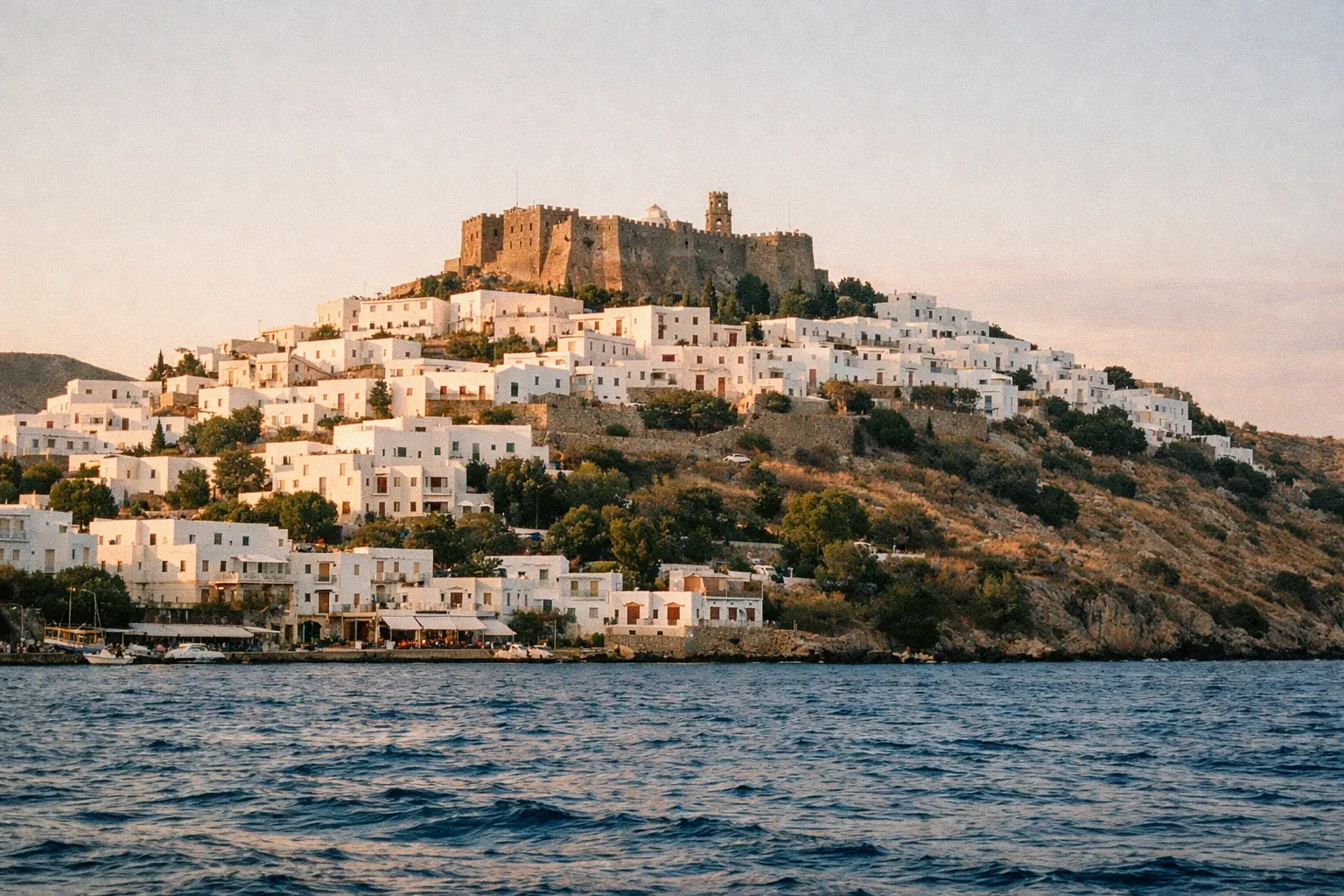
The island stays quiet for structural reasons. With a resident population of 3,283 and an area of just 34.05 km², Patmos is one of the smaller inhabited islands in the Dodecanese. No airport means every visitor arrives by sea, and the long ferry from Athens acts as a natural filter. The result is a place that draws pilgrims, culture-focused travelers, and people who want a calm few days by the water - and almost nobody looking for a party.
So is Patmos a good island to visit? Yes, if you match the island to your intentions. It is not a nightlife destination. It is very much a cultural and contemplative one, and it is fully open to visitors - not a closed religious enclave. You can walk the sacred sites, swim the beaches, and eat in Chora’s tavernas without any special permission.
The Book of Revelation and Patmos’s Place in Christian History
Christian tradition holds that St John the Theologian was exiled to Patmos around 95 AD, and that during that exile he received the visions recorded in the Book of Revelation, also writing his Gospel here (1). The cave where he is said to have lived and dictated became a pilgrimage site, and it has drawn the faithful ever since. That continuity - nearly two thousand years of the same rock treated as sacred ground - is what separates Patmos from islands where the history is something you read on a plaque.
The UNESCO Listing and What It Actually Covers
UNESCO inscribed “The Historic Centre (Chorá) with the Monastery of Saint John the Theologian and the Cave of the Apocalypse” on 2 December 1999, under cultural criteria (iii), (iv), and (vi) (1). The listing covers three elements together, not one monument in isolation: the monastery, the cave, and the medieval settlement of Chora. In plain terms, those criteria recognize the site as an exceptional example of a traditional Greek Orthodox pilgrimage center, an outstanding piece of fortified monastic architecture, and a place directly tied to events of universal significance in the history of Christianity. The point is the ensemble - a living pilgrimage landscape, not a single building.
The Cave of the Apocalypse: What You Actually See Inside
The Cave of the Apocalypse sits roughly halfway up the mountain on the main road between Skala and Chora, so it is neither at the port nor at the summit (10). That midway position makes it a logical stop when traveling between the two, and it is the reason the walking route from Skala passes right by it.
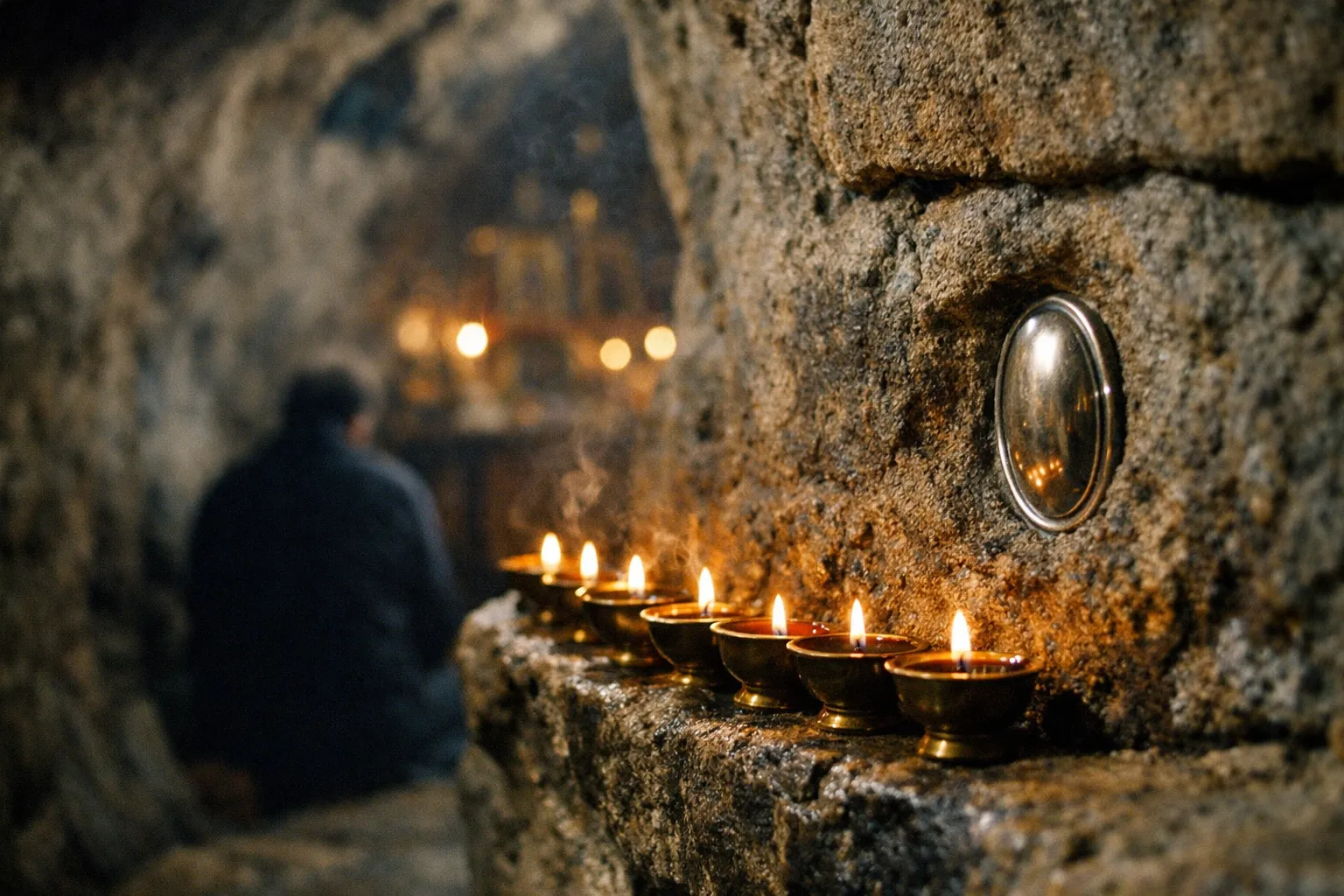
The cave itself is a natural rock fissure adapted into a chapel, part of the larger Monastery of the Apocalypse complex. Inside, the space is small and dense with liturgical furnishings. Travel writer Bob Cromwell describes a small fenced corner beneath several silver oil lamps, next to a silver oval set into the cave wall, marking the traditional spot where St John is said to have rested his head while receiving his visions. You will also see the iconostases, a 12th-century mural depicting St John dictating to his disciple Prochoros, and the crack in the ceiling said to have formed when the divine voice spoke.
I want to be clear about what kind of place this is: an active site of Orthodox worship, not a museum display. When I visited, there was an ongoing service - candles burning, incense in the air, worshippers who had come specifically to pray. Behaving accordingly is part of the deal, not an optional courtesy. Plan on 30 to 45 minutes inside the cave itself. Combined with the monastery and a walk through Chora, the full circuit runs about three to four hours.
Dress Code for the Cave and Monastery: The Actual Rules
The dress code is enforced, not suggested. Shorts and sleeveless tops are not permitted inside either the Cave of the Apocalypse or the Monastery of Saint John, and legs must be covered for everyone (8). Women should wear a long skirt or dress where possible. Some Orthodox sites keep wrap-around coverings at the entrance to lend, but supply is inconsistent and you should not rely on it. Arriving already dressed conservatively is the only way to guarantee you get in without a hassle.
This trips up more visitors than any other single thing on Patmos. The fix costs nothing but a little planning.
Getting to the Cave from Skala
From Skala you have three ways up to the cave: taxi, the local bus, or on foot. Taxis and buses both depart from the harbor area, and a guided tour from Skala will typically fold the cave and monastery into one trip. Walking is the more contemplative option - the route climbs from Skala toward Chora and passes the cave at its midpoint, with sea views opening up as you gain elevation. It is a genuine uphill effort, so save it for a cool part of the day and wear real shoes.
Monastery of Saint John the Theologian: The Fortified Summit
The Monastery of Saint John the Theologian was founded in 1088 by the monk Christodoulos, giving it more than 930 years of continuous monastic history. From the outside it reads as a castle rather than a church. According to Google Arts & Culture, it was built in a heavily fortified style because of the threat from piracy and the Selçuk Turks, which is why the exterior carries thick walls and battlements instead of a typical monastery façade.
It occupies the highest point on the island, above Chora, and UNESCO notes that the monastery and Chora together dominate the island from that strategic hilltop (10). Reaching it means a steep uphill walk from Chora or a vehicle transfer from Skala. Inside, the complex houses an important collection of Byzantine icons, relics, and illuminated manuscripts - one of the most significant assemblages of Orthodox religious art in the Aegean islands. The main church is dedicated to St John. Allow 45 to 60 minutes if you want to see both the church and the museum with its manuscripts.
This remains an active religious community, so the same standards of dress and behavior apply as at the cave. Visit early morning or late afternoon and you sidestep two problems at once: the heat on the climb, and the tour groups.
What Cruise Ship Visitors Should Know
Cruise ships dock at Skala, and organized shore excursions run from the harbor by bus or minivan up to the Cave of the Apocalypse and the Monastery of Saint John - the standard highlights of any cruise stop. The monastery is the primary destination, which means the mid-day window can get busy with tour groups arriving from the port. If you are traveling independently, time your monastery visit for early morning or late afternoon to slip in around the cruise-ship wave.
Patmos Chora: A Hilltop Town That Still Has Residents
Patmos Chora is the island’s capital, and with about 541 residents it is a genuinely inhabited town rather than an unoccupied heritage showpiece. Since roughly one in six islanders lives here, Chora functions as an administrative and social hub, not a tourist-only zone that empties at night.
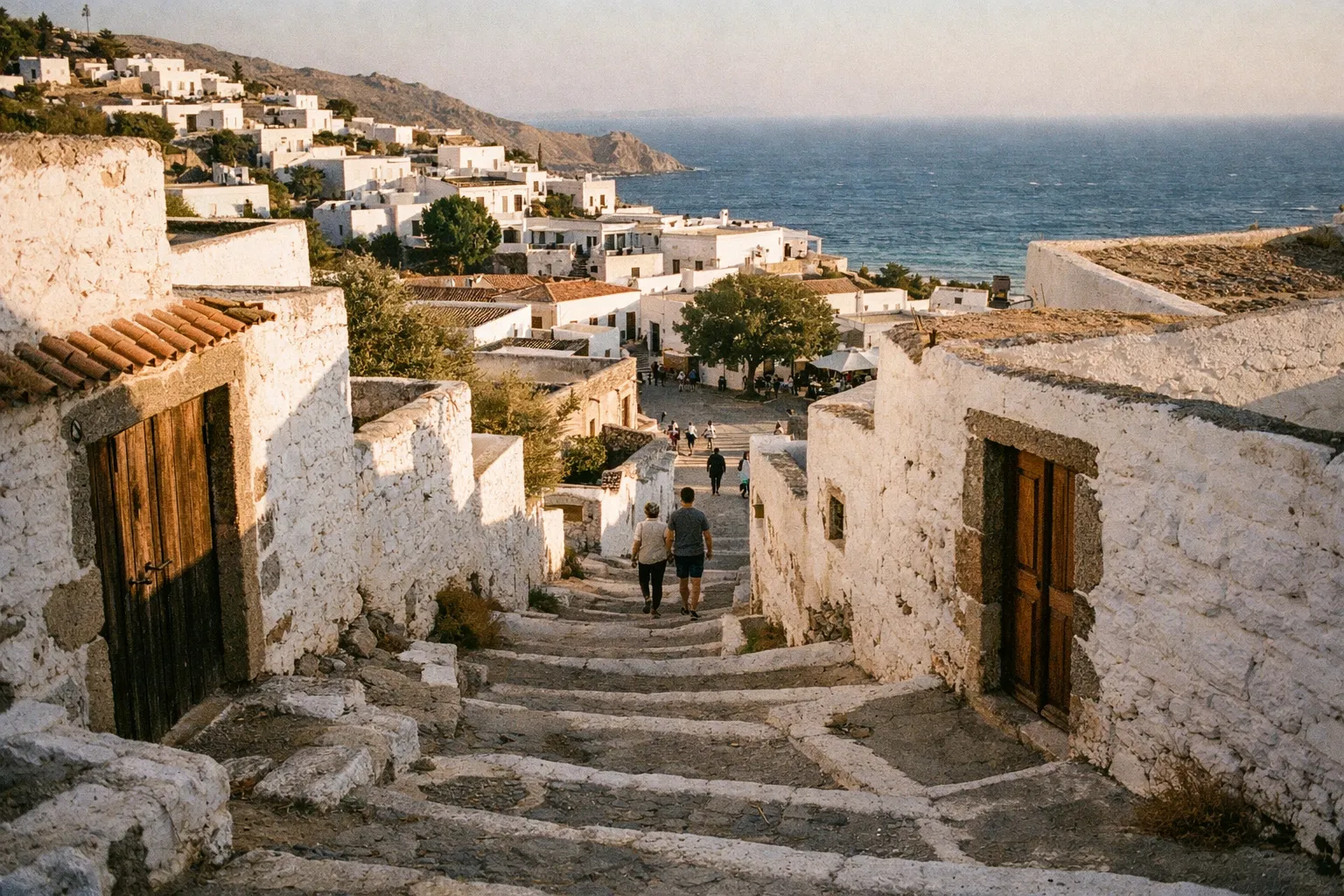
UNESCO describes Chora as a historic center that has grown around the Monastery of Saint John since the 11th century, its street network and houses recognized as an outstanding example of a Greek Orthodox pilgrimage town integrated with a major monastic complex (1). The architecture tells the story of the island’s prosperous centuries. Many of Chora’s fortified merchant houses date from the 17th and 18th centuries, and a good number remain privately owned - which is precisely what keeps the town from feeling like a museum.
Beyond the monastery, the thing to do in Chora is simply walk. The medieval lanes twist between whitewashed walls, opening onto small squares and viewpoints over the Aegean. There are cafés and tavernas that serve residents as much as visitors. Chora reads differently depending on the hour: quiet in the morning before tour groups arrive from Skala, and at its best in the low evening light when the day-trippers have gone. I spent an evening there on my last visit, eating at a table that spilled out onto the cobblestones, and the town felt genuinely lived-in in a way that Santorini’s Oia simply does not.
Does anyone live on the island of Patmos today? Yes - around 3,000 people island-wide, with Chora’s roughly 541 residents making it a working village rather than a preserved relic.
Walking Chora’s Lanes: What to Look For
Head for the main square and the monastery gate, then let yourself get lost in the backstreets - that is where the fortified merchant houses and the quieter viewpoints are. Look for the heavy wooden doors and enclosed courtyards of the old captains’ and merchants’ residences, and work your way to the edges of town for the long views back down toward Skala and the sea.
One practical note: the lanes are paved in uneven cobblestones and the whole town tilts uphill, so wear shoes with grip and skip anything with a heel.
Skala: The Port Town Where Everything Starts
Skala is the main port and largest village on Patmos, and it is where every ferry and cruise ship arrives. Built around a natural bay, its waterfront is lined with cafés, tavernas, and accommodation, which makes it the most practical base on the island if you want to be within walking distance of the ferry pier.
Skala is also the transport hub for everything inland. Local buses and taxis to the Cave of the Apocalypse and Chora depart from the area around the harbor, and most organized tours originate here. Architecturally it is less dramatic than Chora - lower, flatter, more functional - but it is a pleasant place to eat after a day on the hill, and its position makes the rest of the island easy to reach. Base yourself in Skala and the logic of the day falls into place: ferry, transport up the hill, and the beaches all radiate out from here.
Beaches of Patmos: Sand, Pebbles, and How to Reach Them
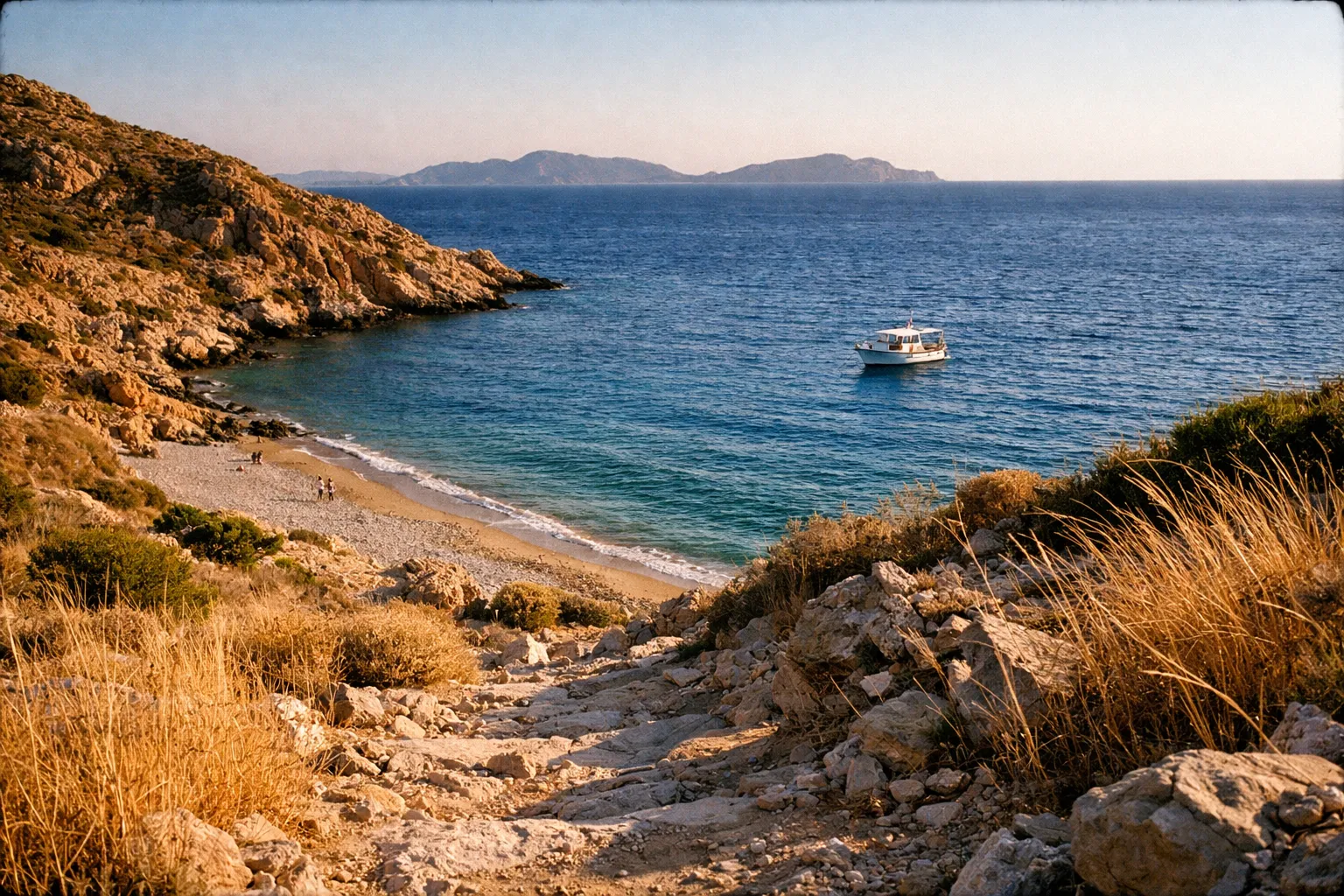
The Patmos beaches are spread across a coastline of roughly 63 km and range from fine golden sand to multicolored pebbles to sheltered bays (4). Because the island is small, none of them is far - but the best one requires either a hike or a boat, which is exactly why it stays quiet.
Patmos Beaches Comparison
| Psili Ammos | Lambi | Agriolivado | Petra | |
|---|---|---|---|---|
| Surface | Fine golden sand | Colored pebbles | Sand/pebbles | Sand |
| Access | On foot (hike) or boat in season | Road-accessible | Road-accessible, near Skala | Road-accessible |
| Best For | Full beach day, swimming | Short visit, geology interest | Quick swim, convenience | Half-day beach outing |
| Effort Level | Medium-High | Low | Low | Low-Medium |
Here is how the main four compare:
- Psili Ammos - fine golden sand, deep blue water, widely considered the best sandy beach on Patmos. No road access. Reach it on foot or by boat in season. Best for a full beach day; medium-to-high effort.
- Lambi - colored pebbles rather than sand, on the north coast. Road-accessible. Best for a shorter stop focused on its unusual geology and clear water; low effort.
- Agriolivado - sheltered, calmer water, close to Skala and road-accessible. Best for a quick, convenient swim; low effort.
- Petra - sandy, road-accessible, ranked among the island’s more impressive beaches alongside Lambi. Best for a half-day outing on the north end; low-to-medium effort.
The practical rule: Psili Ammos when you have a full day, Lambi or Petra when you are exploring the north coast, and Agriolivado when you just want to swim without planning an expedition.
Psili Ammos: The Walk-in or Boat-in Beach
Psili Ammos has no road access, and that is the whole reason it stays uncrowded. According to AlloverGreece, the trail starts from Diakofti and takes about 20 to 25 minutes on foot over two hills; in summer, small boats also run to the beach. Travel.gr confirms you can only reach it by boat or on foot, and warns there are no permanent facilities, so you need to bring your own water and supplies.
The boat is the easier choice for a full-day outing, since it removes the return hike from your afternoon. Either way, come prepared - fine sand and deep blue water are the payoff, but there is no beach bar to bail you out.
Lambi and the Colored Pebble Beaches
Lambi is the island’s standout pebble beach, on the north coast. Aegean Blueprint describes its stones ranging in color from red, green, and yellow to black and white - smooth, water-polished pebbles rather than sand. It suits a shorter visit built around the unusual geology and the exceptionally clear water over the stones. Because it is road-accessible, you can pair it with Petra for a north-coast beach day without much logistical fuss.
Getting to Patmos: Ferries, Timing, and Realistic Expectations
Here is the single most important fact for planning: Patmos has no airport, so every visitor arrives by sea, either on ferries from Piraeus and the Dodecanese or on a cruise ship docking at Skala (7). Anyone hoping to fly in direct needs to replan around another island or Athens.
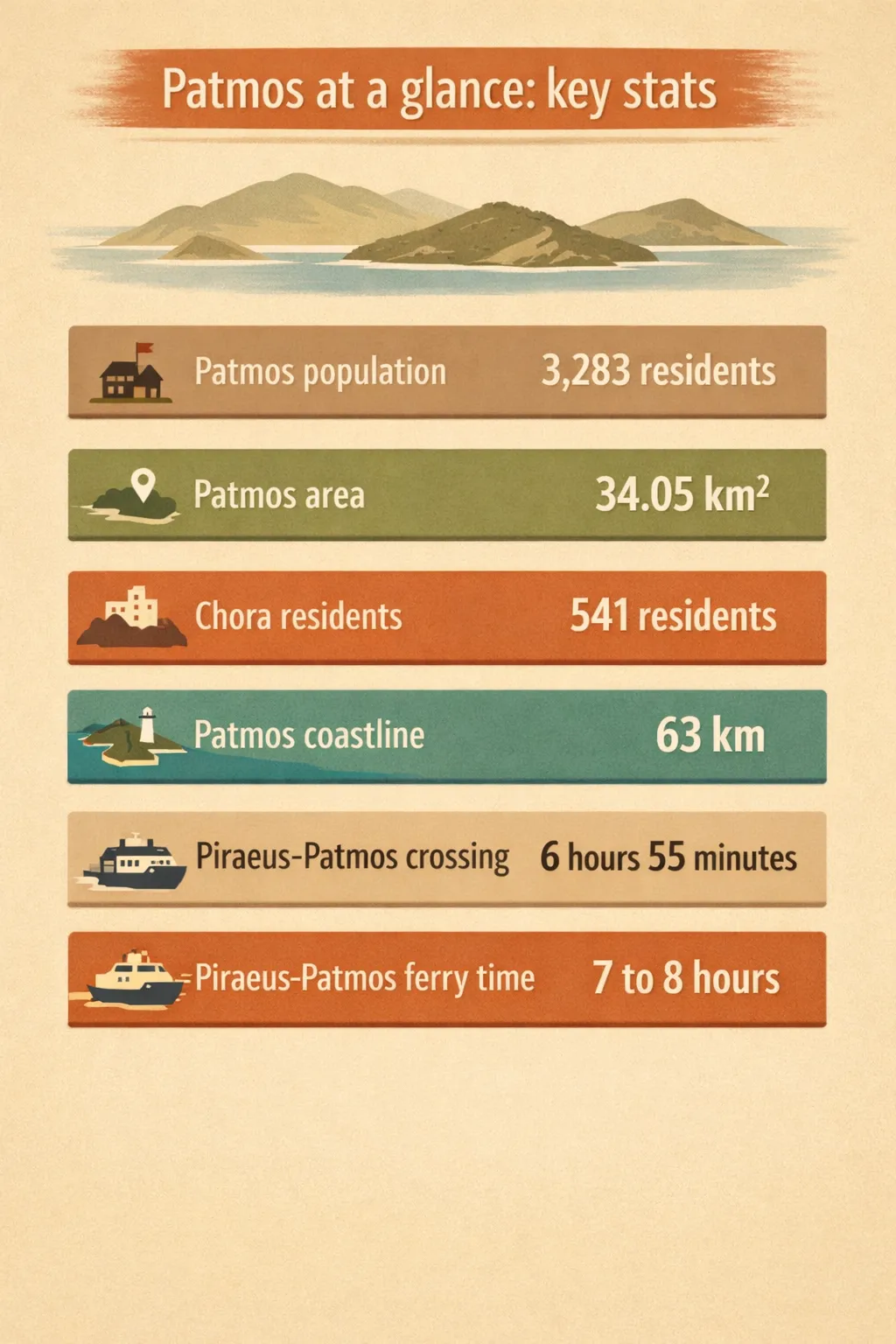 Patmos at a glance: population 3,283; area 34.05 km²; Chora residents 541; coastline 63 km; ferry times - shortest 6 hours 55 minutes, typical 7 to 8 hours (from Piraeus).
From Piraeus, the port of Athens, Blue Star Ferries operates the main route, with journey times typically around 7 to 8 hours depending on the vessel and its intermediate stops (3). Ferryhopper lists a shortest crossing of 6 hours 55 minutes, and reports the route runs year-round, four to seven days per week, operated by Blue Star Ferries and Seajets (3). Overnight sailings are common, and they are efficient - sleep on the ferry and arrive in the morning with the day intact.
The frequency is the catch. With roughly four to seven sailings per week and often just one departure a day, last-minute changes are difficult, so book ahead - especially in peak season. When you arrive, everything happens at Skala: taxis and buses to the cave and monastery leave from the port area.
The upside of all this friction is the island itself. The 7-hour ferry from Athens is exactly why Patmos never gets the volume of Santorini or Mykonos. The distance is not a bug - it is the feature that keeps the place the way it is.
Patmos as Part of a Dodecanese Island-Hop
If Athens feels far, come at Patmos sideways. It has ferry connections to nearby Dodecanese islands including Kos, Leros, Lipsi, and Samos, which makes it straightforward to fold into a multi-island itinerary once you are already in the region (3). Those crossings are far shorter than the haul from Piraeus, and in high season they run several times per week. For a broader look at how the islands connect, see our Greek islands guide.
How to visit the Cave of the Apocalypse and Monastery of Saint John in half a day
3-4 hoursA practical itinerary for the UNESCO circuit on Patmos
- 1
Start at Skala port
Take the local bus or taxi toward Chora, both departing from the harbor area.
- 2
Visit the Cave of the Apocalypse
Get off midway up the hill and allow 30 to 45 minutes inside the cave.
- 3
Continue to the Monastery of Saint John
Take a short taxi hop or walk about 10 minutes uphill; allow 45 to 60 minutes to explore.
- 4
Walk through Chora's lanes
From the monastery gate, spend 45 to 60 minutes wandering the medieval streets.
- 5
Return to Skala
Take a taxi or bus from Chora's main square back to the port.
Frequently Asked Questions
Frequently Asked Questions
- Is Patmos a good island to visit?
- Yes, for travelers seeking calm, cultural sites, and beaches without crowds or nightlife.
- Do cruise ships go to Patmos, Greece?
- Yes, cruise ships dock at Skala and run tours to the Cave and Monastery; independent visitors should avoid mid-day crowds.
- Can people visit the island of Patmos?
- Yes, Patmos is open to all visitors with no restrictions beyond dress codes at sacred sites.
- Does anyone live on the island of Patmos today?
- Yes, about 3,283 residents live year-round, including roughly 541 in Chora.
- What is the dress code for the Cave of the Apocalypse and the monastery?
- Legs must be covered; women should wear long skirts or dresses; no shorts or sleeveless tops allowed.
- How long is the ferry from Athens to Patmos?
- The ferry takes about 7 to 8 hours, with 4 to 7 departures weekly operated year-round.
- Is Patmos worth visiting for non-religious travelers?
- Yes, the historical sites, architecture, and beaches offer value beyond religious interest.
Before You Book the Ferry
Patmos earns its reputation as one of the quieter, more serious islands in Greece. The UNESCO sites are the real thing - a cave where a foundational Christian text was written, and a fortified monastery that has run without interruption for over 930 years - not a backdrop for photos. The dress code is enforced, the pace is slow, and the nightlife is essentially nonexistent. Go in knowing that, and none of it feels like a shortcoming.
The access friction is the reason the island stays the way it is. Factor the long ferry into your planning and it stops being an inconvenience and starts being the thing that keeps Patmos calm. And if the haul from Athens feels like too much on its own, remember you do not have to do it that way - Patmos slots neatly into a Dodecanese route via Kos, Leros, or Samos, where the crossings are short and frequent. For the wider picture on stitching islands together, our Greek islands guide is the place to start.