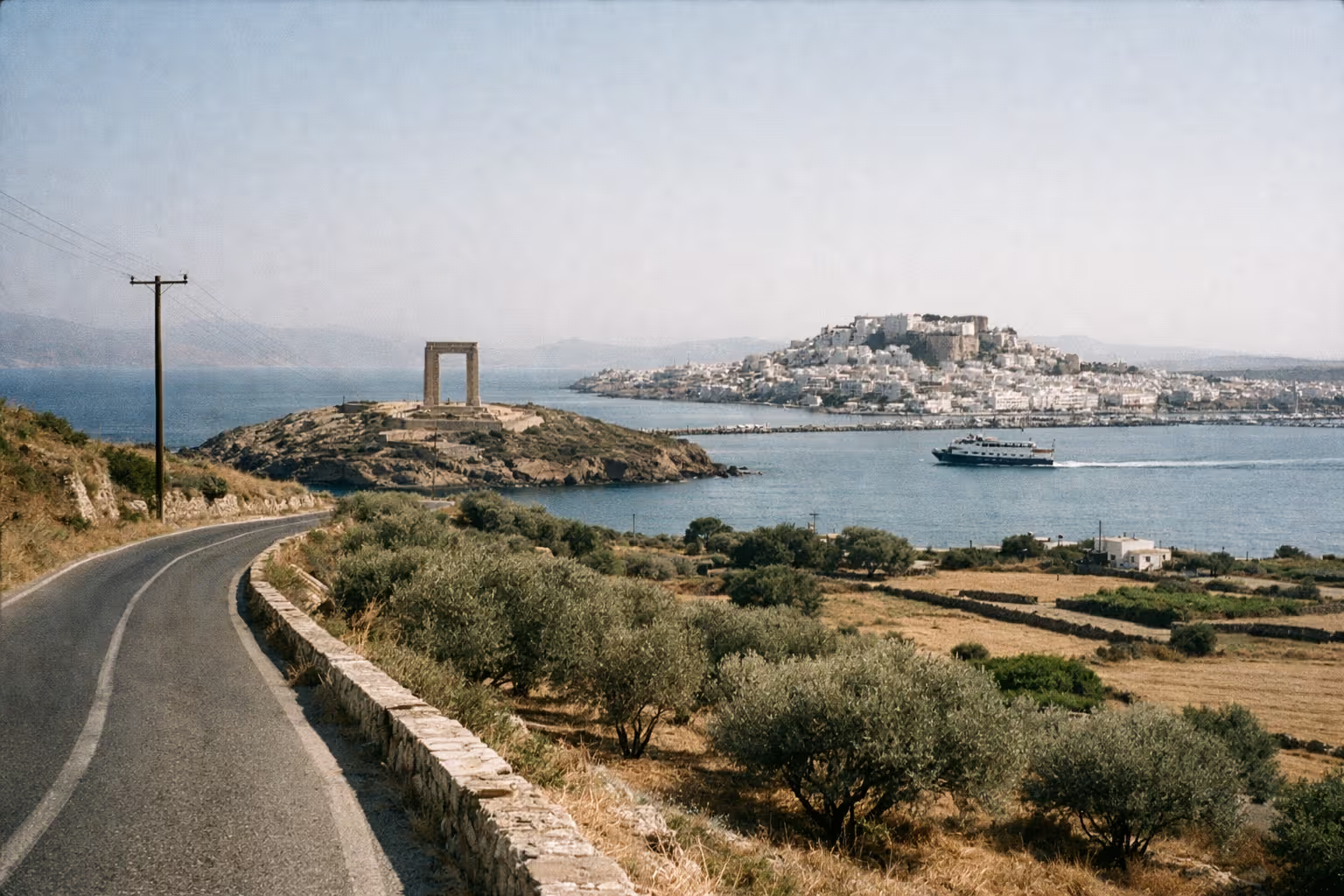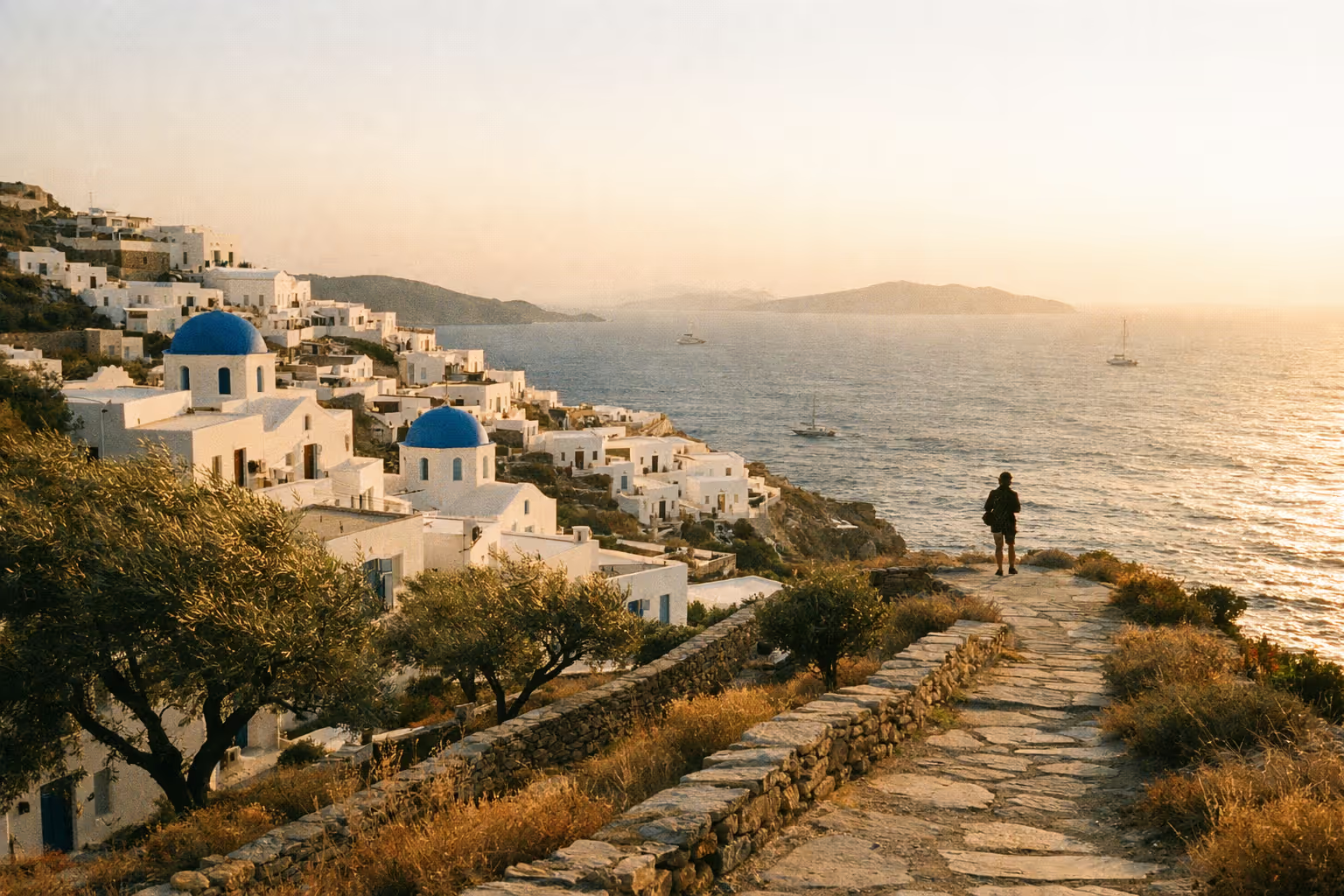
Most people who say they want to visit “the Greek islands” are already picturing the greek islands cyclades without knowing the name: whitewashed cubic houses stacked on a hillside, a blue-domed church, light so sharp it makes the marble glow at dusk. The group holds around 220 islands and islets, of which roughly 24 are inhabited with real infrastructure (1). The ferry network connecting them is genuinely efficient - but only if you understand how it’s structured.
The mistake almost everyone makes is trying to do five islands in a week. You end up repacking more than swimming. This guide is about the opposite: picking the right two or three islands and connecting them without losing a day on a dock. If you’re still deciding between island groups altogether, start with the broader Greek islands pillar, then come back here for the Cyclades-specific detail.
✓ Pros
- Most efficient ferry network in Greece - short hops, frequent routes, central hubs
- Iconic Cycladic architecture found nowhere else in Greece
- 24 inhabited islands across a wide range of vibes, from party to near-silent
- Paros and Naxos as flexible central bases reduce wasted transit days
- Works well in 7-10 days with 2-3 islands
✗ Cons
- Meltemi wind (July-August) disrupts small-boat excursions and some ferry crossings
- Santorini and Mykonos are genuinely overcrowded in peak season
- More expensive than the Ionian or Dodecanese, especially on headline islands
- Arid, stark landscapes - not the place if you want green hills and sheltered bays
- Peak-season ferries and accommodation sell out months in advance
What the Greek Islands Cyclades Actually Are
The greek islands Cyclades are a group of roughly 220 islands and islets in the central Aegean, of which about 24 are inhabited, arranged in a rough circle around the small sacred island of Delos (1). That circular arrangement is where the name comes from - “Cyclades” derives from the Greek for “circle.”
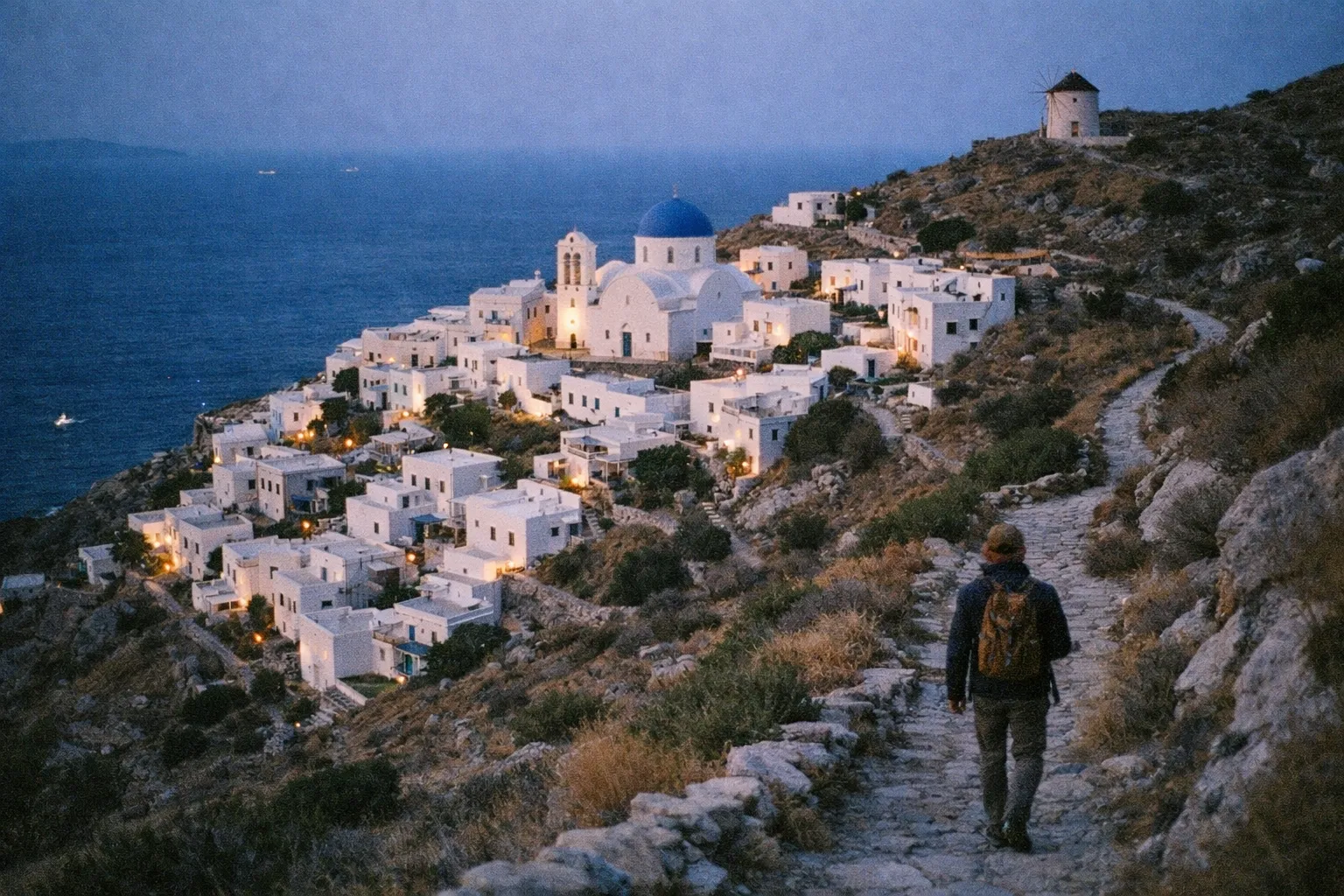
What defines them visually is consistent across the group: whitewashed cubic villages, blue-domed churches, arid and often volcanic terrain, and the hard, clean Aegean light that photographers travel here specifically to catch. The landscape is stark. Milos covers approximately 160 km² of rugged volcanic rock (1), and most islands in the group share that dry, treeless character. If you’re expecting forested hillsides, you’re picturing the wrong part of Greece.
The other defining feature is the wind. The meltemi is a seasonal northerly that builds over the Aegean from May through September. Sailing guidance from SailingHeaven puts it typically at 6-7 on the Beaufort scale, sometimes reaching 8, with its strongest and most persistent phase in July and August - weaker but still present in June and September. Plan around it rather than against it: it shapes ferry schedules, beach comfort, and every small-boat excursion you might book.
First-timers default to the Cyclades for practical reasons, not just the postcard. The ferry hops are short, connections are frequent, and the aesthetic is the one everyone already has in their head.
How the Cyclades Compare to Other Greek Island Groups
The Cyclades win on iconic visuals and easy island hopping. The Ionian wins on beach quality and value. The Dodecanese wins on culture and historical depth. That’s the short version of a decision worth making before you book anything.
The Ionian Islands - Corfu, Kefalonia, Zakynthos, Paxos and the rest - sit off the west coast facing Italy. They’re greener, get more rainfall, have calmer seas and more sheltered sandy bays, and everyday costs (restaurants especially) run lower. The Dodecanese stretch across the southeastern Aegean near Turkey and carry the strongest historical identity of any group, with medieval walls and fortress towns layered with Ottoman and Italian influence.
One structural warning that trips up a lot of first-timers: there are no direct ferries between the Cyclades and the Ionian. Combining them in under 10 days turns a dream itinerary into a repacking marathon. Pick one group and go deep. For the full group-by-group breakdown, see the Greek islands pillar.
The Cyclades Islands List - Sizes, Characters, and What Each One Is Actually For
The Cyclades number around 220 islands and islets in total, of which roughly 24 are inhabited with genuine visitor infrastructure (1). The rest are uninhabited rocks, tiny islets, or communities with no tourist facilities at all. That gap between 220 and 24 is worth holding onto - the “hundreds of islands” figure is real, but your actual choices number in the low dozens.
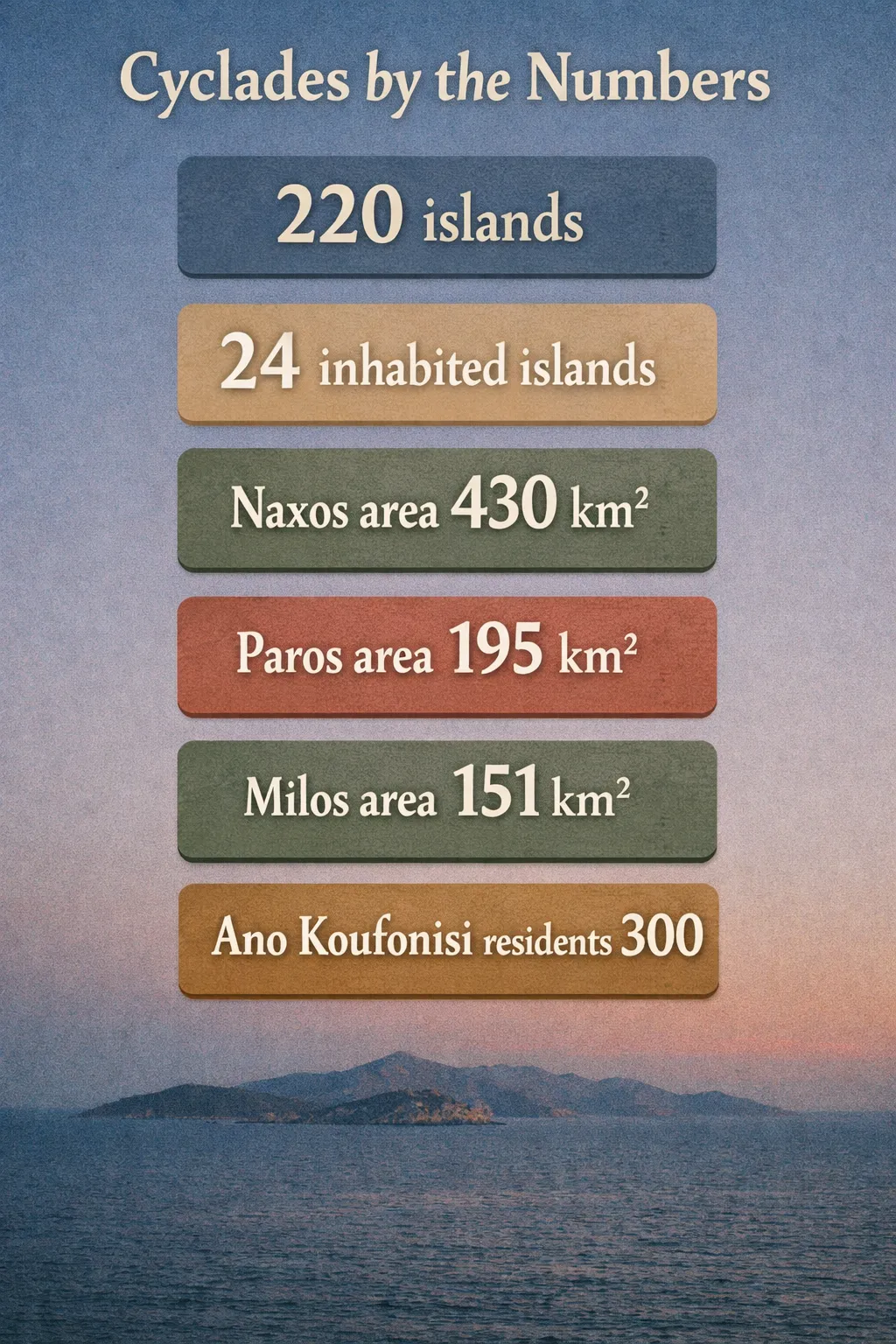 Cyclades overview figures: 220 islands total, 24 inhabited; Naxos 430 km², Paros 195 km², Milos 151 km², Ano Koufonisi 300 residents.
It helps to group the inhabited islands by character rather than reading a flat alphabetical list.
The headline pair is Santorini and Mykonos - the two names everyone knows, the two most crowded, and the two most expensive. The central hubs are Paros (around 195 km²) and Naxos, the largest island in the group at roughly 430 km² with nearly 21,000 year-round residents (1). Santorini Dave’s Naxos guide describes it as a substantial island with more than 52 villages - a real year-round community, not a summer-only resort.
The geology, food, and quiet tier covers Milos (160 km², chosen for its rock formations), Sifnos (the food island), and Folegandros and Amorgos (the quiet pair, the latter at 121 km² with serious hiking). The architecture and town-life tier is Syros - home to elegant neoclassical Ermoupoli, the most populated Cyclades capital - and Tinos, known for traditional villages and pilgrimage sites. Finally, the Small Cyclades are Koufonisia, Iraklia, Schoinousa, and Donousa: village-scale islands with tiny populations. The Greek Travel guide to the Little Cyclades notes only four are currently inhabited, with around 300 residents on Ano Koufonisi, roughly 160 on Donousa, and about 120 on Iraklia.
Population contrasts set your crowd expectations better than any brochure. Naxos and Syros each carry roughly 20,000 permanent residents. Mykonos has a permanent population of 10,704 as of the 2021 census, yet draws an estimated 3.0-3.2 million visitors a year; on peak July-August days, the simultaneous population on the 85.5 km² island can approach 70,000-100,000 people, according to tourism analysis from GreekTripPlanner. Ios has about 2,300 residents. Those numbers explain why two “small” islands can feel completely different in August.
One honest note on the “quiet island” trap: Milos, Sifnos, Folegandros, and Amorgos are not interchangeable. Each has a distinct focus - geology, food, cliffs, hiking and monasteries respectively. Pick the one that matches what you actually want, not the one that came up first in a search.
Cyclades Islands by Traveler Type
Cyclades Islands by Traveler Type
| Santorini | Mykonos | Paros | Naxos | Milos | Sifnos | Folegandros | Amorgos | Syros | |
|---|---|---|---|---|---|---|---|---|---|
| Best for | Caldera views | Nightlife | Balance and first-timers | Food, beaches, families | Geology and boat trips | Food | Quiet and clifftop scenery | Hiking and monasteries | Architecture and town life |
| Crowd level | High | High | Medium | Medium | Medium | Low to medium | Low | Low | Low to medium |
| Ferry connectivity | Well-connected | Well-connected | Major hub | Major hub | Moderate | Moderate | Limited | Limited | Well-connected |
| Relative cost | High | High | Medium | Lower | Medium | Medium | Lower | Lower | Lower |
Matching the Island to the Traveler - Honest Profiles of the Key Picks
The fastest way to figure out which cyclades island to visit is to start with what you want from the trip, not with a top-10 list.

Santorini is genuinely spectacular and genuinely crowded. The caldera views from the cliffside villages of Oia and Fira earn their reputation - in Oia, the main pedestrian lane running from the castle ruins toward the blue-domed churches is where most of that iconic imagery is made, and it earns every bit of the foot traffic. The volcanic beaches are unlike anywhere else in Greece.
One etiquette note worth knowing before you arrive: tipping in the Cyclades is appreciated but not obligatory the way it is in North America. Rounding up the bill or leaving a euro or two per person at a taverna is the norm; leaving nothing is not considered rude, and leaving 15-20% will mark you as a tourist rather than a regular. At beach clubs and bars, a small tip per round is standard if you’re occupying a sunbed for the afternoon. TripAdvisor’s Santorini vs Mykonos guide notes around 15,000 year-round residents and a growing number of hotels and restaurants that now stay open December through February, so the off-season infrastructure is real. Visit in May or September to skip the super-peak crush. See the Santorini guide for the detail.
Mykonos is the nightlife island - beach clubs, design hotels, DJs - and it delivers exactly that. Worth it only if that’s explicitly the goal. GreekTripPlanner’s analysis puts the annual visitor-to-resident ratio far above 200:1, with peak days swelling the island toward 70,000-100,000 people. The cost-to-experience ratio is steep for anyone who isn’t there for the parties. See the Mykonos guide.
Paros is the most consistently recommended first-timer base, and for good reason: balanced beaches, real nightlife, good food, and a major ferry hub position. It runs significantly cheaper than Santorini for comparable accommodation, which is why it’s the smart first move for most travelers. See the Paros guide.
Naxos is the largest island in the group and arguably has the best food scene in the Cyclades, backed by genuine agriculture rather than imported supplies. Long sandy beaches, more than 52 villages, and no party-island reputation make it strong for families and anyone who wants variety without the crush. See the Naxos guide.
Milos is the geology choice. The lunar rock formations, dramatic coastline, and boat trips around the sea caves are the reason to come. It’s rising fast in popularity but still avoids the caldera crowds. Choose it specifically for this - don’t expect Naxos-style beach-town life.
Sifnos is the food island. If eating well is the point of the trip, anchor here. Its culinary tradition runs deep, the tavernas (traditional Greek restaurants) are excellent, and the traditional villages are worth the slower pace.
Folegandros and Amorgos are the quiet pair. Folegandros gives you a clifftop chora (main village) and near-silence in the evenings. Amorgos adds serious hiking and the clifftop Hozoviotissa monastery, plus dramatic terrain. Both suit travelers who found Santorini exhausting and want the Cycladic aesthetic without the volume.
Syros and Tinos are the culture-over-beach alternatives. Syros has elegant neoclassical Ermoupoli - the Vaporia quarter above the port is where the 19th-century merchant mansions are concentrated, and the main square, Plateia Miaouli, anchors the town’s daily rhythm in a way that has nothing to do with tourism. Tinos has traditional inland villages and important pilgrimage sites. Pick these if architecture and town life matter more than a beach day.
How the Ferry Network Actually Works - Gateways, Hubs, and the Hub-and-Spoke Logic
The cyclades ferry routes radiate from two Athens gateways - Piraeus and Rafina - to core islands, then link outward from central hubs at Paros and Naxos to everywhere else. Understanding that hub-and-spoke structure is the difference between an efficient trip and a series of stranded afternoons.
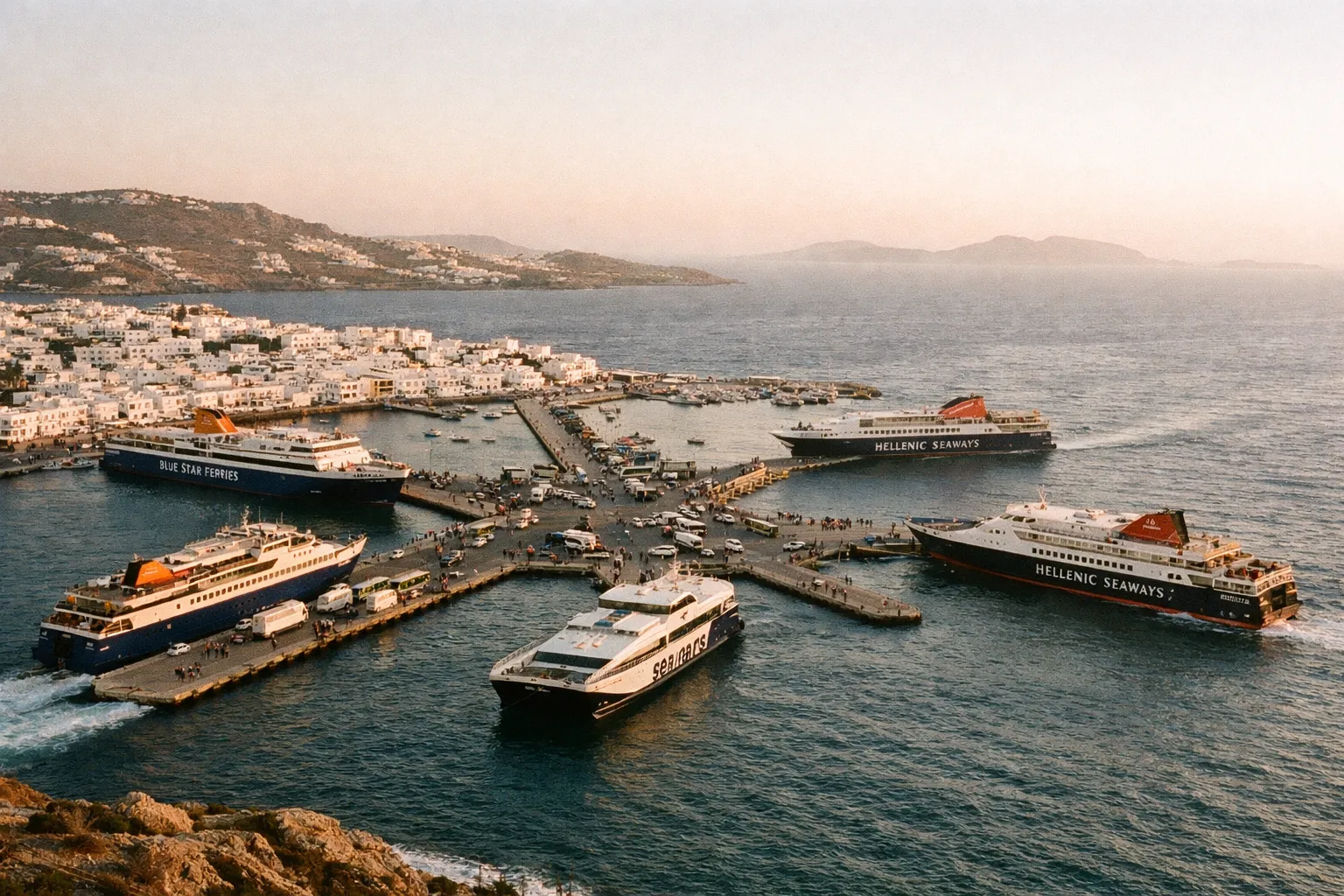
Piraeus is Athens’ main port and carries the most routes, reaching Mykonos, Santorini, Paros, Naxos, Milos, and Ios directly. Rafina, northeast of Athens, is smaller but useful: Fast Ferries runs year-round routes from Rafina to Andros, Tinos, and Mykonos, plus seasonal service to Paros. Which gateway you use depends on which island you start with.
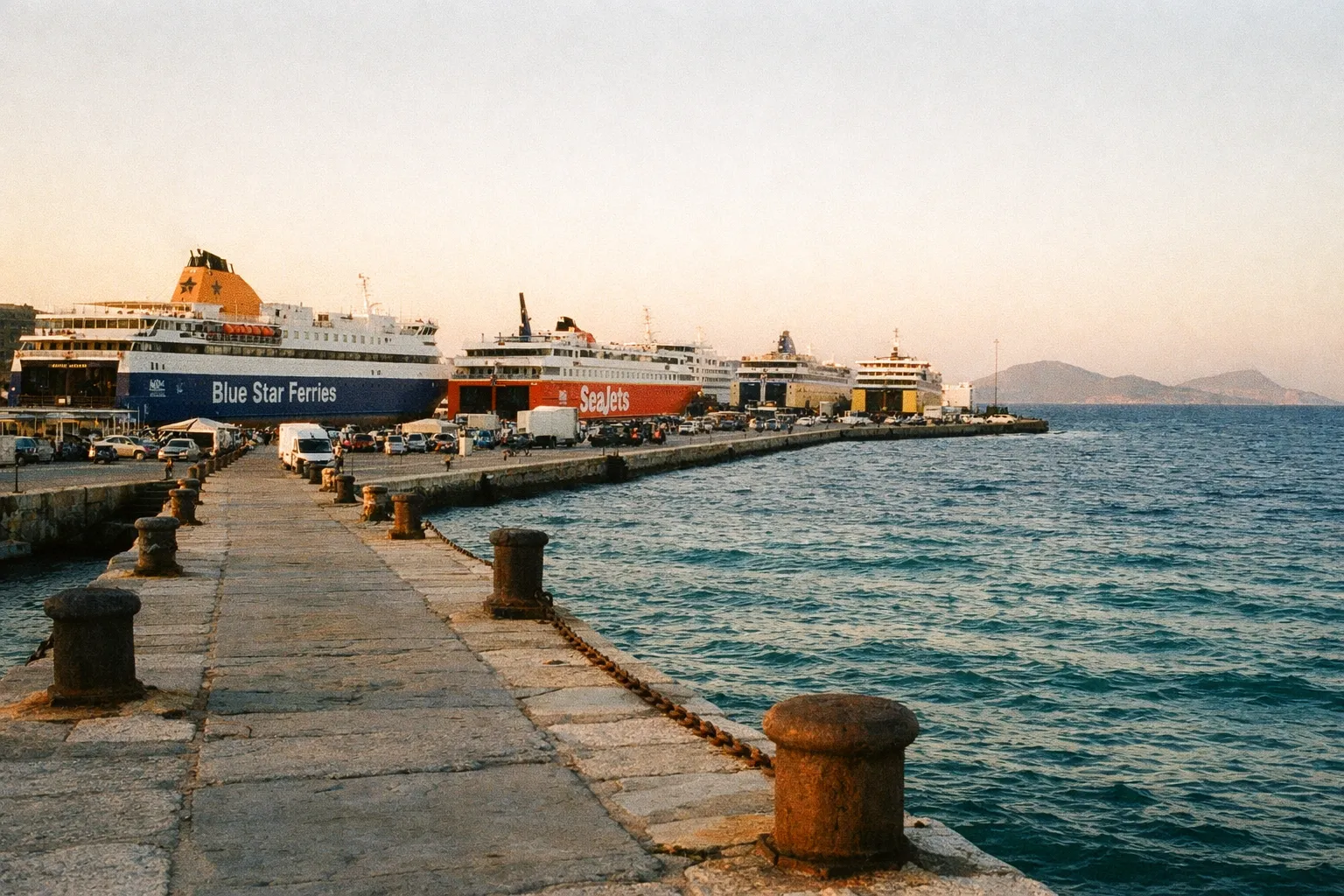
Durations vary sharply by vessel type. Ferryhopper lists high-speed Seajets crossings from Piraeus to Mykonos at a minimum of about 2 hours 40 minutes, while conventional Blue Star ferries take roughly 4 hours 40 minutes. On the Rafina-Mykonos leg, high-speed Golden Star ferries cover it in about 130 minutes versus around 270 minutes on conventional Fast Ferries vessels, according to Feribotseferleri. A high-speed ticket can save you half a day - that’s worth knowing before you book on price alone.
The hub logic is what makes short hops feasible. DiscoverCyclades describes Paros as “the central interchange of the Cyclades” and Naxos as its “twin hub, 25 minutes to the east” by fast ferry. Paros connects to Antiparos, Naxos, Mykonos, Ios, and Santorini - multiple daily connections give you a buffer if one ferry is cancelled. Naxos is the natural base for the Small Cyclades (Koufonisia, Iraklia, Schoinousa, Donousa), plus Paros, Ios, Santorini, and Amorgos.
High-speed ferries connect proximate islands in 1-2 hours - Santorini to Naxos, Naxos to Paros, Paros to Mykonos. That’s precisely what makes two or three island hops realistic in 7-10 days.
Seasonality matters more than most itineraries admit. The network is densest mid-June to mid-September. Some routes are explicitly seasonal: the Rafina-Paros service, for example, runs only during the summer window and drops to minimal frequency outside it - check current schedules before building any itinerary around it (7). Copy a July itinerary into May or October and you’ll find gaps. Book early - July-August ferries and accommodation sell out months ahead, and advance booking is non-negotiable for Santorini and Mykonos.
Booking Your Cyclades Ferry Sequence
Booking Your Cyclades Ferry Sequence
About 1 hourStep-by-step guide to plan and book your ferry itinerary without getting stranded
- 1
Decide your entry point
Choose between Piraeus or Rafina based on your starting island; Piraeus serves most islands, Rafina serves Andros, Tinos, and Mykonos.
- 2
Choose your hub island
Book Paros or Naxos first as your central base; this anchors your ferry chain and offers flexibility.
- 3
Map your sequence from the hub outward
Plan island hops keeping ferry legs to 1-2 hours where possible for efficient travel.
- 4
Check route seasonality
Verify if each ferry route operates year-round or seasonally before finalizing your dates.
- 5
Book ferries and accommodation simultaneously
For July-August travel, secure both ferries and lodging months ahead to avoid sold-out situations.
- 6
Build a buffer night
Include at least one extra night at your hub island to absorb potential delays or cancellations.
The Best Island-Hopping Routes Through the Cyclades for 7-10 Days
Two to three islands in 7-10 days is the right scope for cyclades island hopping. Four or five and you’re repacking more than swimming. Allocate 2-3 nights per island. On short crossings of 1-2 hours, a half-day transfer still leaves meaningful time on either end - a morning ferry can put you on a new beach by afternoon.
Here are four routes, each built for a different traveler.
Route 1 - The Classic First-Timer Circuit (Mykonos to Naxos to Santorini)
For first-timers who want the headline Cyclades experience without apology. Fly or ferry into Mykonos (2-3 nights), take the high-speed ferry to Naxos (2-3 nights), then continue to Santorini (2-3 nights). Every leg runs 1-2 hours by high-speed ferry with frequent connections.
The honest caveat: both Mykonos and Santorini are at the top of the crowd and price spectrum in peak season, and combining them in August means encountering top-end crowding on both ends. Book everything months ahead, and seriously consider May or September instead of high summer.
Route 2 - The Hub-and-Spoke Balance (Paros base to Naxos to Milos)
For travelers who want variety without long ferry days, and for first-timers who’d rather skip the Santorini and Mykonos crush. Use Paros as a 4-5 night base with a day trip to Antiparos, then move to Naxos (2-3 nights), then Milos (2-3 nights).
Paros to Naxos is a short hop - DiscoverCyclades puts it at roughly 25 minutes on a fast ferry, short enough to fold into a beach day rather than dedicating a travel day to it. Naxos to Milos is a manageable leg too. Milos adds real geological drama without the caldera crowds.
Route 3 - The Quiet and Scenic Route (Milos to Folegandros to Amorgos)
For travelers who want the Cycladic aesthetic without the volume - hikers, and anyone who found Santorini overwhelming. Plan 8-10 days and use Santorini or Naxos as transit points to reach Folegandros and Amorgos.
Milos delivers geology and boat trips; Folegandros gives you a clifftop chora and genuine silence; Amorgos brings the Hozoviotissa monastery hike and dramatic terrain. Connections on some of these legs are less frequent, so check seasonal schedules carefully before you commit. This is not a route to improvise in shoulder season.
Route 4 - The Small Cyclades Focus (Naxos to Koufonisia to Iraklia to Schoinousa)
For travelers who want village-scale, low-key stays, and for repeat visitors who’ve already done the headline islands. Base in Naxos (2-3 nights), then hop through the Small Cyclades on regional ferries.
Expect very small communities and limited local transport. Iraklia, for instance, has two substantial villages and a seasonal minibus service for a population of about 120, per the Greek travel guide. Crossings are short but less frequent, so this suits slow travelers who build flexibility into the plan rather than racing a schedule.
Common Mistakes That Cost You Days (and How to Avoid Them)
Over-stuffing the itinerary. Trying to fit four or five islands into seven days produces ferry fatigue, not a holiday. A single conventional Piraeus-Mykonos crossing runs about 4 hours 40 minutes (per Ferryhopper), and once you add port check-in, transfers, and check-out overhead, that’s 6-7 hours of a day gone. Do the math before you book.
Ignoring the hub logic. Booking Athens-Santorini-Mykonos direct without routing through Paros or Naxos leaves you with fewer onward options and longer routes. The central islands have far more frequent connections, which is exactly why they make good bases.
Underestimating the meltemi. In July and August the wind runs 6-7 Beaufort and sometimes 8 (per SailingHeaven), which on exposed crossings like Mykonos-Naxos or Santorini-Milos means significant waves and occasional delays. Favor leeward beaches and larger conventional ferries on exposed legs. Dream Yacht Charter’s guidance stresses the meltemi can be almost continuous in July and August while occurring less frequently from late May - so a beach and crossing plan that worked in early June won’t hold in August.
Treating quiet islands as interchangeable. Milos is not Sifnos is not Folegandros is not Amorgos. Milos is approximately 160 km² of geology; Amorgos is 121 km² of hiking and cliffs; the Small Cyclades run to a few hundred residents. The smaller the island, the more its limited infrastructure shapes your day. Match the island to what you actually want.
Falling for seasonal schedule traps. Routes like Rafina-Paros and certain Small Cyclades connections run only part of the year (7). Verify before copying an itinerary from a different season.
Expecting Ionian scenery. Travelers who loved Corfu or Zakynthos sometimes arrive expecting green hills and sheltered bays. The Cyclades are arid and stark. That’s the point - but only if you’re prepared for it.
When to Go - Seasonality, Wind, and the Case for Shoulder Season
June and September are the sweet spot for most Cyclades travelers: warm weather, manageable crowds, an easing meltemi, and a still-full ferry network. If you can be flexible on dates, this is where to aim.
High season runs mid-June to mid-September - the densest ferry network, the hottest weather, and peak crowds and prices. Santorini and Mykonos in August are genuinely overwhelming, with Mykonos peak days pushing toward 70,000-100,000 people on the island (per GreekTripPlanner). Book months ahead if this is your window.
Shoulder season - mid-May to mid-June and mid-September to early October - brings warm weather with fewer crowds and lower prices. General Greece guidance points to prices in this window running 20-30% below August peaks, and GreekTripPlanner’s seasonality analysis notes that some per-person spending categories on headline islands drop dramatically off-peak. The meltemi eases considerably too: SailingHeaven describes June and September as noticeably calmer than the July-August peak, which makes exposed crossings and beach days more comfortable.
Off-peak (November to April), many smaller Cyclades islands go quiet or close entirely. The year-round Rafina routes to Andros, Tinos, and Mykonos are the reliable backbone here (per Feribotseferleri), and Santorini now keeps a growing number of hotels and restaurants open through winter (per TripAdvisor). For most trips, though, shoulder season is the honest recommendation.
Frequently Asked Questions
Frequently Asked Questions
- What is the best island to visit in the Cyclades?
- Depends on your profile. Paros is the most recommended first-timer base with balanced beaches, good food, and connectivity. Naxos offers space and top food. Santorini is best in May or September. For quiet, choose Folegandros or Amorgos; for nightlife, Mykonos with cost awareness.
- How many islands are in the Cyclades?
- The Cyclades include about 220 islands and islets, with roughly 24 inhabited and equipped for visitors. The rest are uninhabited or lack tourist facilities.
- What is the cheapest island in the Cyclades?
- Naxos, Paros, Sifnos, and Folegandros tend to be significantly cheaper than Santorini and Mykonos for accommodation and food. The Small Cyclades like Koufonisia and Iraklia are also lower-cost.
- How does the Cyclades ferry network work?
- Routes radiate from Piraeus and Rafina to core islands, with Paros and Naxos as hubs for onward connections. High-speed ferries link islands in 1-2 hours. The network is densest mid-June to mid-September; some routes are seasonal.
- How many islands should I visit in 7-10 days?
- Two to three islands is ideal. More than three means more time repacking and waiting on docks than enjoying destinations. Allocate 2-3 nights per island with half-day ferry transfers.
- Do I need to book Cyclades ferries in advance?
- For July and August, yes. Ferries and accommodation sell out months ahead, especially on Santorini and Mykonos. Shoulder season offers more flexibility but booking your hub first is still wise.
- Should I choose the Cyclades, the Ionian, or the Dodecanese?
- Cyclades offer iconic visuals and easy hopping. Ionian has better beaches, calmer seas, and lower costs but no direct ferries to Cyclades. Dodecanese offers rich culture and history. Pick your group first, then islands.
The Planning Sequence, in Order
The Cyclades work because the ferry network is genuinely efficient - but only if you pick the right hub, limit yourself to two or three islands, and match each island to what you actually want from the trip. Anchor on Paros or Naxos and almost everything else falls into place: short hops, frequent connections, and a buffer if a ferry gets cancelled.

Do it in this order. Identify your traveler profile from the island profiles above, check the comparison to confirm your shortlist, then open the individual island guides for Santorini, Mykonos, Paros, or Naxos to lock in the detail. Book early enough that August doesn’t beat you to the last cabin.