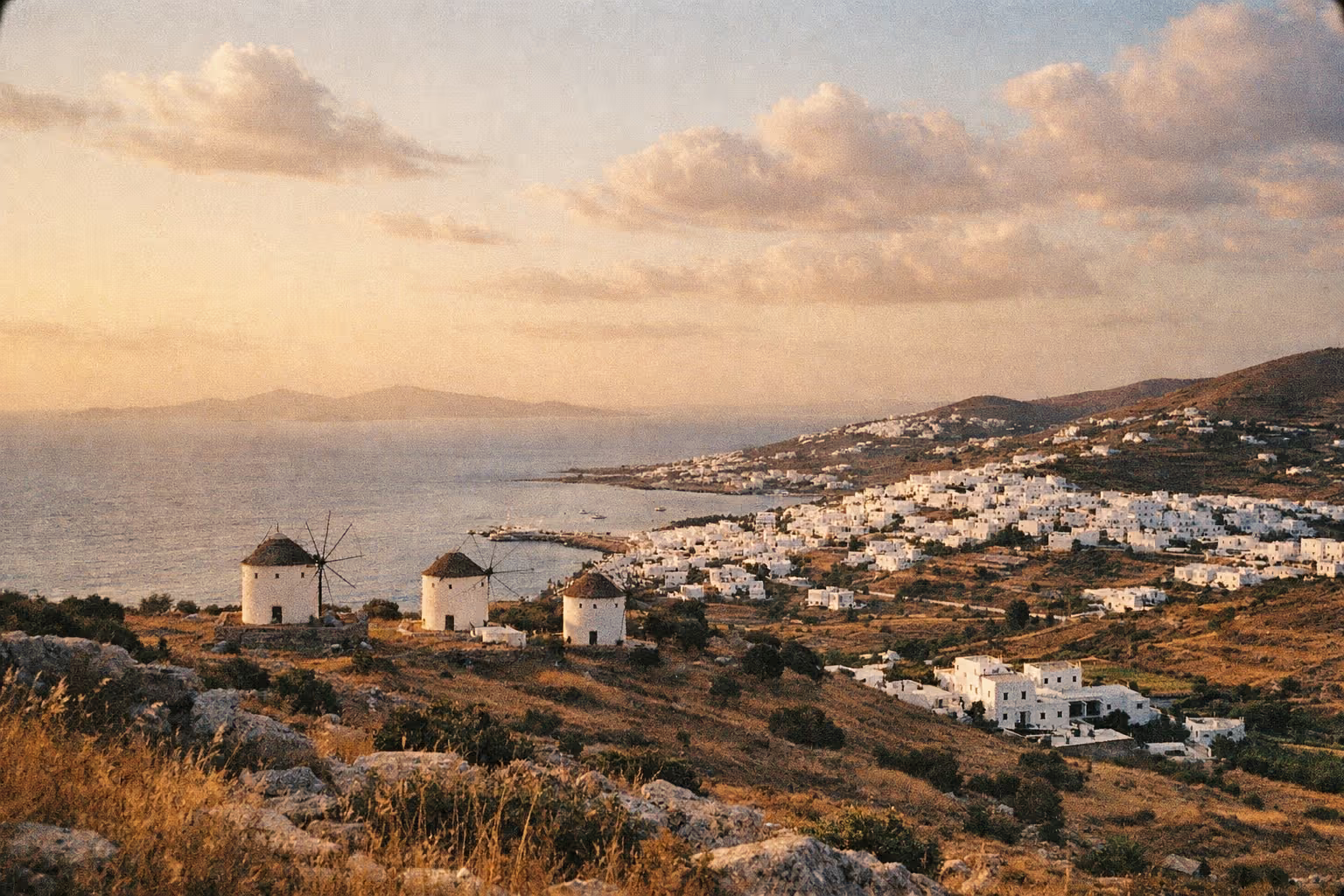
A useful Paros Greece travel guide starts with the wind, because the meltemi kicks up by early afternoon in July and August and decides which beaches are swimmable. Hit Santa Maria, Golden Beach, or Kolymbithres in the morning, then base yourself by mood: Naoussa for harbor bars and seafood, Lefkes for marble lanes and quiet. Rent a car or ATV, since the buses only cover the main routes. Give it five days and Paros does what Santorini cannot, a full island rather than one photogenic cliff.
Your Paros Greece travel guide: what the island actually looks like
This Paros Greece travel guide will help you discover the charm of this Cycladic island located about 150 km southeast of Piraeus, covering 165 km² in a shape that maps generously describe as “plump-pear.” The landscape is mostly gleaming white marble - you notice it in the roads, the church steps, the retaining walls - with gneiss and mica-schist filling in the gaps. It’s not dramatic in the way Santorini is dramatic. The hills are rolling, the villages are compact, and the coastline keeps switching between sandy bays and rocky coves with very little warning.
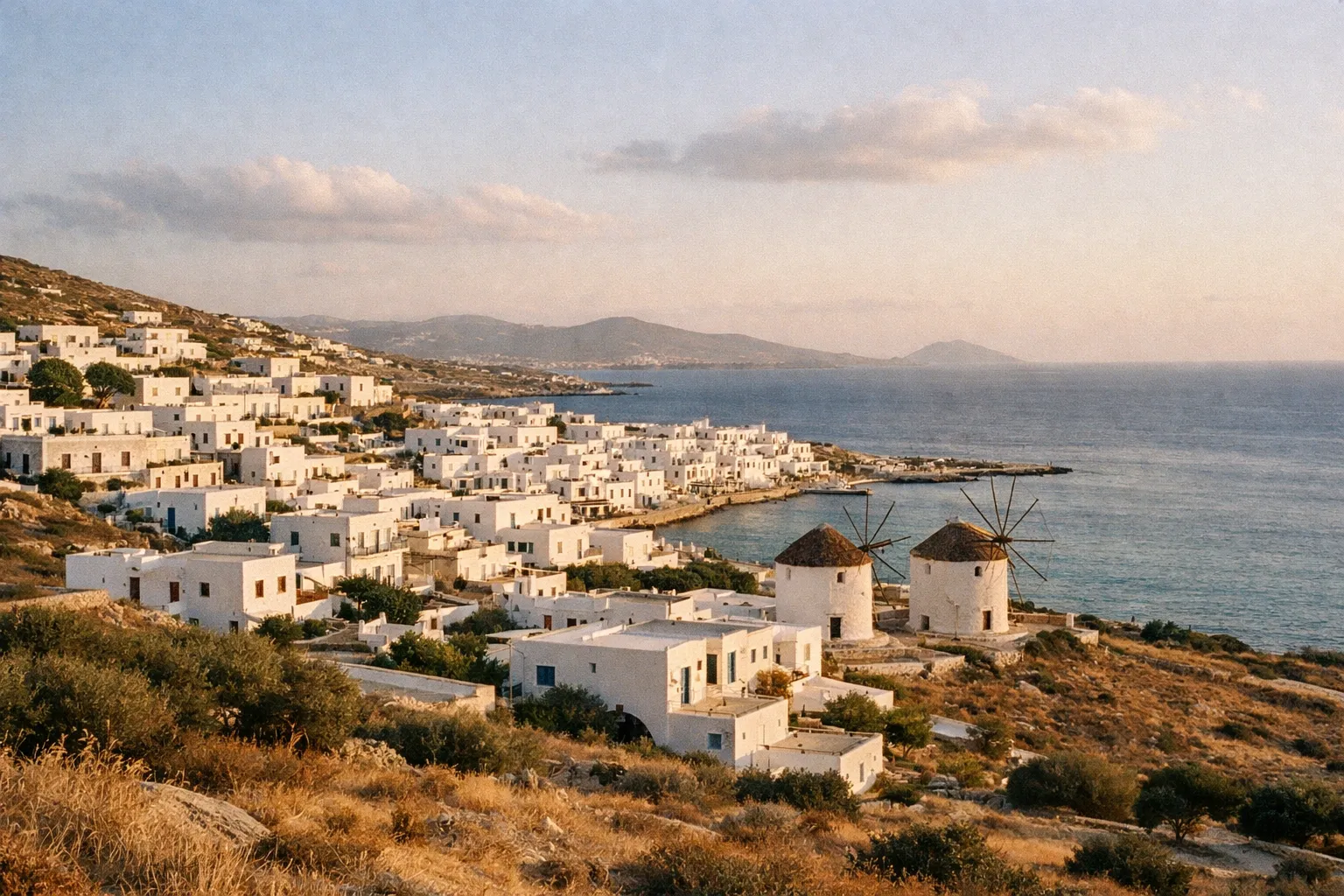
What I find useful about the scale: a full drive around the island takes roughly 90 minutes without stops (1), which means you can actually cover it. Small enough to circle in a morning, big enough to keep you busy for a week.
The geography shapes how you plan your days more than most guides acknowledge:
- Sand and pebble beaches on every coast, with calmer water on the leeward sides
- Rolling inland hills with traditional windmills and marble villages
- Fishing harbors at Naoussa, Aliki, and Piso Livadi
- Ancient marble quarries at Marathi that supplied sculptors across the Mediterranean
The season runs late May through October (1)(2). July and August are hot and genuinely crowded. June and September are the sweet spot - warm water, manageable crowds, ferries still on the full summer schedule.
How to get to Paros and how long to stay
Most travelers arrive by ferry from Athens. Fast ferries from Piraeus reach Parikia in about 3.5 hours (3). Slower conventional ferries take 4.5 to 5 hours and cost noticeably less. Book through Ferryhopper or Bluestarferries.com - in peak season (mid-July through August), reserve at least a few weeks ahead, especially if you’re bringing a car.
Paros also has a small airport with flights only from Athens (4), running around €50-100 one-way depending on season (5). Useful if you’re tight on time, but the ferry - open deck, Aegean light, the slow approach to Parikia harbor - is part of the trip for a reason.
Inter-island connections from Paros:
- Naxos: ~25 minutes by fast ferry (6)
- Mykonos: ~45 minutes (7)
- Santorini: 2-3 hours (8)
- Antiparos: ~10 minutes by small ferry from Pounta
For trip length, three days is the practical minimum (9) - enough for one beach day, one Naoussa evening, and a village day. Five days is better. A full week lets you add Antiparos, a Naxos day trip, and the southern beaches without the feeling that you’re rushing through everything.
Where to stay: Naoussa vs Parikia vs Lefkes
This decision shapes your trip more than almost anything else. Each base has a genuinely different character, and I’ve stayed in all three.
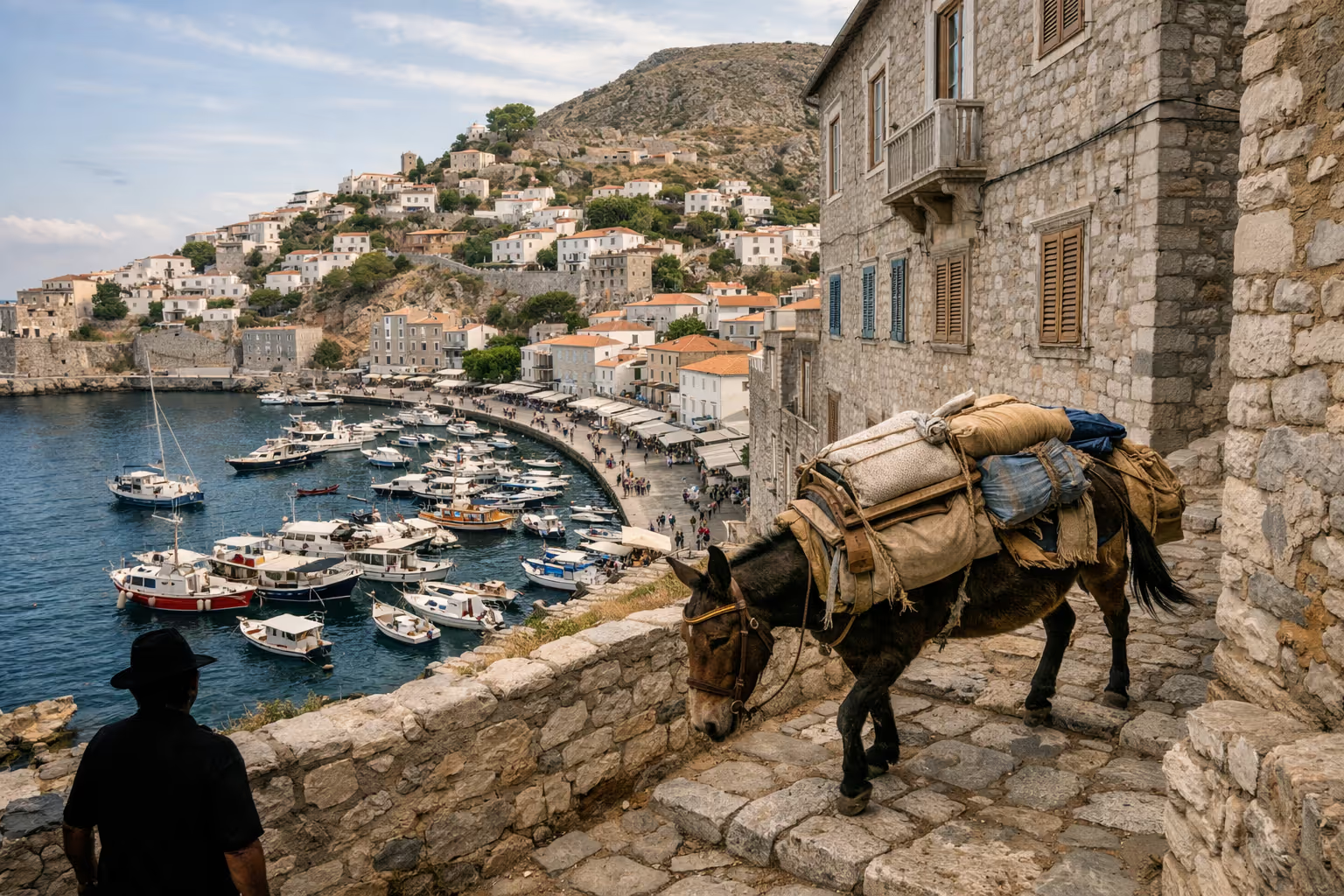
Naoussa is the popular pick and the strongest concentration of restaurants, bars, and boutiques on the island. The old harbor - fishing boats moored next to wine bars built into Venetian ruins - is one of the better evening scenes in the Cyclades. Stay here if you want dining and nightlife within walking distance. Expect €150-300/night in peak season for a decent boutique hotel, less in shoulder season.
Parikia is the port and the logistics hub. Cheaper rooms, easier ferry access, more practical if you’re island-hopping. The old town is genuinely pretty - narrower lanes than Naoussa, fewer crowds in the evening, and the Panagia Ekatontapiliani church is right here. Sub-€100/night rooms are realistic in May or October.
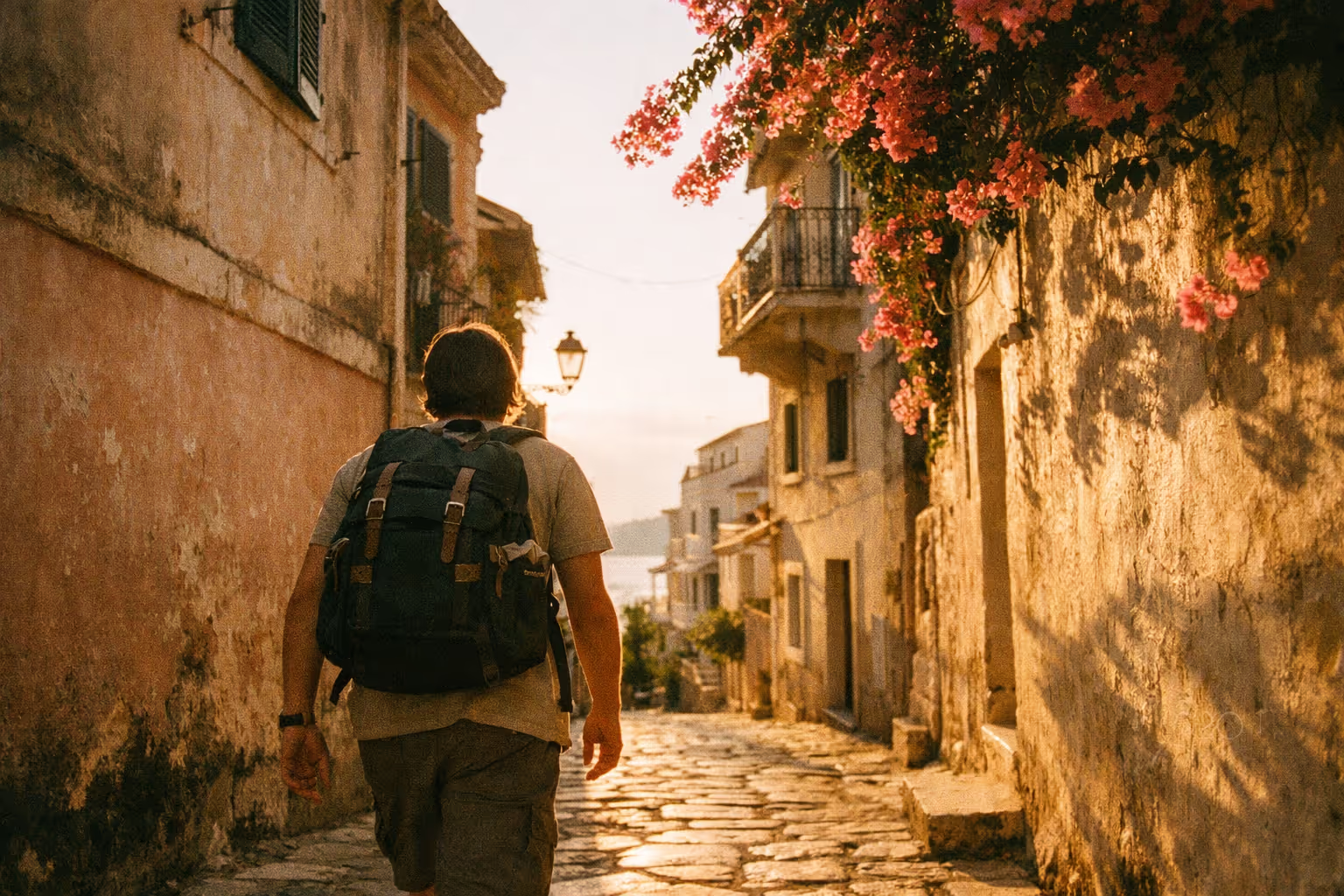
Lefkes paros is the inland choice - a marble village in the hills with stone-paved streets, neoclassical houses, and a much slower pace. You’ll need a car. Stay here if you want quiet evenings, hillside views, and a base for hiking the Byzantine Road down to Prodromos. Two or three small guesthouses operate here; book early.
A practical formula: Naoussa for atmosphere, Parikia for budget and ferries, Lefkes for quiet. Book about three months ahead in peak season - Paros has fewer rooms than Mykonos or Santorini and fills up faster than people expect.
Layers of history visible in the architecture
The island has been inhabited since the 3rd millennium BCE, later colonized by Ionians who left a lasting mark on its culture and architecture. Through the centuries Paros was Roman, then Byzantine, then Venetian, then Ottoman, before joining the newly independent Kingdom of Greece in 1832.
The Parian marble quarried here was used in countless ancient works, including the Venus de Milo and parts of Napoleon’s tomb. The ancient quarries at Marathi, about 5 km east of Parikia, are free to visit - bring a flashlight if you want to peer into the tunnels. I went on a Tuesday morning and had the place entirely to myself.
| Period | Event |
|---|---|
| 3rd millennium BCE | First settlements on Paros |
| 1st millennium BCE | Ionian colonization |
| 146 BCE | Roman conquest |
| 1207 CE | Venetian rule begins |
| 1537 CE | Ottoman conquest |
| 1832 CE | Paros joins independent Greece |
The Panagia Ekatontapiliani in Parikia - the “Church of 100 Doors” - is the historical anchor of the island. One of the oldest continuously functioning Byzantine churches in Greece, founded in the 4th century. Entry is free; modest dress is expected (shoulders and knees covered, both men and women).
Best beaches in Paros: which to choose and when to go
Paros has more good beaches than you can fit into a week. The trick is matching the beach to the wind and time of day. The meltemi - the northerly summer wind - picks up by midday in July and August, which is why the best beaches paros visits are almost always morning affairs. I learned this the hard way on my first trip, arriving at Santa Maria at 2pm in August and spending most of the afternoon fighting sand in my face.
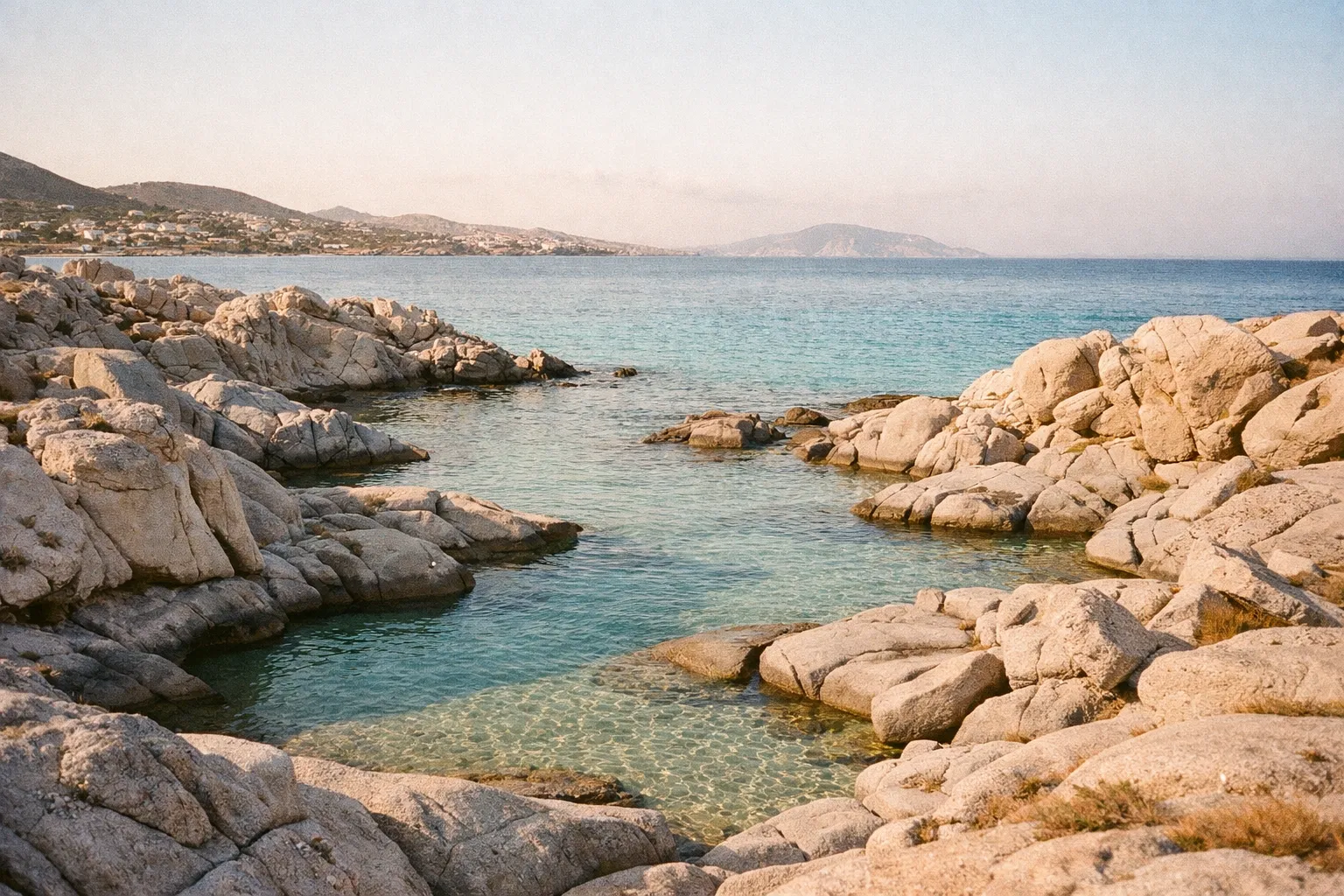
For calm swimming and water sports (go in the morning):
- Santa Maria - wide sandy bay on the northeast coast, beach clubs, calm water before noon, the island’s main spot for waterskiing and wakeboarding
- Paralia (Golden Beach / Chrissi Akti) - long sand beach on the east side, windsurfing in the afternoon, swimming in the morning
- Kolymbithres - granite rock formations across the bay from Naoussa, shallow turquoise pools, accessible by water taxi from Naoussa harbor
For shelter from the meltemi:
- Logaras - protected south-facing beach near Piso Livadi
- Pounda (the southern one, not the ferry port) - small sheltered cove
- Faragas - pebble and sand, dramatic rock walls on either side
For quiet:
- Molos - long, undeveloped, very few sunbeds
- Tsoukalia - pottery shards still wash up here from an ancient ceramic site
- Lageri - accessed by a short walk through dunes north of Naoussa
Easy and walkable:
- Livadia - right at Parikia, fine for a quick swim between ferry arrivals
- Parasporos - 3 km south of Parikia, sunset views
Sunbed and umbrella sets at the organized beaches run €15-30 per day depending on location and season (reference: summer 2025). Free zones exist at every beach if you bring your own gear.
Naoussa Paros: the harbor, the restaurants, and the night
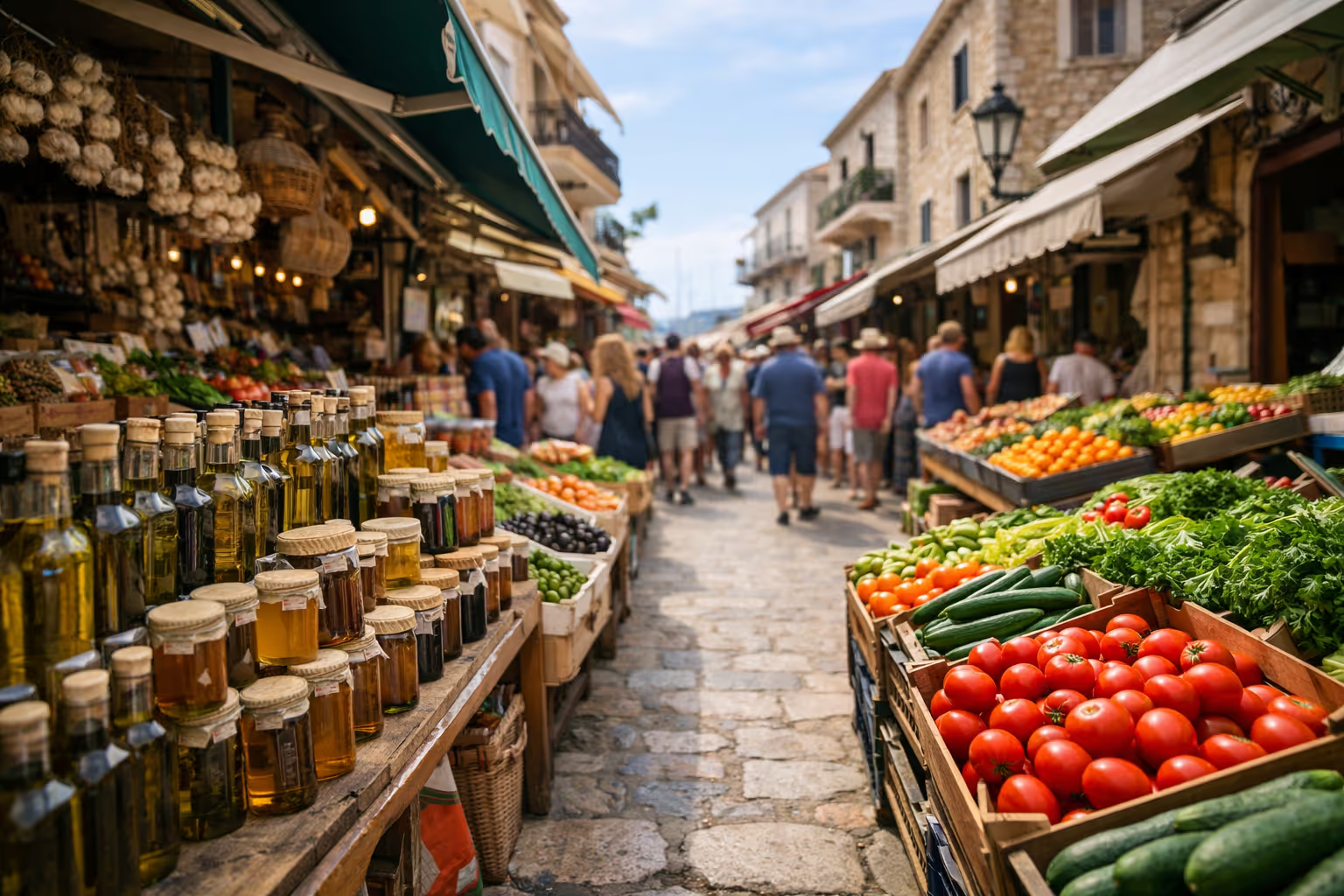
Naoussa paros earns its reputation. The fishing village became the island’s social center without losing the harbor - boats still come in early, and the same nets the octopus dries on get used the next day. Walk inland from the port and the lanes narrow, bougainvillea drops over doorways, and the bars stay open later than you’d expect for a village this size.
Where to eat and drink:
- Mario - long-running seafood taverna on the harbor; order whatever was landed that morning
- Siparos at Santa Maria - beach-club lunch, more polished than the village places
- Sousouro and Linardo - late-night bars on the harbor
- Barbarossa - wine bar in a Venetian arch right above the water
A first-time evening I’d recommend: sunset drink at one of the harbor bars, dinner inland on one of the back lanes (the harbor places are good but priced for the view), and a walk out to the half-submerged Venetian castle ruins at the harbor mouth. The ruins are free, always open, and almost nobody bothers with them after dark.
Etiquette note: tipping in Greece is appreciated but not mandatory - round up the bill or leave 5-10% if service was good. Cash is preferred for tips even when you pay the bill by card.
Lefkes Paros: the inland village most itineraries skip
Lefkes paros is the antidote to harbor evenings. It sits at about 300 m elevation in the island’s interior, built around marble-paved squares and the 19th-century Cathedral of Agia Triada. Most tour buses skip it, which is exactly why it still feels like a working village rather than a stage set.
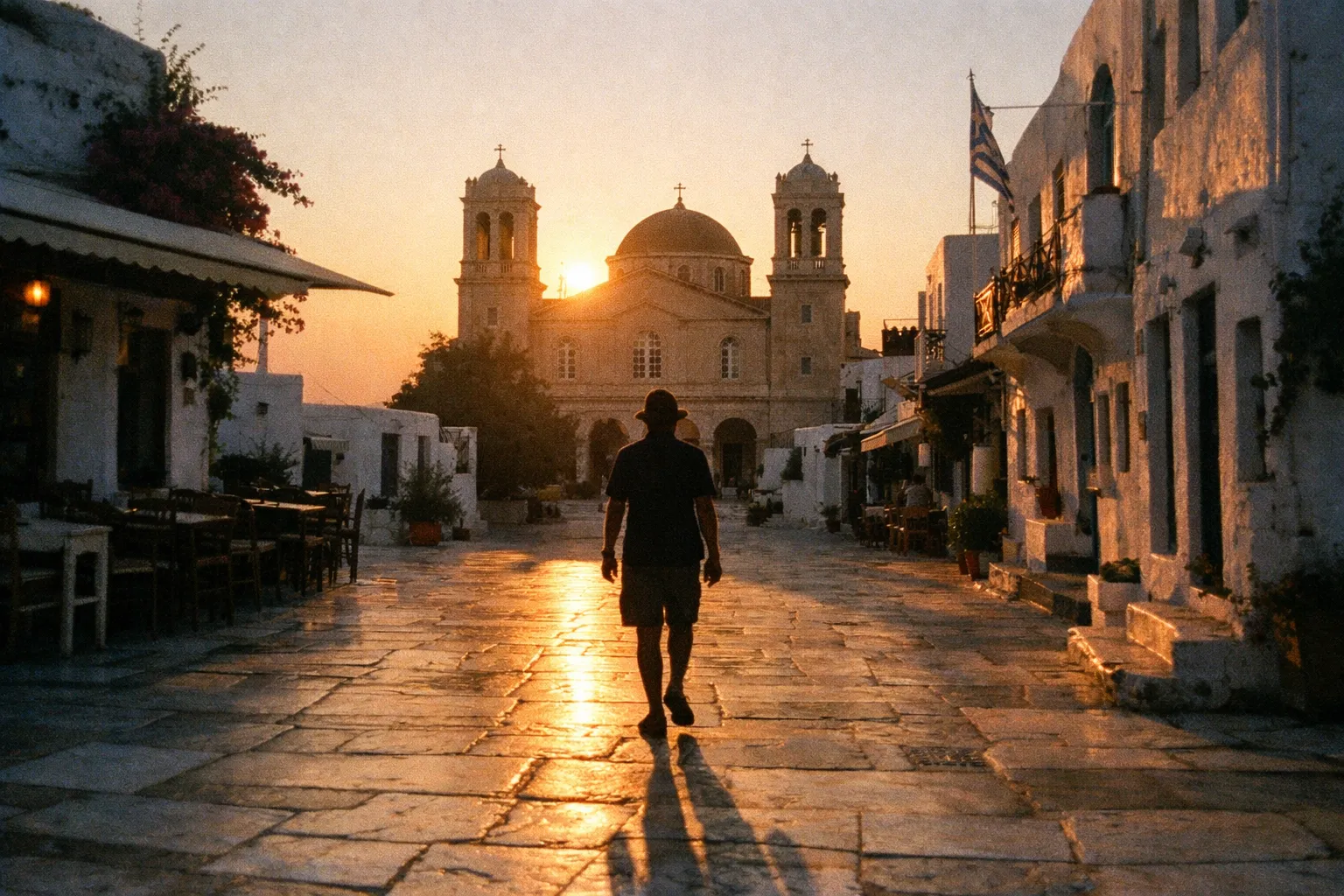
What to do here:
- Walk the Byzantine Road - a restored marble path that drops 3.5 km down to Prodromos village. About an hour each way, easier downhill. Start early; there’s almost no shade.
- Eat at Ramnos or one of the small tavernas on the main square - slow-cooked goat, oven-baked chickpeas (the Paros specialty), local wine by the carafe
- Sit on a bench in the cathedral square at sunset and watch the light catch the marble
Lefkes pairs well with a morning at Piso Livadi or Logaras on the east coast - you’re 15 minutes away by car.
Things to do in Paros Greece beyond the beaches
The things to do in paros greece list is longer than the beach roster if you give it a chance.
- Boat trip to Antiparos - 10 minutes by ferry from Pounta. Rent a scooter on the other side and explore the small island. The cave at the southern end is worth the trip.
- Wine tasting at Moraitis Winery - just outside Naoussa, family-run, daily tastings of Monemvasia and Mandilaria varietals
- Visit the Marathi marble quarries - free, slightly eerie, almost always empty
- Kayak the coast - operators in Naoussa and Pounta run half-day trips
- Sunset at the Frankish Castle in Parikia - 13th-century Venetian fortress built from recycled marble blocks
- Cooking class - a few operators in Naoussa run half-day classes in village houses
- Hike to Agii Anargyri - a tiny clifftop chapel above Naoussa, 30-minute walk for the best view of the bay
- Day trip to Delos and Mykonos - a long day but doable from Paros if you book the right ferry pairing
A realistic activity load is 2-3 things per day, maximum. Paros punishes itineraries that try to cover everything - the heat, the wind, the long lunches all conspire against ambition. This is where most first-timers go wrong.
Paros vs Santorini: how to choose
This is the question every first-time Greece traveler asks. Here’s the honest paros vs santorini breakdown.
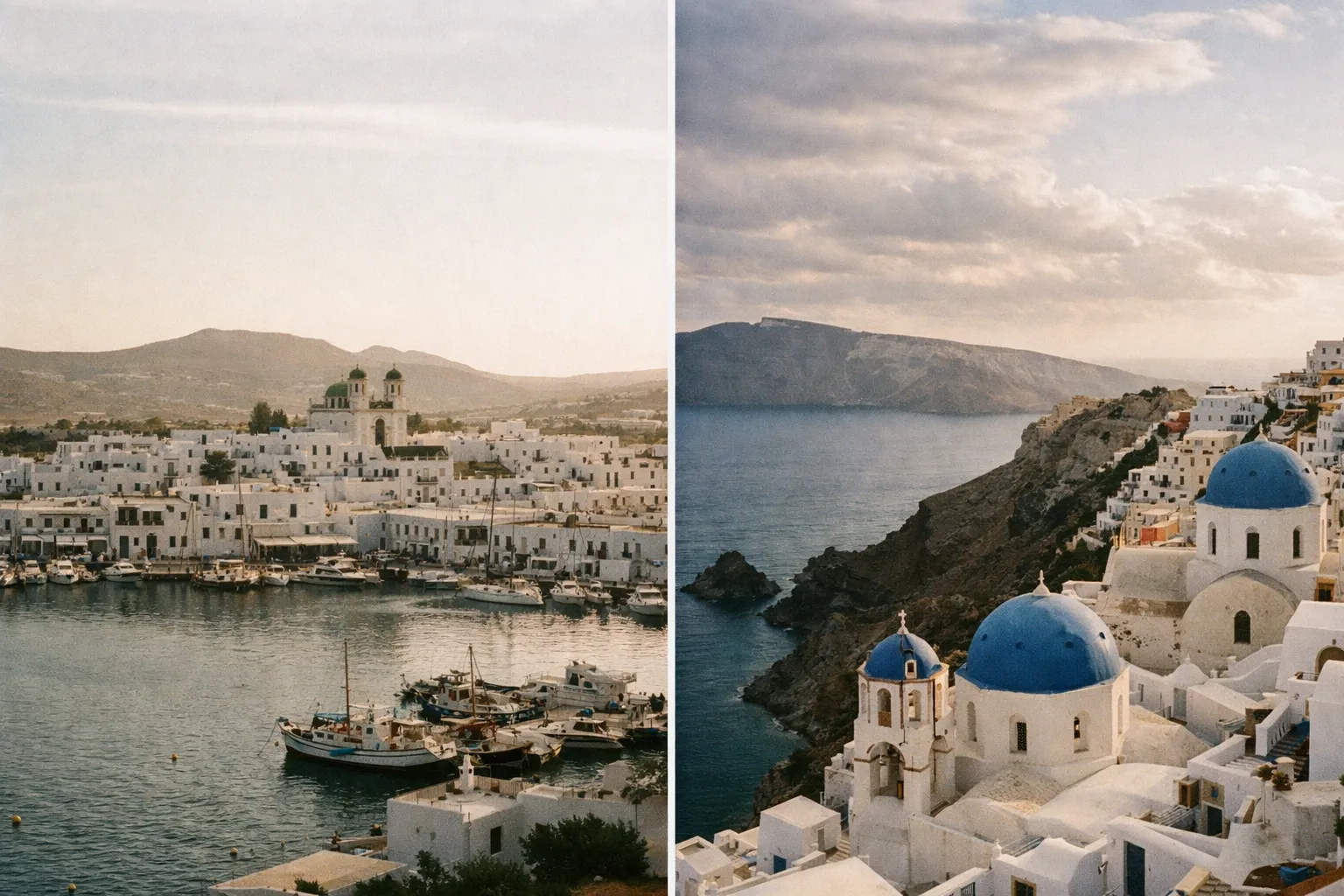
Choose Santorini if:
- You want the caldera view and the dramatic cliffside villages - Oia, Fira, the white-and-blue postcard
- You’re going for a short, focused trip (3-4 days) and want maximum visual impact
- You don’t mind crowds, cruise ship day-trippers, and high prices
- Sunset photos are a primary goal
Choose Paros if:
- You want a more balanced trip with beaches, villages, dining, and quiet inland time
- You prefer to rent a car or quad and actually move around the island
- You’re staying 5+ days and don’t want to feel like you’ve exhausted the place by day three
- Nightlife and restaurant variety matter more than a single iconic view
- Budget matters - Paros runs roughly 30-40% cheaper than Santorini for comparable accommodations in peak season (reference: summer 2025)
A common combination that works well: fly into Athens, ferry to Paros for four nights, then ferry to Santorini for two nights before flying out. You get the variety of Paros and the postcard of Santorini without overpaying for either.
The shorthand: Santorini is a destination, Paros is an island. Different trips, both valid.
Getting around the Paros Greek island
The paros greek island has buses (KTEL runs routes between Parikia, Naoussa, Lefkes, and the main beaches) but they won’t get you to half the beaches worth visiting. A rental vehicle changes the trip entirely.
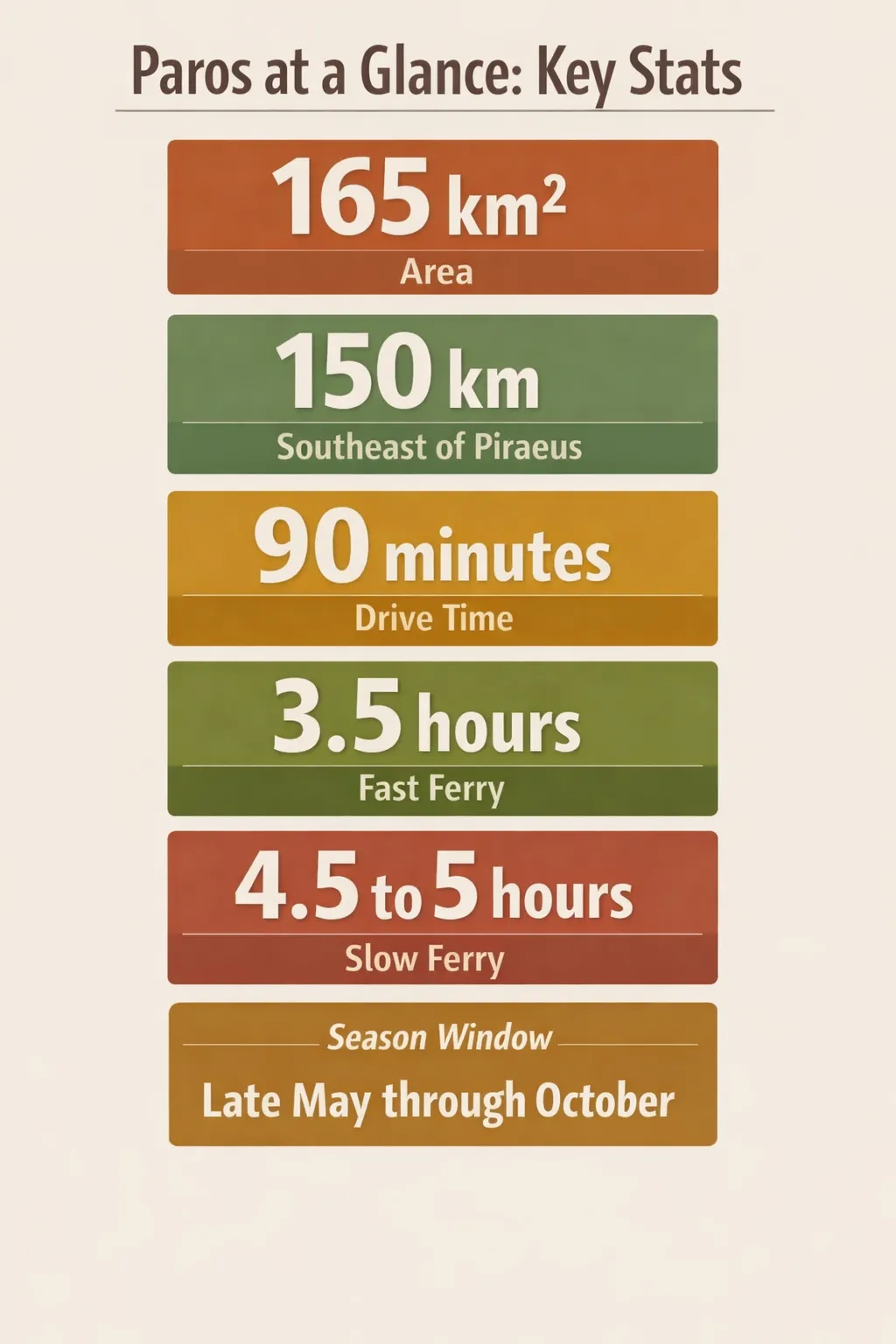 Paros by the numbers: island area, distance from Piraeus, typical travel times, and the peak-season window.
Options, with summer 2025 reference prices:
- Compact car: €40-70/day in peak season, less in shoulder. Book ahead - the island runs out.
- Scooter (50cc): €20-30/day. Fine for solo riders staying near Naoussa or Parikia.
- ATV / quad (200cc): €35-50/day. Recommended for its flexibility on rougher beach access roads. Requires a car license in Greece.
- Taxi: Limited supply, expensive, hard to find at peak times. Don’t plan around taxis.
International driving permits are technically required for non-EU drivers. Police checks happen. Bring one.
Fuel runs around €1.90-2.10/liter (summer 2025). Most rentals come with a token amount of fuel - fill up at the station outside Parikia before heading inland.
Food, wine, and what to actually order
Paros’ cuisine sits comfortably in the Cycladic tradition: simple, ingredient-led, heavy on what came out of the sea or the garden that morning.
Order at least once:
- Revithada - oven-baked chickpeas, the island specialty, slow-cooked overnight in a clay pot
- Gouna - sun-dried mackerel, grilled
- Octopus - grilled, with vinegar and oregano
- Local cheese - touloumotyri (sheep’s cheese aged in skins) and xinomyzithra (sour fresh cheese)
- Souma - the local pomace spirit, similar to grappa, often served as a digestif on the house
Wine: Paros has a protected designation of origin for wines made from Monemvasia (white) and Mandilaria (red). Moraitis is the best-known producer; smaller estates around Naoussa do tastings by appointment.
Reference dinner prices, summer 2025: €25-40 per person at a mid-range taverna with wine; €60+ at the harbor restaurants in Naoussa; €10-15 for a gyros and a beer at a casual spot.
Money, connectivity, and practical details
Cards are accepted almost everywhere - restaurants, hotels, supermarkets, larger tavernas. Keep cash for small tavernas, beach kiosks, taxi tips, and the occasional bakery that hasn’t updated its terminal since 2014. ATMs in Parikia and Naoussa; fewer elsewhere.
Wi-Fi is reliable in towns and most accommodations. Mobile coverage is good across the island; an EU SIM works without extra roaming charges for EU travelers, and eSIM providers like Airalo offer Greece-specific plans from around $5-10 for a week.
Tap water is technically drinkable but tastes brackish; most locals and visitors drink bottled water. Bring a reusable bottle and refill from the large jugs sold at every supermarket.
Pharmacies are well stocked; the green-cross sign marks them. Bring prescriptions in their original packaging.
Best time to visit Paros
- Late May to mid-June: warm days (24-28°C), water still cooling from winter, fewer crowds, lower prices, everything open
- Late June to mid-September: peak season, hottest weather, busiest, most expensive
- Mid-September to mid-October: my preferred window - warm sea, lighter crowds, lower hotel prices, ferries still on summer schedule
- November to April: most hotels, restaurants, and ferry routes shut down; Paros effectively closes
The meltemi blows hardest in July and August, which affects ferry schedules and afternoon beach comfort. If you’re prone to seasickness on ferries, June or September are noticeably calmer months.
Frequently Asked Questions
- Can I visit the Marathi marble quarries without a guide?
- Yes, the Marathi marble quarries are free to visit and usually very quiet. Bringing a flashlight is recommended to explore the tunnels safely.
- Are there any dress codes for visiting religious sites in Paros?
- Yes, modest dress is expected at the Panagia Ekatontapiliani church - both men and women should cover shoulders and knees.
- Is it possible to combine Paros with other Cycladic islands in one trip?
- Absolutely. Paros has fast ferry connections to Naxos, Mykonos, Santorini, and a short ferry to Antiparos, making island hopping convenient.
- What is the tipping etiquette in Paros restaurants and bars?
- Tipping is appreciated but not mandatory. Rounding up the bill or leaving 5-10% for good service is common. Cash tips are preferred even if you pay by card.
- How early should I book accommodation in Paros during peak season?
- Booking about three months ahead is advisable, as Paros has fewer rooms than Mykonos or Santorini and fills up faster than expected.
- Are there reliable public transport options to reach all beaches?
- Buses cover main routes between towns and popular beaches, but many quieter or southern beaches require a rental vehicle for access.
- Can I rent ATVs or scooters without a car license in Paros?
- No, Greek law requires a valid car license to rent ATVs or quads. Scooters may have different rules but check with rental agencies.