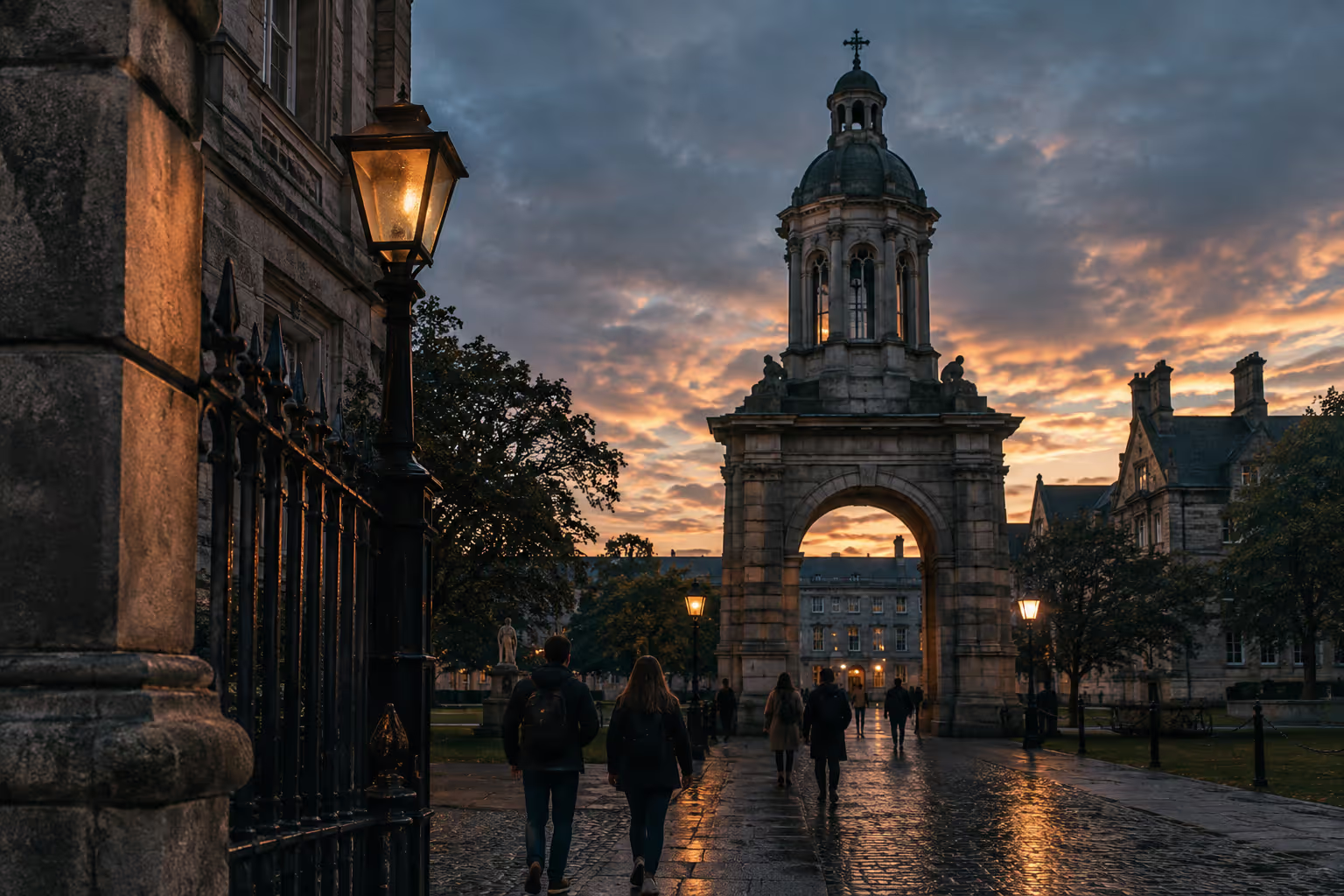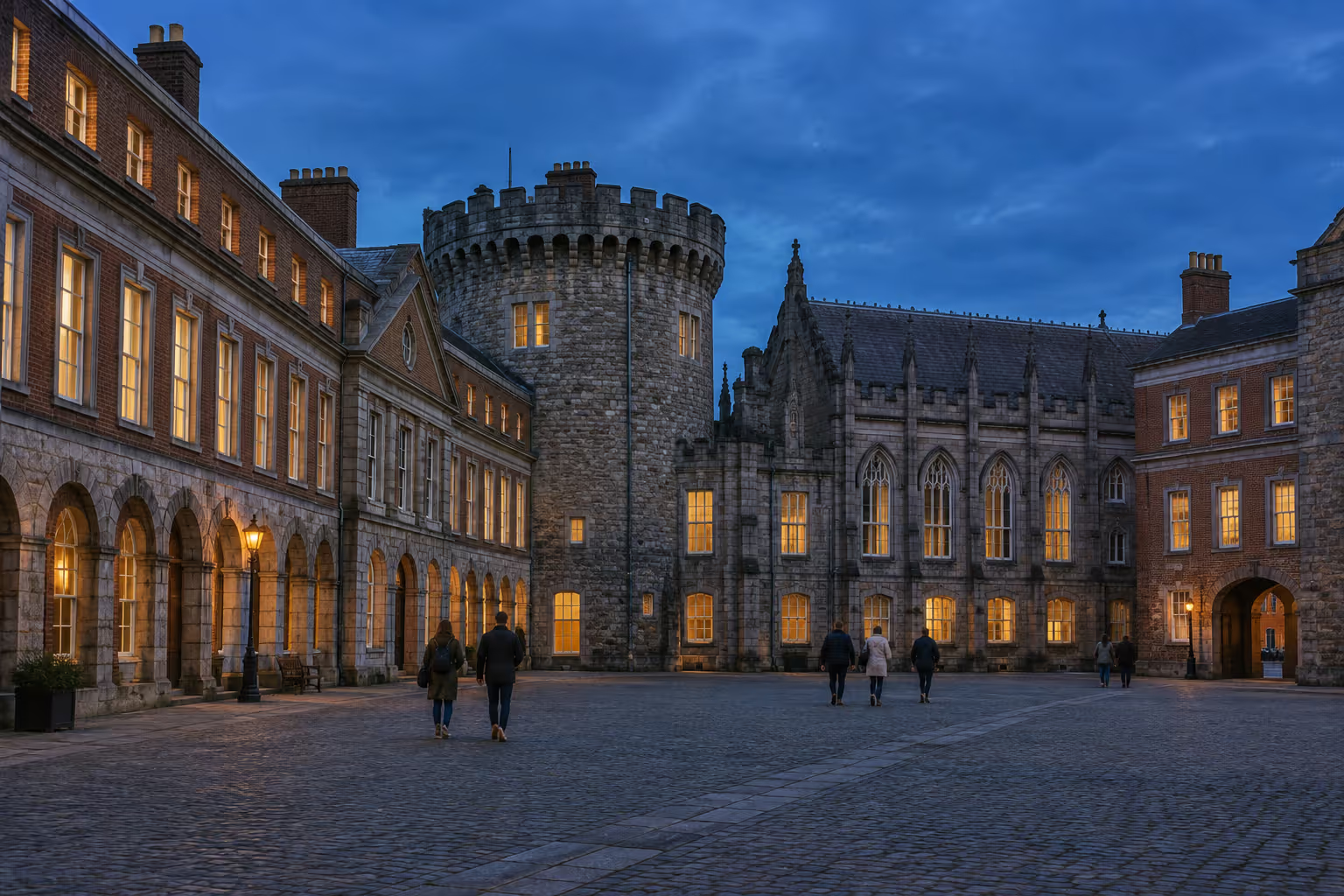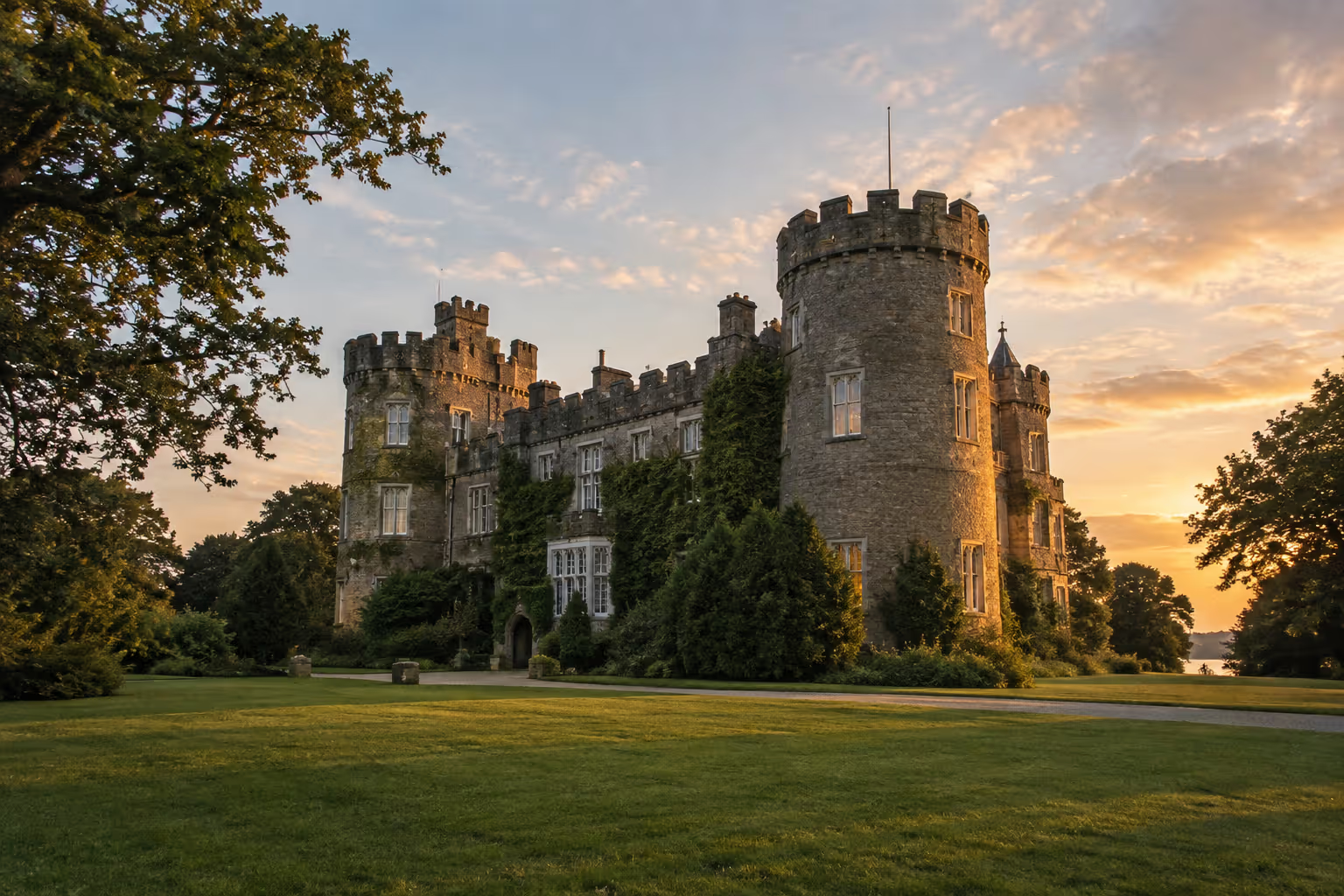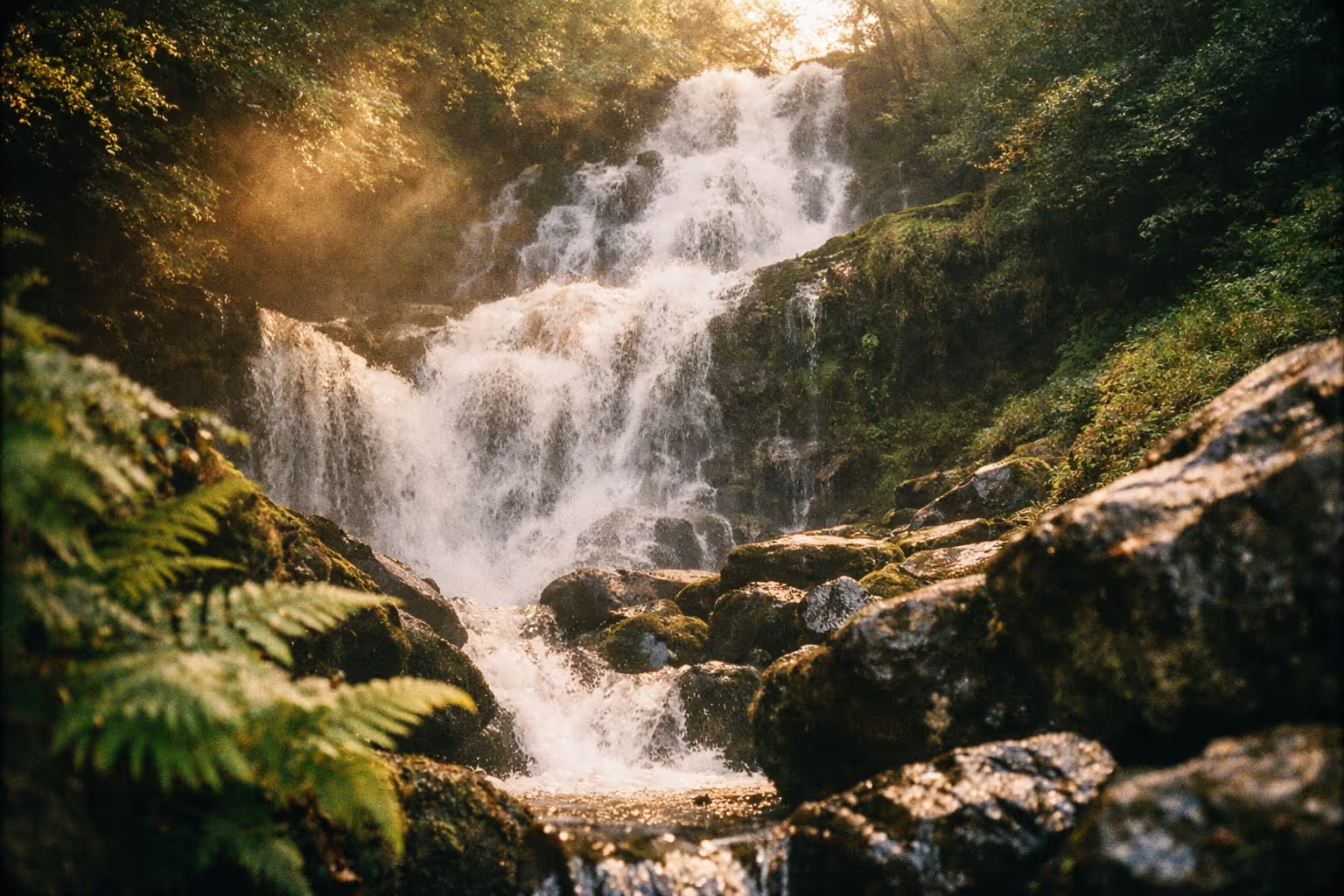
Ireland has six terrestrial national parks, all managed by the National Parks and Wildlife Service (NPWS), and every one of them is free to enter. That’s the first thing worth knowing about national parks in Ireland: the land costs nothing, but the parks themselves cover wildly different ground: limestone pavement in Clare, Atlantic blanket bog in Mayo, glacial lakes in Kerry, upland heath in Donegal. Choosing the right one comes down to what you actually want from a day out, not which park has the best reputation.
There’s also a marine park now, Páirc Náisiúnta na Mara in County Kerry, formally established on 22 April 2024 as Ireland’s first marine national park, per the NPWS announcement (40). That brings the broader count higher if you include marine and other designations, but for a walking, hiking, scenic-drive trip, the six terrestrial parks are what you’re planning around. They stretch from Donegal in the north to Kerry in the south, Clare in the west to Wicklow in the east. Each one gets its own section below with logistics, trails, and honest time estimates.
✓ Pros
- All six parks have free entry to the land, and parking is usually free too
- Open year-round, so there's no closed season to plan around
- Huge variety of landscapes packed into a compact country: you can go from limestone to bog to lakeshore in a single road trip
- Trails range from 1 km family loops to 16 km ridge walks
- Wildlife, geology, and history often sit inside the same park
✗ Cons
- Visitor centres have limited hours, especially off-season
- Irish weather is genuinely unpredictable: plan for rain regardless of the forecast
- Some parks (Burren, Connemara) have limited public transport access
- Popular parks like Killarney get crowded in summer
- Paid attractions inside the parks (Muckross House, Ross Castle, Glenveagh Castle) catch some visitors off guard
What You Need to Know Before Visiting Any of Ireland’s National Parks
All six terrestrial national parks in Ireland are free to enter, open year-round, and managed by the NPWS, but their built attractions and visitor centres keep separate, seasonal hours you should check before you drive out. That single distinction (free land versus paid, time-limited facilities) trips up more visitors than anything else.
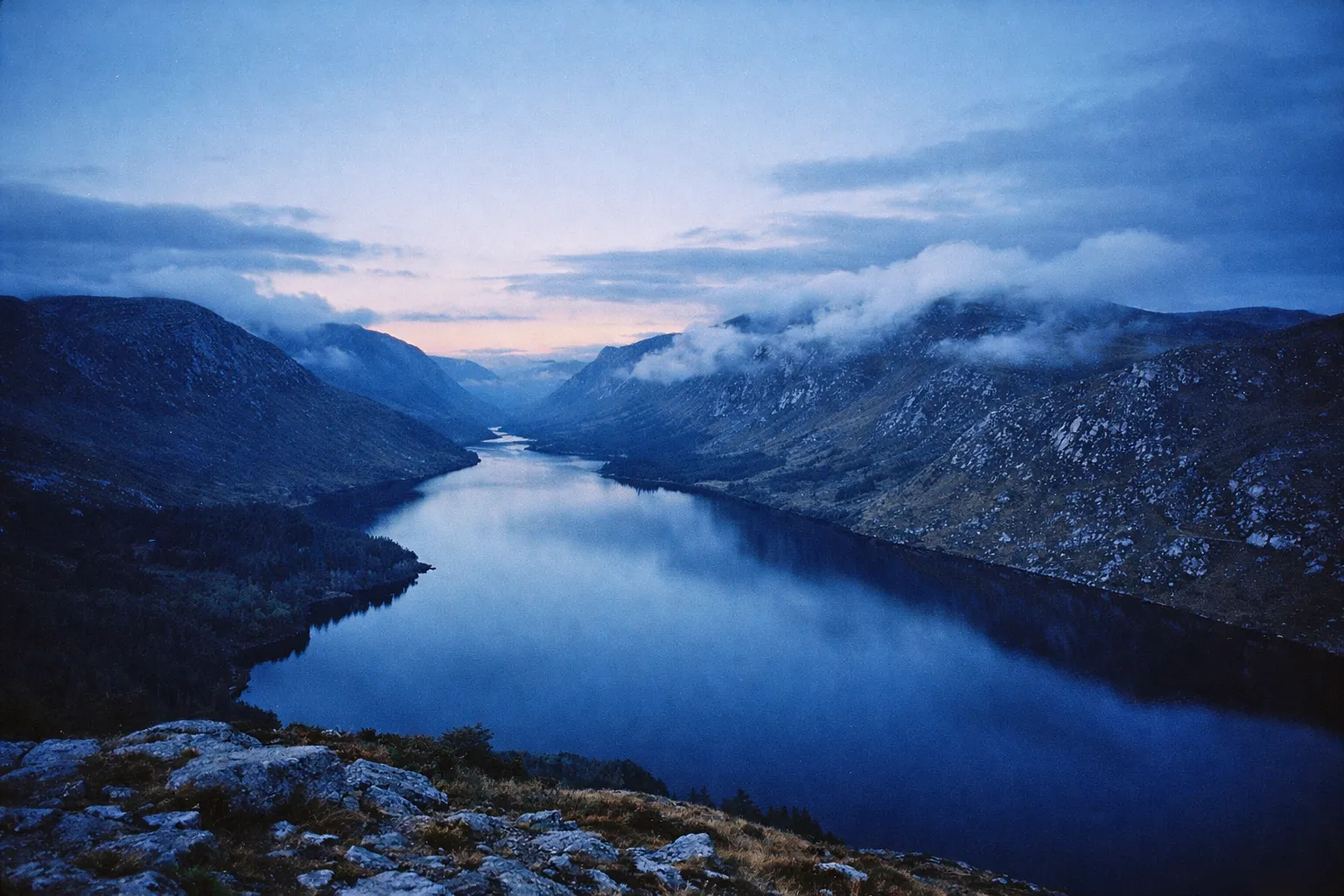
The parks are spread across the island: Glenveagh in Donegal, Wicklow Mountains in the east, Killarney in Kerry, Burren in Clare, Connemara in Galway, and Wild Nephin in Mayo. For most of them, a car is essential. The NPWS website (nationalparks.ie) is the authoritative source and has been the central hub since the 2021 rebrand (16); worth checking a few days before you travel, because opening hours and trail conditions do change.
One universal rule: pack a waterproof layer whatever the forecast says. Conditions change fast, especially on exposed ridges in Connemara, Wicklow, and Glenveagh, where the NPWS advises proper footwear and posts daily trail condition updates at visitor centres.
Free entry vs. paid attractions: what’s actually included
Park walking trails, scenic drives, picnic areas, and parking are free across all six parks. What you pay for is the built heritage inside them. In Killarney, park entry is free but Muckross House and Ross Castle both charge admission: budget these as separate line items, and check current prices on the OPW website before you go, since they update seasonally. In Glenveagh, the park and grounds are free but the castle interior tour is ticketed; the cost is modest relative to comparable heritage sites in Ireland, but it’s not free. NPWS pages for Glenveagh and Wild Nephin both list admission to the park land explicitly as free (19). Assume the outdoors is free and the indoors is not, and you’ll sidestep the most common surprise.
Most guides to these parks lead with the scenery and bury the logistics. The thing they consistently get wrong: treating each park as a half-day stop. Killarney is genuinely a full day if you’re doing the lakes and any built attraction. Glenveagh is a full day once you account for the drive from anywhere. Connemara’s upper trails take longer than the signage suggests. Budget time generously, or you’ll spend the drive home listing everything you didn’t get to.
Getting around: do you need a car?
For most parks, yes. Killarney is the main exception: the town is walkable, tours run from the centre, and the park adjoins the town directly. Wicklow Mountains is reachable by bus from Dublin, with services running to Glendalough. Connemara, Burren, Glenveagh, and Wild Nephin all but require a vehicle; public transport to them is sparse or non-existent, and the trailheads are dispersed. If you’re building a trip around several of these parks, budget for a rental.
Killarney National Park: Lakes, Castles, and a Full Day Well Spent
Killarney National Park in County Kerry covers 10,236 hectares of mountains, lakes, and woodland, and it’s the most visited and most accessible of Ireland’s parks, and Ireland’s first, established in 1932. Best month to visit: May or early June, before the summer coach traffic peaks and while the rhododendron is still in bloom around the lakeshore. July and August are busy but manageable if you start before 09:00; the park is large enough that the crowds thin out past the main car parks. It consistently ranks among the top handful of things to do in Killarney, with a 4.8/5 TripAdvisor rating from over 7,300 reviews.
The park is built around three connected lakes (Lough Leane, Muckross Lake, and Upper Lake) forming one continuous chain (21). Its headline built attractions are Muckross House, a Victorian mansion with paid entry, and Ross Castle, a 15th-century fortress on Lough Leane, also ticketed. Torc Waterfall is free, roughly a 45-minute return walk, and Muckross House to Torc makes an easy flat route.
Pedestrian access to the park runs 24 hours year-round. The Killarney House Visitor Centre in town operates roughly 09:15-17:15, with the gardens open longer (around 08:00-18:00). Use it to orient yourself before heading into the wider park; reviewers repeatedly praise it as free and genuinely useful for planning.
Budget a full day. One TripAdvisor visitor in a July 2025 review put it plainly: plan for an entire day, pick a type of tour, and remember everything in the park is free except entering Muckross House and Ross Castle. Trying to cram the lakes, the historic sites, and a trail or two into a couple of hours leaves you rushed and having seen half of it. I’d add that the park is deceptively large: what looks like a short loop on the map often takes twice as long once you factor in the terrain and the inevitable stops.
Best trails in Killarney National Park
The Torc Waterfall walk (easy, about 45 minutes return) is the quick win: short, accessible, and close to Muckross House. Lakeside strolls near the Killarney House gardens are flat and family-friendly. For more elevation, the Muckross Lake loop is a roughly 10 km flat circuit on foot or by bike that links the mansion, the abbey, the Meeting of the Waters, and Torc Waterfall while keeping you off the main road (20). Trailheads are dispersed, so a car helps you reach the ones further out.
Worth the detour: the Muckross Lake loop, especially by bike. Skip if short on time: the longer mountain routes; save those for a dedicated second day.
Guided tours vs. exploring independently
Jaunting cars (horse-drawn traps) and boat trips are efficient ways to cover the lake area, and typical durations run 1-2 hours. Walking tours add historical context. Independent walking is best for the trails and gardens. The most efficient approach pairs a short guided tour (a jaunting car or a boat across Lough Leane) with independent walking for the parts you want to take slowly. Book tours through the operators directly; prices are set per operator, so compare before committing.
Glenveagh National Park: Donegal’s Remote Upland Wilderness
Glenveagh National Park in County Donegal covers approximately 170 km² (66 sq mi) of upland bog, heath, and mountain, making it one of Ireland’s largest and most remote parks (19). This is not a quick stop. Reaching it means a deliberate detour into the Derryveagh Mountains, and that remoteness is exactly why a wasted trip stings here more than anywhere else.
Best month to visit: June or September. June gives you long daylight for the upland walks and the best chance of clear views across Lough Veagh; September drops the visitor numbers sharply while keeping the weather reasonable. Avoid January and February unless bog walking in low cloud is your idea of a good time; the drive alone is punishing in bad weather.
Most guides focus on the castle and treat the wider park as backdrop. That’s the wrong call. The upland terrain (the bog, the deer, the lough shoreline) is the reason Glenveagh exists, and it’s worth several hours even if the castle is closed.
The headline attraction is Glenveagh Castle, a 19th-century castle on the shore of Lough Veagh surrounded by elaborate gardens. Its reception is open March-October 09:15-17:15 and November-February 10:00-17:15. The critical detail: according to NPWS, the castle is closed to tours on Mondays and Fridays (18), while the park, gardens, visitor centre, and shuttle buses keep running on those days. This closure catches people out constantly.
The park itself is open 7 days a week with free admission. The visitor centre runs roughly 09:00-17:00 in winter and 09:15-17:30 in summer (19). Wildlife here includes a red deer population, upland birds, and blanket bog habitats. The character is dramatic and glacial, a long narrow lough hemmed by steep mountains, and it feels nothing like Killarney or Connemara.
Planning a visit around Glenveagh Castle’s opening days
Glenveagh Castle is closed Mondays and Fridays, so plan your visit for Tuesday through Sunday if the castle interior matters to you. The NPWS notice for the 2026 season explicitly warns of additional short-notice closures and asks visitors to check social media or call before travelling (18). The contact is +353 1 539 3232 or glenveaghbookings@npws.gov.ie. Arrive early: visitor numbers are lower than Killarney, but the drive is long enough that you don’t want to discover a closure on arrival.
What to do if you’re not visiting the castle
The estate grounds have walking trails worth doing on their own. Lough Veagh shoreline walks give you the lake-and-mountain scenery without setting foot in the castle. Wildlife watching is rewarding too: red deer are commonly spotted across the park. If you land on a Monday or Friday, the park is still very much worth the drive; you just skip the interior tour.
Connemara National Park: Diamond Hill and the Twelve Bens
Connemara National Park near Letterfrack in County Galway is free, open year-round, and offers the widest spread of graded trails of any Irish park, from a 1 km woodland loop to a 16 km ridge traverse. All four official marked trails start from the Letterfrack visitor centre, and beyond those four there are no formal footpaths (2). The park includes part of the Twelve Bens range, with Benbaun, the highest peak in County Galway, at 725 m.
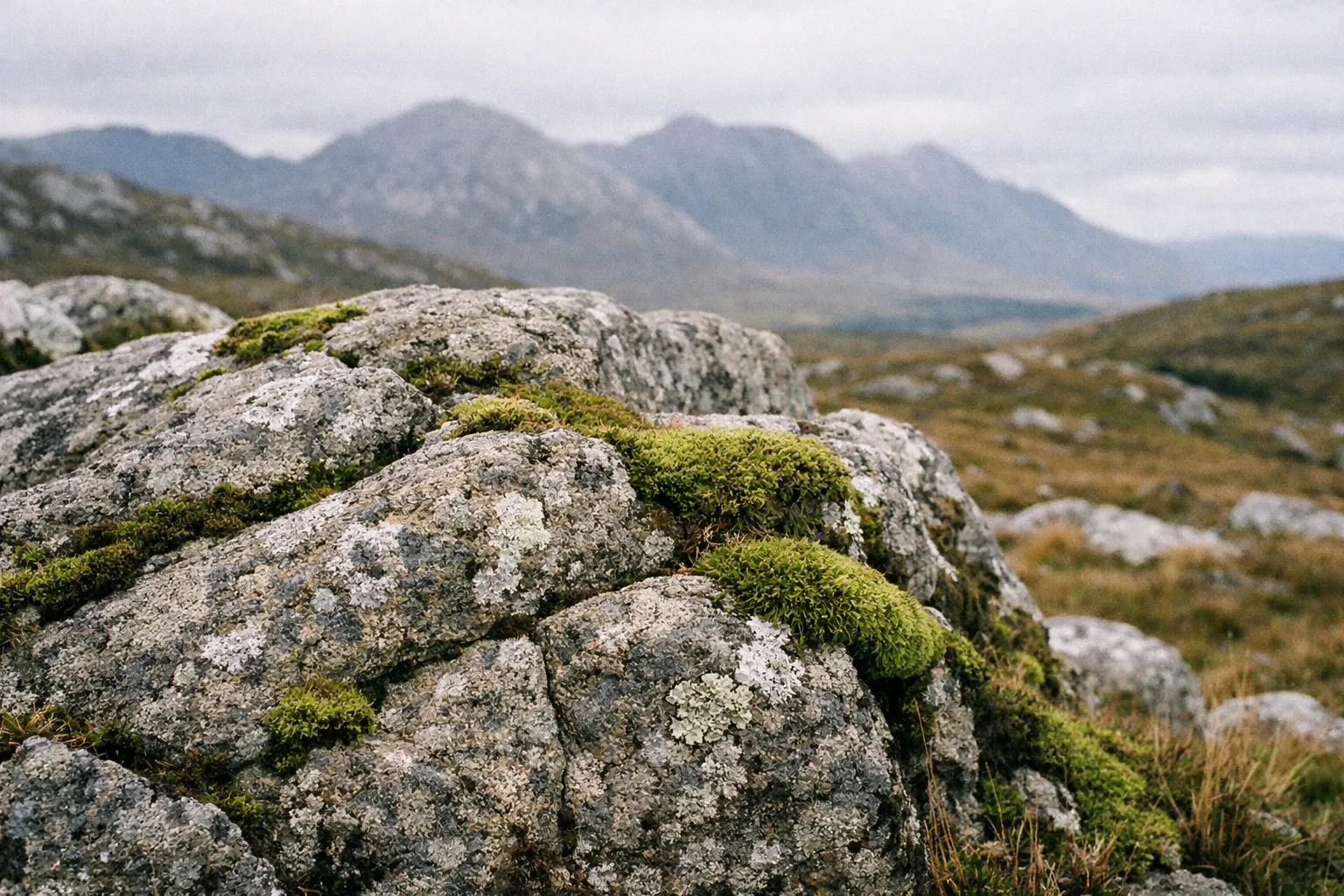
Use the visitor centre as your trailhead and get current conditions from staff before setting out; this matters more than usual here because there are no roads through the park, and the wider terrain demands map-and-compass navigation. The park sits within the broader Connemara region, which also holds Kylemore Abbey (a separate, paid attraction) and Clifden town.
Trail options by difficulty: from Ellis Wood to the Glencoaghan Horseshoe
Here’s how the routes stack up, easiest to hardest:
- Ellis Wood (about 1 km, easy, about 20 min): a flat woodland walk suitable for all ages.
- Sruffaunboy (about 1.5-2.2 km, easy, about 38-45 min): loops through blanket bog and heath, family-friendly with good signage.
- Lower Diamond Hill (about 2.5-2.8 km loop, easy, about 45 min): the accessible version, a mostly flat approach to the lower slopes.
- Upper Diamond Hill (3.7-4 km loop from the visitor centre, moderate, 2-3 hours, summit about 445 m): the one worth doing for views across the Twelve Bens, Kylemore Valley, and the Atlantic coastline (4). Steep and rocky in sections, so proper footwear is essential; the full lower-plus-upper circuit runs about 6-7 km.
- Benbrack & Knockbrack (about 8.7 km, elevation about 760 m, advanced): fitness and navigation required.
- Glencoaghan Horseshoe (16 km, about 9 hours, advanced): a full ridge walk across the Twelve Bens for fit, experienced hikers only. An early start is mandatory.
Upper Diamond Hill is the one I’d push most visitors toward. The views over the Twelve Bens and out to the coast are wide and unobstructed, and the effort-to-reward ratio is hard to argue with. Just don’t start it in trainers.
What to pack and when to go
A waterproof layer is non-negotiable, and footwear with traction is essential from Upper Diamond Hill upward. The visitor centre posts daily trail conditions; check the board before heading out, because the grounds can close during orange or red weather warnings. Weather here turns quickly; the upper loop’s exposure catches people off guard. Late spring to early autumn gives you the mildest conditions and longest daylight for the harder routes.
Connemara National Park Trail Options by Difficulty
| Ellis Wood | Sruffaunboy | Lower Diamond Hill | Upper Diamond Hill | Benbrack & Knockbrack | Glencoaghan Horseshoe | |
|---|---|---|---|---|---|---|
| Distance | about 1 km | about 1.5-2.2 km | about 2.5-2.8 km loop | 3.7-4 km loop | about 8.7 km | about 16 km |
| Difficulty | Easy | Easy | Easy | Moderate | Advanced | Advanced |
| Estimated Duration | about 20 min | about 38-45 min | about 45 min | 2-3 hours | Varies | about 9 hours |
| Notes | Flat woodland walk, all ages | Blanket bog and heath, family-friendly | Mostly flat approach to lower slopes | Steep, rocky; great views; proper footwear needed | Fitness and navigation required | Full ridge walk; early start mandatory |
Burren National Park: Limestone, Rare Wildflowers, and Quiet Trails
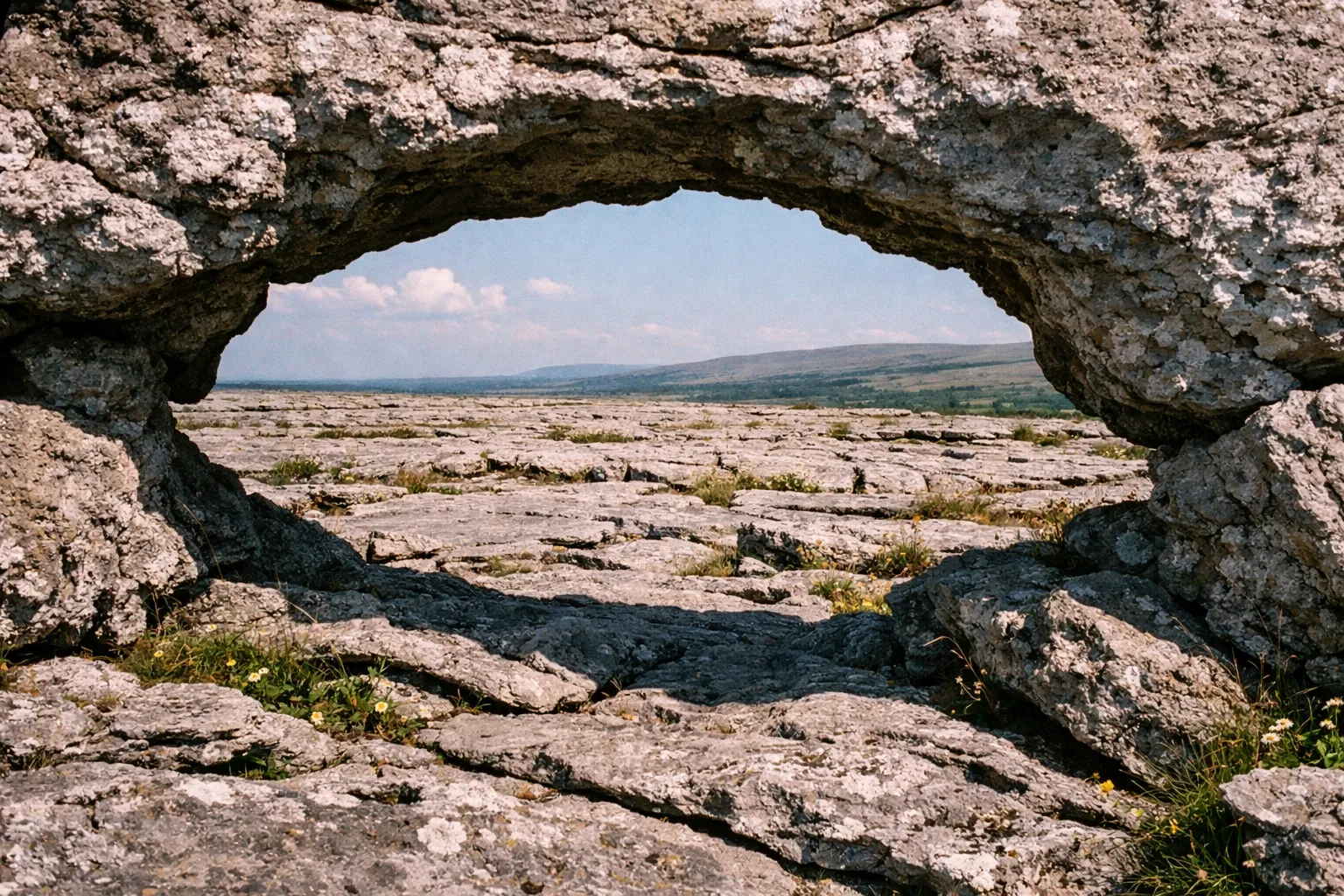
Burren National Park in County Clare is free, open year-round, and unlike any other Irish landscape: a vast expanse of limestone pavement, one of Europe’s largest karst landscapes, where Arctic, Mediterranean, and Alpine plants grow side by side (6). It’s the smallest of the parks in terms of developed infrastructure, and its main information point sits not in the park but in the village of Corofin.
The Burren National Park Information Point is at the Clare Heritage Centre, Church Street, Corofin, and opens 09:00-17:30 (May-September) and 10:00-17:00 (October-April) (8). In winter it closes at 17:00, so a late-afternoon arrival off-season means no staffed support, no maps, and no guide advice. Contact is 065 682 7693 or burrennationalpark@npws.gov.ie. A free shuttle bus runs from the information point into the park during the summer visitor season.
The wider Burren region holds separate attractions (Poulnabrone Dolmen and Aillwee Cave), and the Cliffs of Moher lie within about an hour’s drive. This is the park for geology enthusiasts, wildflower season, and anyone who wants solitude over crowds.
When to visit the Burren for wildflowers
April to June is peak wildflower season, when the limestone pavement fills with orchids and the unusual mix of alpine and Mediterranean species the Burren is known for. Summer is fine but drier, and autumn has its own quieter character. Winter visits are atmospheric and empty, but with the information point on reduced hours, plan to be self-sufficient.
Combining the Burren with the Cliffs of Moher
Both sit in County Clare and pair naturally into a single full day from Galway or Limerick. Do the Burren in the morning while it’s quiet, then the Cliffs of Moher in the afternoon, or reverse it to catch the cliffs early before the coach crowds arrive. A car is essential. Public transport doesn’t connect these two efficiently, and trying to do it by bus wastes the day.
Wicklow Mountains National Park: Ireland’s Upland Escape Near Dublin
Wicklow Mountains National Park in County Wicklow sits roughly an hour’s drive south of Dublin, making it the only major Irish national park you can comfortably visit as a full day trip from the capital. It protects large upland habitats: blanket bog, heath, mountain streams, and some of Ireland’s highest peaks.
Most guides treat Wicklow as a Glendalough day trip and nothing more, which undersells the upland terrain considerably. The ridge routes and bog walks away from the monastic site are where the park earns its keep, and skipping them means you’ve seen the heritage but missed the landscape.
Best month to visit: May and June, when daylight is long, the bog vegetation is at its greenest, and the summer crowds haven’t yet peaked. September is a strong second choice: quieter than July and August, with good light for the ridge walks.
The visitor centre keeps core hours around 10:00-16:30, with seasonal variation, shorter than most other parks, so time your arrival accordingly (14). The star draw is Glendalough, a monastic site with two glacial lakes at the edge of the park and one of Ireland’s most visited heritage sites. The combination of monastic ruins and lake scenery is hard to top for a day trip, and it’s the reason most visitors come. Powerscourt Waterfall and Luggala are other nearby highlights.
Hiking ranges from short lakeside walks at Glendalough to longer ridge routes. Lough Ouler, a heart-shaped lake, is a more demanding hike that isn’t a formal trail; it needs proper footwear and navigation.
Day trip from Dublin: realistic timing and transport
The drive from Dublin city centre takes about an hour. Unlike most Irish parks, you can reach this one without a car: St Kevin’s Bus Service and Bus Éireann run to Glendalough. A realistic day looks like departing Dublin by 09:00, arriving at Glendalough around 10:00, spending the day in the park, and getting back by early evening. Glendalough fills up on summer weekends, so the earlier you arrive, the better your parking and your photos.
Trails worth your time in the Wicklow Mountains
The Glendalough lakeside loop (easy, about 1-2 hours) is the family option and the one most people do. Worth the detour: the Spinc and Glenealo Valley route (moderate, about 3-4 hours), which climbs for wide ridge views over the valley; this is the pick if you want elevation without committing to a full mountain day. The Lough Ouler hike is demanding and unmarked; proper footwear and navigation skills are required, and it’s not a casual afternoon stroll.
Wild Nephin National Park: Ireland’s Sixth Park and Its Quietest
Wild Nephin National Park in County Mayo, on the edge of the Wild Atlantic Way, covers about 15,000 hectares of Atlantic blanket bog and mountainous terrain, and it’s the quietest of the six by design. The Owenduff Bog within it is described by the NPWS as one of the last intact active blanket bog systems in Ireland and Western Europe. Admission is free, and the visitor centre runs typical hours to around 17:30.
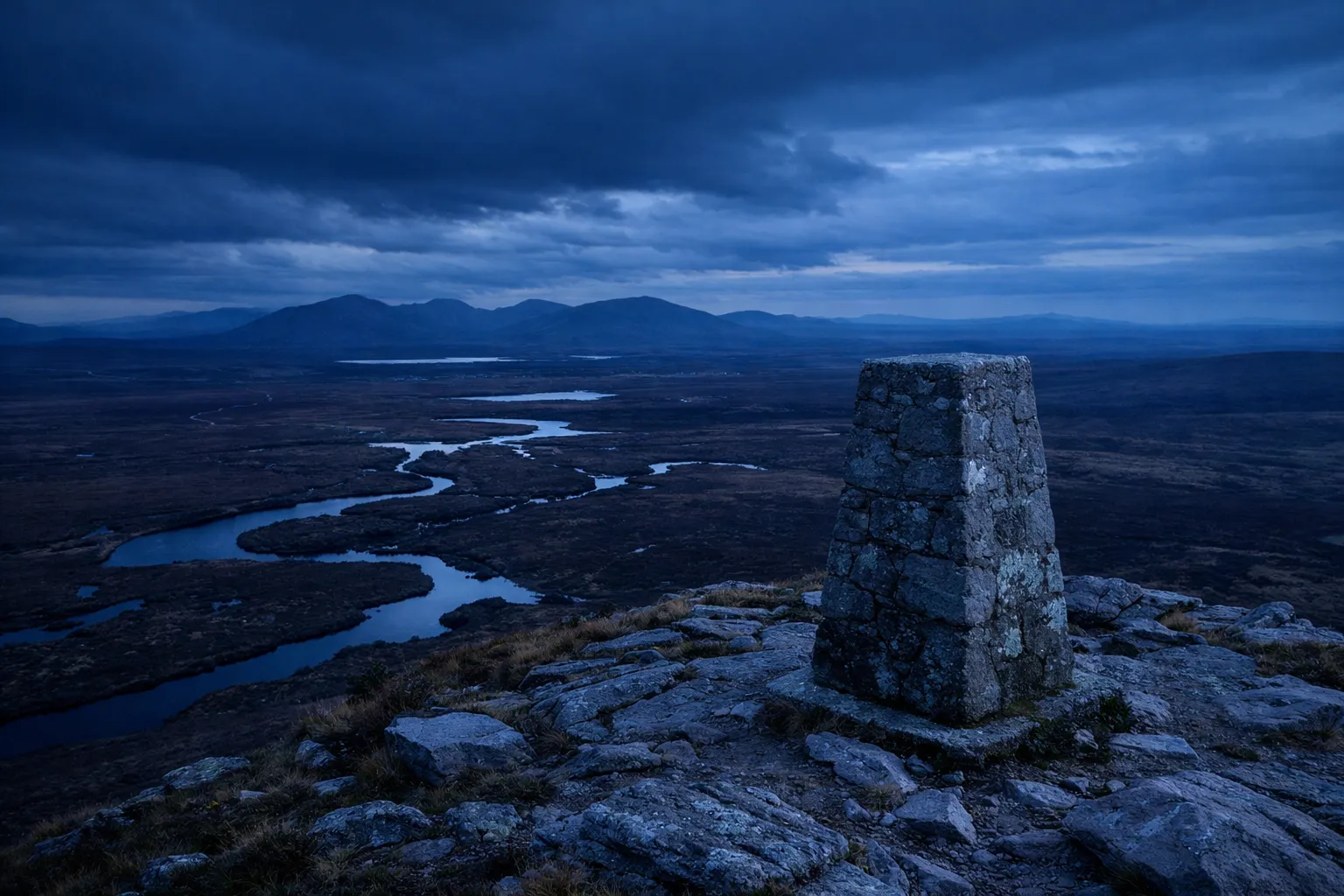
The park’s core is largely roadless, and formal trail infrastructure is deliberately minimal compared with Connemara or Killarney. Its standout credential is dark skies: the International Dark-Sky Association has accredited Wild Nephin as an International Dark Sky Park, making it one of the darkest, least light-polluted places in Ireland for stargazing.
Most guides either ignore Wild Nephin entirely or mention it only as a dark-sky footnote. The thing they get wrong: treating it as a novelty stop rather than a serious wilderness park. The bog terrain demands navigation skills and proper gear; the reward is a landscape that feels genuinely untouched in a way none of the other five parks can match.
Best month to visit: July and August for the longest nights that still carry reasonable warmth, useful if you’re combining a day walk with an evening stargazing session. Clear skies are never guaranteed in Mayo, so check the forecast and have a backup night in mind.
This is a park for dark-sky enthusiasts, serious walkers comfortable with unmarked terrain, and visitors already road-tripping through Mayo on the Wild Atlantic Way. Venture beyond the visitor centre and you need to be self-reliant. If it’s your first trip to Ireland, this probably isn’t your first stop, but it’s worth knowing it exists, and worth a detour if the forecast promises a clear night.
Comparing the Parks: Which One Is Right for Your Trip
Choose your park along three practical lines: fitness level, the theme you care about, and how you’re getting there. All six are free, but they diverge sharply in infrastructure and access.
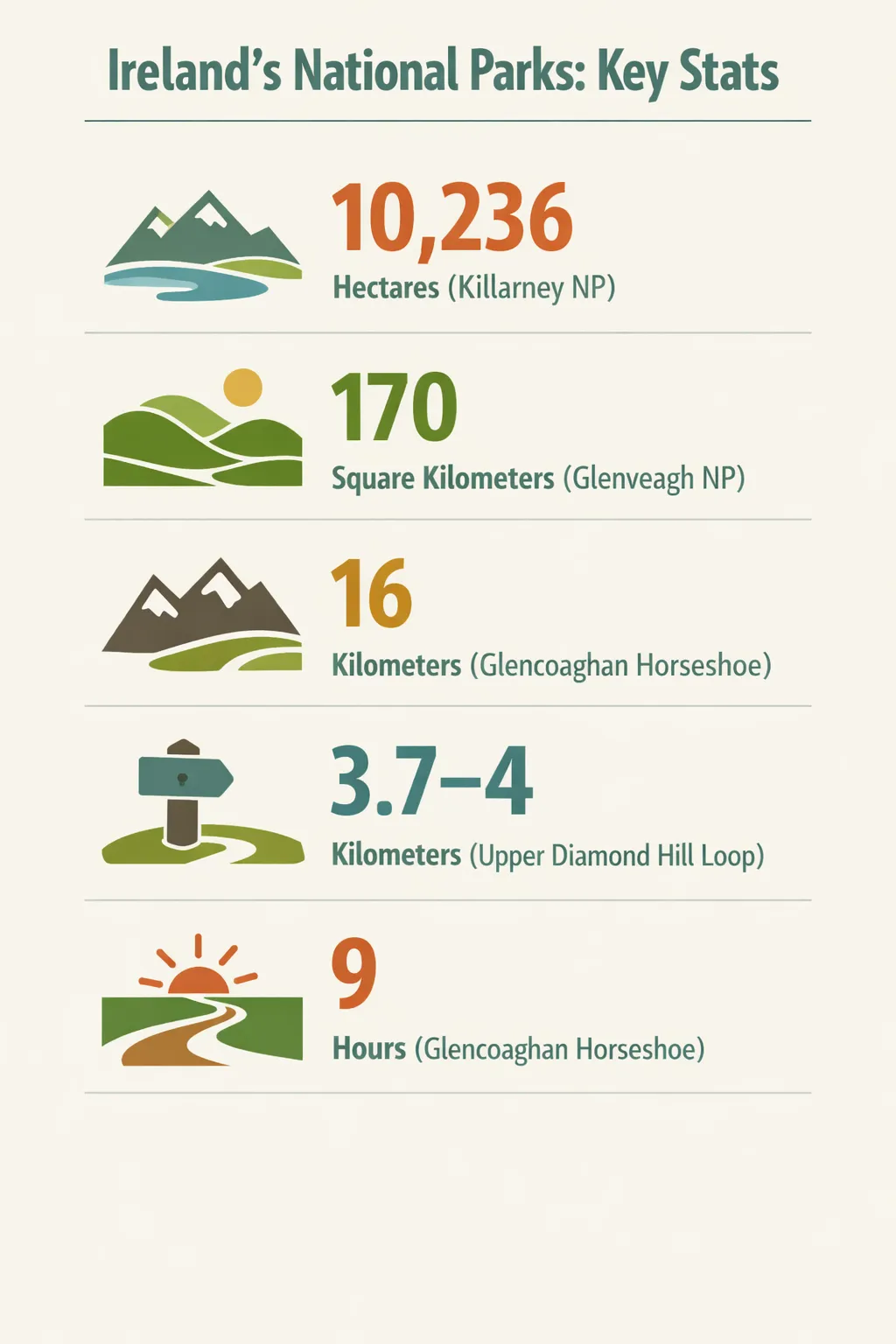 Killarney NP area 10,236 ha; Glenveagh NP area 170 km²; Glencoaghan Horseshoe distance 16 km; Upper Diamond Hill loop 3.7-4 km; Glencoaghan Horseshoe duration 9 hours.
Here’s each park’s strongest suit:
- Killarney (Kerry): lakes, history, and mixed tours. Best for first-timers and families. Full day minimum. No car needed; the town is walkable and tour operators run from the centre. Visitor centre on site.
- Glenveagh (Donegal): remote wilderness and a lakeside castle. Full day including the drive. Car required. Visitor centre on site. Watch the Monday/Friday castle closure.
- Connemara (Galway): hiking and mountain views, with the widest range of graded trails. Half to full day depending on which trail you pick. Car required. Visitor centre at Letterfrack.
- Burren (Clare): geology and wildflowers. Half a day, ideally paired with the Cliffs of Moher. Car required. Information point only, in Corofin.
- Wicklow Mountains (Wicklow): day trip from Dublin, heritage at Glendalough. Full day. No car needed; the bus reaches Glendalough. Visitor centre on site.
- Wild Nephin (Mayo): dark skies and bog wilderness. Full day, remote. Car required. Minimal infrastructure.
For families with young children, stick to Killarney, Connemara’s easy loops (Ellis Wood and Sruffaunboy), or Glendalough in Wicklow. Serious hikers want Connemara’s Twelve Bens, Glenveagh’s upland terrain, or Wicklow’s ridge routes. If you’re without a car, Killarney and Wicklow are the only two realistically doable; the rest effectively require private transport.
Comparison of Ireland's Six Terrestrial National Parks
| Killarney | Glenveagh | Connemara | Burren | Wicklow Mountains | Wild Nephin | |
|---|---|---|---|---|---|---|
| County | Kerry | Donegal | Galway | Clare | Wicklow | Mayo |
| Best For | Lakes, history, mixed tours | Remote wilderness, castle | Hiking, mountain views | Geology, wildflowers | Day trip from Dublin, heritage | Dark skies, bog wilderness |
| Minimum Time | Full day | Full day | Half-full day | Half day | Full day | Full day |
| Car Needed? | ✗ | ✓ | ✓ | ✓ | ✗ | ✓ |
| Visitor Centre? | ✓ | ✓ | ✓ | ✗ | ✓ | ✗ |
Practical Tips for Visiting Ireland’s Parks Without Wasting a Day
A wasted day in an Irish national park almost always comes down to one of a few avoidable mistakes: wrong day, wrong hour, or the wrong footwear.
- Check castle and facility hours before you go. Glenveagh Castle is closed Mondays and Fridays, and arriving on the wrong day means no interior tour after a long drive. Call +353 1 539 3232 or check social media the morning of your visit.
- Start advanced hikes early. The Glencoaghan Horseshoe runs about 9 hours; Upper Diamond Hill takes 2-3 hours from the visitor centre before you add drive time. Long, exposed ridge walks need a morning start.
- Use visitor centres as trailheads. Connemara’s four official trails all begin at Letterfrack, and staff there give current weather and trail advice. Killarney House orients you to the whole park.
- Budget for paid attractions separately. Park entry is free, but Muckross House, Ross Castle, and the Glenveagh Castle interior all charge admission. Check current prices before you arrive.
- Combine parks on a road trip. Burren plus the Cliffs of Moher works as one day from Galway; Killarney pairs with the Ring of Kerry; Wicklow is a clean Dublin day trip; Glenveagh fits a Donegal loop.
- Mind off-season hours. The Burren information point closes at 17:00 in winter and Wicklow’s visitor centre at 16:30. Late arrivals off-season find no staffed support, though the trails stay open.
- Plan for weather, always. Waterproof layer, footwear with grip, and a look at the visitor centre’s daily trail conditions board before you head out. This isn’t optional in the upland parks.
Frequently Asked Questions
- Are all national parks in Ireland free to enter?
- Yes, all six terrestrial parks have free entry to the park land. Paid attractions within parks charge separately.
- Which national park in Ireland is closest to Dublin?
- Wicklow Mountains National Park is roughly one hour south of Dublin and reachable by public bus to Glendalough.
- How many national parks does Ireland have?
- Ireland has six terrestrial national parks managed by NPWS, plus a marine national park added recently.
- Can I visit Glenveagh Castle every day of the week?
- No, Glenveagh Castle is closed on Mondays and Fridays, but the park remains open daily.
- What is the best national park in Ireland for hiking?
- Connemara offers the widest trail variety; Wicklow Mountains has accessible day hikes; Glenveagh suits remote upland terrain.
- What is the best time of year to visit Ireland's national parks?
- Late spring to early autumn (May-September) offers best weather and daylight; Burren is best April-June for wildflowers.
- Do I need a car to visit Ireland's national parks?
- Yes for most parks; Killarney and Wicklow are exceptions with walkable towns or bus access.
Which Park to Pick
Six parks, all free, all open year-round, but very different in character and logistics. That’s the whole decision in one line, and the rest is matching a park to your trip rather than chasing whichever one has the most photos online.
First-timers should go to Killarney or Wicklow; both are accessible, well serviced, and reachable without a car. Hikers should head for Connemara and its graded spread of trails: Diamond Hill for a half-day, the Glencoaghan Horseshoe if you want a full mountain day. If geology and wildflowers are the draw, the Burren rewards a spring visit. For genuine remoteness, Glenveagh or Wild Nephin deliver wilderness the others don’t, though both demand a longer drive and more self-reliance.
Whichever you choose, check the NPWS site and the individual park page a few days before you travel. Hours, trail conditions, and facility closures do change; the Glenveagh castle closure and the off-season information-point hours are the ones that most often derail a day. These parks are the best free thing Ireland offers outdoors. Pick the one that fits your time and your legs, and plan around the closures rather than discovering them on arrival.