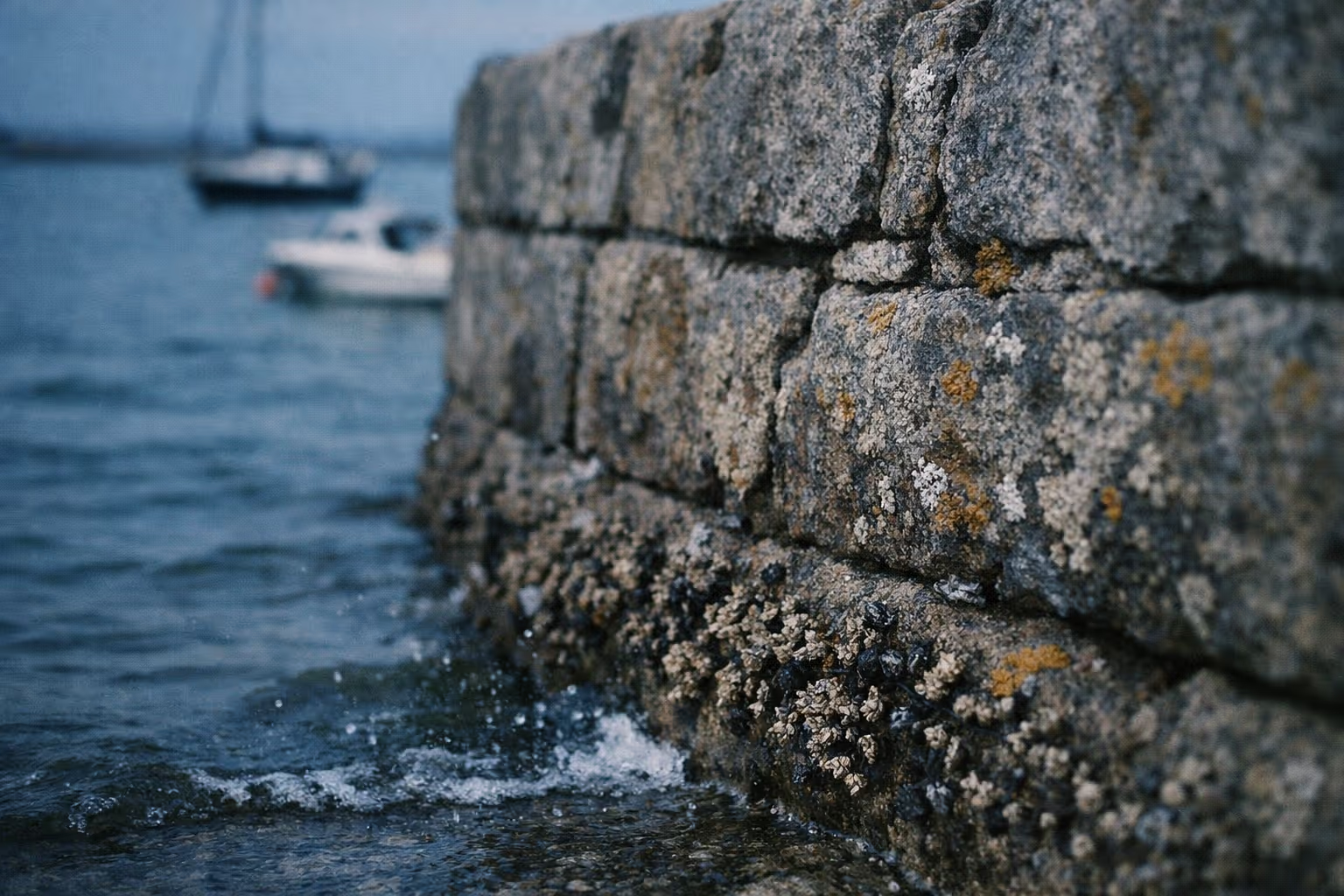
The single biggest mistake visitors make with day trips from Dublin is underestimating how long they actually take. Howth is 35 minutes away on the DART. The Cliffs of Moher is a 13-hour round-trip commitment. That gap, between what people picture and what the day actually costs them, is exactly why this guide leads with real door-to-door times and transport modes instead of a vague list of places worth seeing.
Most articles tell you where to go. This one tells you how long it takes and what gets you there.
The range here runs from a half-day coastal walk to a full 13-hour coach marathon. Below you’ll find five core day trips from Dublin, ranked loosely by time investment, plus a comparison table to match a destination to the hours you actually have. If you’re weighing up the Cliffs specifically, there’s a dedicated deep-dive linked further down.
How the Five Best Dublin Day Trips Compare at a Glance
The five best Dublin day trips (Howth, Glendalough, Newgrange, Kilkenny, and the Cliffs of Moher) range from a 4-hour half-day to a 13-hour full-day haul. The two variables that actually decide your day are travel time and logistics complexity.
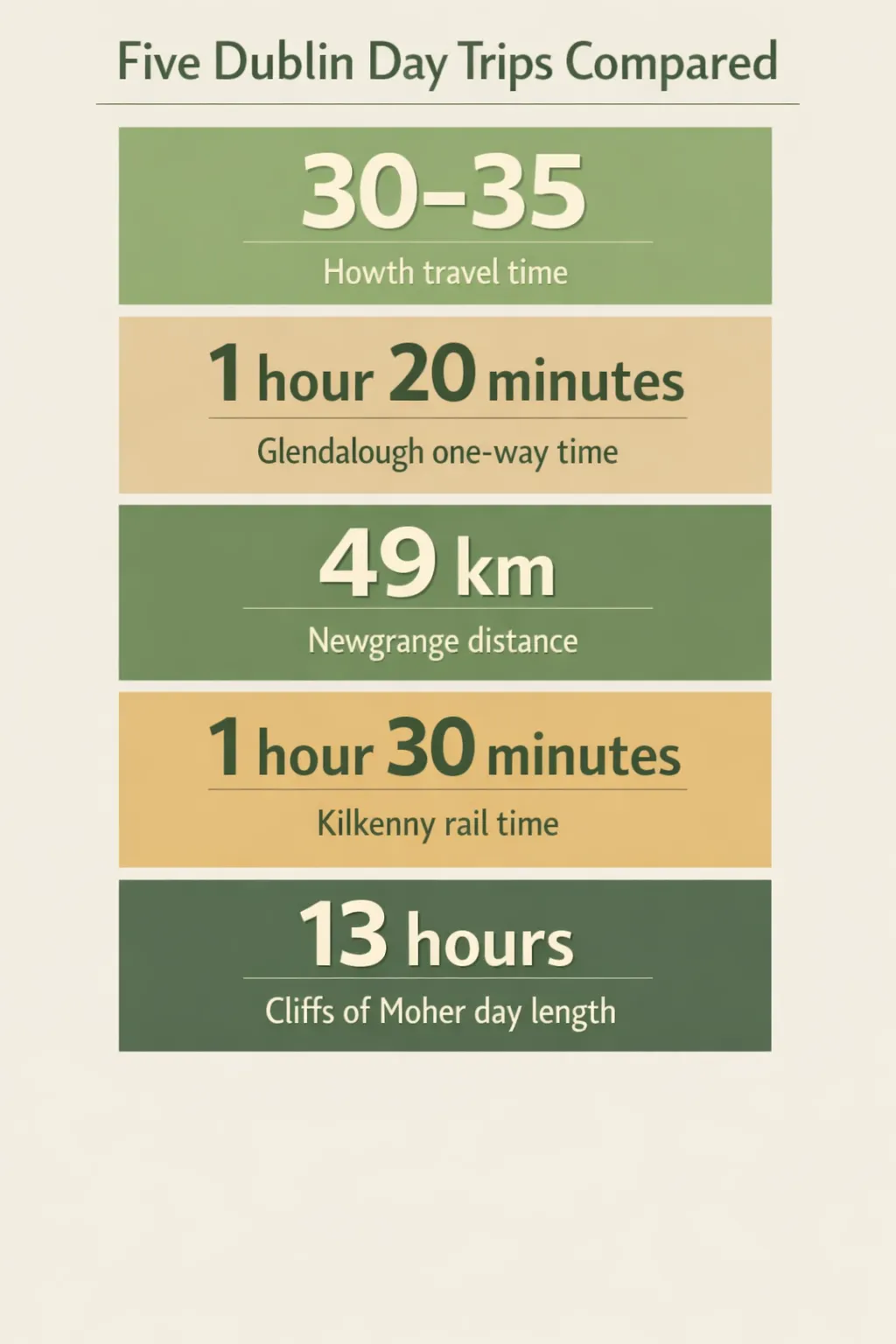 Dublin day trips at a glance: Howth 30-35 minutes; Glendalough 1 hour 20 minutes; Newgrange 49 km; Kilkenny 1 hour 30 minutes; Cliffs of Moher 13 hours.
Here’s how they stack up:
Five Best Dublin Day Trips Compared
| Quickest Howth | Glendalough | Newgrange / Brú na Bóinne | Kilkenny | Cliffs of Moher | |
|---|---|---|---|---|---|
| Best Transport | DART | Bus (St Kevin's) / Car | Car / Tour | Train / Bus | Coach tour / Car |
| One-way Travel Time | 30-35 min | 1h15-1h20 / 45-60 min | about 1 hour | about 1h30 | 2.5-3 hours |
| Total Day Length | 4-6 hours | 6-8 hours | 8-10 hours | 7-9 hours | 12-14 hours |
| Logistics Complexity | Very low | Medium (bus twice daily) | Medium-high (pre-book required) | Low | High (long day, early start) |
| Best For | Coastal walk, seafood, half-day | Hiking, monastic ruins | Archaeology, UNESCO heritage | Medieval history, castle | Iconic scenery, Atlantic coast |
✓ Pros
- No need to change hotels during a 3-4 night stay
- Dublin's rail and coach links cover diverse landscapes within a few hours
- Variety of day trip options from half-day to full-day
- Suitable for travelers with limited time who want to avoid repacking
✗ Cons
- Cliffs of Moher is exhausting as a day trip
- Bus frequency to Glendalough is limited to twice daily
- Some trips require advance booking (Newgrange, Cliffs tours)
- Winter daylight hours reduce on-site time significantly
Howth from Dublin: The 35-Minute Coastal Escape
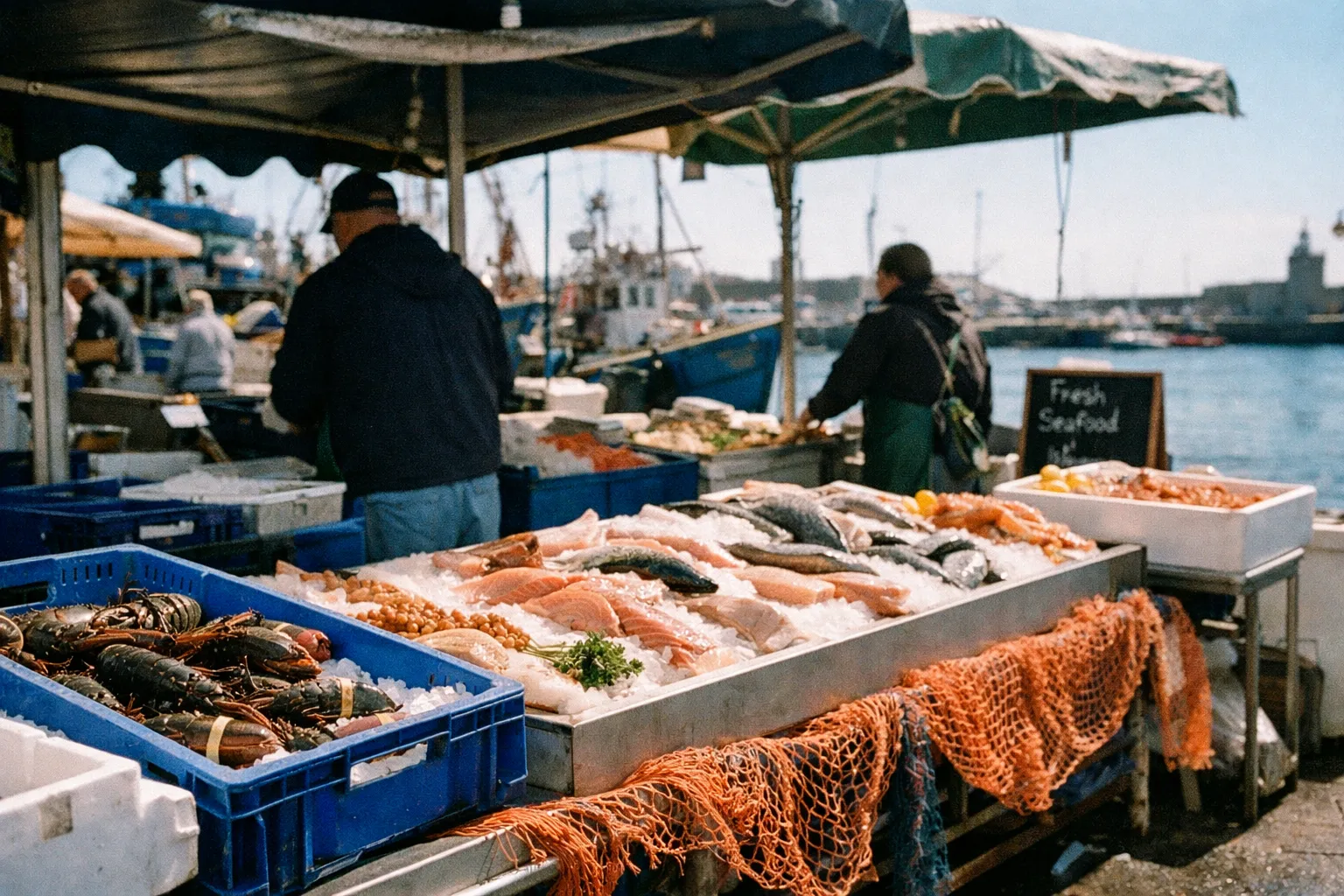
Howth is the easiest day trip from Dublin: a 30-35 minute DART ride from the city centre, no booking required, trains every 20-30 minutes, and a 4-6 hour round trip that leaves your evening free.
The DART runs from Connolly, Tara Street, and Pearse stations out to Howth at the tip of the peninsula, about 13 km northeast of the city centre, overlooking Dublin Bay. A day-trip return on a Leap card lands around €4 total, which makes this the cheapest serious outing on the list. There’s no timetable anxiety: services are frequent and the last DART back runs late into the evening.
The main draw is the Howth Cliff Path Loop, a 6 km clifftop circuit that takes about two hours from the DART station. It’s moderate with some uneven sections that need decent grip, and the headland is fully exposed: bring a windproof layer even on a calm-looking day. The reward is a wide-open sightline across Ireland’s Eye and Lambay Island. Down at the harbour, the seafood is worth building into the plan; chowder runs roughly €8-€12.
Round the walk off with lunch and you’re looking at a genuine half-day. I’d also flag this as the one trip on the list that works year-round without timing stress: the loop is short enough that even Dublin’s compressed winter daylight isn’t a problem.
What to do with the rest of the day
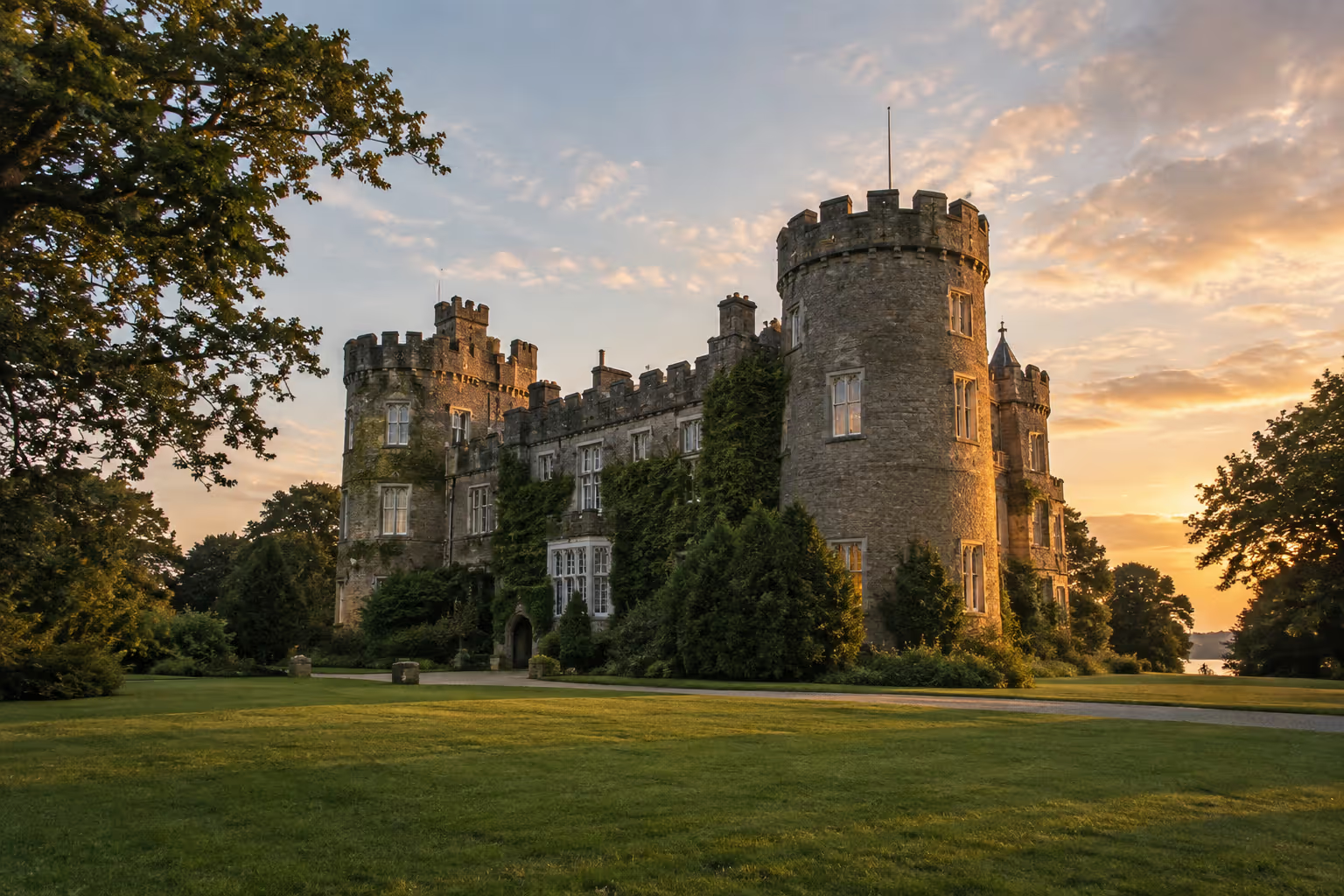
Get back to Dublin by mid-afternoon and an evening pub session is entirely realistic. If Howth feels too familiar on a second visit, Dún Laoghaire to the south is a comparable coastal half-day: about 25 minutes on the DART, with a long pier walk and the Forty Foot sea-swimming spot at Sandycove. Malahide, on the northern DART line, makes a similar half-day: a Malahide Castle tour followed by a walk through its 268-acre parkland.
Glendalough from Dublin: Trails, Ruins, and a Bus That Runs Twice a Day
Glendalough is reachable from Dublin by St Kevin’s Bus in about 1 hour 20 minutes each way, but the bus runs only twice daily, so first bus out and last bus back gives you about 4 hours on site on weekdays, and closer to five at weekends.
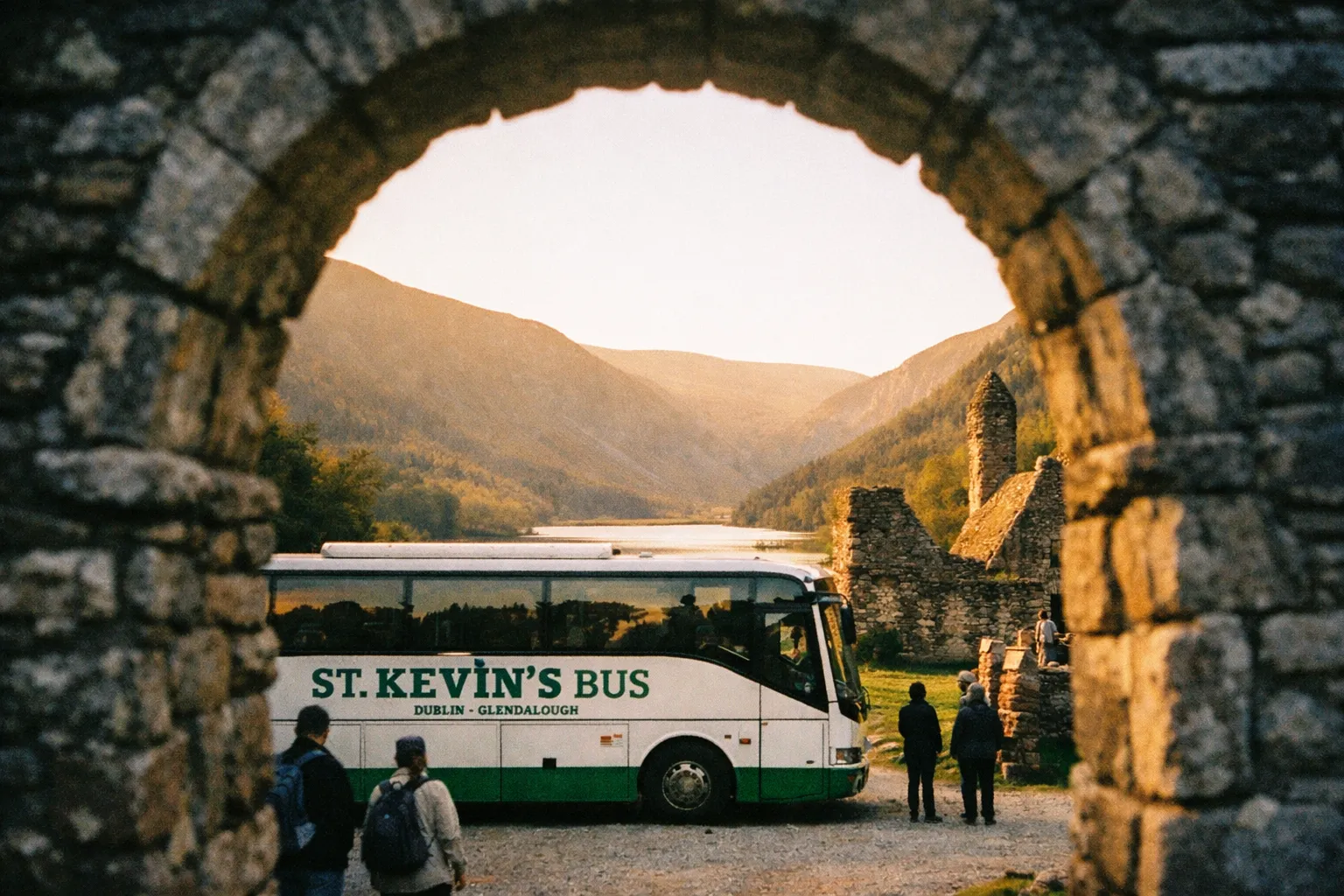
That twice-daily constraint is the single thing that catches people off guard, so it’s worth being precise. St Kevin’s Bus departs from St Stephen’s Green North and Leeson Street Lower. Typical departures from Dublin are 11:00 and 18:00 on weekdays, and 11:00 and 19:00 at weekends. The returns leave the Glendalough visitor centre at 07:15 and 16:30 on weekdays, and at 09:15 and 17:40 at weekends, so a weekend trip buys you roughly an extra hour on site. The standard return fare is €23, with a single at €14. In winter the pattern tightens, so treat the timetable as fixed and check the current one before you travel.
By car it’s a different trip entirely: 45-60 minutes via the N11/M11 and R755, roughly 30 miles, with parking at the Glendalough Visitor Centre. Driving unlocks a much longer, more flexible day: a full loop taking in the trails and nearby Wicklow sites can stretch to 8-10 hours.
On site, the two anchors are the Monastic City (the round tower and cathedral ruins) and the Upper Lake. Glendalough has nine way-marked trails; the Spinc and Glenealo Valley loop is the big one at about 9-9.5 km and 3-4 hours, while the Miners’ Road route is a gentler 5 km in 1-1.5 hours. Advanced hikers can link sections of the Wicklow Way, but only if you’ve sorted your return. Being caught on the trail after the last bus means a taxi or an unplanned night in Wicklow.
How to plan a Glendalough day trip by bus
How to Plan a Glendalough Day Trip by Bus
8 hoursStep-by-step guide to using the St Kevin's Bus service for a day trip to Glendalough from Dublin.
- 1
Check the current timetable
Visit the official St Kevin's Bus website to confirm seasonal departure times and note the service does not run on Christmas Day.
- 2
Get to the departure point
Walk or take Dublin Bus to St Stephen's Green North or Leeson Street Lower where the bus departs.
- 3
Board the first bus
Catch the earliest departure, typically around 11:00, to maximize your time at Glendalough.
- 4
Explore the site
Start with the Monastic City ruins (30-45 minutes), then complete the Upper Lake circuit (1.5-2 hours).
- 5
Return on time
Be back at the Glendalough village bus stop at least 10 minutes before the scheduled departure; the bus will not wait.
- 6
Fallback plan if you miss the bus
Arrange a taxi to Rathdrum or Blessington for onward connections to Dublin; budget accordingly.
Glendalough by car: adding Wicklow to the loop
Self-driving opens up Powerscourt Estate and the Sally Gap as add-ons, turning the day into a realistic 6-10 hour Wicklow loop. The Sally Gap route is a narrow mountain road that adds around 20-30 minutes over the direct N11, and it’s genuinely scenic in clear weather. In low cloud it’s slow and you’ll see nothing. Skip it and take the main road.
Newgrange and Brú na Bóinne from Dublin: Prehistoric Sites That Require a Plan
Newgrange sits about 49 km north of Dublin in County Meath, roughly 43 minutes to an hour by car, but you cannot drive to the monument itself, because access is exclusively through the Brú na Bóinne Visitor Centre and its shuttle buses.
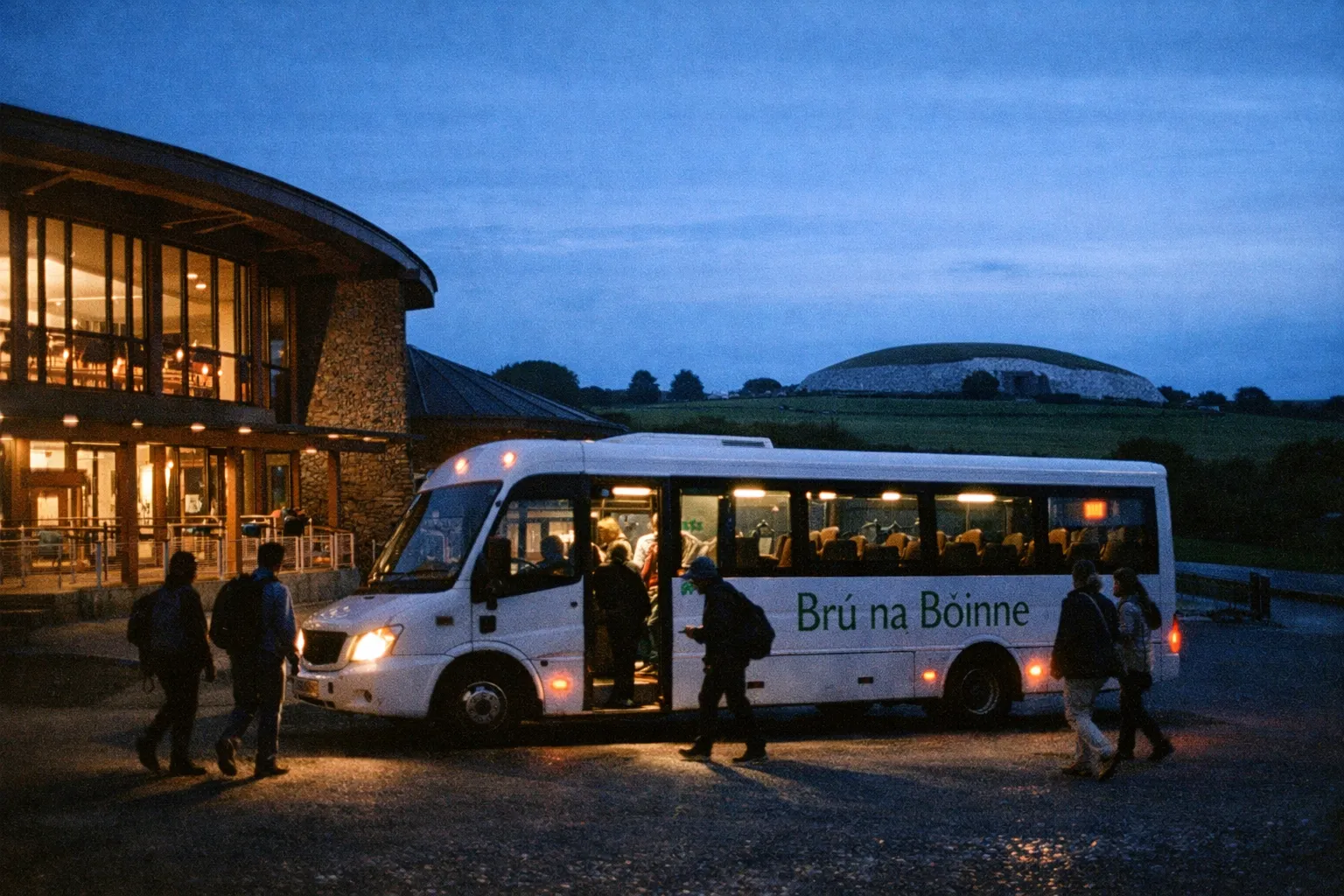
That last point is what most guides skip, and it changes how you plan the whole trip. According to the Office of Public Works, the visitor centre is the only access point for both Newgrange and Knowth, and visitors reach the monuments exclusively by shuttle bus from the centre. Turning up at the tomb directly gets you nowhere.
Newgrange is a 5,000-year-old Neolithic passage tomb that predates the Egyptian pyramids, and it’s a UNESCO World Heritage Site. Tickets for the guided tours must be pre-booked: this is non-negotiable in peak season. Online booking generally opens 30 days ahead in the main season and 7 days ahead in winter; in June through August the timed slots sell out days or weeks in advance, so same-day access is often impossible. Book through the official heritage service before you travel.
Allow 2-3 hours at the visitor centre and the monuments combined. A typical visit covers the Newgrange passage tomb, with the option to add Knowth, the second major mound.
Two ways to do it from Dublin:
- Organised tour: coach day tours typically combine Newgrange and Knowth, sometimes with Trim Castle or the Hill of Tara, for a total 8-10 hour door-to-door day. You trade flexibility for having the logistics handled.
- Self-drive: you control the timing and can add the Hill of Tara (about 20 minutes away) or Trim Castle (about 25 minutes) without being locked to a coach schedule.
One thing worth knowing as context rather than a plan: the famous winter solstice light in the inner chamber, when dawn light floods the passage on mornings between 19 and 23 December, is allocated by an annual lottery run through the official Solstice Lottery site. Your odds are slim: treat it as trivia, not an itinerary.
Kilkenny from Dublin: Medieval Streets Without the Long Haul
Kilkenny is about 1 hour 30 minutes from Dublin by train from Heuston to Kilkenny MacDonagh station, with multiple daily departures and no pre-booking needed for off-peak travel.
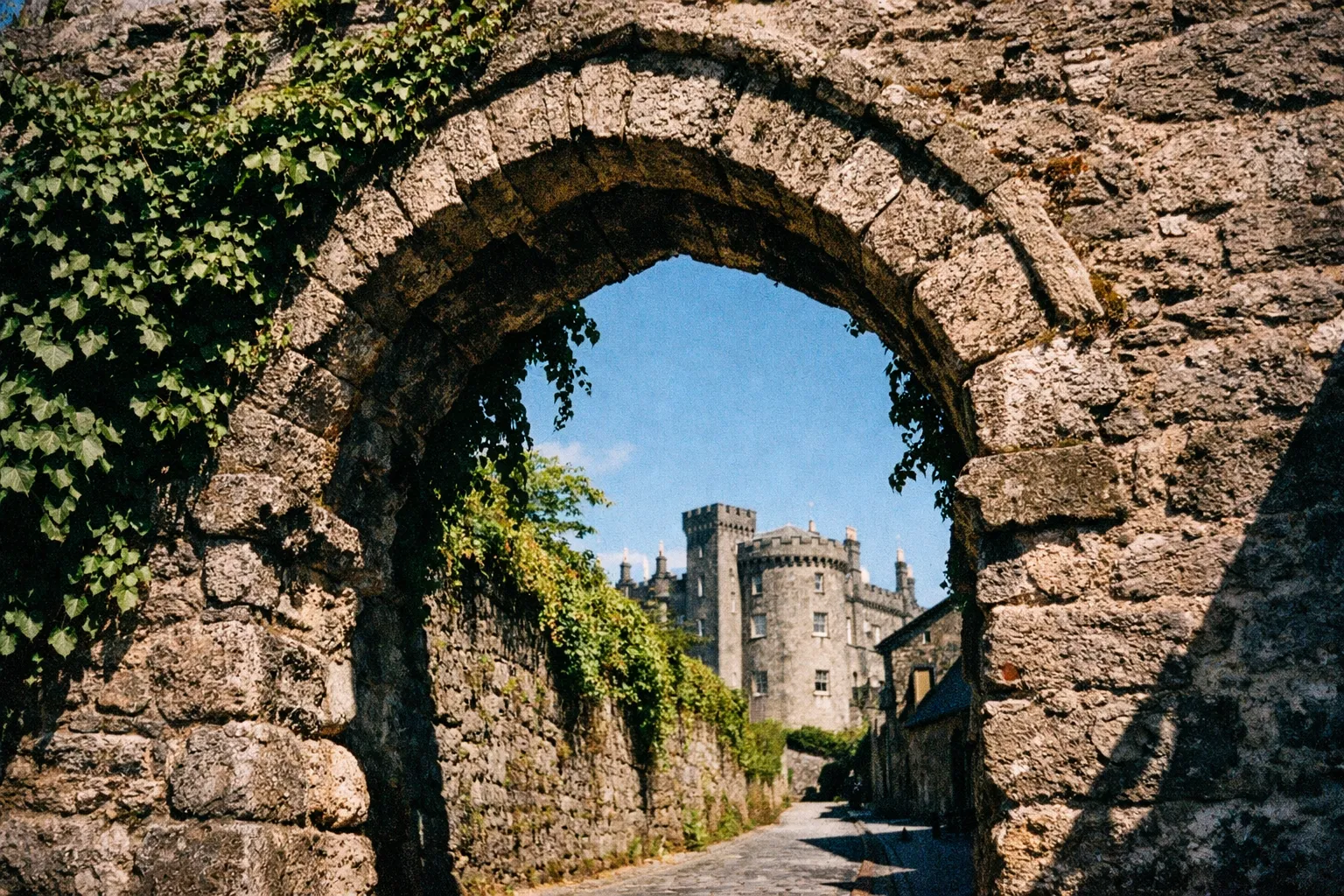
Journey times cluster around 1 hour 27-30 minutes, though some services run closer to 1 hour 44. Bus Éireann also serves the route in around 2 hours, so the train is the faster and more comfortable choice by roughly half an hour.
Kilkenny rewards the low logistics. The town is compact enough to cover entirely on foot. Kilkenny Castle and its grounds deserve 1.5-2 hours, and the Medieval Mile links St Canice’s Cathedral, Rothe House, and the Black Abbey in an easy walking circuit. Centuries of Norman and medieval occupation left their mark on the streets, and it’s dense enough to feel like a real town rather than a set piece.
A realistic pattern: catch a 09:00 train, spend 5-6 hours exploring, and be back in Dublin by early evening: a total outing of 7-9 hours. Kilkenny is small, so a full afternoon is plenty. Don’t try to bolt another major destination onto the same day; it dilutes both. This is a strong pick for anyone who wants a medieval town feel without renting a car, and it pairs well with a separate Howth half-day for a varied three-night stay.
The Cliffs of Moher from Dublin: Ireland’s Longest Day Trip
A coach tour to the Cliffs of Moher from Dublin runs about 13 hours door-to-door, with roughly 90 minutes to 2 hours at the cliffs themselves and the rest split between the bus, the Burren, and Galway.
That’s the honest headline, and it’s the number most first-timers get wrong. Coach tours typically depart between 06:50 and 07:45 and return around 19:00 to 20:30. Train-based itineraries can stretch the total day to nearly 15 hours. By car it’s about 3 hours each way, covering roughly 255-270 km via the M7/M18, for a total day of 10-12 hours including the cliffs, the Burren, and an optional Galway stop.
The trade-off worth understanding: on a coach tour you’re on the bus for something like 5-6 hours total, and your actual time at the cliff edge is 90 minutes to 2 hours. If you’re picturing a full afternoon walking the cliff trail, this is not that trip. What you get is efficiency: Cliffs, Burren, and Galway City bundled into one long day with no driving on your part.
Self-driving flips the balance toward control. You can extend your cliff time, skip Galway, and break the drive to cut fatigue: a short stop at Kilmacduagh Monastery, just outside Gort about two hours in, is a common way to do it. The cost is 5-6 hours of driving in a day, and Irish roads west of the Shannon narrow considerably. Check the official opening hours before you go: the Cliffs of Moher Experience runs 09:00-17:00 in winter and up to 08:00-21:00 from May to August, and it’s closed 24-26 December.
Whatever the mode, pack layers and a waterproof jacket. The cliff trail is fully exposed and the wind can be severe even in July. Coach tours sell out in peak season, so book ahead; self-drivers should pre-check the cliffs car park situation too.
For a full breakdown of every transport option, stop-by-stop timing, and what to expect on arrival, see our complete guide to the Cliffs of Moher from Dublin.
Coach tour vs. self-drive: which makes more sense
A coach tour suits first-timers and solo travellers: no driving fatigue, a fixed itinerary, and someone else watching the clock. Self-drive suits anyone who’s done the coach version before or wants to control the pace: you can extend cliff time and add Doolin or Lahinch on the way back.
The deciding factor is usually fatigue. Five to six hours of driving in a single day, much of it on narrow roads west of the Shannon, is tiring in a way the schedule doesn’t show on paper.
Matching Day Trips to How Long You’re Staying in Dublin
How many days you have in Dublin should decide which day trips you attempt, and the firm rule is one long-haul trip maximum per stay, because two consecutive 12-hour coach days is a bad plan.
- 2 nights (1 full day): Skip the Cliffs. A 13-hour day leaves you wrecked for a flight home. Do Glendalough by car or Howth by DART instead: both give you a real experience without emptying the tank.
- 3 nights (2 full days): One Wicklow day (Glendalough plus a Powerscourt loop by car, or Glendalough by bus) and one coastal half-day (Howth). The Cliffs are viable here, but only if you genuinely want to give up a full day to them.
- 4-5 nights (3+ full days): The classic combination: Cliffs of Moher as the long-haul day, Glendalough or Newgrange as the history-and-nature day, and Howth as the easy half-day. This spreads the effort sensibly.
Kilkenny slots into any stay length as a low-effort addition, and it works especially well as a travel day if you’re heading south afterward.
Day trips from Dublin by train: what’s actually reachable
By train, the DART covers the coastal options with no booking: Howth in 30-35 minutes, Dún Laoghaire in about 25 minutes, and Bray in about 45 minutes. On the intercity network from Heuston, Kilkenny is about 1 hour 30 minutes and Galway about 2 hours 25 minutes: long but feasible as a day trip if you start early. From Connolly, the Enterprise service reaches Belfast in about 2 hours 8 minutes, with 8-10 trains a day each way.
Two of the big draws have no train option at all. Glendalough is served only by St Kevin’s Bus. Newgrange has no direct public transport to the site: it’s car or organised tour, full stop.
What to Know Before You Go: Practical Notes Across All Trips
A handful of logistics apply across every trip on this list, and getting them wrong is what turns a good day into a salvage operation.
Daylight matters more than you expect. Around the winter solstice, Dublin gets as little as 7 hours 30 minutes of daylight, with sunrise near 08:30 and sunset around 16:15. Glendalough’s ridge trails in near-darkness are miserable and unsafe. In winter, align your departure with sunrise and check the sunset time for your specific date. The Cliffs of Moher’s summer opening to 21:00 gives you a generous window from May to August, but the winter 09:00-17:00 schedule compresses a day trip tightly.
Waterproofs on every trip. Howth’s headland, Glendalough’s ridge, and the Cliffs of Moher are all fully exposed. Rain gear isn’t optional: pack it regardless of the forecast, because Irish weather turns fast.
Book what needs booking. Newgrange requires timed entry through the official heritage service. Cliffs of Moher coach tours sell out in peak season, June through August. Howth and Kilkenny need nothing booked in advance.
Bus frequency is not what you assume. St Kevin’s Bus to Glendalough runs twice daily, not hourly. Missing the last evening bus is a real scenario with real consequences: a taxi or an unplanned overnight. Treat that timetable as fixed.
Car rental buys flexibility but costs driving time. Irish roads narrow sharply outside the motorways. Budget extra time for anything west of the Shannon or through the Wicklow Mountains. The Sally Gap is scenic but slow.
Start early on the long trips. Coach tours to the Cliffs leave at 06:50-07:45 for a reason: reaching the cliffs before the coach park fills makes a real difference to what the visit actually feels like.
Frequently Asked Questions
- Where to visit from Dublin by train?
- Howth, Dún Laoghaire, Bray, Kilkenny, Galway, and Belfast are reachable by train; Glendalough and Newgrange require bus or car.
- How many days do you need in Dublin to fit in day trips?
- Three nights allows two full days for trips; four to five nights lets you add the Cliffs of Moher; two nights is tight, so prioritise shorter trips.
- Can you do the Cliffs of Moher from Dublin without a car?
- Yes, daily coach tours run 13-hour round trips with 90-120 minutes at the cliffs; booking ahead in summer is essential.
- Is Glendalough easy to reach from Dublin without a car?
- It is manageable but inflexible; St Kevin's Bus runs twice daily with about 4 hours on-site on weekdays if you catch the first out and last back.
- Do you need to book Newgrange in advance?
- Yes, timed entry via the Brú na Bóinne Visitor Centre is mandatory; peak-season slots sell out well ahead.
- What countries can you visit from Dublin on a day trip?
- Northern Ireland is the only realistic cross-border day trip; Great Britain and continental Europe require overnight stays.
- Which day trip is best if the weather looks bad?
- Kilkenny is best for bad weather with indoor and covered sites; Newgrange also works since much is indoors.
What to Do Next
The decision comes down to how many days you’ve got:
- One day: Howth or Glendalough. Not the Cliffs.
- Two days: Glendalough plus Howth, or Newgrange plus Howth.
- Three or more days: Add the Cliffs of Moher, but go in knowing it’s a 13-hour commitment and plan a lighter day either side of it.
Book Newgrange and any peak-season Cliffs tour well ahead, check the St Kevin’s Bus timetable the day before you travel to Glendalough, and pack waterproofs for anything on the coast or in the mountains. If the Cliffs of Moher is the trip you’re actually planning, read our complete guide to the Cliffs of Moher from Dublin for the full transport breakdown, stop-by-stop timing, and a proper packing list.