County Mayo Ireland is really three trips stacked into one county, and the mistake is assuming you can do them in a day. The far north holds the 6,000-year-old Ceide Fields and Downpatrick Head; the west gives you Achill Island, Ireland’s highest sea cliffs, and Keem Strand; Knock anchors the pilgrim trail and has its own airport. Grace O’Malley’s towers still ring Clew Bay. Rent a car and budget $120 to $250 a day, because the train will strand you miles from all of it.
Getting your bearings in County Mayo, Ireland: geography and layout
County Mayo Ireland sits on Ireland’s northwest coast in the province of Connacht, and it’s big. The population was 137,970 at the 2022 census, spread thin across mountains, bogs, islands, and long indented bays. First-time visitors routinely underestimate the distances.
A few numbers worth knowing before you plan a route:
- Mweelrea is the highest point at 814 m - the tallest peak in both Mayo and Connacht (2).
- Achill Island, off the west coast, is Ireland’s largest island (2).
- Croaghaun on Achill holds Ireland’s highest sea cliffs (2).
- The county has 26 offshore islands and dozens of Blue Flag beaches strung along the Wild Atlantic Way (4).
The practical takeaway: the good stuff is spread out. The drive from Westport to the Céide Fields in the far north runs about 119 km and takes over two hours. This is not a one-base, one-day kind of county - Ireland’s Central Statistics Office recorded Mayo as the third-largest county by area in the Republic, at roughly 5,586 sq km. Plan for 2-3 bases - Westport, Castlebar, and Ballina cover the south, center, and north respectively - and build in at least one weather-flex day, because Atlantic conditions turn fast (1).
Budget-wise, a self-drive trip for a solo traveler or couple runs roughly EUR €110-€230 (approximately USD $120-$250) per day before long-haul flights, covering a rental car, fuel, lodging, and admissions - based on May 2025 pricing. Rural Mayo does not work well for rail-only travel. You’ll want a car.
Unveiling Mayo’s natural wonders
The Great Western Greenway is a 49-kilometer off-road trail linking Westport and Achill Island (3)(6) - the longest off-road cycling and walking trail in Ireland, according to Fáilte Ireland (6) - and it’s one of the better ways to understand why Clew Bay gets the attention it does. I rode a section of it on a clear October morning, and the light on the bay - all those scattered islands - was the kind of thing that makes you stop pedaling and just look.
Start early and use Westport or Newport as your bike-rental base. The full 49 km is a lot to pace across a single day, and morning light on Clew Bay is worth the alarm (3). Most people ride a half or full day rather than tackling the whole thing, and local rental outfits can arrange one-way drop-offs.
Wild Nephin National Park is a different register entirely. Remote, designated dark-sky, good for hiking and stargazing and genuinely disconnecting. On my trek through the park I passed pristine lakes, dense forestry, and a herd of wild red deer that watched me for a long moment before disappearing back into the bog. Bring layers and decent boots - the terrain gets wet fast.
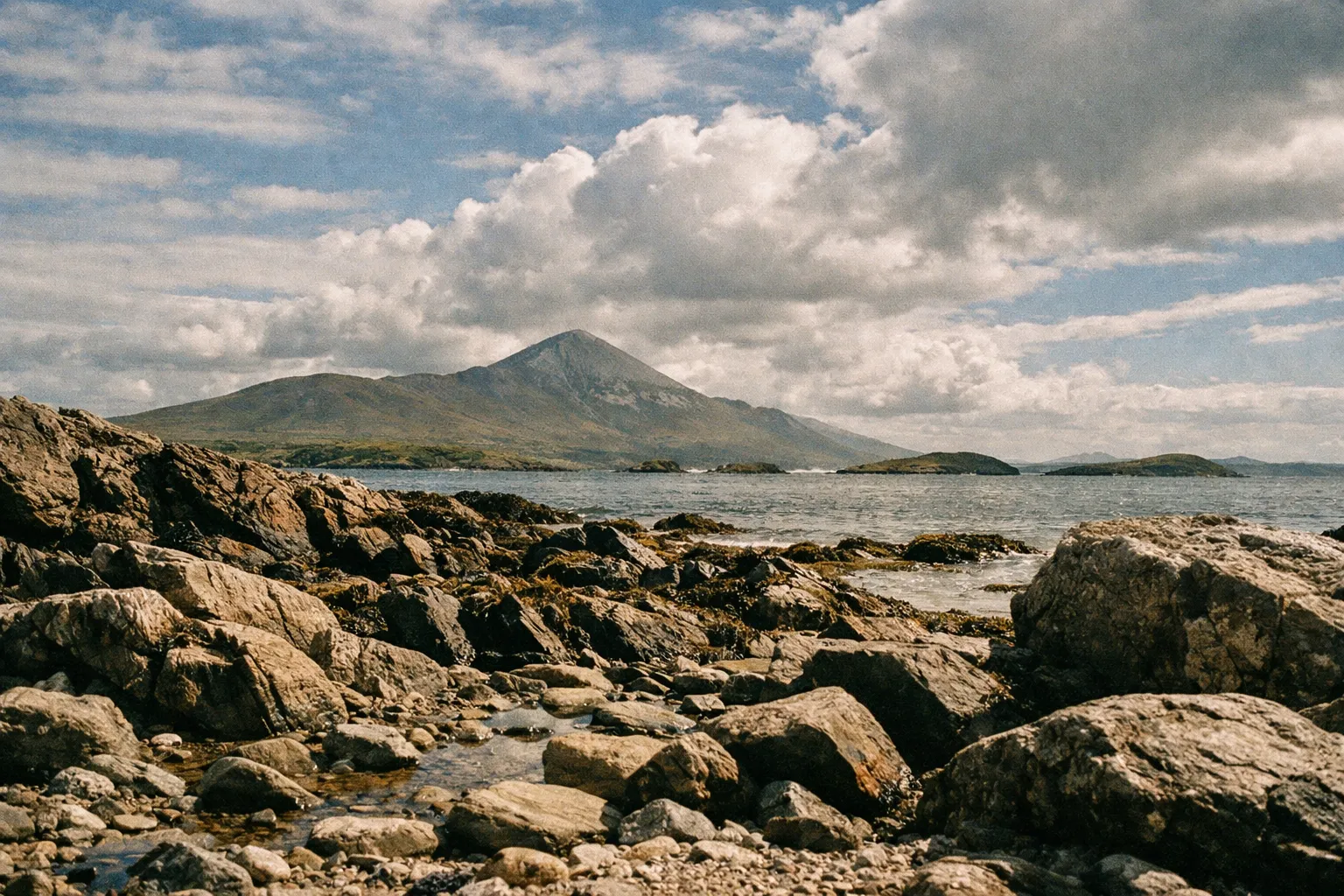
Croagh Patrick rises above the south shore of Clew Bay and draws thousands of pilgrims each year, many climbing barefoot on Reek Sunday in late July. It’s a stiff two-to-three-hour ascent on loose scree near the top. Worth it for the summit view over the bay’s scattered islands, but not a casual stroll. Solid footwear and a windproof layer are non-negotiable.
Downpatrick Head and the new Céide Coastal Path
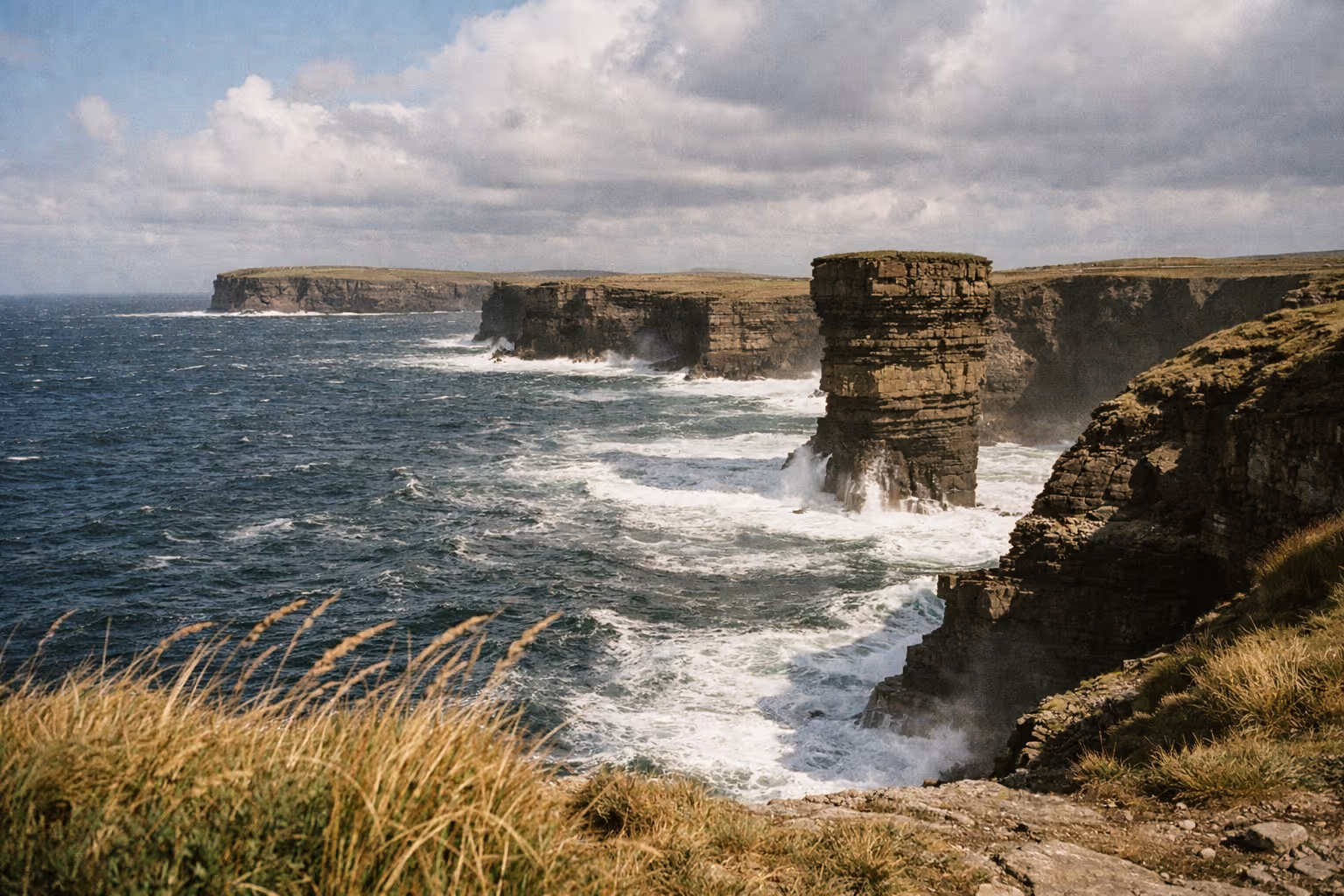
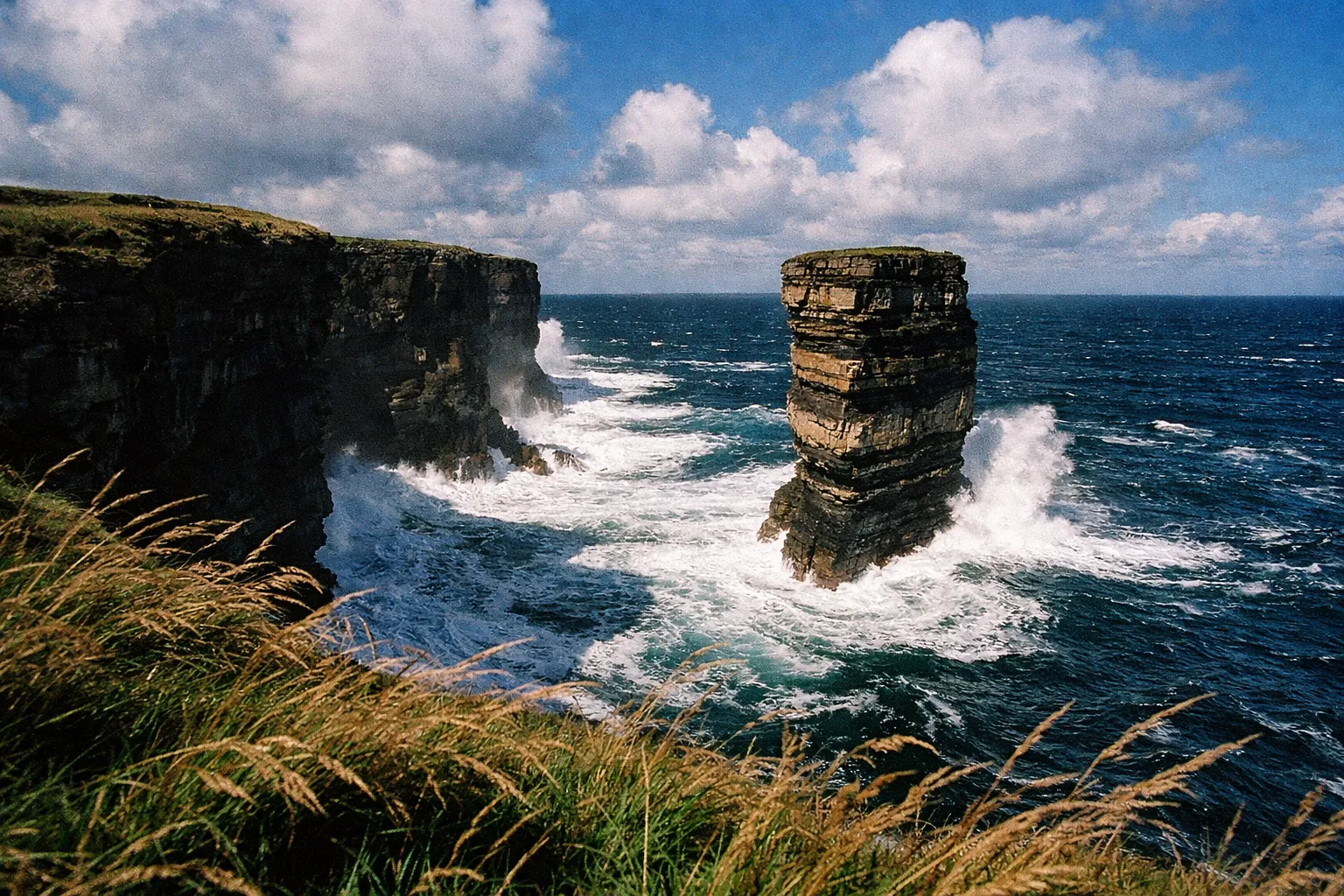
Downpatrick Head, in the far north near Ballycastle, is one of those places that doesn’t need any setup. You park, walk a short trail to the cliff edge, and there’s the sea stack of Dún Briste (“the broken fort”) marooned offshore with the Atlantic crashing below it. Free to visit, easy walk from the car park - just stay well back from the unfenced edges in wind.
Nearby, the Céide Fields are one of Ireland’s most important Neolithic sites: stone walls and field systems dating back roughly 6,000 years, making this one of the oldest known farmed landscapes on Earth (7). The Irish Times has described the site as “the most extensive Stone Age monument in the world,” a claim that holds up when you stand at the visitor center and look out over the bog that preserved it all. The center explains how archaeologist Seamus Caulfield and his father mapped the walls beneath the blanket bog using little more than a steel probe. Good rain-day stop in a region where indoor options are thin on the ground.
Here’s why north Mayo deserves attention right now. On 1 May 2026, Fáilte Ireland and local stakeholders launched the Wild Mayo Destination and Experience Development Plan, a five-year framework aimed at extending the tourist season and spreading benefit across the north of the county (9). Its headline project is a 15 km Céide Coastal Path connecting the Céide Fields with Downpatrick Head (9). It’s not finished - this is a 2026-2031 plan - so don’t arrive expecting a completed trail. But it signals real investment, and the Céide Fields-Downpatrick Head-Ballycastle cluster is already the strongest north-Mayo itinerary going.
Achill Island: Ireland’s largest island
Achill Island county Mayo Ireland connects to the mainland by a short road bridge, so “island” is a loose term - you drive straight on. It’s Ireland’s largest island and the scenic payoff for the effort of getting this far west.
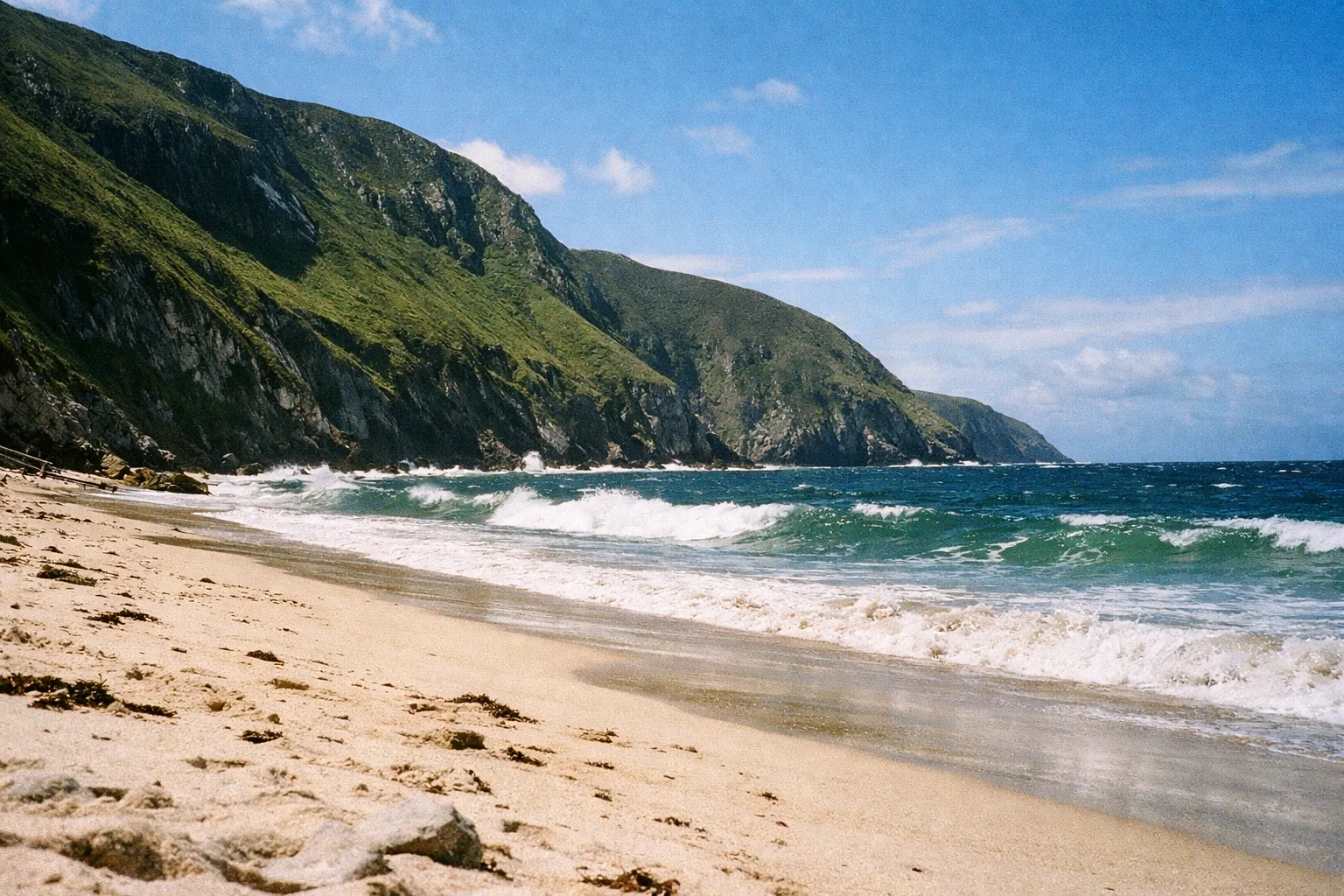
The headline stop is Keem Strand (also written Keem Bay), a horseshoe of pale sand cupped by steep green cliffs at the end of a winding cliff road. The approach drive alone is worth it - pull over at the viewpoints, because the descent into the bay is the money shot. The beach is Blue Flag and, on a still summer day, genuinely swimmable if you don’t mind the cold.
Achill is also where the county earns its adventure reputation:
- Surfing lessons at Keel Strand and Keem, guided by outfits like Wavesweeper Sea Adventures
- Kitesurfing at Keel Strand when the wind cooperates
- Sea kayaking through coves and sea caves along the coast
- Coasteering along the rugged cliff line
- Cycling the western end of the Great Western Greenway, which terminates on the island
I tried surfing off Achill with instructors who were patient with a lot of flailing. On a separate sea kayaking trip, a pod of dolphins swam alongside for a few minutes - the kind of thing you can’t plan for and can’t quite describe without sounding like you’re exaggerating.
Knock and Mayo’s pilgrimage heritage
Knock county Mayo Ireland draws a different crowd than the surfers and cyclists (1)(5). In 1879, villagers reported an apparition of the Virgin Mary, St. Joseph, and St. John at the parish church gable. The site has drawn pilgrims ever since. Today the Knock Shrine complex includes a large basilica, a museum, and grounds that fill during pilgrimage season from spring through autumn.
Worth knowing: Knock has its own airport - Ireland West Airport Knock - which handles seasonal flights from Britain and Europe. If you’re skipping Dublin, this is a practical entry point. For travelers oriented toward religious heritage rather than scenery, Knock is the anchor, and it pairs naturally with a stop at Ballintubber Abbey to the south.
Is County Mayo Catholic or Protestant? Historically, Mayo is one of Ireland’s strongly Catholic-majority counties, and that identity shows plainly in its pilgrimage culture - Knock, Croagh Patrick’s Reek Sunday, the county’s many medieval abbeys (5)(2). Church attendance has declined in recent decades alongside national trends, but the cultural weight of that heritage is still very much present.
Mayo’s history and clans
Mayo’s history stretches from Neolithic farmers through Celtic tribes, Norman lords, and the plantations and famine of later centuries. The county as a formal administrative unit dates to 1585, carved out during the Tudor reorganization of Connacht. Before that, much of the territory sat under the Gaelic lordship of the Mac William Íochtar, a branch of the Norman de Burgh (Burke) family who had gone thoroughly Gaelic over generations (2).
What Irish clans are from County Mayo? The dominant medieval powers were the Burkes (the Mac William Íochtar Burkes), alongside Gaelic families like the O’Malleys - famously led by the 16th-century sea captain Gráinne Mhaol (Grace O’Malley), whose towers still dot Clew Bay - and the O’Dowds and Barretts in the north. The Burke lordship is the clearest lineage frame for anyone chasing Mayo genealogy.
What are the Irish surnames in County Mayo? Common Mayo surnames trace back to those clans and their branches. You’ll still find plenty of Burkes, O’Malleys (Malley), Walshes, Gallaghers, Kellys, Duffys, Moroneys, and Gibbonses in the county - many descended from the Norman-Gaelic and native families who held land here before the county lines were drawn.
I visited a few standout heritage sites on my last trip through:
- Ballintubber Abbey, founded in 1216 and in continuous use for over 800 years. Walk through on a quiet morning and the place earns its reputation.
- National Museum of Ireland - Country Life in Turlough Park near Castlebar, covering rural farming, fishing, and domestic life - an excellent rain-day stop (7).
- The Jackie Clarke Collection in Ballina, a superb archive of Irish political and social history that anchors many north-Mayo itineraries (7).
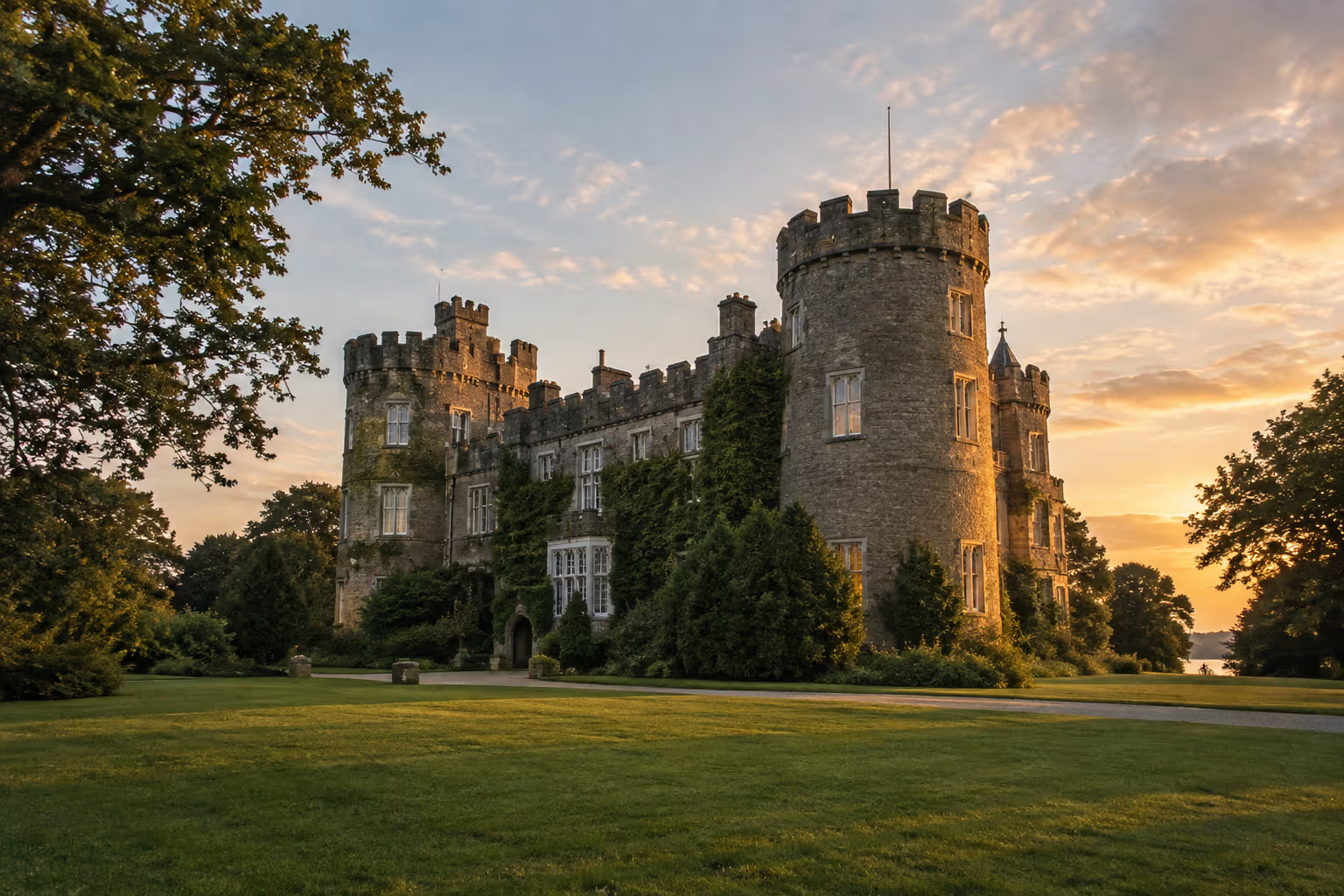
- Cong Abbey, a 12th-century Augustinian ruin on the Mayo-Galway border, near Ashford Castle.
Together these give you a 6,000-year-to-modern arc in a fairly compact touring loop.
Mayo’s towns, food, and pub culture
Westport became my preferred base for exploring county Mayo Ireland. It’s a planned Georgian town with a tree-lined mall and colorful shopfronts - easy to wander, easy to like. I spent evenings in the pubs tapping along to traditional music, including a night at Matt Molloy’s, owned by the Chieftains flautist, where I got swept into a céilí (a traditional Irish social gathering with music and dancing) and made an honest, failed attempt at an Irish jig. The pub didn’t seem to mind.
Castlebar county Mayo Ireland is the county town and the practical inland hub (5)(7). Less scenic than Westport, but efficient for reaching the museums and branching north or south. Ballina, on the River Moy in the north, is your natural base for the Céide Fields, Downpatrick Head, and Achill’s far reaches.
For food, a few things worth seeking out:
Traditional Mayo Dishes to Try
| Boxty | Clew Bay Oysters | Achill Mountain Lamb | Kelly's Black Pudding | |
|---|---|---|---|---|
| Dish | Boxty | Clew Bay Oysters | Achill Mountain Lamb | Kelly's Black Pudding |
| Description | A traditional Irish potato pancake | Fresh, locally-sourced oysters from the bay | Tender lamb flavored by grazing on wild coastal herbs | A savory blood sausage, a Mayo staple |
One etiquette note for the pubs: if you’re near live traditional music, keep the chatter low during the tunes. Sessions aren’t background noise, and locals notice. Tipping in Ireland is modest - rounding up or leaving about 10% at a sit-down meal is standard, and there’s no expectation to tip at the bar for pints.
Things to do in County Mayo Ireland: how to plan your time
Things to do in county Mayo Ireland break cleanly into three trip styles. The smart move is to pick one as your spine rather than cram everything into a couple of frantic days(4)(7).
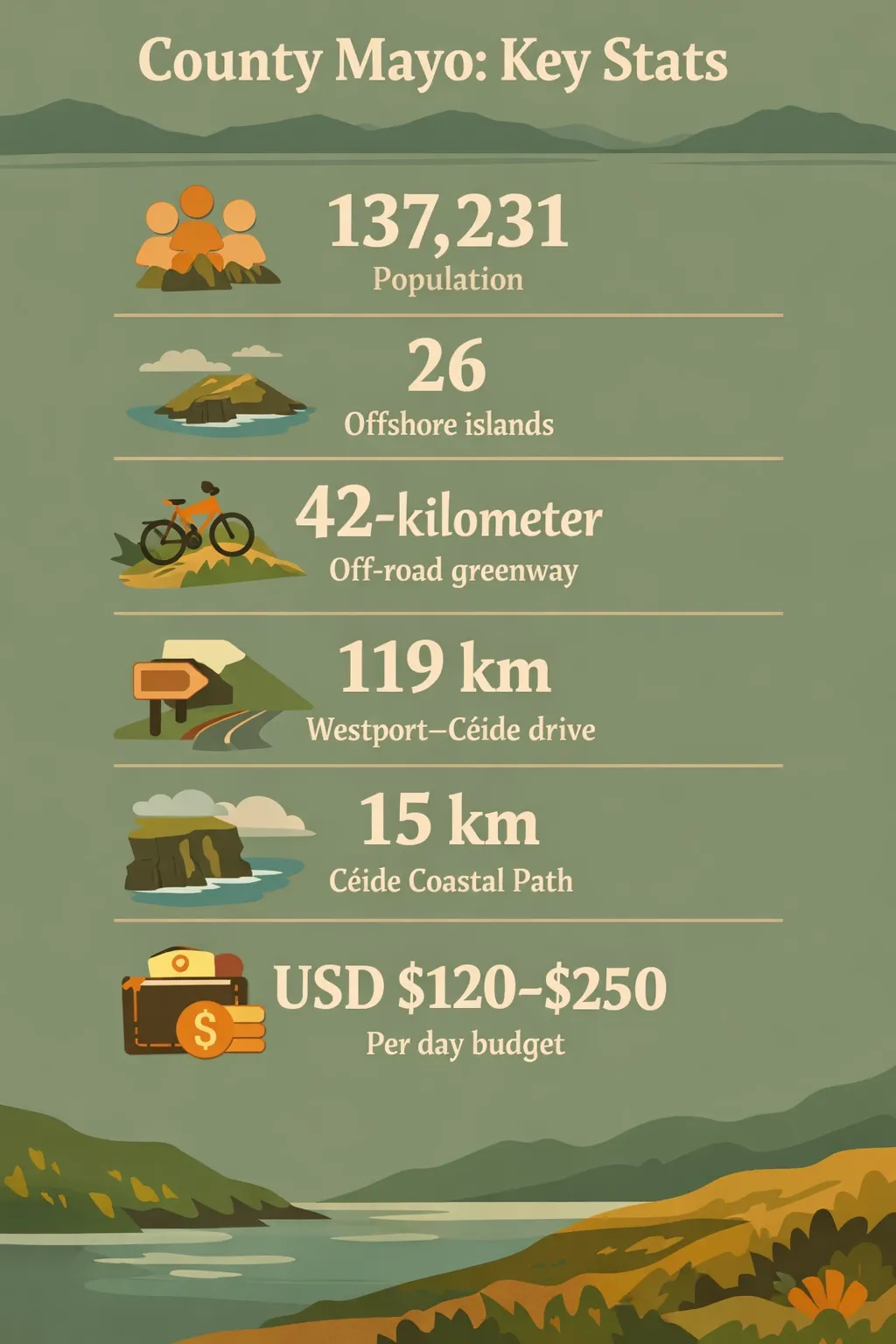 County Mayo at a glance: 137,231 residents (2022), 26 offshore islands, a 42-kilometer Greenway, a 119 km Westport–Céide Fields drive, a 15 km Céide Coastal Path, and a daily budget of USD $120-$250.
First-time / scenic (2 days): Base in Westport or Castlebar. Day one, do Croagh Patrick and Clew Bay with a short section of the Great Western Greenway. Day two, drive out to Achill Island and Keem Strand. This minimizes driving while hitting the county’s best-known scenery.
Outdoor / active (3+ days): Prioritize the full 49 km Greenway, Achill’s beaches and surf, Downpatrick Head, and a day in Wild Nephin. Best fit for cyclists, walkers, and photographers.
Heritage / pilgrimage (2-3 days): String together the Céide Fields, Ballintubber Abbey, the National Museum of Ireland - Country Life, the Jackie Clarke Collection, and Knock. A 6,000-year-to-modern arc in a compact route.
A few pitfalls worth knowing:
- Don’t underestimate drive times. Pairing Achill, Knock, Ballina, and Westport in a single day means rushing all of them (1).
- Don’t skip the weather buffer. Cliff walks and beaches can be unsafe or just visually flat in wind and low cloud. Keep an indoor stop - a museum, a distillery - in your back pocket(9).
- Don’t treat Mayo as one town. It’s a distributed landscape of cliffs, islands, beaches, and heritage sites. One-base trips leave you driving too far each day.
Frequently Asked Questions
- What is County Mayo known for?
- County Mayo is known for its Wild Atlantic Way scenery and pilgrimage heritage, including Achill Island, Knock Shrine, and the Céide Fields.
- Is County Mayo, Ireland Catholic or Protestant?
- County Mayo is historically a strongly Catholic-majority county, reflected in its pilgrimage sites and medieval abbeys.
- What Irish clans are from County Mayo?
- The dominant clans include the Burkes (Mac William Íochtar), O'Malleys, O'Dowds, and Barretts, with Grace O'Malley a notable historical figure.
- What are the Irish surnames in County Mayo?
- Common surnames are Burke, O'Malley, Walsh, Gallagher, Kelly, Duffy, Moroney, and Gibbons, tracing to Norman-Gaelic and native families.
- Do I need a car in County Mayo?
- Yes, a car is necessary due to large distances and limited rail options; 2-3 bases with a rental car is standard.
Final planning notes
Mayo rewards travelers who slow down. Pick your trip style - scenic, active, or heritage - anchor it to two or three bases, and leave a flex day for the weather to do what the Atlantic does. Book Greenway bikes and any guided surf or kayak sessions ahead in summer - rental outfits in Westport or Newport typically fill up on weekends from June through August. If you’re heading to north Mayo, keep an eye on the Céide Coastal Path progress as the 2026-2031 plan rolls out (9). The county’s combination of Neolithic archaeology, Atlantic sea cliffs, and pilgrimage heritage in a single touring loop is genuinely unusual in an Irish context - nowhere else puts a 6,000-year-old field system, Ireland’s highest sea cliffs, and a major Marian shrine within a two-hour drive of each other.
If you have spare days, the Wild Atlantic Way runs on in both directions: Connemara to the south and Sligo to the north are both inside a two-hour drive of Westport.
Come with layers, a windproof shell, and no fixed idea of which day will be the sunny one. That’s the deal on this coast, and it’s a reasonable one.