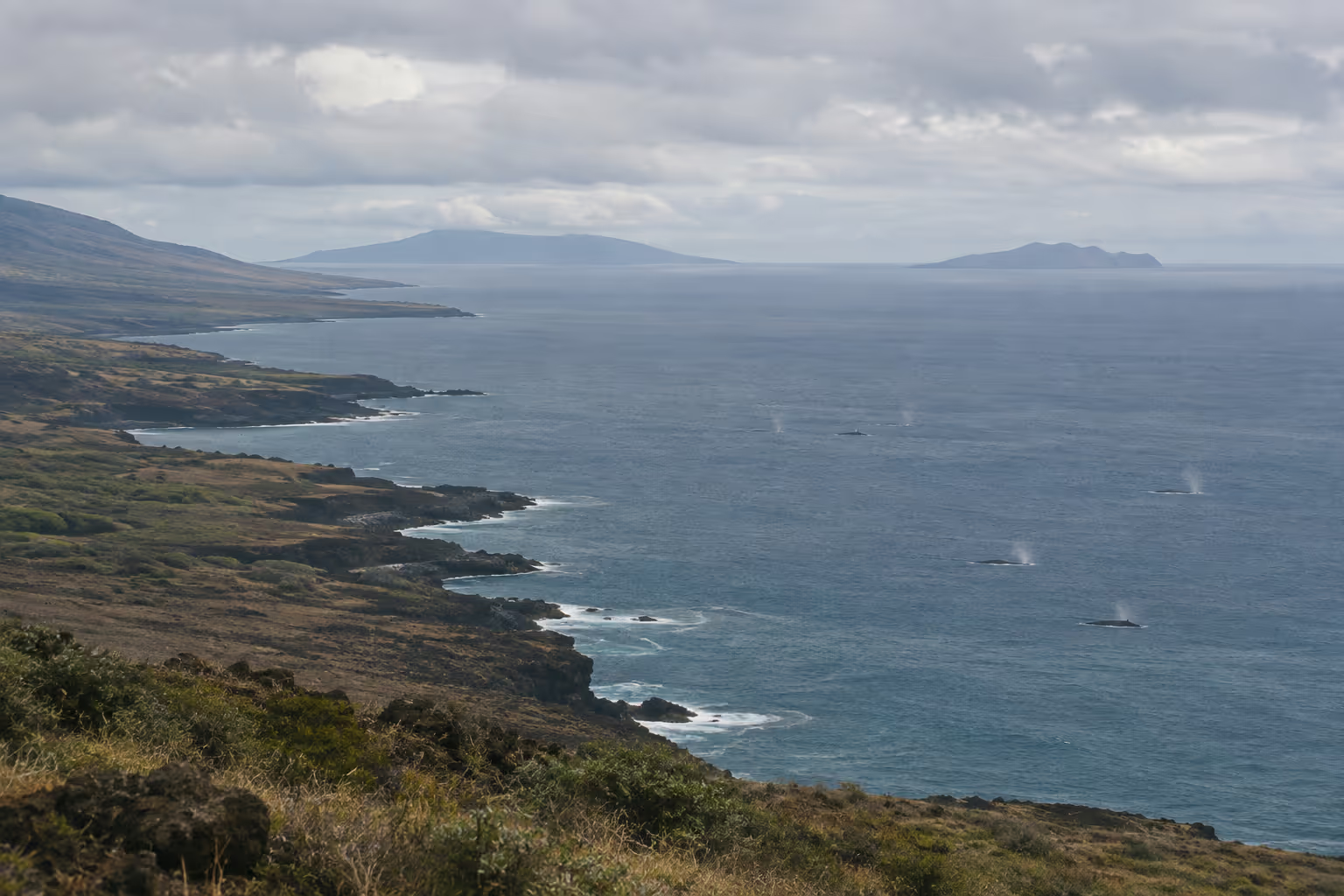
North Pacific humpback whales return to Maui’s shallow coastal waters every winter to breed, give birth, and nurse calves. NOAA puts the Hawaiian season at November through May, with peak abundance January through March (1). That makes Maui whale watching a reliable winter plan, but three things shape your trip: the month you go, whether you watch from a boat or a roadside pullout, and how close the law lets anyone get. The short version: go in February, depart from Mā’alaea Harbor or watch free from McGregor Point, and expect whales at 100 yards (90 m), not alongside the hull.
Humpback Whales on Maui: Why They Migrate Here
Humpback whales come to Maui to mate, give birth, and nurse calves in warm, shallow water (13). Adults feed in Alaskan waters and rely on stored energy during their stay in Hawaiʻi (4). NOAA describes them as acrobatic 45-ton animals, about 41 metric tonnes. The surface behavior that draws people out on boats, such as breaching and tail slaps, also creates hazards for boaters (1).
Depth explains where you will see them. Humpbacks generally gather in water less than 600 feet (183 m) deep around the main Hawaiian Islands (1). Maui sits in a cluster of exactly that kind of water. Hawaiʻi DLNR names the shallow channels between Maui, Lānaʻi, and Molokaʻi as one of the state’s highest concentrations of sightings, along with Kauaʻi’s north coast and the Kohala coast of Hawaiʻi Island (3). Together, those three islands and Kaho’olawe make up Maui Nui. NOAA keeps underwater acoustic recorders there at sites between 15 and 200 m (50-650 ft) deep (12).
Geography is the practical advantage for you. The whales are close to the coastline of the island you are already staying on, so you don’t need a long open-ocean run to reach them, and a whale trip fits around the rest of your things to do in Maui.
You also don’t have to book a boat at all. McGregor Point and Papawai Point are free roadside shore viewpoints between Mā’alaea and Lāhainā, and from either one you can watch whales without paying for a tour (7). Sightings from shore will typically be farther away than from a boat (5), and the law caps every boat at 100 yards (90 m) regardless of the operator (2), so even the pricier charters aren’t buying you a close-up.
Whale Watching Season on Maui: Best Months to Go
The whale watching season on Maui runs November through May (1), and February is the safest single month to book if you can only pick one, because it falls inside both NOAA’s and DLNR’s peak windows (1)(3). Whales may turn up in small numbers in other months, but the reliable window is winter into spring (1). DLNR notes that the first arrivals can reach the main islands as early as September (3).
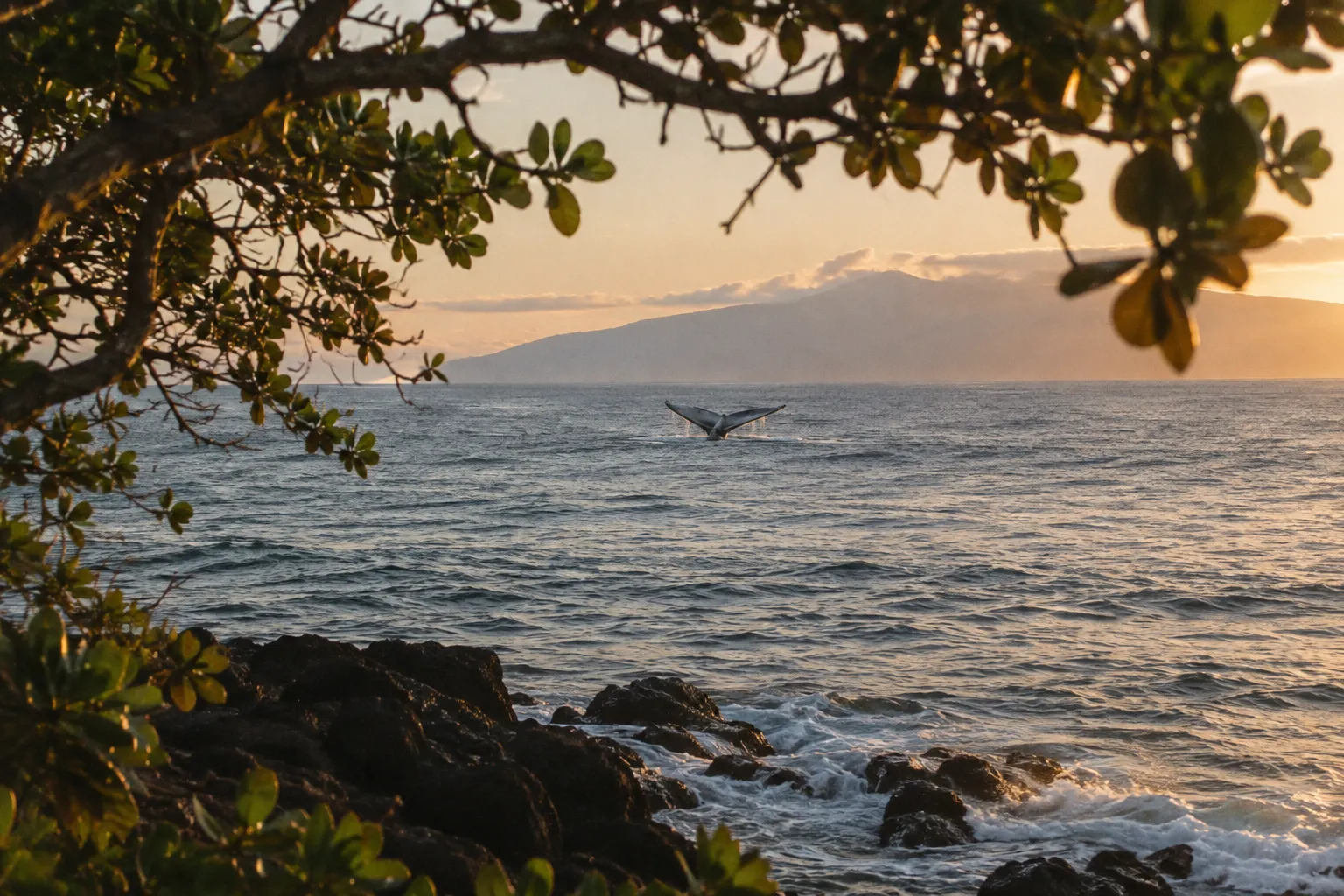
NOAA’s Peak Window vs DLNR’s Peak Window
The two agencies draw the peak slightly differently. NOAA calls January through March the usual peak in abundance (1). DLNR narrows it to January and February (3). February falls inside both windows, so it is the month to target if you have to choose. March still sits within NOAA’s peak, which makes it a reasonable fallback if February fares are too high or your PTO lands later. Late April is a gamble.
Here’s what most guides get wrong: they treat “peak season” as a promise. Sightings depend on wildlife, and even in the peak months nobody controls where or when a whale surfaces. Don’t schedule a shore stop for 10 minutes on the assumption that a whale will surface on cue.
Are whales being seen right now? In November the season is only starting. As of November 2026, Pacific Whale Foundation lists its whale-watch cruises from November 2026 through April 2027 (21), and DLNR says the first whales can reach the islands as early as September (3), but numbers build toward the January-March peak (1). On February 28, 2026, a community-science count logged 847 whales off Maui, the highest tally of any island, with 487 volunteers observing from 46 sites statewide (13). That number reflects one survey day and may include the same whale counted more than once, so it is not a population estimate (13). The broader trend is less encouraging: NOAA estimates the Hawaiʻi humpback population dropped from about 33,000 in 2012 to 26,000 in 2021 (14).
As of November 2026, the 2027 Sanctuary Ocean Counts are scheduled for Saturdays January 30, February 27 and March 27, if you want to volunteer from shore; on Maui, Pacific Whale Foundation runs a similar count (23).
Maui Whale Watching Tours: Where They Leave From Today
Most Maui whale watching tours depart from Mā’alaea Harbor, a central south-shore harbor with several departures a day (6). Some tours launch directly from Kā’anapali Beach (7). Lāhainā Small Boat Harbor, damaged in the 2023 wildfire, is open only to limited commercial ocean operations as of November 2026 (20), so confirm any Lāhainā departure with the operator. From Kīhei, Wailea, Mākena, Pā’ia, Upcountry, Wailuku, and Kahului, Mā’alaea is a short drive (6). If you are staying in Wailea, Kai Kanani departs from there and saves you the drive (7).
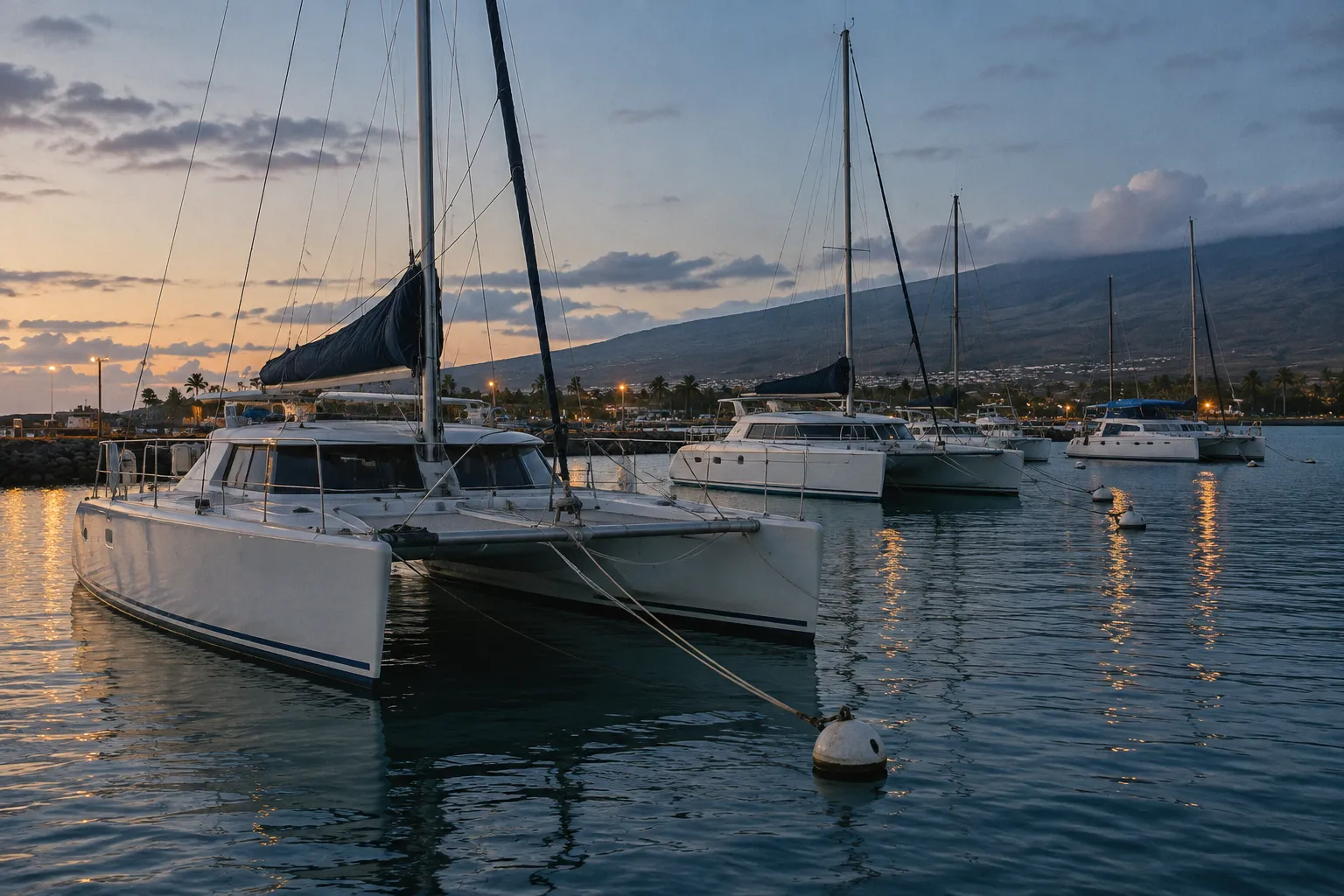
Harbor Check-In vs Beach Departures
At a harbor, you check in at a specific location before boarding a vessel at a numbered slip. Ali’i Nui boards at Slip #56 at Mā’alaea Harbor and asks passengers to check in 15 minutes before its two-hour trip (5). Pacific Whale Foundation wants you 45 minutes early at its Ocean Store in the Mā’alaea Harbor Shops, next to the Maui Ocean Center (6). That is a long lead time, so plan your morning around it.
Beach launches from Kā’anapali work differently. Sea Maui, Gemini Sailing Charters, and Trilogy all leave directly from the sand (7). Expect to wade to the boat, and don’t assume harbor rules apply. Confirm the exact meeting point the day before your trip.
Short Narrated Cruise vs Longer Combined Trip
Rank these by how much time you have:
- Worth prioritizing: the two-hour narrated catamaran. Pacific Whale Foundation’s Classic Whale Watch runs about two hours, with certified marine naturalists on board, and costs $99.05 for adults 13 and over and $55.55 for ages 5 to 12, with children 4 and under free, on the operator’s site as of November 2026, when it also ran a buy-one-get-one-free offer through December 20, 2026 (6). Resellers such as Hawaii Discount list it for less, at $85.00 (15). The company guarantees sightings or a free rebooking on a trip of equal or lesser value within one year (6).
- Worth it on a budget: the Quicksilver two-hour whale-watch cruise from Mā’alaea costs $59.95 for adults 13 and over ($49.95 on the 1:30 p.m. departure) as of November 2026 (19). That is a similar short harbor departure at a lower fare.
- Skip if short on time: the 3.5-hour combined trip. Pride of Maui leaves Mā’alaea at 2:00 pm and pairs whale viewing with a snorkel stop chosen by the captain. It runs seasonally from December 16 to March 31 (4). Book it if you want water time. Skip it if whales are the only goal.
- Small-group option: a six-guest powerboat departs Mā’alaea for anyone who doesn’t want to share a deck with a crowd (15).
Prone to seasickness? Ali’i Nui suggests a non-drowsy remedy an hour before check-in, the 8:00 a.m. departure, and a spot on the open deck where you can see the horizon (5). Larger boats are more stable than small ones (18).
With kids, Pacific Whale Foundation runs a Jr. Naturalist program on board (6), and Quicksilver lets one child 6 or under ride free per paying adult as of November 2026 (19).
Shore Viewpoints: Watching Whales Without a Boat
You can see humpbacks from Maui’s coast for free at McGregor Point and Papawai Point, two roadside viewpoints between Mā’alaea and Lāhainā (7). Both are roadside pullouts, so there is nothing to book (7). McGregor Point also hosts a NOAA whale-counting station (7).
Both stops are easy to add to a drive toward West Maui, and they rank similarly. McGregor Point’s parking fills by 9 a.m. on peak-season weekends, and Papawai Point is usually less crowded (7). If you are staying on the west side, a sunrise stop on the way out costs you almost nothing. For the rest of your packing list, see our Hawaii travel gear guide.
The trade-off is distance. Shore sightings usually happen farther away than encounters from a boat (5). Binoculars turn a distant splash into a recognizable fluke or a mother and calf, so pack a pair. Even on the best boat, though, the legal gap is 100 yards (90 m) (2). The gap between shore and boat viewing is real, but it is smaller than the marketing photos suggest.
These waters are part of the Hawaiian Islands Humpback Whale National Marine Sanctuary. As of November 2026, its visitor center at 726 South Kīhei Road opens Monday to Friday, 9:30 a.m. to 2:30 p.m., closed on federal holidays, and you can sometimes see humpbacks breaching offshore from it (22).
If you’re traveling with kids or a tight budget, start with a shore stop. You may decide a boat trip isn’t necessary.
The 100-Yard Rule and Other Distance Limits
In Hawaiian waters, it is illegal to approach a humpback whale within 100 yards (90 m) by any means on or in the water. That covers boats, swimmers, kayaks, paddleboards, canoes, and drones (2). Aircraft must stay at least 1,000 feet (300 m) away (2). The rule applies year-round, everywhere in Hawaiian waters out to 200 nautical miles (2).
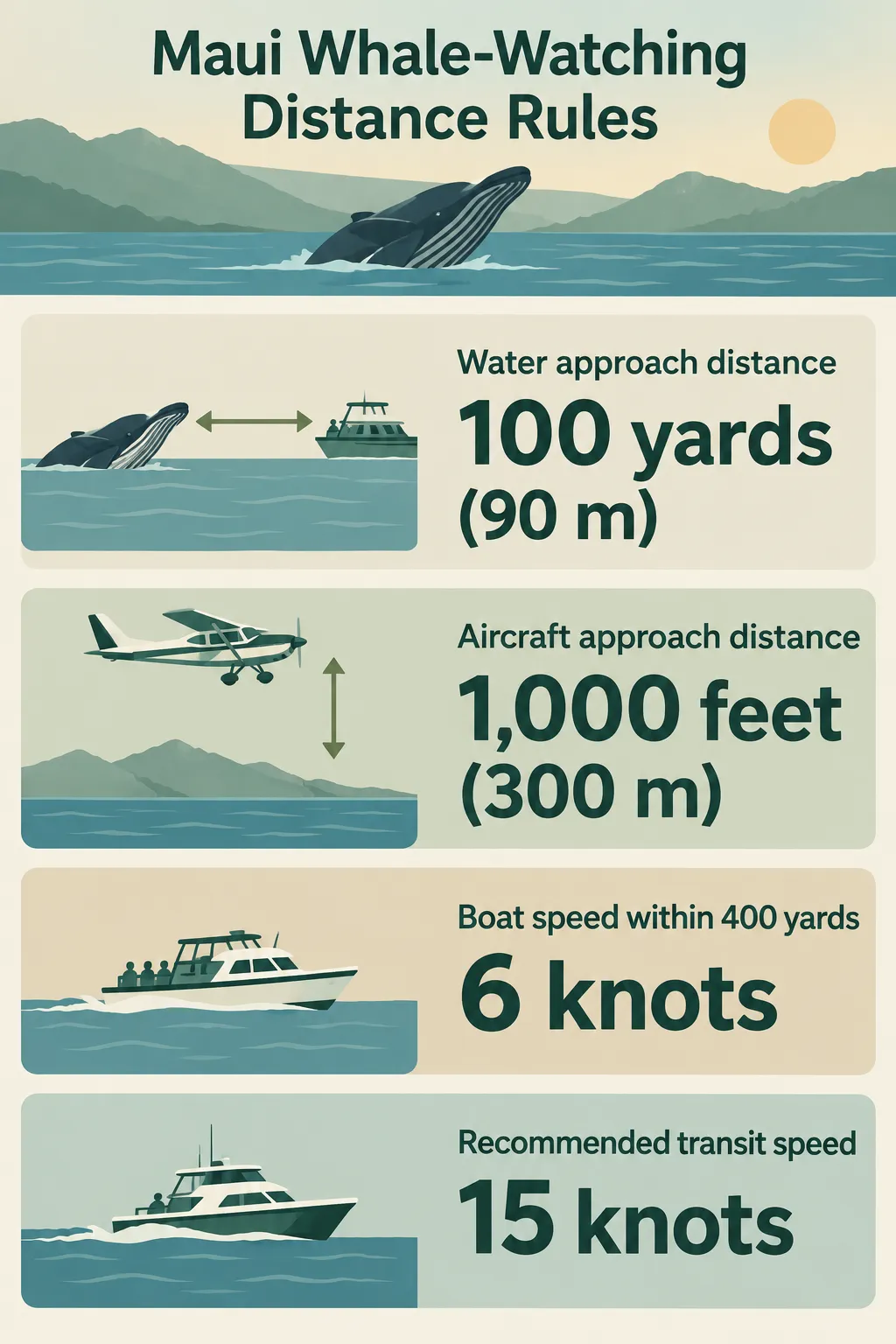 Hawaiian whale-watching rules set a 100-yard (90 m) water approach distance and a 1,000-foot (300 m) aircraft distance, with recommended boat speeds of 6 knots within 400 yards and 15 knots for transit.
NOAA also recommends speed limits for anyone operating a boat:
- No more than 6 knots within 400 yards (366 m) of a whale (1)
- A recommended top transit speed of 15 knots, or safe planing speed (1)
- A dedicated lookout in addition to the operator during whale season, watching for blows, backs, and flukes (1)
The speed figures are guidelines layered on top of the legal approach limit (1). Put together, they mean no legitimate tour can deliver the close, fast approach some advertising implies. If a whale surfaces near a boat that is drifting or stopped, that happens on the whale’s terms. A captain who motors toward a whale inside 100 yards is breaking the law. Report violations to the NOAA Fisheries Enforcement Hotline at 1-800-853-1964 (2).
If you see an injured or entangled whale, keep your distance and call NOAA at 888-256-9840. Don’t try to free it yourself (1).
Whale Songs: What You’ll Actually Hear (and Won’t)
Humpback song travels underwater. From a boat deck or a shore lookout you are unlikely to hear it; tours that lower a hydrophone let you listen (5)(6). From December through April, male song becomes the dominant underwater ambient noise across much of Hawaiʻi. It carries for several miles, which is why NOAA uses it to track whale presence around Maui Nui (12).
A standard narrated cruise without a hydrophone gives you whales to see and nothing to hear. If the sound matters to you, check before you book. Pacific Whale Foundation’s Classic Whale Watch includes underwater hydrophones (6), and Ali’i Nui uses onboard hydrophones on its two-hour catamaran trip (5). The naturalist commentary on these tours explains what you are seeing. The hydrophone is what lets you hear the whales themselves.
Frequently Asked Questions
- Which month is the best single choice for Maui whale watching?
- February is the strongest single-month choice because it falls within both NOAA's and DLNR's peak windows.
- Is Maui or Oʻahu the better island if whale watching is your priority?
- Maui is the stronger choice for whale sightings; DLNR reports more frequent sightings in the Maui-Lānaʻi-Molokaʻi channels than around Oʻahu.
- Are whales being seen around Maui right now?
- In late November the season is just starting: Pacific Whale Foundation opens its whale-watch season in early November, but numbers build toward the January-March peak.
- Which tour should I choose for a smaller group?
- Choose the Mā'alaea powerboat option if a six-guest maximum matters more than a narrated catamaran format.
- Can a whale-watching tour guarantee that I will see a whale?
- Nobody can schedule wildlife, but some operators promise a free rebooking if no whales are seen; Pacific Whale Foundation offers one within a year. Check the specific policy before paying.
- Can I hear whale song from shore?
- Not from a lookout: whale song travels underwater. On a boat, a hydrophone lowered into the water lets you hear it.
- What should I do if a whale surfaces close to my boat?
- Let the whale determine the distance and do not move toward it; the 100-yard approach restriction still applies.
Booking Your Maui Whale Trip
Book February if you can, and January or March if you can’t. Decide early between a boat and the shore. A free stop at McGregor Point or Papawai Point with binoculars may be all you need. If you book a boat, confirm whether it boards at a harbor slip or launches from a beach, check the check-in lead time (15 to 45 minutes, depending on the operator), and ask about a hydrophone if you want to hear the whales. Finally, remember that every legitimate tour stays at least 100 yards (90 m) away, whatever the brochure photo shows.