Hawaii snorkeling tours center on Maui, but the best island shifts with the season, and Oahu’s south shore can beat it in winter. Boat trips run $85 to $275, so for three-plus days in the water, buy your own mask and fins for $40 to $60 and skip the rental line. The experience worth chasing is the Kona night manta ray snorkel, around $99 to $139. And if whale watching matters, come December to March; the rest of the year it is not on offer.
Which Hawaii Island Has the Best Snorkeling Tours?
Short answer: Maui, if you want the most consistent conditions year-round for Hawaii snorkeling tours. The leeward coast around Lahaina and Wailea stays sheltered from trade-wind swell most months, and the water clarity at Molokini Crater is hard to match anywhere else in the state.
That said, “best” depends on what else you want out of the trip:
- Maui - Best year-round snorkeling and the strongest all-around pick for active travelers. Molokini Crater, Honolua Bay, and Turtle Town are all here. Plan 7-10 days to combine snorkeling with hiking and diving.
- Oʻahu - Home to Hanauma Bay, one of the top snorkeling sites in the world, and the easiest island for pairing snorkeling with history at Pearl Harbor. Best for first-timers who want everything within a short drive (2)(7).
- Big Island (Kona) - The only island where you can do the night manta ray snorkel, plus glass bottom cruises and quick access to Volcanoes National Park (6)(9).
One thing most guides get wrong: they name a single “best island” and stop there. In shoulder seasons the ideal island shifts with swell and wind. Oʻahu’s south shore can flatten out beautifully in winter while Maui’s north-facing bays get chewed up. Match the island to the month, not to a static top-10 list.
✓ Pros
- Maui offers consistent snorkeling conditions year-round with multiple top sites.
- Oʻahu combines snorkeling with easy access to historical sites like Pearl Harbor.
- Big Island provides unique night manta ray snorkeling and volcano access.
✗ Cons
- Best island varies by season; no single island is ideal year-round.
- Some islands have more challenging swell and wind conditions in shoulder seasons.
What Guided Snorkeling Charters Cost and What You Get
Boat-based guided snorkeling tours in Hawaii run $85-$275 per person in 2026, depending on the island, boat, and trip length. On Maui, established operators like Trilogy and Gemini sit in that band, with the premium Lanai day trips at $250-$275 per person for a 5-7 hour outing including transit.
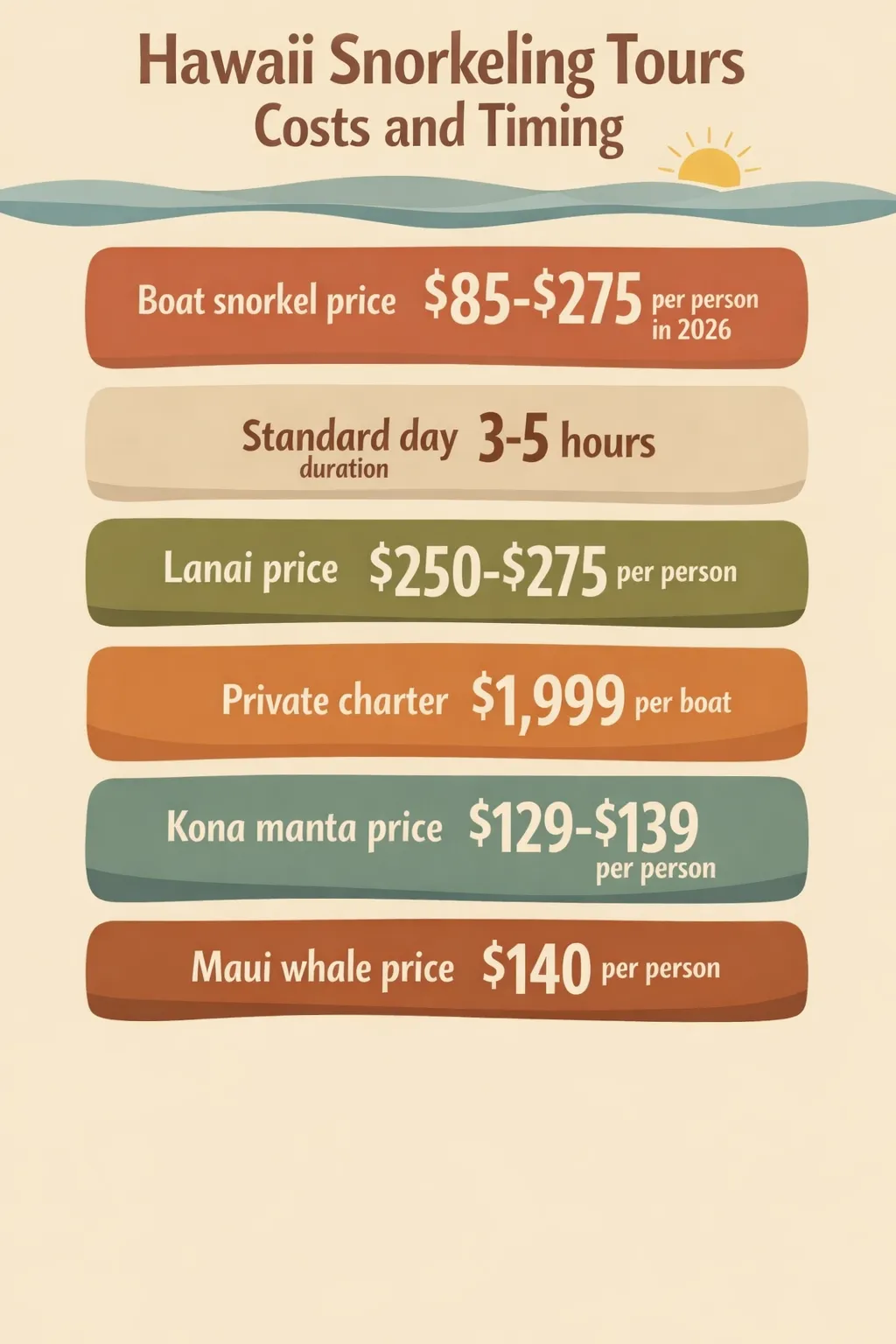 Hawaii snorkeling tours in 2026 cost from $85-$275 per person for boat tours, with Lanai long-haul at $250-$275 per person, private charters up to $1,999 per boat, Kona manta tours at $129-$139 per person, and Maui whale trips at $140 per person, plus standard day snorkel durations of 3-5 hours.
Here’s how the main formats break down:
- Standard day snorkel tour - 3-5 hours, typically $85-$150 per person. Usually two or three reef stops, gear included, sometimes lunch.
- Lanai / long-haul trips - 5-7 hours, $250-$275 per person. More transit, more remote reefs, fewer crowds.
- Semi-private and private charters - You control the timing and the stops. Private manta or snorkel boats can reach $1,999 per boat (1).
A guided trip earns its keep when the good coral is offshore, when you want a captain who knows where the turtles feed, or when you’re bringing kids and want a crew watching the water. But be honest with yourself about whether you actually need one.
What most guides get wrong: they imply you must book a boat to snorkel well in Hawaii. You don’t. Honolua Bay on Maui and Hanauma Bay on Oʻahu are shore-accessible and free (or nearly so), and plenty of travelers report better fish encounters from shore than from a crowded catamaran (2). If you’re on a budget, buy a set and snorkel from the sand first - then add one boat tour for variety, not the other way around.
Kona and the Night Manta Ray Dive
The Kona Hawaii snorkeling tours worth planning your days around are the night manta ray snorkels. Nothing else in the state compares to floating over a light board while manta rays with 12-foot wingspans barrel-roll up to feed on plankton inches below you.
Pricing in 2026 has crept up. Standard manta tours start around $129-$139 per person, with premium options over $160, though some operators still list ranges from $94-$138 and a few budget spots as low as $65 (1). At least one Kona operator advertises adults at $99 with discounted youth and military rates near $95 (8). Private manta charters run up to $1,999 per boat (1).
Trips themselves last 1.5-3 hours - mostly a short boat ride out and roughly 30-45 minutes in the water. A few logistics that matter:
- Book ahead in winter. Manta tours in peak season often sell out several days out (4).
- Non-swimmers can ride along. Many operators offer a ride-along or “stay on the boat” rate around $65-$95, so multi-generational families aren’t stuck on shore (8).
- The mantas aren’t guaranteed. Ask about the operator’s return policy if no rays show - the good ones will re-book you.
I did a Kona manta night snorkel and the ride out was rougher than expected. Take the motion-sickness pill before you leave the harbor, not after.
Glass Bottom Boat Tours in Hawaii for Non-Swimmers
If someone in your group can’t or won’t get in the water, glass bottom boat tours in Hawaii solve the problem. In Kona, a 1-hour cruise runs $50 per adult and $25 per child under 12, with private charters starting around $700 plus taxes and fees (6).
These aren’t a substitute for snorkeling - you’re viewing reef and fish through a hull window, not swimming among them. But they’re the right call for grandparents and toddlers who want to see the reef without gear, anyone recovering from an ear infection, or as a cheap low-commitment intro before committing to a full snorkel tour.
Pair a glass bottom cruise for the non-swimmers with a snorkel tour for the swimmers on the same trip, and nobody ends up stuck in the hotel lobby.
Whale Watching Tours in Hawaii: Timing Is Everything
Whale watching tours in Hawaii only work in winter. Humpbacks migrate to Hawaiian waters roughly December through March, peaking in January and February. Outside that window, don’t book one.
On Maui, 3-hour cruises with the Pacific Whale Foundation run about $140 per person, while shorter 2-hour trips with Maui Ocean Adventures or Hawaii Ocean Rafting run about $80-$90 per person (10). The rafts get you closer to the water and move faster. The larger catamarans are steadier and better for kids and cameras.
The smart move in winter is a combined snorkel and whale-watch trip of 3+ hours, typically $120-$150 per person on current Maui offerings (10). Use the morning light for whale sightings and mid-day sun for underwater photography. You’re paying one boat fee for two experiences.
Pearl Harbor Tours Hawaii and Other Non-Snorkel Days
You can’t snorkel every day without your ears staging a revolt, so build in land days. On Oʻahu, Pearl Harbor tours Hawaii are the obvious anchor. For a broader look at how to structure your time across the islands, the best places to visit in Hawaii guide breaks down each island by trip type and helps you match your itinerary to the right destination.
The catch with Pearl Harbor is access. Independent visitors regularly show up without the timed reservations needed for the USS Arizona Memorial and get turned away. Guided tours advertise guaranteed USS Arizona Memorial tickets plus round-trip transport from Waikiki, which removes the biggest headache (7). Itineraries run 4-8 hours depending on whether they include the USS Missouri, the Pacific Aviation Museum, and a city tour (7).
On the Big Island, Volcanoes National Park Hawaii tours are the counterpart - full-day guided trips to Kīlauea that some operators bundle with volcano photography sessions (9). On Maui, the equivalent land day is sunrise at Haleakalā Crater, which requires a separate reservation you should lock in weeks ahead.
Don’t leave these reservations until you arrive. Both Pearl Harbor and Haleakalā fill up faster than most visitors expect.
When Is the Best Time of Year to Snorkel in Hawaii?
Water stays warm year-round in Hawaii - roughly 75-80°F - so there’s no bad season for the water itself. The real variables are swell, crowds, and price.
Peak season runs mid-December through mid-April and mid-June through August (4). Prices for tours, car rentals, and hotels climb, and popular snorkel tours sell out sooner.
Shoulder months - May, and September through early December - deliver lower prices, thinner crowds, and still-warm water. Booking off-peak can cut total activity costs by 10-30% compared to holiday peaks.
For the calmest snorkeling water, summer (roughly May-September) tends to bring smaller north-shore swells across the islands, which is why many guides point beginners toward those months (4). If you specifically want whales, you’re locked into December-March and should accept the higher prices that come with it.
Should You Bring Your Own Snorkel Gear to Hawaii?
Do the math before you decide. At Hanauma Bay and similar spots, rentals run $15-$25 per day, while a basic personal snorkel set costs $40-$60 to buy (5). The break-even lands around three snorkel days - if you’re snorkeling three or more times, buying wins (5).
Owned gear also gives you a better mask seal, which matters a lot for kids and anyone wearing a prescription mask. It skips the rental line and the hygiene questions. Every major U.S. airline, including Hawaiian Airlines, allows masks, snorkels, and fins in both carry-on and checked bags, so packing a full set from home is straightforward (5). For a complete rundown on what to pack and how to keep costs down, the Hawaii travel tips guide covers gear, airports, and budgeting in one place.
The one case for renting: you’re doing a single boat tour where gear is already included, or you only plan to get in the water once. Otherwise, pack your own.
Building a Realistic Snorkeling Trip Budget
Lead with the number: a snorkel-focused activity budget lands around $430-$500 per person before taxes and tips for a typical mix (4)(10). Here’s how that breaks down:
- One boat snorkel tour: $150
- One Kona night manta snorkel: $130
- One whale-watching trip (winter): $90
- Three days of gear rental - or just buy a set: $40-$60
Three angles depending on your style:
- Budget snorkeler: Buy a $40-$60 set, snorkel Honolua Bay and Hanauma Bay from shore, and add one $85-$120 local boat tour. You’ll spend far less and often see just as much (2).
- Mid-range explorer: One premium Lanai tour ($250-$275), one night manta (about $130), a glass bottom cruise ($50) for non-swimmers, plus $40-$60 for owned gear - roughly $470-$515 per person.
- High-end / photography-focused: Book private charters (up to $1,999 per boat) to control light and timing, add a Haleakalā or Kīlauea photography tour, and budget $600+ per person per activity day (9).
Before finalizing any itinerary, it’s worth reviewing safe adventures in Hawaii’s ocean so you understand how to maintain a respectful distance from marine wildlife and stay out of trouble in the water.
Frequently Asked Questions
- Can you snorkel in Maui while pregnant?
- Many Maui operators accommodate pregnant guests but advise doctor clearance and sticking to calm bays with lifeguards.
- Are glass bottom boat tours a good alternative for non-swimmers?
- Yes, they allow non-swimmers to view reefs without gear, ideal for toddlers, grandparents, or those with ear issues.
- How far in advance should you book manta ray tours in Kona?
- Book several days ahead in peak winter season, as manta tours often sell out quickly.
- Is it necessary to rent snorkel gear on every tour?
- No, buying gear pays off after three uses and avoids rental lines and hygiene concerns.
- Can you combine whale watching and snorkeling in one trip?
- Yes, combined whale-watch and snorkel trips are available in winter, offering two experiences for one boat fee.
- What are the main differences between Maui, Oʻahu, and Big Island snorkeling?
- Maui offers year-round calm waters, Oʻahu pairs snorkeling with history, Big Island has unique night manta ray tours.