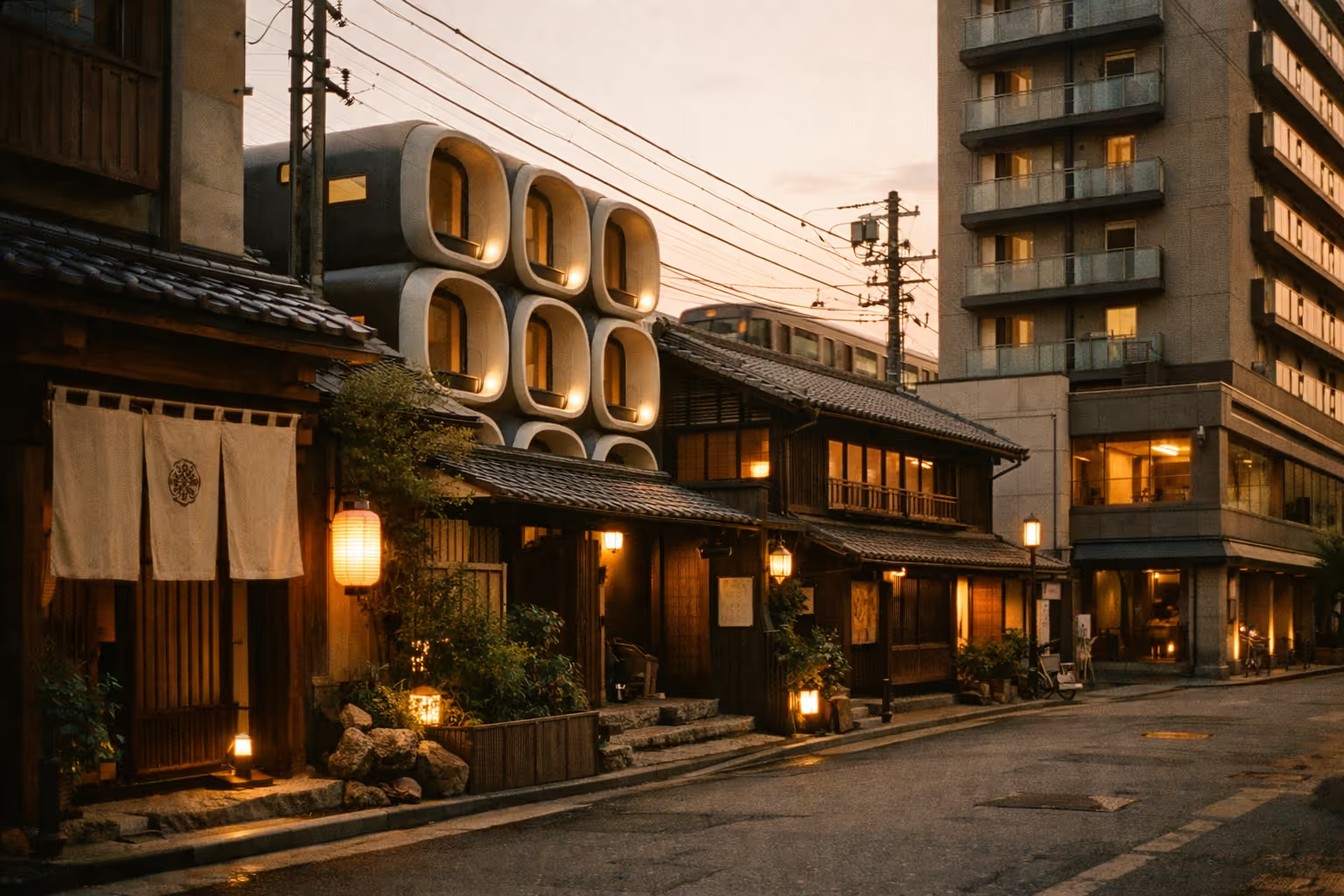
Where to stay in Japan is two decisions: lodging type, and how close to a train line. Sleep within ten minutes of a JR station and the whole country opens up cheaply. Match the type to the trip: a business hotel for city nights, a capsule for solo budget stays, and one splurge on a ryokan with onsen, whose higher rate buys a kaiseki dinner and breakfast for two. Book the ryokan first, because the best rooms for cherry-blossom and foliage weekends sell out nine months ahead.
Which area is best for where to stay in Japan?
Deciding where to stay in Japan can be tricky since it depends on whether you’re focusing on a city or a neighborhood. However, here’s the working consensus from people who plan Japan trips professionally.
For your first trip overall: Tokyo as your primary base (4-5 nights), Kyoto second (3-4 nights), Osaka third (2-3 nights). Tokyo gives you the largest range of hotels at every price point, the densest transit, and the best day-trip options.
Inside Tokyo, the most-recommended areas for first-timers are Shinjuku, Shibuya, Ginza, Tokyo Station/Marunouchi, and Asakusa (1)(2)(4). Each has a clear personality:
- Shinjuku - the single most-recommended first-timer base. It sits on the JR Yamanote Line, has the most hotel inventory in the city, and puts you near nightlife, department stores, and the Shinjuku Gyoen gardens. The trade-off is crowds and neon overload around the station.
- Shibuya - younger energy, fashion, the scramble crossing, easy access to Harajuku and Omotesando. Slightly fewer mid-budget options than Shinjuku.
- Ginza - upscale, quieter at night, well-connected, strong for the boutique and luxury tier. Better for couples than for backpackers.
- Tokyo Station / Marunouchi - unbeatable for shinkansen day trips and for travelers who want a calm, business-district base. Limited street-level character after dark.
- Asakusa - traditional feel, Sensō-ji temple, lower nightly rates, and good for families. Weaker for nightlife and slower commutes to the west side.
Inside Kyoto, the practical bases are Downtown Kawaramachi/Gion for atmosphere and walkable dinner options, Kyoto Station for transit efficiency and bigger rooms, and Arashiyama for quieter ryokan-style stays near the bamboo grove.
Inside Osaka, Namba suits travelers who want food, Dotonbori, and nightlife at their doorstep, while Umeda wins for shinkansen access and shopping (6).
One rule worth memorizing: pick a property within a 5 to 10 minute walk of a JR or subway station. Anything beyond 15 minutes plus transfers will feel punishing after a 20,000-step sightseeing day. I stayed 20 minutes from Kyoto Station on one trip and spent the equivalent of a decent lunch on taxis every single day.
Overview of Japan accommodation types
The Japanese hospitality market has more distinct japan accommodation types than almost any country, and the price spread between them is significant. Here’s what you’re actually choosing between, with typical 2024 nightly rates. For the more unconventional end of the spectrum - temple stays, robot hotels, ski chalets, and Okinawa island bungalows - see the companion guide to unique places to stay in Japan.
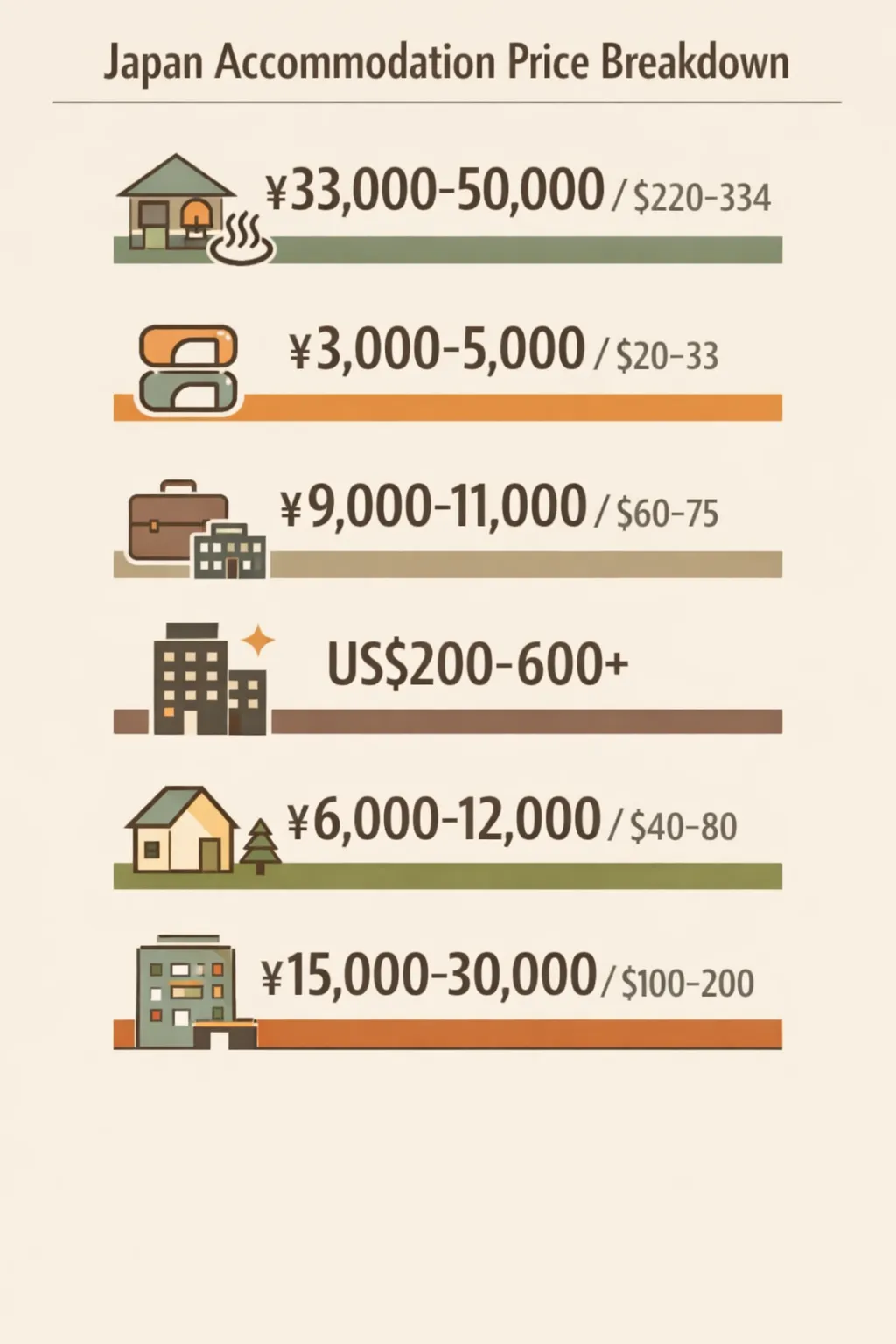 Nightly price ranges by accommodation type in Japan: capsule hotels ¥3,000-5,000 / $20-33; ryokan with onsen ¥33,000-50,000 / $220-334; business hotels ¥9,000-11,000 / $60-75; Western-style & luxury US$200-600+; minshuku & guesthouses ¥6,000-12,000 / $40-80; aparthotels ¥15,000-30,000 / $100-200.
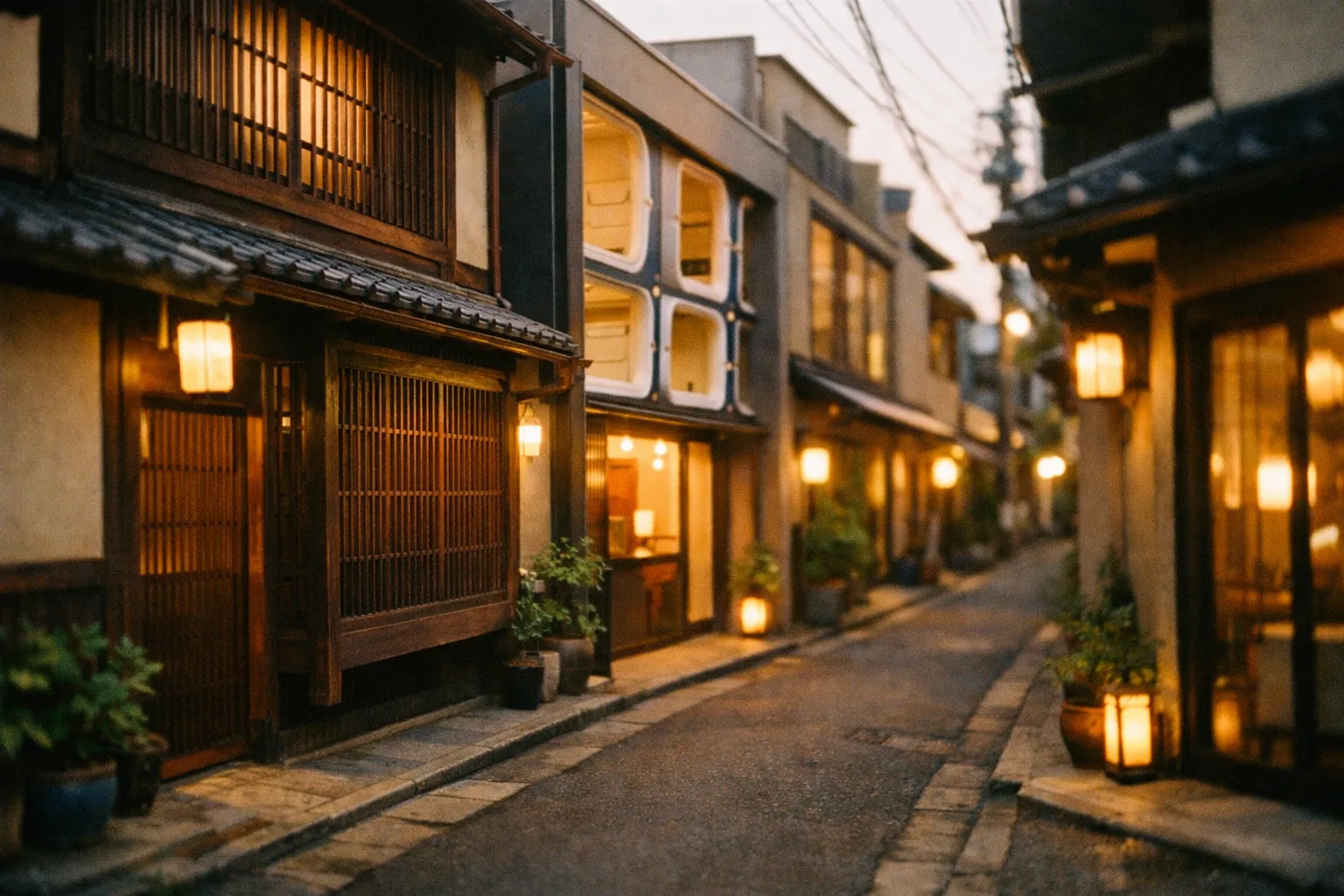
Japan Accommodation Types Overview
| Business Hotels | Western-style and Luxury Hotels | Ryokan with Onsen | Minshuku and Guesthouses | Temple Lodging (Shukubō) | Capsule Hotels | Apartment Hotels / Aparthotels | Hostels | Love Hotels | Manga Kissa / Internet Cafés | |
|---|---|---|---|---|---|---|---|---|---|---|
| Price Range (JPY / USD) | ¥9,000-11,000 / $60-75 | US$200-600+ | ¥33,000-50,000 / $220-334 | ¥6,000-12,000 / $40-80 | ¥10,000-20,000 / $66-133 | ¥3,000-5,000 / $20-33 | ¥15,000-30,000 / $100-200 | ¥3,000-4,000 / $20-27 (dorm) | ¥8,000-15,000 | ¥1,500-3,000 / $10-20 |
| Typical Room Size | 13-18 m² | 30-50 m² | Tatami rooms | Varies, simpler | Tatami rooms | Single sleeping capsule | 30-50 m² with kitchenettes | Dorm beds or private rooms | Themed short-stay rooms | Reclining-chair cubicles |
| Meals Included | Breakfast (usually) | Varies, concierge service | Dinner & Breakfast | Breakfast (home-cooked) | Vegetarian Buddhist cuisine | None | None | None | None | Showers extra |
| Typical Location | Near major stations | Marunouchi, Roppongi, Ginza, Minato, Shijo | Onsen towns like Hakone, Kinosaki | Rural and mountain towns | Koyasan | Urban centers, near stations | City neighborhoods | Asakusa, Kuramae, others | Urban areas | Near stations |
Business hotels (¥9,000-11,000 / US$60-75 per room)
Chains like Toyoko Inn, APA, Super Hotel, and Route Inn dominate this category. Rooms are compact (often 13-18 m²), the bed is a semi-double or double, the bathroom is a molded plastic unit, and breakfast is usually included or available as a cheap add-on. Reliable, clean, near every major station, and the workhorse choice for most multi-city trips (3). Not glamorous, but they do the job without drama.
Western-style and luxury hotels (US$200-600+)
International brands - Hyatt, Hilton, Marriott, Ritz-Carlton, Four Seasons, Aman - cluster in Marunouchi, Roppongi, Ginza, and Minato in Tokyo, and along Shijo and Kyoto Station in Kyoto. Rooms are larger (30-50 m²), and concierge service is the real differentiator at this tier. Aman Tokyo in Otemachi is the often-cited splurge benchmark (4).
Ryokan with onsen (¥33,000-50,000 / US$220-334 per room)
Traditional inns with tatami floors, futon bedding rolled out at night, and a multi-course kaiseki (Japanese haute cuisine) dinner served in your room or a private dining space (3). The price typically covers dinner and breakfast for two. Onsen towns with the deepest ryokan inventory: Hakone (closest to Tokyo, easy half-day approach), Kinosaki Onsen in Hyogo (a seven-bath town where you walk between baths in yukata, a lightweight cotton robe), Kusatsu in Gunma, Noboribetsu in Hokkaido, and Yufuin and Beppu in Kyushu.
Minshuku and guesthouses (¥6,000-12,000 / US$40-80)
Family-run, simpler than ryokan, often with shared bathrooms and a home-cooked breakfast. Common in rural areas and small mountain towns. Good for cultural exchange if your hosts speak some English.
Temple lodging or shukubō (¥10,000-20,000 / US$66-133)
You sleep in a working Buddhist temple, eat shōjin ryōri (vegetarian Buddhist cuisine), and can often join morning prayers. Koyasan in Wakayama is the easiest place to try this - dozens of temples accept overnight guests. When I stayed at Koyasan in November 2023, the morning ceremony started at 6 a.m. and the cedar forest around the Okunoin cemetery was still in mist. Worth the early alarm.
Capsule hotels (¥3,000-5,000 / US$20-33)
The futuristic pod stay invented in Osaka in 1979. You get a single sleeping capsule with a light, a power outlet, sometimes a small TV, and shared bath and locker areas. Modern capsule hotels have moved upmarket - chains like Nine Hours and First Cabin now have female-only floors, private showers, co-working zones, and design that wouldn’t look out of place in a boutique hotel.
Apartment hotels and aparthotels (¥15,000-30,000 / US$100-200)
The MIMARU brand in Asakusa and other Tokyo neighborhoods is the most-cited example for families and small groups (1). Rooms run 30-50 m² with kitchenettes, washer/dryers, and multiple beds - a different value equation than cramming four people into a Western hotel room.
Hostels (¥3,000-4,000 / US$20-27 per dorm bed)
Japan’s hostel scene punches above its weight. Properties like Khaosan, Nui, Wise Owl, and Book and Bed have dorm beds with privacy curtains, well-designed common areas, and cafes attached. Private rooms in hostels typically run ¥8,000-14,000.
Love hotels
Themed short-stay rooms originally designed for couples seeking privacy. Many will rent overnight after 10 p.m. for ¥8,000-15,000 if you can navigate the (often automated, sometimes Japanese-only) check-in. Novelty value rather than a serious recommendation.
Manga kissa / internet cafés (¥1,500-3,000 / US$10-20)
Reclining-chair cubicles in 24-hour internet cafés. Last-resort accommodation if you miss the last train. Showers are usually available for a small extra fee. Not recommended unless the alternative is sleeping on a station bench.
Boutique hotels in Japan: where design beats square footage
The boutique hotels japan scene has matured considerably over the past decade, and it overlaps heavily with the question of finding the best places to stay in Japan for travelers who want character over square footage. In Tokyo, the densest boutique clusters are in Shibuya, Ginza, and Minato (Roppongi, Azabudai, Shiba Park), with properties like Park Hotel Tokyo - each room designed by a different artist around a Japanese theme - Trunk Hotel in Shibuya, and the Hoshinoya properties in Otemachi blurring the line between boutique and luxury (1)(4).
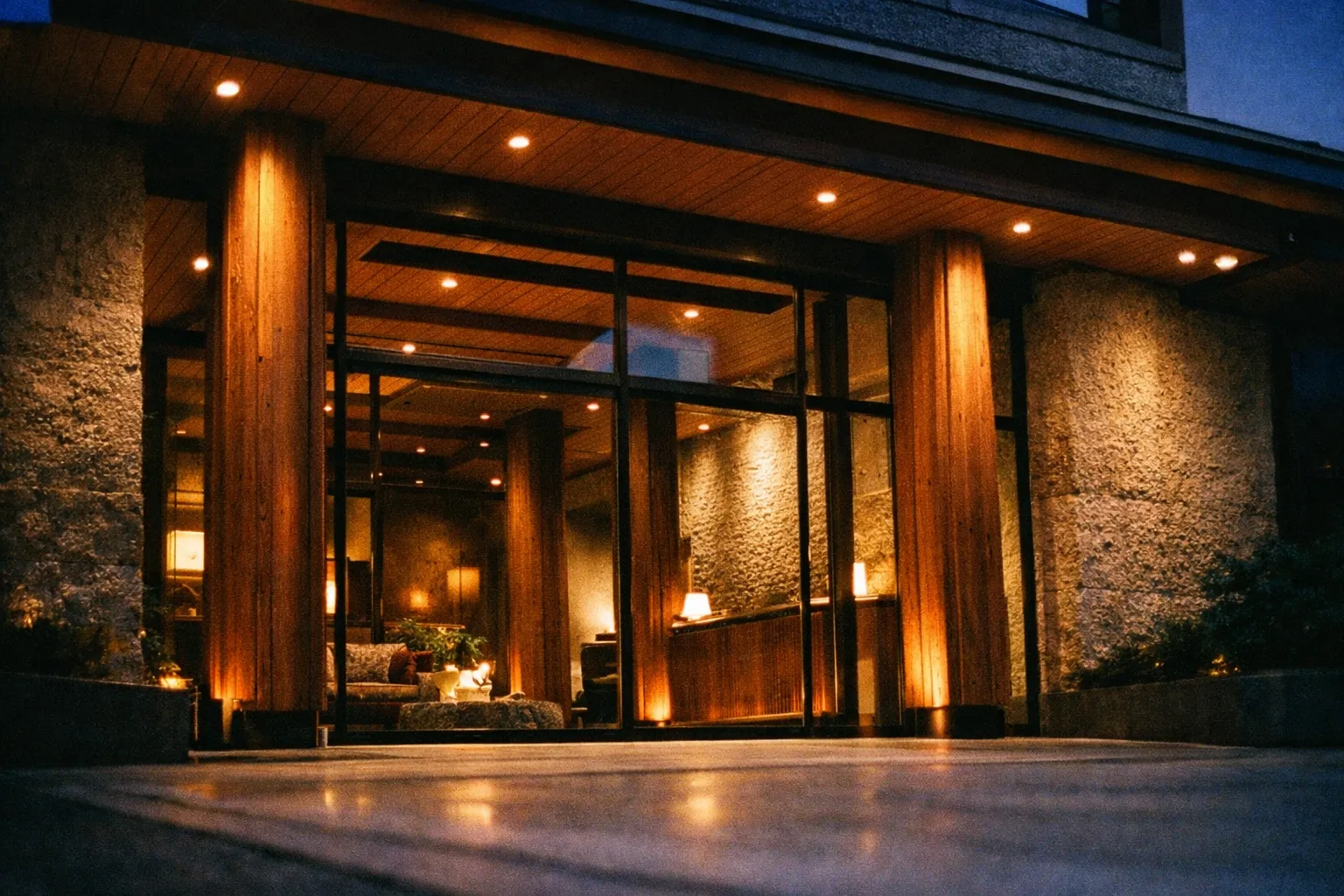
In Kyoto, the boutique conversation revolves around machiya (restored traditional wooden townhouses) turned into small inns of 6 to 15 rooms, mostly clustered around Gion, Higashiyama, and Nishijin. Nightly rates for boutique stays in Tokyo and Kyoto typically run US$150-350, with design-forward Kyoto machiya stays creeping toward US$400 in peak sakura and autumn-foliage weeks.
One practical note: boutique hotels in Japan often run on smaller staff than international chains. Check-in windows can be tight - some end at 9 or 10 p.m. - reception may close overnight, and house rules (no shoes past a certain point, quiet hours starting at 10 p.m.) are taken seriously. Read the policies before you book a late flight.
What you’re actually paying for in a ryokan with onsen
A ryokan with onsen is the single accommodation experience most worth budgeting for, even if you only do one or two nights. Here’s what the ¥33,000-50,000 room rate actually covers:
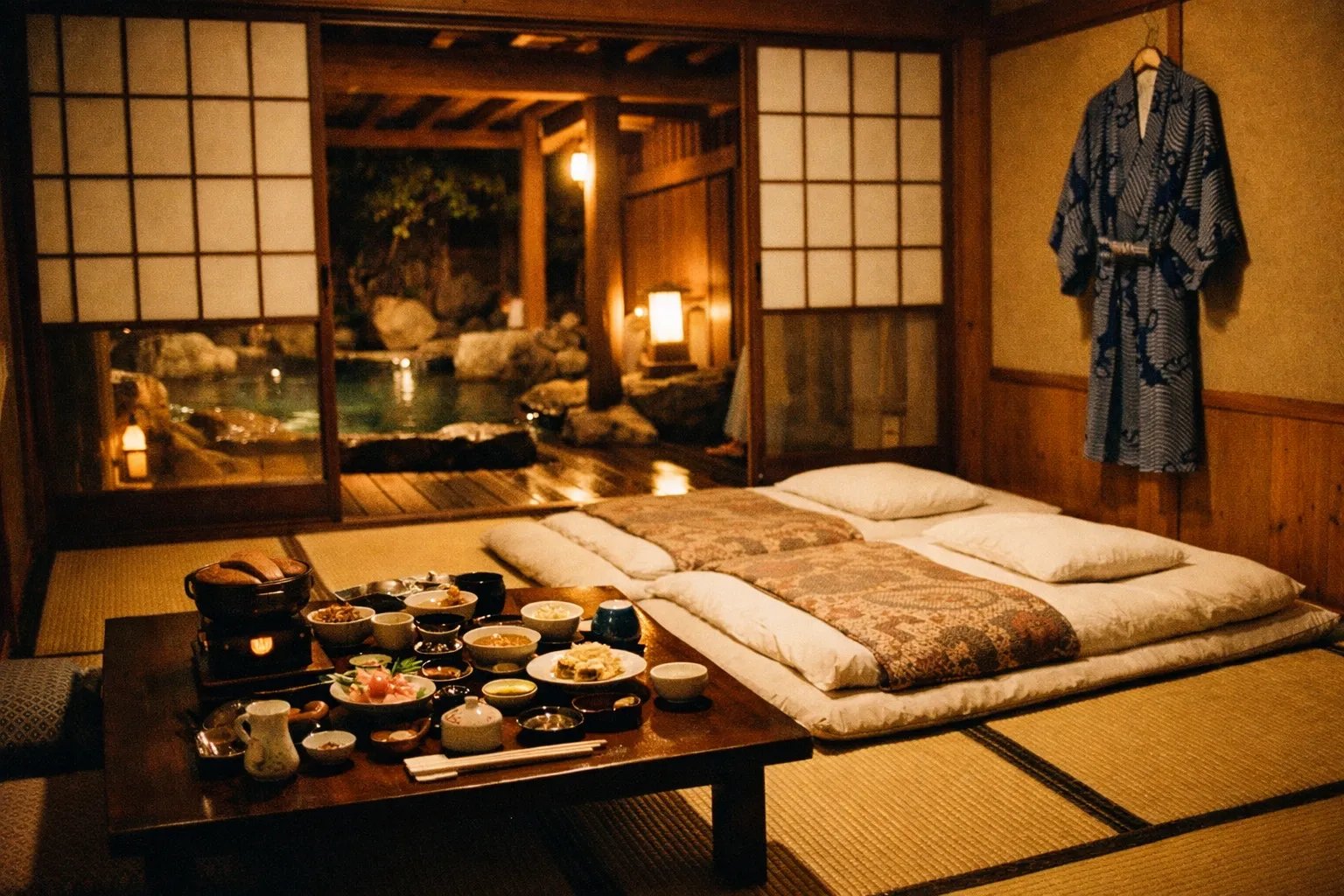
- A tatami room with low table, floor cushions (zabuton), and futons laid out by staff after dinner.
- A yukata and obi sash to wear around the property and to the baths.
- Kaiseki dinner - a multi-course seasonal meal of 8 to 14 small dishes, usually served either in your room or in a private dining room.
- Japanese breakfast - grilled fish, rice, miso soup, pickles, tamagoyaki (rolled egg omelette).
- Onsen access - either communal baths (segregated by gender), private bookable baths, or, at higher-end ryokan, an in-room rotenburo (open-air bath).
Onsen etiquette is non-negotiable. Wash and rinse thoroughly at the seated showers before entering the bath. The small towel never touches the water - fold it on your head or set it at the edge. Bathing is nude. Tattoos remain restricted at many traditional onsen, though private bookable baths and an increasing number of tattoo-friendly properties (especially in Hakone and Kinosaki) work around this. If you have any tattoo, search “tattoo-friendly ryokan” before booking.
For a first ryokan night, Hakone is the easiest call from Tokyo - about 90 minutes via the Odakyu Romancecar - and has properties ranging from ¥25,000 to over ¥150,000 per night. Kinosaki Onsen rewards a longer trip with its seven-bath town setup. Kurokawa Onsen in Kumamoto is the Kyushu standout for atmosphere.
Who capsule hotels in Japan actually suit
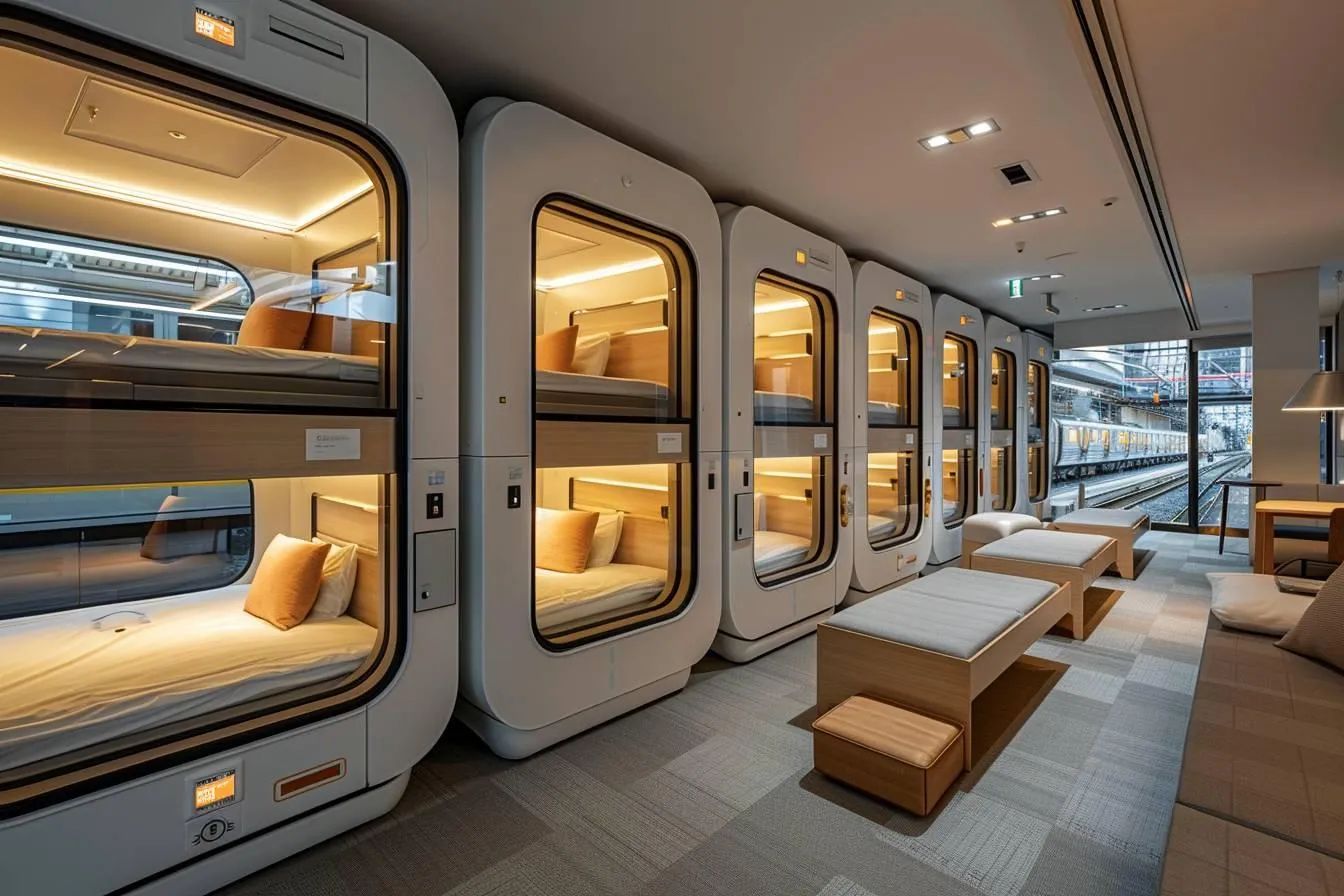
The capsule hotel japan experience is worth trying once, but pick the property carefully. The 1979-era image of cramped tubes for tired salarymen is mostly obsolete - modern capsule hotels are clean, design-conscious, and often more comfortable than budget hostels.
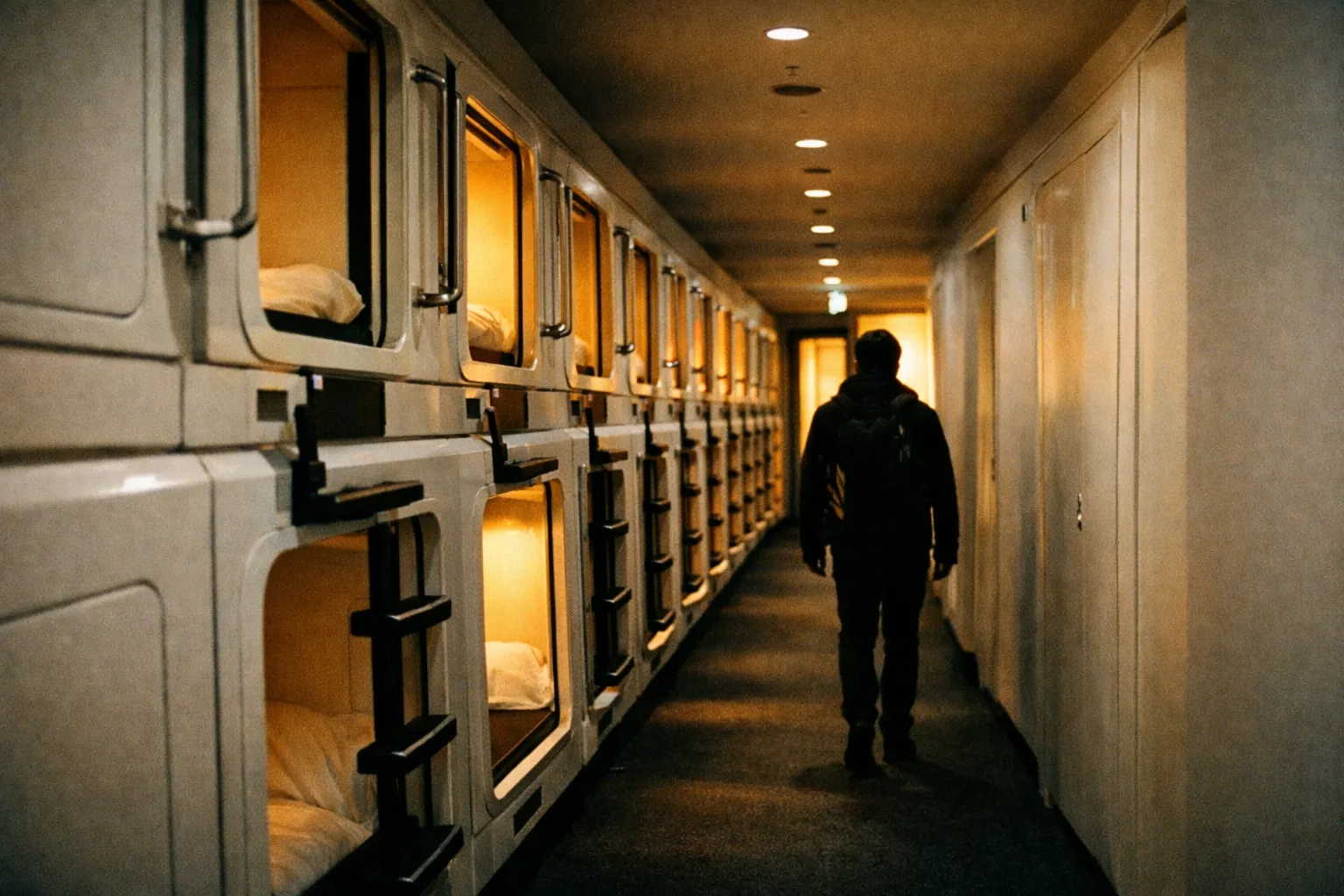
They genuinely suit:
- Solo travelers on tight budgets who want privacy at hostel prices.
- Late-night arrivals who need a bed near a train station for one night.
- Travelers using a city as a daytime base between intercity trips - most capsule hotels charge a daytime use fee if you want to nap, since check-in is usually 3 p.m. and check-out 10 a.m.
They do not suit:
- Couples who want to sleep in the same space - capsules are individual and most properties are gender-segregated by floor.
- Travelers with large luggage - storage is usually a small locker, not a full closet.
- Anyone sensitive to noise - fabric or thin sliding panels separate you from neighbors. Earplugs help; soundproofing does not exist.
For a comfort upgrade at similar pricing, consider a business hotel single room at ¥6,000-10,000 (US$40-70). You get a private room, a private bathroom, and no shared shower line in the morning.
Is $5,000 enough for a week in Japan?
For most travelers, yes. Here’s what a realistic seven-night budget for two people looks like at mid-range, using current rates.
Accommodation: Mid-range business or boutique hotels at US$120-180 per night for a double room × 7 nights = US$840-1,260. Sub in one or two nights of luxury ryokan at US$300 and you’re at US$1,200-1,600.
Transport:
- Tokyo metro/JR daily use: about US$8-12 per person per day = US$112-168 for two over a week.
- One round-trip shinkansen Tokyo-Kyoto: about US$200 per person = US$400 for two.
- Optional 7-day JR Pass: US$340 per person at current rates - only worth it if you’re doing more than one long shinkansen trip.
Food: US$30-50 per person per day at a mix of conbini (convenience store) breakfasts, ramen lunches, izakaya (Japanese pub) dinners = US$420-700 for two over seven days. Add one splurge sushi dinner (US$150-300 for two) and you’re at US$570-1,000.
Sightseeing and incidentals: US$200-400 covers temple admissions, museums, day-trip transit, and the inevitable Don Quijote run.
Mid-range total for two: roughly US$2,500-3,800, leaving US$1,200-2,500 of headroom in a $5,000 budget. That headroom is your splurge fund - a kaiseki dinner in Kyoto, a Hoshinoya night, a private onsen ryokan, or extra shopping.
For one solo traveler, $5,000 for a week is generous enough to stay in luxury hotels most nights, or to mix three- and four-star stays with several high-end meals. The main thing that breaks the budget is peak-season pricing during cherry blossom (late March to early April) and autumn foliage (mid-November), when room rates can double.
What $5,000 does not cover: international flights, which run US$900-1,800 round trip from North America depending on season and origin.
What is the 3-1-1 rule in Japan?
The 3-1-1 rule is a U.S. TSA term for an aviation security standard - Japan and the EU use the same underlying limits but do not use that label. At Japanese airports, the rule is framed as the 100 ml / 1-liter bag standard: each liquid container must hold 100 ml or less, all containers must fit inside one clear 1-liter resealable plastic bag, and each passenger is limited to one such bag. The practical result at the security lane is identical to what U.S. travelers are used to.
For carry-on liquids on flights into and within Japan:
- Each container must hold 100 ml (3.4 oz) or less.
- All containers must fit inside one clear 1-liter resealable plastic bag.
- Each passenger is limited to one such bag.
Toiletries, sunscreen, perfume, drinks, gels, and yogurt-like foods all count as liquids. Anything larger goes in checked luggage. Japanese domestic flights apply the same rule. Convenience stores past security sell anything you had to throw out, often cheaper than at the airport.
If you’re traveling between Japanese cities by shinkansen instead of flying, the rule doesn’t apply - trains have no liquid restrictions, and you can carry the giant bottle of conbini umeshu (Japanese plum wine) home in your suitcase without issue.
What is the 5-minute rule in Japan?
The 5-minute rule is informal travel shorthand for Japan’s punctuality culture: arrive at any scheduled departure - train, bus, organized tour, dinner reservation - at least five minutes early, because nothing waits for you.
Japanese trains are famously precise. JR’s shinkansen lines average annual delays measured in seconds. If your ticket says 9:14 departure, the doors close at 9:14:00 and the train pulls out at 9:14:00. There is no last-call announcement and no grace period.
This extends to:
- Organized day tours and bus tours - operators publish that latecomers will be left and they mean it. No refund.
- Restaurant reservations - being more than 10 to 15 minutes late, particularly at smaller kaiseki, sushi, or omakase counters, may forfeit your seat. Call if you’re going to be late.
- Onsen and ryokan dinner times - if dinner is set at 6:30, staff will start serving at 6:30. Showing up at 7:00 is rude and disrupts the kitchen.
- Check-in windows - boutique and ryokan check-in often closes at 8 or 9 p.m. Message the property in advance if your train arrives later.
The five-minute buffer is the floor, not the target. For shinkansen with reserved seats, 10 minutes is more comfortable - platforms can be long, and finding your specific car (cars 1-16, with numbered floor markings showing where the doors will open) takes a minute.
A booking strategy that actually works
Most of the avoidable mistakes in Japan accommodation come from booking the wrong way or at the wrong time. A workable system (5):
Book accommodation 6 to 12 months ahead for peak seasons (late March through mid-April for cherry blossom, mid-October through November for autumn foliage, late December through early January for New Year, and Golden Week from April 29 to May 5). Top ryokan and boutique properties in Kyoto and Hakone sell out 9 to 12 months ahead for sakura weekends. I’ve watched good Hakone ryokan fill up in January for the following April. Don’t test this.
For shoulder seasons (late May, June, September, early December), 2 to 4 months ahead is usually enough.
Cross-check Rakuten Travel and Jalan against Booking.com and Agoda. The Japanese-language sites - easily readable with browser translation - often surface meal-inclusive ryokan plans and member discounts that don’t appear on global OTAs.
Filter for ratings ≥ 8.0 and free cancellation as your default. Free cancellation matters because you’ll almost certainly tweak your itinerary as you research, and Japan’s mid-tier inventory turns over fast enough that you can usually rebook at a similar price.
Check the walking distance from the station yourself, in Google Maps, not on the booking site. Some properties list “8 minutes from Shinjuku Station” measured from the nearest exit - and Shinjuku Station has over 200 exits. The walk can easily double if you exit on the wrong side.
Watch room size in the listing. Tokyo doubles often come in at 15 to 18 m². If the listing doesn’t state square meters, ask the property - many listings hide compact rooms behind generic photos.
Matching accommodation to traveler type
A quick framework for picking the right mix.
First-timers wanting maximum convenience - Tokyo: Shinjuku or Shibuya business hotel or mid-tier boutique. Kyoto: Kyoto Station hotel or Downtown Kawaramachi machiya. Osaka: Namba or Umeda business hotel(4).
Couples and honeymooners - Two nights of boutique in Tokyo (Ginza or Minato), three nights in Kyoto (Gion machiya), and one or two splurge nights at a Hakone or Kinosaki ryokan with a private onsen.
Families and groups of 3-5 - Apartment hotels with kitchenettes (MIMARU in Asakusa or Ueno is the most-cited brand), or two adjoining business hotel rooms. Stay near a station with a Don Quijote and a supermarket for breakfast supplies (1).
Solo travelers on a budget - Mix hostel private rooms (¥8,000-12,000) with one or two capsule nights for the experience, and one ryokan night as a trip centerpiece. Hostels in Tokyo’s Asakusa and Kuramae neighborhoods have the strongest atmosphere.
Digital nomads on longer stays - Aparthotels or weekly-rate business hotels. Shibuya, Nakameguro, and Sangenjaya in Tokyo have the best café-and-coworking density. Kyoto’s Karasuma district works for a slower pace.
Cultural-focus travelers - Two or three nights of ryokan plus one shukubō night at Koyasan. Pair with traditional bases like Gion in Kyoto or Hida-Takayama in the Japanese Alps.
Common booking mistakes to avoid
A few patterns that wreck otherwise good itineraries(6):
- Splitting too many bases. Six cities in 12 days means six check-ins, six check-outs, and a lot of shinkansen platforms instead of sights. Three or four bases with three-plus nights each is the working sweet spot (6).
- Saving US$15 a night by staying far from a station. Outer suburban hotels in places like Heiwajima or Shinkiba look cheaper, but two daily taxi rides or 45-minute commutes erase the savings within a day.
- Booking a “double” without checking bed width. A Japanese “double” can be 140 cm wide - narrower than a US queen. Couples wanting more space should look for “queen” or “king” rooms specifically.
- Forgetting the check-in window at ryokan and small boutiques. Many close reception by 9 p.m. and there is no automated check-in. If your shinkansen arrives at 10 p.m., book a business hotel that night and start the ryokan stay the next day.
- Ignoring meal inclusions at ryokan. A ¥40,000 ryokan rate usually includes dinner and breakfast for two - comparing it to a ¥15,000 business hotel rate without the meals is apples to oranges.
The short answer
Use Tokyo, Kyoto, and Osaka as your main bases. Sleep within a ten-minute walk of a major station. Pick business hotels as your default, swap in a boutique stay or two for character, and dedicate at least one night to a ryokan with onsen - Hakone or Kinosaki are the easiest first picks. Try a capsule hotel for one night if you’re solo and curious, otherwise book a business hotel single instead. Budget around US$2,500-3,800 per couple per week excluding flights, which leaves real room inside a $5,000 budget for splurges. Book peak seasons 6 to 12 months out, cross-check Rakuten Travel and Jalan against the global OTAs, and arrive at every platform five minutes early.
Japan will leave without you.
✓ Pros
- Wide variety of accommodation types to suit every budget and travel style
- Convenient base cities with excellent day-trip options
- Detailed etiquette and booking advice reduces common pitfalls
✗ Cons
- Some accommodation types have strict check-in windows and rules
- Peak seasons require very early booking to secure top properties
- Capsule hotels and some budget options may not suit travelers with large luggage or noise sensitivity
Frequently Asked Questions
- Can I find tattoo-friendly ryokan easily in Japan?
- Tattoo restrictions remain common at traditional onsen, but many private bookable baths and some towns like Hakone and Kinosaki have tattoo-friendly ryokan. Searching specifically for 'tattoo-friendly ryokan' before booking is recommended.
- Is the liquid bag rule enforced on trains in Japan?
- No, the 100 ml / 1-liter bag standard applies only to air travel security checkpoints. Shinkansen and other trains have no liquid restrictions, so you can carry liquids like large bottles of umeshu in your luggage without issue.
- How strict are check-in times at boutique hotels and ryokan?
- Many boutique hotels and ryokan close reception by 9 or 10 p.m. and do not offer automated check-in. Late arrivals should notify the property in advance or consider booking a business hotel for that night.
- Are capsule hotels suitable for couples?
- Generally no. Capsules are individual pods and floors are usually gender-segregated. Couples wanting to share a room should opt for business or boutique hotels.
- What's the best way to estimate where to stay based on sightseeing plans?
- Dropping pins for your points of interest in Google Maps and looking for clusters helps identify the most convenient neighborhoods to stay in, minimizing transit time.
- Is it worth buying a JR Pass for a one-week trip?
- Only if you plan multiple long-distance shinkansen trips. For a Tokyo-Kyoto round trip plus local transit, individual tickets may be more cost-effective.