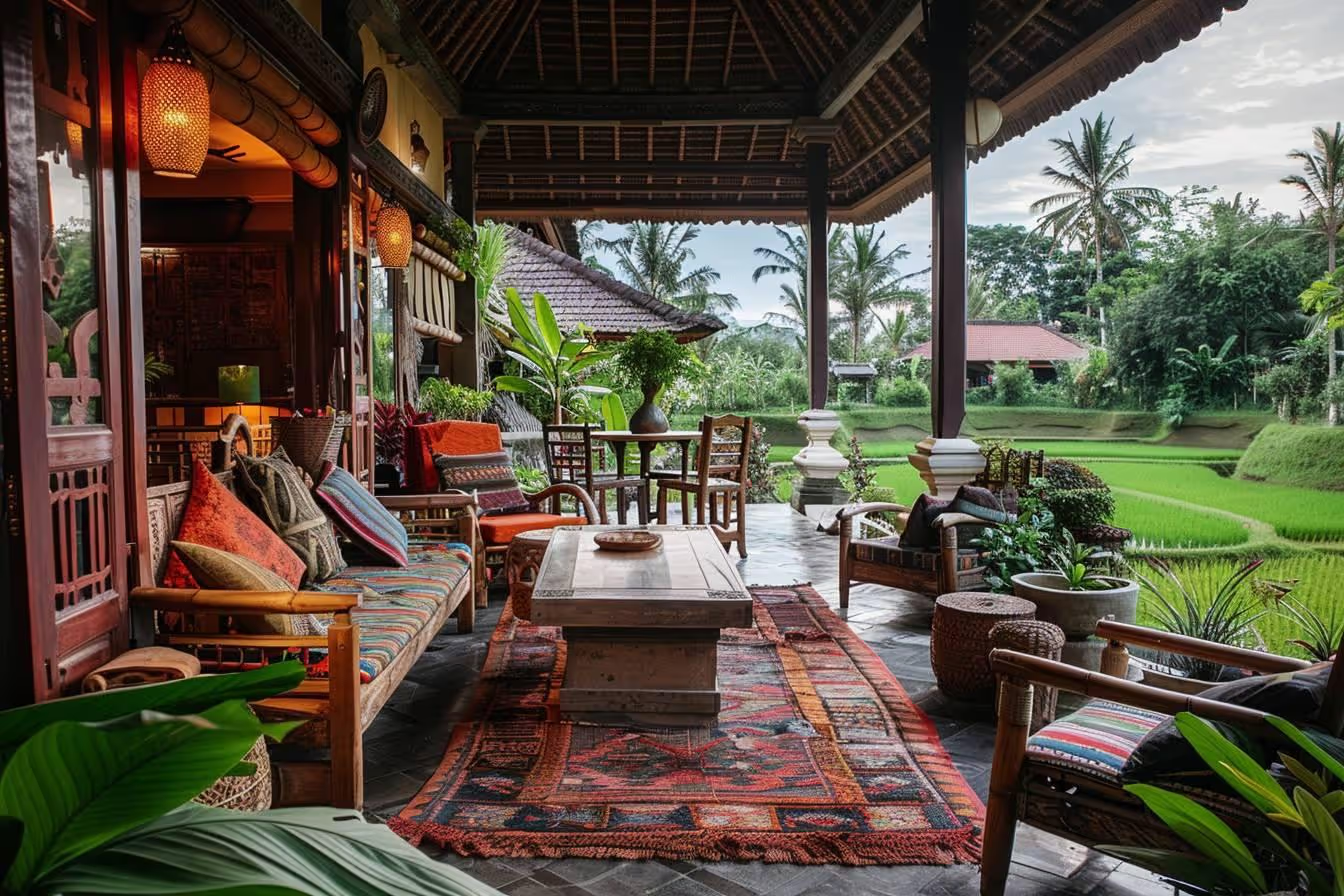
Bali accommodation types cover more ground than almost anywhere I have traveled, from a 5 dollar hostel dorm in Canggu to a staffed villa north of 2,000 dollars a night. The trap is not price, it is matching the category to your trip: a shared villa suits a group, a homestay suits a solo week, and neither is the boutique hotel most people default to. Booking direct on WhatsApp often shaves 10 to 25 percent. Here is how the seven types actually compare.
✓ Pros
- Exceptional value at every tier compared to other tropical destinations - butler-staffed villas cost less than a basic Maldives room
- Seven distinct accommodation categories covering $5 dorm beds to $2,000+ managed villa complexes
- Direct WhatsApp booking with owners typically saves 10-25% off OTA rates for stays of 5+ nights
- Guesthouses and boutique hotels in the $30-250 band consistently outperform their price point
- Nusa Penida adds a rugged island option 35-45 minutes by fast boat from Sanur
✗ Cons
- High season (July-August, late December) pushes rates 30-60% above shoulder-season baselines
- Standalone villas at the lower end ($150-300) often lack 24/7 staff - problems at midnight take time to resolve
- Nusa Penida has routine power and water outages; cliff-side stays can be 60 minutes from the harbor on rough roads
- Canggu traffic in peak season can turn a 3 km trip into a 45-minute crawl
- Beachfront listings often mean a 2 km walk - always check the Google Maps pin before booking
Get ready for your Bali trip
Before you start narrowing down where to sleep, it helps to understand the different Bali accommodation types available, as these options will shape your booking decisions and overall experience on the island. Lock down the logistics that actually influence your choice.
Visa: Most visitors from Western countries qualify for a Visa on Arrival or e-VOA, valid for 30 days and extendable once on the island for another 30. The fee in 2024-26 sits at around IDR 500,000 (roughly $32-35 USD). Processing the e-VOA online before departure skips the airport queue entirely - worth doing.
Travel insurance: Not optional. Scooter accidents send dozens of tourists to Bali International Medical Centre every week, and a hospital evacuation from Nusa Penida can run into five figures. A standard 1-week Southeast Asia policy costs $40-80.
Payments: ATMs are common in tourist areas but charge IDR 25,000-50,000 per withdrawal. Mid-range hotels and above take cards, but most homestays, guesthouses, and warungs (small local restaurants) are cash only. Carry IDR 500,000-1,000,000 for any day outside the main strips.
Connectivity: A local SIM or eSIM with 10-25 GB runs $8-15 for a 7-30 day plan. You’ll need it for Grab and Gojek (Bali’s ride-hail and food delivery apps), Google Maps, and to message guesthouse owners directly on WhatsApp - often a faster and more reliable channel than email for last-minute changes.
Booking lead times:
- High season (July-September, 20 Dec-5 Jan): Book luxury villas and well-reviewed boutique hotels 2-3 months ahead. Budget spots in Canggu and Uluwatu fill 2-4 weeks out.
- Shoulder (April-June, October-early December): Most properties bookable 1-2 weeks ahead; rates often drop 10-30%(6).
- Low season (January-March): Wide availability and best rates, but expect daily rain.
Etiquette note: Most Balinese accommodations - from homestays to luxury villas - expect you to remove your shoes before entering common rooms or family compounds. Look for the pile of sandals at the threshold; if you see one, follow suit. Tipping isn’t mandatory, but IDR 20,000-50,000 (about $1.30-3.30) per day for housekeeping at any stay above guesthouse level is standard and appreciated.
Bali accommodation types: the seven categories that matter
Forget the booking-site filters for a minute. In practical terms, Bali’s stays fall into seven working categories, each suited to a different kind of trip.
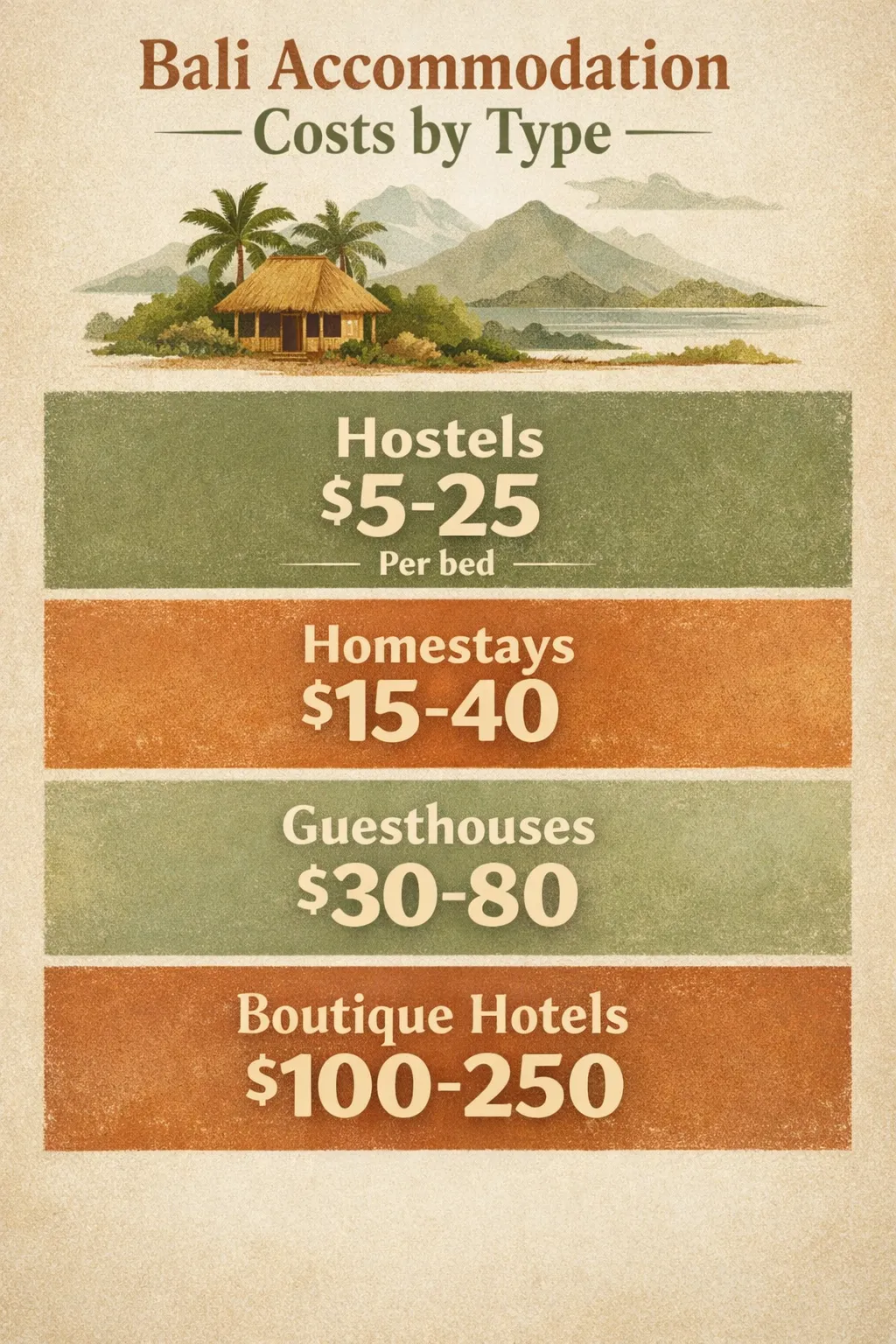 Bali accommodation costs by type: Hostels $5-25 per bed; Homestays $15-40; Guesthouses $30-80; Boutique hotels $100-250.
- Hostels and dorms - $5-25 per bed. Best for solo travelers and backpackers. Heavy concentration in Canggu, Kuta, and Uluwatu (7).
- Homestays (losmen) - $15-40. A room inside a family’s walled compound, usually with fan or A/C, breakfast included. The best window into daily Balinese life.
- Guesthouses - $30-80. Small, owner-run properties with private rooms, often a pool, breakfast, and Wi-Fi.
- Boutique hotels - $100-250. Design-led, often 10-30 rooms, on-site spa or restaurant, common in Ubud and Seminyak.
- Private villas - $150-800 standalone, $250-2,000+ for managed luxury complexes. Private pool, kitchen, multiple bedrooms. Best for families and groups.
- Resorts - $200-2,000+. Full-service properties with multiple pools, kids’ clubs, restaurants; concentrated in Nusa Dua, Jimbaran, and the luxury enclaves of Ubud.
- Niche stays - surf camps ($50-250), dive resorts ($60-250+), yoga retreats ($100-700 per person all-inclusive), eco-lodges ($20-400), and local kos (long-stay apartments) at $10-35 nightly or $200-400 monthly.
The straightforward answer to “what are the five types of accommodations?” maps cleanly onto Bali as: hotels/resorts, private villas, guesthouses/homestays, hostels, and serviced apartments. Everything else is a variation on one of these.
Luxury and premium stays: resorts and private villas in Bali
The premium tier in Bali still delivers real value compared to other tropical luxury destinations. A butler-staffed villa here costs roughly what a basic ocean-view room runs in the Maldives - that comparison holds. Bali luxury resorts cluster in four distinct zones: Nusa Dua and Jimbaran for beach-resort comfort, Uluwatu for clifftop drama, and Ubud for jungle and river settings - each offering a meaningfully different version of high-end.
Five-star resorts sit at $300-2,000+ per night and cluster in four areas: Nusa Dua and Jimbaran for beach resort comfort, Uluwatu for clifftop drama, and Ubud for jungle and river settings. Properties like Four Seasons Sayan and Mandapa, a Ritz-Carlton Reserve in Ubud lead the jungle-luxury segment, while Uluwatu’s cliff resorts - Bvlgari, Six Senses - trade on ocean views from 70-meter drops.
Bali private villas split into two sub-categories, and the distinction matters more than most listings make clear.
- Standalone villas ($150-800/night): Privately owned, rented through OTAs or villa specialists. You get full privacy and a private pool, but at the lower end of this range, expect no 24/7 staff, no reception, and slower problem-solving if the A/C breaks at midnight.
- Managed villa complexes ($250-1,500+/night): A cluster of villas sharing a central reception, security, and service team. You keep villa privacy but get hotel-grade service. For first-time Bali visitors at this price point, I’d lean toward managed complexes - the standalone option sounds appealing until something goes wrong at 11pm.
Standard inclusions at the $400+ tier: private pool, daily housekeeping, in-villa breakfast, and a host or butler. Add another $50-100 per day and you can have a private chef cooking nasi campur (mixed rice plate with sides) and bebek betutu (slow-cooked spiced duck) in your kitchen.
When to book: Christmas and New Year impose 5-7 night minimums and rates 30-60% higher than May or October. For peak season at any of the named luxury properties, 3 months ahead is the floor, not a suggestion.
Authentic and mid-range options: where most travelers should stay
The $30-150 band is where Bali quietly excels. You get a private room, often a small pool, breakfast, and design that actually feels Balinese rather than generic resort.
Bali guesthouses ($30-80/night) are the sweet spot for couples and solo travelers who want a private space without paying boutique-hotel prices. Most include breakfast - usually nasi goreng (fried rice) or banana pancakes - Wi-Fi, A/C, and access to a shared pool. The neighborhood around Jalan Bisma in Ubud and the lanes off Batu Bolong in Canggu are dense with well-reviewed options in this band. I’ve stayed in both areas across multiple trips and the guesthouse quality is consistently higher than the prices suggest - owners here depend on repeat visitors and word-of-mouth in a way that big hotel groups simply don’t.
Boutique hotels ($100-250/night) add design, on-site dining, and usually a spa. Ubud’s rice-paddy boutique hotels - properties along Jalan Raya Sanggingan and the river valleys around Penestanan - offer infinity pools over terraced fields at prices that would buy you a basic hotel room in any European capital. That value gap is real, and it’s one of the stronger arguments for Ubud over the beach towns at this price point.
Traditional homestays / losmen ($15-40/night) put you inside a family compound, usually with a small pura (family temple) in the corner and several generations sharing the space. Rooms are simple - fan or A/C, cold-water bathroom is common at the lower end, hot water at $25+ - and breakfast comes with the room. The cultural value is the point. You’ll learn which days are temple ceremonies and why the streets fill with offerings of canang sari (small woven palm baskets), and you’ll be invited to join family meals more often than you’d expect. When I stayed in Penestanan in November 2023, the family running the compound had been hosting travelers for over twenty years - the grandmother still cooked breakfast herself, and by day three she’d stopped asking what I wanted.
Adventure and niche stays
If your trip has a specific activity at its center, dedicated accommodation categories will outperform a generic hotel every time.
Surf camps ($50-250+/night) in Canggu, Kuta, and Uluwatu bundle a bed (private or dorm), breakfast, board rental, and either group or private lessons. The Canggu camps suit beginners thanks to the mellow Batu Bolong break; Uluwatu camps cater to intermediate-to-advanced surfers tackling the reef breaks. The pricing looks steep until you price out board rental, lessons, and accommodation separately.
Dive resorts ($60-250+/night) concentrate in Amed and Tulamben on Bali’s northeast coast, and on Nusa Penida and Nusa Lembongan. The USS Liberty wreck at Tulamben is a shore dive accessible directly from several lodges - you can be in the water before breakfast. Dive packages typically include accommodation, breakfast, two or three dives daily, and gear.
Eco-lodges ($20-400/night) cluster in Sidemen, Munduk, and the central highlands around Mount Batukaru. Expect fan-only rooms at the lower end, solar power, composting toilets, and limited Wi-Fi. The trade-off is locations no taxi will easily reach - most lodges arrange transport from Denpasar or Ubud.
Glamping has expanded around Munduk and the rim of Lake Buyan, sitting in the $80-200 range with proper beds, en-suite bathrooms, and tent canvas overhead. Cold nights at altitude - down to 18°C / 65°F - come as a surprise to people expecting Bali’s coastal warmth. Pack a long-sleeve layer. This is where people usually get caught out.
Wellness and nature-focused stays
Ubud anchors this category but it’s no longer the only option. Canggu has built out a parallel wellness scene around Pererenan and Berawa over the last few years, and the quality has caught up fast.
Yoga retreats ($100-700/night per person) typically run as 5-14 day packages including accommodation, vegetarian or pescatarian meals, two to three daily classes, workshops, and sometimes airport transfers. The Yoga Barn area in Ubud and the cluster of retreat centers in Penestanan are the established options; newer retreats around Sidemen offer the same model with rice-paddy isolation and fewer other travelers around.
Jungle lodges and rice-terrace stays ($50-250/night) sit further from town centers and depend on hotel shuttles or scooters. The ridge above the Campuhan Ridge Walk in Ubud and the valleys around Tegallalang are the iconic settings - you’ll wake to roosters and farmers walking the terraces with hand tools. It sounds like a cliché until you’re actually there at 6am with a coffee.
Spa-focused boutique hotels in Ubud and Canggu often build packages around daily massage, herbal baths (lulur), and jamu (traditional herbal drinks). The going rate for a 90-minute Balinese massage in a hotel spa is IDR 350,000-600,000 ($23-40 USD); standalone street spas run IDR 100,000-200,000 ($6.50-13) for the same service. The street spas are not a lesser version - they’re just a different setting.
Budget stays and cheap accommodation in Bali
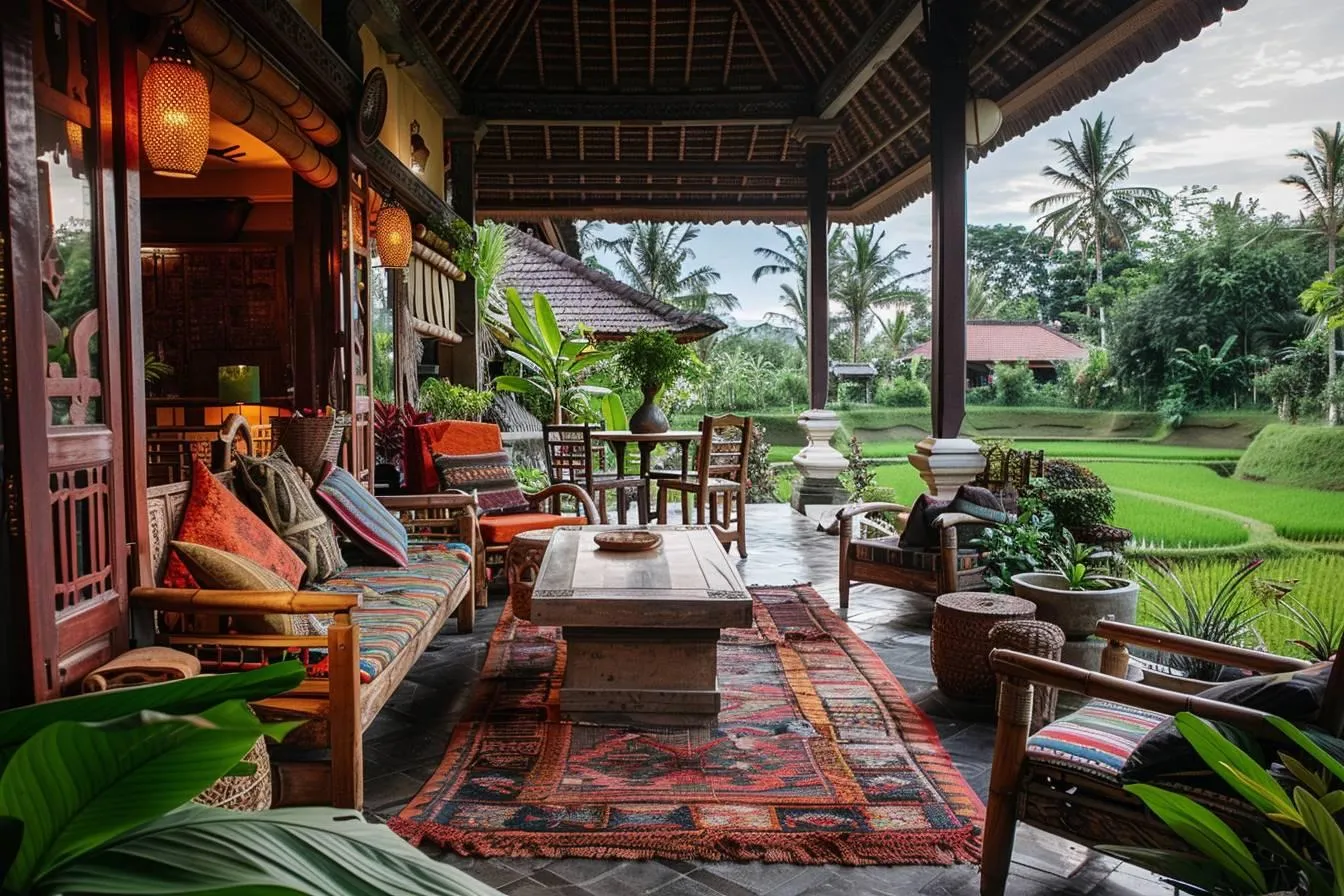
Cheap accommodation bali doesn’t mean a compromise on the experience. It means picking the right format for what you actually want.
- Hostels ($5-25/dorm bed): Co-working hostels in Canggu (around Batu Bolong and Berawa) and Uluwatu have moved noticeably upmarket - pools, on-site cafes, weekly events. Privacy is the trade-off.
- Homestays ($15-40): The best cultural-value option at this price. Look in Penestanan, Nyuh Kuning, and Pengosekan around Ubud; Bingin and Padang Padang for surfers in Uluwatu.
- Guesthouses with pool ($30-60): Possible in Canggu, Ubud, and Sanur if you book 1-2 weeks ahead in shoulder season. These go fast.
- Local kos (apartments) ($10-35 nightly, $200-400 monthly): Long-stay rooms designed for Indonesian renters, increasingly opened to foreigners. Found through Facebook groups (Canggu Community, Ubud Community) and noticeboards more than booking sites. Minimal services - bring your own towels - but unbeatable monthly value.
Practical tip: Book the first 2-3 nights online for a soft landing, then negotiate in-person rates for any extended stay. Owners frequently offer 10-25% discounts off the OTA price for direct cash bookings of 5+ nights, especially in shoulder season. I’ve done this on every Bali trip longer than a week - it works, and the conversation is usually straightforward.
Nusa Penida accommodation: what’s different about the island
Nusa Penida accommodation plays by different rules than mainland Bali, and the gap has widened as more travelers cross over.
The island sits 35-45 minutes by fast boat from Sanur - one-way fares run approximately IDR 150,000-300,000 ($10-20 USD) per person depending on operator and season. Once there, you’ll find:
- Budget bungalows and guesthouses ($15-40/night): Concentrated near Toyapakeh harbor and Banjar Nyuh, the main arrival points. Simple rooms, fan or basic A/C, often inconsistent hot water.
- Mid-range sea-view hotels ($60-150/night): A growing crop near Crystal Bay and along the north coast, several with infinity pools facing Mount Agung on Bali’s mainland.
- Higher-end resorts ($150-400/night): Cliff-facing properties on the south and west coasts near Kelingking Beach and Diamond Beach - stunning settings, but logistically isolated in ways that matter when your scooter has a flat.
Three things to know before booking:
- Power and water outages are routine. Mid-range and budget stays often have backup generators that cover lights and fans but not A/C. The west coast has worse infrastructure than the north.
- Roads are rough. The southwest loop to Kelingking and Broken Beach involves stretches of broken pavement and steep grades. A cliff-side stay 15 km from the harbor can be a 60-minute scooter ride.
- Stay near the harbor if you’re doing day tours. Toyapakeh and Banjar Nyuh save 30-60 minutes each way to most sights. Save the remote cliff stays for trips where the property itself is the destination.
Most accommodations offer transport and sightseeing packages - typically IDR 600,000-1,000,000 ($40-65) per day for a private driver covering 4-6 sights, often the best way to navigate the rough roads without renting your own scooter.
Pricing factors in Bali: what actually drives the price tag
Two hotels with the same star rating can sit $80 apart per night. Here’s what’s behind the gap.
Area. Nusa Dua, Jimbaran, Ubud, and Uluwatu cliff resorts command premiums over Canggu and Seminyak for the same property type. Sanur and Lovina run 20-40% cheaper than equivalent properties in Seminyak.
Season. July-August and 20 December-5 January push rates up 30-60% above April-June or October-November baselines. Booking late September can get you the same villa for 25% less than the same week in early August - a meaningful saving at any price tier.
Property size and staffing. A two-bedroom villa with a daily housekeeper sits cheaper than the same villa with a 24/7 butler and chef on call. The staffed difference can be $100-200 per night.
Proximity. “Beachfront” in Bali is rare and expensive. “Near the beach” can mean a 2 km walk down a busy road. Always check the property’s Google Maps pin against where you actually want to be, not the listing’s stated neighborhood. This is where people consistently get caught out.
Build year. Bali’s hot tropical climate is hard on buildings. A 5-star resort built in 2008 can feel tired next to a 2022 boutique hotel at half the rate. Check recent review photos, not the listing’s promo shots.
Bundled services. Yoga retreats and surf camps look expensive at $150/night until you factor in meals, classes, and equipment that would cost $40-60/day to source separately.
Direct vs OTA. WhatsApp the property directly for stays of 5+ nights. Many owners offer 10-25% off the Booking.com or Agoda rate to skip the platform commission. It takes five minutes and it almost always works.
Best areas to stay: matching neighborhood to trip goals
Which part of Bali is best to stay in depends entirely on what you want from the trip.
Seminyak. Upscale dining, beach clubs (Potato Head, Ku De Ta), and walkable shopping along Jalan Kayu Aya (locally called Eat Street). Best for first-timers who want comfort, nightlife, and don’t mind a more tourist-heavy scene. Mid-range to luxury hotels dominate; budget options are limited.
Canggu. Surf, cafe culture, and a heavy digital-nomad presence. Batu Bolong is the main strip; Pererenan to the north is quieter and noticeably less crowded. Co-living, hostels, mid-range villas, and a few luxury properties. Worst traffic on the island in peak season - a 3 km trip can take 45 minutes.
Kuta and Legian. The cheapest party zone, hostels and budget hotels in volume. Skip unless you’re specifically here for nightlife on a tight budget; the crowds and touts wear thin quickly.
Ubud. Culture, wellness, jungle. Spans $15 homestays in Penestanan to $1,500-per-night Mandapa villas. Best base for first-timers who want a calmer pace, and the natural counterpoint to a beach stay. The Monkey Forest and the artisan markets along Jalan Raya Ubud anchor the central area.
Nusa Dua and Jimbaran. Gated, manicured resort zones - Nusa Dua is purpose-built for tourism, Jimbaran has more local feel. Best for families with kids, honeymooners, and travelers who want zero hassle. If you’re weighing a Bali all-inclusive resort, this is where most of them concentrate. Limited dining and cultural variety outside the resorts.
Uluwatu. Dramatic cliffs, world-class surf breaks (Padang Padang, Bingin, Uluwatu itself), and a mix of homestays, boutique hotels, and cliff-edge luxury resorts. Quieter than Canggu, more spread out - a scooter is close to essential.
Amed and Tulamben. Northeast coast, low-key fishing-village feel, diving (the USS Liberty wreck). Mostly small hotels and dive lodges. Skip if you want nightlife; worth prioritizing if you want quiet.
Sanur. Calm beach, older crowd, family-friendly. Lower prices than Seminyak, gateway to Nusa Penida and Lembongan via the fast boats.
Nusa Penida and Lembongan. Side-trip territory - 2-4 nights typically. Penida is rugged and dramatic; Lembongan is mellower and easier to navigate.
Split-stay strategy: Most experienced visitors recommend 3-4 nights Ubud plus 3-4 nights beach (Canggu, Uluwatu, or Seminyak) for a 7-night trip. Transfer time between Ubud and most beach areas runs 1.5-2 hours by car. It’s not a long drive, but it’s long enough that you want to get the sequence right rather than bouncing back and forth.
Is $1,000 enough for one week in Bali?
Yes - for most travel styles, with caveats. Here’s the breakdown by tier (per person, 7 nights, excluding international flights):
Shoestring: $25-35/day total. Hostel or homestay ($15-30), street food and warungs ($8-12), scooter rental ($5/day) and fuel. Weekly total: $175-245. Leaves $750+ of your $1,000 for activities, day trips, and a splurge night.
Budget-comfort: $40-70/day. Guesthouse with pool ($30-50), mix of warungs and mid-range cafes ($15-25), scooter or occasional Grab. Weekly total: $280-490. Comfortable, with room for a Nusa Penida day tour ($40-60), a cooking class ($35-50), and a couple of massage sessions.
Mid-range: $90-160/day. Boutique hotel or shared villa ($60-120), restaurant meals ($30-50), private driver some days ($35-55). Weekly total: $630-1,120. $1,000 covers a comfortable 7-night mid-range trip for one person, or a budget-comfort trip for two sharing a guesthouse.
Luxury: $250-600+/day. 5-star resort or private villa, restaurant dining, daily spa, private driver. Weekly total: $1,750-4,200+. $1,000 won’t stretch a full week here, but it covers 3 nights at a mid-luxury property.
The honest answer: $1,000 per person funds a great mid-range week, an indulgent budget-comfort week, or a luxury extended weekend. For two people sharing, $1,000 total works for shoestring travel; double that gets you a comfortable couples trip with some room to spend.
Choosing your Bali experience
Picking the right one of Bali’s accommodation types is less about budget tier and more about matching the format to the trip. A $40 homestay in Penestanan delivers cultural depth a $400 resort can’t replicate. A $400 staffed villa in Seminyak delivers privacy and convenience a homestay never will. Neither is better - they’re for different trips.
If this is your first time on the island, default to a split stay: 3 nights in a mid-range Ubud guesthouse or boutique hotel, then 3 nights in Canggu, Seminyak, or Uluwatu in a similar property. You’ll get the culture-and-coast contrast that gives Bali its range, and you’ll have a much clearer sense of what you’d prioritize next time.
If you’re returning, narrow your focus. Bali rewards staying somewhere a week or longer - the relationship with a guesthouse owner who remembers your coffee order, the warung where they start your usual before you sit down, the morning routine at the same beach break - far more than it rewards checklist-style island hopping.
Whichever direction you go: book the first nights online, then negotiate everything else on the ground. The island’s accommodation economy still runs on direct conversation, and the best deals don’t make it onto Booking.com.
Frequently Asked Questions
- What are the 5 types of accommodations in Bali?
- The five core categories are: hotels and resorts ($100-2,000+/night), private villas ($150-2,000+/night, standalone or managed complex), guesthouses and homestays ($15-80/night), hostels ($5-25/dorm bed), and serviced apartments or local kos ($10-35 nightly, $200-400 monthly). Niche stays like surf camps, dive resorts, yoga retreats, and eco-lodges are specialized versions of these main categories.
- Which part of Bali is the best to stay in?
- Ubud for culture, wellness, and jungle scenery; Seminyak for upscale dining and nightlife; Canggu for surf, cafes, and digital nomads; Nusa Dua or Jimbaran for family-friendly resort comfort; Uluwatu for clifftop drama and surf; Sanur for a calmer beach base. Most first-time visitors are best served by splitting their stay between Ubud and one beach area.
- Is $1,000 enough for 1 week in Bali?
- Yes - $1,000 per person comfortably funds a 7-night mid-range trip (boutique hotel or shared villa, restaurant meals, some private driver days). On a budget-comfort tier ($40-70/day), you'll spend $280-490 on basics and have $500+ left for activities. For luxury travelers, $1,000 covers about 3 nights at a 5-star resort or staffed villa, not a full week.
- What fruit is okay to eat in Bali?
- Fruits with a peel you remove yourself - banana, papaya, mango, pineapple, rambutan, mangosteen - are safe almost anywhere. Pre-cut fruit from reputable cafes, restaurants, and hotels is generally fine because they wash with filtered water. The main risk is pre-cut fruit from roadside stalls washed in tap water, which can cause stomach issues. Bali tap water is not potable, so skip ice from unknown sources too.
- Do I need to book accommodation in advance?
- For high season (July-August, late December to early January), book 2-3 months ahead for luxury villas and well-reviewed boutique hotels, and 2-4 weeks ahead for budget spots in popular areas. In shoulder and low season, 1-2 weeks ahead is usually sufficient, and you'll often find 10-30% better rates by booking direct via WhatsApp.
- Are homestays safe in Bali?
- Yes. Balinese homestays are generally very safe, with the family typically living in the same compound. Stick to properties with at least 50 recent reviews on Booking.com or Agoda, and prioritize ones from the last 3-6 months to confirm current conditions.