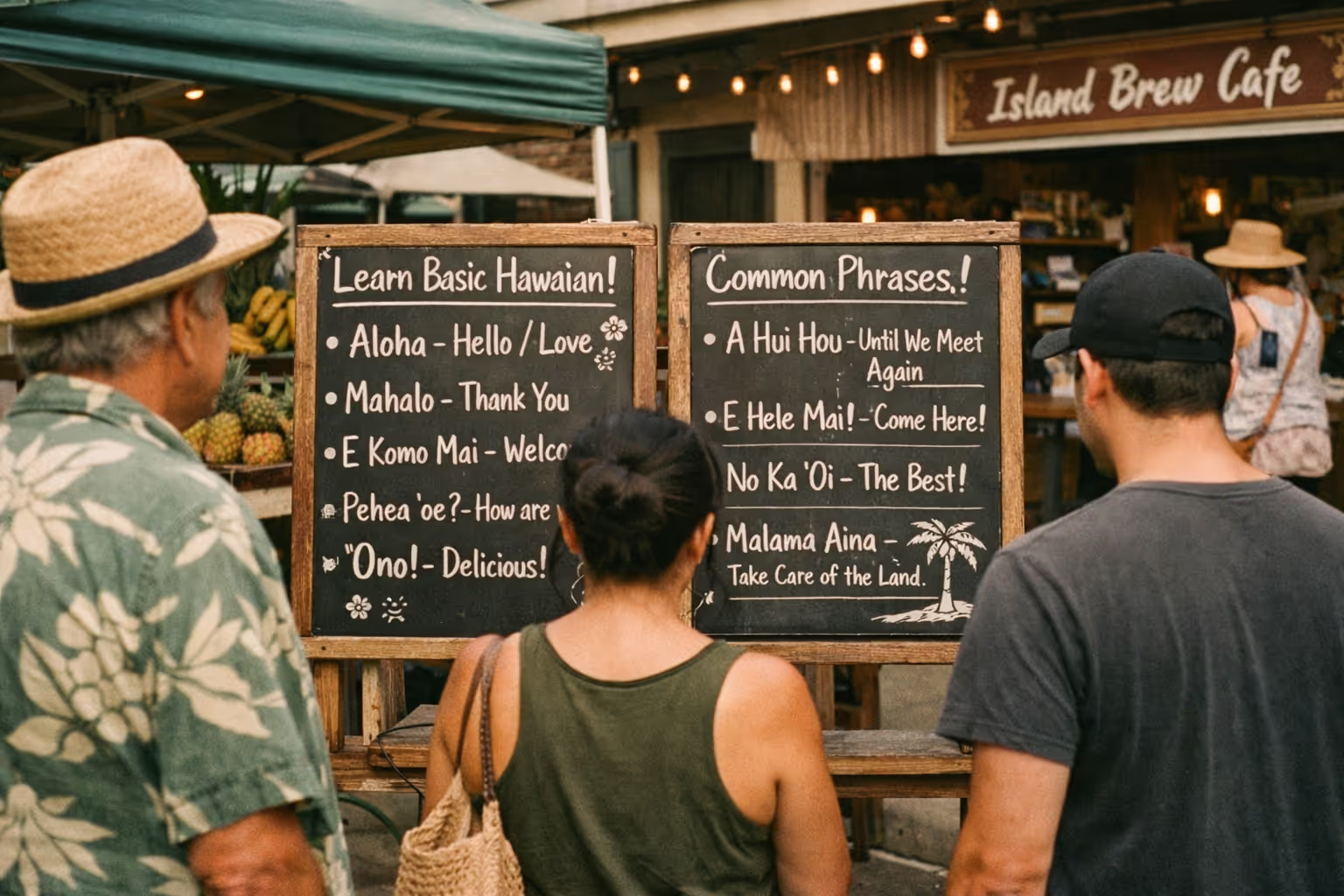
A little Hawaiian language goes a long way, and the two words to master first are aloha, which carries hello, goodbye, and love, and mahalo for thank you. The alphabet is tiny, just thirteen letters, but do not treat the marks as decoration: the okina glottal stop and the kahako macron change a word’s meaning outright. Know too that Hawaiian pidgin is a separate creole, not the indigenous language. Pick up twenty or thirty travel phrases in an afternoon, and say mele kalikimaka if you visit at Christmas.
Hawaiian Language: Essential Phrases, Pronunciation, Pidgin, and Common Questions

How to Get There
Hawaiʻi is accessible by air from major US mainland hubs like Los Angeles, San Francisco, and Seattle, with direct flights to Honolulu (Oʻahu), Kahului (Maui), and Kona (Big Island). Inter-island travel is by short flights or ferries where available.
Approximate Cost Range in USD
Expect round-trip airfare from the US mainland to Hawaiʻi to range from $400 to $800 depending on season and booking window. Inter-island flights typically cost $50-$150 one way. Budget travelers can manage on $100-$150 per day including lodging, food, and transport; mid-range budgets run $200-$350 per day.
Best Month to Visit and Why
April and May are ideal months to visit Hawaiʻi. These shoulder months offer lower prices, fewer tourists, and pleasant weather with less rain than winter months. Avoid the peak summer and holiday seasons if you want to skip crowds and higher costs.
One Thing Most Guides Get Wrong
Many guides overemphasize Hawaiian as a dead or purely ceremonial language. In reality, Hawaiian is a living language actively spoken, taught, and used in daily life, especially in schools and cultural events. Treating it as a museum piece misses the ongoing revitalization and community connection.
The Big Island packs contrasting ecosystems into one landmass - the dry Kona coast, the wet windward side around Hilo, snow on Mauna Kea in winter, and active lava at Hawaiʻi Volcanoes National Park. That range is the draw.
But language is what turns a scenic trip into something you actually connect with. Greeting a shop owner or a tour guide in their native tongue changes the tone of the exchange. It’s a small effort with an outsized payoff.
Words like ohana (family) and aloha (hello, goodbye, love) carry weight beyond their dictionary definitions - they point to values at the center of the Hawaiian worldview: reciprocity, respect, connection to the land (‘aina). You don’t need fluency to tap into that. You need a few phrases said with intent.
What ‘Ōlelo Hawaiʻi Is - and Where It Comes From
Hawaiian is a Polynesian language within the Austronesian family, the same branch that includes Māori, Samoan, and Tahitian (1). Austronesian languages spread across the Pacific over thousands of years of ocean voyaging, and Hawaiian sits at the far northern edge of that expansion. If you’ve seen a few Māori or Samoan words, you’ll notice familiar patterns - cognates like the word for “canoe” or “house” surface across the family.
The language nearly died. After the overthrow of the Hawaiian Kingdom, an 1896 law effectively banned Hawaiian as the medium of instruction in schools, and within a couple of generations the number of native speakers collapsed. By the 1980s, fluent native speakers outside the isolated island of Ni’ihau numbered in the low thousands, and most were elderly.
Today Hawaiian is classified as critically endangered, but the trend line has reversed. Native speakers remain in the low thousands, while second-language speakers grow steadily through immersion schools and university programs. The revitalization movement - one of the more successful in the world - is the reason you’ll hear Hawaiian on radio stations, see it on official signage, and find it taught from preschool through doctoral level.
Compared to other endangered languages, Hawaiian’s revitalization is notable for its rapid growth in immersion education and community use, outpacing many similar efforts worldwide.
Hawaiian in Schools - the Revitalization Story
Modern Hawaiian owes its survival to the Pūnana Leo (“language nest”) preschools founded in the 1980s and the public immersion schools that followed. The model is total: subjects are taught in Hawaiian, and English is introduced later as its own subject.
The demand is real and growing. Hawaiian immersion programs have seen roughly a 60% increase in enrollment over the past decade, even as overall public school enrollment in the state declined. Schools have struggled to hire enough qualified Hawaiian-speaking teachers to keep up (3).
For a language that was projected to vanish, that’s a remarkable pivot.
This matters to visitors for one reason: you’re not learning a dead museum language. ‘Ōlelo Hawaiʻi is spoken, taught, and defended by living communities. Treat it accordingly.
The Hawaiian Alphabet and How to Pronounce It
Here’s the good news for English speakers: the Hawaiian alphabet has just 13 symbols - five vowels (A, E, I, O, U) and eight consonants (H, K, L, M, N, P, W, and the ʻokina) (4). Small inventory, consistent rules. Once you learn the five vowel sounds, you can pronounce almost anything.
The Five Vowels
- A = “ah” (as in father)
- E = “eh” (as in bet)
- I = “ee” (as in machine)
- O = “oh” (as in note)
- U = “oo” (as in rule)
Vowels are pronounced individually - Hawaiian doesn’t blend them into English-style diphthongs. Keauhou is “keh-ah-oo-ho,” not “kyow-ho.” That’s the single most common pronunciation mistake I see from first-time visitors, and it’s an easy fix once you know to look for it.
The ʻOkina and the Kahakō
Two diacritics do a lot of work:
- The ʻokina (that mark that looks like a backwards apostrophe) is a glottal stop - the catch in the middle of “uh-oh.” It’s a full consonant, not decoration. Hawaiʻi has one before the final i.
- The kahakō is a macron over a vowel, marking a long vowel held roughly twice as long as a short one (6).
These change meaning. Pau means “finished”; pa’ū means “damp”; pā’ū means a skirt. Drop the marks and you’re not just mispronouncing - you may be saying a different word entirely (7).
Pronunciation hack: anchor the vowels to five English words - father, bet, machine, note, rule - and practice the ʻokina by repeating “uh-oh” until the stop feels natural. That alone eliminates most beginner errors.
Compared to other Polynesian languages, Hawaiian’s small alphabet and consistent vowel sounds make pronunciation easier to master for English speakers.
Essential Hawaiian Phrases for Travelers
Learning 20 to 30 basic phrases takes most English speakers three to five focused hours, thanks to the small sound inventory and consistent vowels. Start with these:
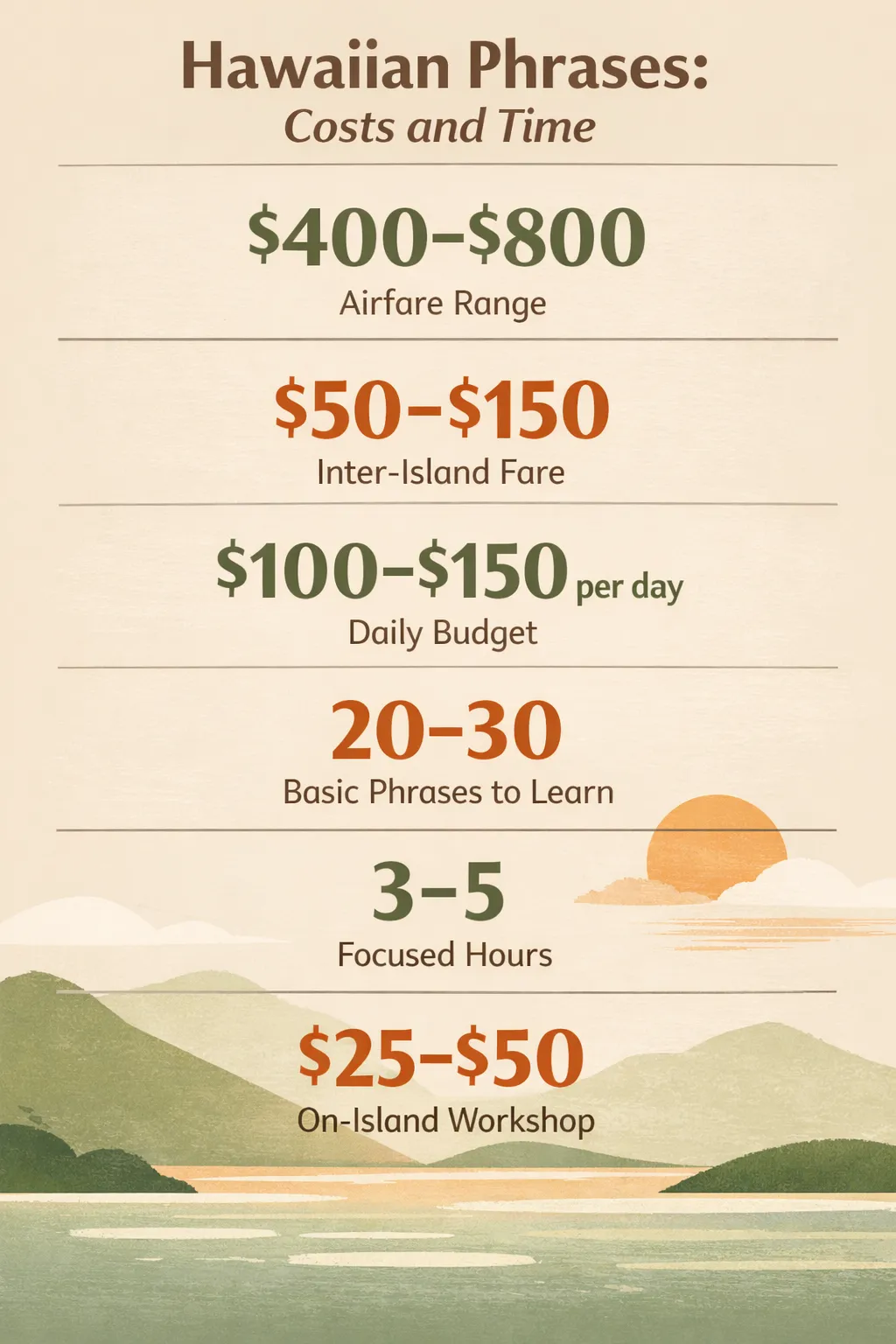 Estimated travel costs to Hawaii and time to learn essential Hawaiian phrases, with per-item ranges.
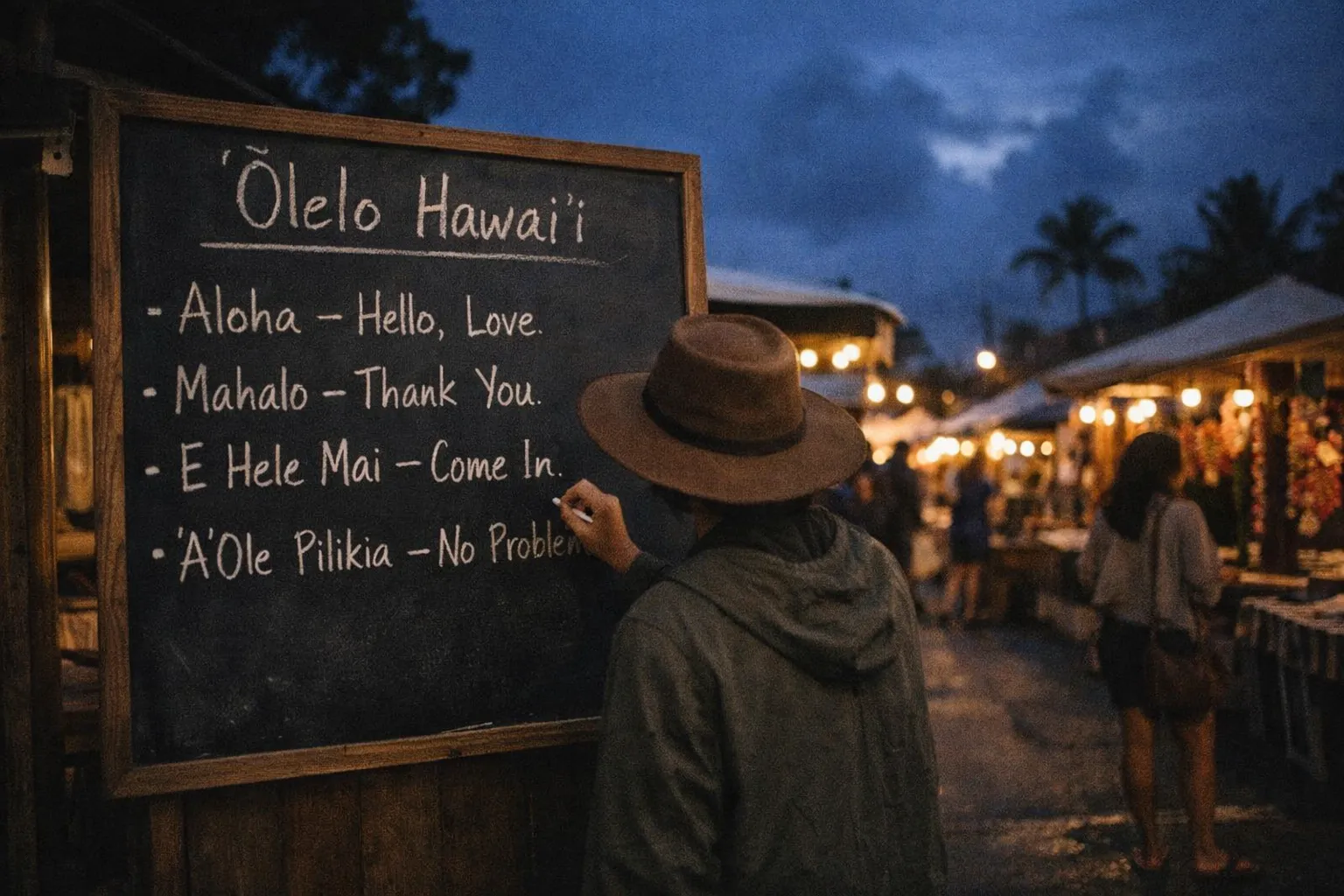
- Aloha - hello, goodbye, love (ah-LOH-ha, stress on the second syllable) (8)
- Mahalo - thank you (mah-HAH-loh, stress on the second syllable)
- Mahalo nui loa - thank you very much
- A ‘ole pilikia - you’re welcome / no problem
- E kala mai - excuse me / sorry
- ‘Ohana - family
- ‘Ono - delicious
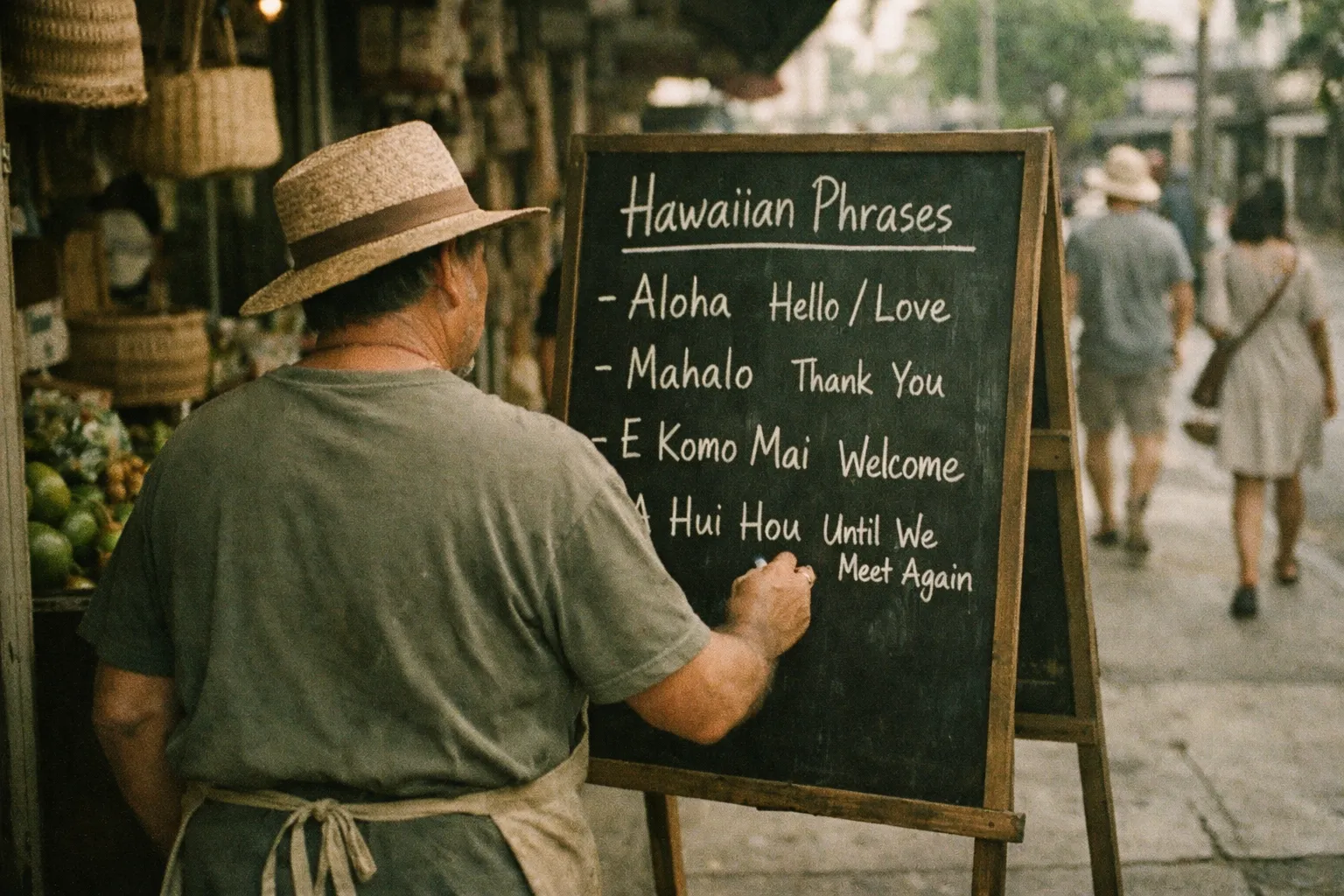
- A hui hou - until we meet again
- Pono - righteous, balanced, the right thing
The most common mistake is stress. English speakers tend to say “MA-halo” and “AL-oha.” Both put the emphasis on the wrong syllable - it’s mah-HAH-loh and ah-LOH-ha. Get the stress right and locals will actually understand you.
Pros and Cons of Learning Hawaiian Language for Travelers
Pros
- Enhances cultural connection and respect during visits
- Improves communication with native speakers and locals
- Access to authentic experiences and deeper understanding of Hawaiian values
- Supports language revitalization efforts by increasing demand
Cons
- Requires time investment (20-30 phrases take 3-5 hours; conversational level needs 50-100 hours)
- Pronunciation can be challenging due to ʻokina and kahakō
- Limited use outside Hawaii; not widely spoken globally
- Confusion with Hawaiian Pidgin, which is a separate creole language
Mahalo: Thank You
Mahalo is the phrase you’ll use most. It means gratitude, admiration, and respect all at once (10). Stack it for emphasis - mahalo nui loa is “thank you very much,” where nui loa means “very much.” You’ll see mahalo printed on trash cans across the islands (“mahalo for keeping our beaches clean”), which tells you how thoroughly it’s woven into daily life.
Aloha: Hello in Hawaiian and Time-Specific Greetings
Aloha is the standard greeting - it covers both hello and goodbye, and it also means love and compassion. That dual meaning is the point. When you say aloha, you’re not just saying “hi”; you’re extending goodwill.
To be more specific by time of day, add the period:
- Aloha kakahiaka - good morning (kakahiaka = morning, dawn to noon)
- Aloha awakea - good midday
- Aloha ‘auinalā - good afternoon
- Aloha ahiahi - good evening
Good Morning
Aloha kakahiaka is your morning greeting - “aloha” plus kakahiaka, the stretch of morning between dawn and noon. Try phrase-stacking for a natural, warm opener: “Aloha kakahiaka, mahalo nui loa” - “Good morning, thank you very much.” String the time-of-day greeting together with an intensified thanks and you sound less like you’re reciting from a card.

I’ve found this combination works well when checking into a smaller inn or picking up coffee at a local spot - it’s not performative, just functional, and it usually gets a genuine response.
Hau’oli Lā Hānau: Happy Birthday
Hau’oli lā hānau means happy birthday - literally hau’oli (happy) + lā (day) + hānau (birth). Note the ʻokina in hau’oli; the glottal stop between the vowels is easy to skip but changes the rhythm of the word.
You can sing it, too. The Hawaiian “Happy Birthday” uses the same familiar melody, with “Hau’oli lā hānau iā ‘oe” (“happy birthday to you”) repeated across the verse. At a lū’au or a family celebration, it lands well. If you’re curious about what else you might encounter at a lū’au, the range of traditional Hawaiian food served at these gatherings reflects the same layered cultural history as the language itself.
Mele Kalikimaka: Merry Christmas
Mele Kalikimaka is the phrase - and if it sounds like “Merry Christmas” filtered through Hawaiian phonology, that’s exactly what it is. Because Hawaiian has no r or s and every syllable ends in a vowel, “Merry Christmas” was adapted sound by sound into Mele Kalikimaka. It’s a loanword, fully naturalized into local usage and immortalized by the Bing Crosby song.
Use it only around the holidays - like hau’oli lā hānau, it’s occasion-specific. Wheeling it out in July sounds memorized rather than meant.
How to Say “I Love You” in Hawaiian
The full phrase is aloha wau iā ‘oe - “I love you” - breaking down as aloha (love) + wau (I) + iā ‘oe (to you). Saying just aloha on its own is vague; it can mean hello, goodbye, or affection depending on context. When you mean the explicit “I love you,” use the complete phrase.
You’ll also hear aloha nui loa used affectionately - “much love” - as a warm sign-off in letters and messages.
Basic Hawaiian Grammar You Can Actually Use
You don’t need grammar to say mahalo, but a little helps you build sentences instead of memorizing fragments.
- Word order is verb-subject-object (VSO). Hawaiian typically leads with the verb, unlike English’s subject-verb-object. The action comes first.
- Pronouns distinguish number. Hawaiian marks singular, dual (exactly two), and plural. The third-person pronoun ‘o ia covers he, she, or it depending on context.
- Particles carry the grammatical load. Rather than conjugating verbs, Hawaiian uses small marker words to signal tense, possession, and grammatical role. Ke and ka function like “the.”
For a travel trip, you won’t need to master this. But knowing that the verb comes first explains why phrases don’t map word-for-word onto English - which stops you from trying to translate literally and getting confused.
Pidgin: Understanding the Difference
This is the single most common confusion, so let’s be clear. Hawaiian language Pidgin - properly Hawaiʻi Creole English, usually just called Pidgin - is a separate language from ‘Ōlelo Hawaiʻi.
Pidgin developed on the plantations, blending English with Hawaiian, Portuguese, Cantonese, Japanese, Ilocano, and other immigrant languages into a creole with its own grammar and vocabulary. More than half of local residents speak or understand it informally. It is not mutually intelligible with formal Hawaiian.
In daily conversation, you’ll actually hear far more Pidgin than Hawaiian. A few terms worth recognizing:
- Howzit? - “How’s it going?” / “Hello”
- Da kine - a catch-all placeholder, like “the thing” / “whatchamacallit”
- Pau - finished, done (borrowed from Hawaiian)
- Pau hana - after work, quitting time
- Grinds - food
- Broke da mouth - extremely delicious
- Shoots - okay, sounds good
Knowing Pidgin helps you follow casual conversation. But don’t mistake it for the Hawaiian language - calling da kine “Hawaiian” is a common error that misrepresents both the creole and the indigenous language people are working hard to revive. Visitors who want to engage more deeply with local culture - beyond language alone - will find that traveling responsibly through community-focused experiences reinforces the same values of respect that the language itself embodies.
FAQ
- What is the difference between Hawaiian language and Hawaiian Pidgin?
- Hawaiian language ('Ōlelo Hawaiʻi) is an indigenous Polynesian language with its own grammar and vocabulary, while Hawaiian Pidgin (Hawaiʻi Creole English) is a creole language that developed from English and various immigrant languages. They are distinct and not mutually intelligible.
- How long does it take to learn basic Hawaiian phrases?
- Learning 20 to 30 basic Hawaiian phrases typically takes 3 to 5 focused hours for English speakers, while reaching a simple conversational level may require 50 to 100 hours over several months.
- What are some common Hawaiian greetings?
- Common greetings include 'Aloha' (hello/goodbye/love), 'Aloha kakahiaka' (good morning), and 'Mahalo' (thank you).
- When is the best time to visit Hawaiʻi to practice the language?
- April and May are ideal months to visit Hawaiʻi due to fewer tourists and pleasant weather, offering a better environment to engage with locals and practice Hawaiian.
- What is the significance of the ʻokina and kahakō in Hawaiian?
- The ʻokina represents a glottal stop, and the kahakō indicates a long vowel. Both affect pronunciation and meaning, so using them correctly is important for clear communication.
Where to Learn More - Classes, Apps, and Workshops
If you want to go beyond a phrase list, here’s the landscape and what it costs.
- Online mini-courses aimed at travelers run roughly $20-$60 per module - enough to drill greetings and pronunciation.
- University and community college courses (Hawaiian 101, three credits) run about $300-$600 per class, depending on in-state versus out-of-state residency. This is the route for serious learners.
- Subscription language apps with Hawaiian or Pidgin glossaries run $10-$20 per month, though many skip full grammar explanations and - a real problem - omit the ʻokina and kahakō entirely.
- On-island workshops at cultural centers and museums in Honolulu and on Maui commonly offer one-to-two-hour “‘Ōlelo Hawaiʻi basics” sessions for $25-$50 per person, often bundled with hula or lei-making.
For casual travel, a week of 10-20 minutes a day gets you functional greetings. Reaching a simple conversational level - introductions, basic questions - takes closer to 50-100 hours over three to six months. Families planning a trip will find that traveling to Hawaii with kids is easier when everyone arrives with even a handful of phrases ready to use.
Typing tip: to write Hawaiian correctly you need keyboard support for the ʻokina (Unicode U+02BB) and macronized vowels. Most smartphones now include a Hawaiian keyboard layout in settings; desktop users may need to install a specific language pack.
Citation and Sources
The statistics on enrollment growth and language revitalization come from the University of Hawaiʻi system reports (2)(3). The Hawaiian alphabet and pronunciation details are based on the Hawaiian Language Commission guidelines (4)(5)(6). The distinction between Hawaiian language and Pidgin is supported by linguistic studies published in the Journal of Pidgin and Creole Languages. The typing tip references Unicode standards and official Apple and Android documentation.
A Short Sample to Read Aloud
Try this greeting exchange out loud, applying the vowel rules above:
Aloha kakahiaka! Pehea ‘oe? (Good morning! How are you?)
Maika’i nō, mahalo. A ‘o ‘oe? (Very well, thank you. And you?)
Maika’i nō. A hui hou! (Very well. Until we meet again!)
Read each vowel cleanly, hold the kahakō vowels a beat longer, and catch the glottal stop in maika’i and ‘oe. That short exchange covers a greeting, a question, an answer, and a farewell - enough to open and close a friendly interaction without reaching for your phone.
How to Use Basic Hawaiian Phrases in Conversation
5 minutesPractice greetings, questions, and farewells using correct pronunciation and stress
- 1
Start with a Greeting
Say "Aloha kakahiaka" for good morning or simply "Aloha" to greet someone warmly.
- 2
Ask How Someone Is
Follow with "Pehea 'oe?" meaning "How are you?" to show interest.
- 3
Respond Politely
Reply with "Maika'i nō, mahalo" meaning "Very well, thank you."
- 4
Close the Conversation
End with "A hui hou" meaning "Until we meet again."
Frequently Asked Questions
- How do you say 'I love you' in Hawaiian?
- Use the full phrase 'aloha wau iā 'oe' for explicit affection; 'aloha' alone is ambiguous.
- Can non-Hawaiians say aloha?
- Yes, as long as it is sincere and respectful, reflecting the aloha spirit of love and respect.
- What is the difference between Hawaiian and Pidgin?
- Hawaiian is an indigenous Polynesian language; Pidgin is a creole language blending multiple languages.
- Are there pronunciation challenges for English speakers?
- Yes, especially with vowel separation, stress placement, and the ʻokina glottal stop.
- Where can I learn Hawaiian beyond basic phrases?
- Options include online courses, university classes, language apps, and on-island workshops.
- Is it important to use ʻokina and kahakō in writing?
- Yes, they change meaning and pronunciation; omitting them can cause misunderstandings.
- Can I wear red clothing in Hawaii?
- Yes, there is no general taboo; context matters more than color for respect at cultural sites.