Hawaii on a budget comes down to two levers most people ignore: where you sleep and whether you rent a car. A low-end week for two runs about $4,760, but camping on Kauai or a Hilo hostel at $45 to $60 drops it far below a resort. On Oahu, skip the car and let TheBus save you $350 to $540; Maui and the Big Island still need wheels. Cash in airline miles for the flights and you can shave a quarter off the whole trip.
Hawaii on a Budget: How Expensive Is a Week, Really?
Start with the number everyone actually wants. A typical midrange 7-day Hawaii trip runs around $4,000 for two people - flights, lodging, food, and activities included. NerdWallet’s shoulder-season breakdown puts the range wider: about $4,936 for a low-cost condo up to $9,574 for a 4-star beachfront resort with a car, both for two people over 7 nights (1).
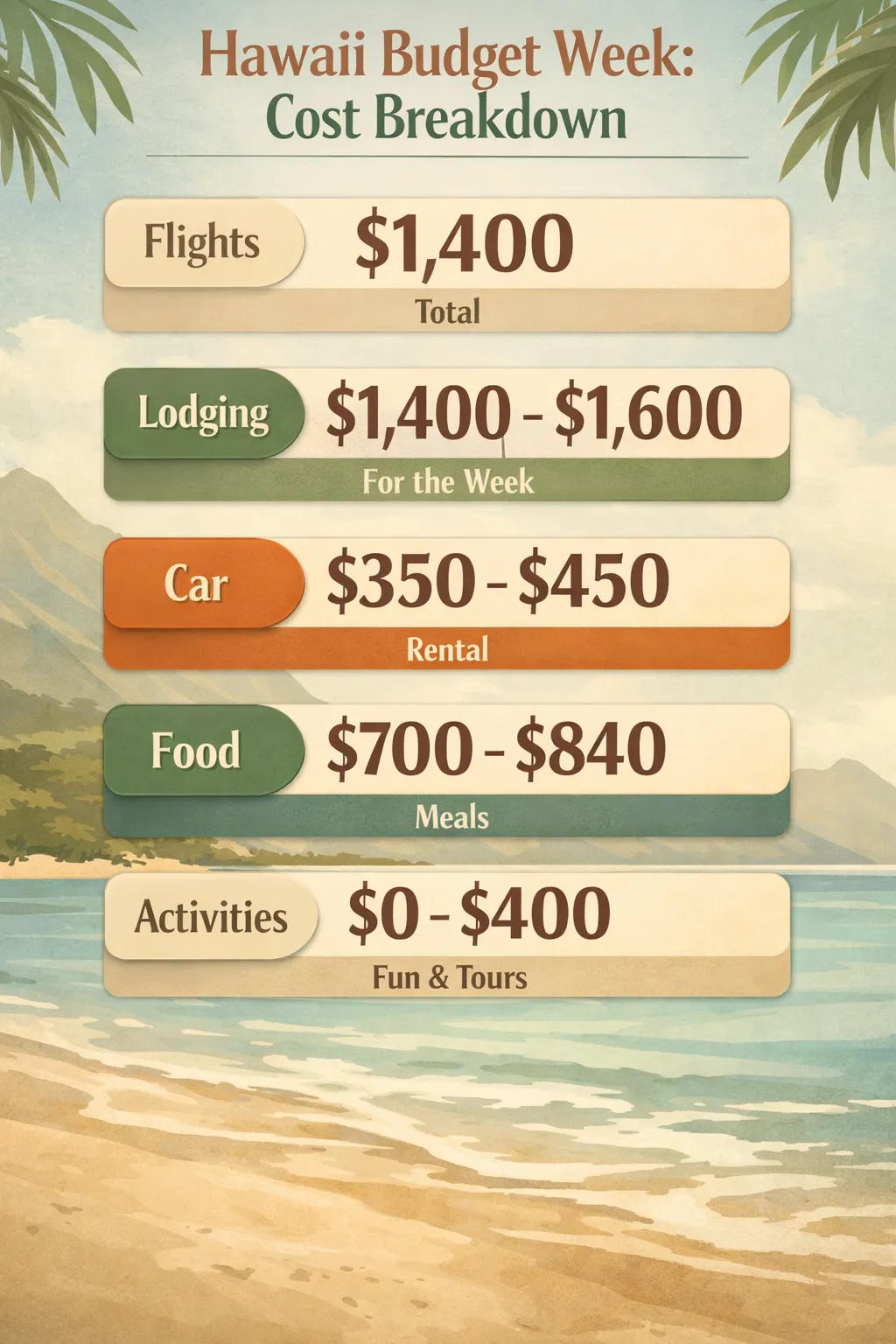 A budget snapshot for two shows major costs: Flights about $1,400 total, accommodation $1,400–$1,600, rental car $350–$450, food $700–$840, activities $0–$400.

Here’s how a budget couple’s week actually splits out:
- Flights: about $1,400 total ($700 per person from the mainland)
- Accommodation: $1,400-$1,600 for the week
- Rental car: $350-$450
- Food: $700-$840
- Activities: $0-$400
That lands a budget-to-lower-midrange trip at $4,760-$5,220 total for two. Push into mid-range comfort - nicer lodging, more paid tours - and daily spend climbs to $900-$1,200 for two, or $6,300-$8,400 per week.
One thing most budget guides get wrong: they quote the advertised nightly rate and forget the add-ons. Taxes and fees pile on 15-20% once you factor in the Transient Accommodations Tax, county taxes, and cleaning fees (1)(8). Hawaii’s “green fee” raised the state TAT by 0.75% to 11%, adding roughly $3 per night to a $400 room (8). Small per night, real over a week.
What is a reasonable budget for Hawaii?
A reasonable target depends on how many people are splitting fixed costs and how you handle lodging. Three realistic tiers, all for two people and excluding flights unless noted:

- Ultra-budget (hostels/camping, mostly free activities): roughly $1,000-$1,500 per person per week, flights excluded
- Comfortable budget: $600-$750 per day for two, or $4,200-$5,250 per week, covering moderate lodging, a car, food, and a mix of free and paid activities
- Mid-range comfort: $900-$1,200 per day for two, or $6,300-$8,400 per week
Below are direct answers to the questions that come up most.
Is $1,000 enough for a week in Hawaii?
For one person with flights and lodging already prepaid - staying with friends or using points - $1,000 covers food, local transport, and modest activities comfortably. Some solo travelers do a full week on about that.
For two people including accommodation, $1,000 total is not enough unless you’re camping heavily discounted sites and skipping the rental car entirely (1). Don’t plan around it.
Is $2,000 enough for a week in Hawaii?
For one person, yes - $2,000 covers a mid-range hotel and basic activities for a week (7). For a budget-minded couple, it works only if flights or lodging are partially covered by points or a package deal. Two people paying full freight for flights, a car, and a room will blow past $2,000.
Is $5,000 enough for a week in Hawaii?
For two people, yes - comfortably. A budget-to-lower-midrange week totals $4,760-$5,220 including flights, a car, lodging, food, and moderate activities. At this level you can book a legal vacation rental or 3-star hotel at $200-$300 per night, a $50-$70/day rental car, and spend around $100-$120 daily on food for two. $5,000 is the sweet spot for a comfortable, no-stress week for a couple.
All Hawaii accommodations, ranked by cost
Where you sleep is the single biggest budget lever after flights. Here’s the full range, cheapest to priciest, with real weekly numbers.
Camping - $3 to $35 per night per person. The cheapest legal roof (or lack of one) in Hawaii. Tent sites on Kauai run $3-$35 per person/night (some free for residents); Big Island county campgrounds sit at $10-$15 per site/night plus any park entrance fee (4)(9). Cabins and “tentalows” jump to $85-$240 per night. Weekly lodging: as low as $21-$245 per person. Best for nature-focused, gear-carrying travelers who don’t mind forgoing daily hot showers.
Hostels - $40 to $70 per night per person. Shared dorms in Hilo and Honolulu commonly run $45-$60 per night (2). Weekly lodging lands around $280-$490 per person - and the savings can fund a rental car or a tour. Many include communal kitchens, which quietly cut your food bill too.
Vacation rentals / condos - $150 to $300 per night for two. That’s $1,050-$2,100 per week for lodging, but the full kitchen matters: cooking breakfast and some dinners cuts food costs by 20-40% versus eating out every meal. A low-cost condo is what brings NerdWallet’s total weekly trip down to $4,936 for two (1).
Budget hotels - $150 to $250 per night. Reliable, central, and simple, but you lose the kitchen savings and pick up the full tax load.
Choosing a hostel
Look for good reviews on cleanliness and safety, and check the social calendar. A well-run hostel becomes the hub of your trip, especially if you’re traveling solo. I’ve done beach cleanups, local food-tasting tours, and a stargazing night with local astronomers on the Big Island that cost nothing beyond my bed rate - the kind of thing that doesn’t show up in any paid itinerary.
Securing camping permits in national and state parks
County and state parks require an online permit booked in advance, and popular sites sell out fast in peak season. Kauai fees run $3-$35 per person/night (9); Big Island national park campgrounds sit at $10-$15 per site/night plus park entrance (4). Check the official National Park Service and Hawaii State Parks sites for current rules and availability windows - each park runs its own reservation system, and they don’t coordinate with each other.
Popular spots for camping:
Follow Leave No Trace principles, pack light but complete, and respect the wildlife. I set up in Haleakalā and woke to the crater sunrise the next morning - that view is genuinely worth the pre-dawn permit hassle.
One math trap to avoid: a campground at $15/night that requires a $50-$70/day rental car can cost more overall than an in-town hostel you reach by bus (3)(4). Factor transport into the lodging decision before you commit.
Go with a vacation rental - with caveats
A legal vacation rental is one of the strongest budget plays because the kitchen pays you back. I’ve stayed in a condo on Kauai where the ocean was the front yard, and prepping fresh market produce for breakfast kept the food line noticeably low across the week.

Book through reputable platforms, read past reviews, and negotiate longer stays for discounts - useful if you’re a slower traveler. But there’s a 2024 wrinkle you have to respect.
Is booking an Airbnb safe on Oahu?
Legally, it’s more complicated than it used to be. Short-term rental laws changed in 2024, especially on Oahu and Maui, tightening the legal zones and minimum-stay requirements to address the housing shortage (5). Some listings that look fine on the platform are non-compliant, and illegal rentals can get shut down with little notice - potentially cancelling your reservation after you’ve already arrived.
Protect yourself:
- Book only permitted short-term rentals in legal zones, and check the county’s short-term rental rules before you pay (5).
- Be wary of listings advertising nightly stays in resort-zoned areas - many Oahu neighborhoods now require 30-day minimums.
- Read recent reviews for any mention of cancellations or permit issues.
Done right, a legal condo for two at $150-$300/night with a kitchen is often cheaper across a week than a hotel once you count the food savings. Done carelessly, it’s a mid-trip scramble for a last-minute room.
Do you need a rental car?
Depends entirely on the island.
On Oahu, no. TheBus and rideshare cover most of what visitors want, and skipping the car saves $350-$750 per week. Honolulu is walkable in parts, and the transit reaches Waikiki, downtown, and several North Shore beaches.
On Maui and the Big Island, you need a car. Attractions are spread out, transit is thin, and camping or out-of-town rentals are impractical without wheels.
Budget $50-$75 per day plus taxes, or $350-$450 for a week at the budget end and up to $750 mid-range. Statewide averages run about $72/day, but Honolulu sits around $52/day, and off-peak deals dip to $32-$33/day (3)(8). You’ll need a valid license, a credit card, and a $200-$500 hold.
If you’re doing multiple islands, weigh a car-free Oahu leg against car-required outer-island legs rather than renting for the whole trip. The math almost always favors island-specific decisions.
Trade airline miles for the expensive parts
Flights are the biggest single line item, so this is where points move the needle most. A roundtrip domestic ticket often runs 40,000-60,000 points per person, offsetting roughly $1,000 per person in airfare and cutting a budget couple’s total trip cost by 25-30%.
Apply miles to the priciest components first - the mainland-to-Hawaii legs and inter-island hops. Trading points for inter-island flights alone can save $400-$600 for two. If you’re chasing a premium international routing, points can offset $2,000-$3,000 in seat cost. Start banking a travel rewards card a year before the trip and you’ll knock the largest number on the budget down before you book anything else.
Eat like a local
Food is the line that quietly balloons if you’re not paying attention - $700-$840 per week for two on a budget versus $1,400+ eating out most meals. The gap is entirely in how you eat, not what island you’re on.
- Supermarket poke bowls run $10-$15 at local chains, versus $20-$50 at a sit-down restaurant (6). This one swap cuts a weekly food budget by 30-40%.
- Use your kitchen. Couples who cook breakfast and some dinners in a condo or hostel keep food near $700-$840 for the week; those eating out every meal roughly double it.
- Shop the local markets for produce, plate lunches, and snacks. It’s cheaper and the food is better anyway.
Reserve restaurants for the meals worth the detour - a good loco moco, a fresh fish spot that locals actually go to - and cook the rest.
Enjoy the all-access beaches
Nearly every beach in Hawaii has public access by law, which means multiple days at the best beaches cost $0 beyond parking. This is the anchor of any cheap Hawaii itinerary and why activity spending can stay near the $0-$100 per week low end.
The mistake budget travelers make is over-scheduling paid tours. Activity ranges run $0-$400 per week, and a lot of that top end is money spent on things free hikes and beaches would have covered. Book one or two paid experiences worth the splurge - a snorkel charter, a volcano tour - and fill the rest with coastline and trails.
Things to do in Maui on a budget
Maui reads as the pricey island, but the free list is long if you skip the resort packages. The best approach to things to do in Maui Hawaii on a budget is to focus on the coastline and the road, not the paid attractions. If you want a broader view of how the islands compare for different travel styles, the best places to visit in Hawaii breaks it down by trip type and budget tier.
Worth the detour:
- The Road to Hana - a full day of waterfalls, black-sand beaches, and roadside stands. Cost is gas and time. Drive it yourself; the pricey guided tours don’t add much if you’re comfortable with narrow one-lane bridges and a little navigation.
- Iao Valley State Park - a small parking/entry fee for out-of-state visitors, then a short walk to the needle. Worth it.
Good for filling days at no cost:
- Big Beach (Makena) and Baldwin Beach - free public-access beaches with parking. Multiple days here cost you nothing.
- Free hula and cultural shows at shopping centers like Whalers Village - no ticket required (more on this below).
Remember Maui is car-required. Budget the rental into the plan from the start and it’s a very affordable island. Forget it and you’re stuck at the resort.
Watch local cultural shows for free
A luau ticket runs $100+ per person, and it’s a real experience - but it’s not the only way to see Hawaiian music and dance. Many resort areas, shopping centers, and towns host free hula performances, live music, and cultural demonstrations on a regular schedule. Attending a couple of these can replace a luau on an ultra-tight budget and save $50-$100 per person.
Check the event calendars at major shopping centers and resort areas when you arrive - most run weekly. Community festivals are another free window into local traditions and often line up with your dates if you look. Also lean on last-minute deal apps for discounted tours when you do want a paid activity (and it’s a good way to embrace the Aloha spirit without the resort markup).
2-week Hawaii itinerary: Oahu, Maui, and the Big Island
Duration: 14 days across three islands. Estimated total for two: roughly $8,400-$10,500 budget (hostels/camping, fewer paid tours) up to $12,600-$16,800 mid-range. Add $400-$600 for two in inter-island flights on top.
Crowdsourced trip data backs this up - one mid-range couple logged $11,000 for 21 days across three islands, about $520/day. For 14 days at a comfortable-budget pace, aim for $600-$750/day for two.
Here’s the shape of it:
Days 1-5 - Oahu (car-free). Base in Honolulu or Waikiki at a hostel or budget condo. Skip the rental car and use TheBus - that’s $250-$540 saved over the leg (3). Fill days with all-access beaches (Waikiki, Lanikai, North Shore), Diamond Head, the free cultural shows at Ala Moana, and a Pearl Harbor visit. Oahu also has bigger-ticket thrills if you want one paid splurge.
Days 6-9 - Maui (car required). Pick up a rental at the airport ($50-$75/day). Drive the Road to Hana, hit Makena and Baldwin beaches, and stay in a legal vacation rental with a kitchen to hold food costs down. Cook breakfasts; save restaurant meals for two or three standouts.
Days 10-14 - Big Island (car required). Camp at a county site ($10-$15/night) or grab a budget condo. Hawaiʻi Volcanoes National Park is the anchor - worth every dollar of the entrance fee. Manta ray night snorkels and stargazing round out the paid list; the beaches and lava fields are free.
Budget lever summary for the two weeks: go car-free on Oahu, cook most meals, camp or use hostels on at least one island, and put airline miles toward the mainland flights. That combination is the difference between the $8,400 and the $16,800 versions of the same trip.
Frequently Asked Questions
- Is $1,000 enough for a week in Hawaii?
- $1,000 covers food, local transport, and modest activities for one person with prepaid flights and lodging; not enough for two including accommodation.
- Is $2,000 enough for a week in Hawaii?
- $2,000 covers a mid-range hotel and activities for one person; couples need partial points or package deals to stay within this budget.
- What is a reasonable budget for Hawaii?
- A typical mid-range budget is about $4,000 per week for two; ultra-budget travelers using hostels and camping can spend $1,000-$1,500 per person excluding flights.
- Is $5,000 enough for a week in Hawaii?
- $5,000 comfortably covers flights, car, lodging, and food for two at a budget-to-lower-midrange level.
- Are all vacation rentals in Hawaii legal to book?
- No, short-term rental laws tightened in 2024; only book permitted rentals in legal zones to avoid cancellations.
- Can I skip renting a car on all Hawaiian islands?
- No, car-free travel works on Oahu but Maui and Big Island require rental cars due to sparse transit and spread-out attractions.
- How much can airline miles save on a Hawaii trip?
- Using miles can reduce flight costs by 25-30%, saving roughly $1,000 per person on mainland-to-Hawaii flights.
- Are there free cultural activities in Hawaii?
- Yes, many resort areas and shopping centers host free hula shows and live music regularly, offering cultural experiences without cost.