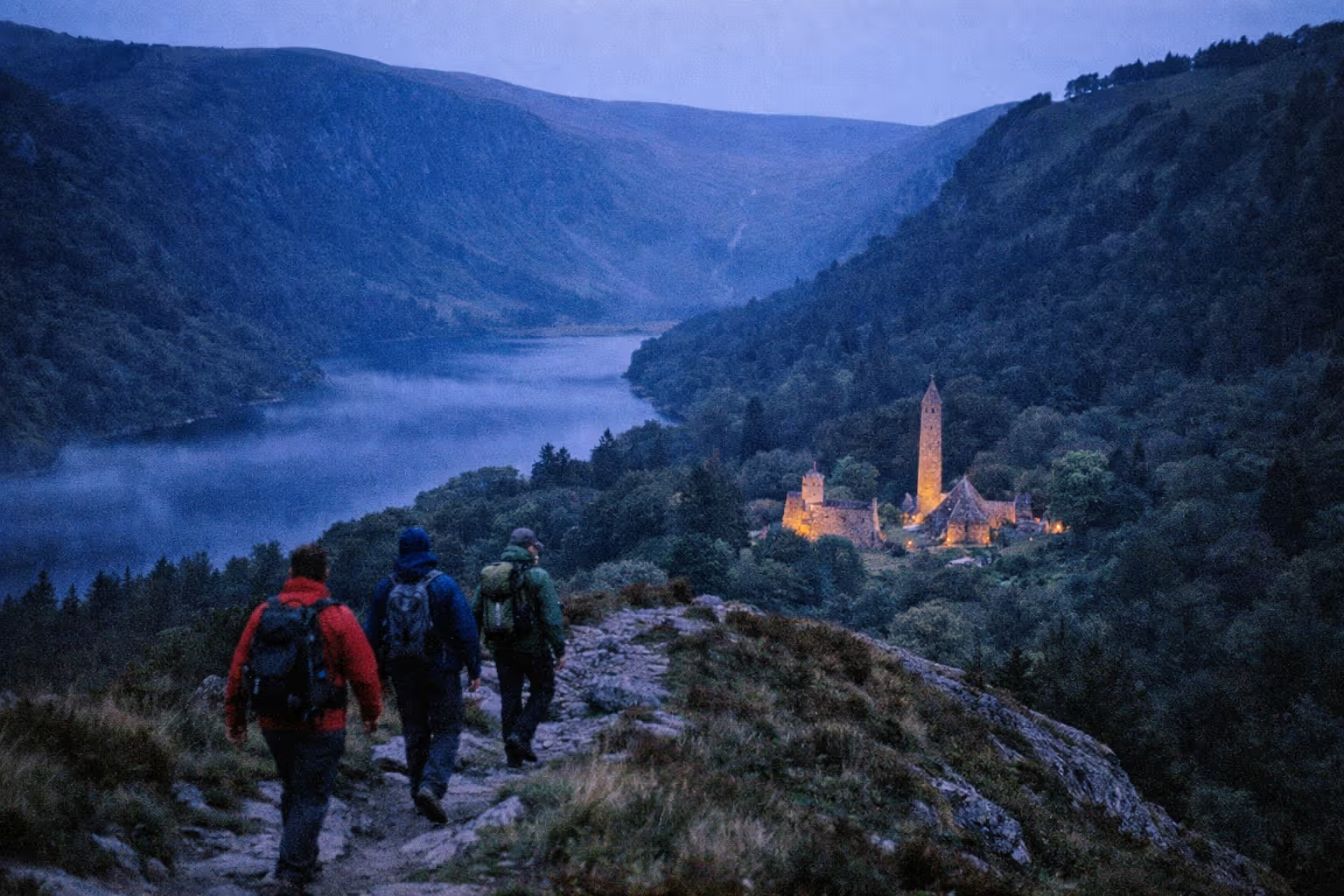
This valley in County Wicklow packs a 6th-century monastic city, two glacial lakes and nine waymarked trails into a single site, roughly an hour’s drive south of Dublin. The hard part isn’t finding something to do here, it’s choosing the right combination for the time you’ve actually got. This guide sorts the trails by distance and climb, walks you through the ruins, and covers the logistics so you don’t spend your day stuck in a car park deciding.
What Glendalough Is and Why It Draws So Many Visitors
The glacial valley sits inside Wicklow Mountains National Park and is known for its early monastic settlement and a dense network of walking trails (5)(8). The name means “the valley of the two lakes,” and that geography drives everything (9).
Two things share the same valley floor. One is the heritage core: the Round Tower, churches and graveyard of the old monastic city near the Lower Lake. The other is the walking hub: nine official waymarked routes, from short family walks to hillwalks with serious climbs, all starting at the National Park Information Office near the Upper Lake (1).
What most guides get wrong: they describe the site as a paid attraction. It isn’t. Admission to the monastic site is free, though parking charges may apply (5). The OPW Visitor Centre, which houses the exhibition and runs guided tours, is the only part that charges: €5 for adults, €4 for seniors and groups, €3 for children and students, and €13 for a family (7). If you pay for parking at the Visitor Centre car park, that includes one free admission to the centre (7).
✓ Pros
- Free access to the monastic ruins year-round
- Nine trails suitable for all fitness levels
- Easy day trip from Dublin
- Distinctive glacial valley scenery with ridge views
✗ Cons
- Site gets crowded on weekends
- Hillwalks require proper footwear and waterproofs
- Limited and seasonal public transport options
- Visitor Centre closed for a week over Christmas
The Monastic City: St Kevin, the Round Tower, and What Remains
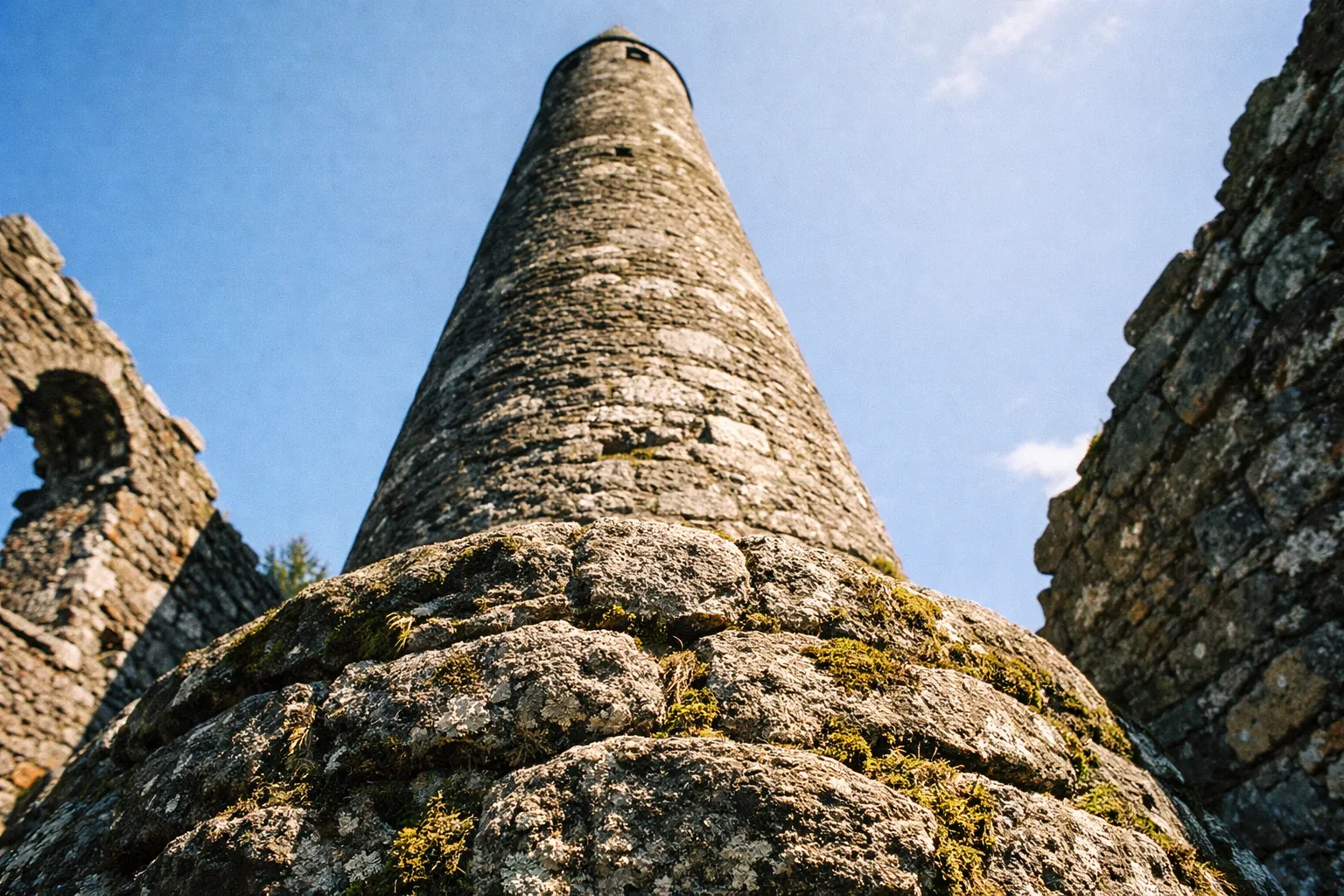
The monastic city is a cluster of early medieval remains, a Round Tower, a cathedral, several churches, high crosses and a graveyard, founded in the 6th century by St Kevin (4). It’s the reason most people first hear the name, and you can walk the whole cluster for free.
St Kevin and the founding of the monastery
St Kevin came to the valley as a hermit in the 6th century, living in isolation before the community that grew around him became the Monastic City (4)(8). Over the following centuries the settlement became one of Ireland’s major centres of early Christianity and pilgrimage.
Key ruins: Round Tower, Cathedral, and St Kevin’s Church
The Round Tower is the landmark, a tall, tapering stone tower that served as a bell tower and a refuge. Alongside it stand the ruined Cathedral, the small stone-roofed St Kevin’s Church (often called “St Kevin’s Kitchen”), high crosses and the graveyard. You can wander the cluster freely; it’s a short walk from the Visitor Centre.
St Kevin’s Bed and the hermit years
St Kevin’s Bed is a small cave in the cliff above the Upper Lake, tied to the saint’s hermit years. It isn’t one of the waymarked walks, so treat it as something you look up at from the lake shore rather than something to scramble to. The lakeside and Spinc routes give you the views without the risk.
Visitor Centre hours and guided tours
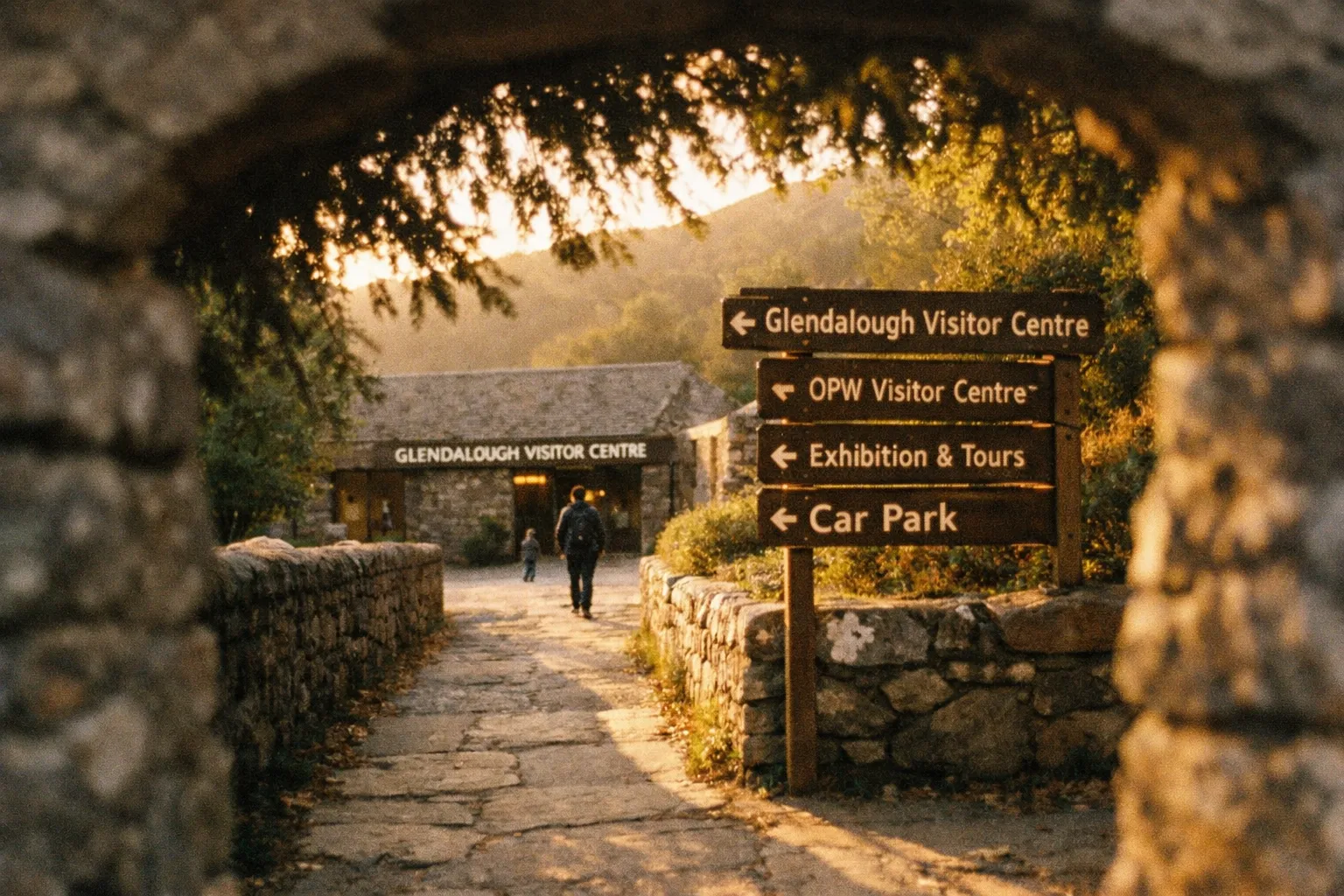
The Visitor Centre is open all year: 09:30 to 18:00 from mid-March to 14 October (last admission 17:15), and 09:30 to 17:00 from 15 October to mid-March (last admission 16:15). It closes 23 to 29 December inclusive, and OPW puts the average visit at 1 to 1.5 hours (7). Guided tours of the monastic site are booked through the centre by telephone only, not by email, on +353 404 45325 (4). A tour gives you structured context on St Kevin and early Irish Christianity that you won’t piece together wandering solo. Over Christmas the ruins stay open and free even while the centre is shut (5)(7).
The Nine Glendalough Walks: Distances, Climbs, and Who Each Suits
The valley has nine waymarked walks, from 1 km up to 11.5 km, each starting at the National Park Information Office near the Upper Lake (1). Distances, times and climbs in this guide come from the park’s printed trail map (1); its current trail page gives slightly different times for a few of them (the Spinc short route at about 2 hours, the Green Road at 45 minutes) and grades the Spinc routes Strenuous (5). The spread is the whole point: you can match a route to your fitness and the hours you have rather than committing to one big loop by default.
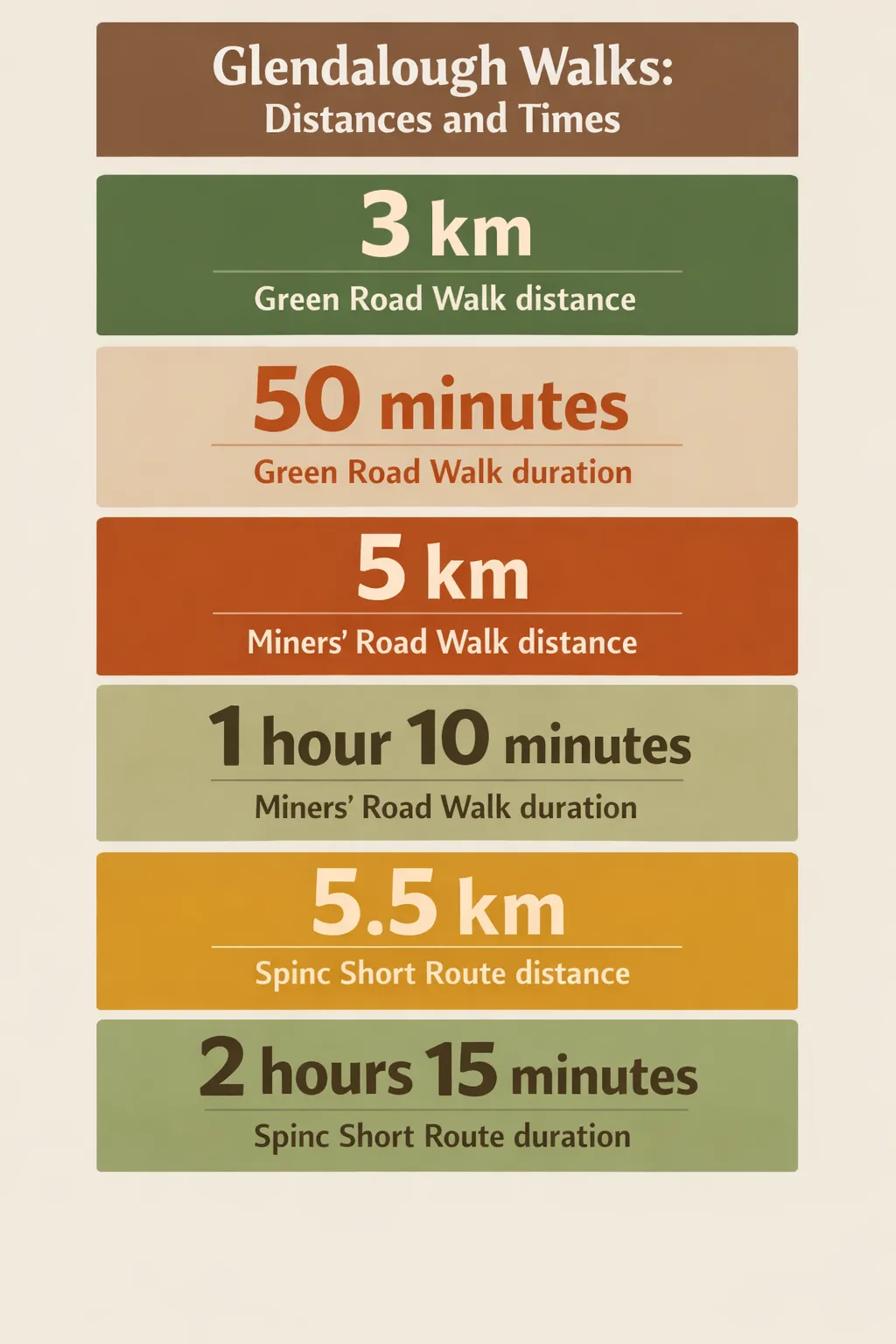 Glendalough offers nine trails with distances and times; this infographic highlights three representative walks: 3 km (50 minutes), 5 km (1 hour 10 minutes), and 5.5 km (2 hours 15 minutes).
Easy walks
The two easy walks do most of the lakes-and-scenery work with minimal effort. The Green Road Walk covers 3 km in about 50 minutes with 20 m of climb, and the Miners’ Road Walk runs 5 km along the Upper Lake shore in about 1 hour 10 minutes, also with 20 m of climb (1). Outside the official nine, the flat 1.5 km loop around the Lower Lake is a popular 30 to 40 minute stroll (9).
Moderate walks and rambles
Poulanass is short but steeper than it looks: 1.6 km in about 40 minutes with 100 m of climb past the waterfall, while Poulanass and St Kevin’s Cell is 1 km in 30 minutes with 85 m of climb (1). The Woodland Road ramble runs 4 km in 1 hour 15 minutes with 90 m of climb, and the Derrybawn Woodland Trail is the quiet one: 8 km, about 2 hours, 160 m of climb (1), through forest that sees a fraction of the Spinc’s traffic (6).
Check the park’s trail page before you pick one of these: storm damage has closed the Poulanass and St Kevin’s Cell loop (you can still walk out to the Cell and its viewpoint over the Upper Lake and return the same way), the path beyond the Poulanass waterfall has collapsed, so that walk now comes back down the steps and follows the re-routed Woodland Road arrows, and the Derrybawn trail has been re-routed to bypass the waterfall (5).
Hillwalks: the three Spinc routes
The Spinc routes are genuine hillwalks, not viewpoint strolls. The number that matters when choosing between an easy walk and a Spinc route is climb: the Spinc and Glenealo Valley loop asks for 380 m of ascent against 20 m on the Miners’ Road (1). If a route lists 300 m or more of climb, treat it as a half-day mountain outing.
Worth the detour regardless of time: the Spinc short route (5.5 km, about 2 hours 15 minutes, 300 m) gives you the boardwalk and the view down over the Upper Lake. The Spinc and Glenealo Valley loop (9.5 km, about 3 hours 15 minutes, 380 m) is the full version if you have the legs for it (1). The Derrybawn Woodland Trail is the quiet alternative, with fewer people and still a proper walk (6).
Skip if short on time: the Woodland Road and the two Poulanass walks are pleasant but add little once you’ve done the lake routes. The Spinc and the Wicklow Way (11.5 km, about 4 hours 15 minutes, 490 m) is only worth the extra distance if you’re building toward the long-distance network (1).
Glendalough Walks Comparison
| Green Road Walk | Miners' Road Walk | Poulanass | Poulanass and St Kevin's Cell | Woodland Road | Derrybawn Woodland Trail | Spinc (short route) | Spinc and Glenealo Valley | Spinc and the Wicklow Way | |
|---|---|---|---|---|---|---|---|---|---|
| Distance (km) | 3 | 5 | 1.6 | 1 | 4 | 8 | 5.5 | 9.5 | 11.5 |
| Duration | 50 min | 1 hr 10 min | 40 min | 30 min | 1 hr 15 min | 2 hrs | 2 hrs 15 min | 3 hrs 15 min | 4 hrs 15 min |
| Climb (m) | 20 | 20 | 100 | 85 | 90 | 160 | 300 | 380 | 490 |
| Grade | Easy | Easy | Moderate | Moderate | Ramble | Ramble | Hillwalk | Hillwalk | Hillwalk |
| Best for | Families | Families and casual walkers | Waterfall views | Loop closed: out and back to the Cell | Casual walkers | Quieter forest walk | Ridge views on limited time | Hikers | Strong hikers |
The Spinc: The Valley’s Signature Ridge Walk
The Spinc is the ridge along the south side of the Upper Lake, with a boardwalk section, and it comes in three lengths that all run along the boardwalk above the Upper Lake (1)(6). The choice between them is a distance-and-climb trade-off, so make it deliberately.
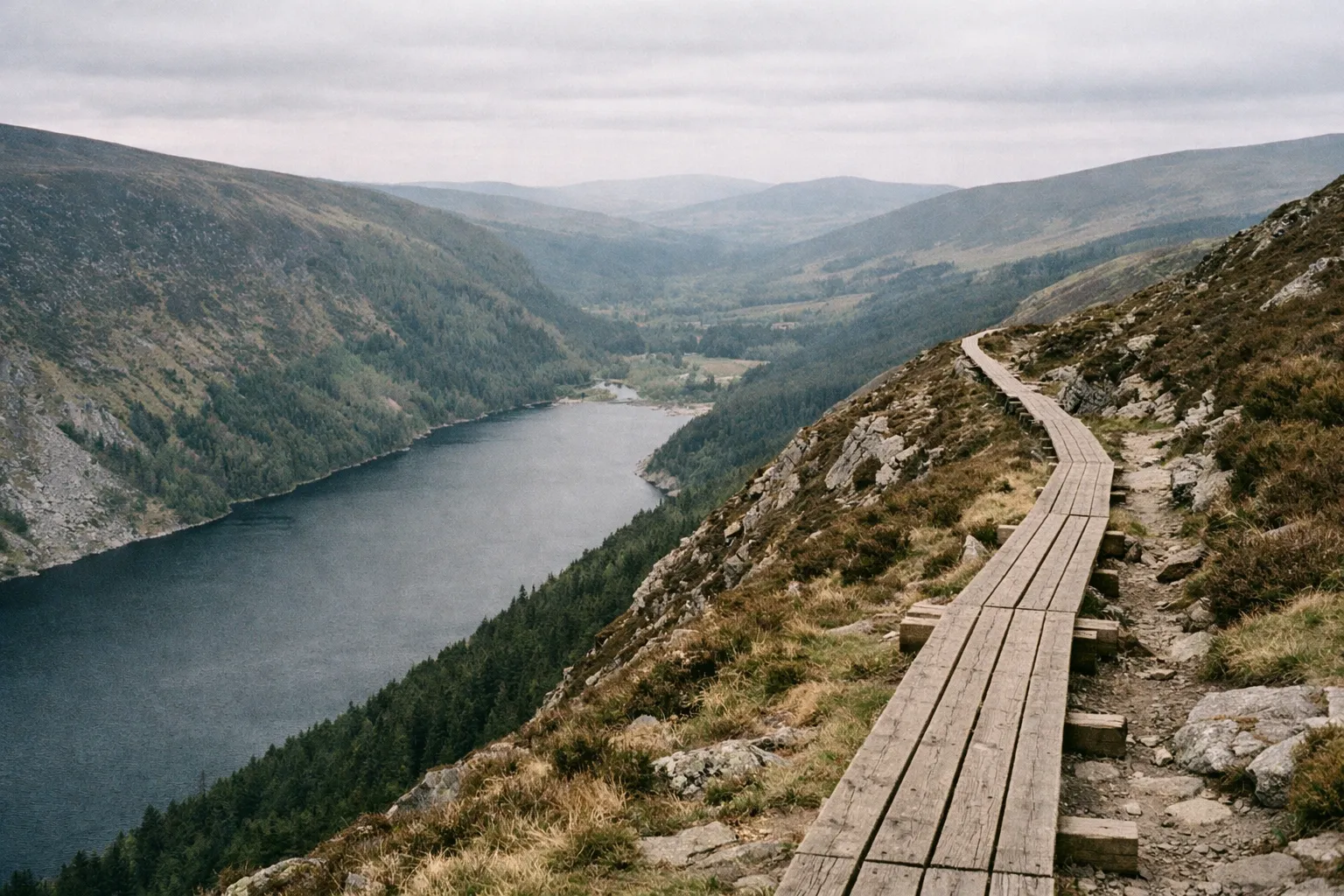
The Spinc short route is 5.5 km, about 2 hours 15 minutes, with 300 m of climb (1). It gets you onto the ridge and the views without the longer valley section, which saves 4 km and 80 m of climbing over the full loop.
The Spinc and Glenealo Valley loop is the standout half-day hike: 9.5 km, about 3 hours 15 minutes, 380 m of climb (1)(3). On the park’s current route description you head out along the flat Miners’ Road, climb steeply past the old Miners’ Village and cross the Glenealo river before the boardwalk and the Spinc cliff path bring you back down to the valley floor (5). The Spinc and the Wicklow Way extension pushes it to 11.5 km, about 4 hours 15 minutes, and 490 m of climb (1).
For any of the three, wear sturdy footwear and carry waterproofs and layers. The boardwalk and rocky steps get slick in rain, and Wicklow’s weather turns fast: fog can wipe out the very views you climbed for (2)(3)(6).
Long-Distance and Pilgrimage Routes Through the Valley
Long-distance trails make the valley a hub rather than just a stop: the Wicklow Way, St Kevin’s Way and the Miners’ Way pass through the national park, and a fourth, the Avonmore Way, finishes close by (5). If you’re building a multi-day itinerary, this is your natural pivot.
St Kevin’s Way is a 30 km (18 mile) pilgrimage trail from Hollywood, typically walked in 6 to 8 hours or split over two days (8)(9). That’s nearly three times the longest waymarked loop in the valley, so if you’re planning it as a day walk, start very early, or split it and stay overnight.
The Wicklow Way is the big one, a national route of roughly 130 km from Marlay Park in Dublin to Clonegal in County Carlow that passes through the valley (5)(8)(10). The Avonmore Way is a 12 km trail from near Rathdrum to Trooperstown, close to the park (5)(8). Glendalough also features on most Ireland’s Ancient East itineraries, if you’re combining walking with a wider road trip.
Planning Your Visit: Getting There, Timing, and What to Bring
Plan on roughly an hour to 90 minutes by car from central Dublin, and the practical decisions come down to transport, timing and gear.
Best month to visit: May or early June. The days are long enough for a Spinc loop without a pre-dawn start, and the summer crowds haven’t peaked yet. September works nearly as well. Avoid July and August weekends if you can: the car parks fill early and the Spinc boardwalk gets congested.
Getting there by car or bus
Parking charges apply at the main car parks: the Visitor Centre car park is free on weekdays but charges at weekends, while the Upper Lake car park charges all year (8). By bus, scheduled services and day-tour operators run from Dublin, but timetables and fares change seasonally, so check the operator directly before you set out. If you’re weighing Glendalough against other options, our guide to day trips from Dublin compares travel times.
How long to allow
For a short heritage visit, the Visitor Centre and Monastic City take 1 to 1.5 hours (7); add a lakeside walk like the Green Road and you’re at two to three hours. The smartest single-day combination if you want both worlds is the Monastic City plus the Spinc short route (about 2 hours 15 minutes (1)), for an outing of roughly four hours on site. For the full Spinc and Glenealo loop plus the ruins, allow most of a day with breaks.
What to wear and pack
For the easy walks, comfortable walking shoes are enough, with only 20 m of climb (1). For any Spinc route or the Wicklow Way sections, you want sturdy boots, waterproofs and layers; the ascents run 300 to 490 m over boardwalk and rock (1)(3). In winter, watch the daylight: a three-to-four hour hillwalk started in the afternoon can finish in the dark (3).
Glendalough Frequently Asked Questions
- What is Glendalough famous for?
- It is famous for its 6th-century monastic settlement founded by St Kevin and its nine waymarked walking trails in a glacial valley.
- How do the Irish pronounce Glendalough?
- It is pronounced "GLEN-da-lock," with a soft guttural sound at the end, like Scottish loch.
- Is Glendalough worth visiting?
- Yes, it offers free heritage ruins and mountain trails close to Dublin, ideal for day trips despite weekend crowds.
- Do you have to pay to visit Glendalough?
- No. The monastic site is free; you pay only for parking and, if you want it, the OPW Visitor Centre (€5 for adults).
- When was Glendalough founded?
- It was founded in the 6th century by St Kevin, who first lived there as a hermit.