Newgrange was already a thousand years old when the first stone went up at Stonehenge, and it had stood for nearly five centuries before anyone broke ground at Giza. That single fact does more work than any amount of superlatives. But here’s the practical reality most guides bury: you cannot drive up and buy a ticket. Access is tightly controlled, tours sell out weeks ahead in summer, and showing up without a booking means staring at a grass-covered mound from across the river.
This guide covers what you actually need to plan a good visit: the monument itself, the wider Brú na Bóinne complex including the Knowth and Dowth tombs, the ticketing system that trips up first-timers, and the logical day-trip extensions to the Hill of Tara and Trim Castle. Book first, plan second. Everything else fits around your confirmed time slot.
✓ Pros
- One of the oldest and best-preserved passage tombs on Earth - the corbelled chamber has kept itself dry for 5,000 years and the interior is genuinely striking
- Compact geography: Newgrange, Knowth, Dowth, the Hill of Tara, and Trim Castle all sit within roughly 40 km (25 miles) of each other in County Meath
- The Brú na Bóinne Visitor Centre exhibition gives you real archaeological context before you reach the monument
- A winter solstice simulation runs inside the chamber year-round, so you experience the alignment effect even without a lottery win
- Shoulder-season visits (March, November) mean lighter crowds and a shorter 7-day booking window
✗ Cons
- Ticket availability is described by Heritage Ireland as "very limited" - selling out weeks ahead in peak season is normal, not the exception (5)
- No walk-up access to Newgrange or Knowth; everything routes through the visitor centre
- Dowth's chamber interior is closed to the public entirely (5)
- The Hill of Tara's visitor centre and guided interpretation only run mid-May to mid-September (7)
- Trim Castle keep tours are weekend-only in some off-season periods; midweek winter visitors may get the grounds only (4)
What Makes Newgrange Worth the Effort
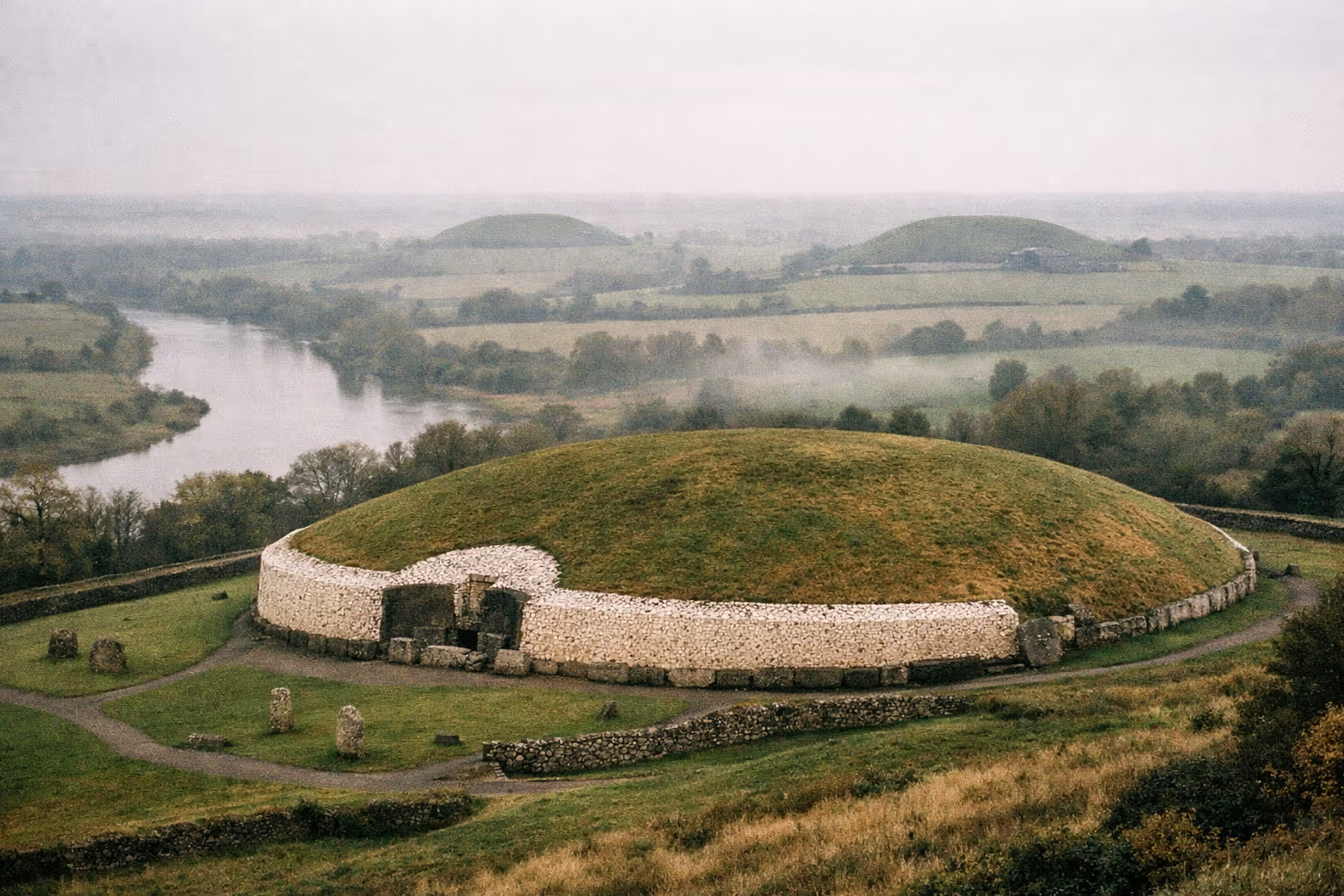
The monument is famous for two things: its age and its winter solstice alignment. Built around 3200 BC, it predates the Egyptian pyramids and Stonehenge by centuries, and its builders engineered a roof-box that channels the solstice sunrise down a 19-metre (62 ft) passage into the chamber with a precision that still holds after five millennia (13).
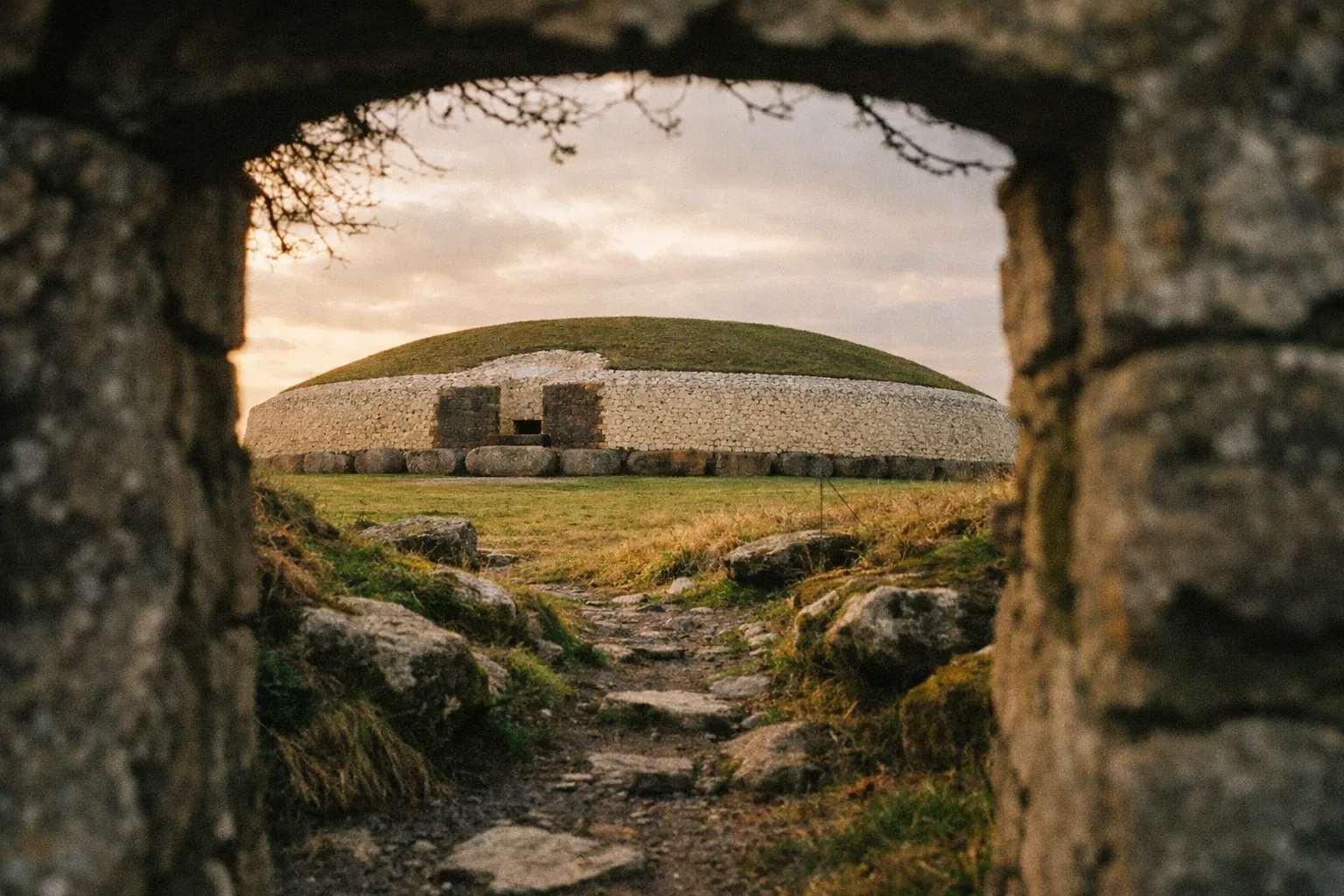
The mound itself is about 85 metres (279 ft) in diameter and 13 metres (43 ft) high, its base ringed by kerbstones carved with spirals, lozenges, and chevrons - some of the finest megalithic art in Europe. Inside, the 19-metre passage opens into a cruciform chamber capped by a corbelled roof: overlapping stone slabs laid without mortar, angled to shed water outward. That roof has kept the interior dry for 5,000 years, which is a large part of why the site survives in the state it does. UNESCO inscribed the Brú na Bóinne Archaeological Ensemble - Newgrange, Knowth, and Dowth - as a World Heritage Site in 1993.
How old is Newgrange compared to the pyramids
The passage tomb dates to roughly 3200 BC, making it about 500 years older than the Great Pyramid of Giza (c. 2560 BC) and around 1,000 years older than the main construction phase of Stonehenge (13). It ranks among the oldest surviving roofed structures anywhere on the planet. When the comparison comes up: the monument wins on age, comfortably.
The winter solstice alignment - what actually happens
On mornings around the winter solstice, sunlight enters through the roof-box above the entrance, travels the full length of the passage, and illuminates the chamber floor for about 17 minutes (14). The alignment is deliberate - the roof-box is a separate, purpose-built aperture, not the doorway - which means the builders understood the solar year well enough to survey a fixed sightline to the horizon without any modern instruments. There’s a full section on this below, including the lottery and livestream.
What we know about who was buried here
Michael J. O’Kelly’s excavations between 1962 and 1975 found the cremated remains of at least five individuals in the chamber basins. That points to a highly selective burial - a monument for a chosen few, not a communal grave. The deeper questions stay open: who organised the enormous labour to build it, exactly how the alignment was surveyed, and what the site meant to the people who raised it. That unresolved quality is the real “mystery” of Newgrange, and no amount of excavation has fully closed it.
Knowth and Dowth - the Other Two Tombs in the Complex
The Knowth and Dowth tombs are the two lesser-visited passage tombs of Brú na Bóinne, and each offers something the main chamber doesn’t. Knowth for the sheer density of megalithic art, Dowth for solitude and a self-guided feel. Skipping them means missing two-thirds of the World Heritage Site.
Visiting Knowth - what the tour covers and when it runs
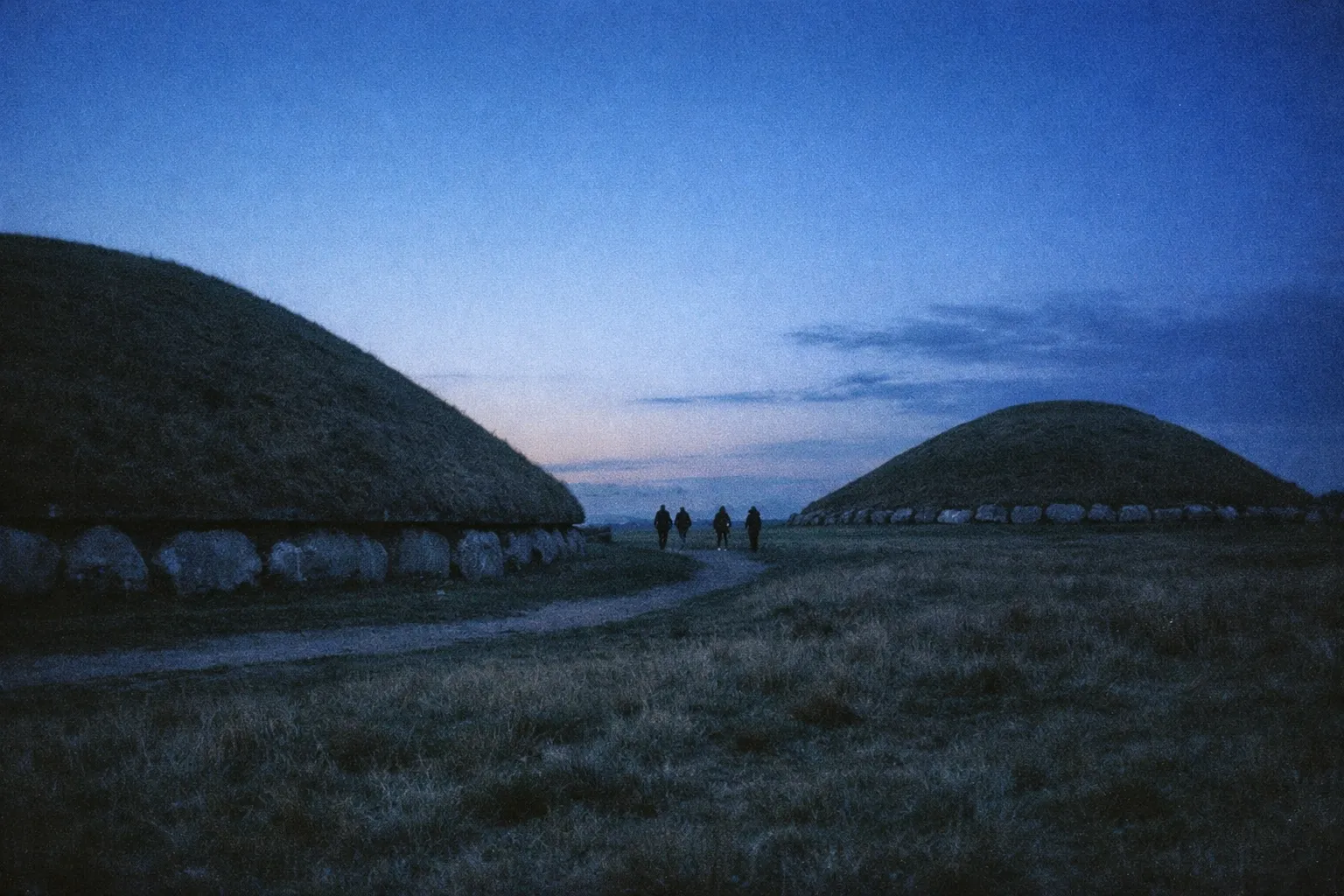
Knowth is the largest mound in the complex: a great kerbed mound ringed by eighteen smaller satellite tombs, containing two separate passage tombs that lead to their own chambers (15). Scholarly estimates put roughly a third of all known European passage-tomb art at this one site - the greatest concentration of megalithic art in Western Europe. The Great Mound was constructed around 3200 BC, and after decades of excavation and conservation you can climb to the summit for a wide view across the Boyne Valley.
The Knowth tour runs from the same visitor centre as Newgrange, generally from March to early November (15). It covers the exterior of the mound, the satellite tombs, and the art - not the passage interiors. It’s a separate tour with its own ticket allocation, so if you want both Newgrange and Knowth, you book both and allow a full day.
Dowth - what you can actually see and how to get there independently
Dowth is comparable in scale to Newgrange: a mound roughly 85 metres (279 ft) in diameter and about 15 metres (49 ft) high, dated to around 3200 BC (8). It holds two passages - Dowth North and Dowth South - both oriented toward the western horizon and the winter solstice sunset. The interior is closed to the public, so you experience Dowth by walking freely around the exterior mound and its ring of kerbstones (5).
The practical draw is that Dowth is genuinely quiet. It sits directly on a road on the north side of the River Boyne, near the Slane-Drogheda road. No shuttle, no ticket, no timed entry - you park and walk. If you’re doing a full passage-tomb day, the logical sequence is the chamber tour and Knowth via the visitor centre in the morning, then a self-drive to Dowth in the afternoon for the exterior circuit.
For most visitors the split is straightforward: Newgrange for the chamber experience, Knowth for the art and satellite tombs, Dowth for the quiet.
The Winter Solstice at Newgrange - Lottery, Livestream, and What to Expect
The winter solstice passage tomb alignment at Newgrange is the most searched and most misunderstood aspect of the site. On the mornings around the solstice (roughly 19-23 December), a beam of sunlight enters the roof-box, runs the full 19-metre (62 ft) passage, and lights the chamber floor for about 17 minutes as the sun climbs (14). The light widens as the sun rises, then narrows and withdraws.
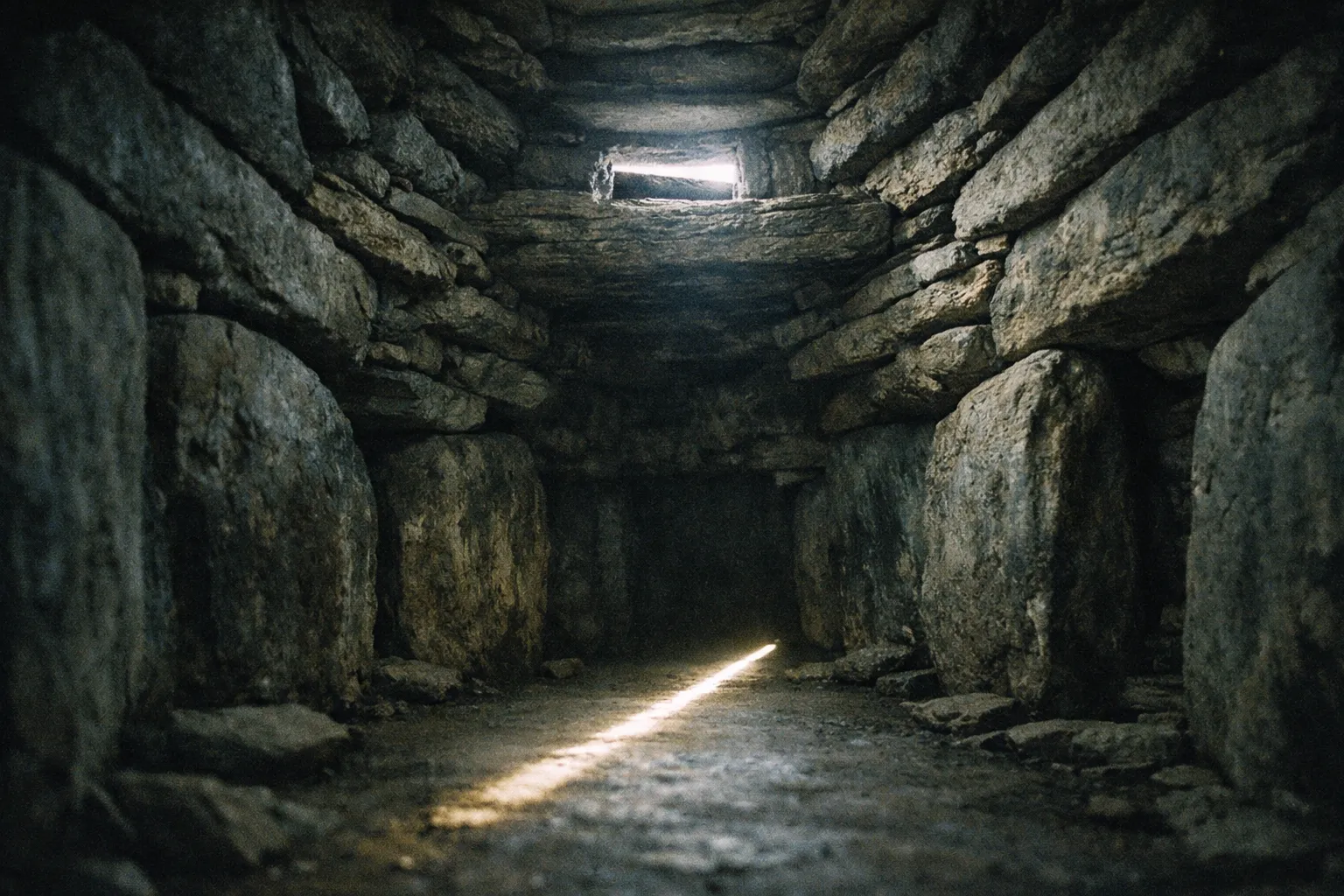
Access to the chamber on those mornings is decided by an annual OPW lottery held in late September. The OPW has run the draw since 2000, and thousands apply for only dozens of places (12). Winners see the actual sunrise beam. Everyone else is welcome to gather outside the monument entrance on solstice mornings, travelling out from the visitor centre by shuttle - though whether the sun cooperates is another matter entirely, and Irish December skies are frequently overcast.
If you can’t travel in December or don’t win the lottery, the OPW live-streams the solstice sunrise from inside the chamber. It runs on gov.ie/newgrange and heritageireland.ie, and in the cloud-out years it has arguably given viewers a clearer look than many lottery winners get (14).
For everyone else visiting during the year, guides recreate the effect inside the chamber using artificial lighting on the standard tour. It’s a controlled approximation rather than the real thing, but it works, and it’s what the large majority of visitors actually experience.
A practical note for December visitors: the visitor centre and site stay open in winter on reduced hours, closing at 16:15 in January and February (5). The Winter Tour is cheaper than the main-season chamber tour - €10 for an adult versus €18, per Discover Boyne Valley.
Getting Into - How the Brú na Bóinne Visitor Centre Timed Tickets Work
The Brú na Bóinne visitor centre timed tickets system is the one thing to understand before anything else, because there is no independent access to the passage tomb or Knowth. Every visit begins at the Brú na Bóinne Visitor Centre in Donore (Eircode A92 EH5C), on the south side of the River Boyne (2). You check in, view the exhibition, cross the pedestrian bridge, and board a shuttle bus to the monuments on a timed schedule. Your shuttle boarding time is effectively your tour time. If you drive straight to the mound, you will not get in.
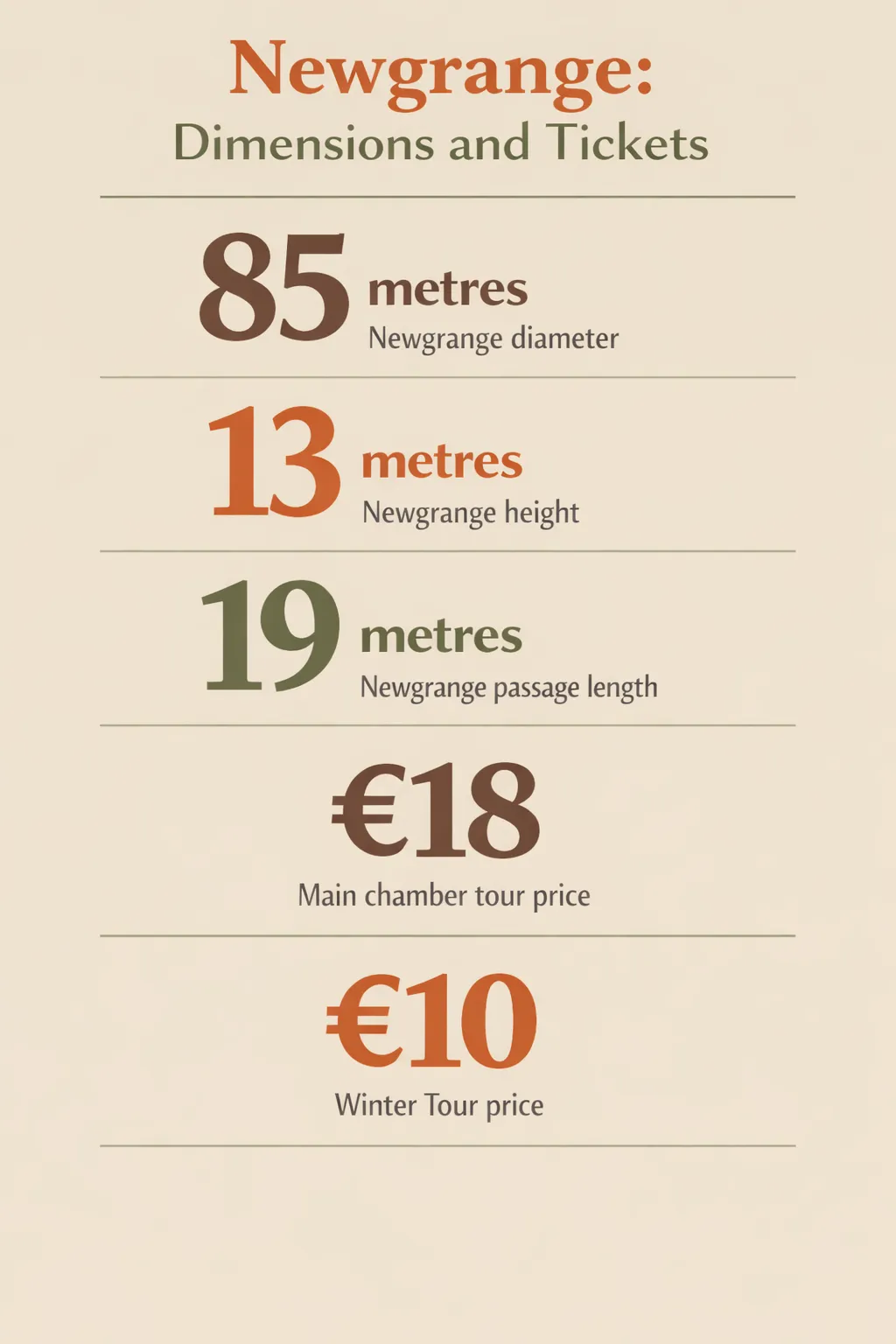 Newgrange dimensions and Brú na Bóinne ticket prices (main tour €18, winter tour €10).
Ticket types and prices
For the current season, the main Brú na Bóinne Tour plus chamber ticket costs €18 for adults, €16 for seniors (60 and over), and €12 for ages 12-17 and students, per Discover Boyne Valley, which reproduces official Brú na Bóinne ticketing information. A family ticket (maximum two adults and five children aged 12-17) is €48. Children under 12 are free but still need a booked ticket (2). The Knowth Tour plus Exhibition is priced at €10 for adults (Senior 60+ €8; Child 12-17 €5; Student €5; Family €25), per Discover Boyne Valley.
The Visitor Centre Exhibition Only ticket - the displays, no monument - is €5 for adults, €4 for seniors, €3 for ages 12-17 and students, and €13 for a family, per Discover Boyne Valley. The Winter Tour (the passage tomb plus exhibition, the only option during the winter schedule) is €10 for adults, €8 for seniors, €5 for children and students, and €25 for a family, per Discover Boyne Valley. Exact start and end dates shift year to year; check the official Heritage Ireland pages for the season you’re travelling in.
To lay it out clearly: the main chamber tour (shuttle, chamber entry, exhibition) is €18 adult / €48 family, available March-November, booked 30 days ahead in the main season and 7 days ahead in the shoulder months. The Winter Tour (shuttle, chamber, exhibition) is €10 adult / €25 family, running roughly November to February - exact dates vary by year, so confirm the current schedule on the Heritage Ireland booking pages - with a 7-day booking window. The Exhibition Only ticket (visitor centre displays, no monument) is €5 adult / €13 family, year-round and more flexible. Knowth is a separate ticket again, running March to early November.
Brú na Bóinne Ticket Types at a Glance
| Brú na Bóinne Tour + Newgrange Chamber | Knowth Tour + Exhibition | Winter Tour (Newgrange + Exhibition) | Exhibition Only | |
|---|---|---|---|---|
| Ticket Type | Shuttle + chamber entry + exhibition | Shuttle + Knowth exterior/art + exhibition | Shuttle + chamber + exhibition | Visitor centre displays only, no monument |
| What's Included | Shuttle + chamber entry + exhibition | Shuttle + Knowth exterior/art + exhibition | Shuttle + chamber + exhibition | Exhibition only |
| Adult Price | €18 | Verify on-site | €10 | €5 |
| Family Price | €48 | - | €25 | €13 |
| Season Available | Main season (Mar-Nov) | Mar-early Nov | Nov-Feb | Year-round |
| Booking Window | 30 days (Apr-Nov); 7 days (Jan-Mar, Nov-Dec) | Same as above | 7 days | Flexible |
The booking windows - where most people go wrong
Heritage Ireland uses a two-tier release system, and tickets drop automatically at midnight Irish time on the release date (5):
- 1 January to 1 March and 2 November to 31 December: tickets released 7 days in advance
- 1 April to 1 November: tickets released 30 days in advance
Cancellations get re-released online too, and this is worth knowing if the initial drop sold out. Check each morning between 08:30 and 09:30 and each afternoon between 15:00 and 16:00 (5).
How to Book Brú na Bóinne Tickets Before They Sell Out
30 minutesStep-by-step guide to secure your Newgrange and Knowth tickets.
- 1
Decide your visit date and check the booking window
Determine if your visit date falls under the 7-day or 30-day advance booking window.
- 2
Count back to the exact release date
Calculate the exact date when tickets become available based on your visit date.
- 3
Set an alarm for 23:55 Irish time
Prepare to book by setting an alarm five minutes before midnight on the release date.
- 4
Go to the official booking page
Use only Heritage Ireland or Brú na Bóinne official websites; avoid third-party resellers.
- 5
At midnight, refresh and select your tickets
Be ready to refresh the page at exactly midnight and choose your preferred time slot and ticket type.
- 6
Complete payment immediately
Finalize your booking quickly as slots can disappear within minutes on popular dates.
- 7
If sold out, check cancellation windows or alternatives
Monitor daily cancellation releases and consider exhibition-only tickets or shoulder-season dates.
What to do when Newgrange tickets are sold out
You have a few real options. The Exhibition Only ticket (€5 adult) gets you the visitor centre displays without the chamber - not the same experience, but still worth doing and more flexible on availability. Shoulder-season dates in March or early November see less competition. Monitor the daily cancellation windows. And consider booking Knowth instead if Newgrange is gone - it’s a separate allocation and sometimes has space when the headline tour doesn’t.
Getting to the visitor centre - driving, parking, and public transport
Self-drive is strongly recommended. The visitor centre in Donore has no direct public transport link from Dublin, and Dowth requires a car regardless since there’s no shuttle to it. The drive from Dublin runs about 45-60 minutes. If you don’t have a car, private tour operators coordinate official OPW tickets and transport - a practical alternative, though you trade flexibility for convenience.
Seasonal opening hours vary month by month and must be verified before you travel: roughly 09:00-16:15 in January-February, 09:30-16:45 in March-April, and 09:00-17:45 in May-September (5). Pre-booking is mandatory for all visitors including infants, unaccompanied minors under 18 are not admitted, and wheelchair users or anyone needing special assistance should email brunaboinne@opw.ie in advance. The centre’s phone line is +353 41 988 0300.
Hill of Tara - Ancient Seat of the High Kings
The Hill of Tara is a complex of Neolithic and Iron Age earthworks on a low ridge in County Meath, traditionally the ceremonial seat of Ireland’s High Kings. The Lia Fáil (Stone of Destiny) stands near the summit, and on a clear day the ridge gives wide views across the midlands. It’s a completely different experience from the passage tombs - open earthworks and sky rather than a roofed chamber - but the historical weight is real.
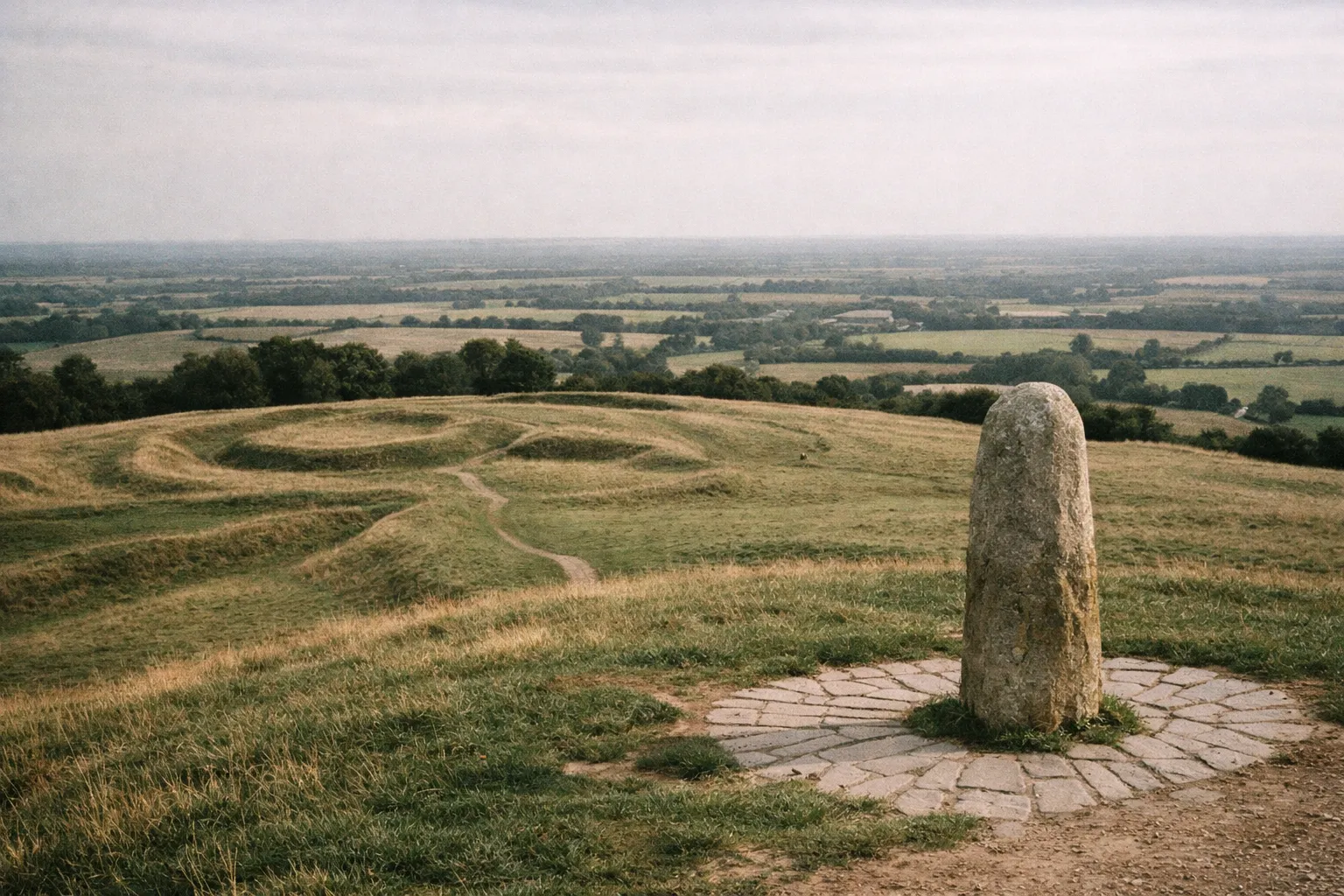
The hill itself is generally accessible year-round and free to walk. The catch is the OPW visitor centre, which runs guided interpretation and facilities daily 10:00-18:00, but only from mid-May to mid-September, with last admission one hour before closing (7). Don’t arrive after 17:00 expecting a full visit. Outside those months the hill stays open but you’re on your own for context, so read up before you go.
Contact details shift with the season: from mid-May to mid-September, call the Hill of Tara directly on +353 46 902 5903; from mid-September to April, enquiries route through the Brú na Bóinne numbers (7). Admission to the earthworks is free; the visitor centre carries a modest fee worth confirming on site.
The itinerary logic is straightforward: pair Tara in the late afternoon after a morning at Newgrange or Knowth. The softer light suits the open landscape, and the 10:00-18:00 summer window gives you flexibility. Driving time from the visitor centre to Tara is roughly 25-30 minutes.
Trim Castle - Medieval Ireland in Half a Day
Trim Castle is the largest and best-preserved Anglo-Norman castle in Ireland, built from the late 12th century on the River Boyne in Trim, County Meath (4). Construction began in 1172 under Hugh de Lacy, and the castle grew over the following decades into the stronghold you see today. The centrepiece is a massive three-storey keep surrounded by extensive curtain walls and towers. It’s the medieval counterpart to the valley’s Neolithic sites, and if you’ve done Newgrange in the morning, Trim rounds out the arc from Stone Age to Norman Ireland neatly.
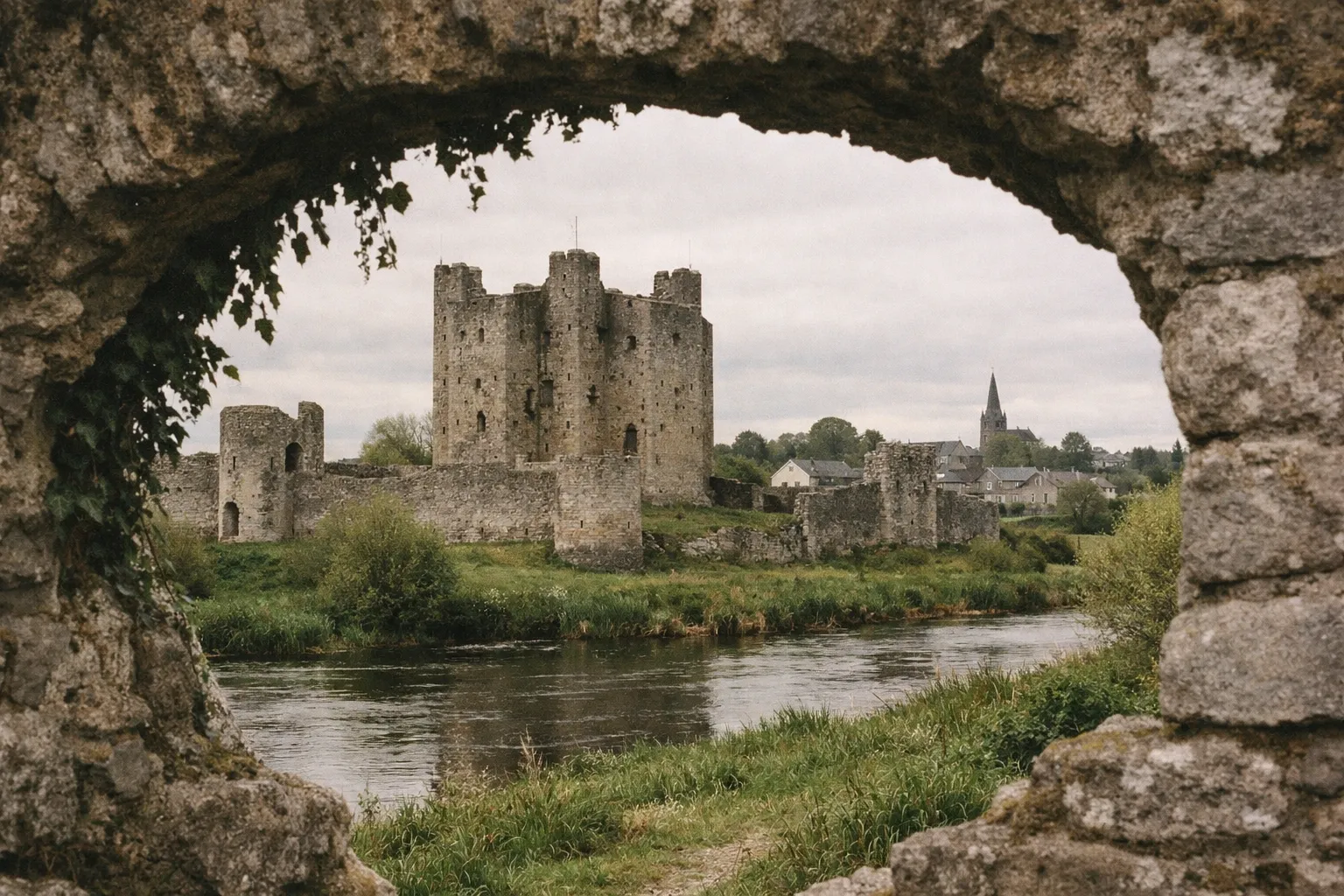
Here’s where visitors get caught out: the grounds and exterior are accessible, but the keep interior is only reachable by guided tour, and availability varies sharply by season. High-season hours (around 17 March-30 September) run roughly 10:00-17:00, with reduced shoulder hours (about 09:30-16:30) from early February to 16 March (4). Keep tours can be weekend-only in off-season periods, while midweek winter visits often allow the grounds but not the interior - Trim Visitor Centre lists midweek winter grounds tours at €2 per person (per Discover Boyne Valley), bookable through them.
Weekend keep tour prices are €5 for adults, €4 for seniors and groups, €3 for children and students, and €13 for a family; the grounds are free on weekends (4). The planning tip writes itself: check whether your date falls in a period with keep access before you drive out. A weekday winter visit gets you the grounds and not much else.
Trim sits about 25-30 minutes from both the visitor centre and the Hill of Tara, making it a natural third stop on a full Boyne Valley day, or a standalone half-day from Dublin (roughly 50 minutes by car). The medieval streetscape around the castle is worth the short walk too - the Yellow Steeple, Talbot’s Castle, and the Sheep Gate are all within easy reach and free.
Planning Your Boyne Valley Day - Two Itinerary Options
The five main sites break down like this, ranked by how much they reward the detour. The passage tomb chamber at Brú na Bóinne is the anchor - worth the full booking effort, about 2-2.5 hours, ticket required, best April-October. Knowth is a strong second if you have a full day: the density of megalithic art alone justifies the separate ticket, March to early November, about 1.5-2 hours. The Hill of Tara earns a stop if the visitor centre is in season (mid-May to mid-September) - the earthworks and wide views are genuinely worth 1.5 hours, and the late-afternoon light suits the open landscape. Trim Castle is worth the half-day if you care about medieval Ireland at all; skip it if you’re already stretched thin on time, and check the keep tour schedule before committing to a weekday. Dowth is the lowest-priority stop for most visitors - the exterior circuit takes 30-45 minutes, there’s no ticket and no shuttle, and the payoff is atmosphere rather than spectacle. That said, if you have a car and the afternoon free, it’s a quiet counterpoint to the busier sites.
Option A - the full archaeology day. Morning at Brú na Bóinne with the chamber tour, plus the Knowth tour if you’ve booked it. Afternoon self-drive to Dowth for the exterior circuit, then an optional late-afternoon stop at the Hill of Tara if the visitor centre is in season. This works best April-October when all sites run maximum hours. May is the single best month for this option: the visitor centre at Tara has just opened for the season, crowds at Brú na Bóinne are lighter than July-August, and the days are long enough to fit all four stops without rushing.
Option B - the Neolithic and medieval loop. Morning at Brú na Bóinne for the chamber tour. Afternoon split between the Hill of Tara (for the late light) and Trim Castle - but check the keep tour schedule before committing to a weekday. This runs comfortably as a full day from Dublin, or better as a relaxed two-day weekend based in Navan or Drogheda. One thing most guides get wrong about this loop: they treat Trim Castle as an afterthought tacked onto the end of a long day. It deserves its own half-day. The keep is substantial, the curtain walls take time to walk properly, and the medieval streetscape around it - the Yellow Steeple, Talbot’s Castle, the Sheep Gate - adds another 30-45 minutes that most visitors don’t budget for.
Boyne Valley Sites Side by Side
| Newgrange | Knowth | Dowth | Hill of Tara | Trim Castle | |
|---|---|---|---|---|---|
| Type | Passage tomb | Passage tomb | Passage tomb (exterior only) | Earthworks | Anglo-Norman castle |
| Access | Guided tour via visitor centre | Guided tour via visitor centre | Self-drive, no shuttle | Free walk, visitor centre seasonal | Grounds free, keep tour paid |
| Ticket Required | Yes | Yes (separate ticket) | No | No (visitor centre fee applies) | Yes for keep tour |
| Visitor Centre | Brú na Bóinne | Brú na Bóinne | None | Hill of Tara (seasonal) | Trim Castle |
| Best Season | April-October | March-early November | Year-round | Mid-May to mid-September | Seasonal hours |
| Approx. Time Needed | 2-2.5 hours | 1.5-2 hours | 30-45 minutes | 1.5 hours | 1.5-2 hours |
A one-day Boyne Valley loop from Dublin
Driving times keep it feasible: Dublin to the visitor centre is about 45-60 minutes; the visitor centre to Dowth about 10 minutes; the visitor centre to the Hill of Tara about 25-30 minutes; and Tara to Trim Castle roughly 20 minutes. A workable sequence: leave Dublin early for a mid-morning slot at the main tomb, add Knowth if booked, drive to Dowth for the exterior, then finish at Tara in the late afternoon. Trim slots in if you skip Dowth or start very early.
Sequence your booking the same way you sequence the day: book Newgrange first, because its ticket supply is the most constrained, then build everything else around your confirmed time slot.
Making it a weekend - where to stay nearby
Navan and Drogheda are the two practical bases. Navan sits roughly 20 minutes from Newgrange, the Hill of Tara, and Trim, which makes it a genuinely central hub for the whole loop. Drogheda is closer to the coast and the visitor centre. Either lets you slow the pace so you’re not sprinting between 5,000-year-old monuments - which, frankly, they deserve.
Booking Mistakes That Will Ruin Your Visit - and How to Avoid Them
Most ruined Boyne Valley days come from a handful of avoidable errors. Work through this list before you go.
- Assuming walk-up tickets exist. They effectively don’t in peak season. Heritage Ireland calls availability “very limited” and day-of tickets, if any, are gone early (5). Treat pre-booking as mandatory April-October.
- Confusing Dowth with Newgrange or Knowth. Dowth’s interior is closed to the public - you get the exterior mound only. Plan for that, not a chamber tour (5).
- Booking through third-party sites. Book only via Heritage Ireland or the official Brú na Bóinne pages. Third-party information has frequently gone stale since the pandemic.
- Missing the midnight release. During April-November, tickets drop at 00:00 Irish time exactly 30 days out (5). Ten minutes late on a popular weekend can mean sold out.
- Ignoring seasonal hour changes. January-February hours end at 16:15 (5). Arriving at 15:30 expecting a full afternoon is a mistake.
- Assuming the Hill of Tara visitor centre is open year-round. Guided interpretation runs mid-May to mid-September only (7). Outside those dates you’re self-guided.
- Expecting Trim Castle keep access on a winter weekday. Many midweek dates are grounds-only. Check before you drive out (4).
- Not booking tickets for under-12s. They’re free, but the system still requires a ticket in each child’s name - and you’ll be turned away at the gate without one (2).
Frequently Asked Questions
- How old is Newgrange, and is it really older than the pyramids?
- Newgrange dates to approximately 3200 BC - roughly 500 years before the Great Pyramid at Giza (c. 2560 BC) and about 1,000 years before Stonehenge's main phase. It is one of the oldest surviving roofed structures on Earth.
- How many bodies were found in Newgrange?
- Excavations found cremated remains of at least five individuals in the chamber. The site was a selective burial monument for a few, not a communal grave.
- Can you visit Newgrange without pre-booking?
- Technically possible but not realistic during peak season. Tickets are very limited and day-of tickets, if any, sell out early. Pre-booking is mandatory April-October.
- What is the winter solstice lottery at Newgrange?
- Each September, the OPW runs a lottery for limited chamber access on solstice mornings (Dec 19-23). Winners see the sunrise beam; others can watch outside or via livestream.
- What's the difference between a Newgrange tour and a Knowth tour?
- They are separate tours from the same visitor centre, each requiring its own ticket. Newgrange includes the chamber and solstice simulation; Knowth covers exterior art and satellite tombs.
- Is Hill of Tara worth visiting alongside Newgrange?
- Yes, if you're in County Meath. Tara offers open earthworks and wide views with historical significance. Visitor centre runs mid-May to mid-September; outside that, it's self-guided.
- Do I need a car to visit Newgrange and the Boyne Valley?
- A car makes the day easier. The visitor centre has no direct public transport from Dublin. Dowth requires a car. Private tours are an alternative but less flexible.
The one thing to do before anything else
Book your Brú na Bóinne ticket before you plan a single other part of the day. That confirmed time slot is the anchor - Knowth, Dowth, the Hill of Tara, and Trim all fit around it, not the other way round. Get the release window right (30 days out April-November, 7 days out in the shoulder months, midnight Irish time either way), book through the official Heritage Ireland pages, and remember that under-12s need a ticket even though they’re free.
Two things determine whether the visit actually works. First, come with some context - the visitor centre exhibition is worth the time, not just a waiting room, and the monument rewards people who understand what they’re looking at. Second, set your expectations correctly by site: the chamber tour for the passage itself, Knowth for the art, Dowth for a quiet exterior circuit and nothing more. The Boyne Valley runs fine as a day trip from Dublin, but it’s better as a two-day loop from Navan or Drogheda. Monuments this old are wasted on a sprint.