Most travel content about Navagio still shows people spread out on that famous white sand. The beach has been closed to landings since 2022, and the restrictions have been renewed every season since, most recently through 31 October 2026 (9). If you’re planning a trip to the Greek islands, Zakynthos rewards you for arriving with current information, and catches you out if you don’t. The island still delivers three genuinely distinct draws: the Navagio bay, the Blue Caves near Cape Skinari, and loggerhead turtles in Laganas Bay. What’s changed is how you access them. Plan four to five days, read what follows before you book anything, and you’ll be fine.
✓ Pros
- Three genuinely distinct headline attractions on one island: a dramatic beach viewpoint, sea caves, and wild loggerhead turtles
- The Ionian Sea location means a greener, calmer landscape than Cyclades islands like Santorini or Mykonos
- Boat-trip infrastructure is well-developed and runs April through October
- Shoulder seasons (May, late September) offer real crowd relief with water still warm enough to swim
- Multiple base options suit different travel styles, from party resort to quiet self-drive
✗ Cons
- Navagio Beach is legally closed to landing and swimming, and still misrepresented in many tour listings
- July and August crowds are intense, and boat trips need advance booking
- The northern ports for Blue Caves and Navagio boat trips are a significant drive from southern bases
- Laganas has a party-resort atmosphere that won't suit everyone
- Boat tours can be canceled with little notice when the wind picks up
Why the Greek Islands, and Zakynthos Especially, Reward a Closer Look
Zakynthos is one of the seven main Ionian Islands, sitting in the Ionian Sea off western Greece about 20 km west of the Peloponnese coast, alongside Corfu and Kefalonia. It covers roughly 405 km² with a permanent population of around 40,000 residents (1), making it one of the larger islands in the group.
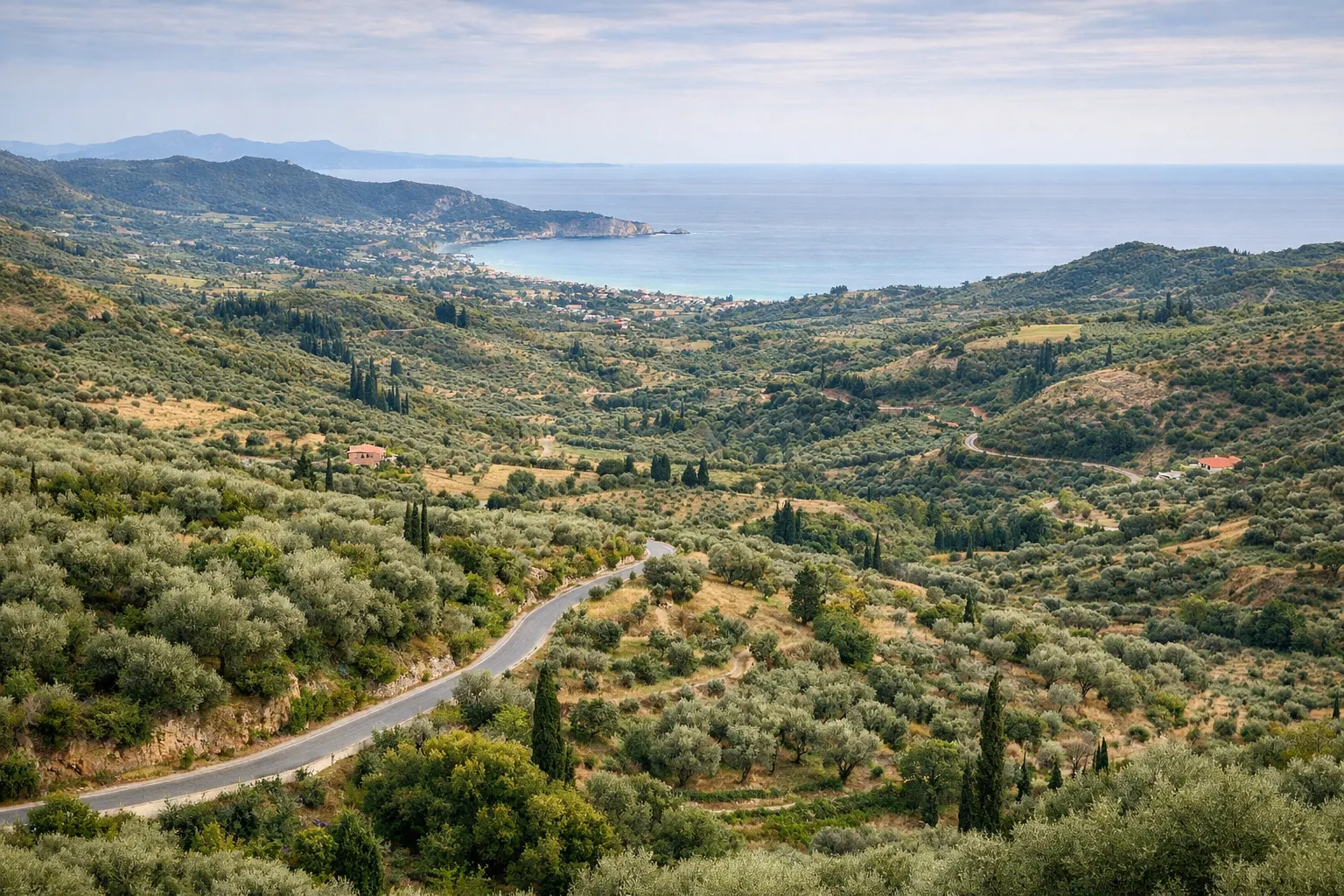
The Ionian character is the first thing you notice if you’ve spent time in the Cyclades. These islands receive markedly more rainfall than the central Aegean, which produces a greener, more forested landscape than the bare volcanic drama of Santorini or Mykonos. Venetian influence lingers in the architecture and place names, and the coastline mixes tall west-coast cliffs with soft sandy bays in the south and east. It’s a different kind of Greek island: less stark, more layered.
Is Zakynthos worth it? Yes, with the right expectations. Its popularity rests on three things that are hard to find together elsewhere: the Navagio shipwreck bay and its white limestone cliffs, the Blue Caves near Cape Skinari, and the loggerhead turtles (Caretta caretta, a protected sea turtle species) nesting in Laganas Bay. A signature beach view, sea-carved caves, and protected marine wildlife on one compact island is a combination that’s genuinely hard to replicate.
The honest caveat: Laganas, the busiest resort strip, has a loud, nightlife-heavy reputation that colors some people’s impression of the whole island. It shouldn’t. Drive fifteen minutes in almost any direction and you’re into olive groves, quiet coves, and cliff roads with no one else on them. Set your base thoughtfully and Zakynthos reads as a scenic, wildlife-rich island rather than a party destination.
Navagio Beach Zakynthos: What You Can (and Can’t) Do There Now
Here’s the single most important fact to get right before you plan around navagio beach zakynthos: it is closed for the whole of the 2026 season. A Joint Ministerial Decision published in the Government Gazette on 2 June 2026 took effect immediately and runs until 31 October 2026 (9). Any tour promising a beach landing is non-compliant. Full stop.
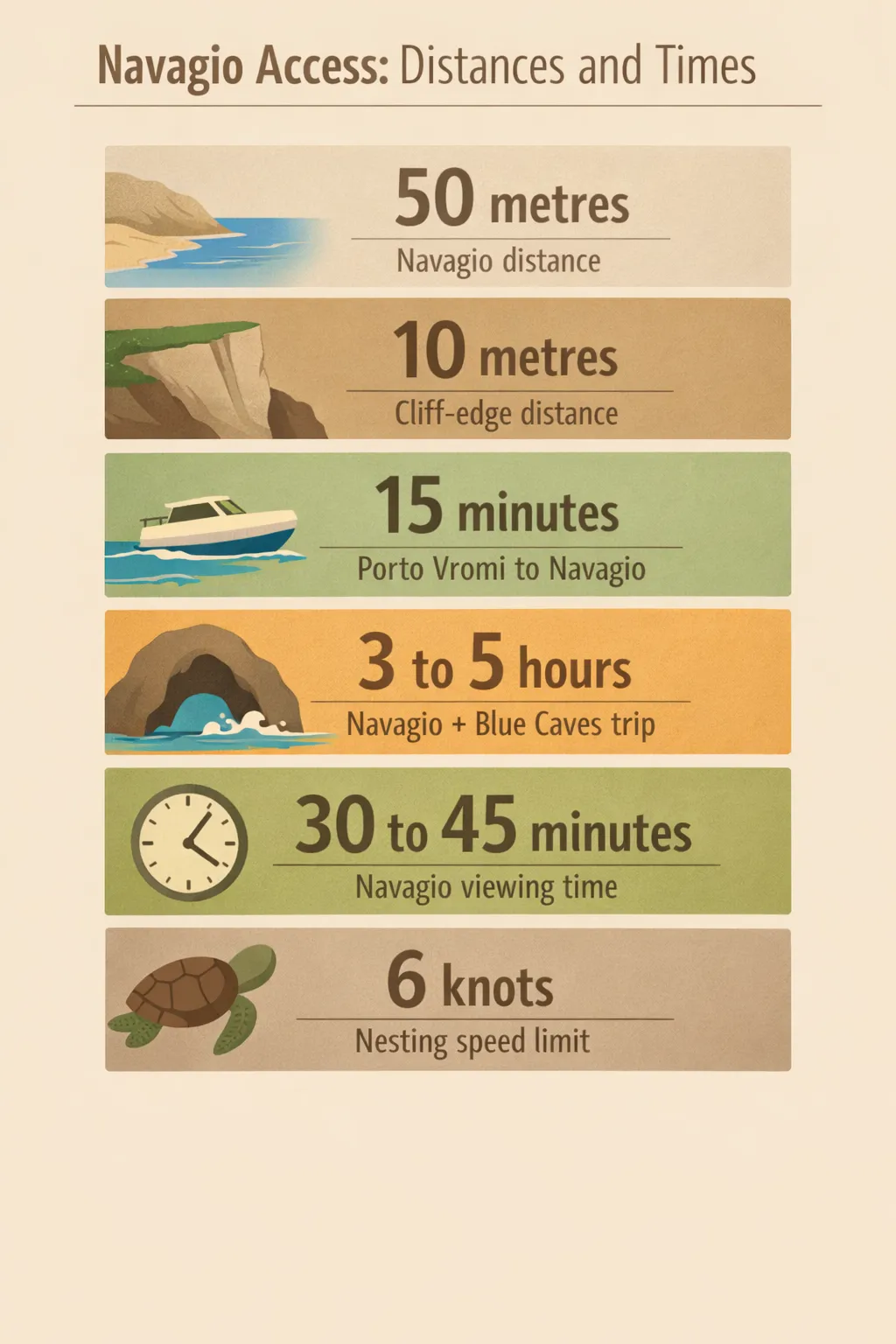 Key Navagio access figures: 50 metres from shore, 10 metres no-go, 15 minutes from Porto Vromi to Navagio, 3 to 5 hours for Navagio+Blue Caves trips, 30 to 45 minutes viewing time, and a 6-knot nesting limit.
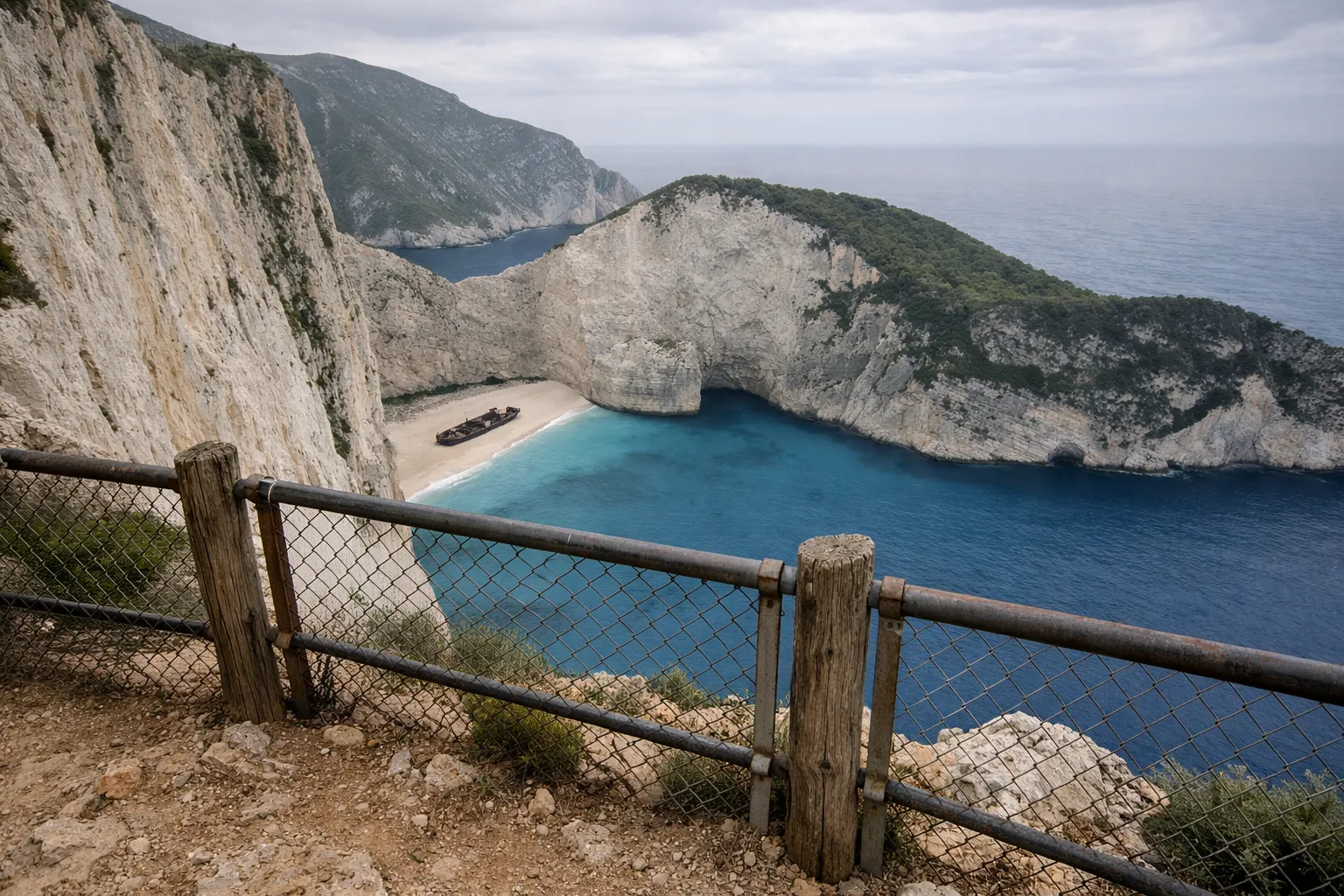
The backstory matters, briefly. A freighter ran aground in the cove decades ago, and the rusting wreck, framed by sheer white limestone cliffs and turquoise water, became one of the most-photographed beaches in Greece. Then the geology turned against it. Authorities first fully banned use of the beach after a landslide in 2018 injured seven people, and the ban has been maintained through further instability and major rockfalls in 2022 (2).
The 2026 decision is explicit, and it is stricter than the 2024 one most guides still quote. Access to both the “Prohibited Zone” and the “Controlled Access Zone” is banned outright. Swimming is forbidden across the whole marine area enclosed by the two ends of the cove. And vessels may not approach or anchor within 50 metres of the shoreline (9). That last figure is the one to check an operator against, because it is measurable from the deck.
From the cliff above, viewing is permitted from the existing upper observation platform, but the decision makes that conditional on the fencing and protective infrastructure along the cliff edge being completed first (9). In other words, the plateau is not an unconditional yes: confirm it is open before you drive up. Approaching the edge or the shipwreck is banned because of landslide risk, and violations carry administrative penalties enforced by the Hellenic Police, on top of any civil or criminal liability (9). These are legal restrictions with fines attached, not safety suggestions.
So what does a legitimate visit look like? Two angles, both from a distance. A compliant boat holds 50 metres off the shore so you can photograph the wreck and cliffs from the water, then continues to the Blue Caves or nearby coves. From land, you drive to the clifftop plateau and take in the whole bay from above. Combining the sea-level boat view with the plateau viewpoint gives you two distinct compositions without breaking any rules, which is what most photographers actually want anyway.
One practical note: this regime has been renewed season after season since the 2018 landslide, each time by a fresh decision with its own end date. The current one expires 31 October 2026, and the Government Gazette explicitly leaves the door open to designated safe maritime zones later, subject to the Port Authority and a fresh assessment by Greece’s Earthquake Planning and Protection Organization (9). Check the status for your own dates before you book, and treat any operator advertising “swim at Navagio” or “land on the beach” as a red flag.
The Clifftop Viewpoint: What to Expect on the Ground
The official clifftop viewpoint is a small, free viewing area reached by road from the west-coast villages of Anafonitria and Volimes, with fencing and signage marking the permitted zone (5). Access to most of the plateau above the beach is restricted: you view from the upper observation platform, set back from the unstable slope, and the 2026 decision makes even that conditional on the cliff-edge fencing and protective works being completed (9). The 10-metre figure that circulates online is the no-go distance from the rocky edge, not the width of a viewing zone (6).
From the marked zone you see the full bay, the wreck, and the surrounding cliffs. Haze and light angle affect visibility: midday sun flattens the scene, while late afternoon brings warmer tones. Those dramatic cliff-edge selfie shots circulating on social media are taken outside the official area, and the setback rule exists precisely because the slope is unstable. Access violations can result in fines.
The roads approaching the plateau are narrow with limited parking, so allow extra time and don’t rely solely on GPS for the final stretch. Budget this as a 20 to 30 minute stop, not a half-day outing. There’s a viewpoint and not much else up there.
Boat Tours Around Navagio: How They Work Now
Compliant operators now hold 50 metres off the shore, pausing for views, then continue to other coves or the Blue Caves rather than landing on the beach (7). From Porto Vromi, the closest northern harbor, boats reach the Navagio area in about 15 minutes (8), which tells you how little of a standard itinerary is actually spent in transit to the bay.
Dedicated Navagio and Blue Caves boat trips commonly last 3 to 5 hours in total, with roughly 30 to 45 minutes spent in the Navagio bay viewing area and the rest allocated to the caves and swimming stops. The red flag bears repeating: skip any operator advertising a beach landing or swimming at Navagio. They’re either misinformed or non-compliant, and neither is who you want captaining your boat.
The Blue Caves Zakynthos: Boat Trips, Timing, and What to Expect
The blue caves zakynthos visitors actually experience are a series of sea-carved limestone arches and caverns near Cape Skinari on the island’s northern tip, where refracted light turns the water a vivid blue-green. There’s no land route. A boat trip is the only way in.
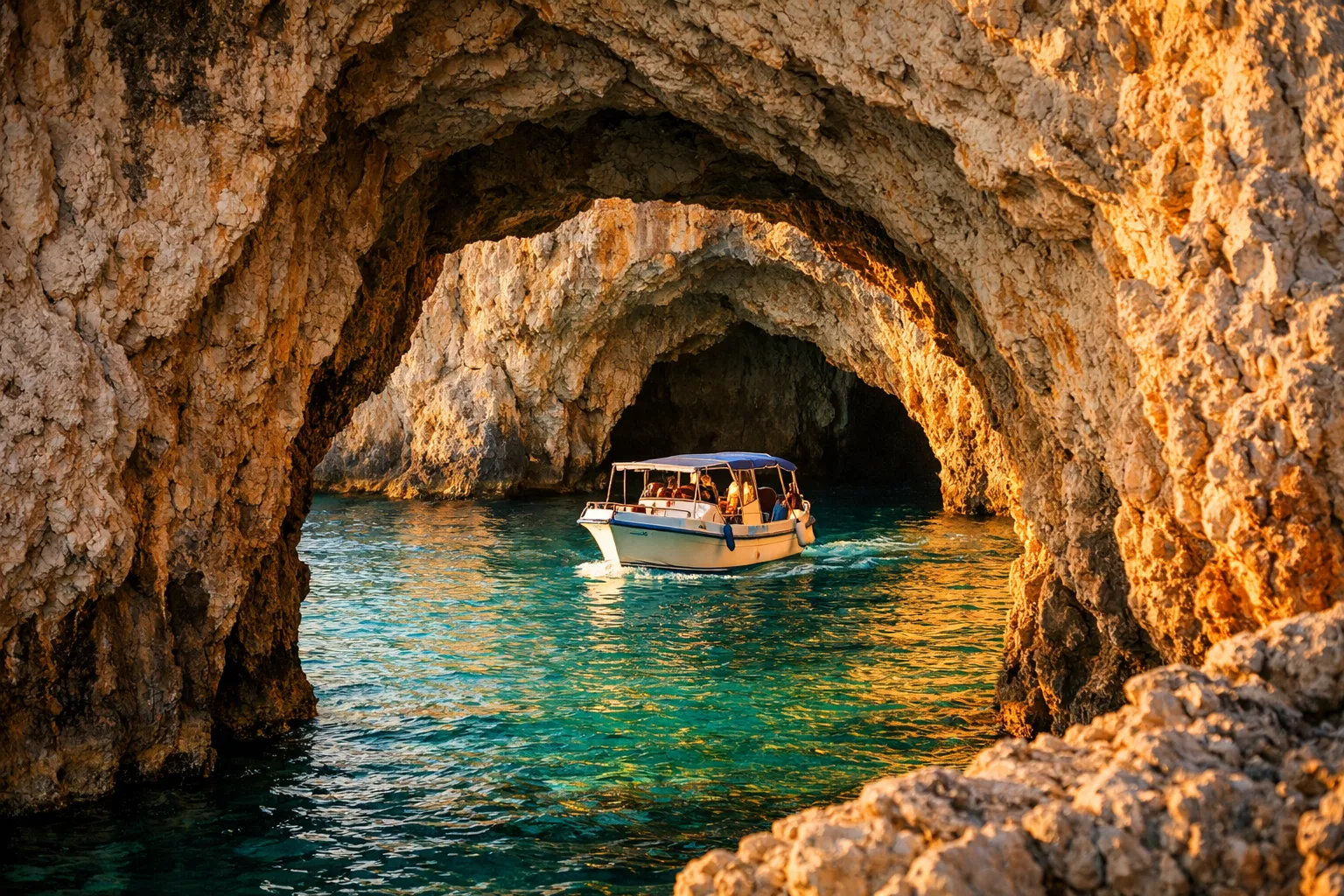
Departures run from Porto Vromi, Agios Nikolaos, and Cape Skinari. The season runs April through late October, with the busiest window between mid-June and early September, when boats operate from early morning until early evening. In peak months, Porto Vromi operators run multiple departures per day for both short cave runs and longer combo cruises, with reduced frequency outside the peak and sometimes “on request” service in the shoulder months.
For light and crowds, early morning or late afternoon beats midday. The blue effect is strongest when the sun hits the water at an angle, and the mid-day window in July and August is both the most crowded and the harshest for photography. I’ve found the shoulder months, May and late September, genuinely deliver on the promise of fewer boats and more flexible schedules, which is worth considering if swimming isn’t your main priority.
Weather is the wildcard. Trips cancel in wind or rough seas, especially outside high summer, so build a spare day into your itinerary rather than pinning the caves to your last morning before a flight.
Short Trip vs. Full-Day Combo: Which to Book
Short Blue Caves-only outings from Agios Nikolaos run about 1 hour and skip Navagio entirely, which makes them ideal for families, cruise-style visitors, or anyone who has already done the northern coast. You get the caves and a brief swim without committing half a day to a boat.
The 3 to 5 hour combo itinerary is the standard first-timer choice: the Navagio bay view, the Blue Caves, and swimming stops in permitted coves. It’s the fuller experience and the better value in terms of what you see.
How to Book and Take a Blue Caves Boat Trip
Up to 5 hoursStep-by-step guide to planning your Blue Caves boat trip for a smooth experience
- 1
Choose your departure port
Select from Porto Vromi, Agios Nikolaos, or Cape Skinari based on your accommodation base.
- 2
Decide on trip length
Pick a 1-hour caves-only run or a 3 to 5 hour combo including Navagio bay and swimming stops.
- 3
Book in advance for peak season
Reserve your spot ahead for July and August; walk-up bookings are more feasible in May and late September.
- 4
Check weather conditions
Confirm the forecast the night before, as trips cancel in windy or rough sea conditions.
- 5
Arrive early
Get to the port 15 to 20 minutes before departure with water, sunscreen, and a light layer for the boat.
- 6
Follow crew instructions on the water
Listen carefully near cave entrances; morning light offers the best blue water effect.
Zakynthos Turtles: Spotting Caretta Caretta in Laganas Bay
Laganas Bay is part of the National Marine Park of Zakynthos, recognized as one of the most important nesting areas for loggerhead sea turtles (Caretta caretta) in the Mediterranean, with several nesting beaches along the bay. Spotting zakynthos turtles is a genuine draw, but it comes with rules that shape the whole experience.
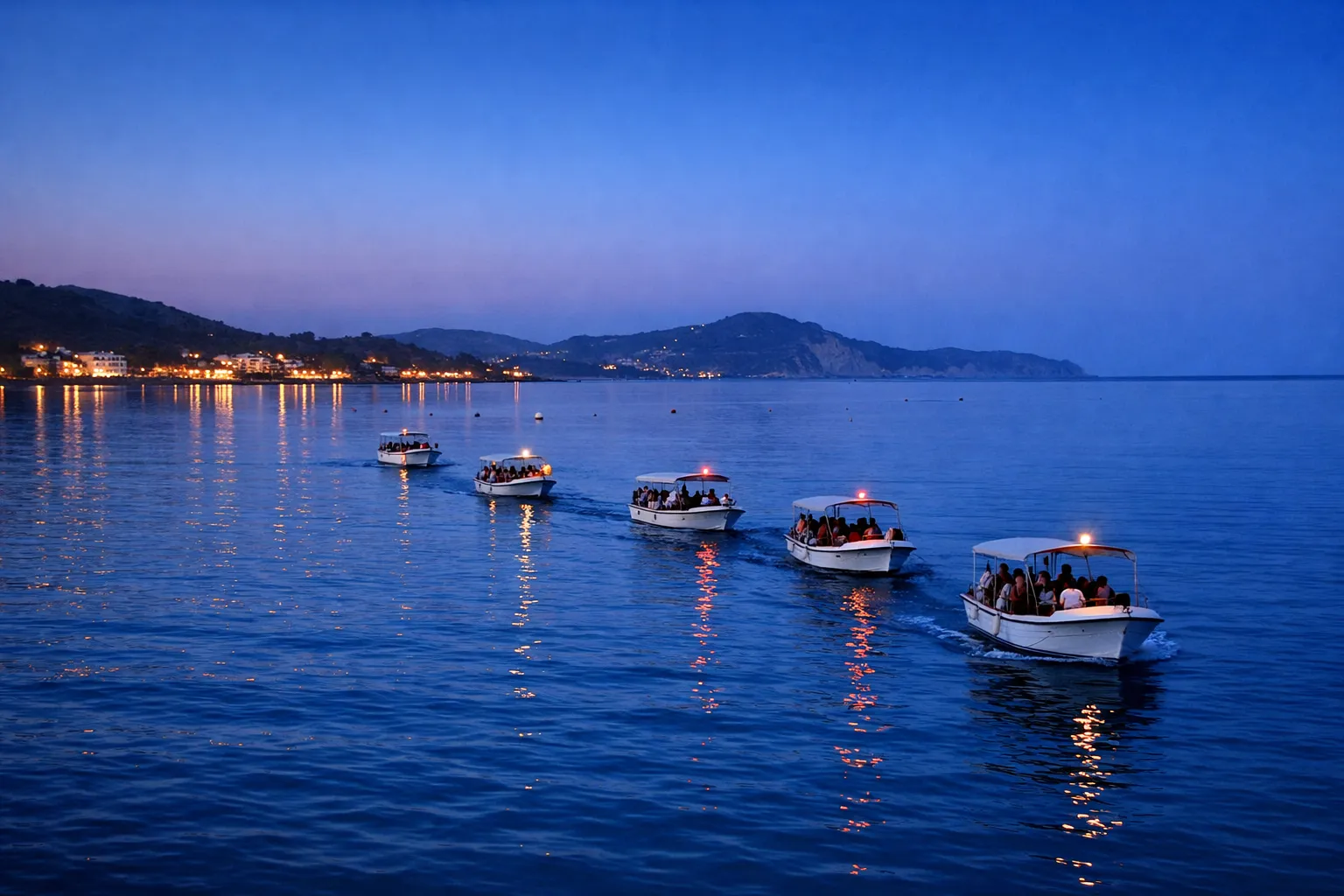
What turtle-watching actually looks like: licensed boat tours cruise the bay at regulated distances, and turtles surface regularly to breathe. Sightings are common but never guaranteed: these are wild animals, not an aquarium. Tours typically operate from May to October, aligning with the nesting and hatching season when turtles are most active at the surface, with peak nesting between June and August.
The marine park rules directly affect what you can and can’t do. Boat speed limits apply near nesting zones (generally 6 knots or less), certain beaches restrict swimming during nesting season, and Sekania Beach is an “Area of Absolute Protection” with no public access at all. Approaching turtles too closely, using flash photography, and landing on strictly protected nesting beaches are all prohibited, and tours that ignore these rules are breaking the law, not bending it.
Choosing a responsible operator is the whole game here. Look for tours that explicitly mention marine park compliance or collaboration with local conservation organizations. Be wary of any operator that advertises getting “close” to turtles, because proximity is exactly what the regulations exist to prevent. A good guide keeps a respectful distance and explains why, which makes for a better experience anyway.
A word on the base: Laganas town, the main departure point for turtle tours, is busy and nightlife-oriented. The wildlife experience out on the water is calm and low-key; the town you launch from is not. If the party-strip atmosphere isn’t your thing, you can still book a turtle tour from Laganas and stay elsewhere.
The Best Beaches on Zakynthos Beyond the Famous One
Navagio gets the attention, but Zakynthos has a strong bench of swimmable beaches worth planning your days around, which matters, since the famous one is now a viewpoint rather than a beach you can lie on.
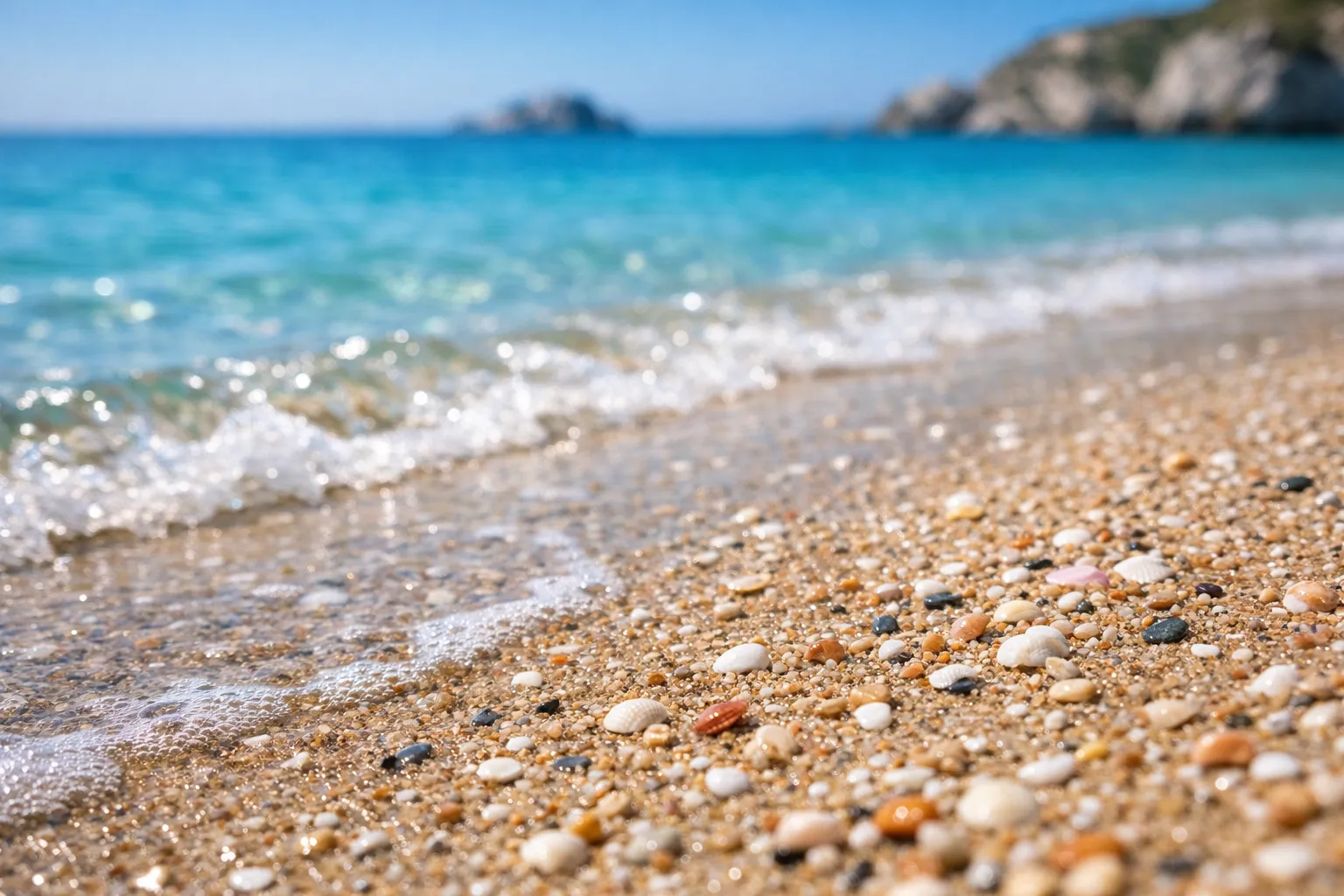
The Vasilikos peninsula in the south holds the densest cluster of sandy coves on the island, with Gerakas, Porto Zoro, and Banana Beach all within a few kilometers of each other. It’s the best base for a multi-beach day. Gerakas doubles as a protected turtle nesting beach, so it carries access restrictions in season.
Laganas Beach stretches roughly 2 km along the south coast and is the island’s busiest resort beach, lined with hotels, bars, and tour kiosks. It’s fine for a day and convenient if you’re staying nearby, but it isn’t the island’s most scenic stretch.
Tsilivi, just north of Zakynthos Town, is family-friendly, calmer than Laganas, and well equipped with facilities. Porto Vromi is a small west-coast cove that functions mainly as a boat-departure point for northern trips, but it’s worth a swim if you’re already there. On the northeast coast, Alykes and Alykanas form a continuous sandy bay of around 1.5 to 2 km, backed by salt flats and low-rise resorts, and generally quieter than the southern resort strips.
Practical note for the Vasilikos beaches: an early start matters. Parking fills by mid-morning in peak season, so plan a multi-beach loop from one base and arrive early to secure a spot and quieter conditions.
Gerakas Beach: Turtles, Restrictions, and Why It’s Worth It
Gerakas is one of the best beaches on the island and a key nesting site within the National Marine Park, which is exactly why it comes with rules. No umbrellas in the marked nesting zone, and the beach closes to visitors at dusk during nesting season to protect the nests.
It sits at the southeastern tip of the island, about 16 to 17 km from Zakynthos Town, making it a realistic half-day outing from most southern bases. Combine it with Porto Zoro and Banana Beach, which lie 3 to 6 km away, for a full southern-peninsula day of driving between coves. The swimming and the setting justify the drive, and knowing you’re on a working turtle beach adds something the resort strips can’t.
Things to Do in Zakynthos Beyond the Boat Trips
Boat trips and beaches anchor most itineraries, but there’s a worthwhile inland and town-based side to the island for anyone wanting a slower day. The list of things to do in Zakynthos beyond the water is shorter than the coastline suggests, but it’s genuinely varied.
- Zakynthos Town (Zante Town): The main port was largely rebuilt after the 1953 Ionian earthquake, giving it a neoclassical character with some preserved Venetian-style facades. Walk the waterfront along Lombardou Street in the evening, have a meal, and visit the Byzantine Museum on Solomos Square, which holds post-Byzantine icons and ecclesiastical art from the 15th to 19th centuries.
- Inland villages around Volimes: A half-day drive through the interior, past olive groves, older architecture, local honey and textiles, gives a completely different read on the island than the coast does.
- Keri Caves and the southern coast: Reachable by small boat from Keri village, these sea caves see fewer crowds than the northern circuit, with cave-focused outings running around 2 to 3 hours including swimming stops.
- Sunset from the west coast: The cliffs above Porto Vromi and the Navagio plateau catch dramatic late-afternoon light. Time a clifftop visit accordingly and you get the viewpoint at its best.
- Water sports: Kayaking, snorkeling, and diving run from multiple beach bases. The clear Ionian water makes snorkeling productive even without a boat trip.
How many days do you need? Most visitors allocate 4 to 5 days to cover the Navagio viewpoint, a Blue Caves boat trip, a turtle tour, the best beaches, and a town evening without feeling rushed. Three days is workable but tight if you prioritize hard; a week suits slower travelers or anyone adding inland exploration.
Where to Stay in Zakynthos: Three Bases and Who Each Suits
Where to stay in Zakynthos isn’t just a vibe decision, it’s a logistics decision. The island’s geography means your base determines your drive times, your wake-up calls on boat-trip days, and how much of the island you can realistically cover. Turtle tours and nightlife point to Laganas; a family beach holiday with central access points to Tsilivi; quieter beaches and self-drive exploration point to Vasilikos.
Laganas is the busiest resort strip, about 8 km (15 to 20 minutes’ drive) southwest of Zakynthos Town, fronting Laganas Bay directly. That makes it the closest major base to turtle-watching departures, and it carries significant nightlife. It suits younger travelers or anyone building their trip around the marine park experience. The downside is the drive to northern ports for the Blue Caves and Navagio trips.
Tsilivi lies roughly 5 km north of Zakynthos Town, about 10 to 15 minutes’ drive, and offers quicker access to the northern-coast roads than Laganas while remaining a full-service beach resort. Family-friendly with good facilities, and a solid middle-ground base.
Vasilikos is the quietest of the three, with multiple beaches within easy reach, best for travelers who want to self-drive and explore. Vasilikos resorts sit about 12 to 17 km from Zakynthos Town (30 to 40 minutes’ drive) and roughly 50 to 60 minutes from Porto Vromi for Navagio and Blue Caves trips, so factor that distance into any morning boat departure.
Zakynthos Town itself is practical for ferry arrivals and departures, has a good restaurant and bar scene, and sits central for day-tripping in any direction, a sensible choice if you’re not tied to a single beach.
Wherever you base yourself, renting a car is strongly recommended. The bus network is limited and the northern ports aren’t easily reached without one.
Base Location vs. Boat Trip Departure Points: The Drive Times That Matter
Your base determines your wake-up time on boat-trip days, and the drive times are significant enough to plan around:
- Laganas to Porto Vromi: approximately 45 to 55 minutes by car, via narrow west-coast roads
- Tsilivi to Agios Nikolaos or Cape Skinari: approximately 30 to 40 minutes
- Vasilikos to Porto Vromi: approximately 50 to 60 minutes
- Zakynthos Town to northern ports: approximately 35 to 45 minutes
The practical implication is simple: if you’ve booked a morning Blue Caves departure and you’re staying in Vasilikos, you’re setting an early alarm.
Zakynthos Base Areas Compared
| Laganas | Tsilivi | Vasilikos | Zakynthos Town | |
|---|---|---|---|---|
| Vibe | Busy, nightlife-heavy | Calm, family-oriented | Quiet, self-drive | Central, practical |
| Proximity to Turtle Tours | Closest | Moderate | Moderate | Close |
| Proximity to Northern Boat Trips | Longest (45-55 min) | Shortest (30-40 min) | Furthest (50-60 min) | Moderate (35-45 min) |
| Beach Quality | Broad but not scenic | Good | Best of the three | Town beach only |
| Nightlife Level | Strong | Moderate | Minimal | Good bar scene |
| Best For | Younger travelers, marine park focus | Families, mixed itineraries | Beach-focused, self-drivers | Ferry arrivals, flexible day-trippers |
Getting to Zakynthos and Getting Around the Island
Zakynthos is reached by air through Zakynthos International Airport (Dionysios Solomos, IATA code ZTH), about 4 km southeast of Zakynthos Town, which handles domestic flights from Athens and seasonal international charters from major European cities. In summer, direct charters make it easy to reach from much of Europe; from farther afield, you connect through Athens.
By sea, the main ferry runs between Killini on the Peloponnese mainland and Zakynthos, with a crossing time of roughly 1 to 1.25 hours and multiple daily departures in summer. There are also connections from Kefalonia.
For getting around, a rental car is the practical default. Public buses primarily link Zakynthos Town to resort areas like Laganas and Tsilivi, but they don’t reliably reach the northern ports or the Navagio viewpoint, the two places you’ll most want to visit. The roads near the Navagio plateau are narrow with limited parking, so allow extra time and don’t trust GPS routing blindly on the final approach.
On boat trips: you don’t need your own boat. Organized trips run from multiple northern ports, so just factor in the drive time from your base to the departure harbor. The boat season runs April through October, peaks between mid-June and early September, and thins out in the shoulder months, when checking operator schedules in advance becomes more important.
When to Visit Zakynthos: Season, Crowds, and the Trade-offs
The practical sweet spot for a greek islands zakynthos trip is May or late September, when boat trips are running, crowds are thinner, and the water is still swimmable, though peak summer maximizes boat frequency at the cost of crowds and higher prices.
Peak season (July and August) is hottest and busiest, with all boat trips running at maximum frequency during the mid-June to early September window. Advance booking is essential, and the crowds at the Navagio viewpoint and the Blue Caves are significant. This is the season for reliable heat and full schedules, not for solitude.
Shoulder season (May and late September) is the balance most scenery- and wildlife-focused travelers should target. Boats are operating, visitor numbers drop, schedules are more flexible, and the water is cooler but still comfortable, with September sea temperatures sit around 25°C. You trade peak-summer intensity for room to breathe.
April and October are quieter still, with some operators on reduced schedules. Good months for travelers who don’t need swimming as the main event.
On trip length: 4 to 5 days covers the Navagio viewpoint, a Blue Caves boat trip, a turtle tour, the best beaches, and a town evening without rushing. Three days is the workable minimum for the headline draws; a week suits slower travelers or those adding inland exploration.
Which is better, Zakynthos or Crete? They’re different trips, not direct competitors. Crete is far larger, more historically layered, and rewards longer stays of five days or more with Minoan sites, gorge hikes, and multiple distinct regions. Zakynthos is more focused and easier to cover in 4 to 5 days, and it wins on the specific combination of a signature beach view, sea caves, and protected turtle habitat in one compact island. Pick Crete for depth and variety; pick Zakynthos for that beach-caves-wildlife package.
Frequently Asked Questions
- Is Navagio Beach open in 2026?
- No. Landing and swimming are banned until 31 October 2026 under a Joint Ministerial Decision of 2 June 2026. You can view the wreck from a boat holding 50 metres off the shore, and from the upper platform once its cliff-edge fencing is finished.
- Can you see the loggerhead turtles in Zakynthos?
- Yes, via licensed boat tours in Laganas Bay. Sightings are common May-October but not guaranteed. Choose conservation-compliant operators.
- How long does a Blue Caves boat trip take?
- Blue Caves-only trips last about 1 hour; combo itineraries including Navagio and swimming stops run 3-5 hours.
- How many days do you need in Zakynthos?
- 4-5 days cover the main draws without rushing; 3 days minimum; a week allows a slower pace.
- Is Zakynthos better than Crete?
- Zakynthos suits focused 4-5 day trips for beach, caves, and wildlife; Crete suits longer stays with more history and variety.
- Do I need to rent a car in Zakynthos?
- Yes, strongly recommended. Buses don't reach northern ports or Vasilikos peninsula efficiently.
- When is the best time to visit Zakynthos?
- May and late September offer the best balance of boat trips, manageable crowds, and reasonable prices.
One etiquette note before you go: tipping in restaurants runs around 10 percent and is appreciated but not obligatory; at beach bars and on boat trips, rounding up the bill is the norm. Photography of turtles is permitted on licensed tours but flash is banned, and pointing a camera at nesting zones on protected beaches like Gerakas after dusk will draw a firm word from the wardens, rightly so.
Zakynthos boils down to a straightforward decision tree. Pick your base according to priorities: Laganas for turtles and nightlife, Tsilivi for family beaches and central access, Vasilikos for quiet coves and self-driving. Book boat trips early if visiting in July or August, and ignore any tour promising a Navagio beach landing, which is illegal through 31 October 2026.
The most useful habit is planning logistics: drive times to northern ports, nesting-season beach rules, and leaving a spare day for weather cancellations. Get these right, stay flexible, and Zakynthos delivers on its three headline draws without surprises.