Katakolo, Greece is not really a destination; it is a doorway to one. This tiny port of about six hundred people and three streets exists on the map because it is the closest harbor to Ancient Olympia, birthplace of the Games. Most arrivals are cruise passengers, and the smart ones skip the pricey ship excursion for the ten euro tourist train or a DIY rail ticket that costs half as much. Treat the town as a pleasant hour and Olympia as the main event.
Is Katakolo Greece Worth Visiting?
Short answer: yes, but temper your expectations about the town itself. Katakolo has only about 600 residents and three main streets (7), so it’s not a resort with days of activities. What makes it worth the stop is what sits around it - chiefly Ancient Olympia, roughly 40 km inland by road, and a genuinely pleasant harbor where you can swim, eat well, and watch the boats without the crush of Santorini or Mykonos.
It’s the second-busiest cruise port in Greece, with roughly 265 cruise ship calls in a recent year and growth continuing(10). That traffic exists for one reason: Olympia. Treat Katakolo as a launchpad plus a relaxed seaside bookend and it delivers. Expect a big town with dozens of sights and you’ll be underwhelmed. Plan accordingly and it’s one of the easier, lower-stress cruise stops in Greece.
✓ Pros
- Compact and walkable port town with easy access to Ancient Olympia
- Pleasant harbor atmosphere with waterfront tavernas and cafes
- Lower crowds and stress compared to major Greek cruise ports
- Affordable local dining and accessible museums
✗ Cons
- Limited activities within the town itself beyond the harbor area
- Transport to Ancient Olympia requires planning and time management
- Small size means fewer entertainment options for longer stays
Unveiling the charm of Katakolo’s port
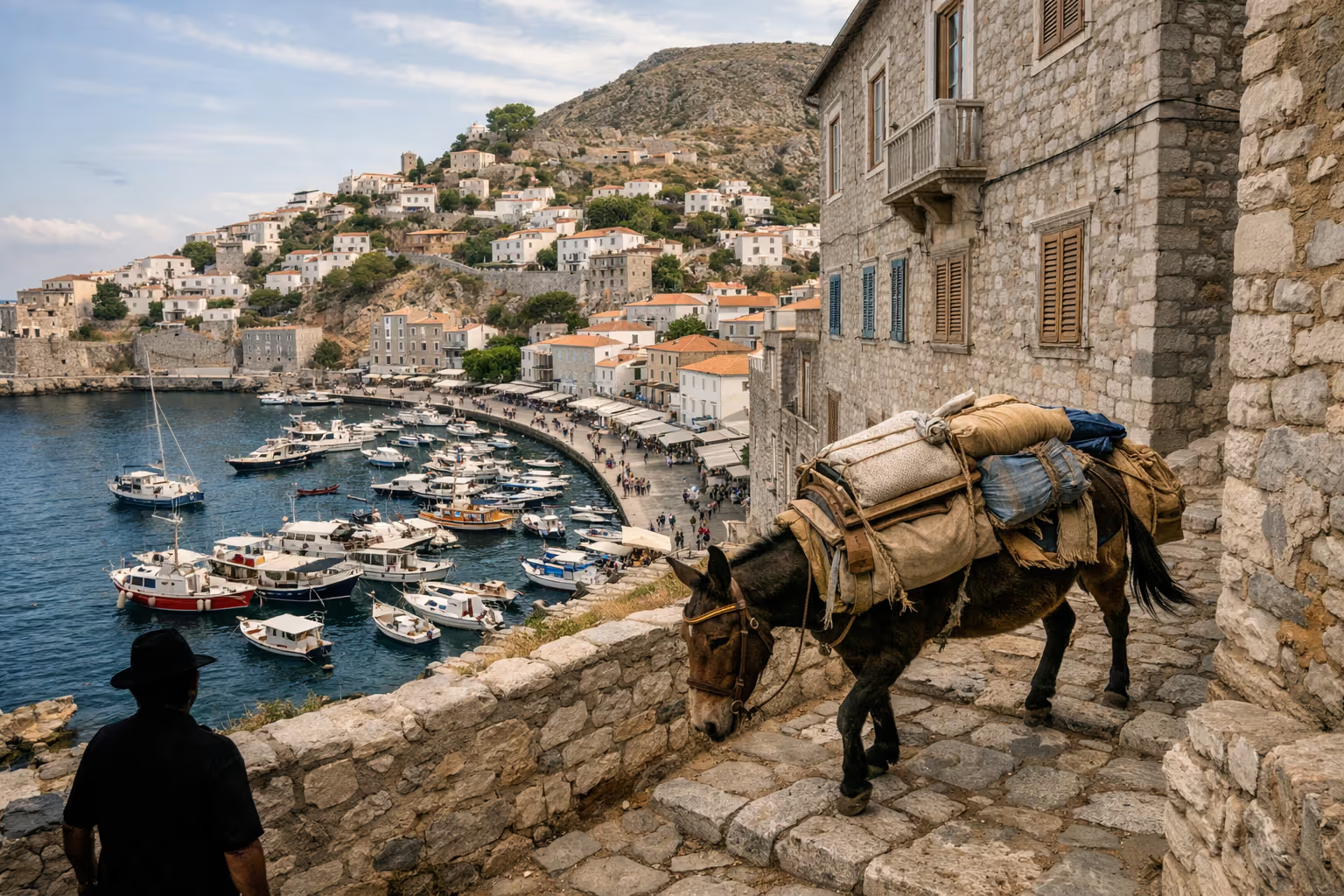
The port was significantly upgraded after a major 2003 donation from shipping magnate John Latsis, which let it accommodate larger cruise vessels (7). Small as it is, the harbor has a particular quality on a clear morning - the kind of place where you sit down for a coffee and end up staying longer than planned.
The heart of Katakolo runs along the three streets hugging the harbor. Here you’ll find:
- Tavernas serving fresh seafood, directly opposite the pier
- Cafes for people-watching over coffee
- Shops selling olive oil, local crafts, and souvenirs
Grab an iced freddo cappuccino (a cold espresso drink with whipped milk foam) - expect to pay €3-€4 (about $3.25-$4.25 USD) - and watch the boats bob in the Ionian Sea. It’s the kind of low-effort pleasure this town does well.
For a wider view, walk up to the lighthouse atop Mount Katakolon. Built and opened in 1865 (7), it gives you panoramic looks at the harbor, the docked cruise ships, and the coastline. The headland viewpoints near it are the best photo spots in town and require minimal walking beyond the main streets.
Etiquette note: Greek tavernas don’t expect heavy tipping the way North American restaurants do. Rounding up or leaving 5-10% for good service is normal and appreciated, not required. At churches and monasteries, cover shoulders and knees - women may be handed a wrap at the door if needed.
Can you walk to Katakolon from the cruise port?
Yes - the town starts at the port gate. Waterfront tavernas and shops begin immediately outside where you disembark, and most cafés and shops sit within a 300-500 m walk (1)(10). You need no transport, no taxi, and no shuttle to reach the center of Katakolo.
The only thing you cannot walk to is Ancient Olympia, which is roughly 40-45 km inland by road and requires the train, a coach, or a taxi. Everything else - the beach, the museums, the lighthouse view, the restaurants - is on foot within roughly 1 km of the ship.
The town’s main beach, Plakes (also called Reneta), is only a few hundred meters from the pier, about a 5-10 minute walk (10). If your only goal is a swim and a meal, you never have to leave the immediate port area.
Katakolon port layout and getting your bearings
Katakolo is small enough that a printed map from the ship or the tourist office does the job - most points of interest are within 1 km of the port. If you’re looking at a Katakolon Greece map before arrival, here’s what to orient around:
- Port gates: where you disembark; town begins immediately outside
- Train station: roughly 200 yards (about 180 m) from the port gates (2)
- Plakes/Reneta Beach: a few hundred meters from the pier, 5-10 minutes on foot (10)
- Main streets: the three parallel streets running along and just behind the harbor hold nearly all the shops, cafés, and tavernas
Mainstream navigation apps work reliably here, but check your mobile roaming plan before you rely on data - EU roaming caps typically run 5-25 GB/month depending on your provider.
The Katakolon tourist train to Olympia
The Katakolon tourist train is the easiest and cheapest way to reach Ancient Olympia on your own. Hellenic Train runs the Katakolo-Olympia line, a 13 km branch that takes about 45 minutes each way (2). A round-trip ticket costs €10 (about $11 USD), with a 50% discount for children under 12, roughly €5 or $5.50 USD.
The station sits about 200 yards from the port gates, so boarding is quick (2). Schedules are seasonal and timed loosely around cruise arrivals, so check Hellenic Train’s site one to two weeks before you arrive. Trains can sell out during peak cruise months (May-October), so don’t assume you can turn up and roll on.
This is your budget path for Katakolon to Olympia: about $11 for the train plus an Olympia site e-ticket saves you a substantial amount versus a ship excursion - more on that below.
Getting to Ancient Olympia: train, coach, or taxi
You have three realistic ways to cover the roughly 40-45 km to Olympia, each roughly 45 minutes each way (9):
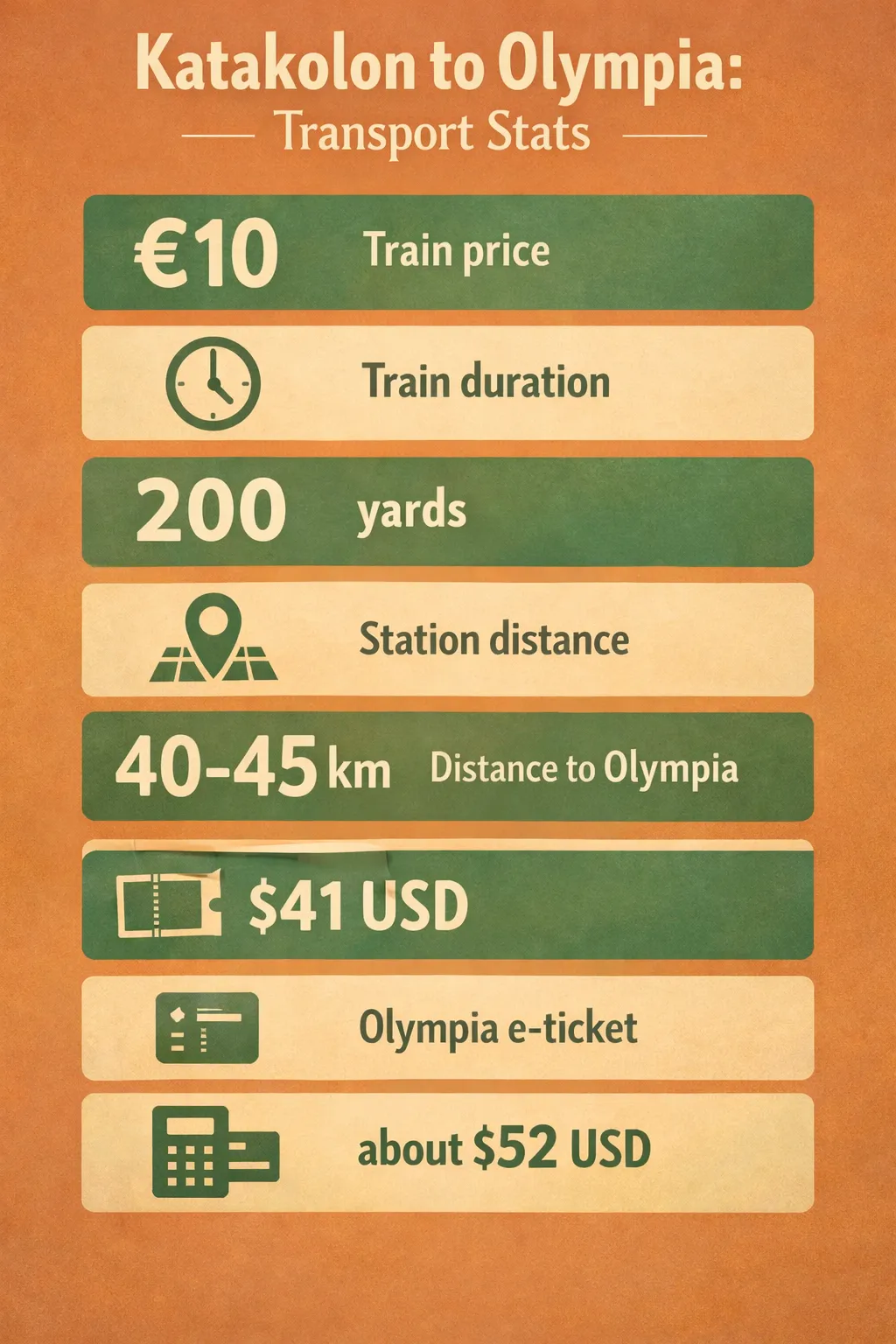 Key transport figures from Katakolon to Ancient Olympia: train €10, 45 min; 200 yards from port; Olympia 40-45 km; e-ticket about $41 USD; DIY total about $52 USD.
- Train - €10 round trip (about $11 USD), 13 km line, station 200 yards from the port (2). Cheapest option; timing depends on the posted schedule.
- Coach/shuttle - direct transfers marketed to cruise passengers; independent transfers typically run $20-$40 USD per person, while guided tours range $60-$150 USD depending on what’s included (9).
- Taxi - available at the port, often offering fixed-price round trips. Shared among a group of four, this commonly works out to $25-$40 USD per person.
Whatever you choose, budget at least 4 hours round trip including walking, queues, and the site visit itself (9). Miscalculating this is the most common way cruisers end up rushing or, worse, sweating over the return time.
Transport Options from Katakolon to Ancient Olympia
| Cheapest Train | Coach/Shuttle | Taxi | |
|---|---|---|---|
| Price Range | €10 (about $11) round trip | $20-$40 independent, $60-$150 guided | $25-$40 per person shared |
| Approx. Duration | 45 min each way | 45 min each way | 45 min each way |
| Departure Point | Station 200 yards from port | Port or arranged pickup | Available at port |
| Notes | Seasonal schedule; can sell out | Varies by provider and inclusions | Fixed-price round trips common |
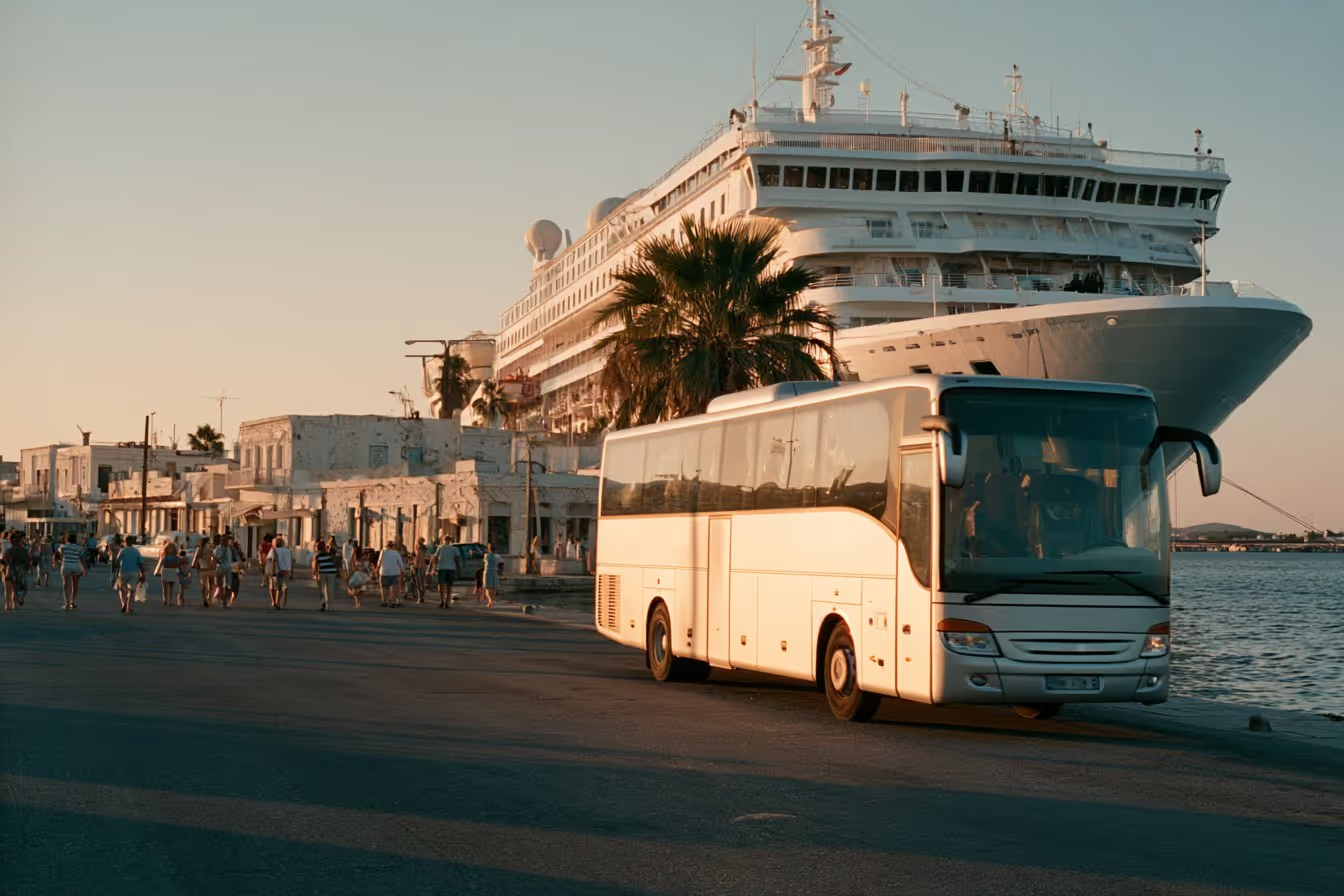
Katakolo Cruise Port: Roundtrip Transfer to Ancient Olympia
A roundtrip port transfer sits at the bottom of that $20-$40 independent range and takes the timing problem off your hands, since the return is built around the ship's departure rather than the posted train schedule.
Check availabilityExploring ancient wonders and local culture
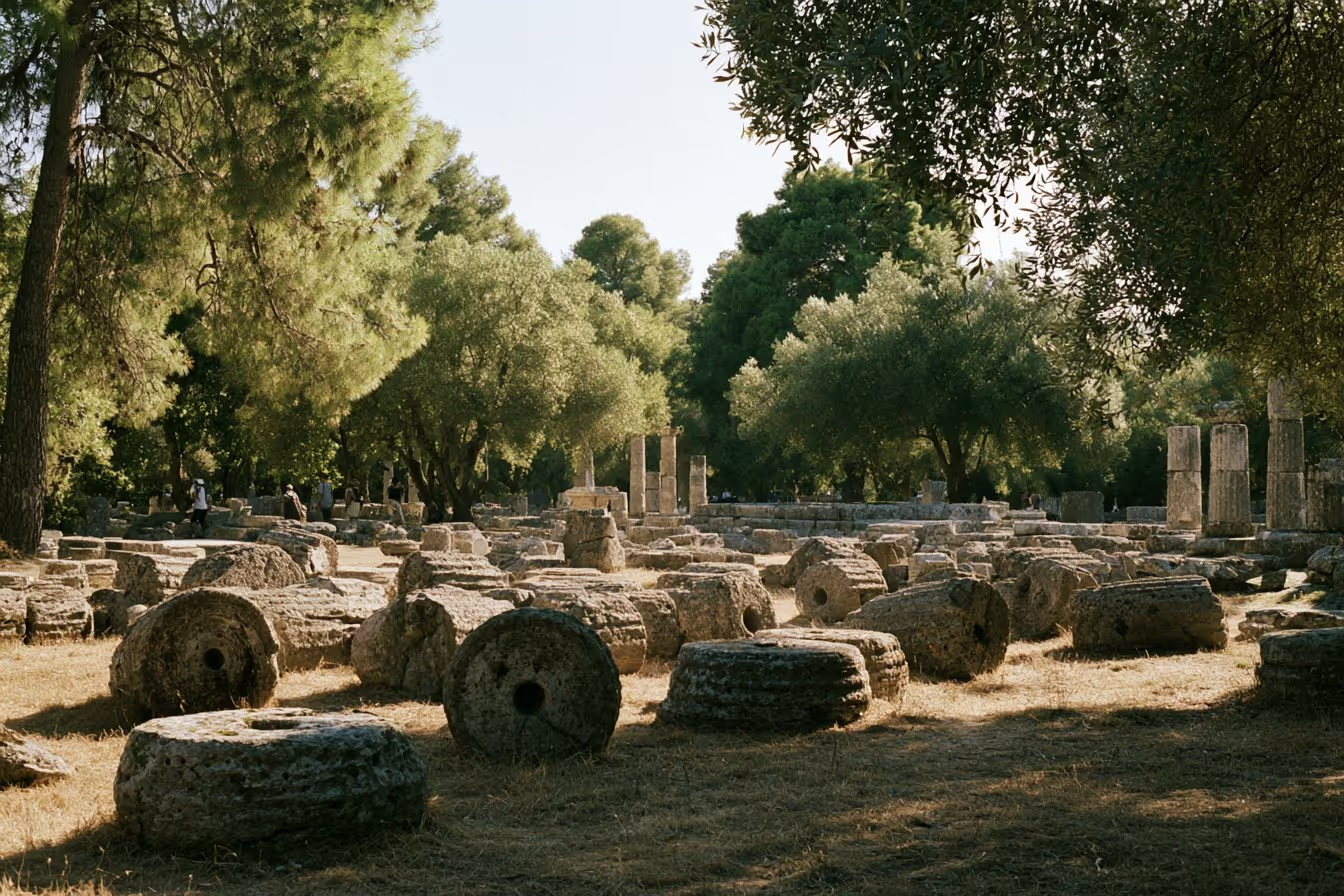
Katakolo’s real draw sits roughly 40 km inland by road: the UNESCO World Heritage site of Ancient Olympia, birthplace of the Olympic Games. Walk the remnants of the original stadium and you start to understand why the site still carries weight - the scale of it, even in ruins, is hard to dismiss. The on-site Archaeological Museum of Olympia holds the famous statue of Hermes by Praxiteles, which alone justifies the entrance fee.
Practical tip: on-site food and water at Olympia are limited, so carry snacks and plenty of water - summer temperatures often hit 30-35°C (86-95°F). You can buy the Olympia archaeological site and museum e-ticket with an audio guide for around $41 USD per adult, which lets you skip the cruise-tour markup while covering the same ground.
Back in town, the Kostas Kotsanas Museum of Ancient Greek Technology is the stop most cruisers miss entirely. Housed in the former residence of shipping tycoon Yiannis Latsis, it displays around 150 working models of mechanisms and inventions dating from 2000 BC to 100 AD - ancient robots, water clocks, cranes, and more. Tickets typically run €5-€10 (about $5.50-$11 USD). Nearby, the Museum of Ancient Greek Musical Instruments and Toys is a well-rated companion stop. Both are compact - 60 to 90 minutes each - and just minutes from the pier.
Most cruisers transit straight through Katakolo to Olympia and miss these museums entirely. They’re the town’s best bad-weather backup and its most accessible culture beyond the harbor. The Kotsanas Museum in particular has drawn coverage from travel writers and archaeology publications for making ancient mechanisms tangible rather than theoretical - the working reconstructions are what set it apart from a standard display case museum.
For a look at local spiritual life:
- St. Nicholas Church, dedicated to the town’s patron saint
- Kremasti Monastery, perched dramatically on a nearby cliff
Savoring the flavors of Katakolo
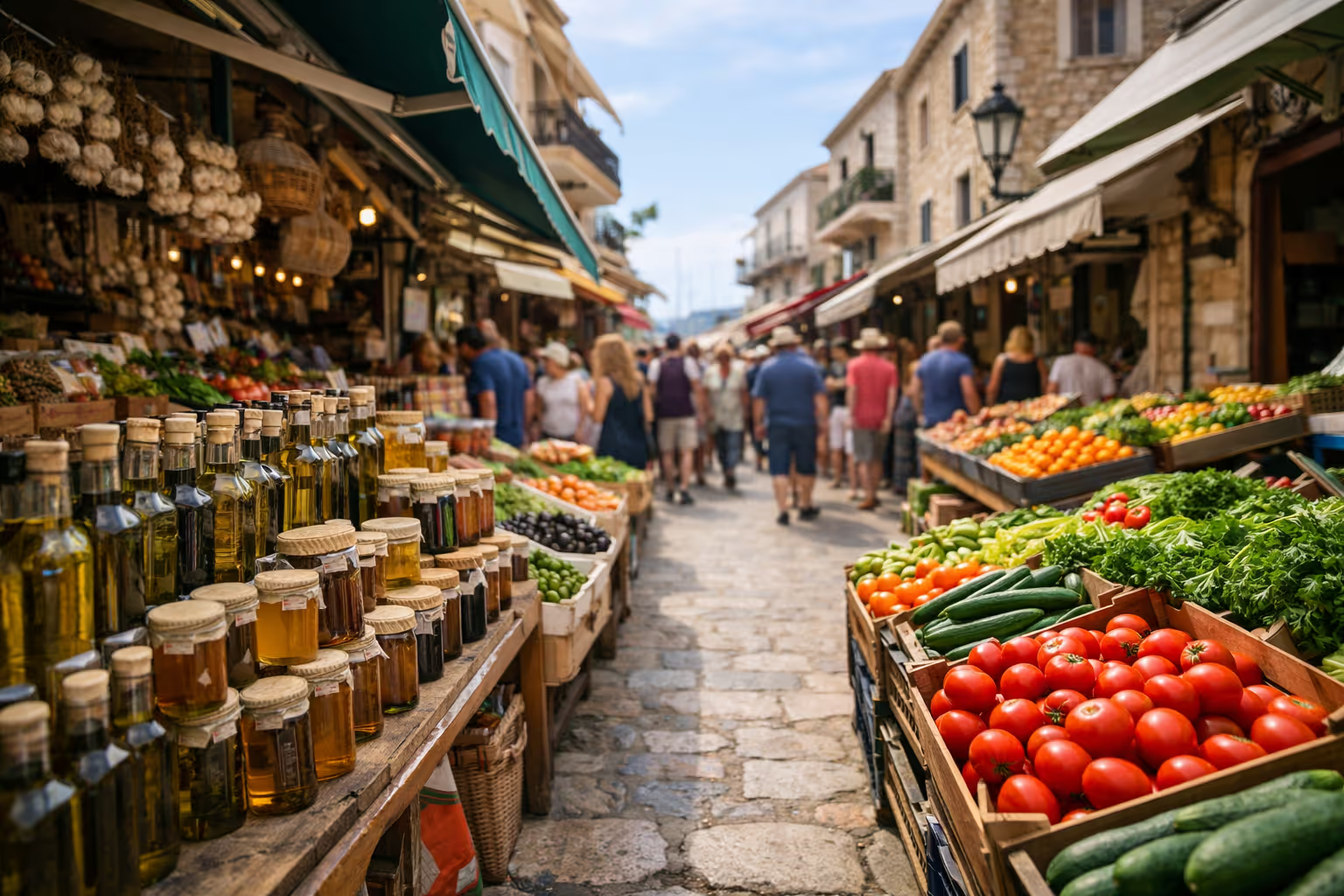
The town’s tavernas trade on fresh seafood, caught daily and served on the waterfront directly opposite the pier. For a real meal rather than a tourist-menu grab, look one street back from the harbor front - the second row of restaurants tends to have lower prices and fewer laminated photo menus. Expect main courses around €10-€18 (about $11-$20 USD, early 2025), a glass of local wine at €4-€6 (about $4.25-$6.50 USD), and coffee at €3-€4. A full sit-down lunch for two with wine typically lands around €35-€50 (about $38-$55 USD), which compares favorably to comparable waterfront dining in Nafplio or Corfu Town.
Katakolo is also known for its:
- Locally produced olive oil
- Sun-ripened fruits and vegetables
- Aromatic Peloponnese wines
For wine, the Mercouri Estate - one of Greece’s older wineries - offers tours and tastings a short drive from the port. An afternoon there pairs the region’s winemaking with views over the coast.
Time your visit for the fall harvest and you’ll catch the olive and grape harvests, celebrated with festive local events. Fall also means thinner crowds.
Seasonal Highlights in Katakolo
| Spring | Summer | Fall | Winter | |
|---|---|---|---|---|
| Season | Spring | Summer | Fall | Winter |
| Highlights | Mild weather, blooming wildflowers | Beach days, warmest sea, most cruise traffic | Harvest festivals, fewer crowds | Quiet tavernas, off-season calm |
One Day in Katakolon: What to See from a Cruise Ship
A typical port call runs 6-8 hours, and Olympia plus transport eats 4-5 hours of that - leaving 1-3 hours for the town and beach. Here’s the sequence that gets you the most from what to see in Katakolon Greece in one day:
- Disembark early - within the first 30 minutes of docking. Catching an early train or coach can buy you an extra 60-90 minutes at Olympia versus a late start (9).
- Go straight to Olympia - tour the site and museum in 2-3 hours, then head back by mid-afternoon.
- Swim at Plakes Beach - a few hundred meters from the pier, ideal for cooling off after the inland heat.
- Visit a town museum - the Museum of Ancient Greek Technology is best after you return, when crowds thin and most cruisers are still on excursions.
- Sunset drink at a waterfront taverna - close out with local wine facing the harbor.
That’s Olympia, seaside, and culture inside a standard 8-hour call. If you skip Olympia entirely and just want a relaxed seaside stop, plan on 3-6 hours strolling the three streets, swimming, and eating for $20-$40 USD per person - a legitimate choice if you’ve seen Olympia before or aren’t drawn to ruins. If your cruise itinerary also includes a stop in Athens, the top things to do in Athens Greece for history and culture can help you plan that leg without overlap.
DIY versus ship excursion: what it actually costs
Booking through the cruise line is convenient and guarantees the ship won’t leave without you - cruise lines hold departure if their own excursion buses are delayed, which is not a courtesy extended to independent travelers. But doing it yourself is significantly cheaper and covers the same core sights.
- DIY: train round trip (about $11) plus Olympia e-ticket with audio guide (about $41) totals about $52 USD.
- Ship excursion: typically $100-$150 USD per person, sometimes more with extras.
DIY saves roughly 50-65% compared to the typical ship excursion price - the train-plus-e-ticket combination at about $52 USD runs less than half the cost of the most common $100-$150 ship tour. The trade-off is timing responsibility - you must watch the train schedule and return with margin. If that stresses you out, or if you’re traveling with people who can’t move quickly, the ship tour buys peace of mind. A middle path is a small-group shore excursion pairing Olympia with an olive farm or winery for $90-$150 USD per person, transport and entrance included.
Ancient Olympia: Archaeological Site and Museum Entry Ticket
Site and museum entry booked ahead runs about $30 rather than the $41 budgeted above, with the audio guide as an add-on. Paired with the port transfer, the independent day lands near $48, under the DIY figure, and less than half the ship excursion.
Check availabilityFree vacation planning resources for Katakolo and Olympia
You don’t need to pay a travel agent to plan this stop. Several free resources effectively act as planning services for Katakolo and Olympia - and given how straightforward the logistics are, the paid options rarely add anything the free ones don’t already cover:
- Cruise-line destination guides - major brands publish free online Katakolon/Olympia guides with itineraries and logistics (7).
- Independent port-guide sites - these offer DIY routes, printable maps, and transport schedules at no cost (9).
- Hellenic Train’s website - the official source for current Katakolo-Olympia train times and fares (8).
- Olympia e-ticket portal - book site entry and an audio guide directly to skip tour markups.
Combine a printed port map, the current train schedule, and a prebooked Olympia e-ticket, and you have a complete, self-directed plan for well under the cost of a ship tour. If your Greek island itinerary extends beyond the Peloponnese, the things to do in Rhodes Greece: 10 sites worth every hour is a useful next read for planning another port stop.
Venturing beyond Katakolo
Katakolo works as a base for the wider region if you’re staying overnight rather than cruising through:
- Beach hopping - sandy stretches run along the coast for sunbathing and swimming.
- Countryside ride - the tourist “fun train” loops through olive groves and vineyards.
- Pyrgos - the nearby regional capital, a short drive inland.
- Pontikokastro (Beauvoir) castle - medieval hilltop ruins northeast of the port.
With a car or private transfer, you can fill a full 8-10 hour day combining Olympia, both Katakolo museums, and a winery, with total spend around $100-$200 USD.
Frequently Asked Questions
- What is Katakolon Greece known for?
- Katakolon is the main cruise gateway to Ancient Olympia and known for its small harbor, seafood tavernas, an 1865 lighthouse, and two niche museums.
- What to do in Katakolon from a cruise ship?
- Visit Ancient Olympia by train or coach, swim at Plakes Beach, explore the Museum of Ancient Greek Technology, and enjoy waterfront tavernas.
- Can you walk to Katakolon from the cruise port?
- Yes, the town starts at the port gate with shops and tavernas within 300-500 meters; only Olympia requires transport.
- How much is the train from Katakolon to Olympia?
- A round-trip ticket costs €10 (about $11 USD), with half-price fares for children under 12; the ride takes about 45 minutes each way.
- Is tipping expected in Katakolo tavernas?
- Tipping is appreciated but not required; rounding up or leaving 5-10% for good service is common.
- When is the best time to visit Katakolo for fewer crowds?
- Fall offers harvest festivals and thinner crowds, while summer has the most cruise traffic and beach days.
- Are there local museums worth visiting in Katakolo?
- Yes, the Kostas Kotsanas Museum of Ancient Greek Technology and the Museum of Ancient Greek Musical Instruments are compact and insightful.