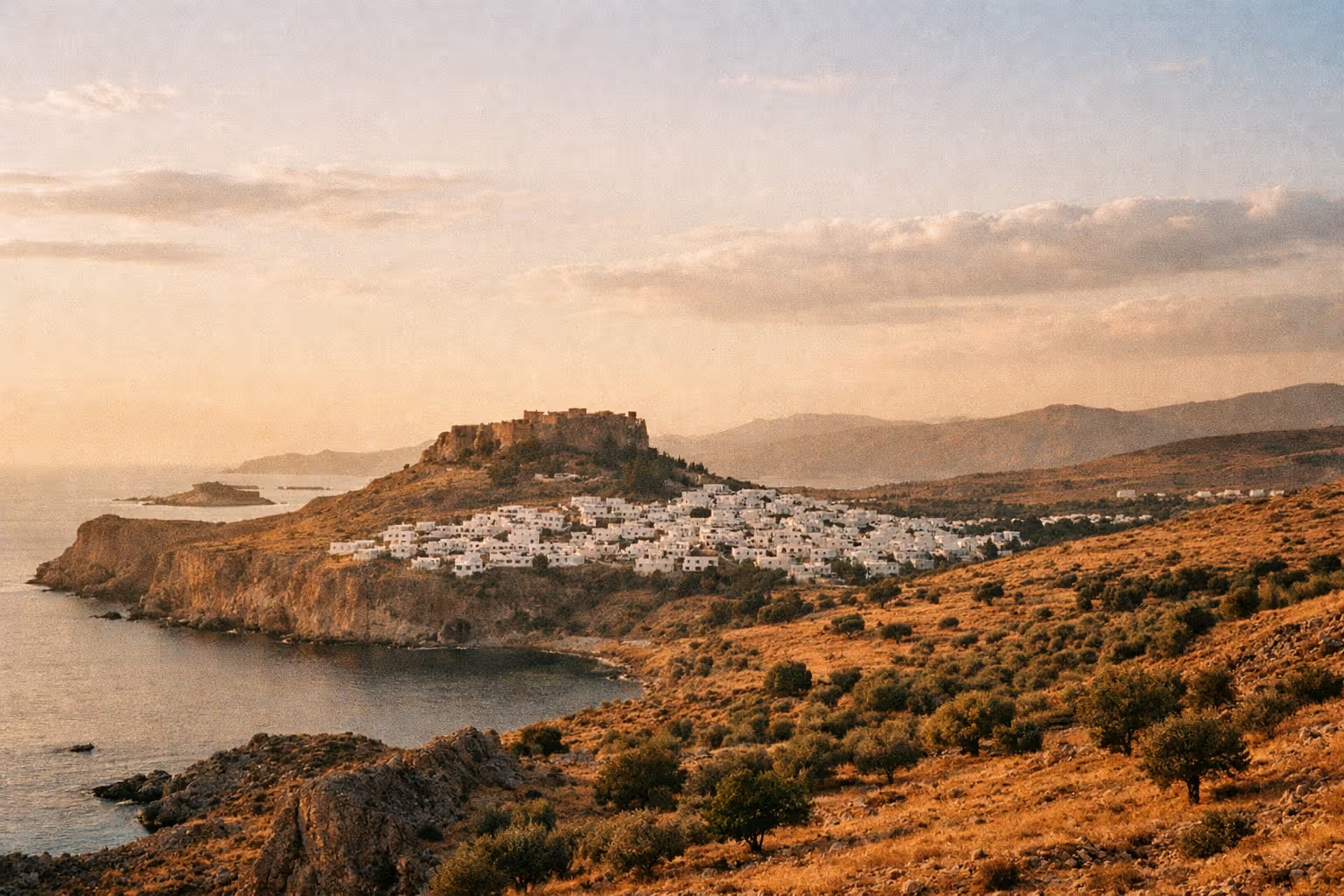
Things to do in Rhodes Greece split between deep history and easy beaches, and at 540 square miles the island needs four to seven days. Give one full day to the UNESCO medieval Old Town, Europe’s largest inhabited one, and another to the clifftop acropolis at Lindos, ideally with an overnight. Between them, work in beach days and a boat trip to Symi or Anthony Quinn Bay. Come in the April or October shoulder, because July and August turn those cobbled uphill streets genuinely brutal.
What Rhodes is best known for
Rhodes is the fourth-largest Greek island, roughly 540 square miles (1,400 km²), and pulls in over 2 million visitors a year. If you’re planning a trip and wondering about the things to do in Rhodes Greece, the short answer is that the island offers a rich blend of layered history and beautiful beaches.
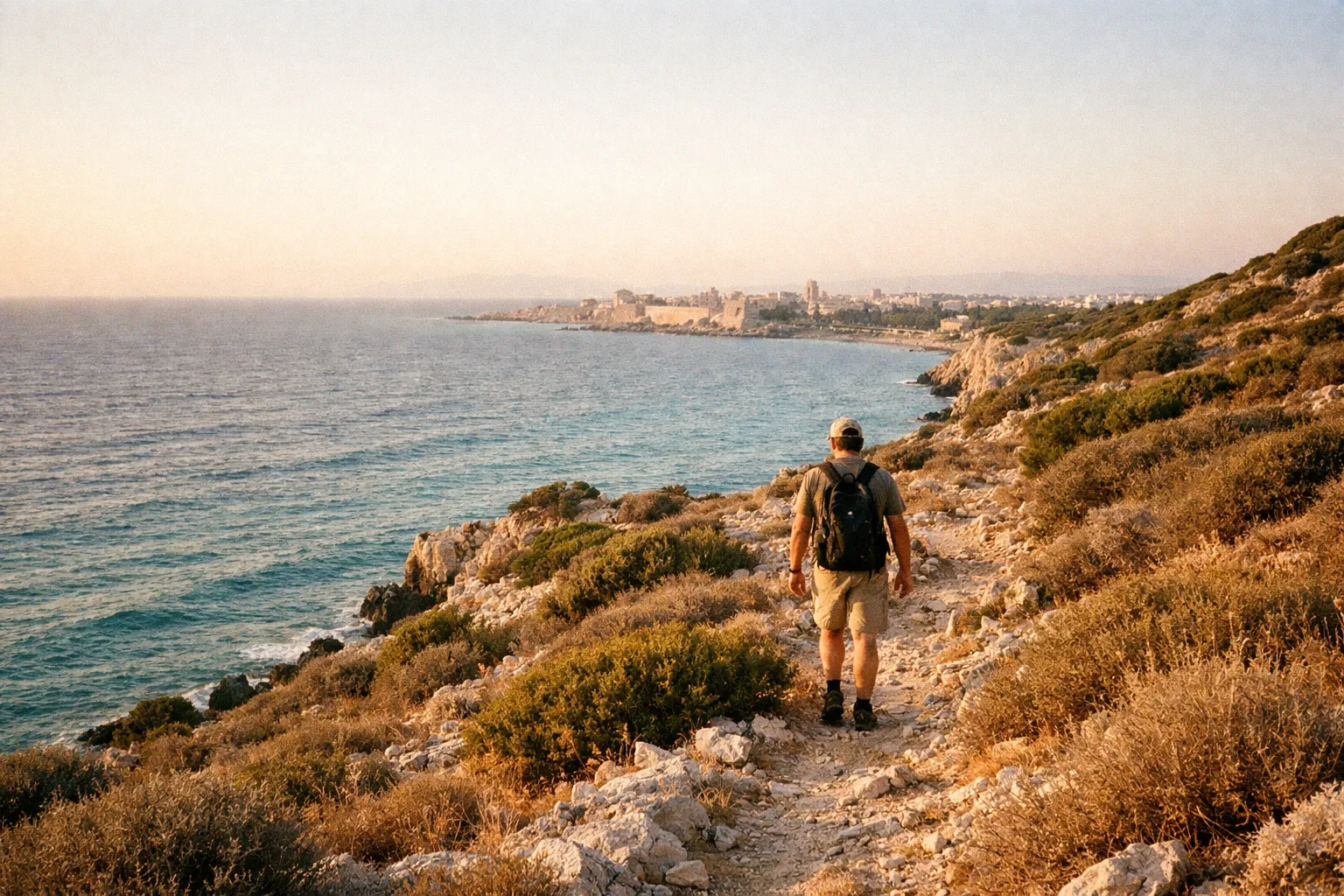
The island is best known for its UNESCO-listed Medieval Old Town - the largest inhabited medieval town in Europe, built by the Knights of St. John. There’s also the ancient Acropolis of Lindos, perched above a cluster of white houses on the east coast, and the legacy of the Colossus of Rhodes, one of the Seven Wonders of the Ancient World. The statue is long gone, but Mandraki Harbor, where it supposedly stood, is still the postcard entry point to the town.
Beyond the monuments, Rhodes draws people for its beaches: Tsambika, Anthony Quinn Bay, Elli in Rhodes Town, and the wind-battered sands of Prasonisi at the southern tip. Add in family attractions like Faliraki Water Park and the Valley of the Butterflies, and the island rarely feels one-note.
✓ Pros
- Diverse attractions combining history, beaches, and family activities
- Largest inhabited medieval town in Europe with rich heritage
- Varied landscapes from mountainous interior to sandy beaches
✗ Cons
- Peak summer heat can be intense for walking tours
- Overtourism in July and August affects some sites
- Public transport limited outside main towns
Centuries of occupation left their mark: the history of Rhodes
Rhodes, the largest of the Dodecanese islands, has a history that spans millennia. Walk the winding streets of the Old Town and you feel it in the stone - ancient Greeks, Romans, the Byzantine Empire, the Knights Hospitaller, the Ottomans, and later the Italians all wanted the Aegean, and all left something behind.
The Knights Hospitaller ruled here from 1309 to 1522, and their mark is everywhere. During my time exploring the Old Town, these were the sites that stayed with me:
- The Palace of the Grand Master of the Knights of Rhodes - a restored medieval fortress and museum; entry runs around €20 / $22 for adults (as of 2025)
- The Street of the Knights - a well-preserved cobbled street lined with the inns of the different knightly orders, best walked at dawn or after 6 pm when the crowds thin (1)
- Roloi Clock Tower - a viewpoint over the Old Town rooftops, roughly €5 / $5.50, often with a drink included
- The medieval city walls - a wall walk for about €3 / $3.30 that puts the fortifications in perspective from above (1)
- The Acropolis of Lindos - an ancient citadel with views over St. Paul’s Bay
- The remains of the Temple of Apollo at the Acropolis of Rhodes on Monte Smith
One etiquette note: several churches and the Suleiman Mosque require covered shoulders and knees. Carry a light scarf in summer - you’ll want it for the historical sites even when the beach dress code is nonexistent.
Rhodes was once home to the Colossus of Rhodes. The statue is long gone, but its legacy still fuels the imagination of everyone who walks past Mandraki Harbor.
Things to Do in Rhodes, Greece: Starting in Rhodes Town
Most visitors base themselves in or near Rhodes Town, and there’s enough here to fill a couple of days without repeating yourself. The things to do in Rhodes Town, Greece cluster naturally into the Medieval City and the New Town beside it.
Inside the pedestrianized Old Town, budget 3 to 6 hours to cover the Palace of the Grand Master, the Street of the Knights, the Archaeological Museum, and Hippocrates Square. The Archaeological Museum sits in the former Hospital of the Knights on Museum Square - a quieter corner of the walled city that most visitors reach by cutting through Argyrokastrou Square from the main tourist drag. Total entry fees for the main sites come to around $20-30 per person. Enter through gates like D’Amboise Gate - the whole medieval core is car-free, so you’re on foot the entire time.
The New Town is where daily life happens. Mandraki Harbor is the anchor point, guarded by its bronze deer statues where the Colossus supposedly stood, with the old windmills and the Fortress of St. Nicholas beyond. Elli Beach sits right in town if you want a swim between sights. For sunset, repeat visitors point you to the beach area opposite the Statue of Diagoras, or up to Monte Smith near the Acropolis of Rhodes for wide sea views that cost nothing but the transport (1)(5).
A practical warning: the Old Town’s cobbled, uphill streets are brutal in July and August midday heat, which regularly hits 86-93°F / 30-34°C. Do the walking early or in the evening. Save the middle of the day for the beach or a long lunch.
Lindos: The Acropolis, the Village, and the Bay
Lindos is the island’s second essential stop, about 48 km / 30 miles down the east coast - 45 to 60 minutes by car or tour bus. The things to do in Lindos, Rhodes, Greece revolve around the whitewashed village and the acropolis above it.
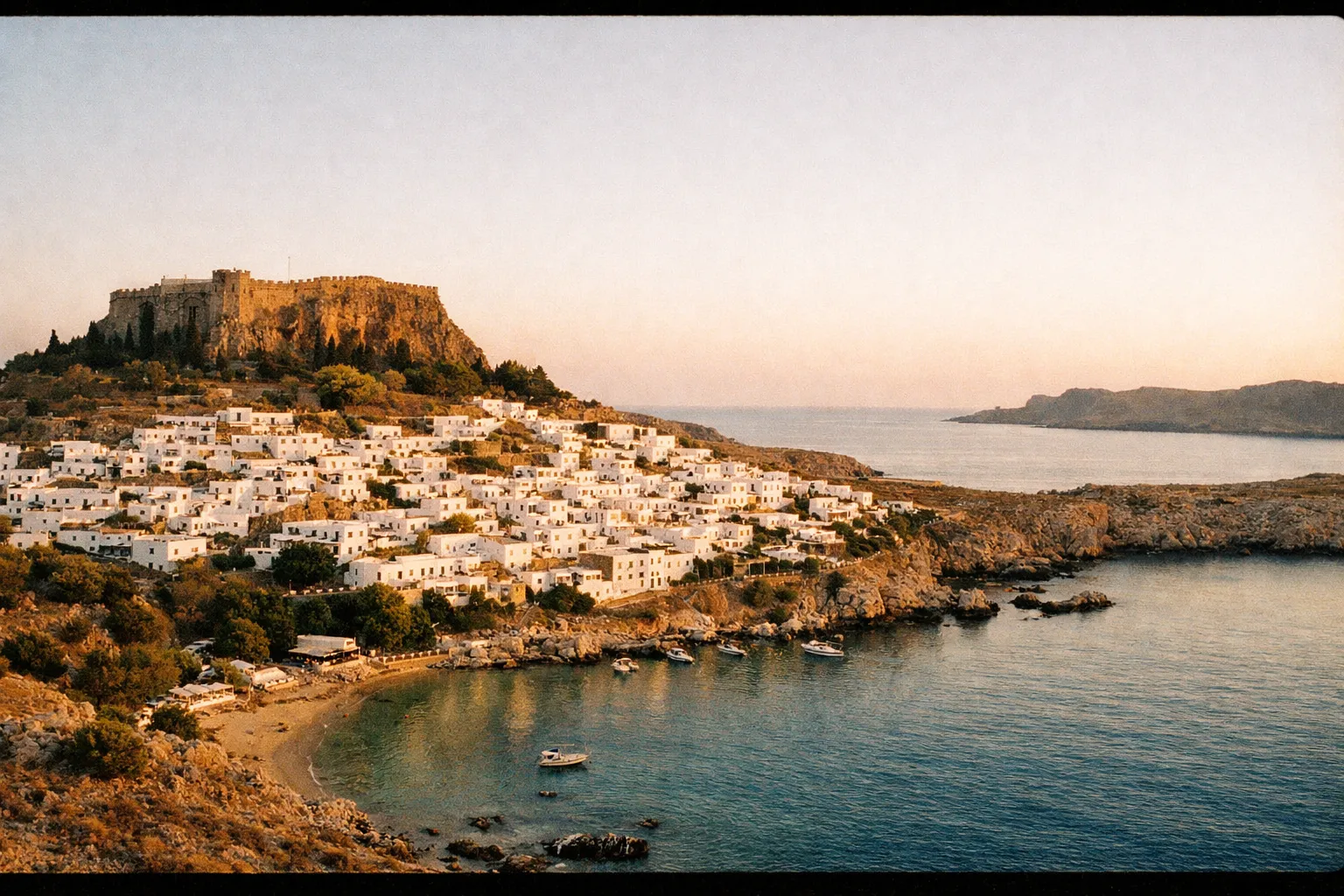
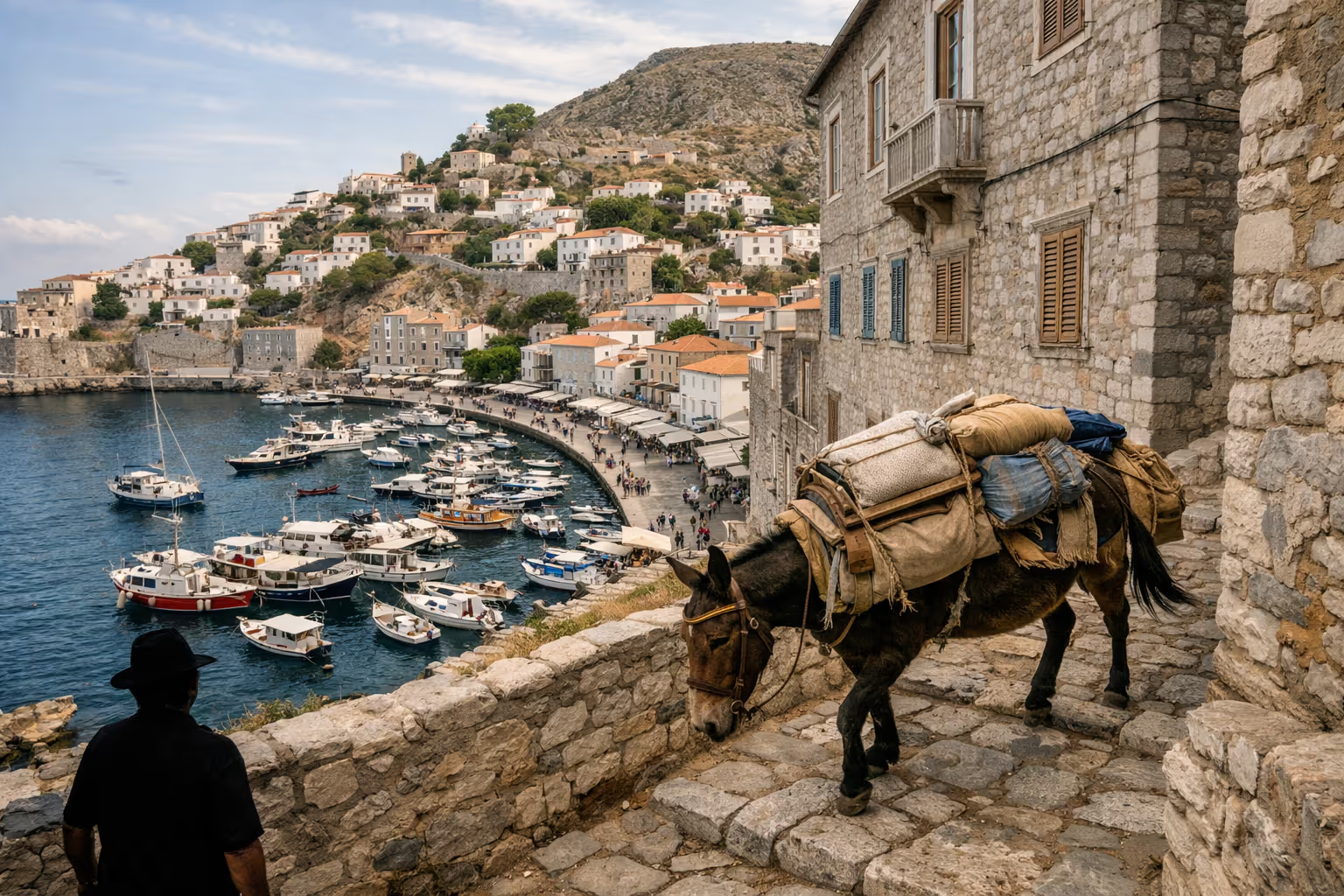
The Acropolis of Lindos is the headline. Entry runs around €20 / $22 for adults (as of 2025), and the walk up is steep and unshaded. Donkeys are offered for the climb, but I’d skip them - many travelers raise ethical concerns, and the walk isn’t long if you go early before the heat builds. From the top you get the Temple of Athena Lindia, a Hellenistic stoa, and a straight-down view of horseshoe-shaped St. Paul’s Bay.
Down in the village, the lanes are car-free and lined with rooftop restaurants. A rooftop dinner for two, with wine and a view of the lit-up ruins, generally runs $50-100. Sunbed sets on the main beach or at St. Paul’s Bay cost roughly $10-20 a day.
My honest tip: if you can, stay overnight in Lindos rather than day-tripping. Early morning and late evening are when the acropolis empties out and the village is at its best - experiences a rushed day trip simply can’t deliver (1).
Faliraki: Waterparks, Beaches, and the Resort Strip
Faliraki sits about 14 km south of Rhodes Town and is the island’s beach-and-activity hub. The things to do in Faliraki, Rhodes, Greece lean toward families by day and nightlife by night.
The big draw is Faliraki Water Park, the largest in Greece. Day tickets commonly run $30-40 per adult and $20-30 per child. It’s a full-day outing with wave pools, slides, and lazy rivers - book ahead in peak season, because it can hit capacity and the queues get long.
The main Faliraki beach is a wide, sandy arc with the usual water sports: jet-ski, parasailing, and banana boats generally start around $40-80 per activity (6)(7). Just north sits the newly renovated Kallithea Springs, a 1930s Italian-built spa complex with pebble mosaics, landscaped gardens, sunbeds, a café, and swimming off the rocks (5). It makes a good half-day between Faliraki and Rhodes Town.
For a compact way to see the highlights, half-day private tours like “Rhodes Town & Lindos” start around $110-120 per adult and pick you up from Faliraki hotels (7). After dark, the resort’s bar strip is loud and cheap - fine if that’s what you’re after, easy to avoid if it isn’t.
Family-Friendly Attractions Worth Planning Around
Rhodes handles kids well. The trick is breaking up historical sightseeing with short, high-impact stops before museum fatigue sets in. Here are the things to do in Rhodes, Greece for families that consistently deliver:
- Faliraki Water Park - the day-long crowd-pleaser (2)(6)
- Rhodes Aquarium - an old Art Deco building in the New Town with a Mediterranean sea-life tour and easy stroller access (2)(4)
- Throne of Helios 9D cinema - a 30-minute immersive experience that makes the island’s ancient history digestible for kids; tickets run about $12-18 (4)(6)
- Valley of the Butterflies - a shaded ravine where thousands of Jersey tiger moths gather in summer; a cool, easy walk
- Rodini Park - Europe’s oldest landscaped park, with peacocks and Rhodian deer wandering the grounds (2)
- Bee Museum - a small, quick stop that surprises kids (2)(6)
- Mandraki Harbor walks - flat, stroller-friendly, with the deer statues and windmills
Most of these are stroller-accessible with snack bars and restrooms on-site. Easy beaches like Pefkos or Lee Beach round out a family week. Budget roughly $800-1,400 for a family of four covering two major paid attractions and one boat trip, excluding lodging (4).
What Cruise Ship Passengers Can Realistically Do in Port
Cruise ships dock within walking distance of the Old Town, and most passengers get 6 to 9 hours in port. Time is the constraint, so the things to do in Rhodes, Greece from a cruise ship break into two realistic plans.
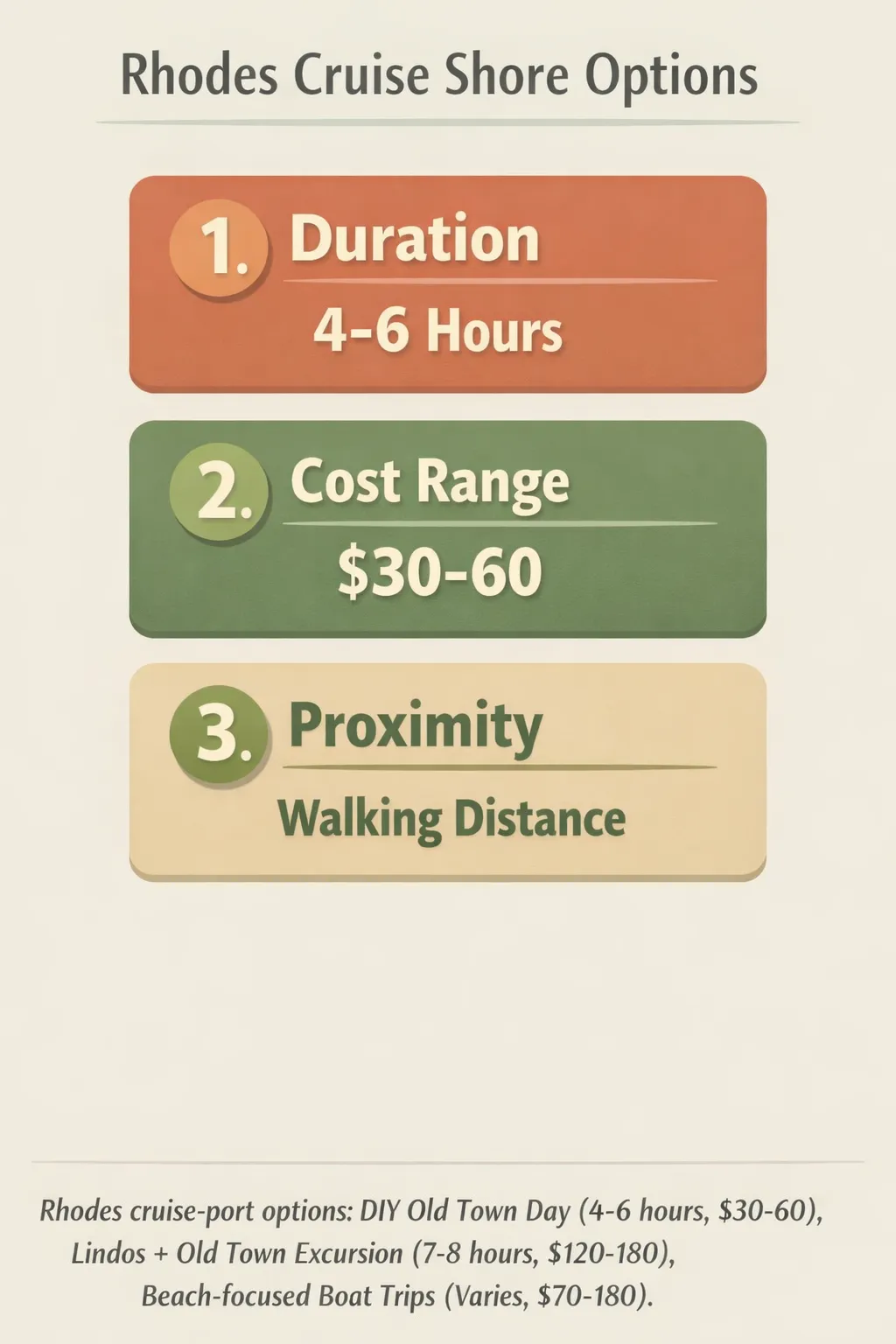 Rhodes cruise-port options: DIY Old Town Day (4-6 hours, $30-60), Lindos + Old Town Excursion (7-8 hours, $120-180), Beach-focused Boat Trips (Varies, $70-180).
Option A - DIY Old Town day. Walk from the port into the Medieval City, cover the Palace of the Grand Master, Street of the Knights, and Mandraki Harbor, then swim at Elli or Zefyros beach. Budget 4-6 hours and $30-60 total for entry fees and lunch. This is the low-stress choice and keeps you close to the ship.
Option B - Lindos + Old Town excursion. Book a “Best of Lindos & Rhodes” shore excursion, typically a 7-8 hour tour at $120-180 per adult, covering the Lindos Acropolis, village time, and a guided Old Town walk. Beach-focused boat trips to Anthony Quinn, Kallithea, and Traganou bays run around $70-180 per person depending on group size.
One hard-learned warning: don’t attempt an independent Lindos trip on a tight port call. Bus schedules and traffic have stranded plenty of passengers, and missing the ship is expensive. If your window is short, take an organized excursion with a guaranteed return time (8).
Cruise Ship Visitor Options in Rhodes
| DIY Old Town Day | Lindos + Old Town Excursion | Beach-focused Boat Trips | |
|---|---|---|---|
| Duration | 4-6 hours | 7-8 hours | Varies |
| Cost Range | $30-60 | $120-180 | $70-180 |
| Included Activities | Old Town walk, Mandraki Harbor, Elli Beach swim | Lindos Acropolis, village time, guided Old Town tour | Swimming stops at Anthony Quinn, Kallithea, Traganou bays |
| Proximity to Port | Walking distance | Requires transport | Boat departure from port |
The 10 Sites That Earn Their Spots on Every Itinerary
If you want the shortlist, here are the top 10 things to do in Rhodes, Greece - the sites that appear on nearly every list and, in my experience, earn their spots (1)(3)(5)(9):
- Rhodes Old Town - the Medieval City, Palace of the Grand Master, Street of the Knights
- Lindos Village & Acropolis - whitewashed lanes and a clifftop citadel
- Acropolis of Rhodes (Monte Smith) - Temple of Apollo ruins and sunset views
- Anthony Quinn Bay - an emerald-water cove named for the actor who filmed here
- Mandraki Harbor - the deer statues, windmills, and Fortress of St. Nicholas
- Kallithea Springs - the renovated 1930s spa complex for a half-day swim
- A boat trip with swim stops - booked on the spot at Mandraki or the Marina
- Tsambika Beach - a long golden strand below its hilltop monastery
- Day trip to Symi - a nearby island of pastel neoclassical houses
- Prasonisi - the southern spit where the Aegean and Mediterranean meet, a windsurfing magnet
Natural wonders and outdoor adventures
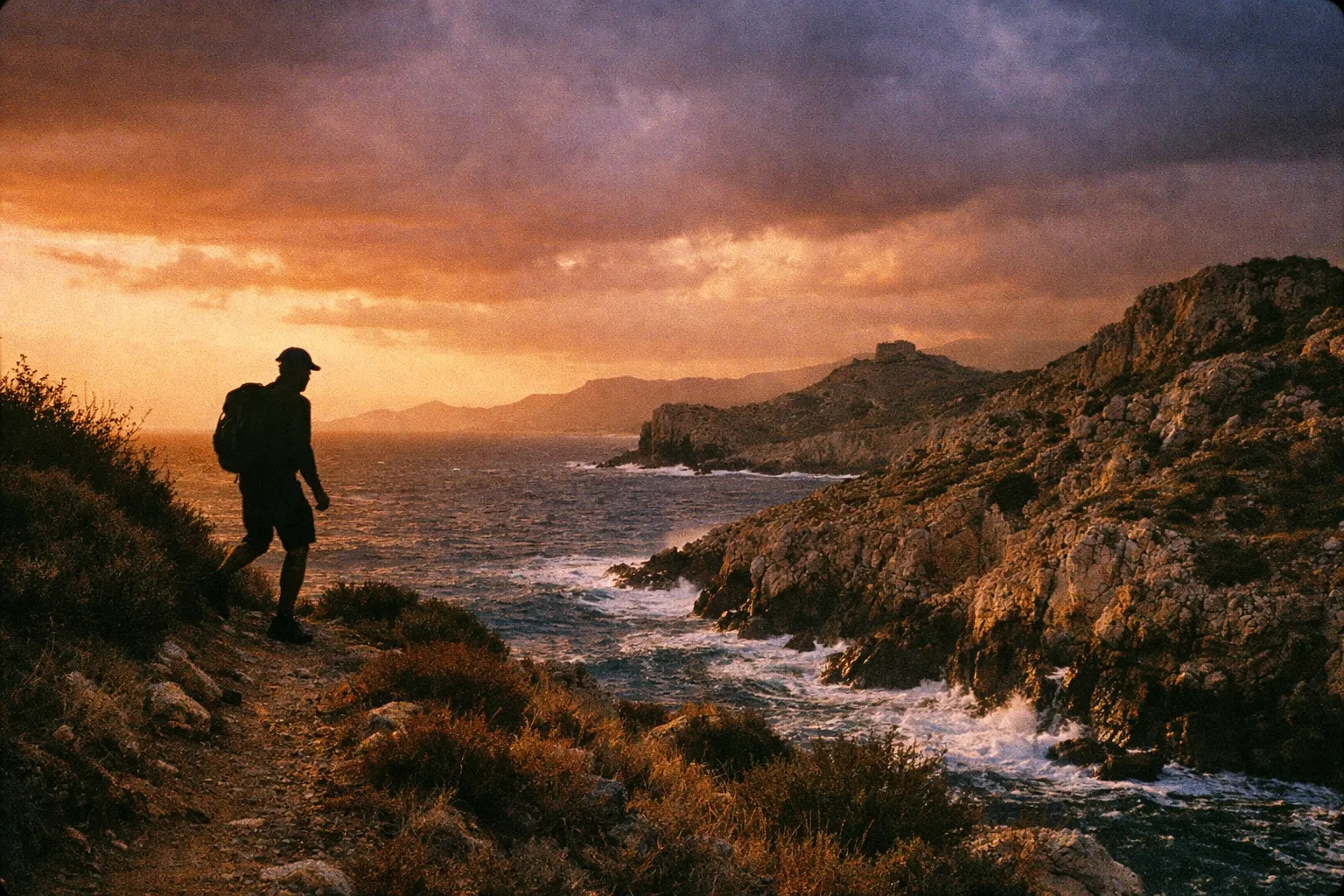
The island’s interior is more mountainous than most visitors expect. Mount Attavyros reaches 1,216 meters (3,990 feet), and I spent a few days hiking through pine forest, past streams, out to viewpoints over the Aegean. One trail I kept thinking about afterward led to the Seven Springs (Epta Piges) - a shaded oasis where water flows year-round and a nerve-testing tunnel walk leads to a small lake.
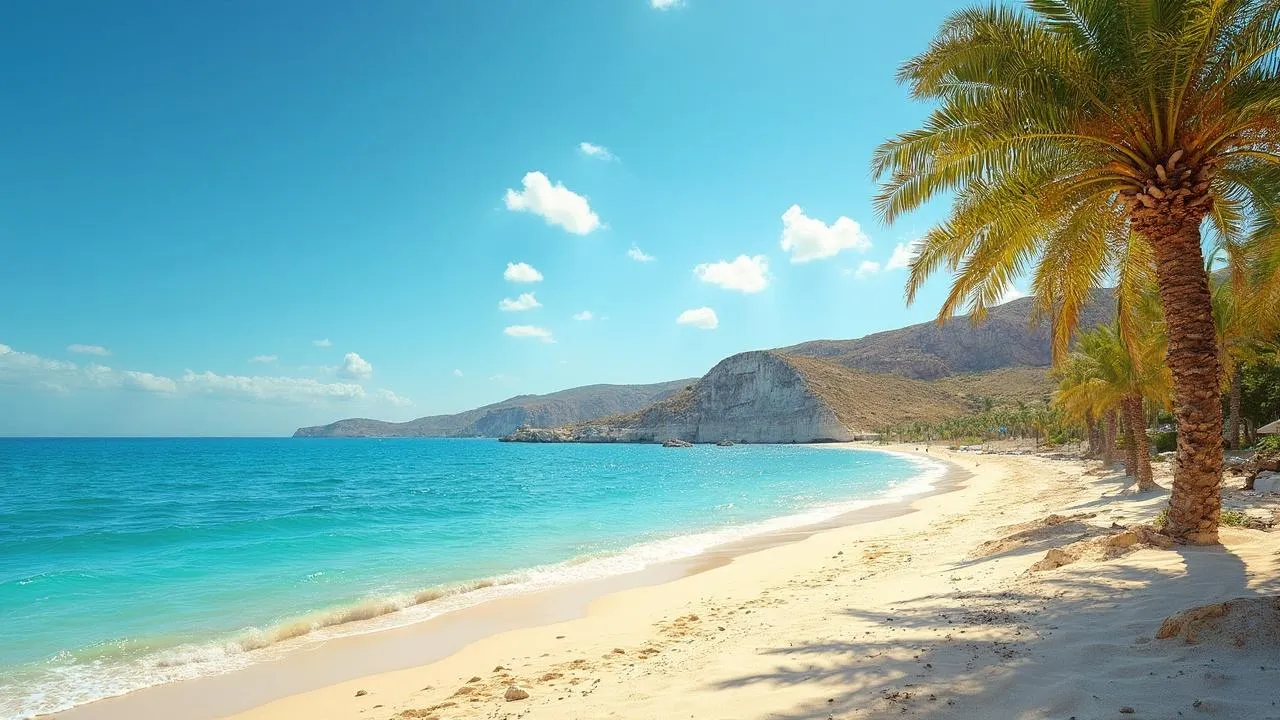
Beyond the interior, these beaches are worth the drive:
- Anthony Quinn Bay - a rocky cove with clear emerald water, good for snorkeling
- Tsambika Beach - long, sandy, packed with water sports
- Prasonisi - the twin-sea sandbar at the island’s tip, best for windsurfers
- St. Paul’s Bay below Lindos - a sheltered inlet with calm water
Rhodes’s consistent summer winds and clear water make it a strong destination for windsurfing, kiteboarding, and scuba diving, with the south around Prasonisi being the wind hotspot.
Eating your way through Rhodian cuisine
The island’s Mediterranean cooking blends Greek, Turkish, and Italian influences, and it’s worth eating your way through it deliberately. Rhodes has produced wine for over 2,500 years - I sampled crisp whites from the indigenous Athiri grape and full-bodied reds from Mandilaria at a couple of small interior wineries, and both were worth the detour.
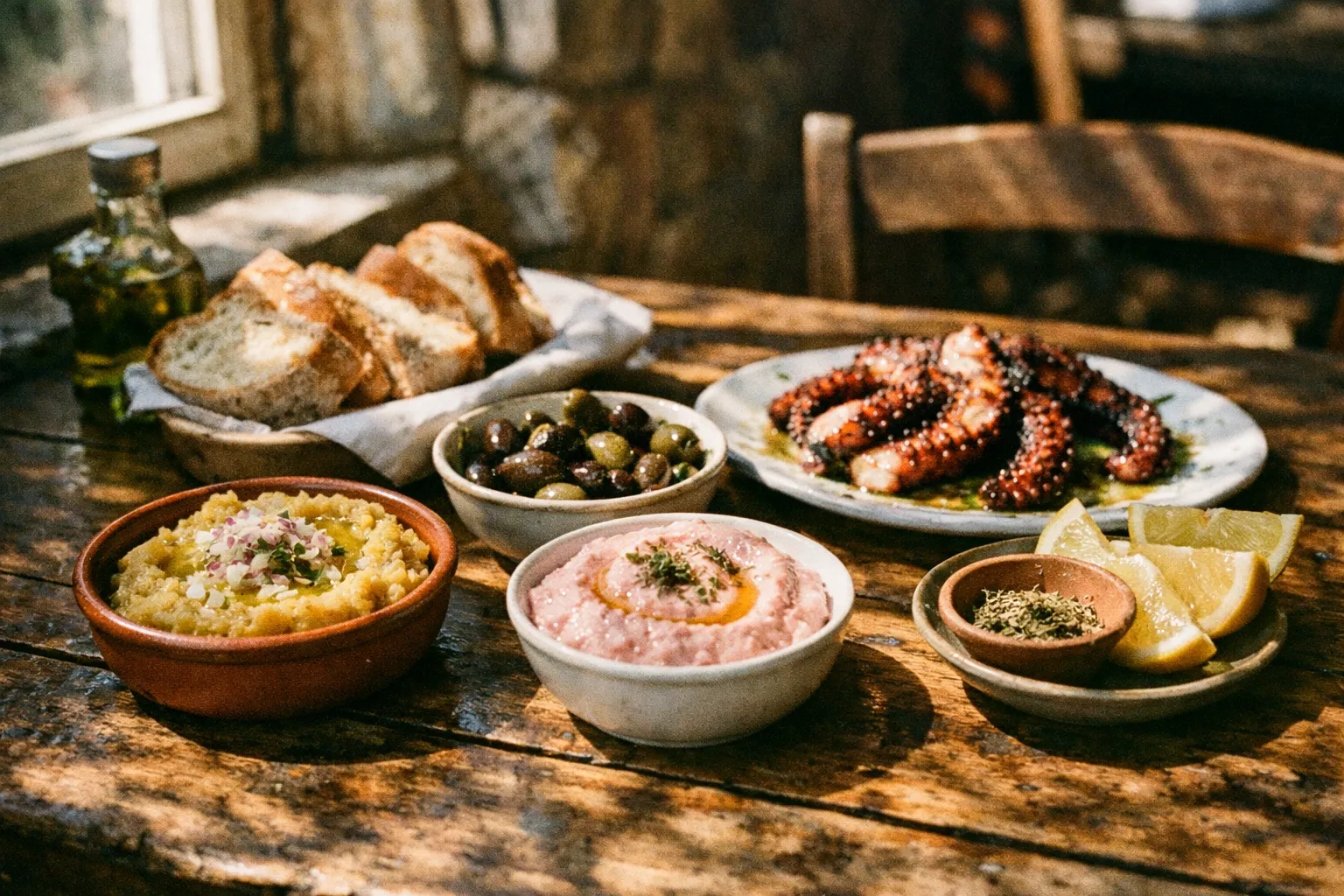
Here’s a quick guide to dishes worth ordering:
| Dish | Description |
|---|---|
| Pitaroudia | Savory chickpea fritters with herbs and onions |
| Kapramas | Slow-cooked goat with chickpeas and tomatoes |
| Dolmades | Stuffed grape leaves with rice and herbs |
| Melekouni | A sesame-and-honey sweet, traditionally served at weddings |
Skip the Hippocrates Square tourist tavernas with English-only menus and touts out front. The family-run places in the villages, and the tavernas tucked along Socratous Street and around Arionos Square in the Old Town, gave me the best meals of the trip - according to the Greek National Tourism Organisation, Rhodes Town’s medieval quarter holds more than 200 registered food and drink establishments, so the contrast between the tourist-facing strip and the quieter residential lanes is stark. On tipping: rounding up or leaving 5-10% is standard and appreciated, not obligatory. A mid-range taverna dinner for two with wine runs roughly €40-60 / $44-66.
Practical tips for visiting Rhodes
A little planning goes a long way.
Getting there: Rhodes Diagoras International Airport takes direct flights from major European cities; summer round-trips from Western Europe typically run $150-400. Athens-Rhodes domestic flights cost roughly $60-160 one-way on Aegean and Sky Express. Ferries also connect Rhodes to other Dodecanese islands and nearby Turkey.
Getting around: Rent a car to reach Lindos, Prasonisi, the interior villages, and the scattered beaches. Peak-season rates for a small car run $35-60 per day including basic insurance, with fuel around $7-8 per gallon. Public buses cover the main coastal routes but leave you dependent on schedules.
Best time to visit: Rhodes runs a Mediterranean climate - hot summers, mild winters. Peak season is June to September, with average highs of 77-89°F (25-32°C). I prefer the shoulder seasons (April-May or October-November) when the weather holds and the crowds thin out considerably.
Accommodation: Options span luxury resorts in Faliraki, boutique hotels inside the Old Town, and traditional stone houses in the villages. Staying inside the Medieval City is atmospheric but noisy in summer; Lindos and Faliraki suit beach-first trips.
Responsible tourism: Rhodes wrestles with overtourism in July and August. Respect site rules, support small family businesses, skip the donkey rides at Lindos, and go easy on water in a place where summer is dry.
How many days do you need in Rhodes, and is it worth visiting?
A few questions come up repeatedly when people plan this trip. Here are straight answers.
How many days do you need in Rhodes, Greece?
For most travelers, 4 to 7 days is the sweet spot. That gives you a full day for the Old Town, a full day for Lindos (ideally with an overnight), a couple of beach days, and one boat trip or a day trip to Symi. Trying to squeeze Old Town, Lindos, and a distant beach like Prasonisi into a single day is the classic mistake - the distances and driving times don’t allow it, and you end up rushing everything (1). Cruise visitors with 6-9 hours should pick one focus: Old Town plus a nearby beach, or an organized Lindos-and-Old-Town excursion.
Is Rhodes worth visiting in Greece?
Yes - and specifically because it isn’t only a beach island. The combination of the medieval Old Town, ancient sites from the Hellenistic, Byzantine, Crusader, Ottoman, and Italian periods, sandy beaches, and family attractions in one place is what sets it apart from smaller Greek islands (1)(9). Average daily spend lands around $100-160 per person for mid-range lodging, meals, and activities, which is reasonable for what you get.
What should you not miss on Rhodes?
If you only have time for the essentials: the Old Town and Palace of the Grand Master, Lindos village and its Acropolis, Mandraki Harbor, Anthony Quinn Bay, and one boat trip with swim stops. Add the Acropolis of Rhodes on Monte Smith for sunset if you can (5)(3).
Give Lindos and the Old Town the full days they deserve, plan around the midday heat, and the island rewards you. More than once, I’ve found myself thinking about a return trip before the ferry has even left the harbor.
Frequently Asked Questions
- Are donkey rides at Lindos recommended?
- Donkey rides at Lindos are not recommended due to ethical concerns; the climb to the Acropolis is short and best done early to avoid heat.
- What is the tipping etiquette in Rhodes?
- Tipping 5-10% is standard and appreciated in Rhodes but not obligatory, especially in family-run tavernas.
- Is public transportation reliable for reaching beaches outside Rhodes Town?
- Public buses cover main coastal routes but are limited; renting a car is recommended for beaches and villages outside Rhodes Town.
- Can cruise ship passengers visit Lindos independently?
- Independent Lindos trips on short port calls are risky due to bus schedules and traffic; organized excursions with guaranteed return are safer.
- What is the best time of day to explore Rhodes Old Town in summer?
- Early morning or evening walks are best to avoid the intense midday heat in Rhodes Old Town during summer.
- Are family attractions in Rhodes stroller-friendly?
- Many family attractions like Rhodes Aquarium and Mandraki Harbor walks are stroller-accessible with facilities nearby.
- How much should a family budget for activities in Rhodes?
- A family of four should budget roughly $800-1,400 for two major paid attractions and a boat trip, excluding lodging.