Nearly every English-language search for yellow spring road japan sends you to the wrong prefecture. The photos are real, the golden ginkgo is real - but the location most sites give you, Wakayama on the Kii Peninsula, is not where this place is. The real site is 太原のイチョウ (Taibaru no Ichō), a private ginkgo grove in Hirokawa, Fukuoka Prefecture, on Kyushu, at the official address 〒834-0112 福岡県広川町久泉1004 (1).
Here is the second thing you need to know before you fall in love with the pictures: this is private land, opened to the public for roughly one week each year in late November. Outside that window, you cannot visit. This article covers where it actually is, the story of the man who planted it, and exactly when and how to see it.
✓ Pros
- Genuinely rare: private land, opened once a year by one person's choice
- The "golden carpet" effect (fallen leaves + canopy together) is visually distinctive
- Located in southern Fukuoka - accessible from Fukuoka City or Kurume as a day trip
- No entrance fee (based on verified sources)
- Small, intimate scale - 60-80 trees, not a theme park
✗ Cons
- Open only about 7 days per year (late November), 9:00-17:00 only
- Private property - no access outside the official window, no exceptions
- Color timing depends on autumn temperatures; a warm year can mean green leaves during the opening week
- Parking is off-site (temporary lot system); group buses require prior coordination
- Very limited English-language information from official sources
Where Yellow Spring Road Actually Is in Japan - and Why Most Sites Get It Wrong
The correct yellow spring road location is Hirokawa-machi, in Yame-gun, Fukuoka Prefecture, on the island of Kyushu. The official address is 〒834-0112 福岡県広川町久泉1004 (1). It sits in the Chikugo region of southern Fukuoka, near Kurume, and the prefectural tourism site lists this exact address under the name “Taibaru Gingko Trees” (1).
This is not Wakayama. It is not the Kii Peninsula. It has no connection to the JR Kuroshio limited express line, and no connection to Yuasa Station. If a travel page tells you to reach “Yellow Spring Road” by riding south from Osaka, that page is describing a place that does not exist at the location it claims. The two spots people confuse are roughly 450 km apart. Act on the wrong version and you land in the wrong prefecture entirely, with no ginkgo in sight.
For verification, the authoritative contact is the Hirokawa Town Tourist Association, reachable at 0943-32-5555 (1). That number, the official address, and the prefectural tourism listing all agree: Fukuoka, not Wakayama.
The Homograph Trap - Same Kanji, Different Prefecture
Here is the mechanical reason the misinformation spreads. The place name 広川町 is written with identical kanji in both Fukuoka and Wakayama. Same three characters. But the two municipalities are read differently: Hirokawa in Fukuoka, Hirogawa in Wakayama. Two separate towns, one shared spelling in Japanese, two different pronunciations.
English-language travel sites copied one another without checking the original Japanese sources. Once one page attached “Wakayama” to the ginkgo photos, dozens of others repeated it, and the error compounded across the web. Not malice - just a copy-paste mistake that nobody upstream bothered to verify against a Japanese-language source.
Use this as a filter. If a source mentions Osaka, the JR Kuroshio line, or Yuasa Station in connection with a golden ginkgo road, it is describing the wrong place. The official Fukuoka sources are unambiguous, and they all point to Hirokawa.
Taibaru no Ichō - the Ginkgo Grove Behind the Name
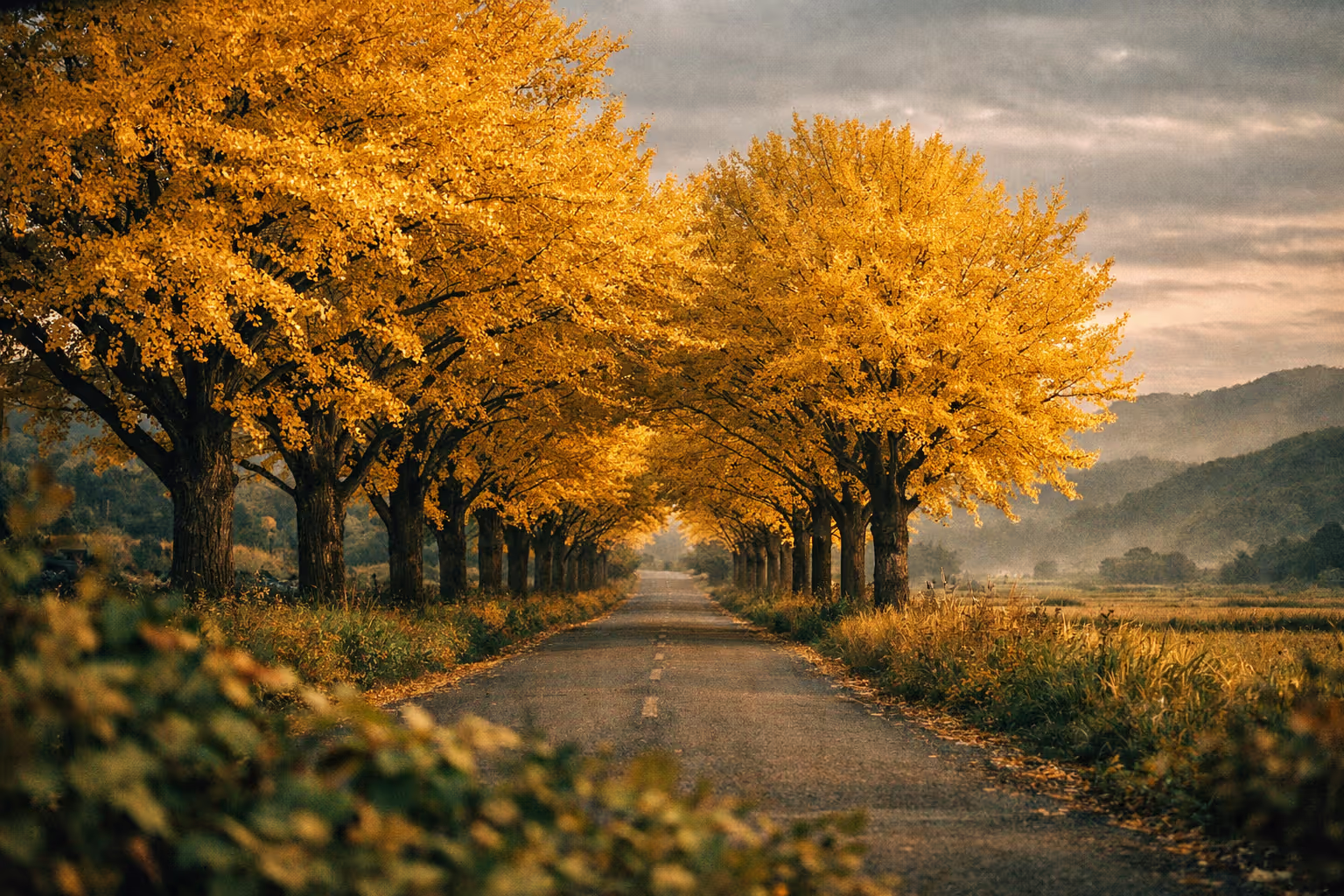
The site’s local name is 太原のイチョウ (Taibaru no Ichō), meaning the ginkgo grove of the Taibaru district in Hirokawa. It sits in the Kusumi area of the town, and during the mid-to-late November viewing period the ground turns into what local reporting calls a “golden carpet” of fallen leaves (3). Late November is also the tail of Kyushu’s autumn colour season, which runs later in the south than in Tokyo or Tohoku.
The scale is smaller than the “tunnel road” imagery online suggests. The Hirokawa tourism office describes roughly 60 trees on a plot of just over 3,500 m² (5), while local news reporting counted around 80 (4). The honest range is 60 to 80 trees on a compact private lot. These are not centenarian giants, and they are not part of a long roadside avenue. Do not believe any page that claims 140 old-growth trees: that figure travels with the mislabelled Wakayama version of this story, and no Japanese source supports it.
The Man Who Planted It
The grove exists because of one person. The land was originally a grape farm that Maruyama Motoun (丸山元運) ran with his wife. After she died, he replanted part of the farm with ginkgo. The couple had loved going to see autumn foliage together, and the trees were his way of keeping that. He has tended them for about 30 years, and they turn gold every November (4).
That is the whole story, and it does not need embellishing. A grape farm, a wife who loved autumn leaves, one man, thirty years of ginkgo. It was never a municipal beautification project. The land is his, and the yearly opening is a courtesy he extends, not a public service you are owed.
What the Site Actually Looks Like
Picture a dense, compact stand of ginkgo rather than a walkable corridor. On just over 3,500 m², the 60 to 80 trees stand close together, and the draw is that density combined with the leaf fall underneath. When both the canopy overhead and the carpet below are fully yellow, the effect is a 360-degree wash of gold (8). You are standing inside a small grove, not driving through a long tunnel.
Because it is private property opened by the owner’s goodwill, the expectation is simple: take your trash with you, keep to the marked areas, and treat the place as someone’s memorial to his wife, which is exactly what it is (7).
One etiquette note worth knowing before you arrive: photography of the grove itself is generally welcomed, but pointing your camera at other visitors without their consent is not - and given how compact the site is, you will be in close quarters with strangers the entire time. If you are unsure whether a shot includes someone who would rather not be photographed, ask or reframe. It is a small grove, not a public street.
The One-Week Access Window - Visiting Taibaru no Ichō
Taibaru no Ichō is private property, and the owner opens it to the public for approximately one week each year in late November. This is the single most important planning fact, and it is where most visitors go wrong. There is no year-round access, no public park, no road verge you can pull over on. Seven days, once a year (6).

For the 2025 season, the published dates were November 18 to 24, open 9:00 to 17:00 daily, with the parking lot open 8:45 to 17:30 (6). Treat 9:00 as your real arrival target. There is no verified basis for entering before the stated opening time, so ignore any advice about showing up at dawn to beat the crowds - the gate is closed until nine.
Off-site parking and a 9:00 gate both assume you arrive under your own steam. Hirokawa has no station of its own, and the nearest hub is Kurume, so most visitors drive the last stretch:

Car rental in Fukuoka (DiscoverCars)
Pick up in Fukuoka or at the airport; Hirokawa is roughly an hour south by road.
Compare rental carsOne caveat you cannot control: color timing depends on the weather. If the autumn cold arrives late, the trees may still be partly green during the opening week; if a cold snap hits early, the leaves may have already dropped before the gate opens. Neither outcome is predictable weeks in advance. The Hirokawa tourism association posts color status on its official Instagram, and that is the most current source before you travel.
For same-season confirmation of dates and conditions, call the Hirokawa Town Tourist Association (広川町観光協会) at 0943-32-5555 (1)(6). This is the office that organizes the opening and answers questions about parking and access.
How to Plan Around the Opening Week
How to Plan Your Visit to Taibaru no Ichō
About 1 hour of planningSteps to ensure your visit aligns with the limited access window and conditions.
- 1
Check the current year's dates
Visit the Hirokawa tourism association website (hirokankou.org) to confirm the exact opening week before booking.
- 2
Confirm color status
Check the association's official Instagram in the days before your visit to see if the ginkgo leaves are at peak color.
- 3
Use the official address for navigation
Enter 〒834-0112 福岡県広川町久泉1004 into your GPS or map app to reach the correct location.
- 4
Plan for off-site parking
Prepare to park at the temporary lots arranged by the tourism association; there is no on-site parking.
- 5
Arrive near the 9:00 opening
The site opens at 9:00; arriving then helps you avoid crowds and ensures access.
A same-day trip from Fukuoka City or Kurume is realistic given the Chikugo location. No overnight stay is required unless you prefer one.
Getting There - Verified Access Points
By car, the site is close to the Kyushu Expressway. Walker Plus notes it is roughly 5 minutes by car from the Hirokawa IC (広川IC) exit, with the recommended parking about 10 minutes from the same interchange (7). Note the spelling - this is Hirokawa IC, not Hiroshima.
Parking is handled as a temporary off-site lot system, open 8:45 to 17:30. There is no parking at the grove itself; Walker Plus points visitors to the Hirokawa baseball ground lot, though you should confirm the current year’s arrangement with the tourism association since it can change (7). Do not assume you can park at the site.
For navigation, use the official address: 〒834-0112 福岡県広川町久泉1004. Any GPS coordinates floating around English sites belong to the wrong location and should not be trusted - there are no verified coordinates to publish here. For public-transport options, the site sits in the Chikugo region near Kurume; because shuttle and bus arrangements vary by year, confirm current options directly with the tourism association before you commit.
Group buses need advance coordination. The tourism office publishes a separate group-bus notice each season, which means you cannot simply arrive with a coach and expect to park (2)(7). Arrange it ahead by phone.
Ginkgo in Fukuoka - Why Hirokawa Chose This Tree
The ginkgo has been Hirokawa’s official town tree since 1983, chosen through public consultation to mark the municipality’s 30th anniversary (7). That civic designation predates the Taibaru grove by roughly a decade, so the town’s relationship with the tree is institutional, not just tied to one private plot. When residents were asked to pick a symbol for their town, they landed on the ginkgo - and years later, a private landowner in that same town chose the same tree for a memorial planting.
Ginkgo (イチョウ, ichō) is one of Japan’s signature autumn trees, planted widely along city streets and around shrines and temples. It is associated with longevity and resilience, which is part of why it turns up so often as a civic and sacred symbol across the country. Several Japanese cities and prefectures use it the same way.
That broader pattern gives Taibaru no Ichō its context. The Fukuoka prefectural tourism body lists it among the prefecture’s notable autumn foliage sites (1). What makes this particular grove stand out is the access model: private land, one man’s planting, opened to strangers for a single week each year.
Photographing the Golden Carpet - Practical Notes for Visitors
The visual signature of Taibaru no Ichō is the combination of a colored canopy overhead and a thick layer of fallen leaves on the ground - the “golden carpet” that local reporting keeps returning to (3)(8). Both elements are present only for a brief window during the opening week, and that overlap is what makes the photographs recognizable.
Weather governs your odds. A warm autumn can leave the canopy still partly green during the opening days; a cold snap before the gate opens can mean a thick carpet below but bare branches above. Neither is guaranteed, which is why checking the association’s Instagram for current color status matters more than any camera setting.
A few practical notes:
- The site is compact - just over 3,500 m² - so wide-angle shots that capture both canopy and carpet are achievable without a long lens. You do not need heavy telephoto gear.
- Arrive near the 9:00 opening for softer morning light and before visitor density builds.
- Expect other people, especially on weekends. Seven days a year on a small plot concentrates the crowd; this is not a place for a solitary shot at noon on a Saturday.
For current visual documentation before you travel, the Hirokawa tourism association’s official Instagram is the best source - it shows the real state of the leaves, not last year’s postcard. If you want video of what the grove looks like in peak color, search the association’s own channels rather than relying on the mislabeled clips that attach “Wakayama” to Fukuoka footage.
Frequently Asked Questions
- Where is Yellow Spring Road in Japan?
- The real site is in Hirokawa-machi, Yame-gun, Fukuoka Prefecture, on Kyushu. The official address is 〒834-0112 福岡県広川町久泉1004. It is not in Wakayama.
- When can you visit Yellow Spring Road Japan?
- The grove opens about one week in late November each year, 9:00 to 17:00 daily. Check Hirokawa tourism association for current dates before planning.
- Is there an entrance fee?
- No entrance fee is documented. The owner opens the land as a courtesy; visitors should respect the site and carry out their trash.
- How many ginkgo trees are at Taibaru no Ichō?
- Approximately 60 to 80 trees on just over 3,500 m². They were planted about 30 years ago and are not centenarian.
- Why do so many websites say Yellow Spring Road is in Wakayama?
- The kanji 広川町 is identical in Fukuoka and Wakayama but read differently. English sites copied each other without verifying Japanese sources.
- What are the yellow paths in Japan?
- Several places have autumn ginkgo displays. Taibaru no Ichō is unique for private land opened one week yearly and the dense golden carpet effect.
- Can I visit with a group or tour bus?
- Group bus visits require prior coordination with Hirokawa tourism association. Do not arrive unannounced with a coach.
Before You Book Anything
The correction is the whole point: Hirokawa, Fukuoka - not Wakayama. Same kanji, different place, 450 km apart. Get that right and everything else follows.
The practical summary is short. Taibaru no Ichō opens for about one week in late November, 9:00 to 17:00, on private land, with no access outside that window. Parking is off-site, group buses need advance arrangement, and there is no documented entrance fee.
Your one action item before you plan travel: check the current year’s dates at hirokankou.org or call the Hirokawa Town Tourist Association at 0943-32-5555. Then, in the days before you go, check the association’s Instagram for color status - a warm autumn can leave the trees green during the opening week, and a cold snap can strip them early.
Once the dates are confirmed, the base to book is Kurume - the nearest city of any size, and close enough to be at the gate for opening:

Hotels near Hirokawa, in Kurume (Expedia)
Kurume puts you within about half an hour of Hirokawa, with a wider choice than the town itself.
Check prices on Expedia
Hotels near Hirokawa, in Kurume (Booking.com)
Worth comparing on the same dates: the opening week is short and rooms nearby go early.
Check prices on Booking.comTiming is everything here. Confirm the dates, confirm the color, use the official address. Everything else is secondary.