The Kumano Kodo’s most popular section with overseas visitors, the Nakahechi route from Takijiri to Hongu, runs about 38 km (24 miles) (2). Tanabe’s tourism bureau splits it into two walking days: about 16 km and around 6 hours from Takijiri to Chikatsuyu, then about 24.5 km and around 9 hours on to Hongu (14). That second day is long on steep, uneven ground, so a three- or four-day split leaves time for the oji shrines along the way. Below: how the routes fit together, how to split the walk across 2 to 4 days, and the booking order (lodges first, luggage second) that decides whether you go independent or buy a package.
✓ Pros
- Pilgrimage history is woven into the trail and its shrines.
- Several village stops make a multi-day walk possible without camping.
- Luggage services can let you hike with a daypack.
✗ Cons
- Small inns and shuttle services make advance planning part of the trek.
- Steep, wet steps and descents can make short distances tiring.
- Sparse services and transport options leave little room for an improvised change of plan.
What Is the Kumano Kodo? Routes, History and UNESCO Status
The Kumano Kodo is a network of pilgrimage trails across Japan’s Kii Peninsula, preserved since ancient times (2). Part of it belongs to the UNESCO World Heritage property “Sacred Sites and Pilgrimage Routes in the Kii Mountain Range” (2), inscribed on July 7, 2004 (16)(21). The property covers three sacred sites, Kumano Sanzan, Koyasan, and Yoshino and Omine, and the pilgrimage routes that link them to the ancient capitals of Nara and Kyoto (21).
The Kii Peninsula is Japan’s largest. It juts south from central Honshu into the Pacific, and most of its interior is steep, forested mountain (2).
UNESCO’s list of component parts names four Kumano routes: Nakahechi, Kohechi, Ohechi and Iseji (22). This guide focuses on Nakahechi because it fits a 2-to-4-day trip and has the best lodging and luggage infrastructure. For other multi-day treks across the country, see our guide to hiking in Japan.
From Imperial Pilgrims to Commoners
The first imperial pilgrimage to Kumano came in the 11th century, and between the 11th and 13th centuries the imperial family made the trip from Kyoto almost 100 times, with parties of up to 300 people lodging around Chikatsuyu (17). Over time the pilgrimage spread down the social ladder, and by the late 15th century commoners made up most of the pilgrims, in such numbers that the crowds were likened to “ant processions” (16).
The Nakahechi Course: Japan’s Classic Pilgrimage Route
The Nakahechi route is the Kumano Kodo’s main pilgrimage trail, running from Tanabe on the west coast east through mountain villages to Kumano Hongu Taisha. Its core walking section is the roughly 38 km (24 mi) stretch from Takijiri-oji to Hongu, and a Japanese government feature describes it as the most popular route among overseas visitors (2).
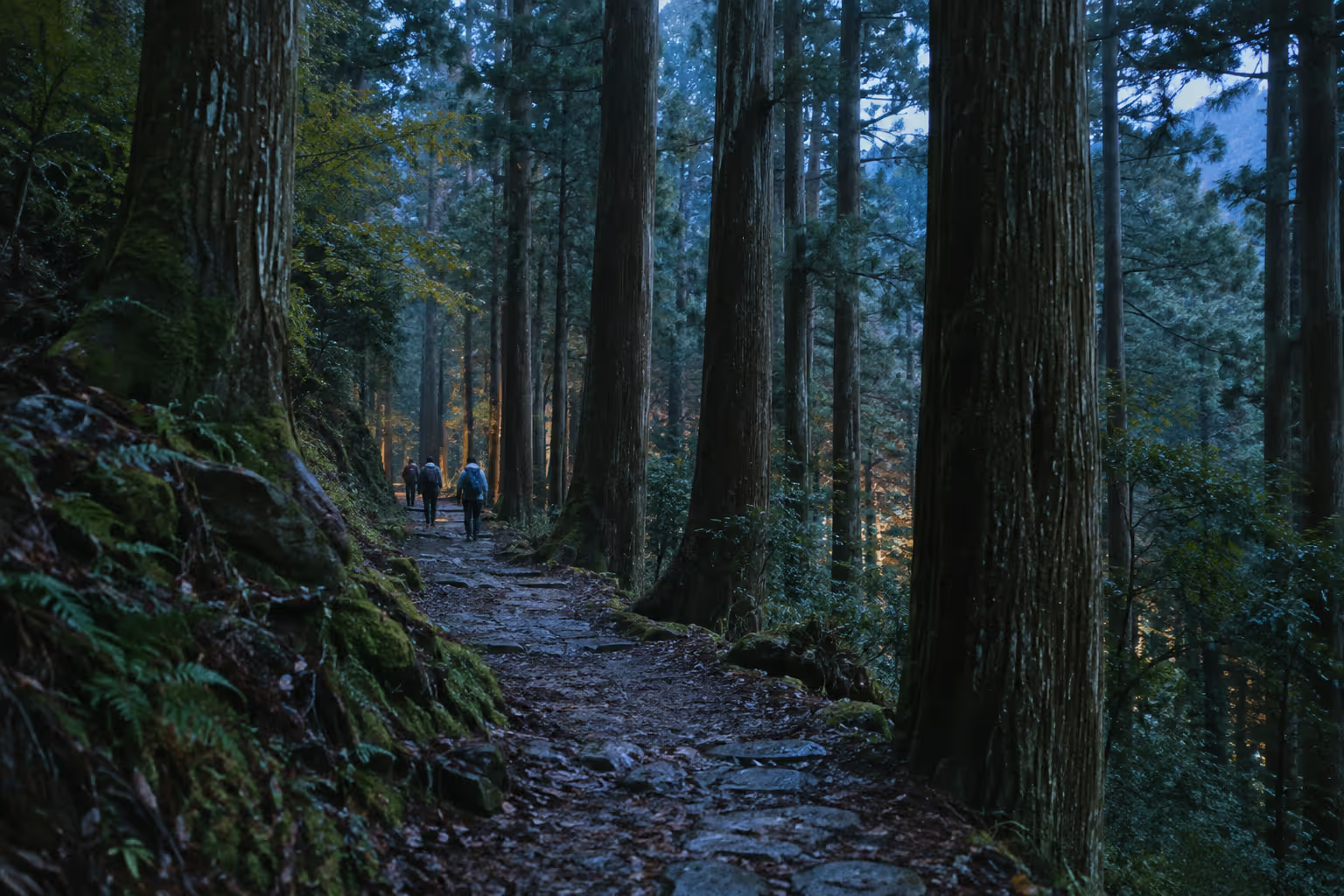
The Kumano Kodo Nakahechi trail starts at Takijiri-oji, which is about a 40-minute bus ride inland from Kii-Tanabe Station (1). From there it climbs into cedar and cypress forest, passes through the settlements of Takahara, Chikatsuyu and Nonaka, and ends at Hongu. Traditional inns in those villages are the only practical places to sleep.
Tanabe’s tourism bureau times the two halves at around 6 and 9 hours (14), under 3 km/h on the trail. Walking the whole section in one day would mean about 15 hours on foot.
Trail Surface: Forest Paths, Cobbles and Stairs
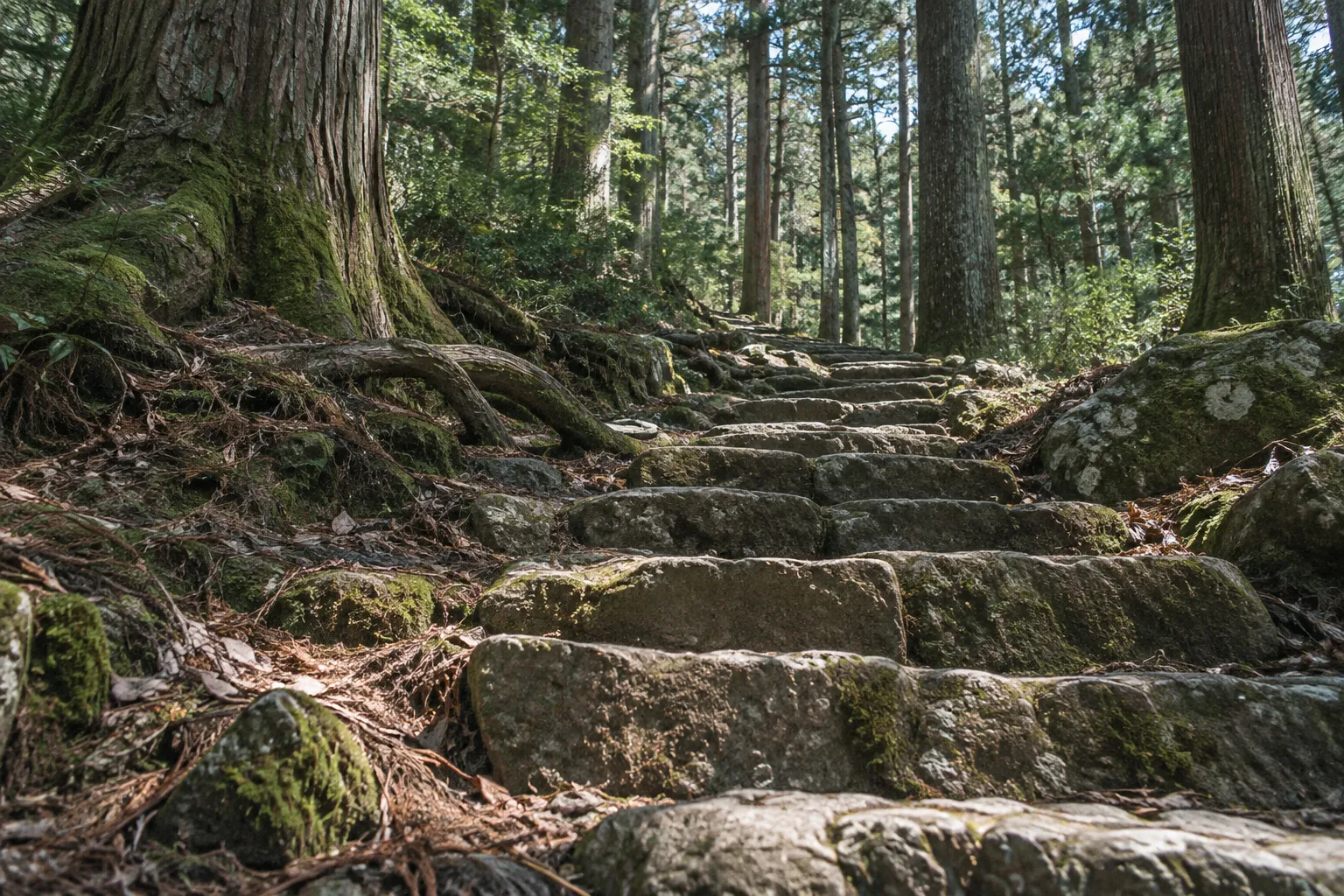
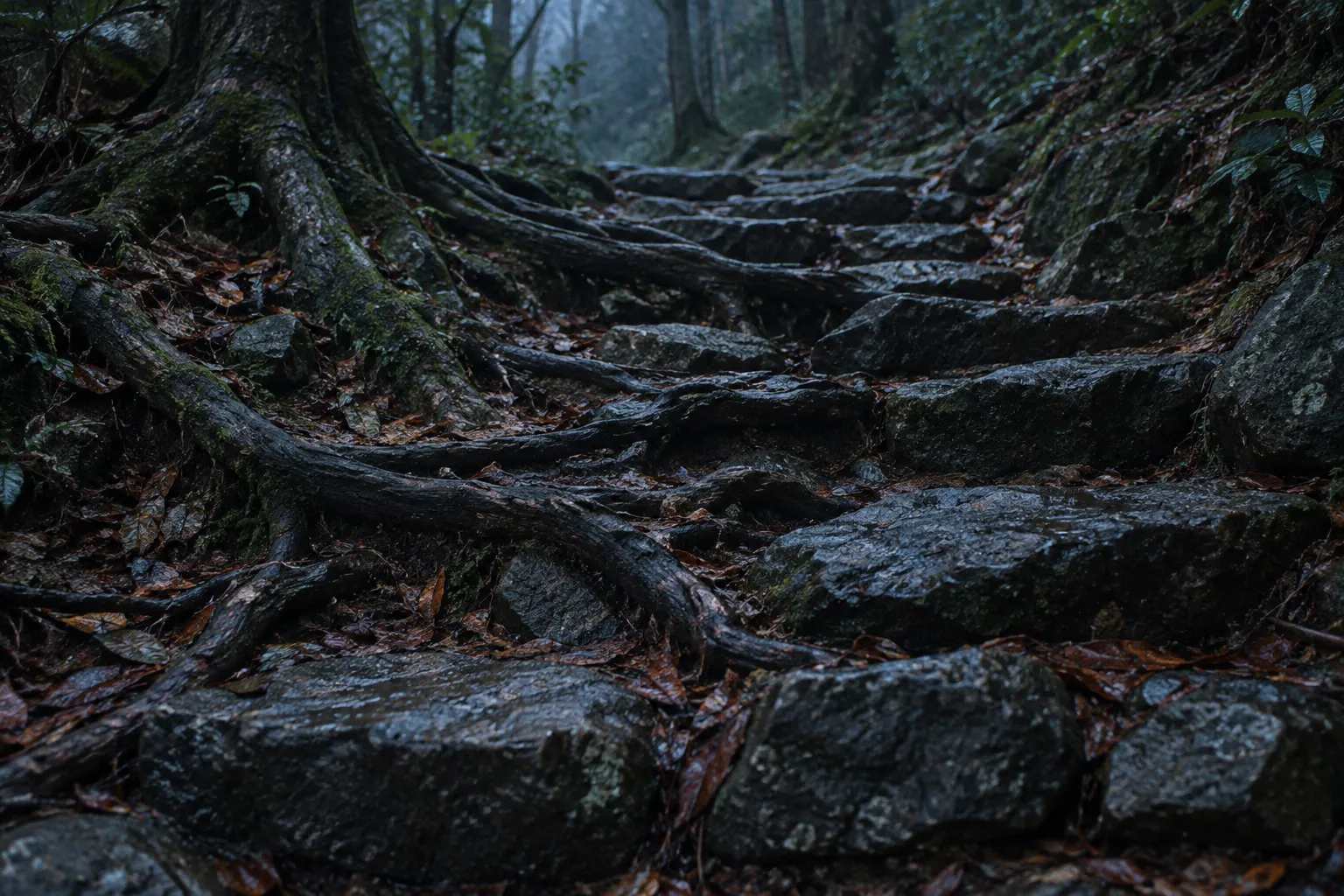
The Nakahechi surface changes constantly: dirt forest trail, worn stone steps, cobbled sections, tree roots and stretches of paved village road (15). The climbs are steep and the descents are often harder than the climbs, especially when the stones are wet. The Kumano tourism bureau warns that people often underestimate the difficulty of the walk because they do not anticipate the steep climbs (15), and that matches what you’ll feel by mid-afternoon on day one. “Easy to walk,” as some descriptions put it (2), means easy to navigate, not easy on your knees.
The Oji Shrines Along the Way
Oji are small subsidiary shrines along the route. The word means “prince,” and each is dedicated to the divine offspring of the Kumano Sanzan deities (2). They serve as places of both worship and rest (17). On Nakahechi you’ll pass Takijiri-oji at the trailhead and Tsugizakura-oji past Chikatsuyu (1), then Hosshinmon-oji, the outermost entrance to Hongu’s sacred precinct, and Fushiogami-oji, where pilgrims got their first glimpse of Kumano Hongu Taisha (17).
Kohechi, Ohechi and Iseji: The Other Pilgrimage Routes
Besides Nakahechi, the Kumano network has three main routes: Kohechi through the mountains from Koyasan, Ohechi along the southwest coast, and Iseji along the eastern coast from Ise. Each suits a different kind of trip, and none is the obvious first choice for 2 to 4 days.
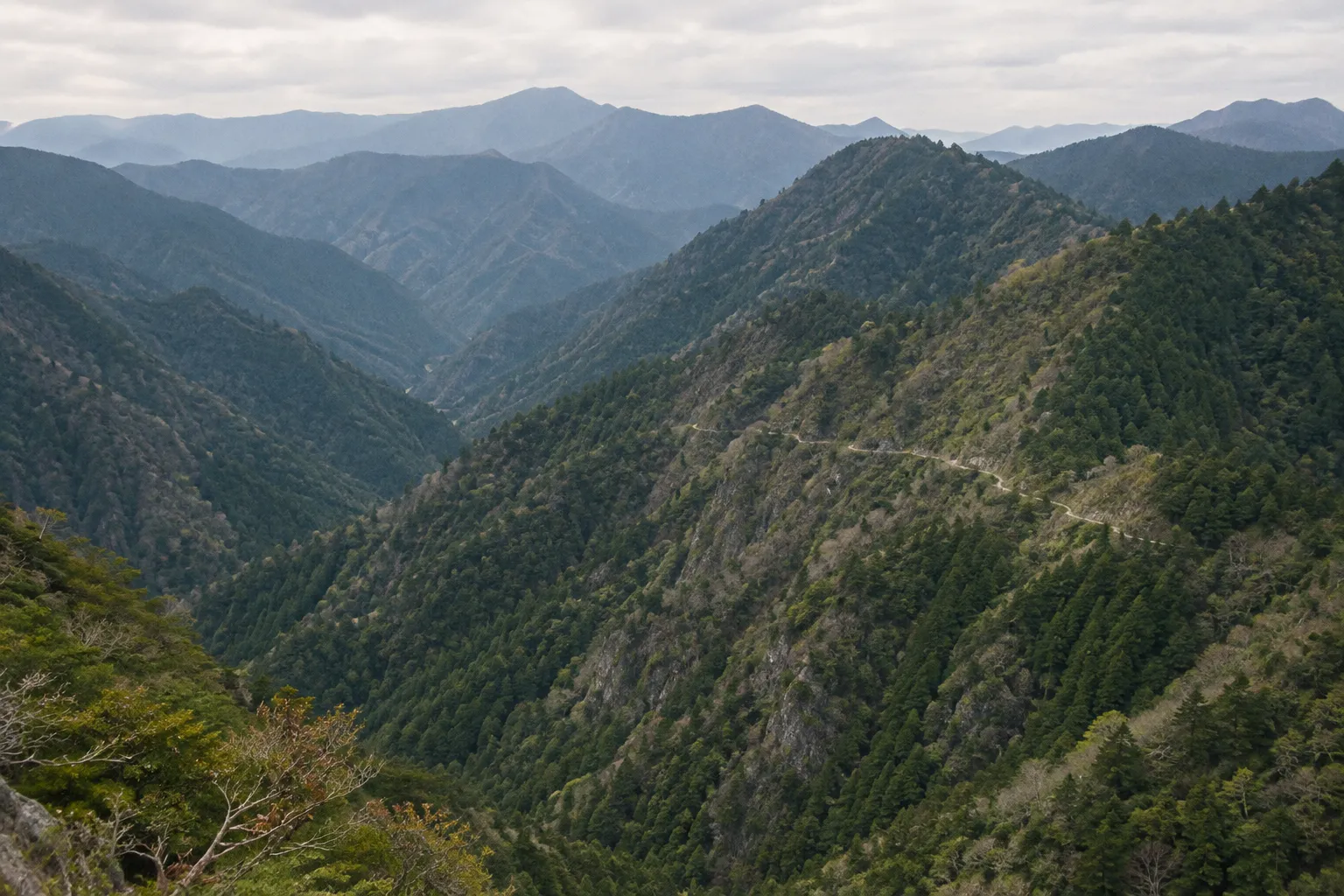
Kohechi links Koyasan, the Buddhist monastery complex, directly with Kumano Hongu Taisha. It runs more than 65 km (40 mi) over high passes above 1,000 m (3,280 ft), walked in about four days (18). The northern sections are isolated, with limited transport and facilities, and the route is technically closed from mid-December to mid-March because the passes can be snowbound, except Hatenashi-toge in the south (18). The bureau requires reservations in every village on the route (18), and a landslide detour has been in place on the north side of Obako-toge pass since May 2, 2023 (15).
Ohechi runs along the southwest coast through small villages, from Tokei-jinja in Tanabe to Fudarakusan-ji temple in Nachi; away from the train line, public transport is limited and some sections only have Japanese signs (23). The section between Wabuka and Tako stations is closed from June 8, 2026 to April 30, 2027 (estimated) for expressway construction, and the official advice is to bypass it by train or bus (15).
Iseji connects Ise Jingu, the Ise Grand Shrine, with the Kumano Sanzan along the Kii Peninsula’s eastern coast, about 170 km in all. Walking the full length takes one to two weeks, but many trailheads sit near train stations, so its cobblestone passes, fishing villages and the Maruyama Senmaida rice terraces also work as day hikes (19).
If you have 2-4 days and this is your first time, Nakahechi wins on access, signage and the luggage shuttles covered below.
Kumano Kodo routes at a glance
| Nakahechi | Kohechi | Ohechi | Iseji | |
|---|---|---|---|---|
| Length or span | About 38 km (Takijiri to Hongu) | More than 65 km | Tanabe to Nachi along the southwest coast | About 170 km |
| Route character | Mountain villages, forest paths and shrine stops | Mountain route over high passes above 1,000 m | Coastal villages, limited transport away from the railway | Cobblestone passes, fishing villages, beaches and rice terraces |
| Time noted in the guide | Two to four days for the core section | About four days | Shorter recommended courses | One to two weeks for the full length |
| Access or closure note | Main route in this guide; lodging and luggage services are described | Isolated north; closed mid-December to mid-March except Hatenashi-toge | Wabuka-Tako section closed until April 30, 2027 (estimated) | Many trailheads near train stations |
The Kumano Sanzan: Three Grand Shrines and Two Temples
The Kumano Sanzan are the three grand shrines at the heart of the pilgrimage: Kumano Hongu Taisha, Kumano Hayatama Taisha and Kumano Nachi Taisha. Two Buddhist temples, Seiganto-ji and Fudarakusan-ji, are closely tied to them (16).
- Kumano Hongu Taisha sits inland in Hongu, at the end of the Nakahechi trail. It originally stood on Oyunohara, a sandbank at the river confluence below, until a flood in 1889 destroyed it and the shrine was rebuilt on higher ground (17). Oyunohara is now marked by a huge torii (shrine gate) (1).
- Kumano Hayatama Taisha stands in Shingu, at the mouth of the Kumano River on the east coast.
- Kumano Nachi Taisha stands halfway up Nachi Mountain, about 350 m above sea level, and has its origin in the worship of Nachi Falls (24).
- Seiganto-ji, a Tendai Buddhist temple, is closely tied to Nachi Taisha (24).
- Fudarakusan-ji is about 6 km downstream from the falls near the coast (24), and marks the end of the Ohechi route (23).
A Shinto shrine and Buddhist temples bound together at Nachi are the clearest sign of what makes Kumano distinct. The region’s nature worship (mountains, waterfalls, rivers and rocks as sacred) gradually blended with Buddhism, and the three Kumano deities became a mixture of Shinto and Buddhism (16).
Etiquette at the shrines: bow once before passing under the torii, and rinse your hands and mouth at the water basin (temizuya) before approaching the main hall. Avoid walking in the dead center of the approach, which is traditionally reserved for the deity, and watch for signs forbidding photography inside temples (25).
Building a 2-to-4-Day Walking Itinerary
The best Kumano Kodo itinerary for most first-timers splits the 38 km (24 mi) Takijiri-to-Hongu section into two to four days, matched to your walking pace and to where lodges have free beds.
A Japanese government feature suggests the walk is best enjoyed over two or three days at a leisurely pace (2). Tanabe’s tourism bureau also lists 4-day sample itineraries for the same section (14). The deciding factors are your fitness, how much daylight you have, and whether you can get a bed in the village where you want to stop.
Sample 2-Day, 3-Day and 4-Day Splits
2 days: Takijiri to Chikatsuyu on day one (about 16 km / 10 mi, around 6 hours), then Chikatsuyu to Hongu on day two (about 24.5 km / 15 mi, around 9 hours) (14). The second day is the longer one by a wide margin and suits only strong hikers with an early start. Buses stop at Chikatsuyu-oji, so you can also walk just one of the two days (14). Coming from Osaka or Kyoto, stay the night before in Tanabe, or make Takahara your first stop: even the earliest train and bus leave too little time to reach Chikatsuyu or Nonaka the same day (14).
3 days: Takijiri to Chikatsuyu, then Chikatsuyu to the Nonaka area, then on to Hongu. This spreads the long half of the route over two days and leaves time at the oji shrines.
4 days: A short first afternoon from Takijiri to Takahara, a ridgeline settlement with panoramic views of the Hatenashi mountains (1). Then Takahara to Chikatsuyu, Chikatsuyu to Nonaka, and Nonaka to Hongu. The 5-day package sold through Kumano Travel lists overnight stays in Tanabe, Chikatsuyu, one of the Hongu-area hot spring villages (Yunomine, Kawayu or Watarase Onsen) depending on availability, and Katsuura (1).
Whatever split you pick, add a day at the end for Shingu and Nachi if you want to see all three grand shrines. The packaged version includes a river boat trip toward Shingu, which fills up quickly (1). From September 19 to December 10, 2026, Tanabe City also runs one extra Kumano Kodo Express Bus a day between Kii-Tanabe Station and Hosshinmon-oji, plus an Onsen Extra Bus from Yunomine Onsen to Hosshinmon-oji (20).
Why Stages Aren’t Equal in Difficulty
Two stages of the same length can feel completely different on the Kumano Kodo Nakahechi trail. Steep ascents, slippery roots and wet cobblestones make your pace less predictable than distance suggests, so plan by hours, not kilometers. The climb out of Takijiri to Takahara is short but steep, and it hits before your legs have warmed up (1). Use the bureau’s timing for that opening stage, about 16 km in around 6 hours (14), as your planning number, not the 4-5 km/h you’d manage on a city street.
Booking Lodges Along the Trail
Book lodging first and well ahead: meals and luggage transfer both depend on it.
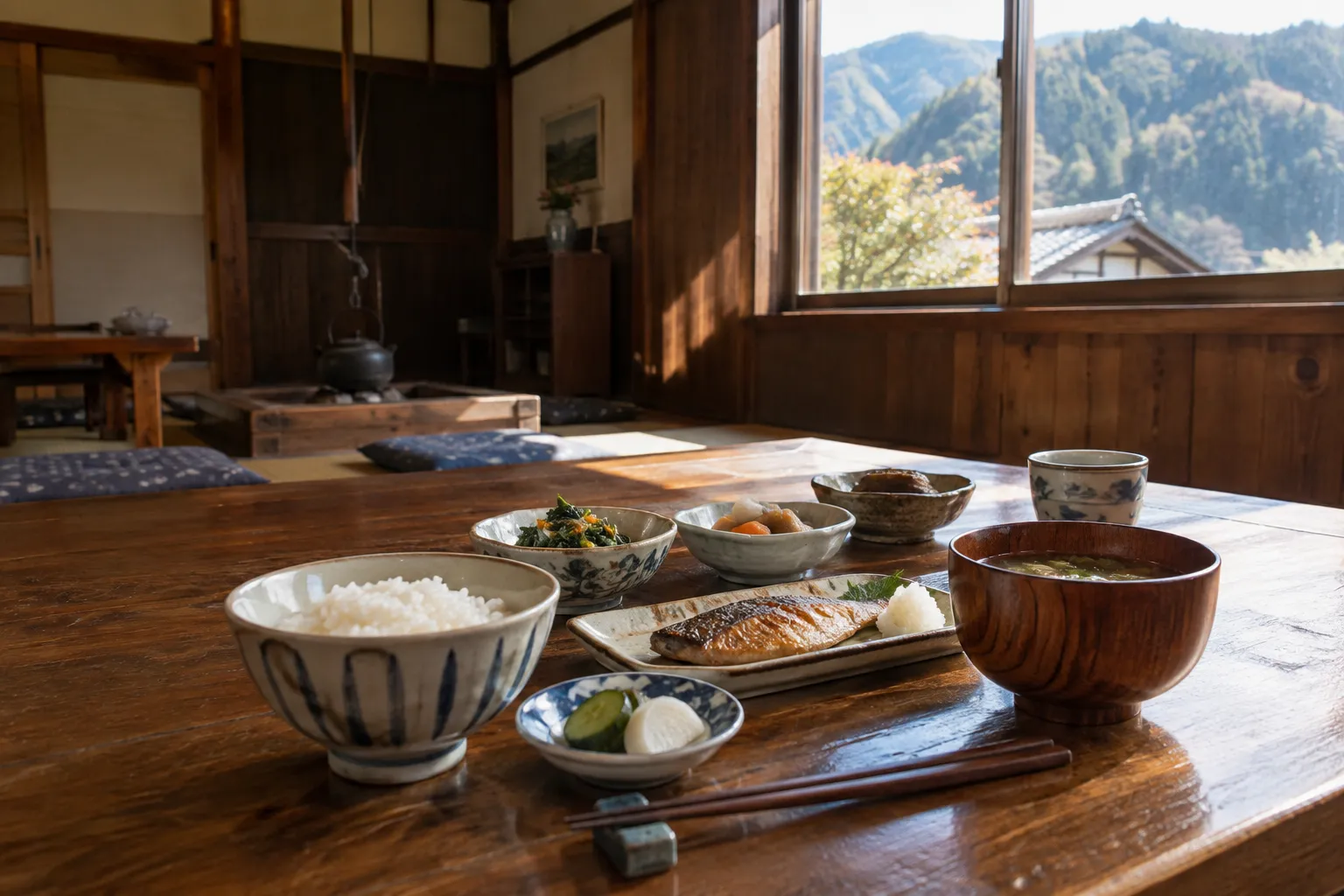
Many inns are small, family-owned places (9), and beds are limited in the smaller settlements, especially in the popular spring and autumn seasons (15). Some inns may be full, may not have food prepared, or may even be closed on a date with no reservations, and with few evening buses it is hard to get back to the coast if you have nowhere to stay (15).
Kumano Travel, the booking platform run by the local tourism bureau, is the main gateway. Its process has two parts: you send a reservation request for your inns and services, the team processes it and emails you the results, and you then confirm by paying with a credit card within 48 hours of receiving the “Processed Reservation” email (9). You’ll need a MyPage account to start (9). Processing takes about three days to a week, and up to a month in peak seasons (9), and since February 27, 2026 new reservation requests are only accepted daily from 7:00 to 9:30 and 19:00 to 22:00 Japan time (20). Build that delay into your planning.
How Luggage Shuttle Services Work on Nakahechi
A Kumano Kodo luggage transfer picks up your bag at one inn and delivers it to your next accommodation the same day (7), so you walk with a daypack instead of your full pack. Several providers operate on Nakahechi, each with its own service area, and booking rules are strict.
Kumano Travel lists several luggage shuttle providers for the route (8). Three of them:
- Kumano Kodo Shuttle Service has the widest coverage, including Central Tanabe, Takijiri, Takahara, Chikatsuyu, Nonaka, Fushiogami, Hongu, the three Hongu onsen villages, Nachisan, Central Katsuura, Shirahama Onsen and Koyasan (8). It attaches a wooden tag to each bag with destination details in Japanese; do not remove the tag (8). Pick-up times vary by plan (8).
- Kumano Luggage Express covers the Tanabe to Nachi-Katsuura area, including Takijiri, Takahara, Chikatsuyu, Nonaka, Fushiogami, Hongu and the onsen villages, and handles up to six pieces of luggage (7).
- Shuttle Service Kumo is based in Nonaka and covers a similar Nakahechi footprint, including Kamitonda and Ukegawa (11).
The catch: the online luggage booking only works when every pickup and drop-off accommodation is reserved through Kumano Travel’s own system (8)(11). If you booked an inn elsewhere, Kumano Travel will not take a shuttle-only booking; its FAQ points you to a next-day courier such as Yamato, or to a provider contacted directly, with the inns told in advance (9). Shuttle bookings must also be made at least 20 days in advance (7)(11).
Same-day delivery makes short stages workable, but coverage isn’t universal. Confirm that each inn on your list falls inside the provider’s area before you commit, and recheck the provider’s terms close to departure.
Book a Nakahechi luggage shuttle
Arrange your stages and inns first, then book a shuttle that serves every accommodation on your route.
- 1
Fix your walking stages
Choose your daily stops before booking so you know which inns need luggage pickup and delivery.
- 2
Reserve every night through Kumano Travel
Use the platform's reservation system for all accommodations involved in the shuttle booking.
- 3
Check each inn against the service area
Confirm that your chosen provider serves every pickup and drop-off accommodation.
- 4
Book the shuttle in advance
Several providers require a booking at least 20 days before your first walking day.
- 5
Reconfirm the details before departure
Check the provider's service area and pickup times shortly before you leave.
Independent Trek or Packaged Tour: Costs Compared
A self-guided package on the Kumano Kodo bundles lodging, meals and luggage transfer into one booking, while independent planning gives you more control but depends on hitting the reservation system’s lead times.
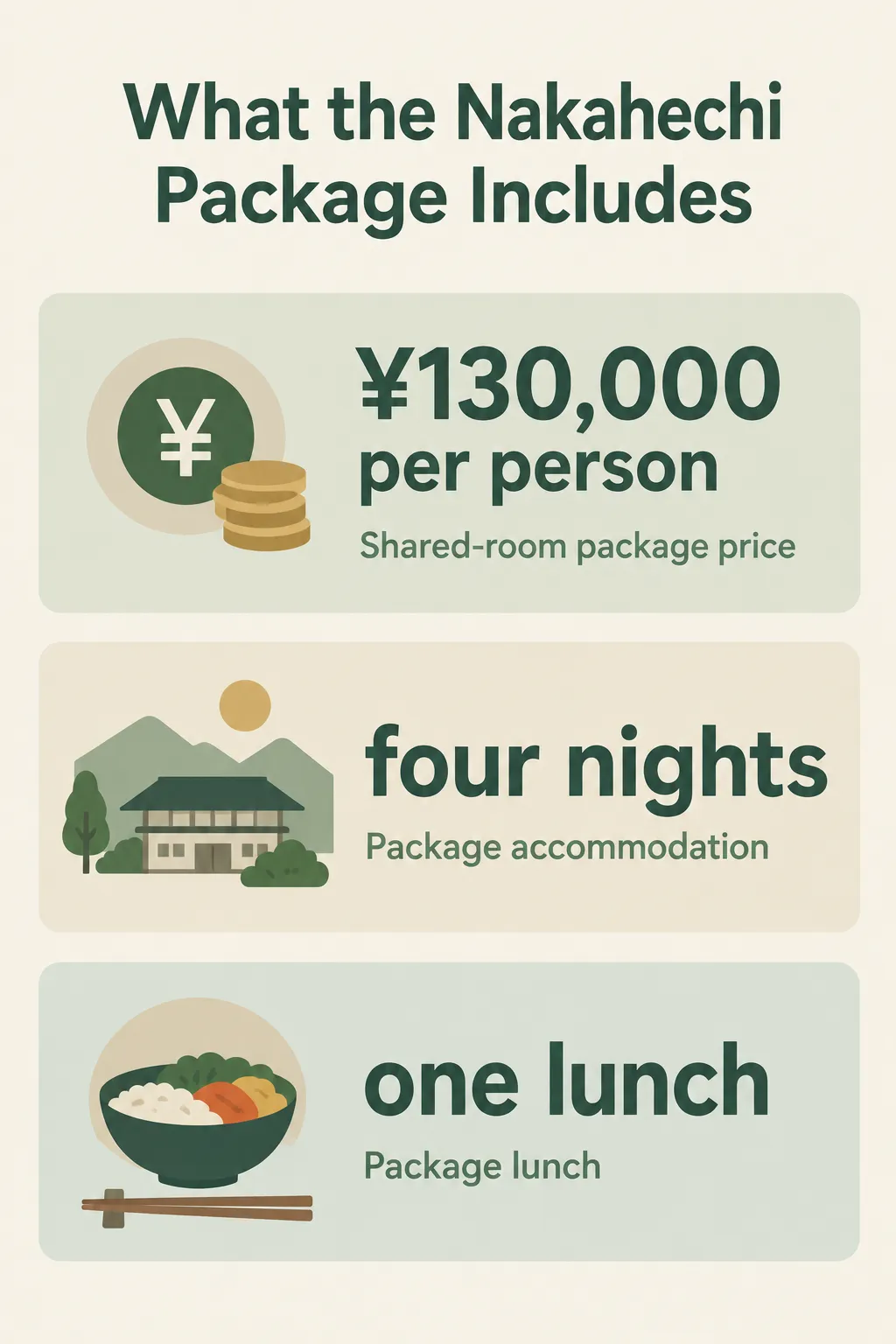 As of November 2026, Kumano Travel’s five-day, four-night Nakahechi package costs ¥130,000 per person for two people sharing a room, including four nights’ accommodation and one lunch.
What the Package Price Includes
The 5-day/4-night Nakahechi trek sold by Kumano Travel costs ¥130,000 per person for two people sharing a room, as listed on November 13, 2026 (1). That covers four nights’ accommodation, three suppers, three breakfasts, one lunch and daily luggage shuttles; buses and trains are not included (1). It walks Takijiri to Chikatsuyu and, after a bus, Hosshinmon-oji to Hongu, then adds a river boat toward Shingu and the Daimon-zaka climb to Nachi (1). It’s self-guided: you walk alone, but every bed and bag transfer is already arranged.
Inn rates, shuttle fees and bus fares vary by season and provider, so price each element on Kumano Travel for your exact dates.
Can You Walk It Without a Package?
Yes. You can walk the Nakahechi without a guide or a package: numbered signposts along many routes help you pinpoint your location (15). The bureau still recommends walking with a partner and telling someone your plans, and notes that booking everything through Kumano Travel registers your trek with the local authorities (15). Independent planning works when you:
- Book all lodging through Kumano Travel’s system, early enough to secure beds in the villages you want.
- Book luggage transfer at least 20 days ahead (7)(11).
- Handle bus and train connections to Takijiri and back from Hongu yourself.
- Have a fallback (a bus or taxi option) if a stage runs long.
It falls through when you book inns through mixed channels, leave it too late for the shuttle cutoff, or plan to find beds as you go. If you can’t commit to that lead time, the package is the safer buy. For weighing the same trade-off on organized trips elsewhere in Japan, see our guide to whether guided tours are worth it.
Safety, Water and Weather for Walkers
The main risks on the Nakahechi route are underestimating the terrain, running out of water and walking into heavy rain. All three are manageable with preparation.
Water: carry enough for the full day. Natural water sources along the trail have not been tested, so don’t drink from streams without treatment; small shops or vending machines are found in the villages and settlements (15).
Weather: heavy rain and wind, especially from typhoons, can cause flash flooding and landslides, and JR trains sometimes stop or run late during typhoons (15). Don’t walk through extreme weather. Check the forecast and ask your accommodation each morning before you set out (15), and know your bus options for skipping a section.
Gear: local safety advice is explicit. Practice with walking poles before the trip, wear broken-in shoes, carry a light source and know the escape routes or ways to shorten each day (15). Paper maps are available at the information centers (15).
Timing: aim to reach your lodging by about 17:00. The common dinner time is around 18:00, and arriving at 17:00 leaves time to bathe first (15). In late fall, winter and early spring nightfall comes early, and the bureau suggests leaving early to arrive between 15:00 and 17:00 (15).
Frequently Asked Questions
- How long does it take to walk the entire Kumano Kodo?
- It is a network of routes rather than one trail: Nakahechi from Takijiri to Hongu takes two to four days, the Kohechi about four, and the full Iseji one to two weeks.
- Why is the Kumano Kodo so expensive?
- The price reflects overnight logistics as much as trail access: village inns, meals and bag transport are harder to arrange independently than on a town-to-town walk.
- How much does it cost to hike the Kumano Kodo?
- Kumano Travel's 5-day Nakahechi package was listed at ¥130,000 per person for two sharing a room in November 2026, transport extra; independent travelers should price each inn, shuttle and transport leg for their dates.
- Can you walk the Kumano Kodo by yourself?
- Yes, independent walking is practical on Nakahechi thanks to numbered signposts, though the tourism bureau recommends a walking partner; secure your overnight stops and transport before setting out.
- Do I need a guide for the Nakahechi route?
- A guide is not required for most walkers in good weather, but carry a map and know how you will shorten a stage if conditions change.
- Can I book luggage transfer if I booked my inns elsewhere?
- Not through Kumano Travel, which requires every pickup and drop-off inn to be reserved on its system; the alternatives are a next-day courier such as Yamato or a shuttle provider contacted directly.
- What are the Kumano Sanzan shrines?
- The Kumano Sanzan are Hongu, Hayatama and Nachi; visiting all three requires adding onward travel beyond the Nakahechi trail's finish at Hongu.
Locking In Your Dates
Treat the 38 km Takijiri-to-Hongu section as a two-to-four-day walk paced to your legs, not a distance to squeeze into as few days as possible. Then work the booking in order: lodges through Kumano Travel first, luggage shuttle at least 20 days out, transport last. If you can’t make those deadlines, buy the package. Before you pay for anything, check the bureau’s current detours and closures (including the Ohechi section, estimated to reopen April 30, 2027) and the provider’s service area for every inn on your list.