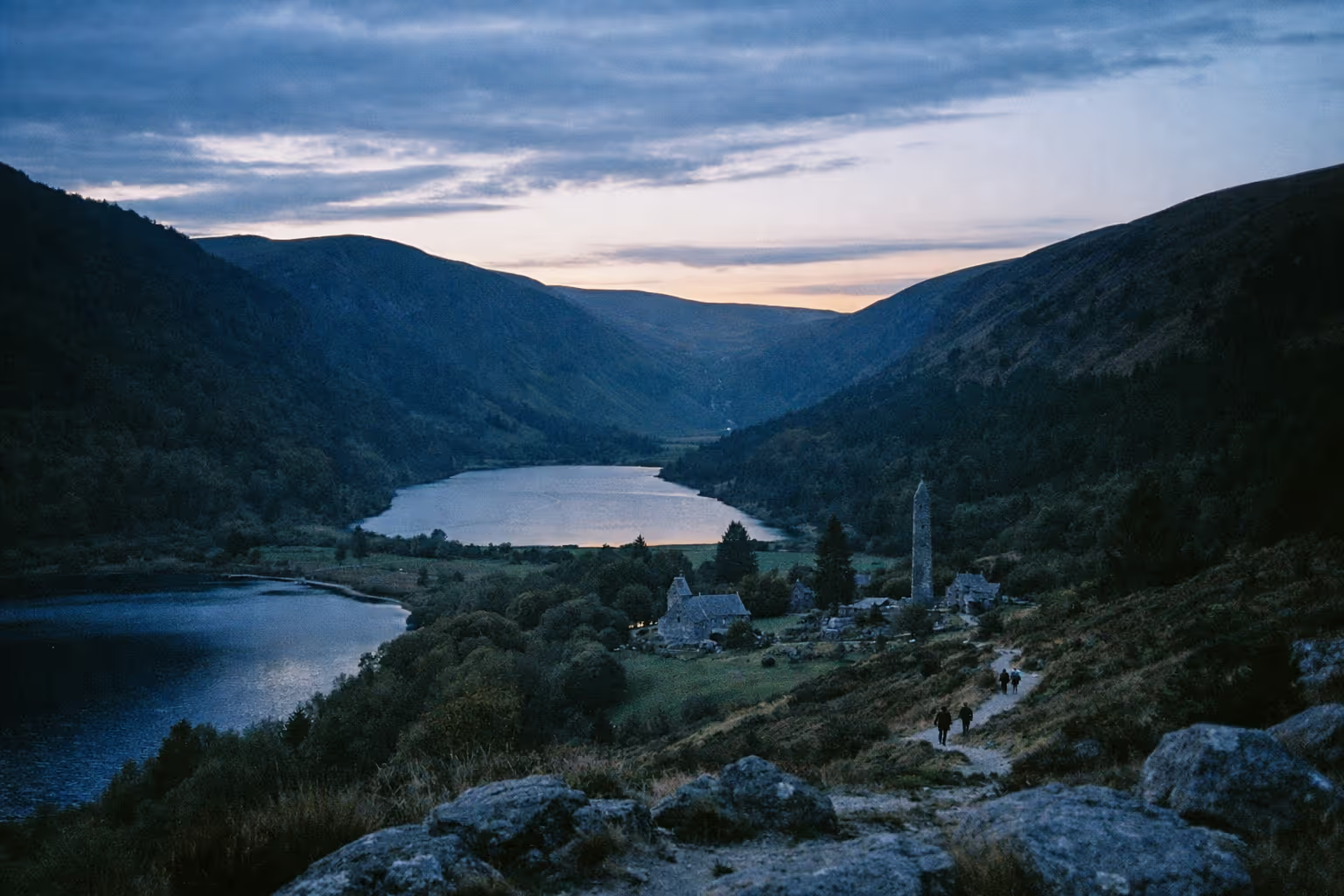
Glendalough - “Gleann Dá Loch,” or the valley of the two lakes - is a stunning glaciated valley located about 48 to 51 km southwest of Dublin in County Wicklow. This iconic Irish destination, Glendalough, features a 6th-century round tower framed by a valley shaped during the last Ice Age. It offers two distinct experiences in one place: a major early Christian monastic site and a trailhead for the Wicklow Mountains National Park. That split personality is exactly why so many visitors get their day wrong.
Most people underestimate either how much time they need or the range of what’s on offer. They rush through the ruins to squeeze in the Spinc ridge hike, or they arrive by bus only to find they have 3.5 hours to cover what realistically takes longer. This guide breaks down transport options, the monastic site, trails by fitness level, and the logistics that decide whether your day works or falls apart.
✓ Pros
- Free access to both the monastic ruins and all valley trails
- A doable day trip from Dublin by car, bus, or guided tour
- Trails range from a flat 3 km lakeside loop to a strenuous 11 km ridge circuit
- One of Ireland's most important early Christian sites, with standing structures from the 10th to 12th centuries
- Genuine mountain scenery inside a national park, without a long drive
✗ Cons
- One of Ireland's busiest heritage and nature sites; coach crowds arrive mid-morning and don't thin out until late afternoon
- Bus day trippers get roughly 3.5 hours on site - not enough for both the ruins and a long hike
- Parking is confusing and has changed repeatedly; arriving at the wrong lot wastes time
- Wicklow weather changes fast; the Spinc becomes hazardous in rain or low cloud
- The Visitor Centre exhibition requires a paid ticket, which some visitors assume is included with the ruins (it isn't)
What Glendalough Is and Why It’s Worth a Full Day
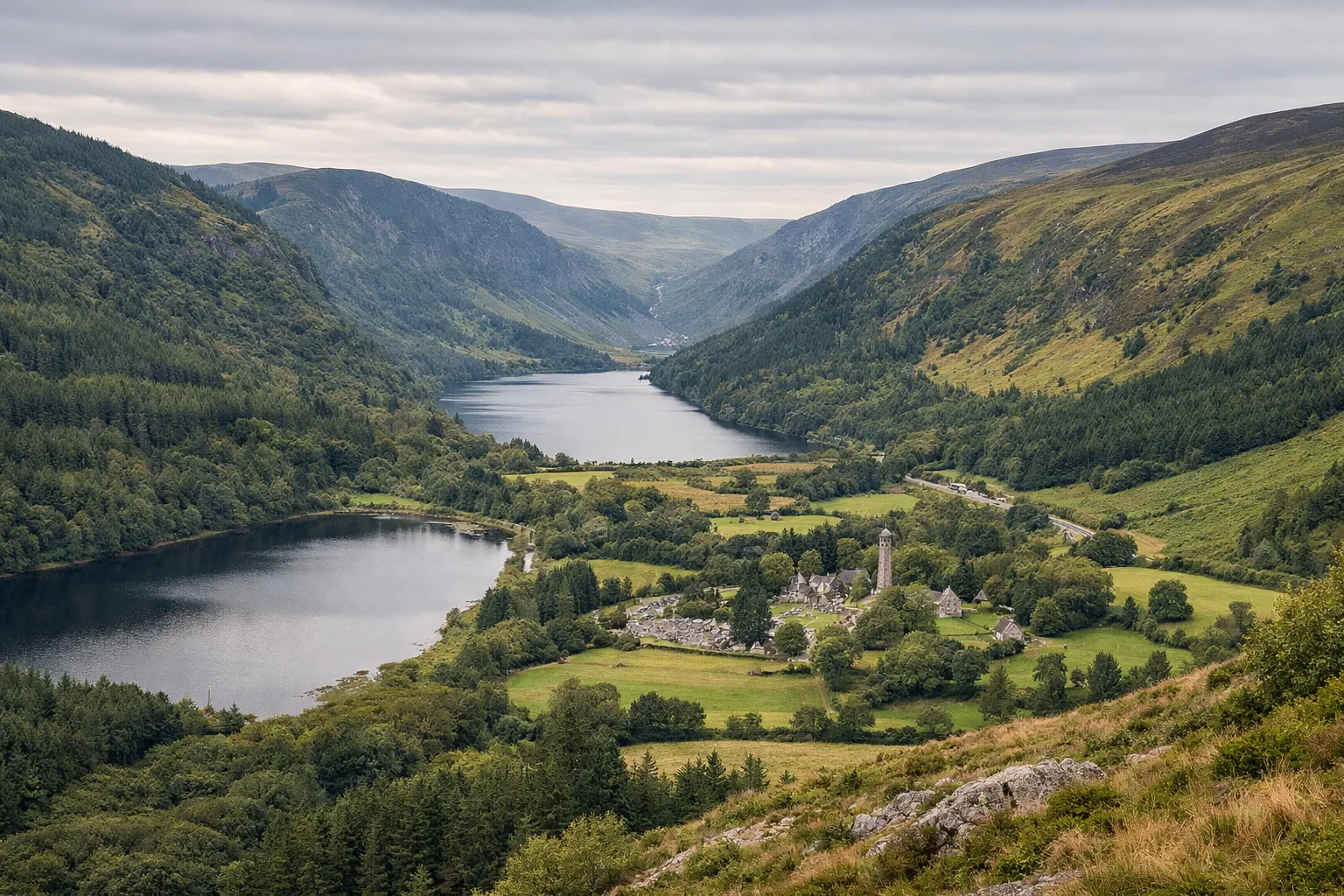
Glendalough is a glaciated valley in County Wicklow holding two lakes - the Lower and Upper Lake - with the ruins of a major early Christian monastic city on the valley floor and a network of mountain trails climbing the slopes above. The name means “valley of the two lakes,” and in practice that means two bodies of water separated by a short stretch of valley floor, with wooded lower slopes and open mountain above.
The valley is one of six within Wicklow Mountains National Park, which covers roughly 20,000 hectares of uplands in County Wicklow. The monastic settlement was founded in the 6th century by St Kevin and grew into one of Ireland’s most significant monastic cities, though most surviving stone buildings date from the 10th to 12th centuries (1). Those ruins sit right beside the trail network, which is what makes the place unusual - and what trips people up.
Here’s the core issue: there are two distinct draws, each demanding its own time budget. The monastic ruins are about history and slow walking - plan on one to two hours. The trails are about physical effort and duration - anything from 90 minutes for a flat valley floor loop to five hours for the Spinc ridge. Add the drive from Dublin (around 45 to 60 minutes each way) and you’re looking at a full day, not a half-day add-on.
Visitor volume shapes everything. According to Ireland’s National Parks and Wildlife Service, Glendalough is the single most visited site in the park, monitored by 11 automated pedestrian counters tracking visitor pressure. This is not a quiet valley on a summer weekend. When you arrive - and where you park - matters more here than at almost any other site in Ireland.
Getting to Glendalough from Dublin: Car, Bus, and Guided Tour
You have three main ways to get to Glendalough from Dublin: self-drive, the St Kevin’s Bus Service, or a guided day tour. Each suits a different visitor profile, and the differences are enough to shape your entire itinerary.
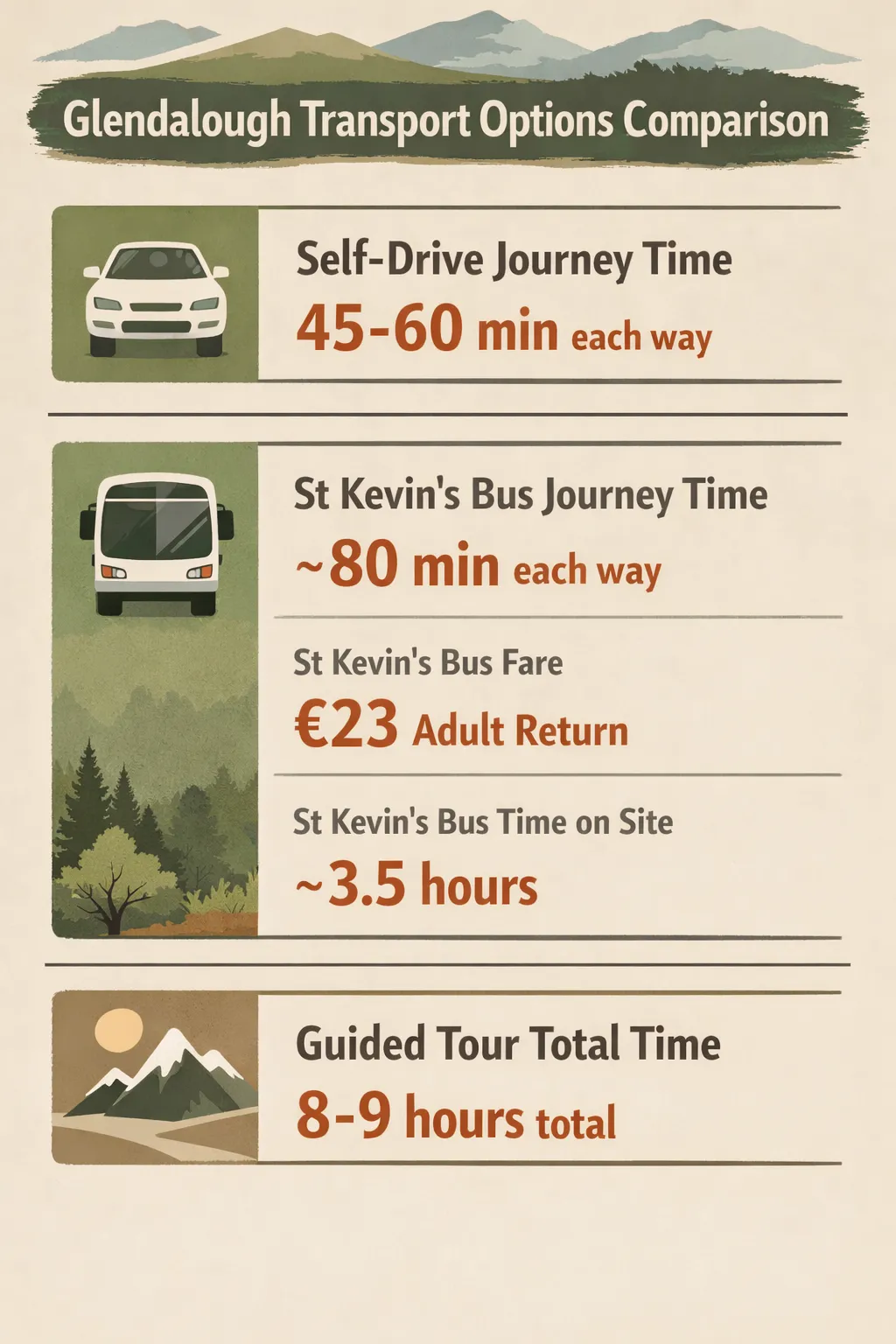 From Dublin, self-drive: 45-60 min each way; St Kevin’s Bus: about 80 min each way with €23 adult return; Guided Tour: 8-9 hours total; Parking €4 per day.
Self-drive offers the most flexibility. The route takes the M50, then M11/N11, turning off at Kilmacanogue onto the R755 through Roundwood and Laragh. The distance is about 48 to 51 km, typically 45 to 60 minutes depending on traffic. The advantage is control: arrive before the coaches, stay after they leave, and even detour to spots like Sally Gap or Lough Tay on the same day. If you have a car, use it.
The St Kevin’s Bus Service departs daily at 11:00 from St Stephen’s Green North, with a journey time of about 80 minutes each way and an adult return fare of €23. That schedule leaves you roughly 3.5 hours on site - enough for the ruins and a valley-floor loop, but not the Spinc. Book online in advance during high season; capacity is limited.
Guided day tours from operators like Paddywagon Tours run 8 to 9 hours door to door, usually combining Glendalough with the Wicklow Gap or Sally Gap and a coastal town like Bray. They allot about 3 to 3.5 hours at Glendalough itself. This option suits visitors who want narration and logistics handled but accept limited on-site time similar to the bus.
Quick comparison:
- Self-drive: 45-60 min each way; fuel and €4/day parking; up to a full day on site; maximum flexibility; best for hikers and early starters.
- St Kevin’s Bus: about 80 min each way; €23 adult return; about 3.5 hours on site; fixed schedule; best for budget travelers doing the ruins plus a short walk.
- Guided tour: 8-9 hours total; higher cost, logistics handled; about 3-3.5 hours at Glendalough; low flexibility; best for those wanting narration and multiple Wicklow stops.
Parking at Glendalough: Lower Lake vs. Upper Lake
There are two main car parks, and arriving at the wrong one for your plan adds 10 to 20 minutes of unnecessary walking. The Lower Lake car park sits beside the Visitor Centre and is a two-minute walk from the monastic ruins; the Office of Public Works charges €4 per day here, collected by barrier or pay-and-display. The Upper Lake car park is closer to the Spinc trailhead and is managed separately by the local authority, with fees and arrangements that have changed repeatedly into 2026 - check signage when you arrive.
Rule of thumb: if your day starts with the ruins, park at Lower Lake. If you head straight for the Spinc, park at Upper Lake. The Upper Lake is about a 20-minute walk from the Visitor Centre along the valley floor, so the difference is real.
Transport Options to Glendalough from Dublin
| Self-Drive | St Kevin's Bus Service | Guided Tour | |
|---|---|---|---|
| Journey Time | 45-60 min each way | about 80 min each way | 8-9 hours total |
| Cost (approx.) | Fuel + €4/day parking | €23 adult return | Higher cost, logistics handled |
| Time on Site | Up to full day | about 3.5 hours | about 3-3.5 hours |
| Flexibility | Maximum | Fixed schedule | Low |
| Best For | Hikers, early starters | Budget travelers, ruins + short walk | Narration, multiple stops |
Exploring the Glendalough Monastic City: What You’re Looking At and Why It Matters
Glendalough’s monastic city is a compact cluster of early medieval stone buildings - a round tower, a cathedral, several churches, a stone gateway, and high crosses - founded by St Kevin in the 6th century, with most standing structures dating from the 10th to 12th centuries. Everything fits within a few hundred metres, walkable in an hour, though giving it 90 minutes to two hours lets you actually make sense of the site rather than just ticking it off.
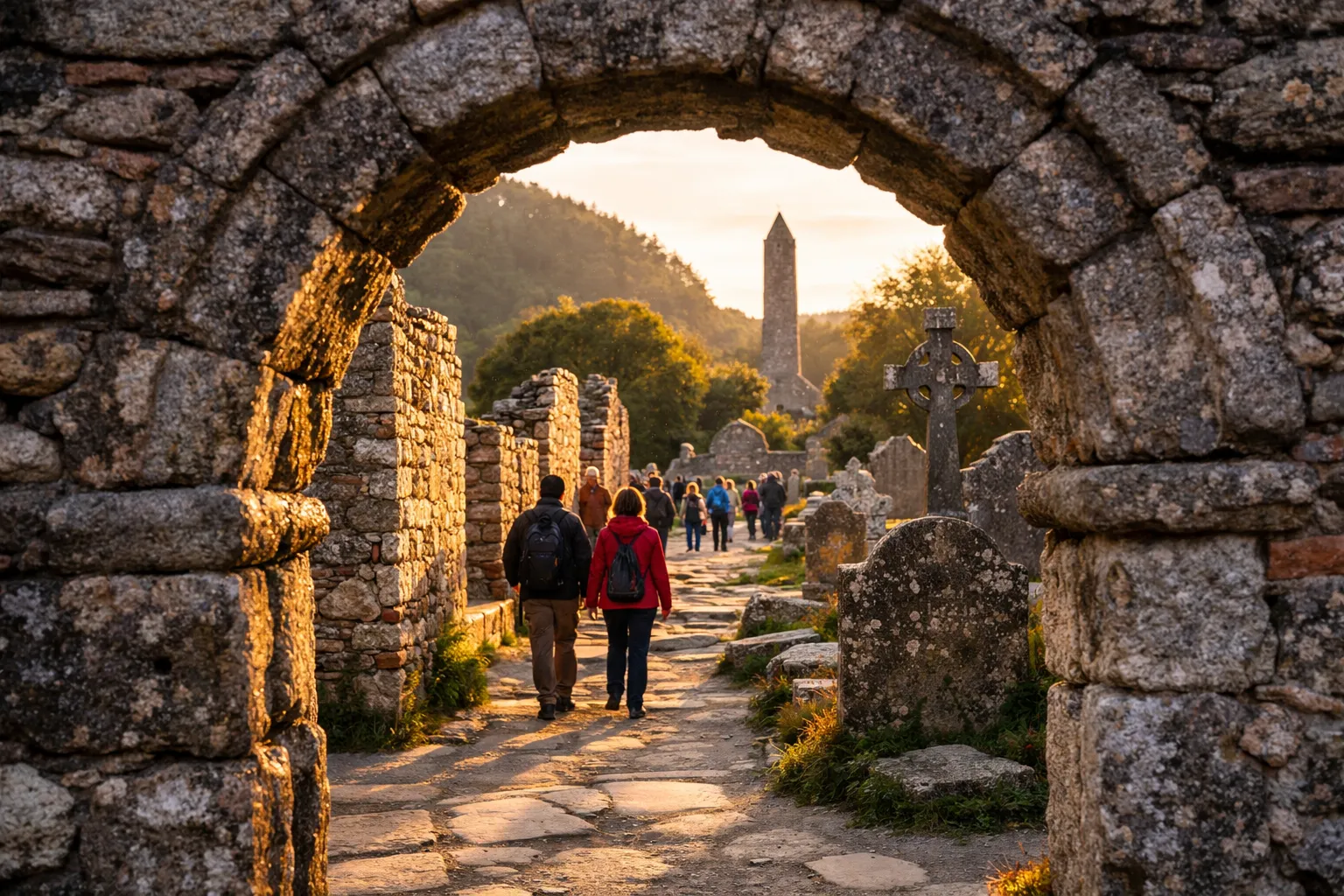
The Round Tower is the landmark. The Office of Public Works measures it at about 30 metres (nearly 100 feet) tall, built from local granite with a conical cap. Its door is set roughly 3.5 metres above ground level - it served as a bell tower, a landmark for arriving pilgrims, and a refuge. It’s the structure everyone photographs, which is exactly why you want to be standing there before the coaches arrive.
Other monuments to seek out: the cathedral ruins (the largest building on site), St Kevin’s Church - nicknamed “Kevin’s Kitchen” for its belfry that looks like a chimney - the medieval stone gateway, and scattered high crosses and inscribed grave slabs. Then there’s St Kevin’s Bed, a cliff cave above the Upper Lake. It’s not a casual walk-in; better to view it with a zoom lens from the lakeside paths rather than trying to reach it.
The history didn’t end quietly. OPW records show the monastery was plundered by English forces in 1214 and again in 1398, after which it declined; substantial conservation work began in 1878 to stabilise the cathedral walls and other structures.
The Visitor Centre: What the Ticket Gets You
The monastic ruins and all valley trails are free, but the Visitor Centre exhibition requires a ticket: €5 for adults, €3 for children/students, and €13 for a family (2 adults plus 2-3 children) (1). The ticket grants an audiovisual presentation and interpretive displays, with OPW suggesting 45 to 60 minutes for the visit.
Is it worth it? If you care about history, yes - watching the film and reading the displays before walking the ruins turns a pile of old stones into a legible settlement. If you’re mainly here to hike and short on time, you can skip it without missing the site itself, since the ruins are free and open.
St Kevin’s Story in Brief
Kevin arrived in the valley in the 6th century seeking hermit’s solitude. The legends explain the site layout you’re walking. He’s said to have lived first in the cave now called St Kevin’s Bed above the Upper Lake, drawing followers who settled the valley floor below. That’s why the earliest associations cluster around the Upper Lake while the later “city” of churches grew near the Lower Lake and the Round Tower. You don’t need the legends to enjoy the ruins, but they explain why the site sprawls as it does.
Glendalough’s 9 Waymarked Trails: Matched to Fitness and Time
Glendalough has nine official waymarked trails, ranging from short loops under a kilometre to the 11 km Spinc and Glenealo Valley route. They’re colour-coded and signposted from near the Upper Lake car park (5). Download or print the National Parks trail leaflet before you arrive - mobile coverage dips at trail junctions, and the colour codes on the map are how you navigate.
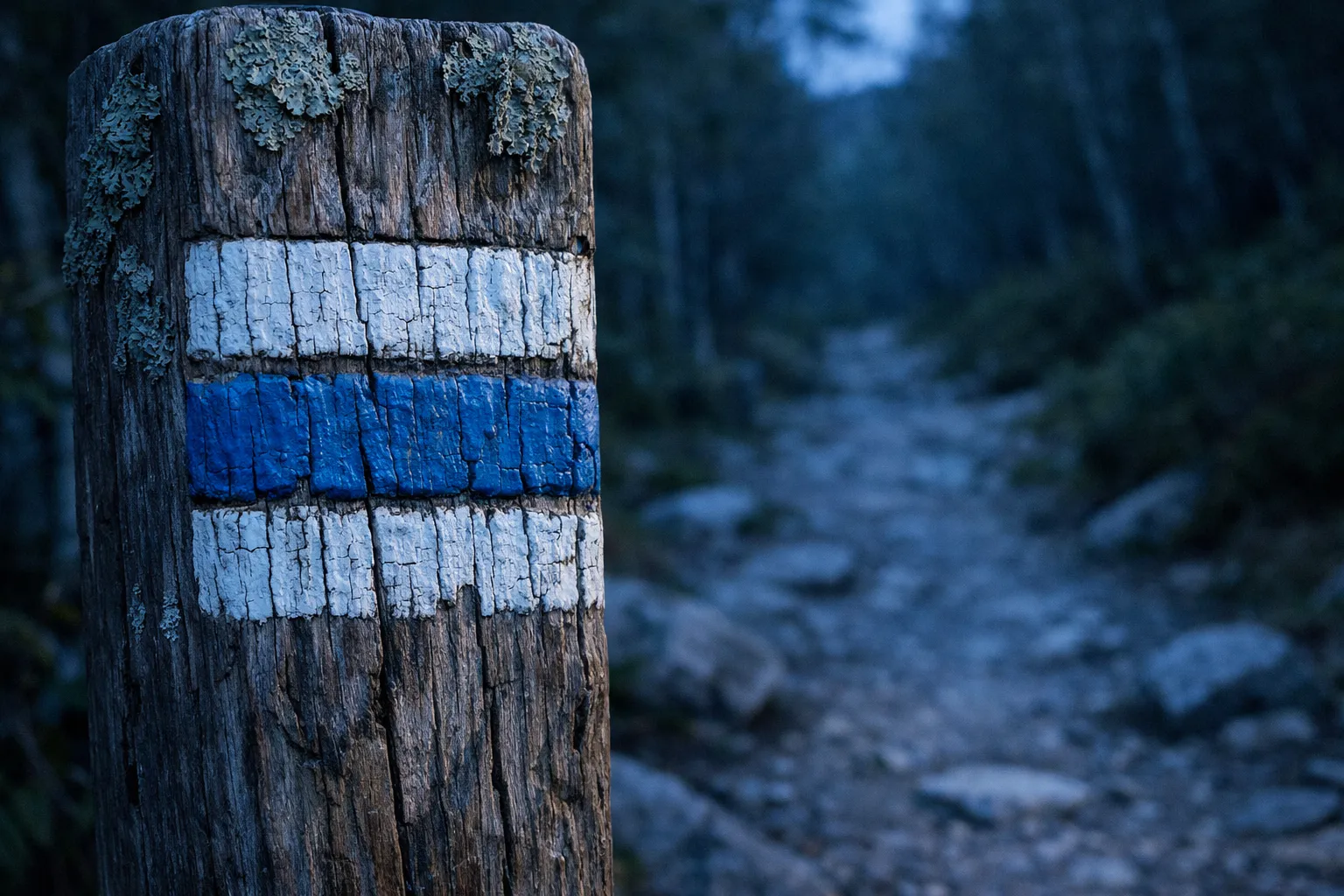
Here’s how they break down by effort.
Glendalough Trail Comparison
| Green Road Walk | Valley Floor Circuit | Poulanass Waterfall / Miner's Road | Spinc and Glenealo Valley | |
|---|---|---|---|---|
| Distance | about 3 km | 4.5 km | 5-8 km combined | 9.5-11 km |
| Duration | About 1 hour | About 1.5 hours | Half-day | 4-5 hours |
| Difficulty | Easy | Easy | Intermediate | Strenuous |
| Best For | Short, flat stroll | Maximum value per hour, bus day trippers | Moderate effort, quieter valley corners | Fit hikers, 4+ clear hours |
Easy Trails: Valley Floor and Green Road
The Valley Floor Circuit is the single best option if you’re short on time. According to the National Park leaflet, it’s a 4.5 km loop linking the monastic ruins, Lower Lake, and Upper Lake, with an estimated walking time of about 1.5 hours and no major ascent (5). You’ll see both lakes and ruins views in that time - maximum value per hour for bus day trippers.
The Green Road Walk is even shorter: about 3 km, mostly level, roughly an hour along the valley floor near the lakes (5). Both are suitable for most visitors and steer clear of anything steep.
Intermediate Options: Waterfall Loop and Miner’s Road
If you want more effort without the ridge, combine the Poulanass Waterfall loop with the Miner’s Road Walk along the Upper Lake. Together these add up to roughly 5 to 8 km with some ascent - enough to feel like a proper hike and reach quieter corners of the valley, while avoiding the exposed Spinc boardwalk. This is the sweet spot for moderately fit walkers who want a half-day on foot but don’t want to gamble on weather higher up. If you’re building a broader itinerary around Ireland’s west, the Connemara Ireland: Nature, Hiking, and What to See guide covers similarly rewarding walking terrain in a very different landscape.
The Spinc: What the Strenuous Rating Actually Means
The Spinc and Glenealo Valley walk is officially rated strenuous by the National Park: 9.5 to 11 km depending on the variant, 4 to 5 hours, with cumulative ascent of roughly 380 to 450 metres, including long flights of wooden steps and boardwalks that rise 200 to 300 metres above the Upper Lake (5). The reward is the ridge - wide-open views down the valley, the kind that make you stop walking. The cost is real physical effort on steep, stepped terrain.
You need sturdy hiking boots with ankle support, waterproof layers, and reasonable fitness. Here’s the warning that saves the most days: the Spinc is not a fallback if you’ve already spent two hours at the ruins and arrived by bus. A 4-5 hour hike won’t fit inside a 3.5-hour bus window. Strong hikers can extend it further by combining the Spinc with Wicklow Way segments for 15 to 20 km point-to-point routes, but that’s a self-drive, early-start commitment.
How to Plan Your Day: Three Itineraries by Time and Transport
The single decision that makes or breaks a Glendalough day is matching your on-site time to your trail ambition. Below are three realistic plans based on actual transport windows - pick the one that fits your arrival method.
Glendalough Day Trip Itineraries
Up to 8 hoursThree realistic plans based on transport and available time on site
- 1
3.5 Hours on Site (Bus Day Trip)
Arrive around 12:20. Spend 45 minutes at the Visitor Centre exhibition, 60 minutes walking the monastic ruins, and 90 minutes on the Valley Floor Circuit. Depart by 16:00. No Spinc.
- 2
5-6 Hours on Site (Self-Drive, Mixed Day)
Arrive by 09:30. Explore the monastic ruins before the crowds (60-75 minutes), visit the Visitor Centre (45 minutes), hike the Miner's Road plus Poulanass Waterfall loop (2-2.5 hours), picnic at the Upper Lake, and depart by 15:30-16:00.
- 3
Full Day (Self-Drive, Serious Hike)
Arrive by 09:00. Spend 60 minutes at the monastic ruins, 30 minutes at the Visitor Centre (skip the film if pressed), hike the Spinc and Glenealo Valley loop (4-5 hours), have a late lunch in Laragh, and depart by 17:00-17:30.
A note on basing yourself: Laragh village lies about 2 to 3 km (a five-minute drive) from the main Glendalough car parks and has guesthouses, B&Bs, cafés, and pubs. For an early start or late finish, staying in Laragh beats the valley itself.
One seasonal caution: from mid-October to mid-March the Visitor Centre closes around 17:00 with last admission near 16:15, and daylight is short. Plan winter visits around the light, not the clock.
Gear, Weather, and When to Skip the Spinc
The decision framework is straightforward: if it’s raining steadily on arrival, or you have less than four clear hours on site, skip the Spinc and stick to the valley floor and ruins. That’s not caution for its own sake - it’s the difference between a good day and a bad one.
Met Éireann, Ireland’s national meteorological service, notes the Wicklow Mountains see some of the country’s highest rainfall totals and warns upland weather can change within hours, with fog, heavy showers, and strong winds developing fast (met.ie/forecasts/mountains). On the Spinc, that means slippery boardwalk and rocky sections where a fall matters.
Gear by trail tier:
- Easy trails (Green Road, Valley Floor): normal walking shoes suffice.
- Intermediate (Miner’s Road, Poulanass): waterproof footwear pays off, especially after rain.
- Spinc: sturdy hiking boots with grip and ankle support, waterproof jacket and trousers, plus a warm mid-layer for the exposed ridge. Add hat and gloves in colder months.
Seasonally, summer (June to August) means sun protection and enough water; spring and autumn mean full waterproofs; winter means warm layers plus a hard check on daylight hours before committing to anything above the valley floor. The National Park advises allowing at least four hours of daylight for the Spinc and Glenealo route and warns against starting late (5).
Accessibility note: the Green Road and much of the valley floor are relatively flat and suitable for most visitors, but the Spinc involves steep steps, narrow boardwalk, and uneven rock - not suitable for wheelchairs, strollers, or limited mobility. When weather is poor above the treeline, the valley floor and ruins make a good day on their own - you’re not missing the point of Glendalough by staying low.
Crowd Patterns, Sustainability, and Visiting Responsibly
Glendalough is the most visited destination in Wicklow Mountains National Park, monitored by 11 automated counters and receiving several hundred thousand visits a year. Those counters aren’t a footnote - visitor pressure here is a genuine management challenge, and knowing the rhythm helps you avoid the worst of it.
Peak times are predictable. Park data shows visitor numbers concentrate between late morning and mid-afternoon, especially on weekends and bank holidays when coach tours arrive between roughly 10:30 and 11:30. The monastic city entrance is busiest then. Practical responses:
- Self-drive and arrive before 09:30, or
- Arrive after 15:30, when day tours start leaving, or
- Start with the Spinc from the Upper Lake car park, letting the crowds fill the ruins while you climb.
Erosion is another reality. The National Park flags trail erosion and trampling on popular routes like the Spinc as serious conservation issues, which is why much of the route is boardwalked. Stay on the constructed paths, don’t cut switchbacks, and don’t attempt the route in conditions that push you off the marked line - the upland vegetation doesn’t recover quickly.
Basic rules apply, too: pack out all litter, no fires, keep dogs under control. Leave No Trace Ireland notes heavy visitor use around Glendalough shows up measurably in soil compaction and vegetation loss near popular viewpoints. Behaving well here isn’t abstract virtue - the damage is documented.
Practical Information: Tickets, Hours, and What to Bring
Everything you need for a quick decision. Hours and parking can change, so confirm on arrival.
-
Visitor Centre hours (OPW):
- Mid-March to mid-October: roughly 09:30 to 18:00, last admission about 17:15
- Mid-October to mid-March: roughly 09:30 to 17:00, last admission about 16:15
- Closed annually 23 to 29 December
-
Tickets:
- Monastic ruins and all valley trails: free
- Visitor Centre exhibition: €5 adult, €3 child/student, €13 family (2 adults + 2-3 children)
-
Parking:
- Lower Lake car park: €4 per car per day, payable on entry
- Upper Lake car park: managed separately; check signage on arrival (arrangements continue to evolve)
-
Bus:
- St Kevin’s Bus Service, adult return €23 from St Stephen’s Green North; 11:00 departure; book online in high season
-
Food and facilities:
- Café near the Visitor Centre; more options in Laragh village
- Bring water and snacks if planning a full-day hike
-
Mobile coverage:
- Patchy in the valley, with dead spots near Upper Lake and on higher trails
- Download the National Parks trail PDF and an offline map before leaving Dublin
Frequently Asked Questions
- How long do you need at Glendalough?
- Minimum 3-4 hours for the monastic ruins and a short lake walk; 5-6 hours for a proper mixed day; 8+ hours if doing the Spinc. Bus trips allow about 3.5 hours.
- Is Glendalough free to visit?
- Monastic ruins and trails are free. Visitor Centre exhibition costs €5 adult, €3 child/student, €13 family. Lower Lake parking is €4/day.
- What is the easiest walk at Glendalough?
- The Valley Floor Circuit (about 4.5 km, about 90 minutes) covers both lakes and ruins on flat ground. The Green Road Walk (about 3 km) is shorter and equally flat.
- Is the Spinc walk hard?
- Yes. It's strenuous: 9.5-11 km, 4-5 hours, steep boardwalks and rocky scrambles. Avoid in poor weather, without boots, or if under 4 hours on site.
- Can you do Glendalough without a car?
- Yes. St Kevin's Bus runs from Dublin at 11:00, return fare €23, with about 3.5 hours on site, limiting you to ruins and a short valley walk.
- What is Glendalough poitín, and how does it compare to vodka?
- Glendalough poitín is a traditional Irish spirit, triple-distilled malted barley at 55% ABV. Unlike neutral vodka, it's malty and robust, linked to monastic distilling.
- When is the best time of year to visit?
- Late spring (May-June) and early autumn (September) balance daylight, crowds, and weather. Summer weekends are busiest; winter is quiet but daylight is short.
The whole day comes down to one honest question: how much time will you actually have on the ground, and does it match what you’re planning to walk? A bus day tripper who tries to squeeze in the Spinc will spend the afternoon rushing and still miss the return; a self-driver who arrives at 09:30, walks the quiet ruins, and does the valley floor will have a genuinely good day. Match the trail tier to the clock before you leave, not once you’re standing at the trailhead.
Glendalough fits naturally into a broader Irish itinerary - if you’re planning a week across the country, the Things to Do in Ireland: A Week of Hidden Gems and Classics guide places it alongside other essential stops. And if you’re spending time in the capital before or after your visit, Hidden Gems in Dublin: 10 Experiences Worth Seeking is worth reading for what to do with the days around your Wicklow day trip. For those extending west along the Wild Atlantic Way, Things to Do in Sligo: Hikes, Coast, and Culture offers a similarly rewarding mix of ancient sites and mountain walking.
So do three things before you go: download the National Parks trail PDF while you still have signal, decide your trail tier based on your transport and the forecast, and don’t let the Spinc be an afterthought. Get those right and Glendalough rewards the planning.