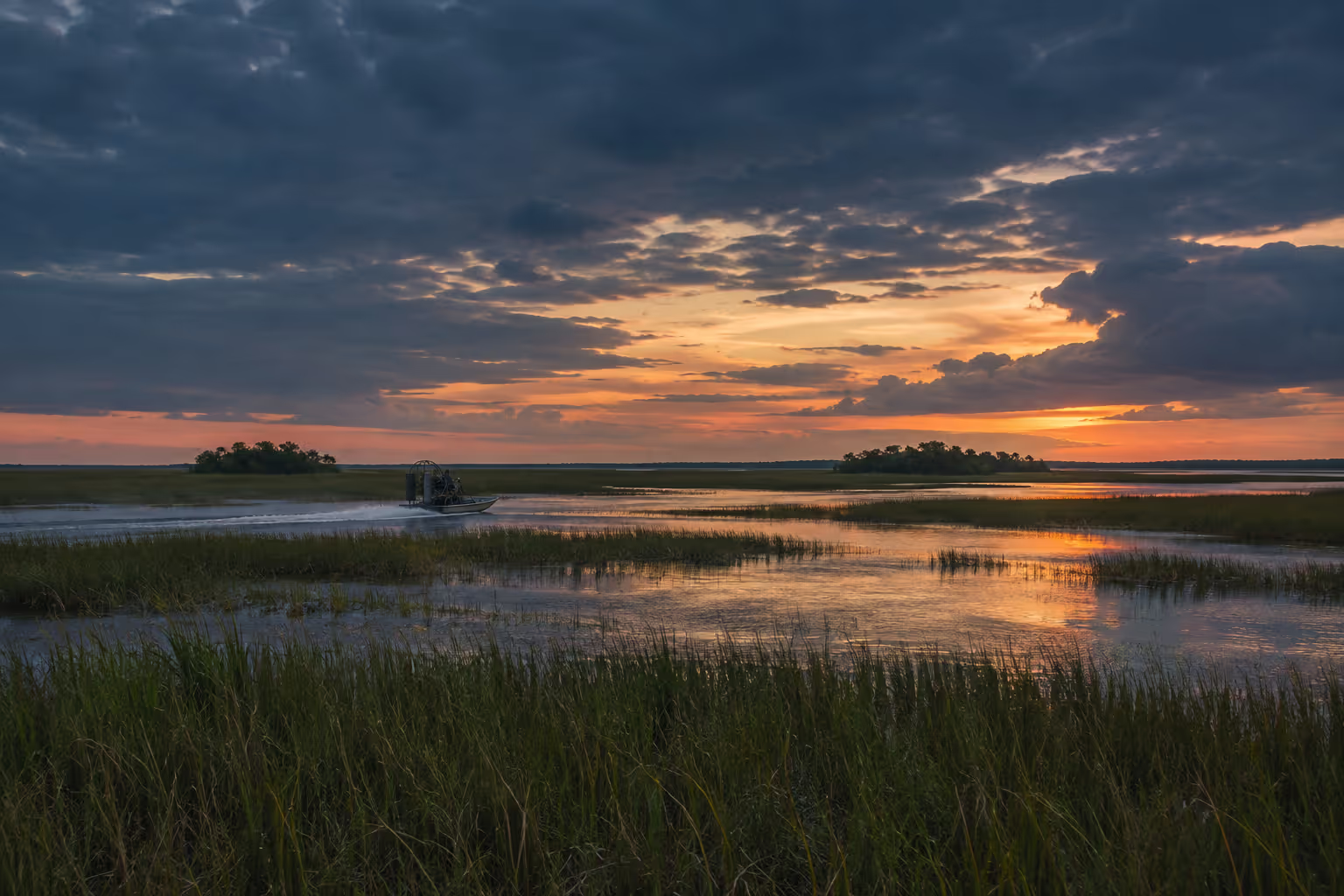
Everglades National Park has three entrances: Homestead, Shark Valley and Everglades City. None of them connect inside the park. Each entrance and the interior Flamingo area sit at least an hour’s drive apart (8), so your choice of entrance shapes your trip more than your choice of date. This guide covers which option fits your time and mobility (the Shark Valley loop, the Anhinga Trail, or an Everglades airboat tour from the concessions east of Shark Valley) and what the fees and the dry season mean for your plan.
Everglades National Park at a Glance
Everglades National Park protects 1.5 million acres (about 607,000 hectares) of wetlands, forests and marine habitat at the southern tip of Florida, spread across Miami-Dade, Monroe and Collier counties (8)(5). Most of that area has no road at all. It is sawgrass, open water, mangrove and bay, and you reach it by boat, by paddle or not at all.
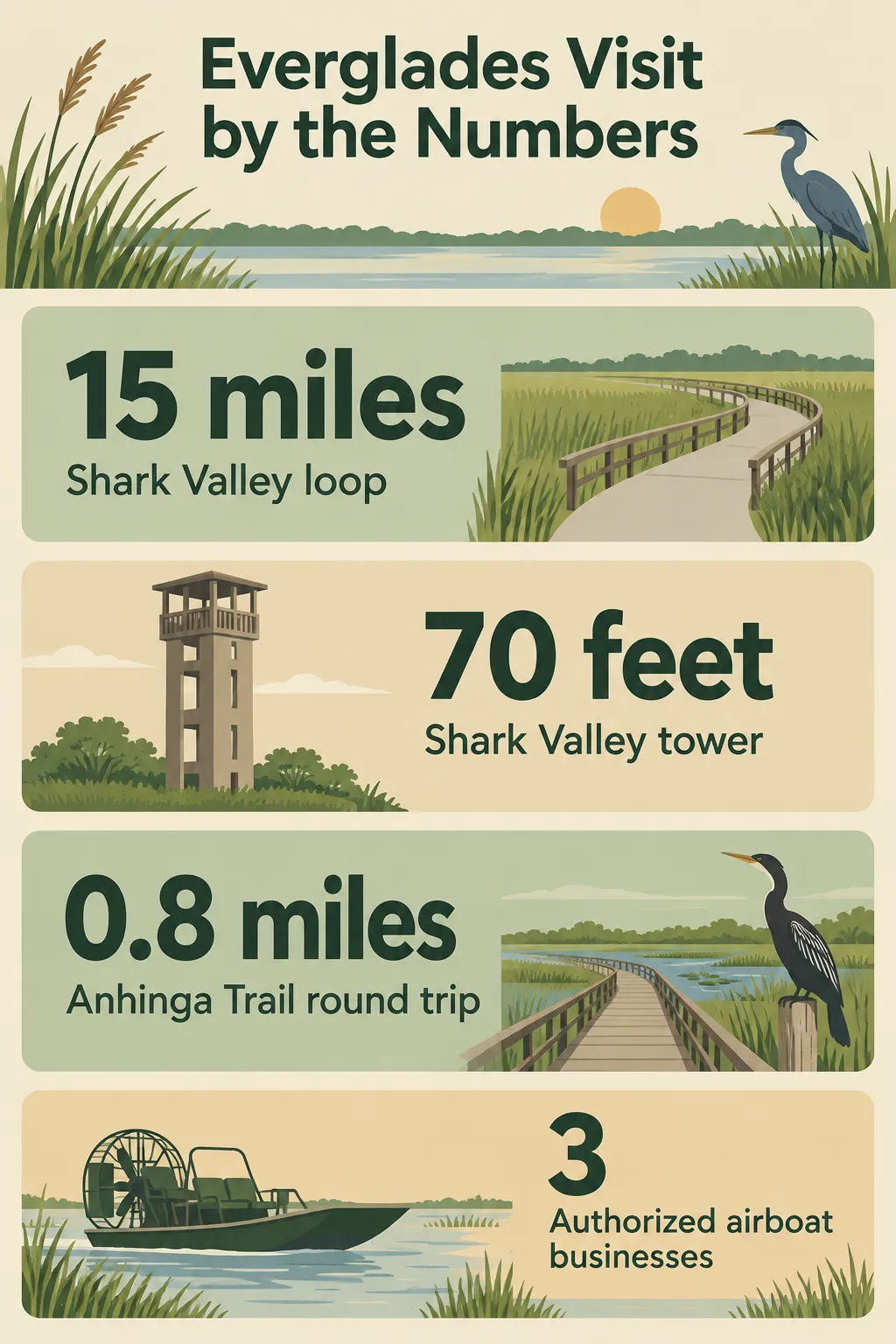 Shark Valley’s loop is 15 miles, its observation tower is 70 feet tall, the Anhinga Trail round trip is 0.8 miles, and 3 authorized airboat businesses operate inside the park.
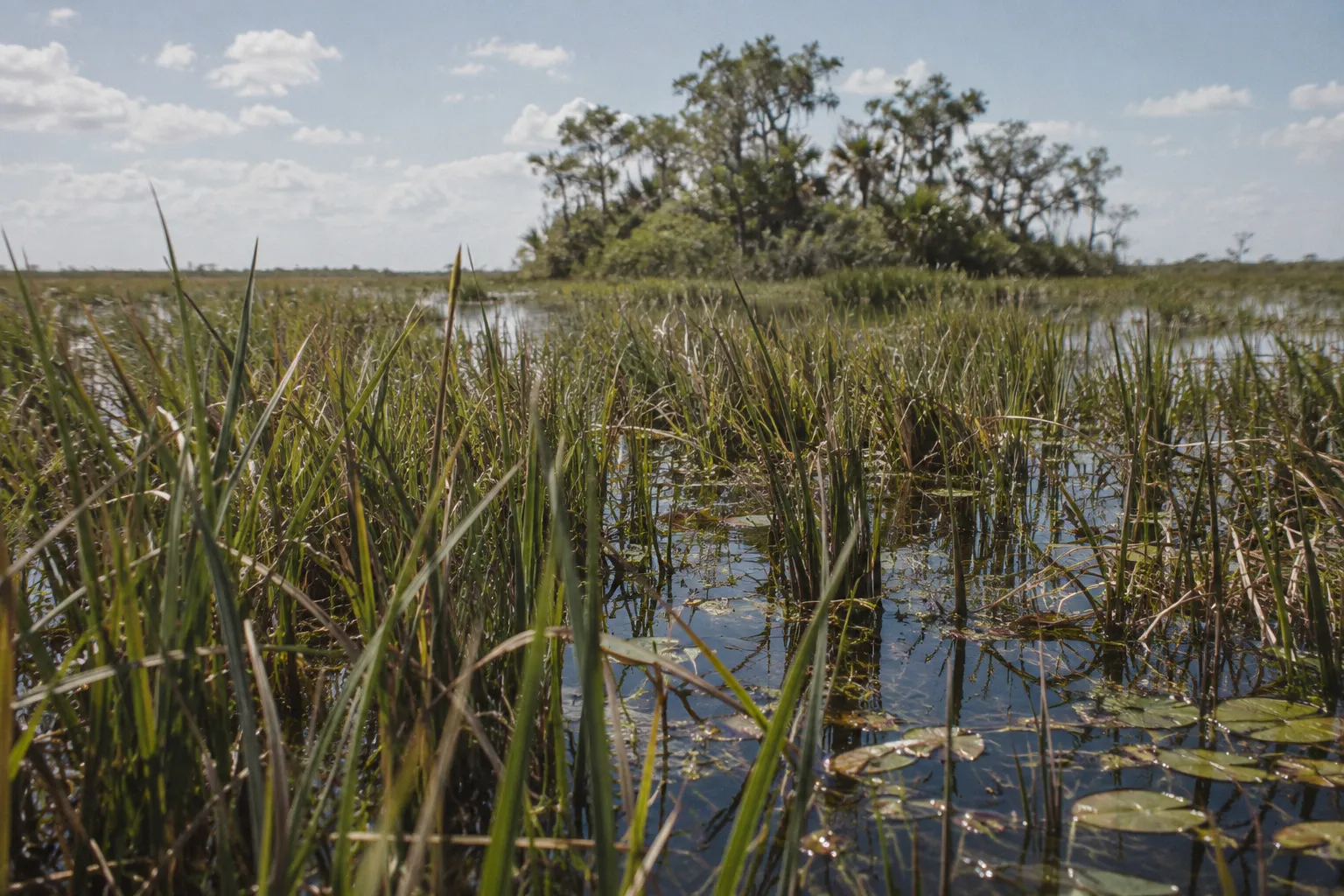
The parts you can drive to are thin slices along the edges. The Main Park Road runs from the Homestead entrance through the Royal Palm area to Flamingo. The Shark Valley entrance road comes off U.S. 41, the Tamiami Trail. The Gulf Coast area at Everglades City is a water-based entrance (5). Boaters and paddlers can also enter through the park’s coastal boundaries and waterways (5). For a first visit, assume you will see one or two of those slices, not “the Everglades” as a whole.
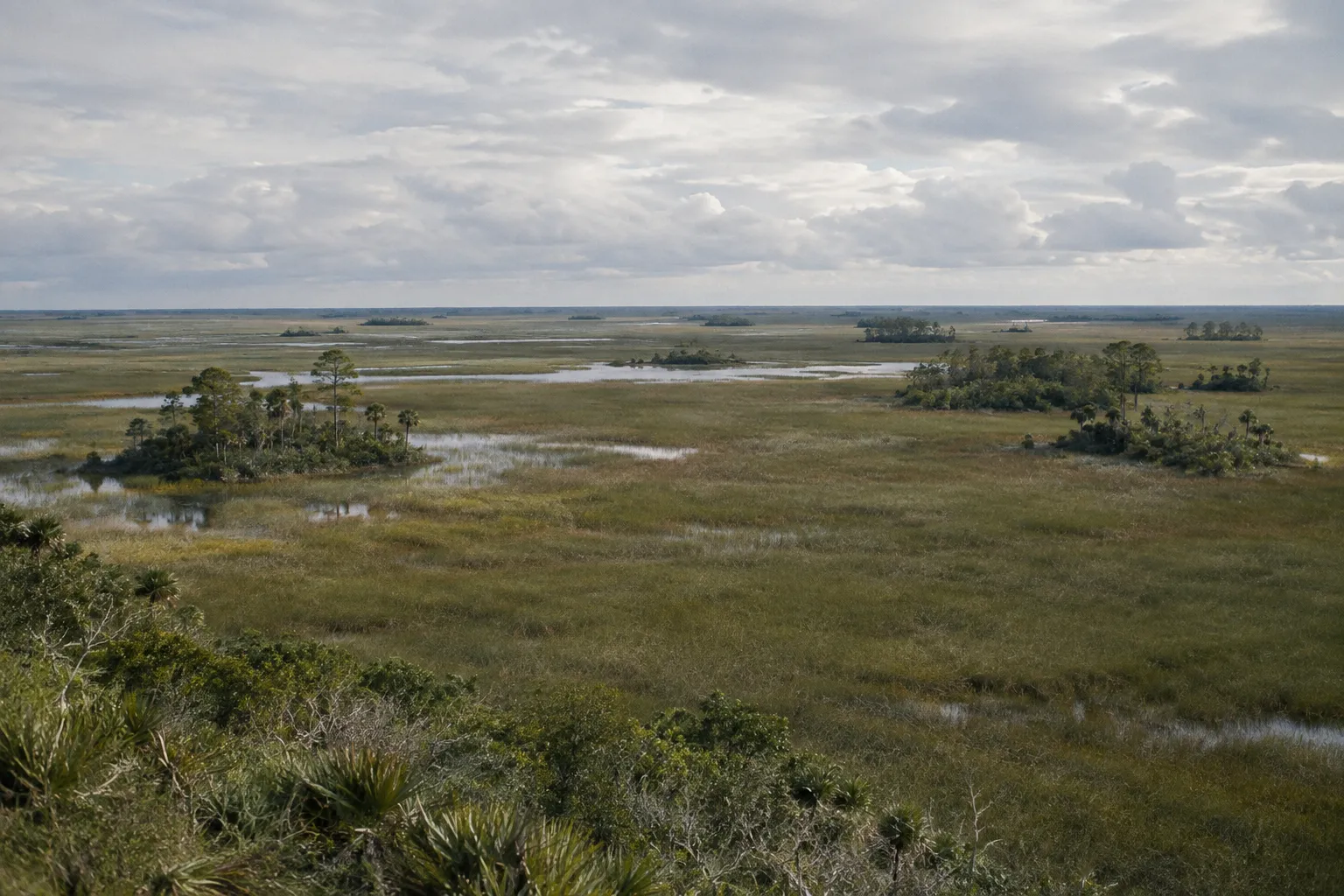
The park was authorized by an act of Congress in 1934 and dedicated in December 1947 (18). It is often described as the first US national park set aside for its ecosystem rather than for mountains, canyons or geysers. That framing matters when you set expectations. There is no summit, no waterfall and no single viewpoint that sums the place up. The scenery is horizontal: a flat sea of sawgrass broken by tree islands, under a very large sky. Most of the park sits only a few feet above sea level, so the 70-foot (21 m) observation tower at Shark Valley is one of the few places where you get any height over the marsh (10).
Expect a quieter landscape than other US national parks. What it offers instead is wildlife density. On a good dry-season morning you can stand on a boardwalk with alligators, turtles, anhingas, herons and egrets in view at the same time (14). That is the reason to come.
How Water Moves Through the Everglades
The Everglades is a slow-moving sheet of fresh water, not a swamp in the stagnant sense. Historically, water spilled south from the Lake Okeechobee region and crept across a nearly flat limestone shelf toward Florida Bay and the Gulf of Mexico. It moved as a shallow, wide flow through the sawgrass rather than in a single channel. Marjory Stoneman Douglas called it a “river of grass” in her 1947 book, the same year the park was dedicated. The Gulf Coast visitor center in Everglades City carries her name (8).
The deepest part of that flow is Shark River Slough, and that is where Shark Valley’s 15-mile (24 km) loop road takes you (10). Standing on the tower, you are looking across the main drainage of the park. In the wet season it looks like a sawgrass prairie with standing water. In the dry season it shrinks into pockets and channels where fish, and therefore birds and alligators, crowd together.
The seasonal rhythm drives everything about planning a visit. The wet season, May to November, refills the marsh. The dry season, typically December through April (16), drains it back down. In the wet season, rising water lets animals disperse, which makes wildlife viewing harder (19); as the marsh shrinks in the dry months, they gather around what remains. This is why the same boardwalk can feel empty in September and crowded with birds in February.
Ecosystems You’ll Pass Through
The park lists freshwater sloughs, marl prairies, tropical hammocks, pinelands, cypress, mangrove, coastal lowlands, marine and estuarine habitats (16). You won’t see all of them on a first trip. Which ones you do see depends on the entrance.
From the Shark Valley entrance you are in freshwater marsh and slough the whole time. It is sawgrass to the horizon, with scattered tree islands and an open sky. There is almost no shade on the loop.
From the Homestead entrance the Main Park Road passes through the widest range of habitats. You start near pinelands, reach the Royal Palm area with its sawgrass marsh (where the Anhinga Trail runs) and shaded hardwood hammock, and continue toward Flamingo through prairie and eventually mangrove at the coast. The park describes some of these areas as shaded trails and boardwalks through tropical hardwood hammocks (9).
From the Gulf Coast entrance at Everglades City the experience is coastal: the waters and mangrove islands of the Ten Thousand Islands (9). This is boat and paddle country, not walking country.
Wildlife you can expect. These are the animals most first-time visitors see:
- American alligators, common along the Anhinga Trail and the Shark Valley loop (14)
- Wading birds: great blue herons, egrets and many other species, at their most varied in the dry season (14)(16)
- Anhingas, the long-necked diving birds that give the trail its name, often perched with wings spread to dry (14)
- Turtles in the marsh waters along the Anhinga Trail (14)
Rarer sightings include the American crocodile in the brackish coastal waters around Flamingo. South Florida is the only place where alligators and crocodiles live side by side in the wild (22).
The dry season brings the largest variety of wading birds and the predators that follow them (16). That’s the main argument for timing your trip between December and April.
Pros and cons of a visit. In favor: high wildlife density on short, easy trails, including a fully accessible boardwalk; flat terrain with no elevation gain anywhere you’ll walk; and an entrance pass that covers a week at all entrances. Against: the entrances don’t connect, so seeing more than one area costs you hours of driving. Cell coverage is limited. Heat, sun and biting insects are part of every visit, even in the dry season. Winter weekends at the two most popular entrances can mean long gate lines and full parking lots (8).
The Park’s Three Entrances and Why They Don’t Connect
The three entrances to the Everglades (Homestead, Shark Valley and Everglades City) are separate access points with no internal road linking them. Each one, plus Flamingo, is at least a one-hour drive from the others (8)(9). The park states it plainly: you cannot drive between Ernest F. Coe, Shark Valley or Gulf Coast from inside the park (9).
Here is what most guides get wrong. They list Shark Valley, the Anhinga Trail and Flamingo as if they were stops on one scenic drive. They aren’t. Shark Valley is 50 miles (80 km) from the Ernest F. Coe Visitor Center at the Homestead entrance (10). Getting from one to the other means leaving the park, driving through suburban Miami-Dade, and re-entering. Treat each area as its own trip.
Homestead entrance (Ernest F. Coe Visitor Center). The main entrance is on State Road 9336 in Homestead and connects you to the Royal Palm area and the Flamingo area (5). The Anhinga Trail starts at Royal Palm Visitor Center, four miles (6 km) inside the entrance (14). Flamingo is the interior visitor center at the far end of the Main Park Road. It’s a long drive in, and it counts as its own hour-plus leg (8). This is the entrance with the most variety: an accessible wildlife boardwalk, pinelands, hammocks, and coastal boating at Flamingo.
Shark Valley entrance. Shark Valley is about 30 miles (48 km) west of Miami on U.S. 41, the Tamiami Trail (10). It is the park’s freshwater-marsh experience: the 15-mile (24 km) loop road, the tram, bike rentals and the 70-foot (21 m) observation tower (10). It’s the closest entrance for most visitors staying in Miami, and it’s also where the authorized airboat concessions sit, 15-20 minutes further east on U.S. 41 (11).
Gulf Coast entrance (Everglades City). The Gulf Coast entrance is water-based and centered on the Marjory Stoneman Douglas Visitor Center (5)(4). The Marjory Stoneman Douglas Visitor Center opened in 2026, after Hurricane Irma in 2017 and Hurricane Ian in 2022 destroyed the earlier buildings; as of November 2026 it is open daily from 9 a.m. to 5 p.m. (20). The main attraction here is the Ten Thousand Islands. A concession runs guided 90-minute boat tours through them daily (21). If you’re coming from Naples or Fort Myers, this is your nearest access point. From Miami, it’s the farthest.
How to get there. Most visitors fly into Miami International Airport and drive. For the Gulf Coast entrance, Southwest Florida International Airport near Fort Myers is the closer gateway. Shark Valley and the Everglades City side are both reached via U.S. 41. The Homestead entrance is reached through Homestead, south of Miami. The park describes its northern section as accessible from Miami or Everglades City and its southern section from Homestead (16).
Plan the drive, not just the destination. The Main Park Road from the Homestead entrance has narrow shoulders and pulloffs, separate parking areas at each trail and wayside, and a maximum speed limit of 45 to 55 mph (72-89 km/h) in most areas (8). On busy winter weekends, both the Homestead and Shark Valley entrances can become extremely congested, with long gate lines and parking that can be difficult or impossible to find. The park recommends weekdays, arrival before 10 a.m., carpooling, and buying a digital pass in advance (8).
Sample plans by trip length. One day from Miami: pick one entrance. Choose Shark Valley if you want the tram and tower plus a nearby airboat ride. Choose Homestead if you want the Anhinga Trail and the option to continue toward Flamingo. Two days: Shark Valley and an airboat ride on day one, then Homestead, the Anhinga Trail and Flamingo on day two. Three days or more: add the Gulf Coast for a Ten Thousand Islands boat tour, ideally while based on the west side so you aren’t crossing the state twice. The $35 private-vehicle pass is good for 7 consecutive days at all park entrances (4), so a multi-day plan doesn’t mean paying again at each gate.
Why You Need a Car
You need a car to visit the Everglades: there is no public transportation within the park, and the distances between areas are long (8). This is one of the few national parks near a major US city where a rental car is close to mandatory. The one exception is seasonal. As of November 2026, the park says the City of Homestead runs a trolley to the Ernest F. Coe Visitor Center and Royal Palm from about December through April, the only public transportation into the park (8). It won’t get you to Shark Valley, Flamingo or the Gulf Coast.
Rideshare is a trap. The park warns that visitors arriving by on-demand services such as Uber, Lyft or taxi have found themselves unable to get a return ride from Shark Valley (11). The same warning appears for the park in general (8). If you do arrive that way, arrange the return trip with your driver before they leave, or line up a taxi you can call. There is no other public transportation to Shark Valley (11).
A car also gives you flexibility with the weather and the crowds. If the Shark Valley lot is full at 10 a.m. on a Saturday in February, you can drive east to an airboat concession and come back later. You can also abandon the plan and head to Homestead, as long as you accept an hour or more of driving.
Fill the tank before you go. Services inside the park are sparse, and the Main Park Road to Flamingo is a long out-and-back.
Checking for Closures Before You Go
The park’s current conditions page is the place to check before every visit, because fire, construction and maintenance closures change through the year (2). As of November 2026, the page reports all entrances and areas open except those listed for special closures (2).
Those listed closures matter more than they sound. As of November 2026, the East Everglades Day Use Area on the park’s northeastern boundary is closed for construction with heavy machinery, including SW 168 Street westbound to SW 237 Avenue and the full length of SW 237 Avenue (2). On the Gulf Coast, the interior of Pavilion Key and the middle of Hog Key are closed, and several wilderness sites, including Johnson Key Chickee and Shark Point Chickee, are closed for maintenance (2). Halfway Creek is not completely passable for paddlers (2).
Fire is the bigger wildcard. In late April 2026, the Highway 41 Fire burned about 8,500 acres (3,440 ha) in the northeastern corner of the park, south of U.S. 41 and east of Shark Valley and the airboat concessions. On April 30, the park amended its emergency closure to exclude the airboat concessioners and the airboat trails in the northwestern corner of the original closure, and all related emergency closures were lifted by 8 a.m. on May 2, 2026 (3). Four months later, Shark Valley closed during nearby wildfires; the Chipmunk Fire alone reached about 17,000 acres (6,900 ha), with activity in sawgrass prairie roughly six miles (10 km) south-southwest of the observation tower. The district reopened at 1 p.m. on August 24, 2026 (1). An old closure notice tells you nothing about today. Check the live page on the morning you drive out.
Useful contacts: the park information line is 305-242-7700 (1). For Shark Valley specifically, call 305-221-8776 to ask about current access conditions, including parking (11). Because cell service is limited across the park, download maps, directions and any tickets before you leave your hotel (9).
Shark Valley: Loop Road, Tram Tours, and the Observation Tower
Shark Valley is a 15-mile (24 km) loop road into Shark River Slough, about 30 miles (48 km) west of Miami on U.S. 41, with a 70-foot (21 m) observation tower halfway around (10).
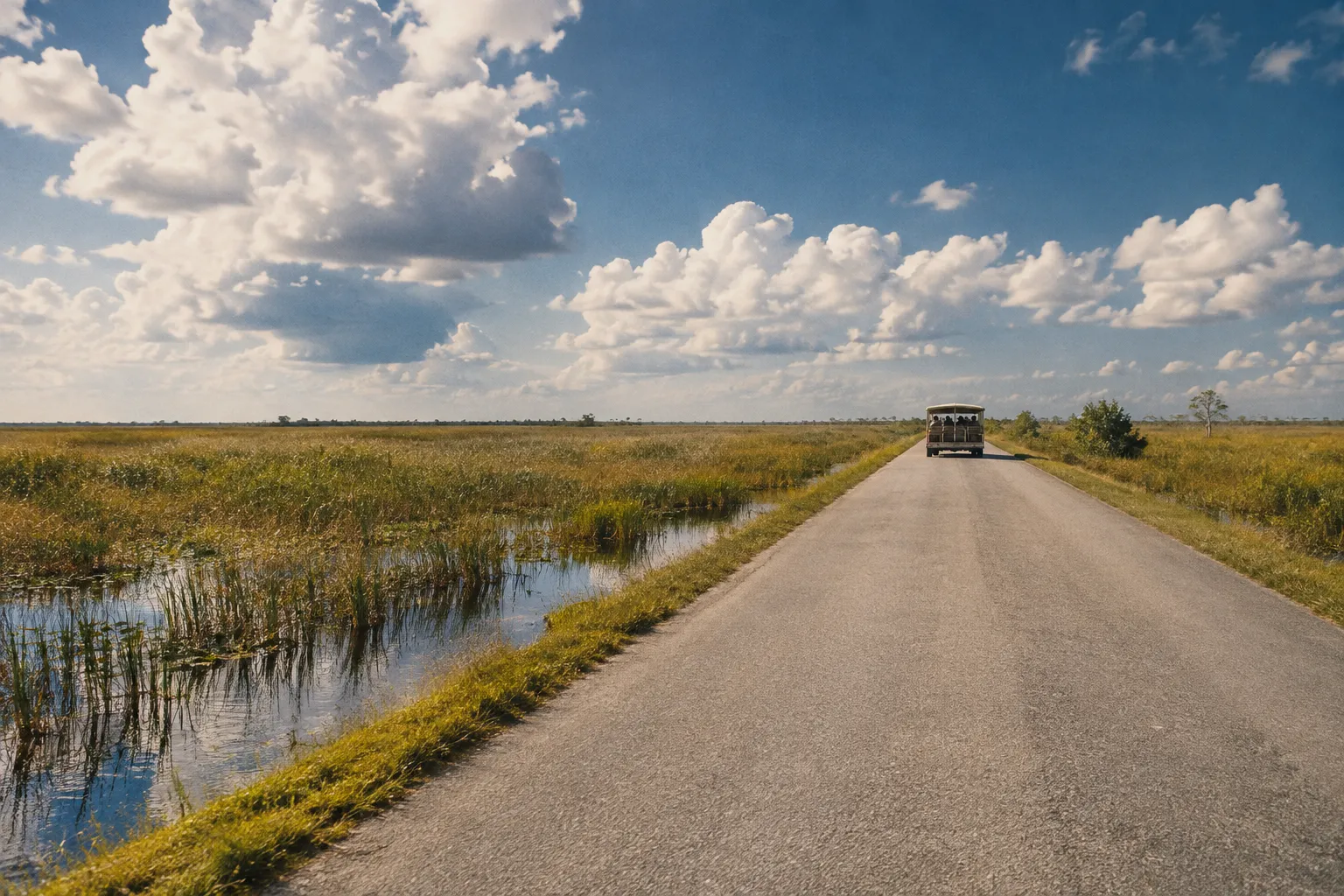
The loop is paved and flat, with sawgrass on both sides and water close to the road edge in places, and the park describes it as an opportunity to see wildlife up close (10). Alligators often lie near the pavement.
From the top of the tower you get a panoramic view of the sawgrass marsh, which the park describes as much as it appeared to Native people more than 300 years ago (10).
Hours. The Shark Valley gate is listed as open 8:30 a.m. to 6 p.m. daily (5). As of November 2026, the park’s Shark Valley page lists seasonal visitor-area hours of 9 a.m. to 4:30 p.m. from mid-April to mid-December, then 8:30 a.m. to 5 p.m. from mid-December to mid-April (10). Confirm the current schedule if you’re timing a tram tour or bike rental late in the day.
Amenities. The Shark Valley Visitor Center has educational displays, a park video, brochures, and a gift store with books and souvenirs. Shark Valley Tram Tours runs the guided trams and rents bicycles, and also sells snacks and soft drinks (10). Restrooms are available. Two short walking trails branch off the main trail, and one of them is accessible (10). Bring lunch and plenty of water.
Cell coverage is limited at Shark Valley (10), so download directions and tickets before you arrive.
Crowds and parking. The park warns of long wait times between 10 a.m. and 3 p.m. Parking fills quickly and may switch to one car in, one car out (11). For scheduled tram tours, the park advises arriving 1.5 to 2 hours early (11).
Tram, Bicycle, or On Foot?
You can experience Shark Valley’s 15-mile (24 km) loop by narrated tram, by bicycle, or on foot (10).
Tram. The narrated tram, run by the park concessioner Shark Valley Tram Tours, is the best option for most first-time visitors (10). Tram tickets are priced separately from your park entrance pass (4). The trade-off is control: you follow the tram’s schedule.
Bicycle. Bikes give you the best balance of distance and freedom. You can rent one from the concessioner or bring your own (10)(11). There is almost no shade, and a midday ride is tiring even in winter. If an alligator lies on or beside the pavement, stop well back and wait or walk around at a distance, never ride past within reach. Plan two to three hours with tower time, more if you stop often.
On foot. Walking the full loop on exposed pavement is roughly five hours before stops, and the tower is about 7.5 miles (12 km) in either direction. A better walking plan is a short out-and-back from the visitor center combined with the two short trails off the main route, one of which is accessible (10).
Can You Drive the Loop Yourself?
You cannot drive the Shark Valley loop: private vehicles are not permitted beyond the entrance road and parking lot, and the loop and observation tower are reached only on foot, by bicycle, or by tram (11)(10). Vehicles must stay in designated parking areas at all times for visitor and wildlife safety (11).
How to plan a Shark Valley visit, step by step:
- Check conditions the night before and the morning of (2), and confirm the visitor-area hours if you’re taking the tram (10).
- Buy your entrance pass online to cut your wait at the gate (8). The park accepts no cash (4).
- Arrive before 10 a.m., and 1.5 to 2 hours ahead of a scheduled tram tour (11).
- Leave the car in the lot (11).
- Choose tram, bike or a short walk (10).
- Stop at the 70-foot (21 m) tower at the halfway point (10).
- Save energy and water for the return leg, which is as long as the first half.
- Head east for an airboat ride if you want one: the three authorized operators are 15-20 minutes away on U.S. 41 (11).
Anhinga Trail: A Short, Accessible Walk Near Homestead
The Anhinga Trail is a 0.8-mile (1.2 km) wheelchair-accessible round trip from the Royal Palm Visitor Center, four miles (6 km) from the Ernest F. Coe entrance near Homestead (14). The park calls it one of its most popular trails because of the abundance of wildlife (14).
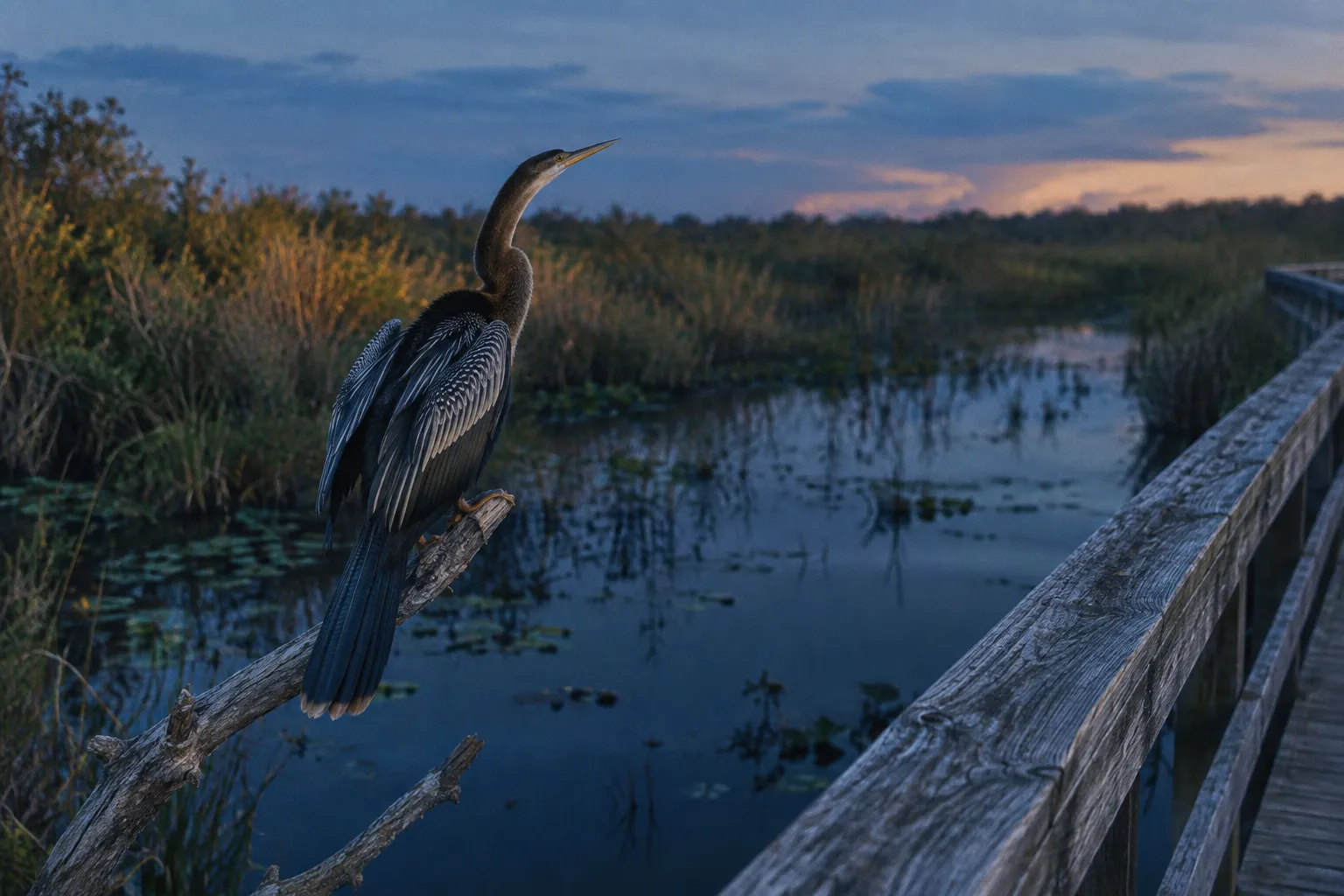
The trail is self-guiding and winds through sawgrass marsh. Along it you may see alligators, turtles, anhingas, herons, egrets and many other birds, especially during the winter (14). The route is a mix of paved trail and boardwalk over the water, so the wildlife is often directly below you or lying beside the path rather than off in the distance. Bicycles are not allowed (14).
Royal Palm Visitor Center. The park’s visitor centers offer maps, orientation information, exhibits, restrooms and ranger guidance (9). Royal Palm is also one of the areas where the park runs ranger-led programs (17), though many programs pause during the wet season because fewer people visit (16). The Gumbo Limbo Trail also starts at Royal Palm and runs through shaded tropical hardwood hammock, a contrast to the open marsh of the Anhinga Trail.
Protect your car. Vultures at Royal Palm have damaged parked cars, pulling at the rubber around windshields, sunroofs and wipers, so the park leaves tarps and bungee cords free of charge in the Royal Palm parking area (23). Use one if available, especially on a rental.
Timing. Wildlife is at its best in the dry season (17), when water levels drop and animals gather in the remaining deeper pools. On a February morning, the water along the boardwalk can be crowded with birds and alligators. In the wet season, wildlife spreads out across the flooded marsh (19) and the trail feels quieter. Mosquitoes are also worse then (16). The Homestead entrance gets congested on busy winter weekends, and the park recommends arriving before 10 a.m. on a weekday (8).
Wildlife etiquette. The alligators along the Anhinga Trail can be within a few feet of the path. Stay back, keep children close, never feed any animal, and don’t step off the trail for a better angle. The same goes for birds: if an anhinga or heron changes its behavior because of you, you’re too close.
Everglades Airboat Tours: Inside the Park vs Nearby Concessions
An Everglades airboat tour inside the national park is offered only by three authorized businesses, Coopertown, Gator Park and Everglades Safari Park, and all three are located 15-20 minutes east of Shark Valley on U.S. 41, not at Shark Valley itself (11)(7). The park identifies these three as its authorized airboat operators. Airboats are restricted to a designated area, and operating them anywhere else in the park is prohibited (6).
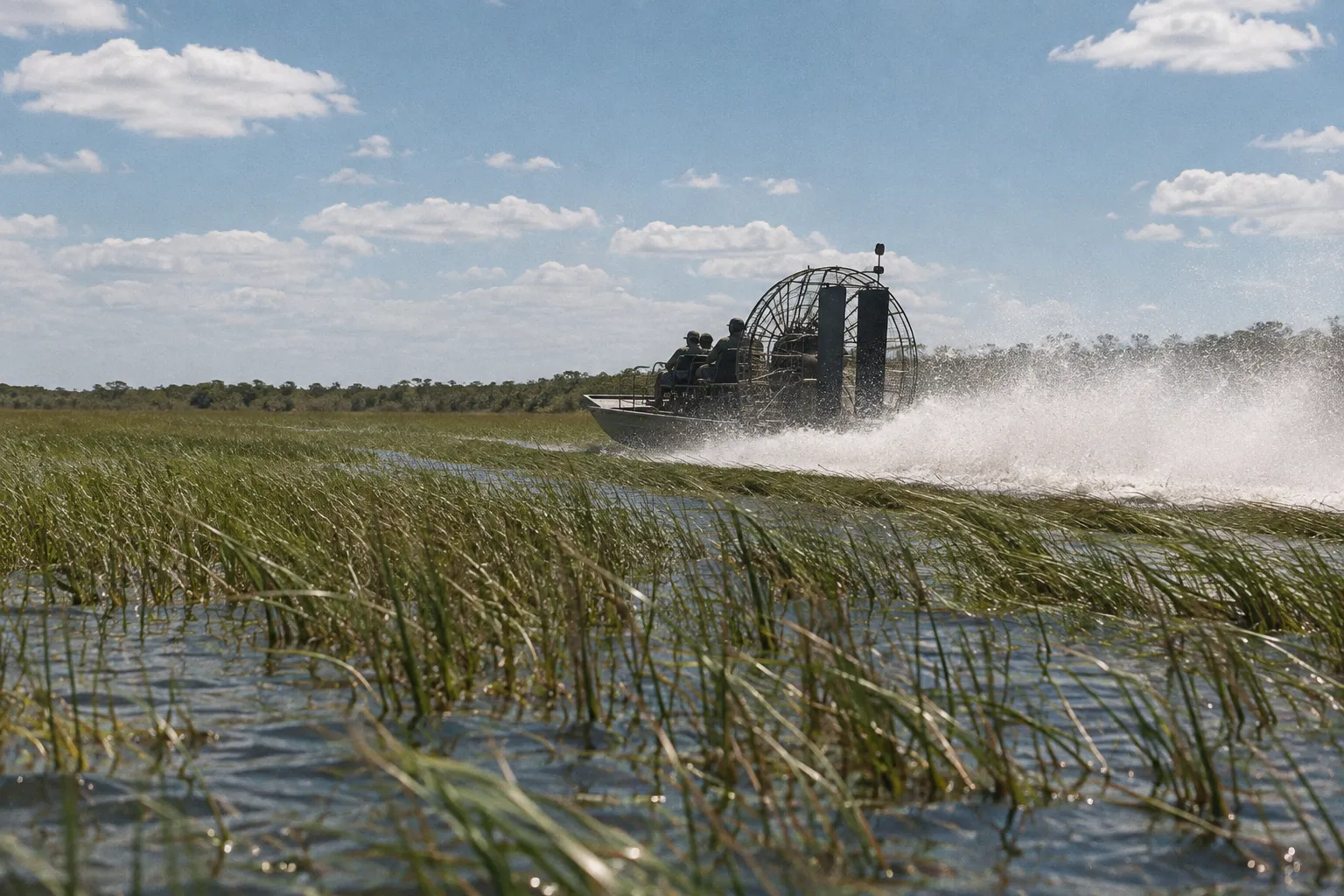
That geography confuses a lot of first-time visitors. People arrive at the Shark Valley gate expecting an airboat dock and find a tram, bike rentals and a visitor center instead. The park states it directly: airboat tours are not physically located at Shark Valley (10). If an airboat ride is your main goal, drive to one of the three concessions on U.S. 41. Paying the entrance fee and parking at Shark Valley first only makes sense if you also want the loop.
Why so restricted? Airboats are loud, fast, flat-bottomed boats pushed by an aircraft-style propeller. They skim over shallow water and sawgrass where other boats can’t go. That makes them effective for covering marsh quickly and disruptive to wildlife and to other visitors. The park confines them to one designated zone, with launch points on U.S. 41 next to Coopertown, to limit noise and protect the habitat of species such as the Cape Sable seaside sparrow (6). Everywhere else, including the Shark Valley loop and the Anhinga Trail, you experience the marsh at walking or tram speed.
Are airboat tours worth it? Yes, as a fun hour that most people enjoy. No, as a substitute for the park itself. An airboat ride gives you speed, spray and the feeling of crossing open sawgrass, often with a stop to look at an alligator. What it doesn’t give you is time with wildlife. The engine noise moves animals off before you reach them, and the pace leaves little room for patient watching. If you have a single day and care most about seeing animals, the Shark Valley tram or the Anhinga Trail will usually show you more. If you’re traveling with kids who want something exciting, or you already walked a trail in the morning, an airboat ride fits well on the same day as Shark Valley.
The Three Authorized Operators
Coopertown, Gator Park and Everglades Safari Park are the three authorized airboat operators for the park (7). They sit along U.S. 41 between Miami and Shark Valley (7), 15-20 minutes east of the Shark Valley entrance (11). Coopertown Airboats is at 22700 SW 8th Street, Miami (10). The park’s Shark Valley page lists addresses for all three, and those are the ones to put into your navigation app (10).
The three operators are concessions with their own ticket prices, ride lengths, schedules and extras. Before you book, compare them on these points:
- Ride length. Ask how long you’re on the water, not how long the “experience” lasts. A package that includes a show, a walk-through exhibit and a gift shop can be long while the boat ride itself is short.
- Boat size. Large airboats carry many passengers and are cheaper per person. Smaller, private boats cost more but let you ask questions and stop longer. Ask which one your ticket covers.
- What the price includes. Some tickets bundle an animal show or exhibit. Others charge separately.
- Hours and last departure. Late-afternoon departures can be shortened to get boats back before dark. That’s the case at least at one outside operator (12), and it’s worth asking about anywhere.
- Ear protection. Airboats are loud. Ask whether hearing protection is provided, and bring earplugs if you’re unsure.
None of these tour charges is part of your park entrance pass. The park notes that concession tours and rentals carry separate fees (4). Pay attention to where the operator sits relative to the park boundary too. A concession entrance on U.S. 41 doesn’t always mean you pass through a park entrance station, so ask the operator whether a park pass is required for your tour.
Airboat Tours Outside the Park
Many airboat tours marketed as “Everglades” tours operate outside the national park, so check the operator’s location and what the ticket includes rather than assuming every Everglades airboat tour enters the park (12)(7). The broader Everglades ecosystem extends well beyond the park boundary, and airboat parks operate across it, including in Broward County north of Miami. Those rides can be good fun. They’re simply not in Everglades National Park, and they’re not among the three authorized concessions (7).
Everglades Holiday Park is one example of an outside operator, and it publishes its own schedule and prices. As of November 2026, its adult ticket (ages 12 and older) for a 60-minute airboat tour was $41.99, plus tax and an applicable booking fee (12). The ticket covers the airboat tour, a gator show and one free group photo per party (12). Tours depart every 20 minutes or less. The park opens at 9 a.m. seven days a week, rain or shine. The last full 60-minute tour leaves at 4 p.m., and the final 4:30 p.m. boat is a shorter 30-minute ride. The operator says to arrive 30 minutes before the tour you want (12).
That operator’s page includes a booking mechanic worth knowing: if you buy online, you must present the credit card matching the last four digits used for the purchase, along with a matching driver’s license, when you arrive (12). If someone else in your group bought the tickets, make sure that person and that card come along.
Entrance Fees and Tour Costs: What You’ll Pay
The entrance pass for Everglades National Park costs $35 for a private vehicle and its passengers, or $20 per person arriving without a vehicle or vessel, as of November 2026. Both are valid for 7 consecutive days at all park entrances (4). Visitors 15 and younger enter free (4).
The private-vehicle pass is the one most visitors buy. It admits the passholder and all passengers in a single vehicle, so your passengers don’t need separate passes (4). Vehicles carrying more than 15 passengers fall under separate organization and business fees (4). A motorcycle pass is $30 as of November 2026 (4). The $20 per-person pass covers walk-ins and cyclists (4).
International visitors, read this. As of November 2026, the park lists an additional $100 per person fee for non-US residents aged 16 and over, unless they’re admitted with an Annual or America the Beautiful Pass (4). If you’re visiting from abroad, check the park’s fee page close to your trip and work out whether a pass that waives the surcharge makes sense for your itinerary.
Other pass options. You can also enter with an Annual pass or an America the Beautiful pass (4). If you’re visiting several national parks in a year, or qualify for a discounted America the Beautiful pass, compare the options on the park’s fee page before buying a standard pass at the gate.
Payment: no cash. The park does not accept cash (4). In-person purchases are by credit or debit card only (4), and as of November 2026 passes are sold in person only at the Homestead and Shark Valley entrance stations, not at the Gulf Coast visitor center (20). Passes can also be bought online, which the park recommends to shorten waits at the gate (11)(8). Show up with only cash and you’ll be turned around.
Tours and rentals are separate charges. Your entrance pass covers entry only. Concession tours and rentals cost extra (4). In practice that means:
- Shark Valley tram tickets and bike rentals are sold by Shark Valley Tram Tours, separately from the entrance pass (10)(4). As of November 2026, Shark Valley Tram Tours lists its roughly two-hour tram at $36 for adults, $27 for seniors 62+ and $19 for children 3-12, with departures at 9:30 a.m., 11 a.m., 12:30 p.m., 2 p.m. and 4 p.m. through December 18 (26). Check current prices with the concessioner when you book.
- Airboat tours from the three authorized operators are priced by each operator (7). For a sense of scale, the outside operator Everglades Holiday Park charged $41.99 per adult as of November 2026 for a 60-minute tour, plus tax and booking fee (12).
- Gulf Coast boat tours through the Ten Thousand Islands are run by a concession (7) and priced separately.
- Camping at Flamingo Campground and Long Pine Key Campground has its own fees and reservation systems (7).
Best Time to Visit: Dry Season Wildlife and Bug Reality
The best time to visit the Everglades is the dry season, typically December through April, when lower humidity, milder temperatures and an abundance of wildlife make viewing easier (17). It’s also the busy season, because warm winters attract the largest variety of wading birds and their predators (16).
Dry-season weather is mild, with low humidity and clear skies. Average highs reach 77°F (25°C) and lows 53°F (12°C) (17). Strong cold fronts occasionally bring near-freezing conditions, but those events are rare (17). You can walk the Anhinga Trail at midday without overheating, and biking the Shark Valley loop is reasonable in the morning.
The wildlife advantage is the bigger reason. The park notes that rising water in the wet season lets animals disperse, which makes wildlife viewing more challenging (19). As the marsh drains through the winter, the reverse happens: fish concentrate in deeper pools and channels, and birds and alligators gather around them. Places like the Anhinga Trail, with permanent water beside the boardwalk, become feeding hot spots. In the wet season, the same animals spread out across miles of flooded sawgrass.
What is the best single month? If you have to pick one, aim for roughly February into March: the marsh has had a couple of months to drain, and the weather is still within the mild dry-season pattern (17). Winter weekends bring long gate lines (8), so choose a weekday. Late in the season, fire becomes more of a factor: the April 2026 Highway 41 Fire led to closures until May 2 (3).
Dry Season Does Not Mean Bug-Free
Even though December through April is the dry season favored for wildlife viewing, mosquitoes and biting flies can still occur, especially at dawn and dusk (17). This is the point where expectations and reality part most often. The dry season brings fewer mosquitoes (17), but fewer isn’t none.
The park recommends mosquito repellent and suggests head nets or bug jackets (17). Early morning is the best time for wildlife and also one of the buggiest. If you’re on the Anhinga Trail at sunrise or biking the Shark Valley loop late in the afternoon, put repellent on before you leave the car. Insects also vary by area: the park notes they may persist “in some areas,” and mangrove zones near the coast tend to be worse than open marsh.
Wet Season Trade-Offs
The wet season runs from May to November. It is rainy and can produce a lot of mosquitoes (16). Visitation drops sharply, and because of that, many ranger-led programs aren’t offered. Guided tour options from concessions continue (16).
What you gain: fewer people, easier parking at Shark Valley and Royal Palm, and a greener, fuller marsh. The park says to expect afternoon thunderstorms daily in the wet season (19), so plan outdoor time for the morning. What you give up: wildlife concentration, comfort and some programming. The mosquitoes in the wet season are a different order of problem from the dry season. The Atlantic hurricane season also runs from June through November, which can disrupt travel plans.
What to Pack Regardless of Season
The park’s recommendations cover the core: repellent, sun protection and hydration (17). Pack these for any season:
- Insect repellent, plus a head net or bug jacket for dawn, dusk or mangrove areas (17)
- Sun protection: a wide-brimmed hat, sunglasses and sunscreen. The Shark Valley loop has almost no shade (11)
- Water, more than you think you need. Food and drink options are limited inside the park (5)
- Cool, loose-fitting clothing (17), plus a light layer for the rare cold front or a chilly early-morning tram ride
- A credit or debit card, because the park accepts no cash (4)
- Downloaded maps, directions and tickets, since cell service is limited (9)
- Binoculars, for birds that stay out of camera range
- Earplugs if you’re taking an Everglades airboat tour
- Closed-toe shoes for boardwalks and bikes, and a rain jacket in the wet season
Top Things to Do in the Park
The top things to do in the Everglades, ranked for a first visit:
- Ride the Shark Valley tram. Worth the detour: the narrated tram covers the 15-mile (24 km) loop and stops at the 70-foot (21 m) observation tower (10).
- Walk the Anhinga Trail. Worth the detour: a 0.8-mile (1.2 km) wheelchair-accessible round trip, and the top pick if you’re short on time or mobility (14).
- Take a nearby airboat tour. Worth it if you’re already at Shark Valley, since the three authorized operators are 15-20 minutes east (11)(7). Skip it if wildlife is your priority.
- Paddle or boat at Flamingo if you have a second day.
- Join a ranger program when the schedule lines up.
4. Paddle or Boat at Flamingo
Worth the detour if you have a second day. Skip if short on time. Flamingo is the interior visitor area at the end of the Main Park Road from Homestead, at least an hour’s drive from every other area (8). It’s the park’s base for water access on the south side: boat tours and boat and canoe or kayak rentals operate there through the park concessioner, and the marina area is a known spot for crocodiles and, at times, manatees. Ranger-led programs also run at Flamingo (17).
Flamingo is 38 miles (61 km) south of the main entrance (8), and it is where you can sleep indoors in the park: the park concessioner runs the 24-room Flamingo Lodge with a restaurant, plus houseboats and glamping tents (24). As of November 2026, its 90-minute Florida Bay boat tour runs daily from November through April, and the 90-minute Backcountry tour runs year-round (25).
Flamingo has a campground, so you can stay overnight instead of driving in and out in one day (7). For backcountry trips by canoe or kayak, a wilderness permit is required for all overnight camping, except when sleeping aboard a boat. Reservations go through Recreation.gov on a rolling basis, three months before your start date (7). If you want a popular backcountry site in peak dry season, mark your calendar for the date three months out and book then.
The Gulf Coast equivalent is a guided 90-minute boat tour through the Ten Thousand Islands from Everglades City (21). It’s a strong option if you’re approaching from the west.
5. Join a Ranger Program
Worth it when the schedule lines up. The park runs ranger-led programs at Royal Palm, Flamingo, Shark Valley and the Gulf Coast (17). They’re the cheapest way to get expert interpretation, since they come with your entrance pass, and they often point out things you’d walk past on your own.
Availability is seasonal. Because visitation drops during the rainy summer, many ranger-led programs are not offered in the wet season (16). Check the park calendar for the current schedule before your visit, and build your day around a program if one matches your entrance and time.
What about the drive itself? The Main Park Road from Homestead to Flamingo is the closest thing the park has to a scenic drive. It has pulloffs, trailheads and waysides along the way (8). Treat it as the connector between activities 2 and 4, not as an attraction by itself. The speed limit is 45 to 55 mph (72-89 km/h) in most areas (8), and the scenery changes slowly.
Can You Swim in the Everglades? Safety Notes
Swimming is not something to plan for in the Everglades. The park prohibits swimming and snorkeling in all canals, ponds, freshwater lakes, marked channels and boat basins (5), and its freshwater marshes, canals and ponds are alligator habitat. Coastal waters near Flamingo and the Gulf Coast hold crocodiles, sharks and strong tidal currents. Treat the water as wildlife habitat, not a place to cool off.
Alligators along the Anhinga Trail (14) and the Shark Valley loop (11) are the clearest reason. They can lie still for hours, which visitors often mistake for docility, yet the park warns that they can move fast (5). An alligator in the water near you doesn’t have to be visible to be present. The marsh is shallow, murky in places, and full of animals that see a splashing person differently than a quiet one on a boardwalk.
That doesn’t mean you can’t get on the water. Your options include:
- Canoeing and kayaking from Flamingo or the Gulf Coast, with rentals available through concessions. Overnight backcountry trips require a wilderness permit, reserved up to three months ahead on Recreation.gov (7).
- Guided boat tours, such as the 90-minute Ten Thousand Islands tour from Everglades City (21).
- Airboat tours with one of the three authorized operators east of Shark Valley (7)(10).
If you want to swim on the same trip, plan a beach stop elsewhere in South Florida, such as Miami’s beaches or the Keys, on a different day from your park visit. Inside the park, stay out of the water and keep your distance from its edge, especially with children and pets.
Frequently Asked Questions
- What should I prioritize if I have only one day in the Everglades?
- Choose one access area for the day: Shark Valley suits a tram-and-tower visit, while Homestead suits the Anhinga Trail and a drive toward Flamingo.
- Can I drive between the Everglades entrances without leaving the park?
- No; there is no internal road connecting Homestead, Shark Valley and Everglades City, so reaching another entrance means driving outside the park.
- Where can I cool off safely during an Everglades visit?
- Plan a beach stop outside the park; inside Everglades National Park, use a boat, canoe or kayak rather than entering the water to swim.
- Which month is a practical choice for a first visit?
- February or March is a practical first-visit choice for dry-season wildlife viewing, but a weekday arrival can reduce the winter parking and gate delays.
- How much of the park can a road visitor see?
- A road visitor sees only a small portion of the 1.5-million-acre park; the remainder includes areas reached by boat, paddle or not at all.
- When did Everglades National Park become a park?
- Congress authorized Everglades National Park in 1934, and the park was dedicated in December 1947.
- Can I board an airboat at the Shark Valley entrance?
- No; Shark Valley has no airboat dock, and the three park-authorized operators are located east of the entrance along U.S. 41.
Choosing Your Entrance: The Short Version
Match the entrance to your time and mobility. With a few hours or limited mobility, walk the accessible Anhinga Trail from Homestead (14). With a half day from Miami, take the Shark Valley tram or a bike around the loop (10), then add an airboat tour 15-20 minutes east (11). Pay for the pass and any tour separately, by card (4), and check the conditions page the morning you drive out (2).