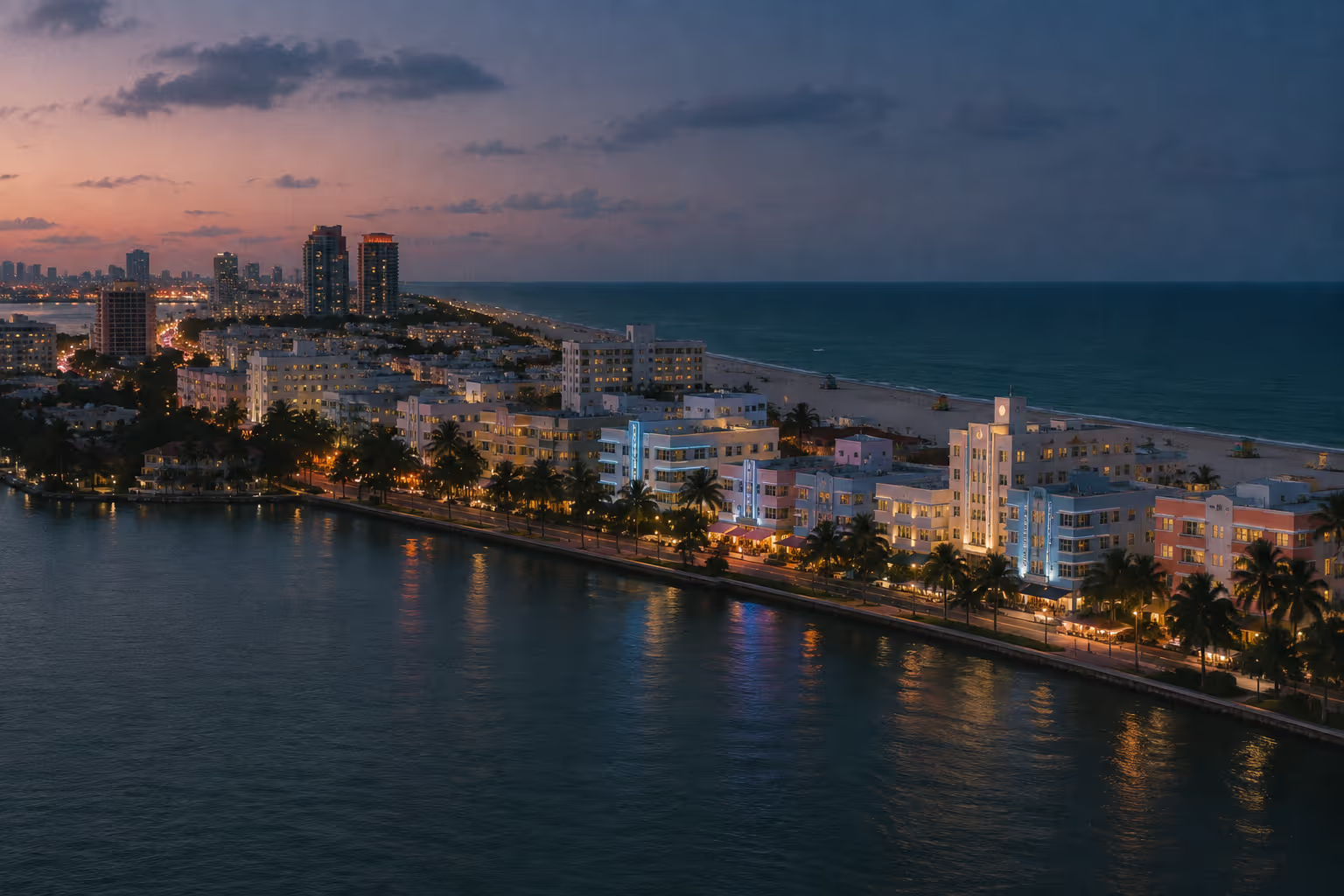
The City of Miami Beach counts more than 800 Art Deco buildings from 1923 to 1943 (18), and South Beach holds the country’s largest concentration of Art Deco architecture (15). That’s before you’ve crossed the causeway to Wynwood’s murals or Little Havana’s Calle Ocho. The best things to do in Miami Florida sort into four areas: the beach and Art Deco district, the Wynwood street-art blocks, Cuban-American Little Havana, and the national parks to the west and south. This guide ranks what’s worth your limited days, what costs money, and what you can skip.
✓ Pros
- A mix of built heritage, neighborhood culture and outdoor excursions makes it easy to vary the pace of a short trip.
- Several signature experiences work well without an admission ticket, leaving room to choose one paid activity.
✗ Cons
- The coastal and mainland highlights are spread out, so the order of your days can affect how much time you lose in transit.
- Water-based outings and park visits are less flexible than neighborhood walks because they depend on departures, access conditions or both.
Miami Attractions at a Glance
The main Miami attractions for a first-time visitor are South Beach, Wynwood Walls, Little Havana and a day trip to Everglades or Biscayne National Park. Each one needs anywhere from half a day to a full day. The visitor bureau’s first-timer advice leads with South Beach’s architecture and beach (19). The National Park Service lists boating, snorkeling, wildlife watching and fishing at Biscayne (1). Those two sources frame the right approach: pair at least one neighborhood with at least one outdoor day.
The four areas differ enough that you should decide before you land which ones fit your trip:
- South Beach: beach, Art Deco architecture and waterfront parks. It takes a full day if you add a walking tour, and it suits first-timers and families.
- Wynwood Walls and the Wynwood Arts District: a ticketed mural compound surrounded by free outdoor street art. Plan on a morning. It suits photographers and art fans.
- Little Havana: Calle Ocho’s coffee counters, cigar shops, the Walk of Fame and a monthly street festival. Budget a half day, or longer on the last Friday of the month. It suits food-focused travelers and culture seekers.
- Everglades (Shark Valley) and Biscayne National Park: sawgrass marsh reached by tram, bike or on foot, or a bay reached by boat. Each takes a half day to a full day, and you need a car or a booked tour. It suits wildlife watchers and anyone who wants time away from the city.
The costs line up the same way. South Beach, Calle Ocho and the Wynwood murals outside the gates cost nothing to walk. Wynwood Walls is ticketed (23), and Biscayne boat cruises are the priciest item in this guide, at $65-90 on the Biscayne National Park Institute’s cruise listings in October 2026 (2).
Miami’s strengths are easy to list. Beach time, architecture, Cuban-American food and two national parks all sit within a day’s drive of each other, and most neighborhoods are walkable once you’re there. The trade-offs are just as specific:
- Shark Valley has midday waits.
- Wynwood Walls charges admission.
- Neither park works without a car or a pre-booked tour.
What is Miami’s main attraction? For most visitors it’s South Beach. It holds the beach, Ocean Drive and the Art Deco district in one walkable strip, and the City of Miami Beach says it has the world’s largest collection of Art Deco buildings (18). If you only have a day, spend it there. If you have three, South Beach should fill one of them, not all three.
Miami Experiences at a Glance
| South Beach | Wynwood Walls | Little Havana | Shark Valley (Everglades) | Biscayne National Park boat tour | |
|---|---|---|---|---|---|
| Type of experience | Beach, architecture and waterfront parks | Ticketed mural compound and galleries | Cuban-American culture, food and street life | Sawgrass marsh by tram, bike or on foot | Bay, islands and reefs by boat |
| Time needed | Full day | A morning, including nearby murals | Half day; longer on the last Friday of the month | Half day to full day | 2-4 hours for most listed cruises |
| Cost | Free to walk; paid parking may apply | Adults $12; children 12 and under free (23) | Calle Ocho walk is free; food tours are paid | Entrance pass required; see the NPS fees page | $65-90 as of October 2026 |
| Best for | First-timers and families | Art fans and photographers | Food-focused travelers and culture seekers | Wildlife watchers and active visitors | Visitors who want a water-based park outing |
South Beach and Ocean Drive’s Art Deco Coast
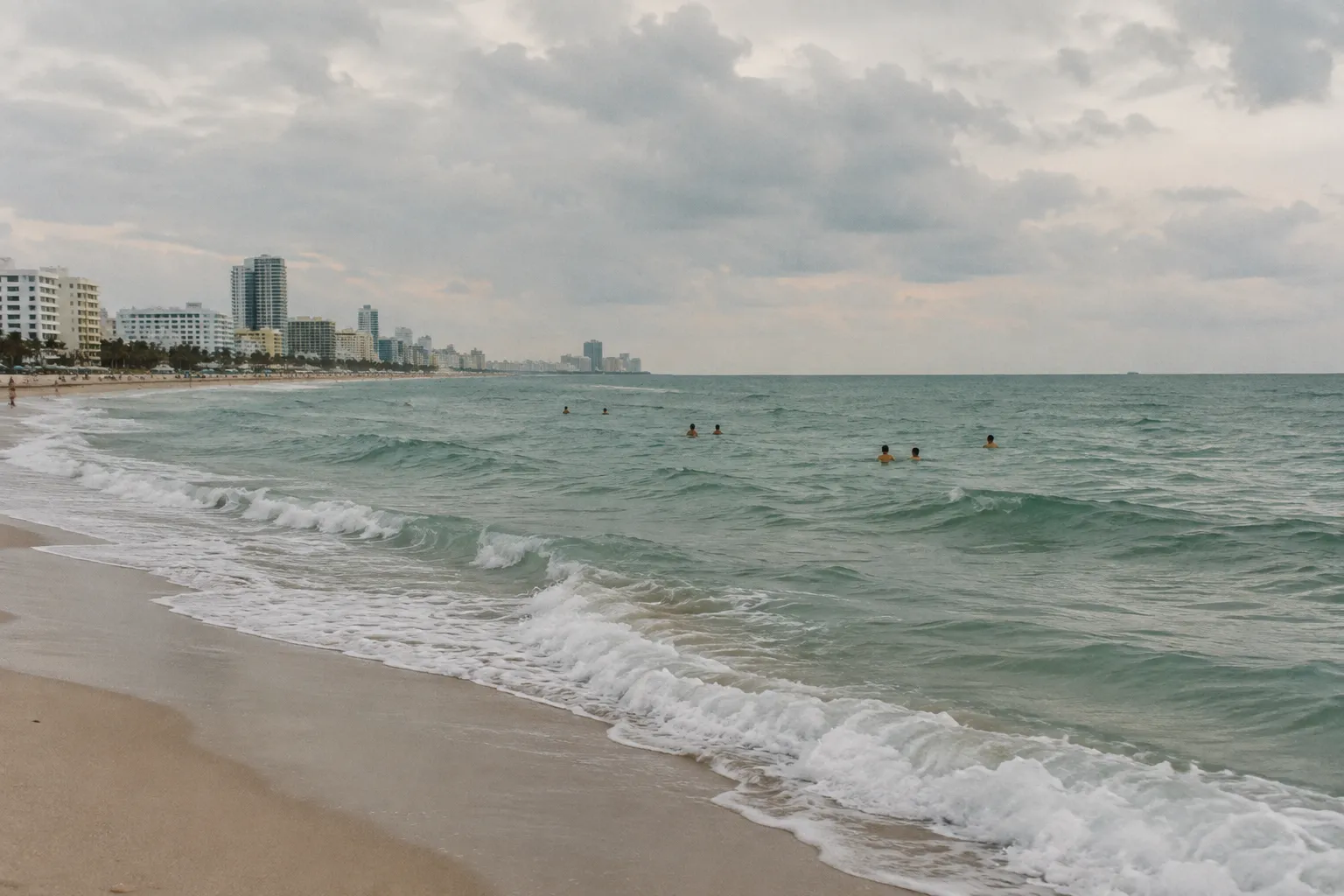
South Beach combines a wide public beach, the Art Deco Historic District and two waterfront parks along one walkable stretch of Ocean Drive. Most visitors can cover it in a single day on foot. The mistake is treating it as only a beach day. The architecture sits one block from the sand, and South Pointe Park at the southern tip offers a calmer alternative to the Lummus Park crowds.
Ocean Drive and the Art Deco Historic District
Ocean Drive is the spine of the Art Deco Historic District. The pastel facades and geometric trim you’ve seen in TV shows line the street directly across from the beach (15)(17). According to the City of Miami Beach, the city holds over 800 Art Deco properties built between 1923 and 1943 (18). The architecture is visible from the sidewalk, so you don’t need a ticket to see the best of it.
The Art Deco Welcome Center on Ocean Drive is the logical starting point. It houses the Official Art Deco Exhibition Gallery, which explains the district’s architectural heritage (16)(17). From there you have three ways to see the buildings:
- Guided walking tour (worth the detour). The Miami Design Preservation League runs two-hour walking tours covering Art Deco, Mediterranean Revival and Miami Modern (MiMo) styles (15). The visitor bureau describes the tour as daily (17). Take this if you can tell a porthole window from a keystone facade and want to know why they’re there. Guides also point out the buildings used as film and TV backdrops.
- Self-guided tour. The same preservation league offers a downloadable self-guided route (15). It’s the better pick if you’re traveling with kids or want to stop for coffee every three blocks.
- Citi Bike. Renting a bike and riding Ocean Drive and the Miami Beach Boardwalk covers more ground than walking. You lose the detail, though (17).
A practical self-guided route is to walk the ten-block Lummus Park stretch of Ocean Drive, from 5th to 14th streets (15)(16). That route puts beach on one side of you and many of the district’s more than 800 preserved Art Deco buildings on the other (17). Walk it in the morning, when the facades face softer light and the sidewalk café crowd hasn’t set up yet.
Two museums sit inside the district if the weather turns. The Wolfsonian-FIU holds one of the largest American university collections devoted to design, propaganda and the decorative arts, and The Bass is Miami Beach’s contemporary art museum (16). Both are “skip if short on time” for a first visit. Neither beats walking the district itself.
If your dates are flexible, look at Art Deco Weekend, a free festival on the district’s architecture that the Miami Design Preservation League has organized since 1977, with support from the city (18). Check the festival’s current dates before you build a trip around it.
Lummus Park’s Ten-Block Beach Stretch
Lummus Park is where most South Beach time happens. It runs along Ocean Drive from 5th to 14th streets, and at all hours you’ll find runners, walkers and picnicking families (15). The park has a playground, volleyball nets and two outdoor gyms (15). The sand in front of it is where the visitor bureau sends first-timers for a beach day. It’s also where you’ll find the colorful lifeguard stands and the Muscle Beach workout crowd if you arrive early (19).
Here’s what the postcards don’t tell you. Lummus Park is the most crowded, least relaxing section of Miami Beach precisely because everyone starts here. It’s worth the detour for the lifeguard towers, a morning swim and the people-watching. After that, if you want a long, quiet beach afternoon, walk south.
Ocean Drive’s sidewalk restaurants are the other overrated piece. They’re convenient and the views are real, but read the menu’s fine print and your bill line by line before you pay. Walk a block or two inland if you want more choice.
South Pointe Park for Quieter Waterfront Time
South Pointe Park sits at the southern tip of South Beach at 1 Washington Avenue. According to the City of Miami Beach, it’s open daily from sunrise to sunset (10). It’s the best answer to “what can you do on the Miami waterfront besides the beach,” and it’s where South Beach feels least like a scene.
The park has beach access, seating, public restrooms near the concession, a water fountain and paid parking (10). For families, it’s a stronger pick than Lummus. The playground sits beside the water and includes a splash spray zone, with separate areas for ages 2-5 and 5-12 (10). There’s also a Bark Park if you’re traveling with a dog (10).
The closing time is the logistics catch. Sunrise-to-sunset hours mean you can’t linger after dark, so arrive at least an hour before sunset if you want to watch it from the water’s edge. A good full South Beach day runs in this order:
- Art Deco tour in the morning.
- Beach time at Lummus Park midday.
- A walk south to South Pointe Park for late afternoon.
Pairing Lummus Park and South Pointe Park covers the waterfront without spending anything on admission.
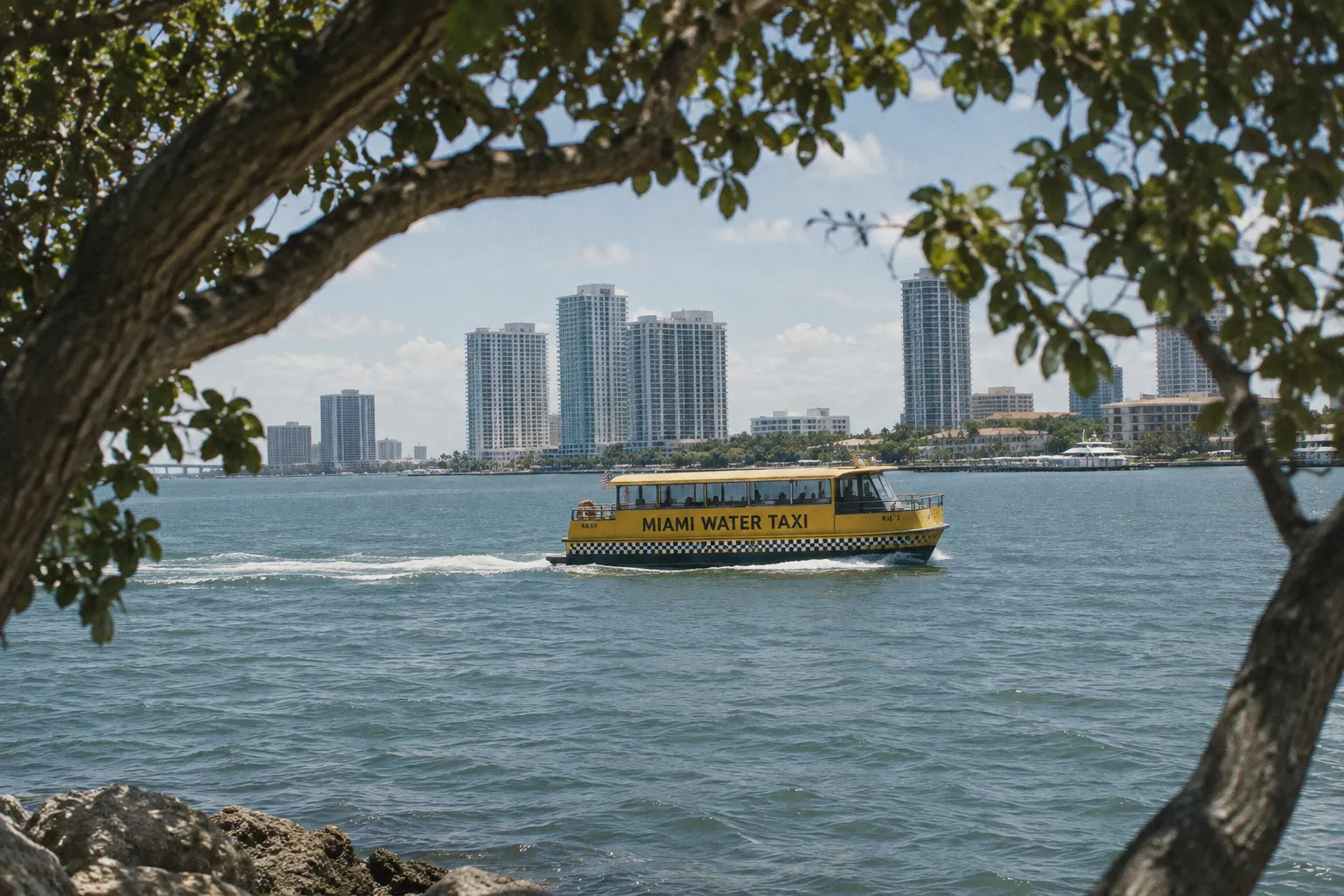
If you’re staying downtown, the free water taxi between Miami Beach and Downtown Miami takes about 20 minutes (16). It runs Monday through Friday, every 60 minutes from 7:00 a.m. to 4:30 p.m. and every 30 minutes from 4:30 p.m. to 7:30 p.m. (25). You board at Maurice Gibb Memorial Park in Miami Beach or the Venetian Marina & Yacht Club downtown (16). There’s no weekend service, and it doesn’t run on observed federal holidays (25), so Saturday and Sunday plans need a car, a rideshare or a bike.
Wynwood Walls and the Street Art District
Wynwood Walls is a ticketed open-air street art museum featuring murals, sculptures and an indoor contemporary urban art gallery (23). The surrounding Wynwood Arts District has additional murals you can see free from the sidewalk. Knowing where the gate is, and what’s on both sides of it, is the whole planning job here.

Wynwood Walls: What’s Inside and What It Costs
Inside the gates, Wynwood Walls shows murals and sculptures, plus an indoor gallery of contemporary urban art. As of October 2026, general admission is $12 for adults (18 and over), $10 for seniors (65 and over), $5 for youth aged 13 to 17, and free for children 12 and under (23). The Walls lists its hours as 10:30 a.m. to 6:30 p.m. daily, with doors closing 30 minutes before closing time (27). Ticket tiers and hours change, so confirm both on the official Wynwood Walls site before you go.
Is it worth paying for? If street art is a main reason you’re in Miami, yes. The compound concentrates large, well-maintained pieces in a space built for viewing them, and the galleries add work you won’t see on the street. If you’re lukewarm on murals and short on time, the free walls outside cover much of the appeal. Rank it “worth the detour” for art fans and “skip if short on time” for everyone else.
The entrance is at 2516 NW 2nd Ave (27). For peak-season weekends, buy ahead online so you’re not queuing on the sidewalk, and leave time for the free murals outside after the compound.
Free Murals Just Outside the Gates
The common mistake with Wynwood is treating Wynwood Walls as the entire attraction. It isn’t. Murals cover building exteriors, shutters and side walls throughout the surrounding blocks, and you don’t need a ticket to see them. Many first-time visitors pay admission, see the compound and leave without realizing the neighborhood outside is part of the same experience.
The simplest approach is to see the ticketed Walls first, then walk the streets around them with no fixed route. New pieces go up and old ones get painted over, so any printed “top murals” list is out of date the moment it’s published. Keep your camera out and expect to stop every half block.
Exploring the Wider Wynwood Arts District
The wider Wynwood Arts District is a grid of converted warehouses. Its murals, galleries, breweries and cafés run for several blocks in each direction from the Walls. The mural walk outside the gates is free and self-paced, and it’s where you’ll get most of your photos without the compound’s crowd in the frame.
A few practical notes:
- Go in the morning. Wynwood has very little shade between buildings, and midday light flattens mural colors in photos.
- Wear real walking shoes. The sidewalks are uneven in places, and the best walls are spread out.
- Combine it with Little Havana or downtown, not South Beach. Wynwood sits on the mainland side, so pairing it with the beach means crossing the causeway twice in one day.
For readers asking “what should I visit in Wynwood,” the ranked answer is short. The outdoor murals come first because they’re free and extensive. Wynwood Walls comes second if you care about the curated pieces and galleries. Everything else is optional.
Little Havana and Calle Ocho’s Cuban Culture
Little Havana, just west of Downtown Miami, centers on Calle Ocho (Southwest 8th Street), where Cuban coffee counters, cigar shops, restaurants and the Calle Ocho Walk of Fame line the sidewalk (8). The neighborhood took its name when Cuban immigrants arrived in Miami in the 1960s. The National Trust for Historic Preservation has declared it a National Treasure (8).
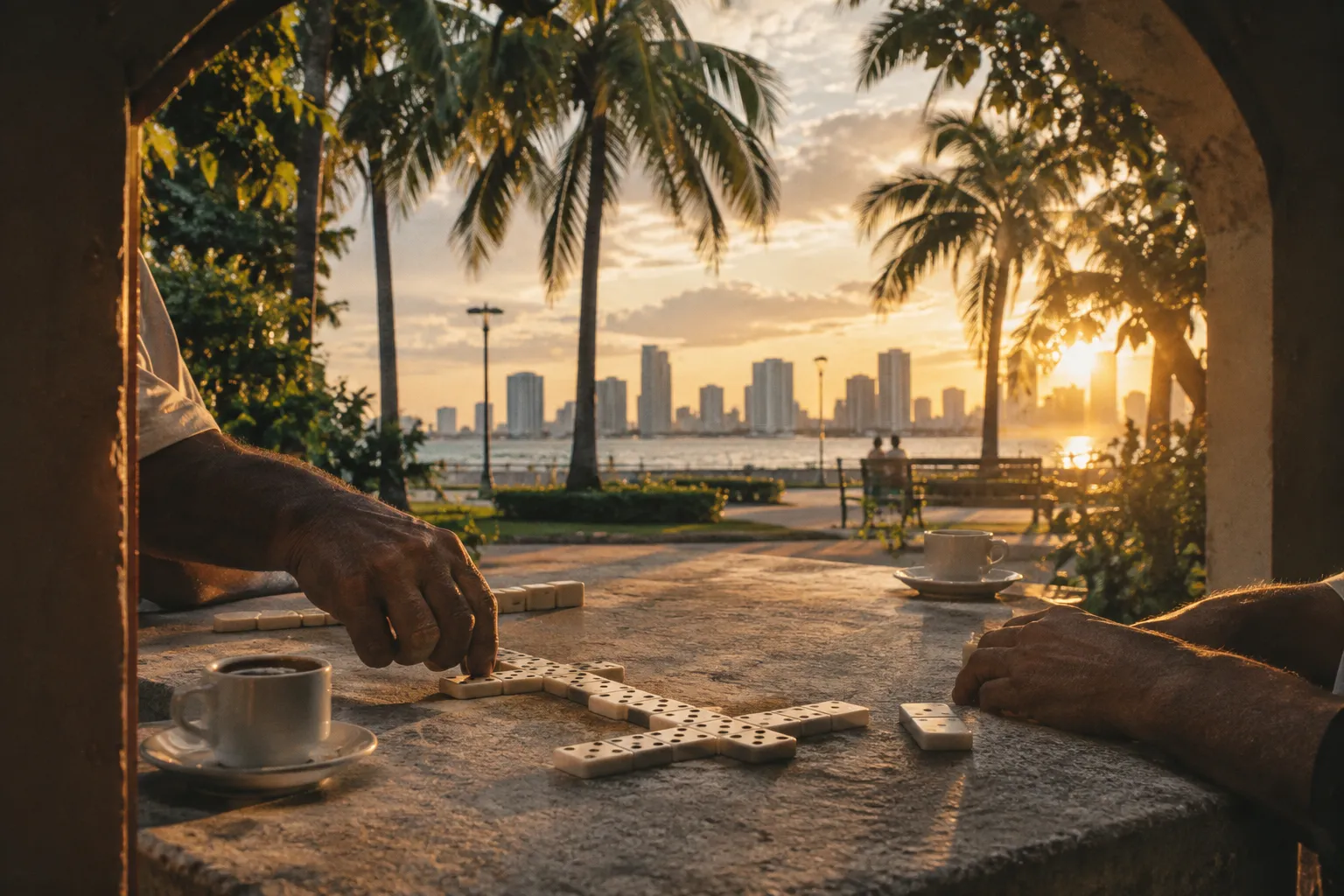
The planning decision here is how you visit. You can browse on your own, book a scheduled food tour, or time your trip to the free monthly street festival. Each one gives you a different Little Havana.
Browsing Calle Ocho on Your Own
Calle Ocho’s main stretch runs between SW 21st and SW 10th avenues (8). You’ll know you’re there when you see the colorful rooster sculptures along the road. They’re six-foot (1.8 m) figures dressed as farmworkers, carpenters or doctors, and they serve as an emblem of Cuban pride (9).
The Calle Ocho Walk of Fame spans 12th to 17th avenues (8)(9). Stars set into the sidewalk carry the bronze-lettered names of Cuban and Latin American icons, including Celia Cruz and Gloria Estefan (9). The Tower Theater is another landmark along the way (8).
The cigar shops are worth the detour even if you don’t smoke. You can watch cigars being hand-rolled, and the smell carries along the sidewalk near the factories (9). You must be over 21 to buy (9).
The Little Havana Visitor Center is the usual suggested first stop. It’s where you learn local history, sample Cuban coffee, buy souvenirs like dominoes and fedoras, and find out which walking and food tours run (8)(9). Don’t build your morning around it, though. The visitor bureau’s listing says its hours vary and advises calling ahead (13), while Viernes Culturales, the nonprofit that manages the neighborhood’s official welcome center, lists it as open daily from 10 a.m. to 4 p.m. (24). Call before you go, and have a backup plan of walking straight to the Walk of Fame if it’s closed.
A route tip worth knowing: the Tamiami Trail (U.S. Highway 41), which runs west to the Everglades, is also Southwest 8th Street (12), the same road that runs through Little Havana as Calle Ocho. That makes Calle Ocho a natural stop on the drive back from Shark Valley. We use that pairing in the itinerary below.
Little Havana Food and Culture Tours
For readers asking where to get a Cuban sandwich or what a Little Havana food tour covers, a guided tour answers both questions in one booking. The visitor bureau lists food-and-culture walks lasting 2.5 hours and three hours (8). The 2.5-hour Little Havana Food and Cultural Tour from Miami Culinary Tours includes tastings from Cuban restaurants and visits to cigar shops to see cigars being made. It also covers the history of the Cuban exile community (8).
Should you book one? Here’s the decision rule:
- Book the tour if it’s your first time in Little Havana, you don’t speak Spanish, or you want context on why the neighborhood looks the way it does. The history is the part you won’t get by wandering.
- Go solo if you already know Cuban food, you’re on a tight budget, or you’d rather linger at one coffee counter than follow a 2.5-hour tour.
Because the Visitor Center’s published hours disagree (13)(24), a scheduled tour (8) is the more reliable anchor for a Little Havana visit. Book it for late morning. You’ll hit the restaurants at lunch without the evening crowd.
Viernes Culturales: The Last-Friday Street Festival
Viernes Culturales is a free cultural festival (8) held on the last Friday of each month, starting at noon on Calle Ocho (24). The organizers list its 2026 dates on their site, including October 30 and November 27 (24). It features live music, dancing and work by more than 30 local artists and artisans (24), and it’s the best alternative to clubbing in Miami if you want an evening out that isn’t a nightclub.
If your trip dates overlap the last Friday of the month, move your Little Havana day to Friday afternoon and stay into the evening. It’s the single most efficient scheduling move in this guide. You get live music, local artists and a busy Calle Ocho without paying a cent for admission. Arrive in mid-afternoon to walk the Walk of Fame before the evening crowd builds, then stay for dinner.
Don’t rearrange a whole trip around it, though. On any other day of the month, Calle Ocho still delivers the coffee, cigars and Walk of Fame. You’re only missing the festival’s music and artists.
Everglades Day Trip from Miami and Biscayne National Park
An Everglades day trip from Miami works best through Shark Valley, 30 miles (48 km) west of the city (11). Biscayne National Park is 95% water, so most of it is reached by boat (1). Both need a car or a reserved tour, and both reward arriving early. They’re different experiences, too. Shark Valley is freshwater sawgrass marsh seen from a paved loop, while Biscayne is open bay, mangrove-lined islands and reefs seen from a boat.
Before you choose either, check current conditions. Shark Valley closed temporarily for wildfire in August 2026, and the National Park Service lifted the emergency closure at 1 p.m. on August 24 (22). When the reopening was announced, one fire was still being suppressed and monitored in the sawgrass prairie south-southwest of the observation tower (22). NPS directs visitors to the Everglades Current Conditions page at nps.gov/ever/planyourvisit/conditions for updates (22).
Shark Valley: The Closest Everglades Entrance
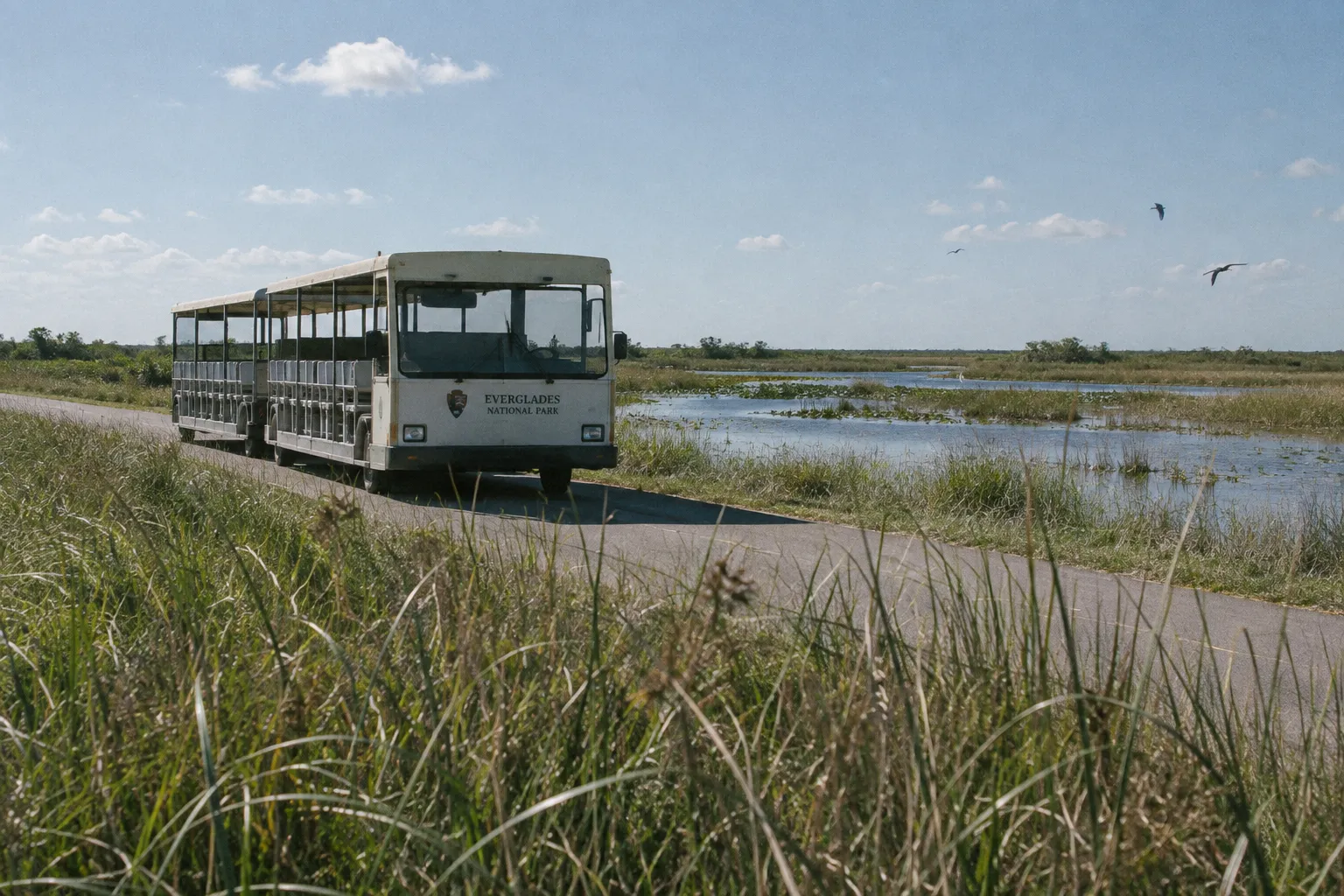
Shark Valley is the Everglades entrance closest to Greater Miami. It sits 30 miles (48 km) west of Miami off the Tamiami Trail (U.S. Highway 41), in the heart of the Everglades freshwater marsh (11)(12). The core experience is a 15-mile (24 km) loop road into Shark River Slough. You can walk, bike or take a narrated tram ride along it (11). Halfway around the loop, a 70-foot (21 m) observation tower gives you a panoramic view over the sawgrass marsh (11).
Private vehicles can’t go past the entrance road and parking lot. You reach the tram road and tower on foot, by bicycle or by tram only (20). Guided tram tours, bicycle rentals, snacks and soft drinks are available from Shark Valley Tram Tours (11). There are also two short walking trails off the main trail, one of them accessible (11).
Here’s how the options rank:
- Tram tour (worth the detour for first-timers). You get the full loop, a narrator who spots wildlife you’d miss, and no 15-mile ride in the heat.
- Bike rental. It’s the better choice if you’re fit and want to stop wherever you like. Bring more water than you think you need, since the loop is flat but exposed.
- Walking. Walk only if you’re doing a short out-and-back or the side trails. Few visitors walk the full loop.
The thing most guides get wrong about the Everglades is treating it as one park you drive through. It isn’t. The park’s entrances do not connect, so you cannot drive between Ernest F. Coe, Shark Valley or Gulf Coast from inside the park (14). Each of the three entrances and the interior Flamingo Visitor Center is at least a one-hour drive from the others (12). Shark Valley alone is 50 miles (80 km) from the Ernest F. Coe Visitor Center (11). Pick one entrance per day. For a Miami-based trip, that’s Shark Valley. If you’d rather see the western Everglades, our Naples guide covers the Gulf Coast side.
A few more access rules:
- You need your own car. There’s no public transportation to Shark Valley, and NPS warns that visitors arriving by Uber, Lyft or taxi often can’t get a return ride (20)(12). Arrange your return with your driver or book a tour with transport included.
- Download everything first. Cell service is limited, so save maps and park information before you leave Miami (14).
- Buy your pass ahead. Entrance passes are sold online or in person at the Shark Valley and Homestead entrances (20). NPS says buying a digital pass before you arrive can cut your wait at the gate (12).
Timing Your Visit to Beat the Midday Crowds
At Shark Valley, NPS says to expect long waits between 10 a.m. and 3 p.m. Parking fills quickly and may operate as one car in, one car out (20). That window is the entire reason to plan this day carefully.
The decision rule:
- Arrive before 10 a.m. This is the best option. Open the day at the gate, get a parking spot, and start the loop before the midday queue forms.
- Arrive after 3 p.m. This is the fallback, but check the hours first. NPS lists Shark Valley’s hours as 8:30 a.m. to 5:00 p.m. from mid-December to mid-April, and 9:00 a.m. to 4:30 p.m. from mid-April to mid-December (11). An after-3 p.m. arrival leaves you 90 minutes to two hours, which is enough for a short walk or the tower but tight for the full loop.
- With a booked tram tour, arrive 1.5 to 2 hours before your scheduled time (20). That buffer is for parking, not the tram line.
Winter weekends are the worst case. NPS says the Homestead and Shark Valley entrances can become extremely congested, with long lines at the gates and parking that’s difficult or impossible to find (12). The park recommends weekdays, arriving before 10 a.m. and carpooling (12). For current access conditions on the day, call Shark Valley at 305-221-8776 (20).
Biscayne National Park Boat Tours: Homestead vs Coconut Grove
Biscayne National Park is 95% water, with only one mile (1.6 km) of paved roadway. You need some kind of watercraft to reach most of it (1). That makes it a boat trip, not a hiking park. The park lists boating, snorkeling, diving, fishing and wildlife watching among its activities (1). Campgrounds on Boca Chita and Elliott keys are reachable only by boat (1).
The Biscayne National Park Institute runs guided eco-trips in the park, including snorkeling, island cruises, sailing and trips to Jones Lagoon (4). Boat trips depart from locations including Homestead and Coconut Grove (2). Your departure point matters because Homestead is well south of the city while Coconut Grove is inside Miami.
Here’s how the main options compare, with prices from the Institute’s own listings in October 2026:
- Heritage of Biscayne Cruise, from Homestead: $83, 3.5 hours. It crosses the bay along the northernmost Florida Keys and includes a stop at Boca Chita Key, Elliott Key or Adams Key (2). Pick this if you want an island landing included.
- Boca Chita Key Heritage Cruise, from Coconut Grove: $83, four hours, daily. It visits Boca Chita Key and Stiltsville (2). This one suits you if you want the island stop without driving to Homestead.
- Stiltsville guided boat tour, from Coconut Grove: $70, two hours (2). It’s the shortest cruise with a listed duration, and the one to book if your time is tight or you’d rather add Biscayne to a half day than give it a full one.
- Other listings: evening cruises cost $68 from Coconut Grove, or $65 from Homestead, where the sunset cruise runs from November to February. A four-hour cruise from Deering Estate is the priciest, at $90 (2).
A weather note matters for winter trips. The Institute says cold fronts can make exploring the Atlantic Ocean reefs impossible, while the bay’s calmer waters stay usable (2). If you visit in winter and a front comes through, a bay cruise is the safer booking than a reef snorkel.
On booking, the National Park Service advises advance reservations for guided trips (4). You can book through the Biscayne National Park Institute link on the NPS guided tours page, by calling 786-335-3644, or at the park store (4). NPS also lists other authorized operators, including sightseeing and snorkeling charters in the Stiltsville area (4).
Shark Valley or Biscayne? Choose Shark Valley if you want alligators, birds and the sawgrass horizon, and you’re fine with an early start. Choose Biscayne if you want to be on the water, you’re traveling with people who won’t enjoy a 15-mile (24 km) loop, or you’d rather book one fixed time slot than manage parking queues. With only one outdoor day to spare, most first-timers get more from Shark Valley. With two, do both.
Things to Do in Miami Florida: Itineraries, Budget, and Timing
A three-day Miami trip covers South Beach, one mainland neighborhood pairing, and one outdoor day at Shark Valley or Biscayne National Park. Budget pressure comes mostly from lodging, not attractions. Most of the core sights in this guide cost nothing to walk, and the paid items (Wynwood Walls and Biscayne boat trips) are listed below.
A Sample 3-Day Miami Itinerary
This is a 3-day plan covering three areas plus one national park. It assumes you have a car for Day 2. Without a car, swap Day 2 for a Biscayne boat trip from Coconut Grove.
Day 1: South Beach, full day
- Morning: start at the Art Deco Welcome Center and take the Miami Design Preservation League’s two-hour walking tour, or the self-guided route (15).
- Midday: beach time and a swim in front of Lummus Park, between 5th and 14th streets (15).
- Late afternoon: walk south to South Pointe Park and arrive at least an hour before sunset, since the park closes at sunset (10).
Day 2: Everglades day trip from Miami, then Little Havana
- Early morning: drive 30 miles (48 km) west on the Tamiami Trail to Shark Valley and reach the gate before 10 a.m. (11)(20).
- Late morning: take the tram or bike the 15-mile (24 km) loop to the 70-foot (21 m) tower (11).
- Afternoon: drive back east on the same highway, which becomes Calle Ocho in Little Havana. Walk the Walk of Fame between 12th and 17th avenues (8). If it’s the last Friday of the month, stay for Viernes Culturales into the evening (24).
Day 3: Wynwood and the water
- Morning: Wynwood Walls when it opens, then the free outdoor murals in the surrounding blocks.
- Afternoon: the two-hour Stiltsville boat tour from Coconut Grove (2), or a 2.5-hour Little Havana food tour if you’d rather eat than cruise (8).
What should you not miss? On a first trip, don’t skip the Art Deco district, Calle Ocho and at least one of the two national parks. Those are the three things you can’t get in another beach city. Everything else is optional.
What to cut if you’re short on time: the South Beach museums, a second Wynwood visit, and any attempt to hit two Everglades entrances in one day.
Is $1,000 Enough for a Miami Trip?
Whether $1,000 covers a Miami trip depends almost entirely on where you’re flying from and where you sleep. Hotel and flight prices swing too much by date to quote here. What we can tell you is that the attractions are not where the money goes.
Here are the listed costs from this guide, as of October 2026:
- Wynwood Walls adult admission is $12 (23).
- The Stiltsville boat tour from Coconut Grove costs $70 (2).
- The Heritage of Biscayne Cruise from Homestead costs $83, as does the Boca Chita Key cruise from Coconut Grove (2).
Several highlights of this trip carry no admission charge:
- The Art Deco district from the sidewalk.
- The beach at Lummus Park.
- South Pointe Park (parking is paid) (10).
- The murals outside Wynwood Walls.
- The Calle Ocho Walk of Fame.
- Viernes Culturales.
- The weekday water taxi between Miami Beach and downtown (16).
Everglades entrance passes are sold online and at the Shark Valley and Homestead gates (20). Check the NPS fee page for the current rate.
Your real budget variables are lodging, car rental (needed for Shark Valley), parking and meals. To stretch a limited budget, lean on the free list above. Book one paid outdoor experience instead of two. Eat in Little Havana rather than on Ocean Drive.
Best Times to Visit: Weekends, Families, and Couples
The best time to visit Miami for most travelers is a weekday in the dry season, which NPS puts at about December to mid-May in the Everglades (26). Late April is the best single month: you’re still in the dry season, but at the tail end of the December-to-April peak that NPS describes at Shark Valley (20). The trade-off is that Shark Valley switches to its shorter hours from mid-April, 9:00 a.m. to 4:30 p.m. (11). Arrive early regardless.
Other timing notes by traveler type:
- Weekend trips: the free water taxi runs Monday through Friday only (16). Winter weekends also bring the longest gate lines at Shark Valley, with waits that can top an hour on the busiest ones (20). For a weekend visit, put South Beach on Saturday and the Everglades on a weekday if you can extend.
- Families: South Pointe Park’s waterside playground and splash zone make it the easiest family stop (10). Lummus Park also has a playground (15). The city also lists no-school-day, winter break and spring break programs on the South Pointe Park page (10).
- Couples: time your trip for the last Friday of the month and spend the evening at Viernes Culturales (24). Add the two-hour Stiltsville boat tour in the afternoon (2).
- Summer and fall: the Atlantic hurricane season runs June 1 to November 30 (26). Watch the forecast, and buy travel insurance that covers weather cancellations.
- Winter: cold fronts can shut down reef trips at Biscayne, though bay cruises continue (2).
Frequently Asked Questions
- What should you not miss in Miami?
- For a first visit, choose one defining neighborhood and one outing beyond the city; that pairing gives the trip contrast without packing every day.
- What should I do with three days in Miami?
- Give each day a clear geographic focus: the beach district, a mainland neighborhood, and a separately planned outdoor excursion.
- What is Miami's main attraction?
- South Beach is the most recognizable starting point, while visitors who prefer wildlife and open landscapes may value a park day more.
- Is $1,000 enough for a Miami trip?
- It may cover a trip with modest transport and lodging costs, but airfare, accommodation and car rental will determine whether that budget holds.
- What can I do in Miami besides the beach and nightlife?
- Look for neighborhood-specific experiences: local food and cultural events, outdoor murals, or a guided trip into the nearby national parks.
- Where can I see Art Deco architecture in Miami?
- Start in South Beach's Art Deco Historic District and walk the streets around Ocean Drive; the buildings are visible from public sidewalks.
- How do I get from Miami to the Everglades or Biscayne National Park?
- Plan separate transport for each park: Shark Valley requires a road trip, while reaching much of Biscayne means joining a boat trip.
- When is the best time for a weekend or seasonal visit to Miami?
- Late April is a useful shoulder-season choice; for weekend park visits, schedule the Everglades early and verify conditions before setting out.
Planning Your Miami Days
Don’t try to rush all four areas. Pick one neighborhood that fits your interests and give it a full day: South Beach for architecture and beach, Wynwood for murals, or Little Havana for food. Then match it with one outdoor day, either Shark Valley before 10 a.m. or a booked Biscayne boat trip. With three days, add a second neighborhood. Traveling with kids who want rides? Our guide to Miami’s amusement parks ranks the options, and our West Palm Beach guide covers the next stop up the coast.
Before you leave the hotel on park day, check the Everglades Current Conditions page and the Biscayne National Park alerts. Download your maps while you still have cell service, and book the Biscayne cruise before you book anything else. It’s the one item on this list that can sell out.