Visiting Mount Rushmore costs nothing at the gate because there is no entrance fee, but you’ll pay $10 per vehicle to park, or $5 if you’re 62 or older (15). That single parking ticket covers unlimited entry for a full year (15), which matters if you’re basing yourself in the Black Hills for several days. Everything else comes down to timing: when to arrive, how much of the Presidential Trail to walk, and whether the evening program is running the week you’re there.
The case for going is simple. There’s no entrance fee, the grounds are open every day of the year, the sculpture is lit every night at no extra charge, and two strong add-ons (Crazy Horse Memorial and Custer State Park) sit within an easy drive. The downsides are few. The parking fee is mandatory and no federal pass covers it (15), the full trail loop is stair-heavy (7), and the ranger-led evening program only runs from late May through September (1).
✓ Pros
- No admission charge makes a short stop easy to fit into a Black Hills itinerary.
- The year-round nightly illumination leaves you an evening option outside ranger-program season.
- Nearby memorial and park stops give you ways to build a varied day.
✗ Cons
- The parking charge applies even when a federal pass is in your wallet.
- The full trail loop is a poor fit if stairs are a problem.
- The ranger-led evening program is seasonal, so some visits have no scheduled ceremony.
Visiting Mount Rushmore: Entrance Fees, Parking, and Tickets Explained
Mount Rushmore National Memorial charges no entrance fee, so the only mandatory cost is a concession-run parking fee (2) of $10 per vehicle (15). Mount Rushmore tickets in the theme-park sense don’t exist. You won’t buy an admission ticket online, and you don’t need a reservation for a daytime visit or for the evening program (2). The “ticket” people talk about is the parking ticket you get at the garage entrance.
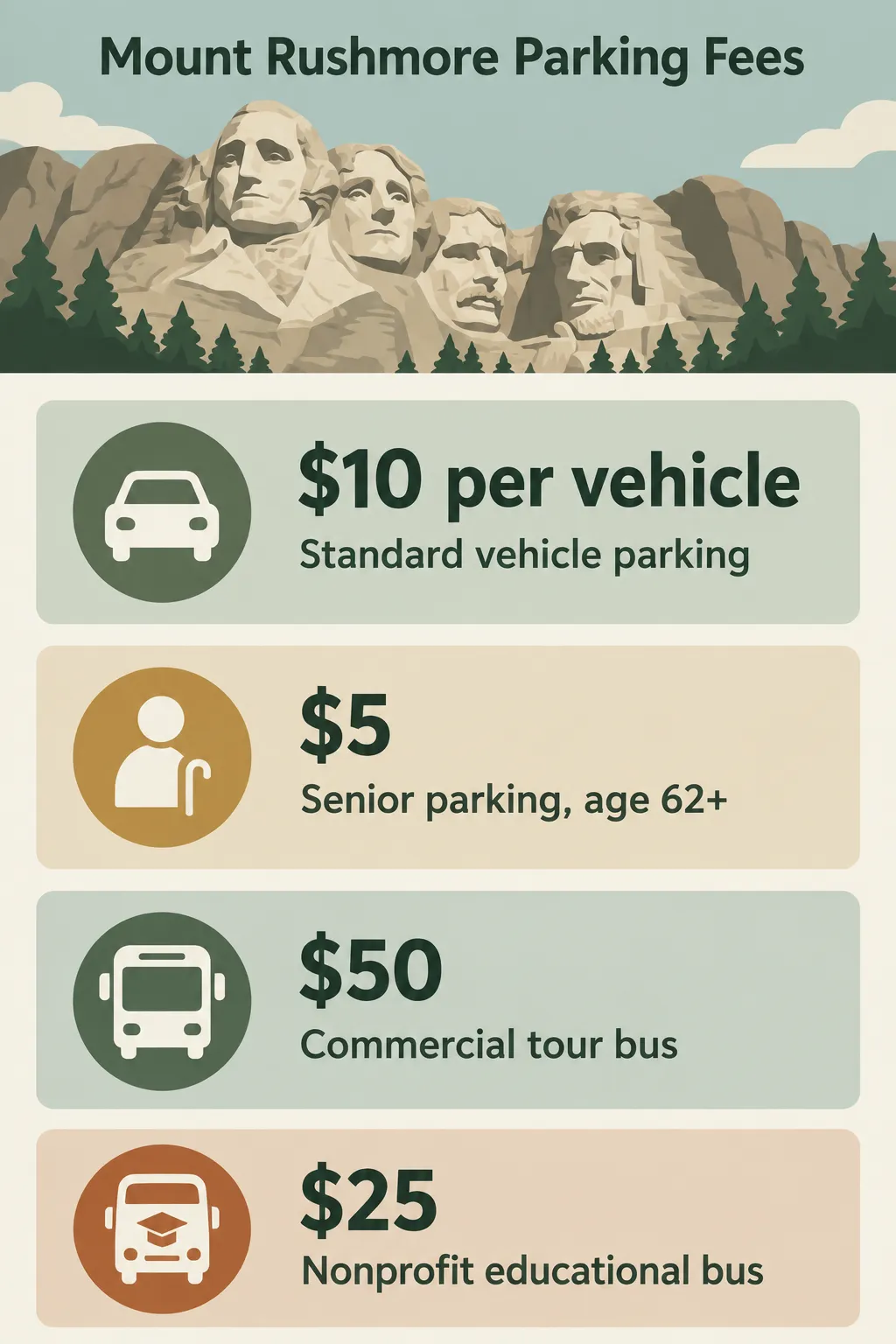 As of November 2026, Mount Rushmore parking costs $10 per vehicle, $5 for seniors age 62 and older, $50 for a commercial tour bus, or $25 for a nonprofit educational bus (15).
That fee is easy to miss in trip planning because the National Park Service runs the memorial. The parking facility is run by a different operator: Xanterra Travel Collection operates it under a concession contract with the NPS (15). That split explains most of the confusion about who you’re paying and why your park pass doesn’t help.
The parking fee and what it buys you
As of November 2026, the NPS parking page lists these rates (15):
- $10 per vehicle for standard visitors
- $5 for seniors age 62 and older
- Free for active-duty military
- $50 for a commercial tour bus, valid for 24 hours from first entry
- $25 for a nonprofit educational bus, valid for 24 hours from first entry
For a non-commercial vehicle, the parking ticket allows unlimited entry to the memorial for one year from the date of purchase (15). In practice, you can do a morning visit, leave for Crazy Horse Memorial or Custer State Park, and come back for the evening lighting without paying again. You can also return on a later trip within the year. For visitors 62 and older, the deal is better still: half the standard rate for the same year of re-entry (15).
You can pay with cash or most credit cards. At very busy times the entry gates switch to ticket kiosks and you pay after parking; if you pay at the exit kiosk instead, it takes credit cards only and gives no senior or active-duty military discount (15). For parking questions, call Xanterra directly at 605-574-2515 (15).
The garage also has a few practical extras (15):
- Six EV charging stations on Level Two
- A free tire inflation station near the exit of Level Four
- A limited number of bicycle lockers on Level One. Ask the parking attendants at the entrance gate about using them.
If anyone in your group has a mobility impairment, enter through lane 4, which is marked for RVs, buses, trailers, and accessible parking. A staff member there will direct you (7). You can drop off a passenger next to the main entryway, then park in the garage (7). Elevators run to all levels of the parking facility (7).
Overnight parking is not allowed anywhere within the memorial’s boundaries (15). Don’t plan on sleeping in your vehicle after the evening program.
Why your Senior or Access pass won’t waive it
The America the Beautiful National Parks and Federal Recreational Lands passes, including the Senior and Access passes, do not cover the Mount Rushmore parking fee (15). Many visitors expect otherwise. If you bought an annual pass for a western road trip, it covers the entrance fee at parks that charge one, such as the Grand Canyon, but at Rushmore you’ll still pay the parking rate for your age group. The memorial has no entrance fee to waive, and the parking charge belongs to the concessioner.
For the same reason, don’t expect the NPS fee-free entrance days (2) to make a difference here. Those dates help at the national parks that charge an entrance fee, and Rushmore doesn’t charge one.
Best Time of Day to Visit and Avoid Crowds
The best time of day to see Mount Rushmore in June, July, and August is before 9:00 a.m. or after 3:30 p.m., which are the windows the NPS recommends for avoiding crowds (3). The memorial gets just over two million visitors a year, and those three summer months are the busiest (3). May, September, and October are quieter and still popular (3).
The summer gate hours make both windows workable. The memorial’s visiting areas keep two schedules, and all times are Mountain Time (1):
- October 1, 2026, to March 9, 2027: 6:00 a.m. to 9:00 p.m. (4)
- March 10 to September 30: 5:00 a.m. to 11:00 p.m. (1)
During the busy months, a 5:00 a.m. opening gives you four hours before the 9:00 a.m. cutoff, and an 11:00 p.m. closing leaves plenty of room after 3:30 p.m. You won’t be racing a closing gate either way.
The buildings keep shorter hours than the grounds. The Lincoln Borglum Visitor Center and Information Center run on this schedule (1):
- May 22 to August 9: 8:00 a.m. to 10:00 p.m.
- August 10 to September 30: 8:00 a.m. to 9:00 p.m.
- October: 8:00 a.m. to 6:00 p.m.
- November 1 to May 21: 8:00 a.m. to 5:00 p.m.
On December 25, all buildings close, but the parking structure and grounds stay open if the weather allows (1).
So should you go early or late? The sculpture faces southeast (10), so morning light falls on the faces and afternoon light comes in from the side and behind. Travel bloggers Mark and Kristen Morgan describe watching the faces take on orange and pink tones at sunrise during an October 2019 visit (10). If photos matter to you, go early. If you want the evening lighting, go late and fold the visit into the end of your day. An early start also suits the rest of a Black Hills itinerary. You can be done at Rushmore by mid-morning and still have the whole day for Crazy Horse Memorial and Custer State Park.
The Presidential Trail: Accessible Views vs. the Full Loop
The Presidential Trail is a 0.6-mile (1 km) loop below the sculpture. The first 0.2 miles (0.3 km) from Grand View Terrace are surfaced for wheelchairs, and the remaining stretch includes 422 stairs (7). It’s the main route for close-up views. It’s also short enough that the real decision is about stairs, not distance.
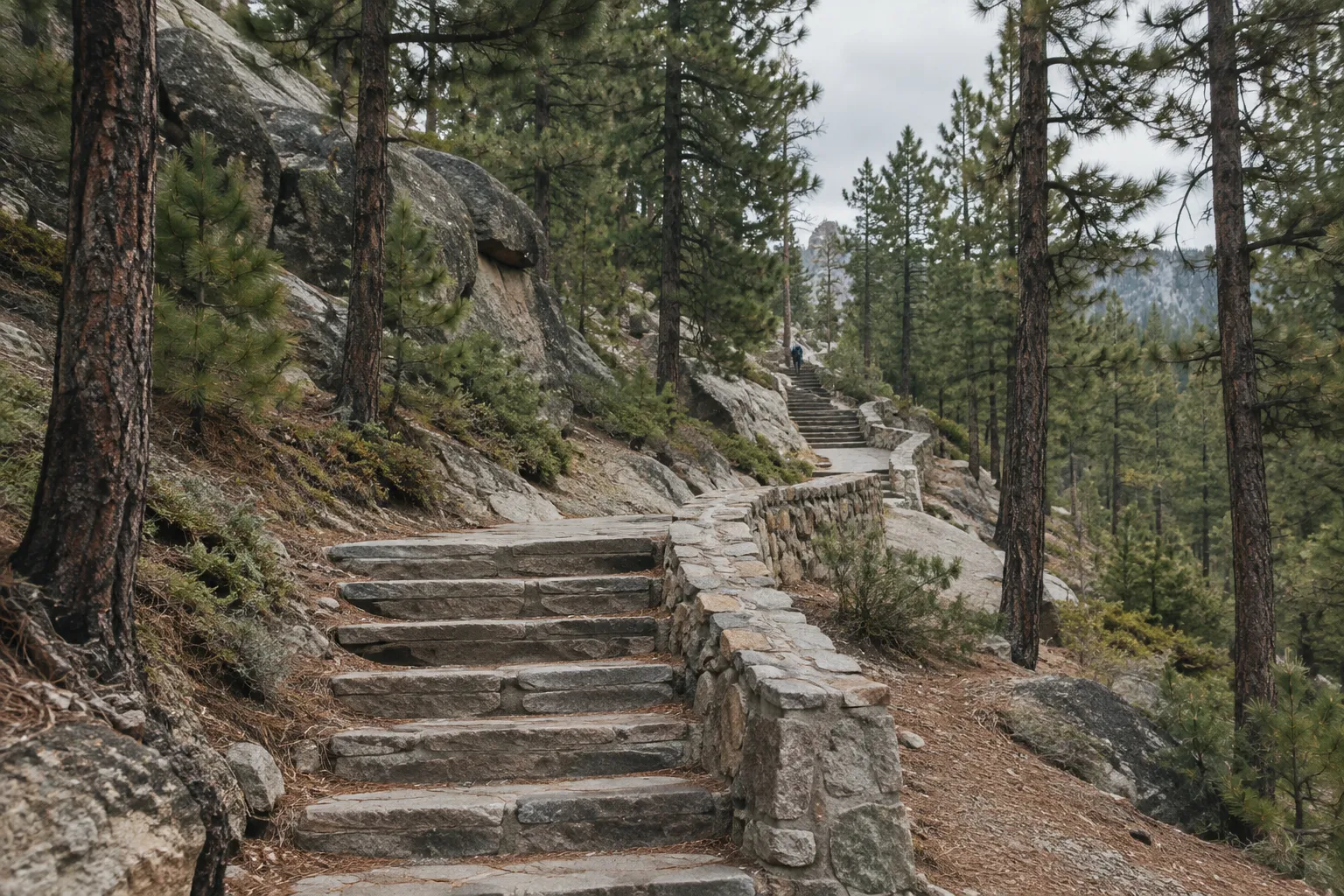
Trail specs:
- Total distance: 0.6 miles (1 km) loop
- Accessible segment: about 0.2 miles (0.3 km), Grand View Terrace to the viewing areas at the base of the mountain (7)
- Non-accessible segment: 0.4 miles (0.6 km) leading away from the mountain to the Sculptor’s Studio, with 422 stairs (7)
- Water: carry your own from the car. This is a short walk, but summer afternoons at the base of the granite get warm.
Grand View Terrace to the mountain’s base
If anyone in your group has limited mobility, or you’re short on time, walk the paved 0.2-mile (0.3 km) segment from Grand View Terrace and turn back the way you came (7). It takes you to viewing areas at the base of the mountain, which gives you the close-up angle most people come for without a single step. For a first visit with kids, grandparents, or a stroller, this is the right call.
Grand View Terrace itself is the classic straight-on view. If you stop there and never set foot on the trail, you’ve still seen the sculpture properly.
The stairs to Sculptor’s Studio
The remaining 0.4 miles (0.6 km) leaves the mountain and heads to the Sculptor’s Studio through 422 stairs. The NPS lists this section as not accessible for mobility impairments (7). The stairs climb and drop through ponderosa pine and give you angled views of the profiles that you can’t get from the terrace.
The Sculptor’s Studio closes earlier than the other buildings (7), and it is closed for the season from October 1 to May 22 (1). If you want to go inside, visit between late May and September and do the stair section earlier in the day, not on your way to the evening program.
The separate Nature Trail is also not wheelchair accessible (7).
Safety note: 422 stairs is a real effort for anyone with heart, knee, or breathing problems. Take the stairs slowly, stop at the landings, and turn back if you need to. Don’t do the stair section in the dark after the evening program unless you have a headlamp or phone light and steady footing. The paved terrace route back to the garage is the safer exit at night.
Mount Rushmore’s Lighting Ceremony vs. Nightly Illumination
The Mount Rushmore lighting ceremony is a seasonal 45-minute ranger program held late May through September, but the sculpture itself is lit every night of the year (1). People mix these up all the time, so it helps to separate them. One is free lighting you can see any evening of the year. The other is a scheduled program that only runs in summer.
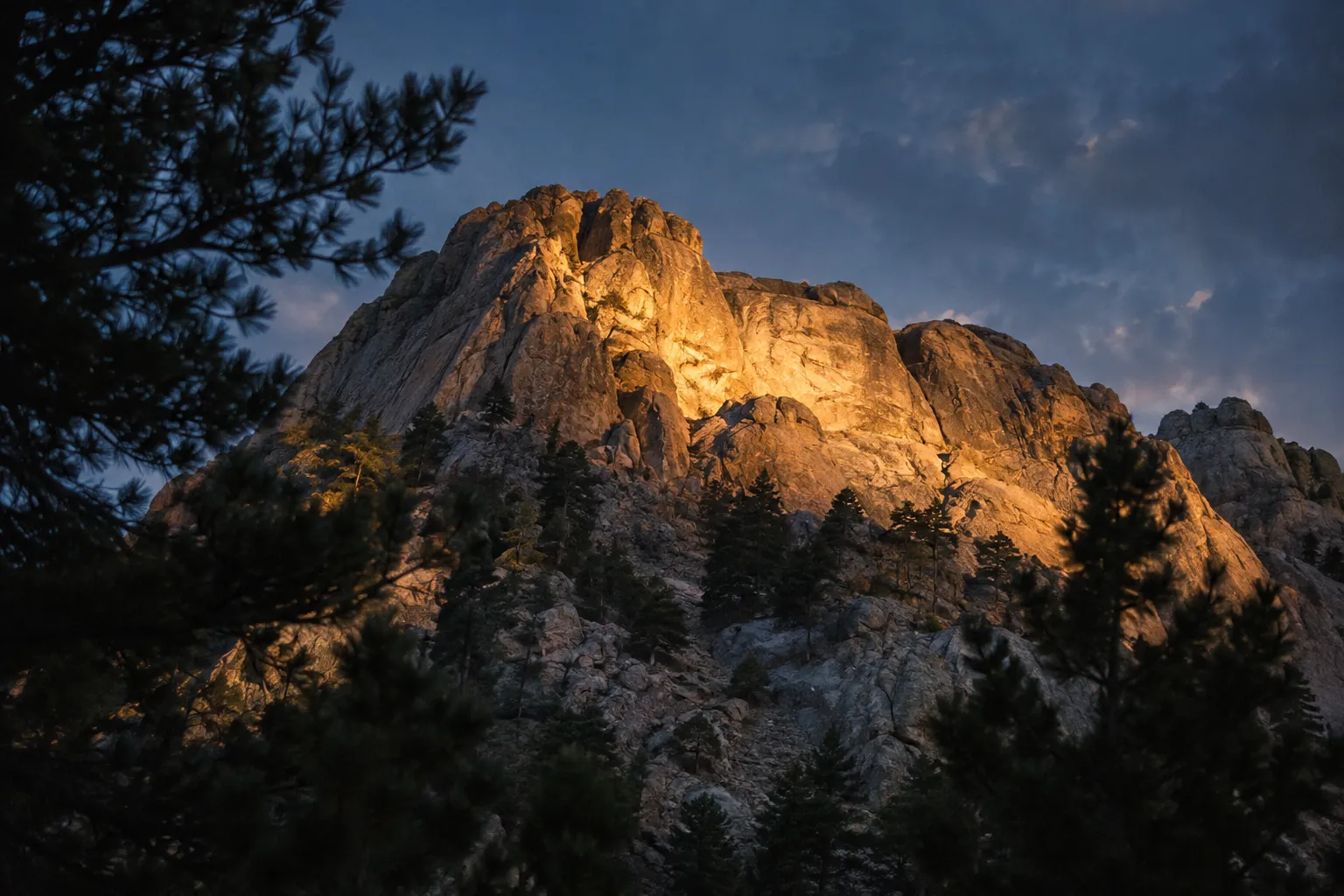
Some background on what you’re looking at: the four presidents are George Washington, Thomas Jefferson, Theodore Roosevelt, and Abraham Lincoln, and the carving took place between 1927 and 1941 (4). The Lincoln Borglum Visitor Center covers that history in more depth than any sign on the terrace.
Illumination every night of the year
The sculpture is illuminated nightly, year-round (1). From October 1 to May 22, there’s no evening program, but the lights still come on at sunset (1). They stay on until 9:00 p.m. from October 1 to March 9 and until 11:00 p.m. from March 10 to May 22 (1). In those months, plan on arriving before dark, walking to Grand View Terrace, and watching the faces light up with far fewer people around than you’d get in July.
Remember the shorter off-season gate hours. From October 1 to March 9, the visiting areas close at 9:00 p.m. (4). In winter that still leaves time after sunset to see the lighting.
The 45-minute ranger program and its start times
From late May through the end of September, a park ranger runs a 45-minute evening program in the outdoor amphitheater. It focuses on the presidents, patriotism, and the nation’s history (1). It runs in three parts: a ranger talk, then the captioned film “Voices of America,” then the lighting of the memorial (1). No reservation is needed (2).
The start time shifts partway through the season. The NPS hours page lists (1):
- May 23 to August 9: 9:00 p.m. start
- August 10 to September 30: 8:00 p.m. start
Check the date before you go. If you show up at 8:45 p.m. on August 12 expecting a 9:00 p.m. start, you’ll arrive for the end of the program. As of November 2026, the season is over: the program runs nightly from late May through the end of September (1), so confirm next season’s start times on the NPS hours page before your trip.
Practical notes for the evening:
- Arrive with enough time to park, walk through the Avenue of Flags, and find a seat. The amphitheater is outdoors (1).
- Bring a warm layer. Black Hills evenings cool off quickly once the sun drops, even in July.
- The visitor center stays open until 10:00 p.m. from May 22 to August 9 and until 9:00 p.m. from August 10 to September 30 (1), so restrooms and indoor exhibits are available before the program.
- The grounds stay open until 11:00 p.m. during the program season (1), so you won’t be rushed out the moment the lights come on.
If you already paid for parking that morning, your parking ticket gets you back in for the evening (15).
Pairing Your Visit with Crazy Horse Memorial
Crazy Horse Memorial sits 17 miles (27 km) southwest of Mount Rushmore (17), which makes it the easiest second stop on a Black Hills day. From Rushmore, head west on SD Highway 244 (10) to US 16/385, then turn south toward Custer: the memorial’s entrance is on US 16/385, 9 miles south of Hill City and 4 miles north of Custer (17). The NPS conditions page flags a multi-year construction project on Highway 385 that can cause delays, so check South Dakota 511 before you drive (20). The road climbs through ponderosa pine and granite outcrops, and the carving comes into view on the mountainside west of the highway.
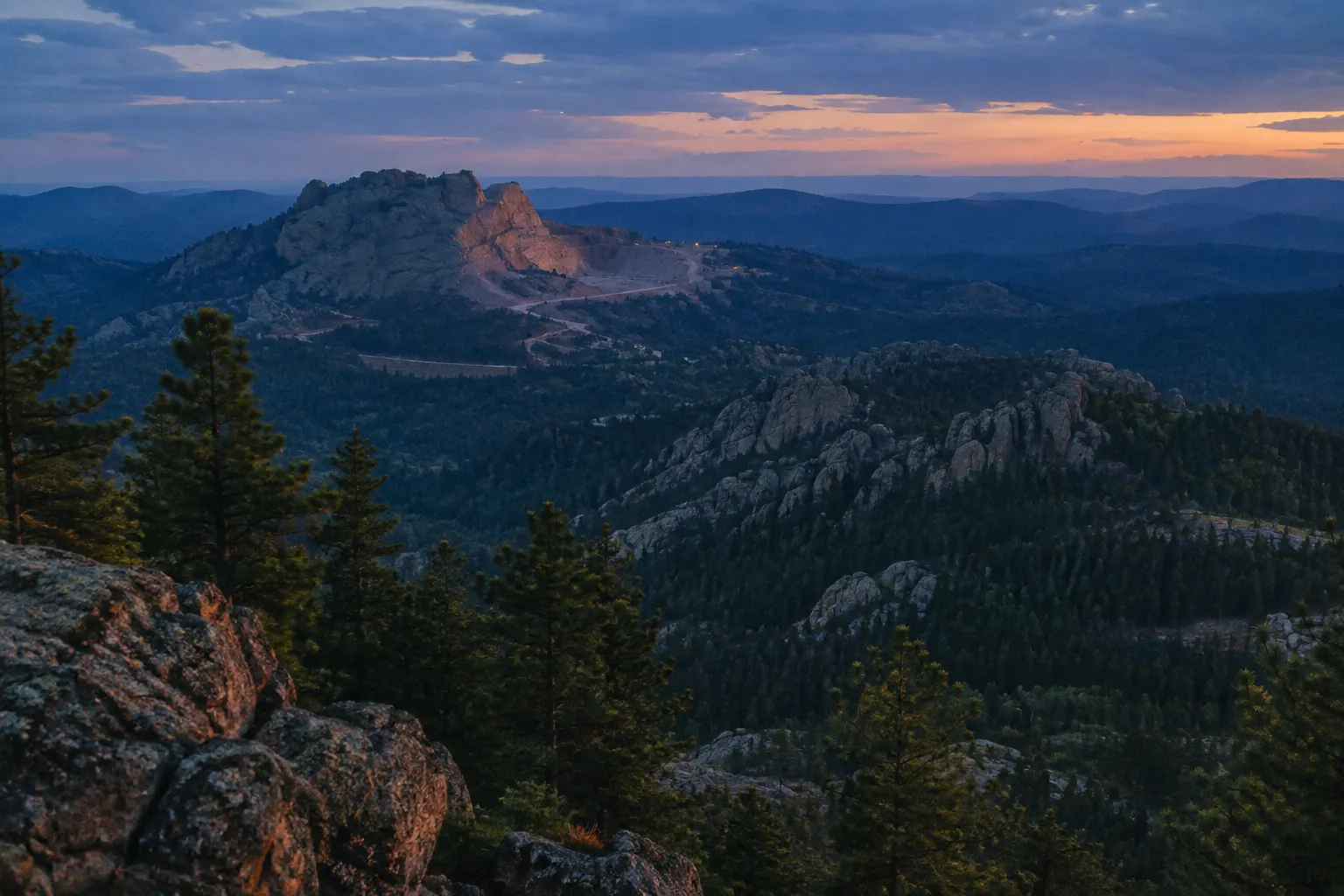
How Crazy Horse differs from Rushmore
Crazy Horse Memorial is not part of Mount Rushmore. It is a separate memorial, not an NPS site, sustained only by admission and private contributions, and it is still an active carving site (18). Sculptor Korczak Ziolkowski began the work in 1948 (19). Your Rushmore parking ticket doesn’t apply there, and neither does a national park pass. Crazy Horse Memorial sets its own admission and is open daily year-round (18), so check current prices on its official site before you go.
If you only have time for one carved mountain, Rushmore is the finished work with the full NPS setup: the trail, the evening program, and the visitor center. Crazy Horse is a working project. You’re looking at a mountain mid-carving and a visitor complex with three museums and an orientation film (18). Seeing both on the same day gives you the contrast between a finished federal memorial and a work still underway.
Where Crazy Horse fits in the day
The geography decides the order for you. Rushmore is near Keystone. Crazy Horse is southwest, between Hill City and the town of Custer. Custer State Park lies east and south of the town of Custer. A logical loop runs:
- Rushmore before 9:00 a.m. (3), when crowds are lightest
- Crazy Horse Memorial late morning, 17 miles (27 km) southwest (17)
- Lunch in Custer or Hill City
- Custer State Park’s Wildlife Loop Road in the afternoon
- Back to Rushmore for the evening program or the sunset illumination, using the same parking ticket (15)
If you want the evening program, you can flip the order: Crazy Horse and Custer State Park first, then Rushmore after 3:30 p.m. That way you arrive after the summer rush the NPS warns about (3) and stay through the lighting.
Adding Custer State Park’s Wildlife Loop to Your Day
Custer State Park’s Wildlife Loop Road is 18 miles (29 km) long and takes about 1 hour 30 minutes to drive, though “wildlife jams” can stretch that out (5). A jam means bison standing in the road, and they move when they feel like it. The loop winds through prairie and pine-studded hills (5) inside a park that covers 71,000 acres (12).
To find it, note that US Highway 16A is five miles (8 km) north of where Wildlife Loop Road meets SD Highway 87 (5). Most visitors coming from the Rushmore side link up through 16A.
The vehicle entrance license
Custer State Park requires a vehicle entrance license for visits. As of November 2026, a temporary license costs $25 per vehicle and is valid for seven days (12). If you’re in the Black Hills for a week, that covers repeat trips into the park without buying another. Residents and nonresidents can also buy annual licenses (12).
The one exemption is non-stop travel through the park on US Highway 16A (12). If you’re only driving through on that road without stopping, you don’t need the license. Once you pull over or turn onto the Wildlife Loop, you do.
How much time the loop and evening program add
Budget roughly 2 hours and 15 minutes beyond your core Rushmore visit if you add both the 45-minute evening program (1) and the Wildlife Loop at its estimated 1 hour 30 minutes (5). That figure doesn’t include driving between sites, lunch, or the time bison take to cross the road. In practice, those extras are what turn a quick stop into a full day. Leave slack in the schedule. If you try to squeeze the Wildlife Loop into the gap between Crazy Horse and a 9:00 p.m. program, one bison herd parked on the asphalt can mean missing the lighting.
Safety note: Bison, elk, and the park’s other animals are used to cars, but they are wild. Custer State Park rules say to stay in your vehicle or keep at least 100 yards (91 m) from bison, elk, and other animals. Feeding or disturbing wildlife is against park regulations (12). Bison look slow until they aren’t. Don’t walk up for a photo, and don’t let kids out of the car near a herd. If animals surround your vehicle, stay put and wait.
Two alternatives to the Wildlife Loop
If you’ve seen enough bison and want granite instead, the Needles Highway (SD Highway 87 North) is 14 miles (23 km) long, with an expected travel time of 60+ minutes (5). Check your vehicle size before you commit. The Needles Eye Tunnel is 8 ft 0 in (2.4 m) wide and 9 ft 9 in (3 m) high, and the Iron Creek Tunnel is 8 ft 9 in (2.7 m) wide and 10 ft 10 in (3.3 m) high (5). Large RVs and trailers won’t fit. The Needles Highway closes to vehicles with the first snow and does not reopen until April 1 or later, and Iron Mountain Road closes periodically in winter depending on conditions (5). The park points drivers to South Dakota 511 for the current status of its scenic drives (12).
Comparing the three stops
Here’s how the three stops compare, starting at Rushmore and working outward:
Comparing the Three Stops
| Mount Rushmore | Crazy Horse Memorial | Custer State Park's Wildlife Loop Road | |
|---|---|---|---|
| Distance from Rushmore | Starting point | 17 miles (27 km) southwest | Reached via US 16A |
| Time to allow | Short terrace visit to an evening visit | Varies with the museums and film you take in | About 1 hour 30 minutes, before wildlife delays |
| Cost or fee | $10 per vehicle; $5 for ages 62 and older | Admission set by the memorial | $25 seven-day vehicle license |
| What sets it apart | Close-up mountain views and nightly illumination | A mountain carving still in progress | Free-roaming wildlife across prairie and pine |
Practical Logistics: Pets, Food, Lodging, and Time Needed
Pets at Mount Rushmore can’t go into the buildings, onto the main walkways, the Avenue of Flags, Grand View Terrace, the amphitheater, or the Presidential and Nature trails; the grassy pet exercise areas around the main parking complex are where they can go (4). That rules out the Presidential Trail and the evening amphitheater for your dog. Food, lodging, and time budgets are easier to solve.
Pets at the memorial
Leaving a pet tied up and unattended is prohibited throughout the memorial (4). If you’re traveling with a dog, someone stays behind or you take turns. On a hot summer afternoon, a car in a concrete garage heats up fast, so don’t leave a pet inside while you walk the full loop. An early-morning visit is easier on a dog for that reason alone.
Custer State Park is more dog-friendly. Pets must be on a leash no longer than 10 feet (3 m), can’t go into park buildings or onto designated swim beaches, and can’t be left unattended. Clean up after them (12). Service animals are welcome there (12).
Food and lodging nearby
At the memorial, Carvers’ Café is the on-site option. Its closing time moves through the year, from 4:30 p.m. in winter to 9:00 p.m. in early summer (1), so on a program night, eat before the program starts. For more choice, Keystone is the closest town and is a short drive down the hill. Hill City and Custer are good lunch stops between Crazy Horse Memorial and the state park.
There’s no lodging inside the memorial, and overnight parking is not allowed anywhere within its boundaries (15). Most visitors base themselves in Keystone, Hill City, Custer, or Rapid City. Custer State Park also has four historic lodges and nine campgrounds (12), which work well if you want to start the Wildlife Loop at dawn. If you’re attending a 9:00 p.m. summer program, book somewhere close. Driving winding Black Hills roads late at night, with deer and bison about, is not where you want to save money.
How much time to set aside
Travel bloggers Mark and Kristen Morgan, after two visits, suggest planning about 3 hours to fully explore the grounds (10). Beyond that, the answer depends on what you add:
- Short stop: Grand View Terrace and the paved 0.2-mile (0.3 km) segment of the Presidential Trail (7). This works on a road trip passing through.
- Half day: the full loop, the paved 0.2 miles plus the 0.4-mile stair section with its 422 stairs (7), the Sculptor’s Studio before it closes (open late May through September) (1), and the Lincoln Borglum Visitor Center.
- Full day: Rushmore plus Crazy Horse Memorial, the Wildlife Loop, and the evening program. The program and the loop alone add roughly 2 hours and 15 minutes (1)(5) on top of your Rushmore time and driving.
Staying several days? The parking ticket is good for a year (15) and the Custer license for seven days (12), so both favor splitting things up. Do Rushmore in the morning one day and come back for the lighting on another.
Frequently Asked Questions
- Can you use a Mount Rushmore parking ticket at Crazy Horse Memorial?
- No. Crazy Horse Memorial sets its own admission, and a Mount Rushmore parking ticket does not cover entry there.
- Can you sleep in your vehicle at Mount Rushmore after the evening program?
- No. Overnight parking is prohibited within the memorial, so arrange lodging or a campground outside its boundaries.
- Is the entire Presidential Trail wheelchair accessible?
- No. The surfaced route reaches the base viewing areas; the rest of the loop includes stairs and is not accessible for mobility impairments.
- Are Mount Rushmore's grounds open on December 25?
- The grounds and parking structure may remain open on December 25 if weather allows, but all buildings close.
- Can you see Mount Rushmore lit without attending the ranger program?
- Yes. The sculpture is illuminated at sunset every night of the year, including evenings without a ranger-led program.
Putting Your Black Hills Day Together
Mount Rushmore itself asks for very little: a parking fee of $10, or $5 if you’re 62 or older (15), and a plan to arrive before 9:00 a.m. or after 3:30 p.m. in summer (3). Bring cash or a card for the garage, and don’t count on your federal pass (15). Walk the paved 0.2 miles (0.3 km) if stairs are a problem, or the full 422-stair loop if they aren’t (7). Check the date-specific start time before you head back for the evening program (1).