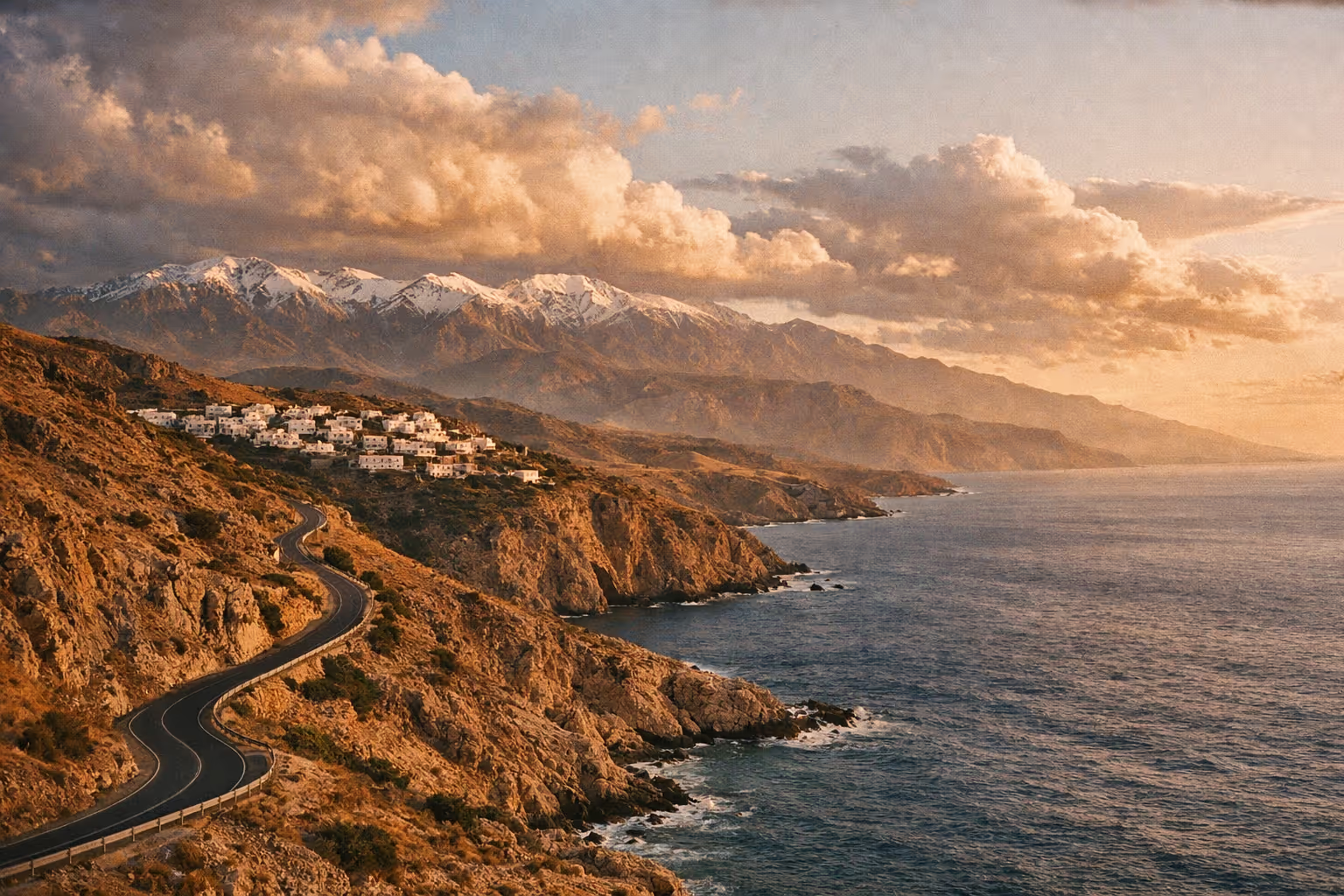
A Crete travel guide has to start with one warning: the island is big enough that a bad base can cost you six hours a day in the car. For a first five-day trip, Chania in the west is the answer, close to the famous Elafonisi and Balos beaches and the mouth of the Samaria Gorge. June and September give you warm water without the August crush, and a rental car is non-negotiable past two days. Get the base right and Crete stops feeling like a commute.
Crete Travel Guide: Orienting Yourself to the Island
This Crete travel guide begins with an overview of the island’s geography and administrative divisions. Crete stretches roughly 260 km east to west and up to 60 km north to south, divided administratively into four prefectures - Chania, Rethymno, Heraklion, Lasithi - but practically into two halves: west (Chania and Rethymno) and east (Heraklion and Lasithi) (1)(2). The White Mountains (Lefka Ori) spine the west, with peaks above 2,450 m that feed the gorges cutting down to the Libyan Sea (3). The east flattens into agricultural plains and the resort coast around Elounda and Agios Nikolaos.
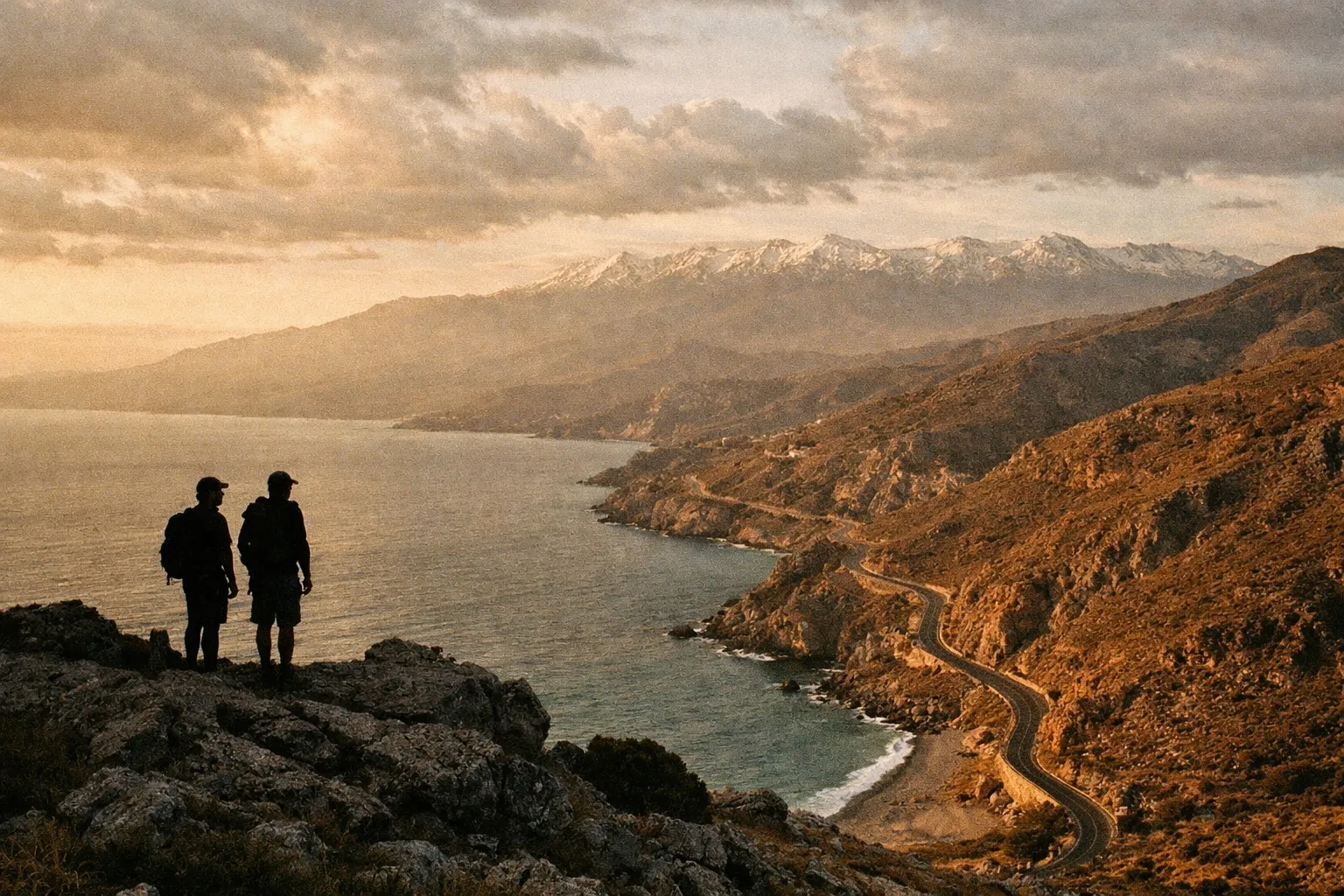
Population sits around 630,000 - more than any other Greek island - which means year-round towns with hospitals, universities, and tavernas that don’t close in November. That matters when you’re planning shoulder-season travel.
The split between west and east is the single most important planning decision you’ll make. Each side has enough to fill a week. Trying to base yourself in one and day-trip across to the other means 6+ hours in a car for what should be a swim and lunch.
- West (Chania, Rethymno): dramatic beaches (Elafonisi, Balos, Falassarna), the Samaria Gorge, atmospheric Venetian Old Towns
- East (Heraklion, Elounda): Knossos and other Minoan sites, the Archaeological Museum, Spinalonga island, calmer resort feel
What makes Crete different from other Greek islands
A few specifics separate Crete from the Cyclades and answer the “why here, not Santorini?” question:
- Two international airports. Heraklion (HER) and Chania (CHQ) both take direct flights from across Europe and 45-minute hops from Athens (1)(6). Most Greek islands have one airport or none.
- Year-round life. Because the island is so populous, towns like Chania and Heraklion function normally in winter. Tavernas stay open. This is rare for the Cyclades.
- Mountains and beaches in one day. Few Mediterranean destinations let you swim at sea level in the morning and hike at 2,000 m in the afternoon.
- Strong food culture. The Cretan diet - wild greens, olive oil, sheep’s cheese, slow-roasted lamb - is genuinely distinct from mainland Greek cooking and has a longevity reputation backed by Mediterranean diet studies (5).
- Value. Hotels and tavernas run roughly 20-40% cheaper than equivalent Santorini or Mykonos options (2)(6).
How to get to Crete: flight or ferry?
Two ways onto the island, and the math usually favors flying.
Flights from Athens take 45 minutes to either Heraklion or Chania. Booked a few weeks ahead, one-ways often run €40-70. From elsewhere in Europe, summer brings direct routes from London, Berlin, Vienna, Amsterdam, and more - with frequency increasing for the 2026 season (1)(2)(6).
Ferries from Piraeus (Athens’s port) to Heraklion or Chania run overnight, taking 8-9 hours. A reclining seat costs around €40, a basic cabin €70-100, and you save a hotel night. Companies like Minoan Lines and ANEK run the routes. For solo travelers, flights usually beat ferries on combined cost and time. For families or anyone bringing a car, the ferry math gets more interesting (2)(5).
Inter-island ferries matter if you’re combining Crete with Santorini - daily Heraklion-Santorini boats run in season, roughly 2 hours by high-speed, €60-80 each way (2)(6).
Choosing Your Arrival Airport in Crete
5 minutesDecide between Chania and Heraklion airports based on your itinerary priorities.
- 1
Fly into Chania (CHQ)
Best if your priority includes Elafonisi, Balos, Falassarna, the Samaria Gorge, or Rethymno's old town. CHQ is 15 minutes from Chania town.
- 2
Fly into Heraklion (HER)
Ideal if focused on Knossos Palace, the Heraklion Archaeological Museum, Elounda, Spinalonga, or onward ferries to Santorini.
- 3
Fly open-jaw (into one airport, out the other)
Recommended for trips of 7+ days to cover both halves of the island without backtracking.
For a 5-day trip, most travel bloggers - and I’d agree - vote for Chania as the base (1)(4). The Old Town is more atmospheric than Heraklion’s, and the iconic beaches cluster on the west coast.
Best time to visit Crete
The best time to visit Crete depends on what you’re willing to trade away. Here’s the honest breakdown:
- June - Warm but not punishing (75-85°F / 24-29°C), sea is swimmable, crowds manageable until mid-month. My pick if you want beach weather without August prices.
- July-August - Peak heat (86-95°F / 30-35°C), peak crowds, peak prices (3). Hotel rates can climb 30-50% over shoulder season. Book months ahead for Chania, Elafonisi, or Elounda.
- September - Possibly the sweet spot. Sea is at its warmest after summer baking, air temperatures drop to the high 70s-80s, prices ease, and kids are back in school across Europe.
- May, October - Cooler (sometimes too cool for daily swimming), 10-30% cheaper than peak, and ideal for hiking Samaria and exploring archaeological sites without heat stress (3).
- November-April - Many seaside hotels and tavernas close. Cities stay open. Not a beach trip, but fine for Knossos and food-focused travel. The Samaria Gorge is officially closed roughly November through April due to flash flood risk.
If you’re hiking the gorges, aim for late May-June or September-October. Midsummer heat in the gorge can be brutal - I hiked Samaria in early July once and wouldn’t repeat it.
The Cretan dilemma: Chania or Heraklion as a base?
This is the framework I use when friends ask.
Choose Chania if you’re:
- Visiting for the first time and want the postcard version
- Focused on beaches (Balos, Elafonisi, Falassarna)
- Planning to hike Samaria Gorge
- Looking for a more walkable, atmospheric old town
- Traveling for 3-5 days
Choose Heraklion if you’re:
- Specifically here for Minoan history (Knossos, Phaistos, the Archaeological Museum)
- Combining Crete with Santorini (daily ferries from Heraklion)
- Heading to the east coast (Elounda, Agios Nikolaos, Spinalonga)
- Looking for a working Greek city rather than a tourist town
Choose both (open-jaw) if you have:
- 7+ days
- A rental car
- A historical interest broad enough to justify the drive across the island
For most first-timers on a 5-day trip, my recommendation is unambiguous: base in Chania, take a single day trip across to Heraklion and Knossos on your departure day, and fly out of HER. You’ll see the highlights of both halves without backtracking.
How to Spend 5 Days on Crete
5 daysA suggested itinerary for a 5-day trip based in Chania with a rental car.
- 1
Day 1: Chania Old Town
Arrive by late afternoon, explore the Municipal Market and Venetian harbor at sunset. Dine in back streets behind the harbor for better prices and quality.
- 2
Day 2: Elafonisi Beach day trip
Leave early to reach the pink sand lagoon by 9:00 AM before crowds and wind pick up. Return via Rethymno for an early dinner and old town walk.
- 3
Day 3: Gramvousa and Balos boat trip
Take the boat from Kissamos port to Balos Lagoon with a stop at Gramvousa island. Bring cash for snacks; boat runs 10:00 AM to 6:00 PM.
- 4
Day 4: Samaria Gorge
Full-day 16 km hike from Omalos plateau to Agia Roumeli. Use organized tours or early KTEL bus. Bring hiking shoes, water, and sun protection.
- 5
Day 5: Drive to Heraklion and Knossos
Drive 2.5 hours east, visit Knossos Palace early or late to avoid crowds, then the Archaeological Museum. Dinner in Heraklion old town before flying out.
The best things to do in Crete
Beyond the 5-day route, here’s what else earns the drive:
- Falassarna Beach - wide, sunset-facing west coast beach, less crowded than Elafonisi
- Seitan Limania - tiny fjord-like cove near Chania with a steep access trail; arrive before 10:00 AM
- Spinalonga Island - former leper colony off Elounda; a haunting ferry trip set against Victoria Hislop’s novel “The Island”
- Phaistos - Minoan palace site without the crowds of Knossos
- Lasithi Plateau - high mountain valley with windmills and the Dikteon Cave (Zeus’s mythological birthplace)
- Anogeia and Archanes - mountain villages with strong food traditions and weaving culture
- Loutro - car-free fishing village on the south coast, reachable only by boat or trail
- Agia Triada Monastery - working Orthodox monastery north of Chania with olive oil tastings
Crete beaches worth the drive
The island has hundreds of Crete beaches. These are the ones I’d plan a full day around:
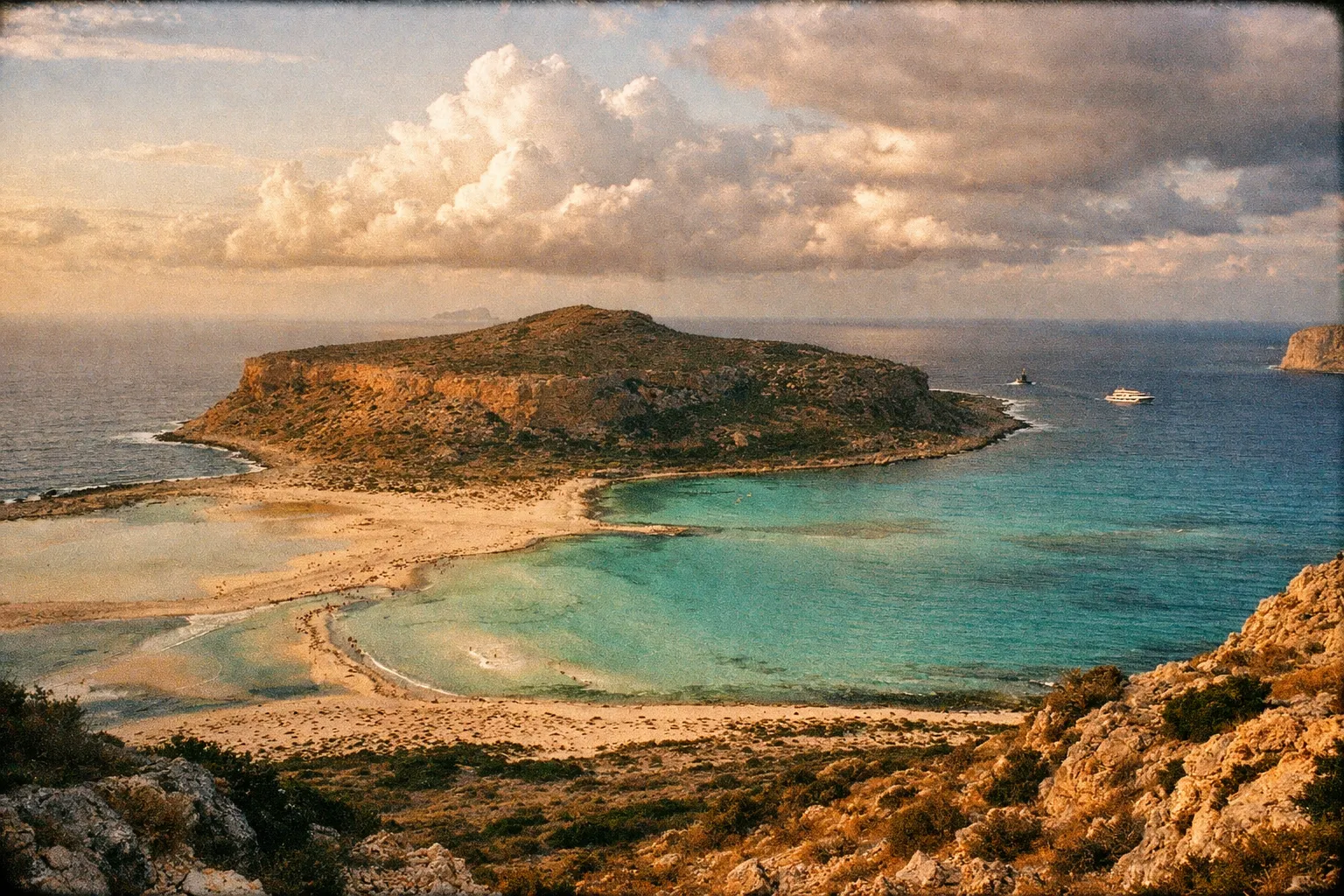
- Elafonisi - pink sand, shallow lagoon, southwest corner
- Balos - turquoise lagoon, northwest tip, boat or rough 4WD road
- Falassarna - long west-coast beach, best sunsets, easier access than Balos
- Preveli - palm-lined river meets the sea on the south coast
- Vai - palm forest beach on the eastern tip, completely different feel from the west
- Matala - south coast beach with carved caves and a 1960s hippie history
- Seitan Limania - dramatic narrow cove near Chania (steep trail, no facilities)
For families, Elafonisi’s shallow water wins. For drama, Balos. For an empty beach in August, head south.
Where to Stay in Chania Crete: Old Town Versus the Outskirts
Where you sleep in Chania makes a real difference because the Old Town is the experience. Chania, Crete’s most visited city, rewards guests who position themselves well - the harbor and old quarter are compact enough to walk everywhere, but the neighborhood you pick shapes your whole trip. Three areas to consider:
- The Venetian Harbor - most atmospheric, most expensive. Sunset and lighthouse views. Boutique hotels run $180-350/night in high season (June 2026 rates).
- Splantzia - quieter old quarter just inland, cheaper, still walkable to everything. $90-160/night.
- Nea Chora - beach neighborhood just west of the Old Town, more modern. Good if you want to swim from your hotel. $100-200/night.
If your trip is short, pay up for harbor-view. You’re here for the view of the lighthouse from your balcony at 8:00 PM with a glass of Vidiano (a local white wine). Save money on lunch instead. One practical note for Chania, Crete visitors: the Old Town lanes are mostly pedestrian-only after 9:00 AM, so drop luggage at your hotel before parking in a municipal lot.
Stick with Chania or move on?
For a 4-5 day trip, my advice is to stay all nights in Chania except possibly the last. Daily long drives erode your trip faster than you’d expect. For a 7+ day trip, split your stay: 4-5 nights Chania, 2-3 nights Heraklion or Elounda, fly out of HER. For a 10-14 day trip, add a south coast base - Loutro, Plakias, or Matala - for the slower-paced Libyan Sea experience.
Knossos Palace and Crete’s history
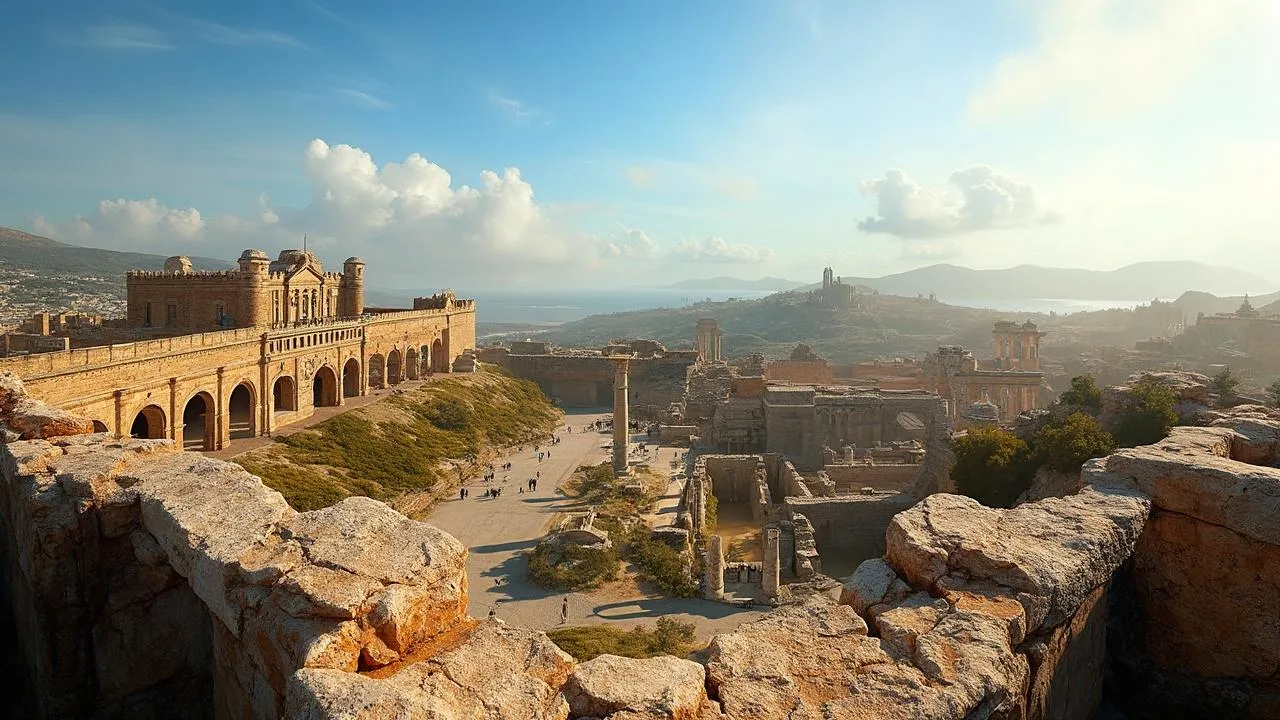
The knossos palace is the most famous Minoan site in the world, and the Minoan civilization (2700-1420 BC) was Europe’s first advanced culture - palace complexes, plumbing, frescoes, a script (Linear A) we still can’t read.
Walking through the partially reconstructed ruins - Sir Arthur Evans’s controversial early-20th-century restoration - you can see the throne room, the storage magazines, the famous bull-leaping fresco location, and the labyrinthine layout that probably inspired the Minotaur myth. Allow 90 minutes minimum.
Tickets: €15 standalone, €20 combined with the Heraklion Archaeological Museum. Buy combined and do both. The museum is where the actual artifacts live, and I’d argue it’s the more rewarding of the two visits.
Beyond Knossos, Crete’s history includes:
- Roman period (67 BC-330 AD): Gortyn served as the Roman capital of Crete
- Byzantine and Arab eras
- Venetian rule (1204-1669): left the harbors of Chania and Rethymno and the Fortezza
- Ottoman rule (1669-1898): mosques and minarets still visible in old towns
The Heraklion Archaeological Museum recently completed renovations with improved climate control and signage. Worth 2-3 hours on its own.
Cretan cuisine: what to eat and order
Cretan cuisine is one of the real reasons to visit. It leans on olive oil, wild greens (horta), barley rusks (paximadi - a twice-baked bread), sheep and goat cheeses, fresh fish, and slow-cooked meats. Order meze-style - a handful of small plates rather than one big main - to taste more.
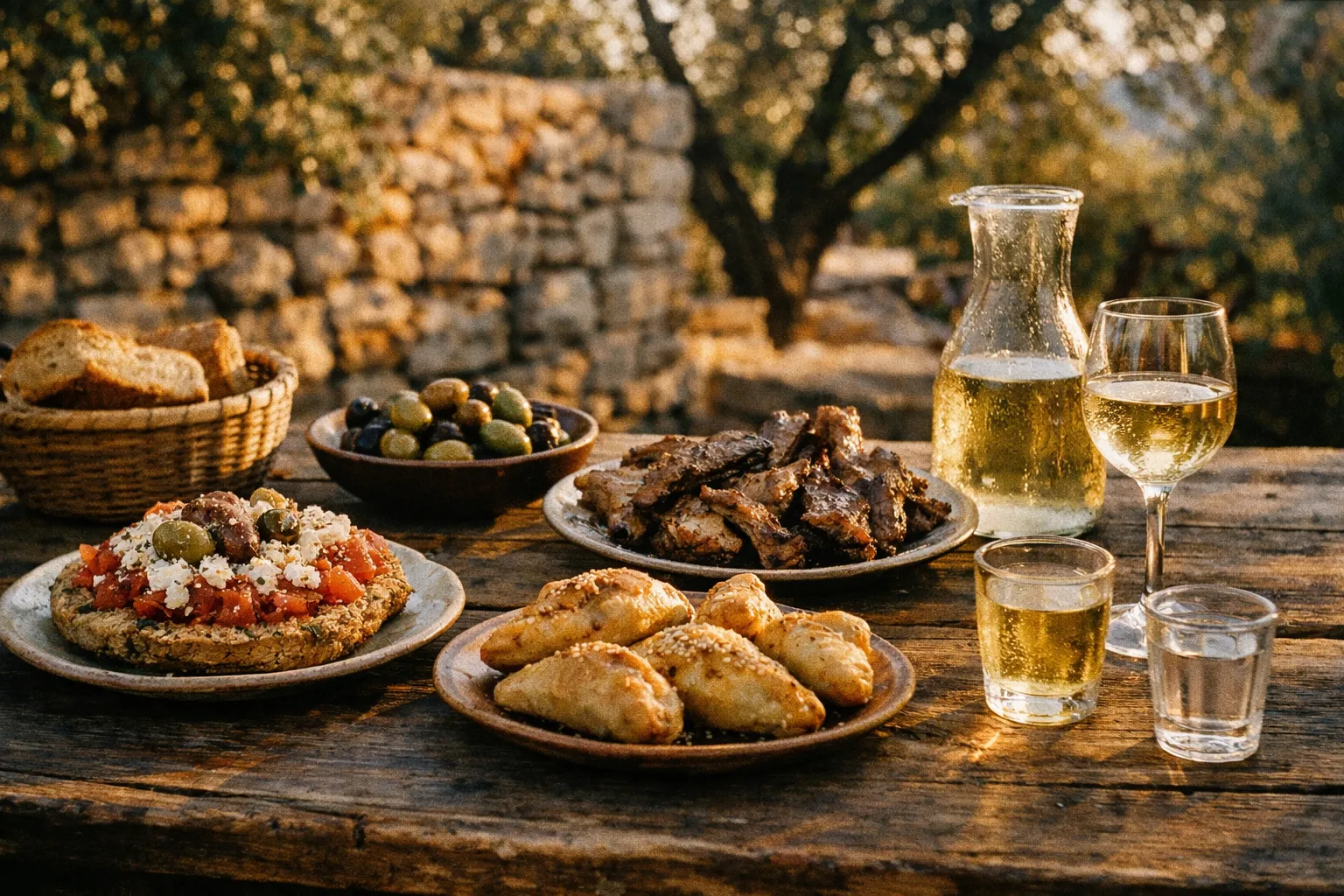
Dishes to seek out:
- Dakos - barley rusk topped with grated tomato, mizithra cheese, olive oil, and oregano. The Cretan answer to bruschetta. €5-7.
- Kalitsounia - small filo pies filled with mizithra or wild greens; sometimes sweet with honey. €4-6.
- Antikristo - lamb slow-roasted around an open fire pit; traditionally Sfakian. Found in mountain tavernas, €18-25.
- Chochlioi boubouristi - snails fried with rosemary and vinegar. Better than it sounds. €6-8.
- Apaki - smoked pork, often served sliced cold with rusks. €7-10.
- Sfakiani pita - thin pancake stuffed with soft mizithra, drizzled with thyme honey. €4-5.
- Gamopilafo - wedding rice cooked in goat broth until creamy. €10-14.
Drink the house wine in carafes - usually local Vidiano (white) or Kotsifali/Mandilari (red), €5-8 per half-liter and miles ahead of cheap bottled imports. Finish with raki (also called tsikoudia), the local grape spirit, which most tavernas pour for free at the end of a meal.
A typical taverna dinner with wine runs €20-35 per person. Street gyros are €3-4. Mid-range full meals in Chania harbor can hit €40-50 per person - walk two streets inland to halve that.
Etiquette note: Don’t tip 20% - Greek service tipping runs 5-10%, rounded up on the bill. The free raki at the end of dinner is a gift, not a request for a bigger tip. Drink it. Refusing it reads as cold.
Getting around Crete
Renting a car is the right move for any trip longer than 2 days. Public buses (KTEL) connect the major towns reliably but get sparse toward remote beaches like Elafonisi or Balos.
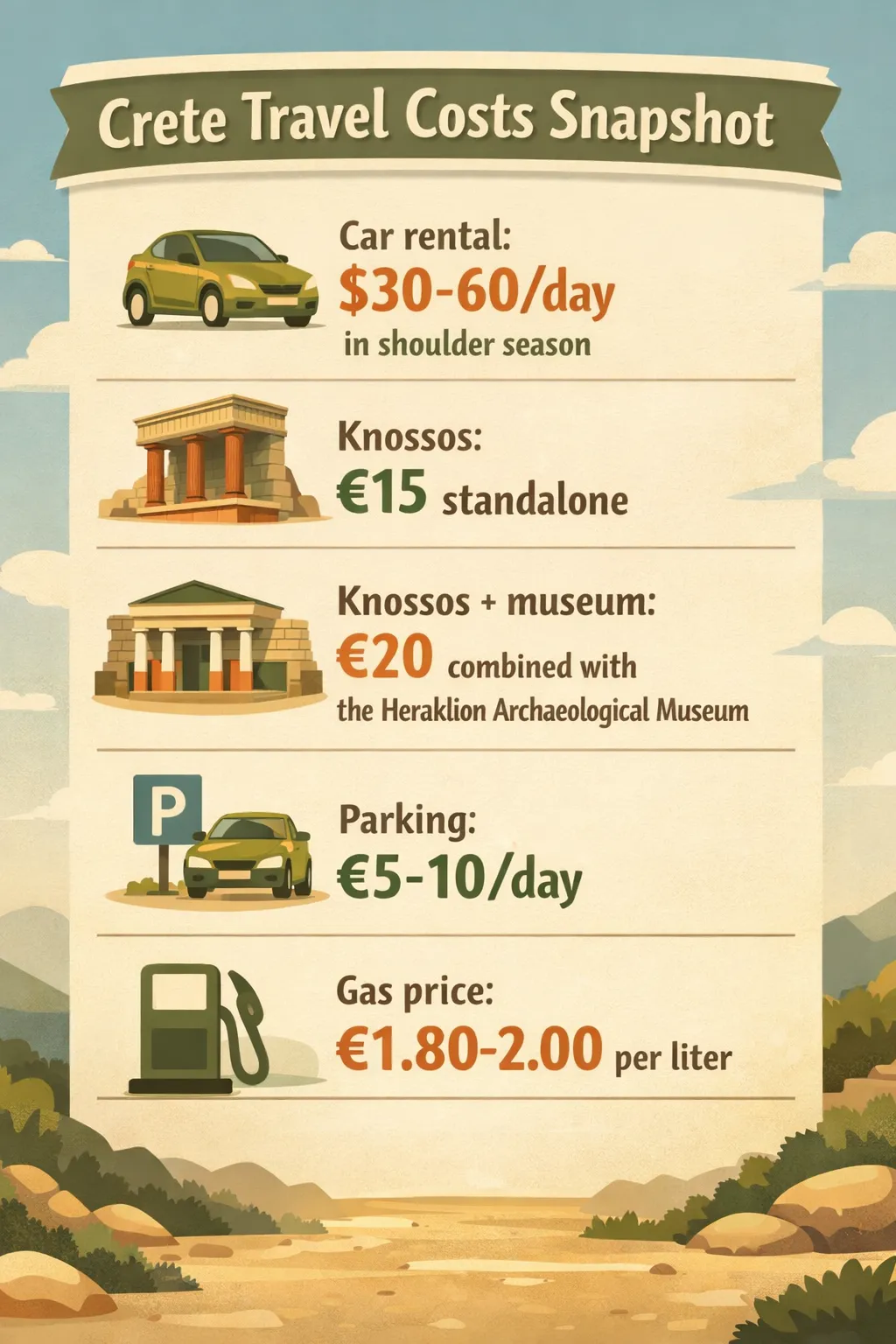 Cost snapshot for a Crete trip, highlighting car rental, Knossos tickets, parking, and gas prices.
- Car rental: $30-60/day in shoulder season, up to $80/day in August (5). Book ahead for July-August; cars sell out. Small manual transmissions are cheapest; automatics cost 30-50% more.
- Roads: The northern coast E75 highway is fast and modern. Mountain roads to Elafonisi, Balos, and the south coast are narrow, winding, and slow - budget 30-50% more time than Google Maps suggests.
- Parking: Free at most beaches and trailheads. In Chania and Heraklion old towns, use marked municipal lots (€5-10/day) - narrow lanes are mostly pedestrian or impossible to navigate.
- Buses: Reliable Chania-Rethymno-Heraklion routes run every 30-60 minutes. Crete bus tickets are cheap (€8-15 between cities), but trips to remote beaches may only run once or twice a day.
- Gas: Around €1.80-2.00 per liter as of 2025.
Common mistakes first-timers make
The patterns I see repeatedly:
- Trying to do the whole island in 4-5 days. You’ll spend more time driving than seeing things (1)(3)(6).
- Basing in Heraklion while wanting west-coast beaches. Elafonisi is 3+ hours each way from Heraklion.
- Underestimating Samaria Gorge. It’s 16 km of rocky downhill plus transport logistics. Not a casual stroll.
- Visiting Knossos at noon in July. No shade, full crowds, full heat. Go early or late (7).
- Skipping a car rental. Buses to remote beaches are rare and inflexible.
- Eating on the harbor in Chania. Tourist tax of 30-50% for the view.
- Not pre-booking July-August. Last-minute rates run 30-50% higher.
- Ignoring shoulder closures. November-April, expect many beach hotels and seasonal tavernas shut (3).
Frequently Asked Questions
- How many days do you need in Crete?
- Four to five days lets you explore one half of the island well, usually the west based in Chania. Seven days adds a Knossos day. Ten to fourteen days lets you cover both halves and the south coast.
- Is Crete better than Santorini?
- They serve different trip types: Santorini is a short 2-3 day volcanic-view getaway, while Crete offers a longer, varied experience with beaches, hiking, archaeology, and mountain villages. Many travelers combine both via the Heraklion-Santorini ferry.
- Can you visit Crete without renting a car?
- Yes, but it limits your freedom. Staying in Chania or Heraklion and using organized tours works for short trips, but you miss remote beaches and villages. For trips longer than 3 days, renting a car is strongly recommended.
- Is Crete expensive?
- Crete is about 20-40% cheaper than Santorini or Mykonos for comparable quality. Mid-range hotels in Chania run $120-220/night in high season, meals with wine cost €20-35, and car rentals $30-60/day. Budget travelers can manage on $80-100/day.
- Do I need to know Greek?
- No. English is widely spoken in tourist areas. Learning simple greetings like kalimera (good morning), efharisto (thank you), and yamas (cheers) is appreciated. Menus are usually bilingual.
- Is the tap water in Crete safe to drink?
- Tap water in cities like Chania and Heraklion is treated and safe but tastes mineral-heavy; most locals prefer bottled water. In small villages, ask before drinking tap water.
- Can you swim in Crete in May or October?
- Yes, but sea temperatures are cooler: around 18-20°C (65-68°F) in May and 21-23°C in October. September has the warmest sea temperatures.
- Are credit cards accepted everywhere?
- Cities and tourist tavernas accept cards, but small village tavernas, beach kiosks, some bakeries, and ferry kiosks often require cash. Carry €100-150 in cash for rural days.
A practical send-off
Book your flights with arrival into Chania, base yourself in the Old Town near the Venetian harbor, rent a car at the airport, and give yourself at least five days. Hit Elafonisi and Balos early in the morning, hike Samaria in the cooler months, eat dakos and drink raki, and save your last day for the drive to Heraklion and Knossos before flying home from HER. That’s the Crete trip that works - not the one that tries to cover 260 km of island in 96 hours.