Channel Islands National Park sits a little over an hour offshore from Ventura by boat, but once you step off the dock there is no store, no shuttle, and at several landings no drinking water. Every decision about food, water, campsites and ferry seats has to be made on the mainland, often months ahead. This guide covers the order to book in, which island suits a day trip or an overnight, how to handle the sea caves, and what to carry.
Channel Islands National Park: five islands and one planning challenge
Channel Islands National Park protects five islands (Anacapa, Santa Cruz, Santa Rosa, San Miguel and Santa Barbara) plus the ocean within 1 mile (1.6 km) of each one (12). The park’s listed gross area is 249,561 acres (about 101,000 hectares) (16), and much of that is water. The NPS describes the park as five of California’s eight Channel Islands, which explains why the map can be confusing: the other three are outside the park (12).
The islands host more than 2,000 plant and animal species, and 145 of them are found nowhere else in the world (12). That level of endemism is why the islands get compared to the Galápagos. It is also why the rules on food storage, gear cleaning and wildlife distance are strict.
The planning challenge comes from the absence of any infrastructure. There is no transportation once you land: you go everywhere on foot, by private boat or by kayak, and bicycles are not allowed (24). The walk from the landing to camp and to every trailhead is on you. All campgrounds sit away from the boat landings, and you carry your gear in yourself (8).
Most first-time visitors only need to decide between two islands. Anacapa Island and Santa Cruz Island are about an hour from Ventura by boat (24), and they are the two islands where a one-night camping stay fits the Island Packers schedule; overnight trips to Santa Rosa usually take at least three days and two nights (12). Island Packers boats do not currently land at Santa Barbara Island (12). Santa Rosa and San Miguel are reachable, but the long boat rides leave little time ashore on a day trip (12).
✓ Pros
- A rare mix of land wildlife, seabirds and protected coastal water in one trip.
- You can choose between a compact hiking visit and a longer paddle-and-camp stay.
✗ Cons
- Each island visit is constrained by boat departure times, not just trail plans.
- A missed piece of gear or a weather delay has few on-island workarounds.
The case for going, and the case against
The case for going rests on a few points. The islands are uncrowded once the boat leaves. The endemic wildlife includes a fox you cannot see anywhere else. The surrounding ocean is protected. Hiking, camping, snorkeling and sea kayaking are all available from the same two landings (20).
The case against is mostly logistics. There are no services. You need two separate bookings that have to line up. The weather and swell can disrupt a crossing. Water is limited or absent depending on where you land.
If you want a trip that runs on autopilot, this park will frustrate you. If you enjoy solving the logistics, it pays you back.
Channel Islands ferry: routes, crossing times and fares
The Channel Islands ferry is run by Island Packers, the park concessioner, from Ventura Harbor and Channel Islands Harbor in Oxnard. The NPS requires advance reservations for boat transportation to the islands (6). Island Packers runs trips to Santa Cruz Island landings at Scorpion Anchorage (Scorpion Cove) and Prisoners Harbor, and Anacapa Island trips go almost entirely to the Landing Cove on East Anacapa (5)(22).
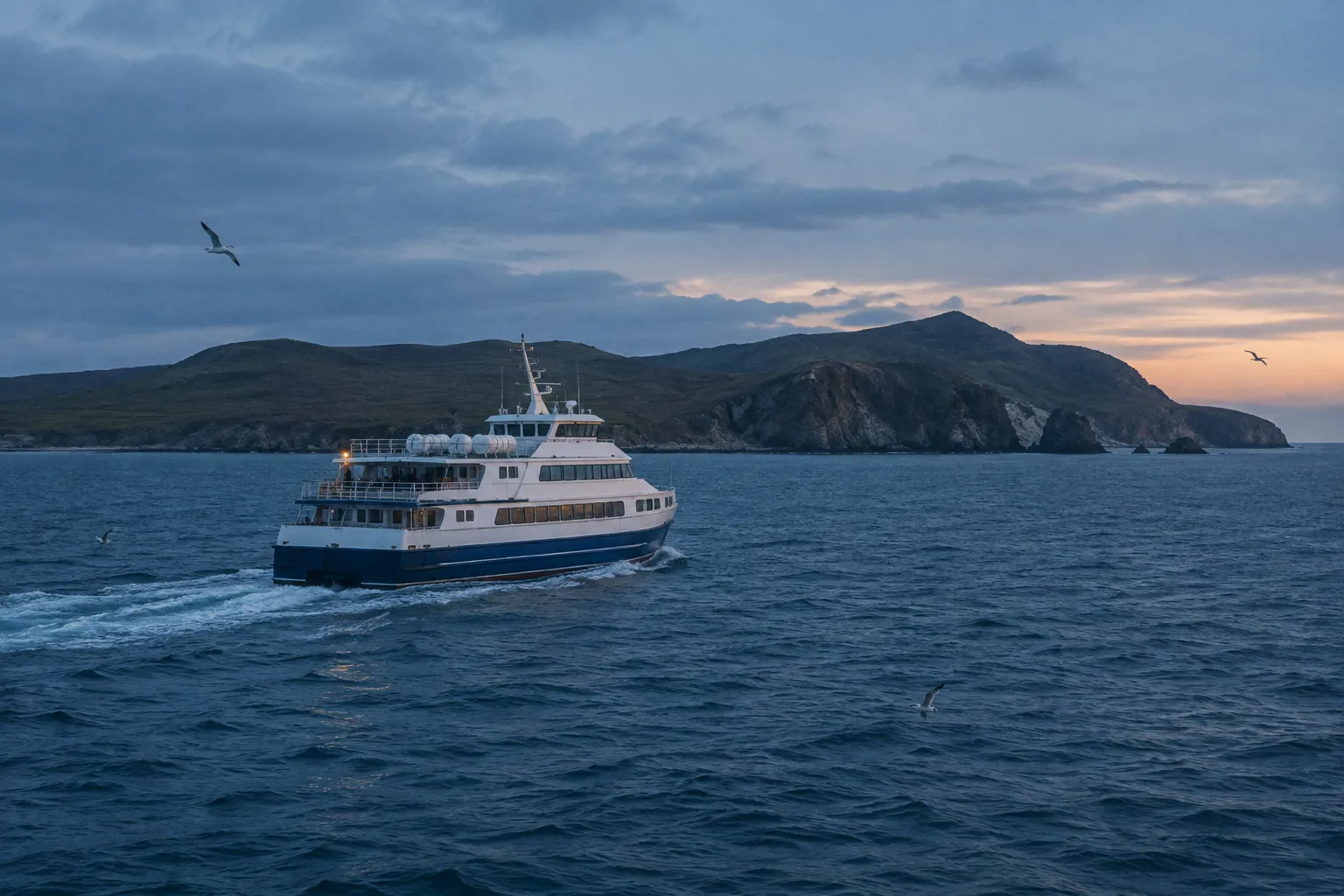
Booking contact, for reference: Island Packers, 1691 Spinnaker Dr., Ventura, CA 93001, 805-642-1393 (6). In peak season, April through September, phone wait times can be long, and Island Packers suggests email instead (24).
As of November 25, 2026, the Island Packers calendar lists day and camper trips to both Scorpion Anchorage and Prisoners Harbor on Santa Cruz Island every day from November 27 through December 5, with none on Thanksgiving Day, November 26 (26). The Anacapa Island calendar from Ventura is much thinner, and a landing there is never guaranteed: if the captain cannot land, the trip continues as a wildlife cruise and the fare is prorated (27).
Crossing times from Ventura to Santa Cruz and Anacapa
The Ventura-to-Santa Cruz Island crossing to Scorpion Anchorage typically takes a little over 1 hour (23). The Island Packers FAQ gives about 1 hour for both Santa Cruz Island and Anacapa Island trips (24), and the NPS lists Anacapa Island travel time at about one hour (22). Santa Cruz Island sits about 20 miles (32 km) offshore from Ventura Harbor (23).
Prisoners Harbor is farther west, and the direct run there takes about 1½ hours (23). Some trips stop at Scorpion Anchorage first to unload, which adds time.
Those times are a baseline, not a promise. Wildlife sightings can lengthen a crossing (23)(24), and if the captain slows for a pod of dolphins or a whale, you arrive later. On a day trip, that time comes out of your hours ashore. Getting to Anacapa Island also has a physical step: you climb from the boat up a steel-rung ladder to a dock before you even reach the stairs (22).
Day-trip vs overnight fares: which to book
Island Packers prices the Channel Islands ferry by trip type, and the fare you pick should match your trip length. As of November 2026, the published round-trip fares for Santa Cruz Island and Anacapa Island are (5):
- Adult day trip (ages 13-54): $79
- Child day trip (ages 3-12): $57
- Adult camper/overnight round trip (ages 13-54): $105
If you are coming back the same day, book the day-trip fare. The camper/overnight fare costs more because it covers the transport of you and your camping gear on separate outbound and return dates (24). Check the Island Packers trips page for senior, military and child overnight rates before you book (5).
Galley food and drink are available on Island Packers boats (10). Don’t count on that for island meals, though. Once you step ashore, the galley leaves with the boat.
There is no entrance fee for Channel Islands National Park (28), so the boat and any campsite are your main costs. As of November 2026, Island Packers lists paid parking at Ventura Harbor on Fridays, weekends and major holidays, at $1 per hour for the first 4 hours or $10 for the day, with free parking along Spinnaker Drive and at the Dolphin Lot (24).
Booking sequence: line up the boat and the campsite together
For a Channel Islands overnight, the boat and the campsite are two separate bookings that have to match. Frontcountry campsite reservations open up to six months ahead, and boat transportation is booked separately with Island Packers (6). If you ride Island Packers, you have to find dates when both a boat ticket and a campsite are available, and booking early widens your options (8). Island Packers’ own advice is to check both first, then book the boat and reserve the campsite right away (24).
Campsites are the scarcer resource: Prisoners Harbor Campground has 6 sites and Del Norte has 4 (5). Boats are the other constraint, since Island Packers does not travel to every island every day (24). The rule follows from that: confirm both are open for your dates, book the boat, then reserve the campsite on Recreation.gov in the same sitting.
A few mechanics to know:
- Camping reservations go through Recreation.gov or by phone at 877-444-6777. The booking asks for your camping dates, transportation information and number of campers (6).
- A confirmation notice is issued, and you present it to the island ranger on arrival (6).
- Backcountry camping at Del Norte also requires an advance reservation. Reservations are per site, per night, and cover up to four people (6).
- Day visitors only need the boat. No campsite booking is required.
Build slack into the plan as well. Recreation.gov advises campers to bring extra food in case weather delays the return boat (11). If the crossing gets cancelled, you stay on the island until the next one.
Book a Channel Islands trip in the right order
Coordinate the island, campsite, ferry and any kayak transport before packing for an island with few services.
- 1
Choose the island and activity
Match the island to the trip: Scorpion Anchorage for kayaking, or Anacapa for a short hike and birding.
- 2
Check boat and campsite availability
For an overnight, confirm that Island Packers runs your dates and that Recreation.gov shows an open campsite for the same nights.
- 3
Book the ferry, then the campsite
Choose a day-trip or camper/overnight fare, then reserve the matching campsite on Recreation.gov right away.
- 4
Arrange kayak transport
If bringing your own kayak, coordinate its transport with Island Packers in advance.
- 5
Pack supplies and check conditions
Bring food, water and gear, then review the forecast and cancellation policy before departure.
Santa Cruz Island: kayaking sea caves and where to camp
Santa Cruz Island is the largest of the Channel Islands, more than 24 miles (39 km) long and over 62,000 acres (25,000 ha), with about 77 miles (124 km) of shoreline (23). It is the better choice if you want to kayak, camp with drinking water nearby, or walk more than a couple of miles. Most visitors land at Scorpion Anchorage on the east end. Prisoners Harbor, farther west, is the quieter landing near the boundary between NPS land and The Nature Conservancy property (23).
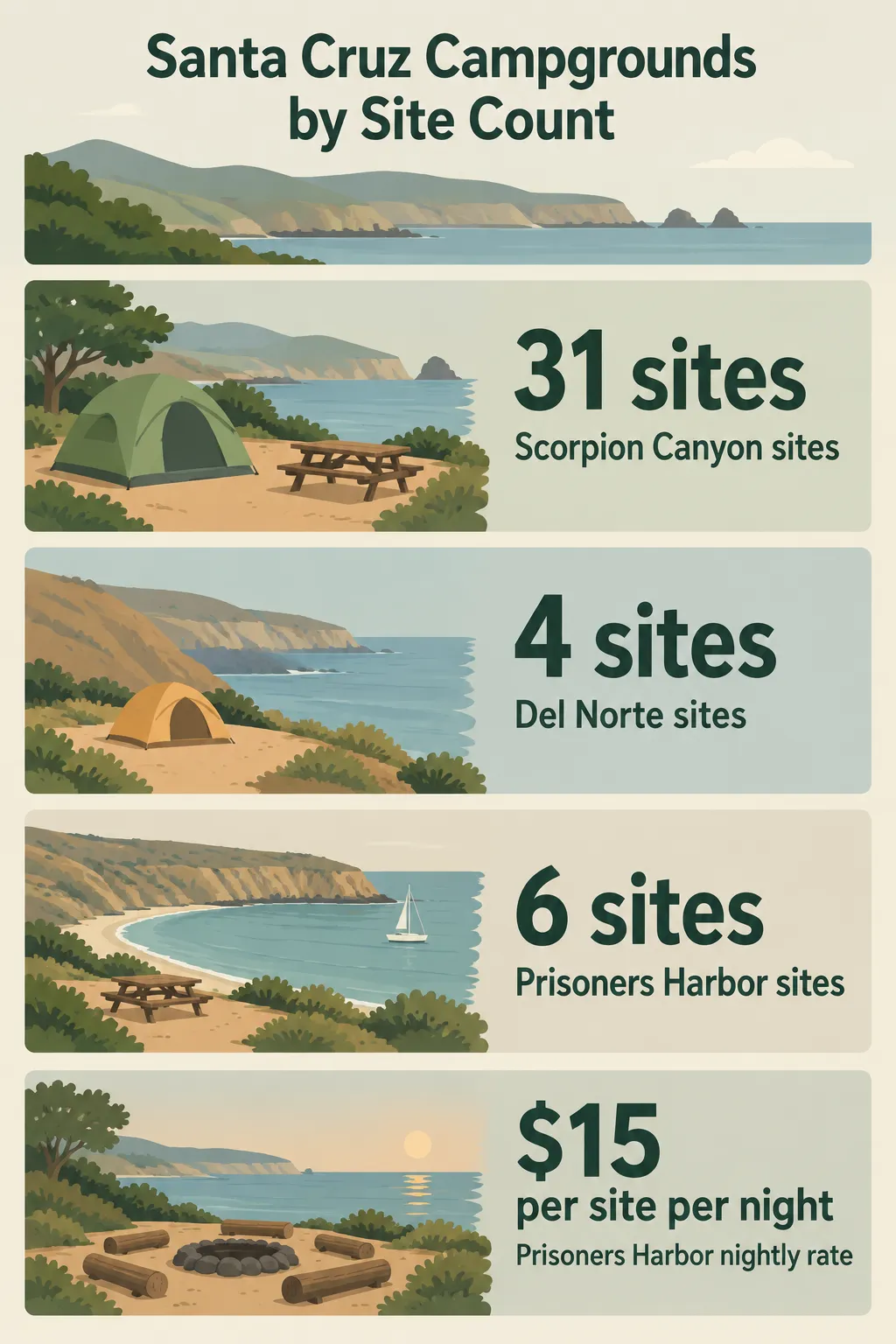 On Santa Cruz Island, Scorpion Canyon has 31 sites, Del Norte has 4, and Prisoners Harbor has 6 sites costing $15 per site per night.
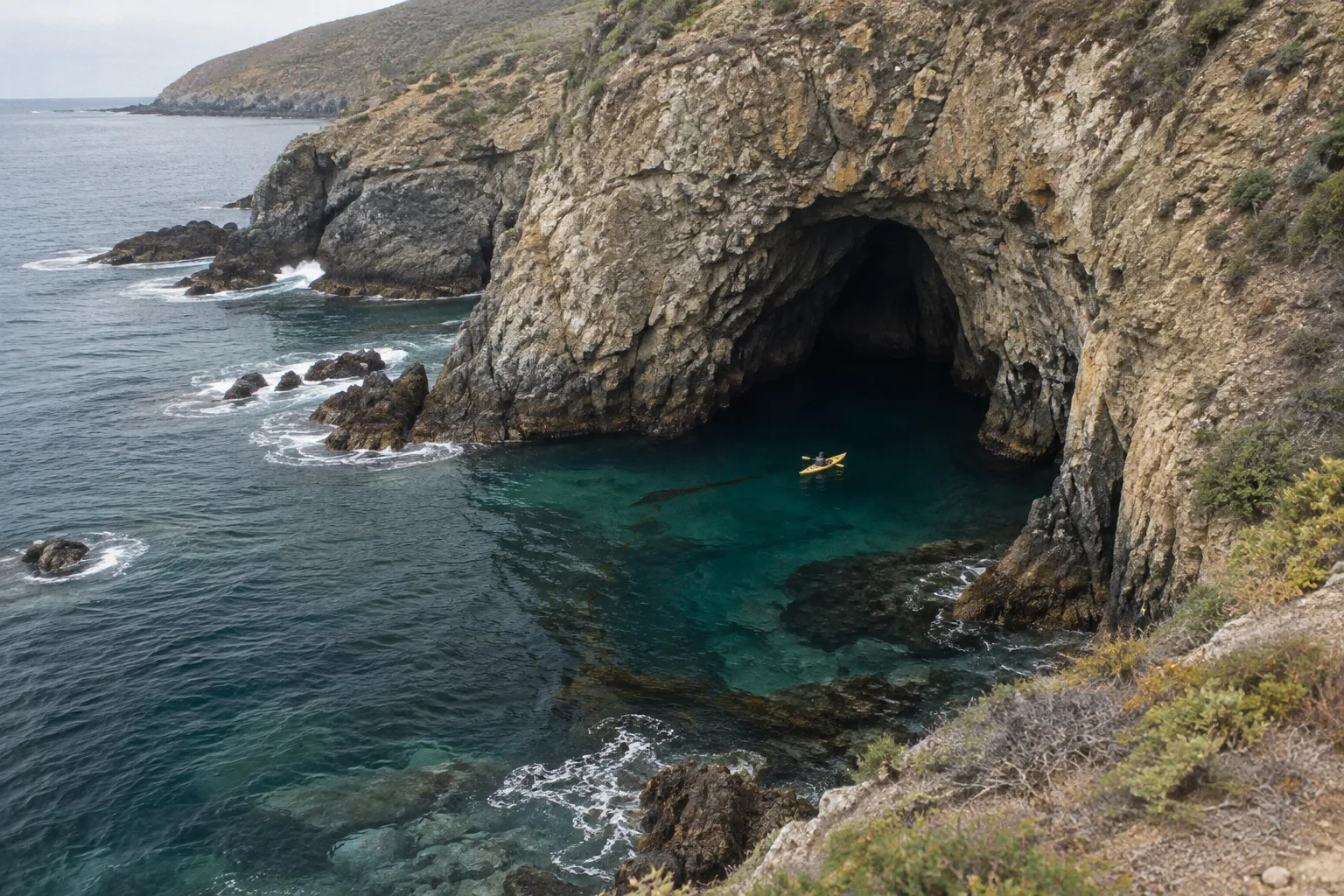
Scorpion Anchorage: the park’s top kayaking area
Scorpion Anchorage is the main sea-kayaking area in Channel Islands National Park. The NPS identifies it as the most popular, with a rugged coast and sea caves (15)(20). The cliffs, caves and islets of eastern Santa Cruz Island hold 8 of the park’s 17 breeding seabird and shorebird species, including Scripps’s murrelets, Cassin’s auklets, pigeon guillemots and black oystercatchers. California sea lions and harbor seals rest and breed along the same shoreline (3).
There are no kayak rentals on the island. You have two ways to paddle:
- A guided tour. Channel Islands Adventure Company is the authorized kayak guide and outfitting concession at Scorpion Anchorage (7). It also runs snorkel rentals and guided snorkel tours there (7). The NPS describes the guided trips as moderate to strenuous, though some do not require previous kayaking experience (15).
- Your own kayak, transported on the Island Packers boat for an extra fee (15). Arrange the kayak transport when you book the ferry, not at the dock.
Here is how the Santa Cruz Island options rank if your time is limited.
Worth the detour:
- A guided sea-cave paddle out of Scorpion Anchorage. It is the reason most people pick this island.
- The Cavern Point hike, which pairs coastal views with a visit to the visitor center in the historic ranch house (20).
Skip if short on time:
- A Prisoners Harbor day trip. The crossing runs longer, and there is no drinking water at the landing (23)(10).
Picking a campsite: Scorpion, Del Norte or Prisoners Harbor
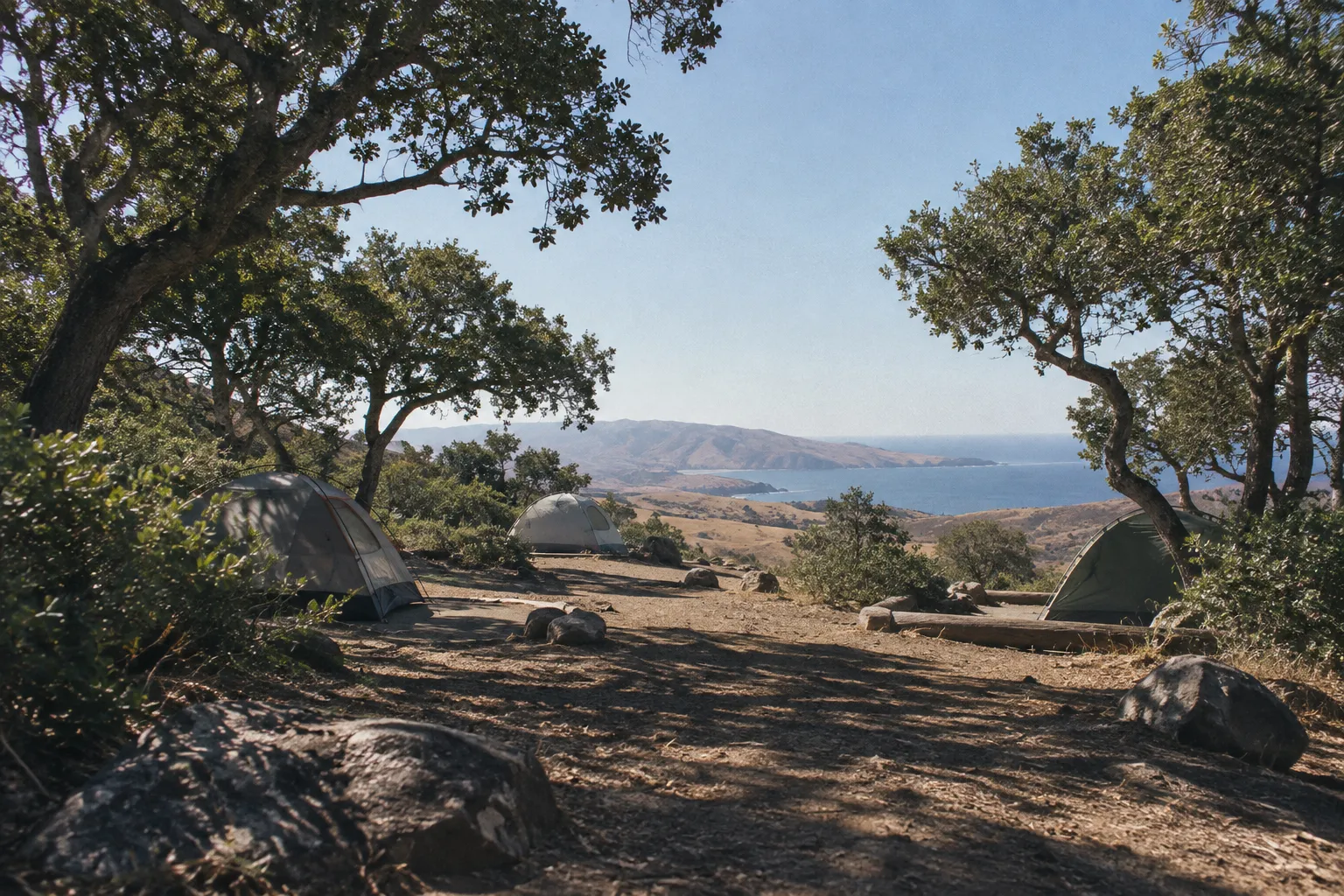
Santa Cruz Island now has three camping options, and the NPS frames them as a scale of remoteness. Scorpion is convenient and family-friendly, Del Norte is remote, and the new Prisoners Harbor Campground sits in the quieter middle (4). Its six sites are seasonal, as of November 2026 (5). The decision rule follows from that. Families and first-timers should pick Scorpion. Backcountry-seekers should pick Del Norte. If you want quiet without a long haul, Prisoners Harbor is the fit in season.
Scorpion Canyon Campground is the most convenient campground in the park and offers the most recreational options (20). It sits about ½ mile (0.8 km) from the pier (8), with a lower loop of 22 individual sites and an upper loop of 3 individual and 6 group sites less than ¼ mile (0.4 km) farther up the valley (13). Outhouses, picnic tables, food and trash storage boxes and potable water are provided (13). The water supply is limited, so conserve it. Scorpion sits next to the kayaking area, which makes it the obvious base for a paddle-and-camp trip.
Del Norte is the backcountry site near Prisoners Harbor, open for camping year-round (5)(6). It is the remote option. You have to carry everything, and that includes water.
Prisoners Harbor Campground opened August 27, 2026, the first new campground on Santa Cruz Island in decades (4). It sits a short walk from the Prisoners Harbor Pier, which shortens the gear carry (4). One catch: drinking water is not available at Prisoners Harbor, so you carry it all in (10). See the comparison below for sites, fees and water access across all three.
Santa Cruz Island campgrounds compared
| Scorpion Canyon | Del Norte | Prisoners Harbor | |
|---|---|---|---|
| Camp style | Convenient; family-friendly | Remote backcountry | Quieter middle ground |
| Sites | 31 | 4 | 6 |
| Drinking water | Potable water | None; carry it in | None; carry it in |
| Nightly fee | Charged per site, per night | Charged per site, per night | $15 per site per night |
| Access from landing | Next to Scorpion Anchorage | Near Prisoners Harbor | Short walk from the pier |
Point-to-point backpacking and the harbor-to-harbor paddle
The Prisoners Harbor campground also makes a new kind of trip possible. You can now backpack point-to-point between Scorpion Anchorage and Prisoners Harbor, landing at one and leaving from the other. The NPS also describes a multi-day kayak trip between the two harbors for experienced paddlers (4). Either way, coordinate your outbound and return boats to different landings when you book.
That route answers a common question: can you move between islands? There is no general inter-island service. Island Packers runs shuttles between island locations only for campers on select dates, and there are no shuttles between Anacapa Island and the other islands (24). The point-to-point option on Santa Cruz Island is the closest thing to a multi-stop trip most visitors will get.
Anacapa Island: the 157-step climb and a short-hike day
Anacapa Island suits a short, self-contained outing. The trail system on East Anacapa is about 2 miles (3.2 km), the climb from the landing is 157 stairs, and there is no drinking water anywhere on the island (22)(10). The NPS calls Anacapa Island the right place for a half-day, one-day or short overnight trip, and suggests that if you can visit only one island, this may be it (22). I’d qualify that slightly. It is the right one island for hikers and birders. It is the wrong one for kayakers who want a guided cave tour.
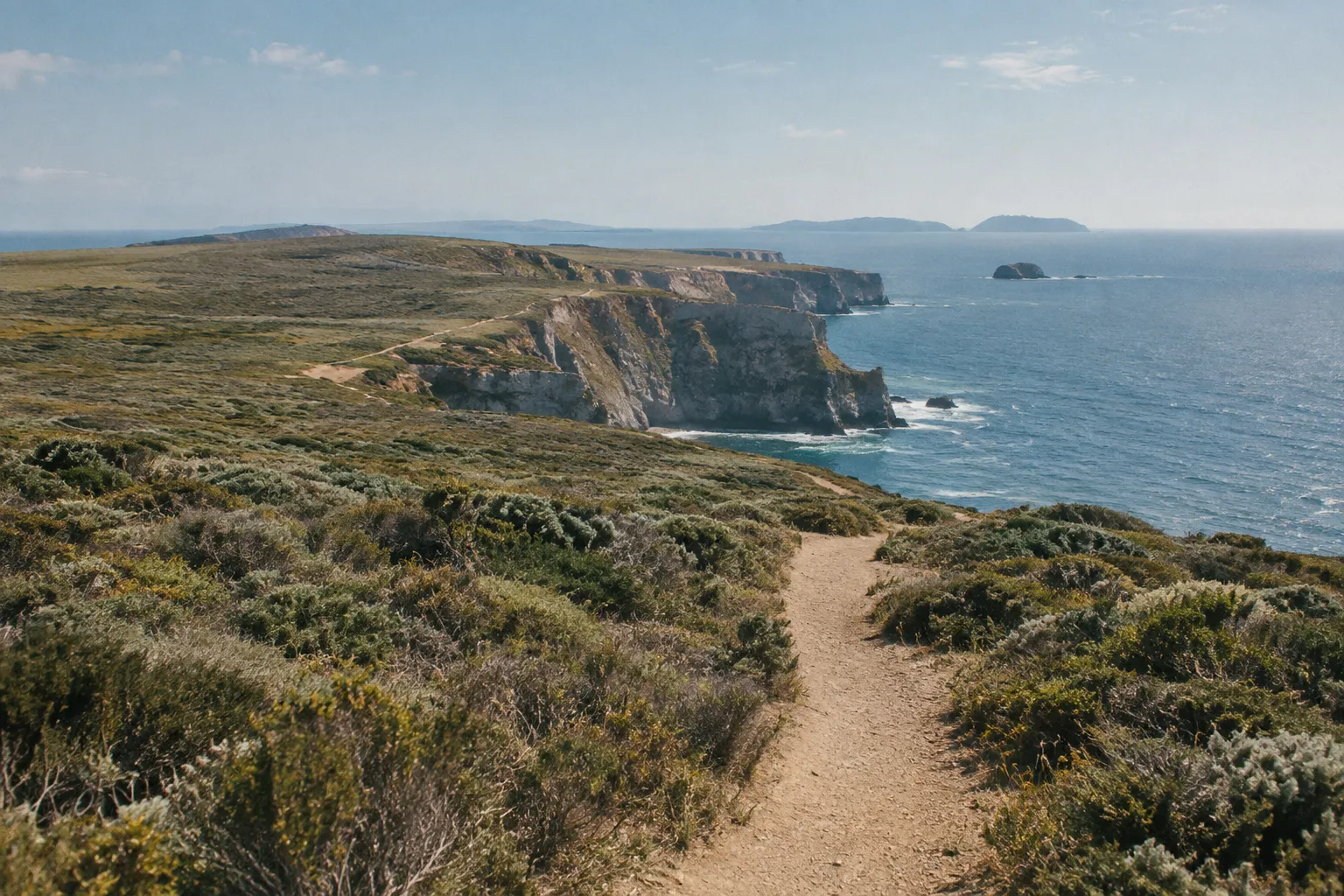
The climb from the landing
The approach is the first test. You climb a steel-rung ladder from the boat to the dock, then 157 stairs to the top of the island (22). There is no water waiting at the top, so everything you drink on the hike and in camp goes up those stairs on your back. Campers on the overnight fare should pack in bags they can carry one-handed while holding a rail. The boat concessionaire caps each item at 45 pounds (20 kg) (8)(9).
The payoff is a campground on the bluffs with wide coastal views (11). Anacapa Island has seven campsites (5).
Trail options and overlooks
Two miles of trail sounds short, and it is, but that distance covers the island’s main overlooks with time left over. Anacapa Island is a volcanic island that waves have carved into sea cliffs, sea caves and natural bridges. The best-known is the 40-foot (12 m) Arch Rock, the symbol of the park (11).
Worth the detour:
- Inspiration Point, which the NPS calls one of the best views in the park even on a foggy day (20).
- The birding. West Anacapa’s cliffs hold the largest breeding colony of California brown pelicans, and the islets together host the largest western gull breeding colony in the world (11).
Skip if short on time:
- Frenchys Cove on West Anacapa Island. Only a limited number of trips go there each year, so don’t build a plan around it (22).
One seasonal warning: western gulls nest on Anacapa Island from April through mid-August. During those months, expect guano, strong odor, constant noise, bird carcasses and gulls defending their territory. The NPS advises visitors who find that adverse to choose another island (22). Birders may love it. Everyone else should book outside that window or go to Santa Cruz Island instead.
Sea cave safety: when to go guided
Sea caves are the most dangerous part of a Channel Islands kayak trip, and the NPS strongly recommends kayaking with one of the park’s authorized guides (15). The NPS warns that large waves or ship wakes can create danger inside sea caves even when the sea looks calm, and recommends wearing a helmet in caves (7)(15). A flat surface outside the entrance tells you little about what a set wave does once it compresses inside a low ceiling.
The park’s own language on kayaking is stark. Sea kayaking here has caused visitor deaths, and near-fatal incidents happen every year. The NPS cites fast-changing weather, at times extreme sea conditions and dangerous sea caves as the main risks (15). It also says solo kayaking anywhere in the park should not be attempted by novices or anyone not properly experienced, trained, conditioned and equipped (15).
Conditions also shift over the day. Wind and swell generally come from the northwest and strengthen as the day goes on (7). A morning paddle is usually the calmer one, and that matters for timing a cave exploration.
The decision rule is simple. If you have not paddled sea caves before, book the guided tour at Scorpion Anchorage. Bring your own kayak only if you already have open-water and cave experience, and wear a helmet regardless.
What to pack: water, layers and camp gear
The packing list for Channel Islands National Park starts with water. The NPS calls for 1 gallon of water per person per day, carried in containers no larger than 2.5 gallons each (8)(9). Add a windbreaker, layered clothing, sun protection, a sturdy tent and a first-aid kit (8)(9). There are no stores, restaurants or hotels on any of the islands, so anything you forget stays forgotten (10).
Water: how much to carry
Plan on 1 gallon (3.8 L) per person per day, split into containers of 2.5 gallons (9.5 L) or less (9). The size limit is practical as well as a rule. Smaller jugs are easier to haul up Anacapa Island’s stairs and along the walk to camp.
Where you can refill:
- Water available: near Scorpion Harbor on Santa Cruz Island, at Scorpion Canyon Campground, and on Santa Rosa Island near Bechers Bay and at Water Canyon Campground (8)(10).
- No water: Anacapa Island, Prisoners Harbor on Santa Cruz Island, San Miguel Island and Santa Barbara Island. Bring all of it (10).
If you use a natural source, purify the water before drinking or washing with it (8). The NPS notes that some visitors find the island tap water has an unpleasant taste (9), so pack a flavor packet if that bothers you.
Clothing and sun protection
Island weather swings between cool mornings, warm afternoons and wind. The NPS list covers it (9):
- Short and long pants
- Fleece jacket or sweatshirt
- Windbreaker and waterproof outer layer
- Hat, gloves and long sleeves for mornings and evenings
- Sunscreen
- Sturdy hiking shoes with non-slip soles
Pack light. Concessionaires limit each bag of gear to 45 pounds (20 kg), and duffels, backpacks or coolers with handles carry best over uneven ground (9). Clean seeds and insects off your boots and gear before you leave home to keep non-native species off the islands (9).
Leave the wagon at home: as of November 2026, Island Packers no longer carries carts or wagons to Santa Cruz Island, except compact carts packed inside your gear ($12 fee) (24), and it does not transport propane tanks larger than 16 ounces or coolers over 45 pounds (26).
Food, trash and camp storage
Bring every meal you plan to eat, plus a buffer. Recreation.gov advises extra food in case weather delays your return boat (11). Repackage your food at home to cut weight and litter, and keep meals simple (9).
At camp:
- Store all food, trash and scented items in a secure, animal-proof container at all times (13). Scorpion provides food storage boxes (13).
- Use mouse-proof food containers (9). Island mice have tested positive for hantavirus, so keep food sealed and never feed wildlife (8).
- No campfires. Cook only on a chemical-fuel stove (8).
- No trash collection. You pack out everything you brought in (8).
Wildlife you might see, including the island fox
The island fox is the signature animal of Channel Islands National Park. It lives on only six of the eight Channel Islands, and each island’s population is a distinct subspecies found nowhere else on Earth (21). It descends from the mainland gray fox and is the largest native mammal on the islands, yet it is one of the smallest canids in the world (21).
Its recovery story is part of the reason the park’s rules feel strict. In the 1990s, golden eagles drove the foxes on San Miguel, Santa Rosa and Santa Cruz Islands into a steep decline. By 2000 only 15 remained on San Miguel and on Santa Rosa, and fewer than 80 on Santa Cruz Island (21). Each park subspecies was federally listed as endangered in 2004. The recovery program that started in 1999 included captive breeding, golden eagle removal, bald eagle reintroduction and removal of non-native grazing animals (21). The foxes you might spot near camp today are the result of that program. Do not feed them, and do not leave food where they can reach it.
The fox is one of the park’s 145 endemic species, alongside endemic skunks and lizards (12)(18). Beyond the land animals, the wildlife spectrum includes:
- Marine mammals: California sea lions and harbor seals along the Santa Cruz Island and Anacapa Island shorelines (3)(11). Humpback and gray whales move through the surrounding channel (18), which is why your crossing may slow for a sighting.
- Seabirds: brown pelicans on West Anacapa, the world’s largest western gull colony across Anacapa Island, and storm-petrels, murrelets and cormorants on eastern Santa Cruz Island (11)(3).
How many days to plan, and the best time to visit
Most first-time visitors need one full day for Anacapa Island or Santa Cruz Island, or two days with one night of camping for the full experience. The park says island trips generally take a whole day or more, and overnight stays are possible on both islands (12). A full day gives you 6-8 hours ashore (12).
The trip length to skip is the “less than a full day” trip. On those, most of your 2-3 hours goes to the boat, and you have very little time on the island (12). If you only have half a day, visit the mainland visitor center in Ventura Harbor instead. It is the only part of the park you can see in less than half a day (12).
How to match days to goals:
- One full day: Anacapa Island’s trails and overlooks, or a Santa Cruz Island hike or guided kayak from Scorpion Anchorage.
- One night: Camp at Scorpion and fit in both a paddle and the Cavern Point hike, or camp on Anacapa Island’s bluffs.
- Two or more nights: The point-to-point backpack between Scorpion Anchorage and Prisoners Harbor (4).
- Day trips to Santa Rosa or San Miguel: Possible, but the long boat rides leave very little time to explore (12). Camp if you go.
Best month to visit
If you are reading this in late autumn, Island Packers describes October and November as a time of mild weather, pleasant sea conditions and fewer visitors (23), but strong east or Santa Ana winds are possible from October through January (7). Gray whale season runs from December through April (20).
My pick is September. Western gull nesting on Anacapa Island ends by mid-August (22), the Prisoners Harbor campground is open, and you are still inside Island Packers’ April-to-September peak season (24). Santa Rosa Island trips run spring through fall (20), which keeps a third island on the menu.
Late spring works too if gulls don’t put you off. Santa Rosa Island campers should note that, after the 2026 Santa Rosa Island Fire, the NPS scheduled Water Canyon Campground and backcountry beach camping in the northwest and southwest quadrants to reopen on October 14, 2026, while the southeast quadrant stays closed to backcountry camping for the rest of the 2026 season and the burn area stays closed (2). That is a separate trip from a first visit, and current closures are posted by the park.
In any month, the crossing is open-channel water, and swell can make it rough. Wind generally builds through the day (7). If you are prone to motion sickness, plan for it on both legs.
Is it worth visiting?
Yes, if you treat the trip as a logistics problem and solve it in advance. The wildlife is not found anywhere else, and the islands are quiet once the boat leaves. It is not worth it if you want to show up without a plan, or if all you can spare is a half-day boat ride with an hour on the ground. Pairing the islands with another California park? Our guides to Yosemite’s Half Dome, Glacier Point and waterfalls, Sequoia’s giant trees and to how the Pacific West parks compare by season cover the next stop.
Frequently Asked Questions
- How long is the ferry ride to Channel Islands National Park?
- About 1 hour from Ventura to Scorpion Anchorage or Anacapa Island, and about 1½ hours on the direct run to Prisoners Harbor; wildlife viewing and an intermediate stop can add time.
- How many days do you need in Channel Islands National Park?
- Plan at least one full day ashore; an overnight makes sense when you want to combine activities without compressing them around the return boat.
- Is Channel Islands National Park worth visiting?
- It suits travelers willing to plan around boat schedules and carry their supplies; it is a poor fit for a spontaneous half-day outing.
- What is the best month to visit the Channel Islands?
- September is a practical first-visit choice for avoiding Anacapa's gull nesting period while retaining a broad range of seasonal boat trips.
- Can you travel between the islands?
- Do not assume you can transfer between islands on demand; confirm that a camper shuttle serves your dates before building a multi-island itinerary.
- Do you need reservations for both camping and the Channel Islands ferry?
- Yes. Check both calendars, book the Island Packers boat, then reserve the matching campsite on Recreation.gov right away, for the same dates and landing.
- Can you rent a kayak on Santa Cruz Island?
- No on-island rental option is available, so paddlers need to book an authorized guided outing or coordinate transport for their own kayak.
Lock in your dates in the right order
A smooth Channel Islands trip comes down to booking order and fit. Once your dates fall inside the six-month window, check that Island Packers runs them and that Recreation.gov has a matching campsite, then book the fare (day trip or camper/overnight) and reserve the campsite in the same sitting. Pick Scorpion if you want water, kayaking and convenience. Pick Anacapa Island for a short hike and seabirds. Pick Prisoners Harbor or Del Norte for quiet. Then pack 1 gallon of water per person per day plus a day’s spare food, because the boat schedule decides when you leave.