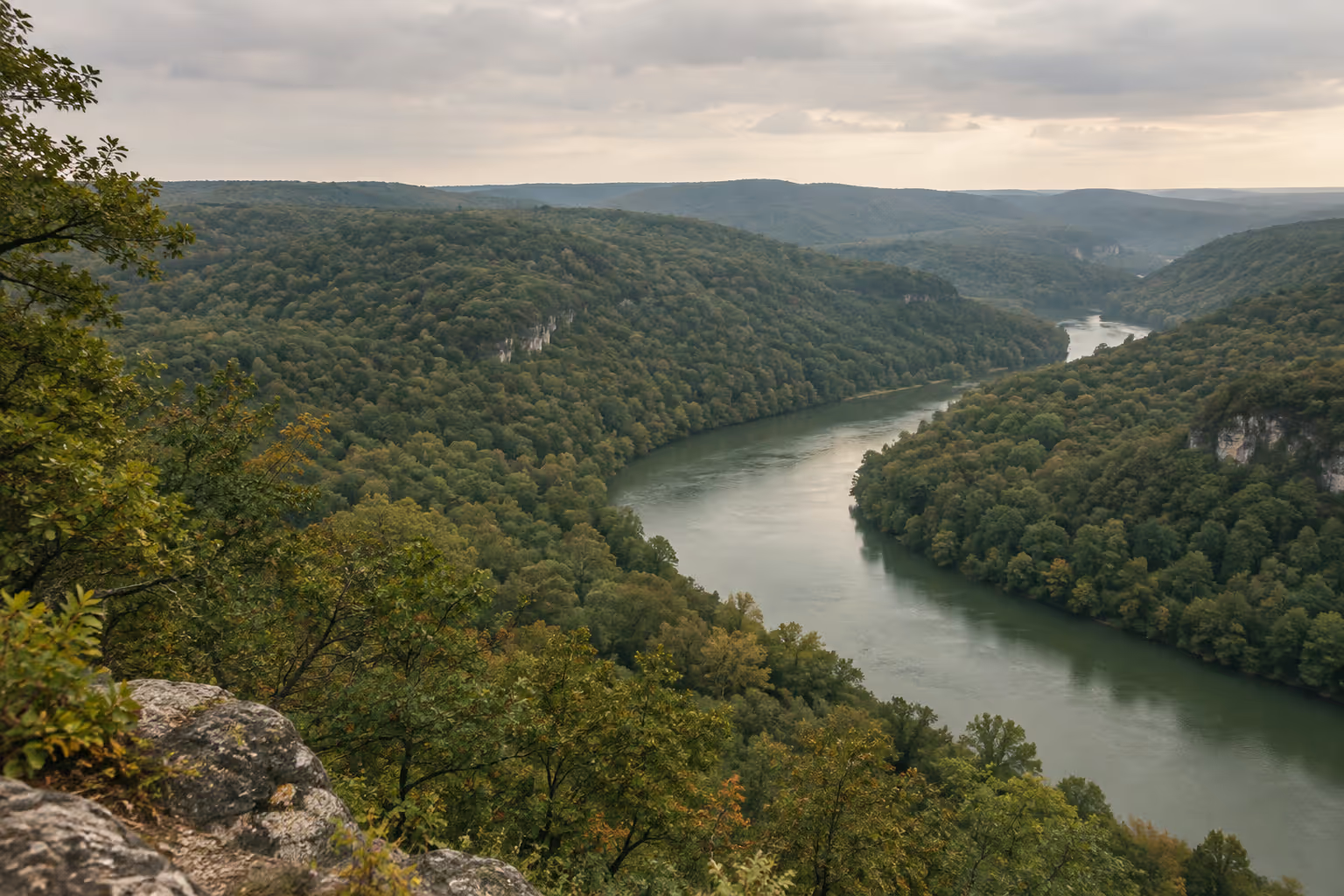
Mammoth Cave National Park in south-central Kentucky costs nothing to enter, but you only go underground with a ticket. The tour you book decides whether your day is a 30-minute self-paced walk or six hours of crawling through passages sized for a 42-inch chest. The cave’s mapped length now stands at 426 miles (685 km) (8), after surveyors added six new miles in 2022 (11). Plenty of older guides still quote a smaller number, so check tour schedules, ticket prices and ferry status against your exact dates the same way.
✓ Pros
- The underground experience can be matched to very different mobility and stamina levels.
- A cave visit can be paired with above-ground hiking without an entrance fee.
✗ Cons
- Planning has several moving parts: tour availability, ticket inventory and seasonal schedules.
- A north-side hike can require a last-minute change if the river crossing closes.
Mammoth Cave National Park: Location, History, and the World’s Longest Cave System
Mammoth Cave National Park protects the world’s longest known cave system, with 426 miles (685 km) of passage mapped to date. It also covers forests, two rivers, trails and historic sites near Brownsville, Kentucky (10)(8). The park covers 52,830 acres (21,380 hectares) (8). Most visitors spend their time on the south side of the Green River, where the visitor center, ticket counter and cave tour departures sit (15).
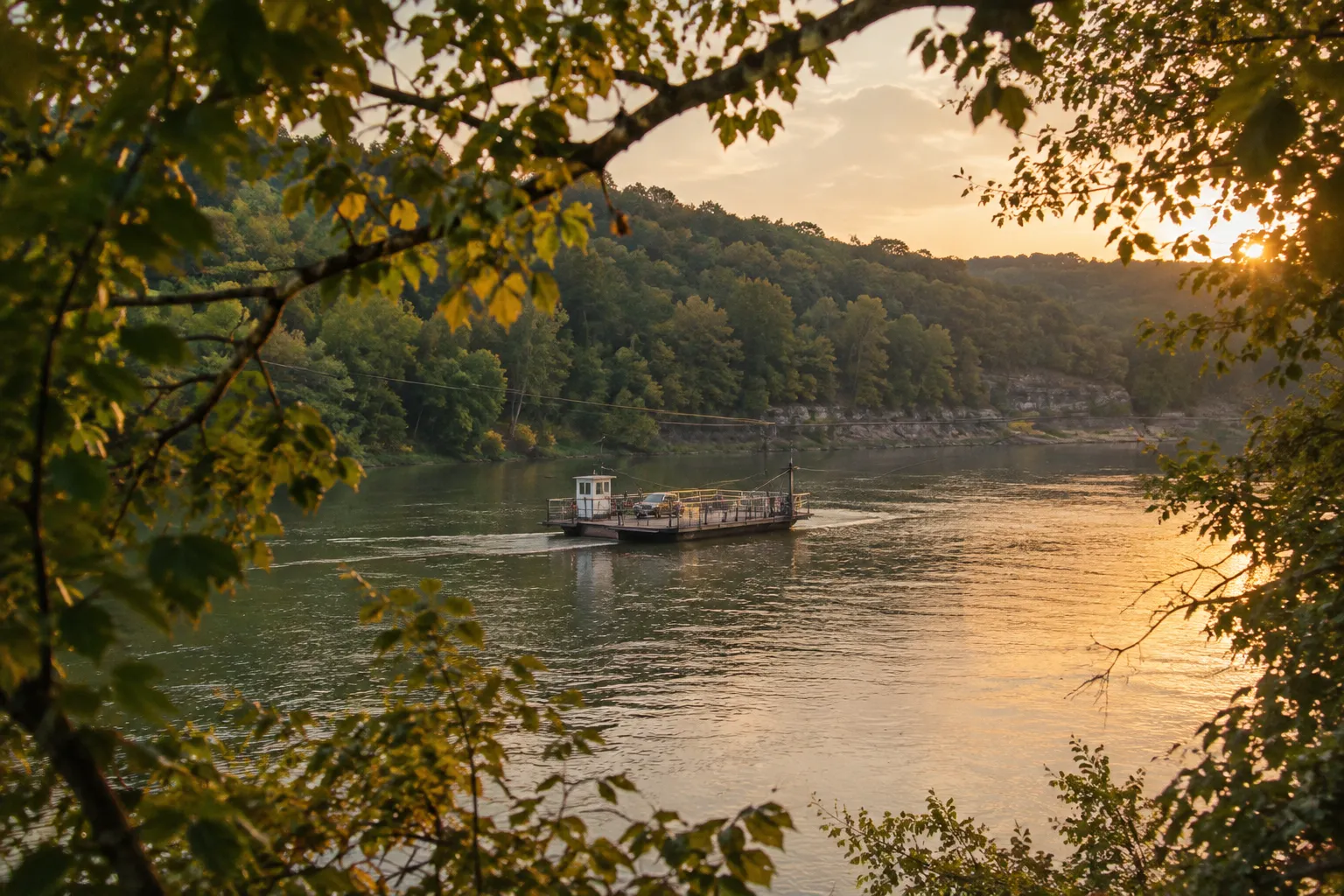
Where the park sits across Edmonson, Hart, and Barren counties
The park spreads across Edmonson, Hart and Barren counties in south-central Kentucky (10). Interstate 65 is your access road. Coming from the north, take Exit 53 (Cave City), turn right onto KY-70, and follow 70/255 as it becomes the Mammoth Cave Parkway to the visitor center. Coming from the south, take Exit 48 (Park City), turn left onto KY-255, and follow it as it becomes Park City Road until it joins the Mammoth Cave Parkway, then turn left (7)(15).
The closest full-service international airports are Louisville, about 80 minutes away, and Nashville, about 90 minutes away (7). That puts the park within a half-day drive window from either city, so you don’t need to overnight on the way in. If you fly into Nashville, our guide to things to do in Nashville covers the city end of the trip.
The park runs on Central Time. If you drive in from the north, you cross from Eastern Time at the northern Hart County line (7). A 10:00 AM tour time means 10:00 AM Central. Visitors from Louisville or Cincinnati who forget this arrive an hour early, which is the better mistake to make.
The landscape above ground is low and forested rather than mountainous. The lowest surface point is 411 feet (125 m) on the Green River near Brownsville, the highest is 852 feet (260 m) at Brooks Knob, and the visitor center sits at 741 feet (226 m) (8). Expect rolling ridges and sinkholes, not summit views.
How the cave became the longest known system on record
The record has deep roots. Prehistoric American Indians first entered the cave around 5,000 years ago and explored more than 19 miles of passage inside what is now the park (9). Before the War of 1812, the cave was mined as a saltpeter source, and much of that infrastructure is still visible underground (12). In the 1840s, Stephen Bishop, an enslaved Mammoth Cave guide, extended the known cave and drew one of its first detailed maps (9).
The modern timeline runs like this:
- May 25, 1926: Congress authorizes the park (8)
- July 1, 1941: the park is officially established (8)
- September 9, 1972: Mammoth Cave is identified as the world’s longest cave system (8)
- October 27, 1981: UNESCO designates it a World Heritage Site (8)
- October 28, 2021: certified an International Dark Sky Park (8)
The Cave Research Foundation, an official park partner, has mapped and explored the cave since the late 1950s, and its survey work drives the mileage figure upward (9). The 426-mile total reflects what has been discovered so far, not a fixed endpoint (9).
The geology explains the length. The park is a karst landscape of limestone caves, two rivers and forested, rugged terrain (12). Water dissolving limestone over long periods created layered passages, which is why tours range from huge rooms to tight crawls within the same system. The cave’s total vertical relief is 398 feet (121 m), from Echo River at 412 feet (126 m) up to the top of the elevator shaft at 810 feet (247 m) (8). That relief is where the stairs on your tour come from.
Cave Tour Options: From Self-Guided Walks to Six-Hour Wild Caving
Mammoth Cave tours range from a 30-minute self-guided Discovery Tour to the six-hour Wild Cave Tour. Each one lists its duration, distance, stair count and age rules, and those details should drive your booking more than the tour’s name does (1). You cannot enter the cave on your own, unlike Carlsbad Caverns in New Mexico, where two paved cave trails are self-guided. Joining a ticketed tour is the only way to see inside Mammoth Cave and the park’s other toured caves, Great Onyx Cave and Wondering Woods Cave (3)(7).
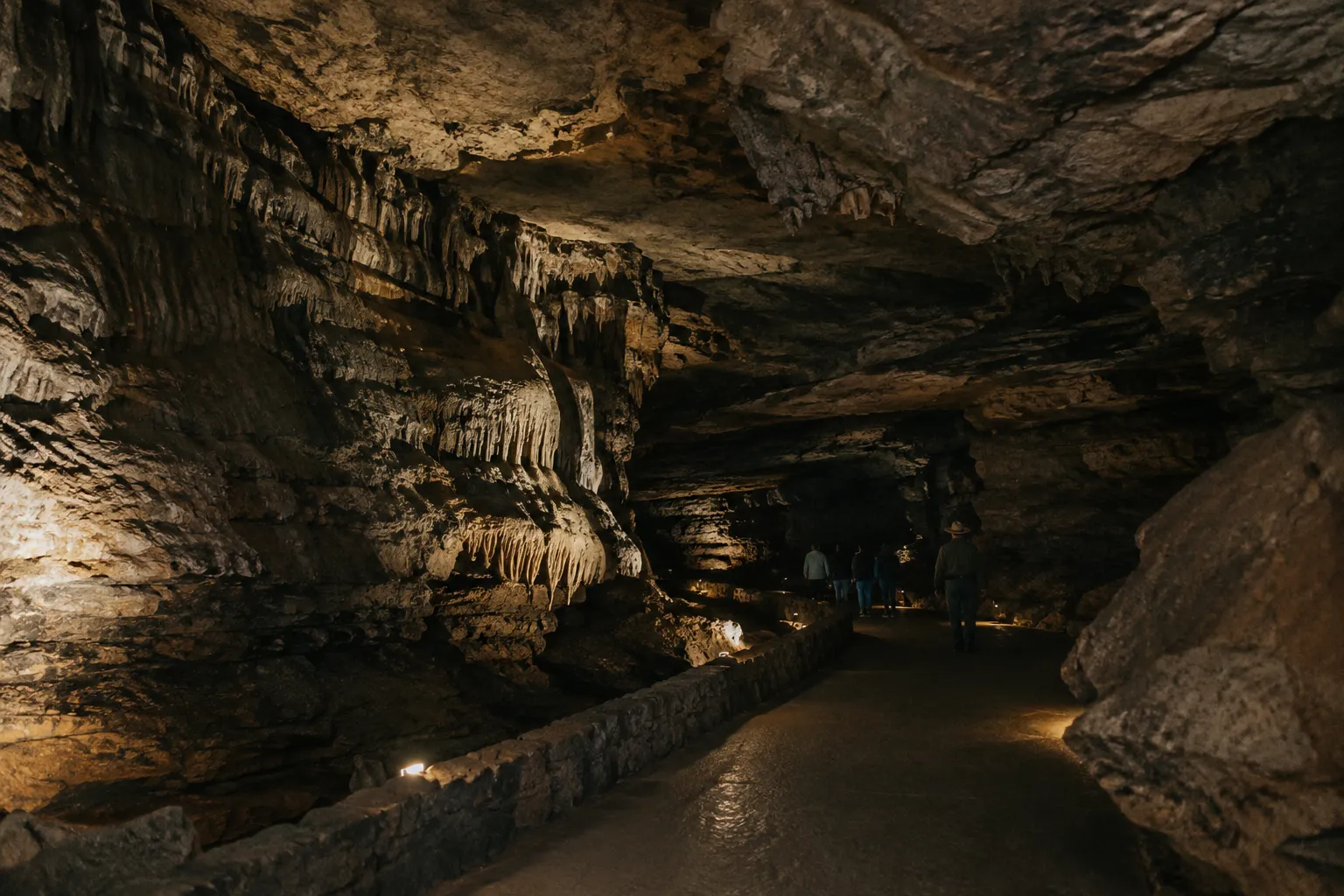
Tour availability shifts with the seasons, and not every tour on the park’s master list runs on every date (1). A tour you read about in a blog post may not operate the week you’re there. Search Recreation.gov for your actual dates before you build the rest of the trip.
The thing most guides get wrong is ranking tours by mileage. A 0.5-mile tour and a 2-mile tour can both take two hours, and the 2-mile one has 540 stairs (1). Pick by stairs, age limits and tight spaces, in that order.
Here is how the main tours compare. The Discovery Tour takes about 30 minutes over 0.75 mile (1.2 km) with 130 stairs (2), is rated easy, and is open to all ages, with adult tickets at $12 for the October 2026 schedule (13). The Historic Tour runs 2 hours over 2 miles (3.2 km) with 540 stairs, is rated moderate, and is open to all ages, with adult tickets at $24 for May to August 2026 (1)(16). The Frozen Niagara Tour takes 1.25 hours over 0.25 mile (0.4 km) with 64 required stairs (1)(4). The Accessible Tour takes 2 hours over 0.5 mile (0.8 km) with no stairs and is open to all ages (1). The Wild Cave Tour runs six hours over five miles (8 km) with about 500 stairs, a minimum age of 16, and an adult ticket of $79 for May to August 2026 (1)(18). On any of the all-ages tours, visitors under 16 must be accompanied by an adult aged 18 or older (1).
Age rules vary by tour beyond that baseline. Some lantern tours set a minimum age of 6 (1).
Two of the tours on the NPS schedule for November 15, 2026 to February 28, 2027 are worth adding to that comparison (2). The Broadway Tour enters through the Historic Entrance and passes the Rotunda, the saltpeter mining ruins and Giant’s Coffin, covering 1.75 miles (2.8 km) and 160 stairs in two hours (1). The Domes and Dripstones Tour starts down a 280-stair descent and ends at Frozen Niagara: 0.75 mile (1.2 km), 640 stairs, two hours (1). As of November 2026, an adult ticket costs $22 for Broadway and $30 for Domes and Dripstones (5).
Several items are banned on every cave tour: strollers, child backpack carriers (front packs are allowed), tripods and monopods, walking sticks, metal-framed backpacks or packs that ride above the shoulders or below the hips, flash photography, weapons and pets (3). Day-use kennels are available for rent at the Lodge at Mammoth Cave (3). If you’re traveling with a toddler, the stroller rule changes how you pack.
Discovery Tour: the only self-guided option
The Discovery Tour is the only cave tour you walk at your own pace. It follows large, open passageways with interpretive signs and artifacts from the cave’s early history, and rangers are stationed along the route to answer questions (13)(1). It is the self-guided version of the Mammoth Passage Tour and includes part of the Historic Tour route (13). There are no restrooms on this one (13).
It runs only on selected dates, with unlimited tickets per time slot (13). As of November 2026, the NPS schedule does not list it from November 15, 2026 through February 28, 2027 (2). Worth the detour if you have a short window or a group with mixed stamina. Skip it if you’re already booked on the Historic Tour, since you’ll cover some of the same ground.
Frozen Niagara: a shorter, decorated-cave pick
Frozen Niagara takes 1.25 hours, covers 0.25 mile (0.4 km), and has 64 mandatory stairs. The park describes it as a relatively easy tour through some smaller, narrow sections (1)(4). It suits visitors who struggle with long distances or long stair runs but still want to see decorated cave formations (4).
Wild Cave Tour: five miles and about 500 stairs
The Wild Cave Tour is the most extreme tour the park offers. It runs six hours over five miles (8 km), with about 500 stairs and a minimum age of 16 (1). You spend long stretches crawling through tight spaces and climbing through difficult sections, with no alternative routes (18).
Two hard requirements catch people out. Chest and hip measurements must not exceed 42 inches (107 cm) in circumference. You must bring your own lace-up hiking boots that cover the ankle and have slip-resistant tread. Athletic shoes don’t qualify, and the park turns away anyone without proper footwear, with no exceptions (18). Pack a spare pair of tennis shoes or sandals for the boot cleaning at the end (18). For May 17 to August 8, 2026, the tour departs at 9:00 AM on Sundays, Tuesdays, Thursdays and Saturdays, and the park notes it often sells out (18).
Cleaveland Avenue and the elevator backup route
The Cleaveland Avenue Tour exits the cave by elevator, and you need to plan for the version without one. As of November 2026, the NPS lists that elevator as out of service (19), and the tour is not on the published schedule through February 28, 2027 (2). If the elevator fails, the tour may add 30 minutes and another mile, plus a return climb of about 231 stairs (1). If 231 stairs at the end of a tour would be a problem for anyone in your group, pick a different tour.
Logistics after the tour matter too. Some tours require a short bus ride, and the Accessible Tour uses a caravan of visitors’ own vehicles to an entrance about 2 miles (3.2 km) away (1). Read the departure details in each listing.
The Mammoth Cave Historic Tour: Stairs, Distance, and What You’ll See
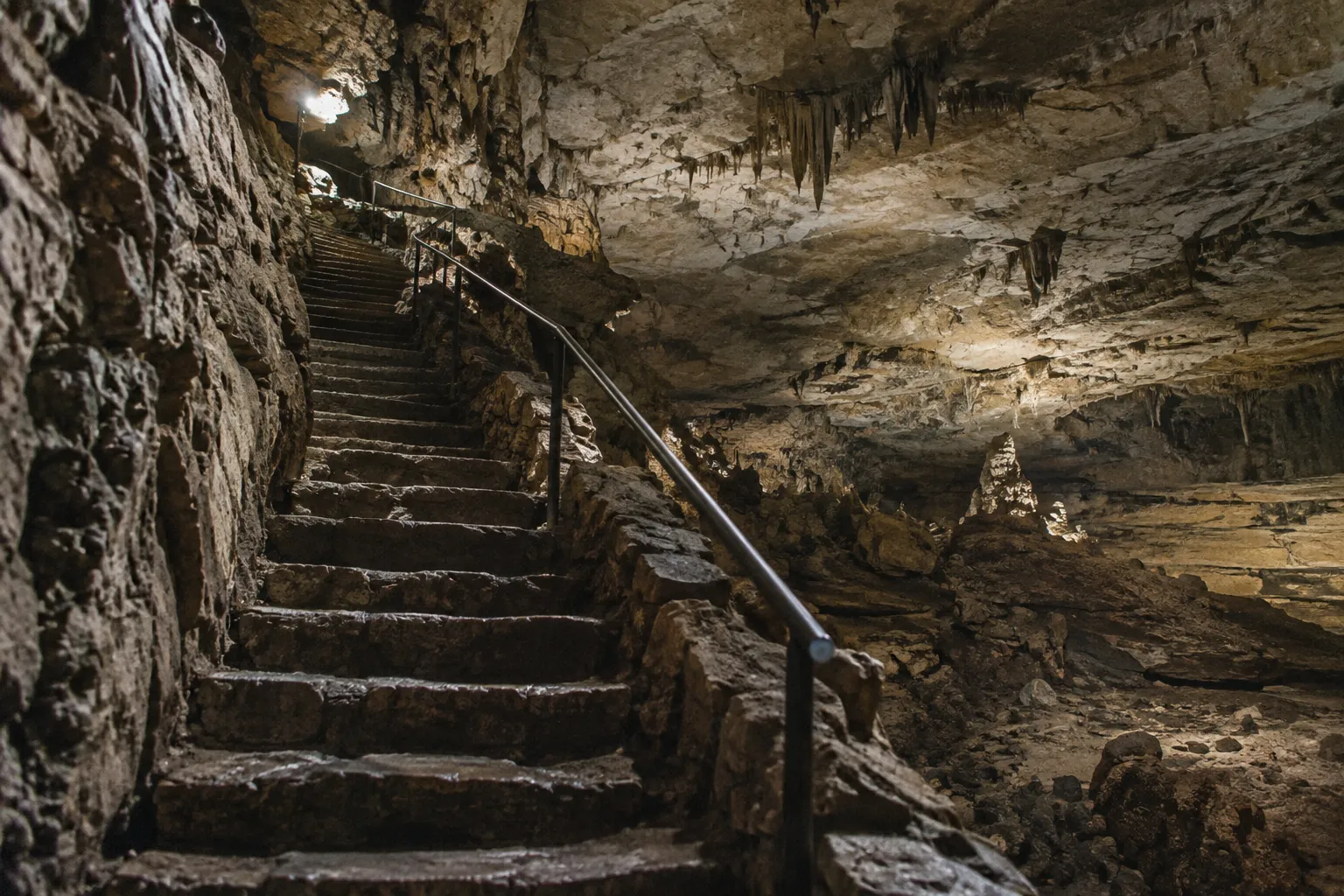
The Mammoth Cave Historic Tour is the park’s classic two-hour, two-mile route with 540 stairs and a moderate difficulty rating. It visits the historic areas that made the cave famous, including huge rooms and much tighter passages (1)(16). For a first underground visit, it gives you more of the cave’s variety than any other single standard tour. It also asks more of your knees than the “2 miles” headline suggests.
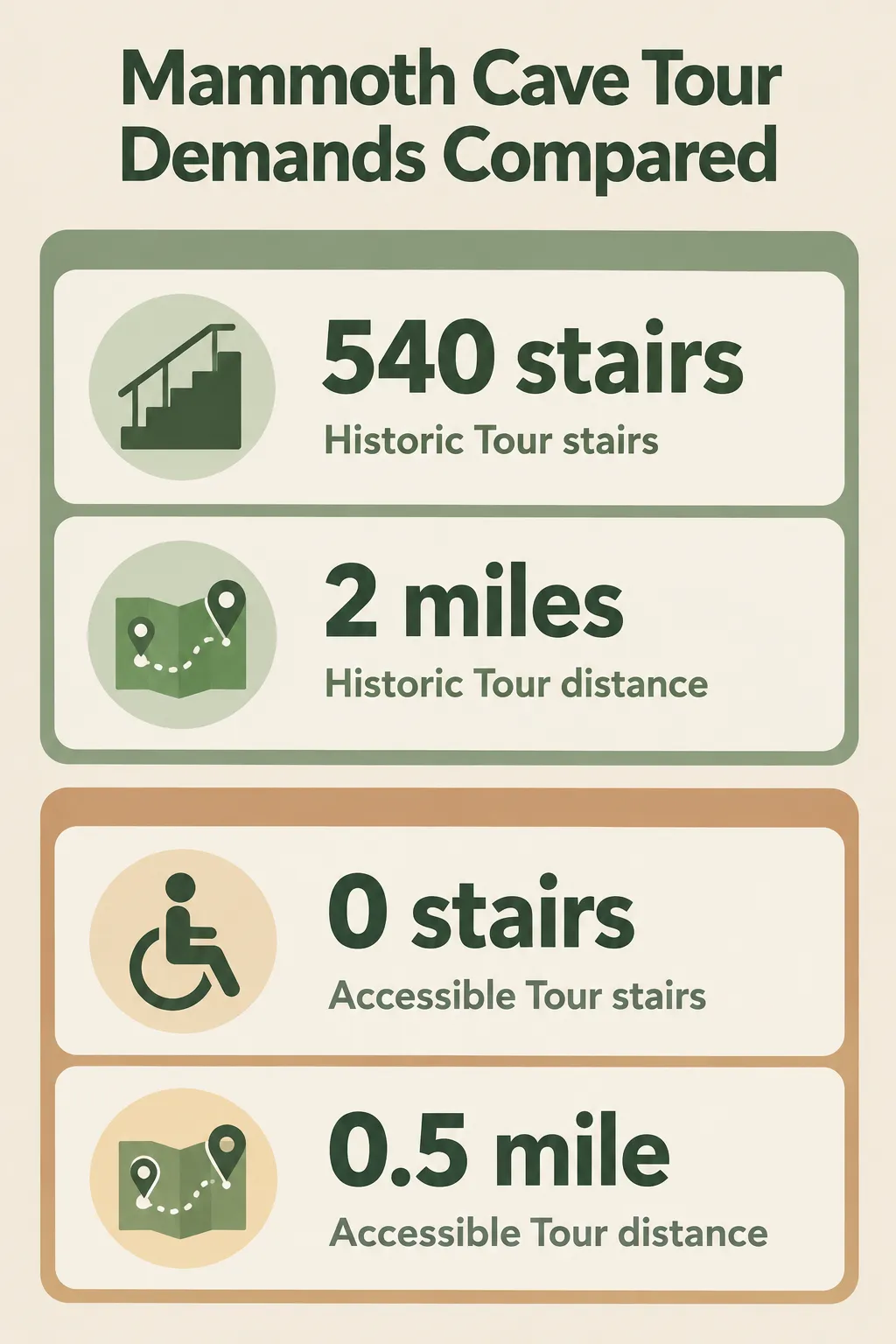 The Historic Tour covers 2 miles and 540 stairs in 2 hours, while the Accessible Tour covers 0.5 mile and 0 stairs in 2 hours.
What the two-hour route covers underground
The route goes through tunnels people have used for thousands of years. It moves from the large rooms that gave Mammoth Cave its name down into tighter spaces deep inside the cave (16). Of the 540 stairs, 155 are at Mammoth Dome alone (16). The park warns that the tour climbs and descends hundreds of stairs and several steep inclines, and that there are no alternative routes once you’re underground (16). If you turn back, you turn back the way you came.
Restrooms are available on the route (16). Visitors under 16 must be with an adult aged 18 or older (16).
Parts of the route also appear on the Violet City Lantern, Star Chamber and Gothic Avenue tours, and the River Styx Tour includes the whole Historic route (16). If you want a longer day and the River Styx Tour runs on your date, that’s a way to see everything on the Historic Tour and more. If River Styx isn’t running, the Historic Tour is the default.
Booking mechanics for summer 2026: from May 17 to August 8, 2026, the Historic Tour runs daily at 10:00 AM, 11:45 AM, 12:15 PM, 12:45 PM, 2:30 PM, 3:00 PM and 3:30 PM, with 110 tickets per departure (16). That’s seven departures a day, and they still fill, because this is the tour most first-time visitors book. The park advises reserving well ahead, since tickets can sell out weeks in advance (2).
The 540-stair count is the number to weigh. Two miles on flat ground is an easy walk for most people. Two miles with 540 stairs, steep inclines, uneven surfaces and stretches where you duck under low ceilings is a different workout (2)(16). Wear sturdy shoes, since some cave trails are uneven (2). The cave stays cool year-round, so bring a light layer even in July.
Who should pick Frozen Niagara instead
Frozen Niagara is the better pick when time or stair tolerance is limited but you still want a decorated-cave experience.
Reconsider the Historic Tour if any of these apply to someone in your group:
- Knee or hip problems that make long stair descents painful
- Discomfort in tight or low-ceilinged spaces
- Young children who would need carrying (child backpack carriers are banned; front packs are allowed) (3)
- A tight schedule where two hours underground plus check-in time doesn’t fit
The decision rule is simple. If your group can handle 540 stairs, the Historic Tour gives you more cave history and more varied passage. If stairs are the limiting factor, Frozen Niagara gets you underground with roughly an eighth of the stair count. If stairs are off the table entirely, the Accessible Tour is your only option, so check its status first (19).
Frozen Niagara is not a lesser version of the Historic Tour. It covers a different part of the cave and serves a different purpose. For fit visitors with only one tour slot, though, the Historic Tour is the stronger use of the time.
Mammoth Cave Tickets and Reservations: Prices, Booking, and Arrival Rules
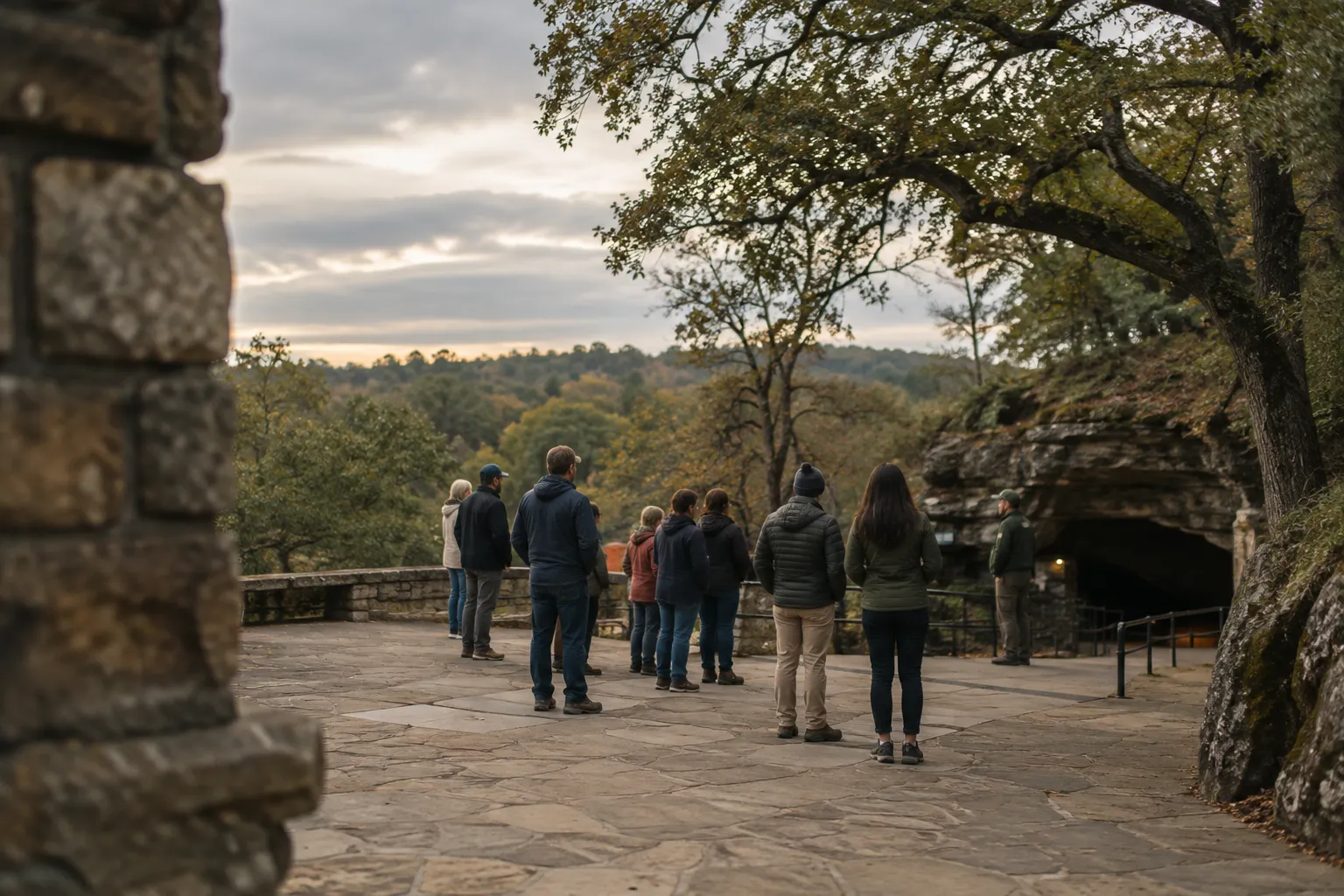
Mammoth Cave tickets are required for every cave tour, guided or self-guided, and Recreation.gov reservations are the only way to guarantee a spot on the tour you want (7)(2). Park entry is free, with no entrance pass required, but there are fees for cave tours, camping and shelter rentals (5)(6). As of November 2026, the park’s fee table puts an adult ticket between $12 for the Discovery Tour and $79 for the Wild Cave Tour (5).
How to reserve online or by phone
Book through Recreation.gov. Reservations are strongly recommended because tickets can sell out weeks in advance (2). On Recreation.gov you can filter tours by distance, time and difficulty (2). For help with booking, call 877-444-6777 (2). The full booking sequence, from picking a tour to checking in at the visitor center, is laid out step by step below.
Can you walk up and buy a ticket on the day? The ticket counter is in the visitor center, which the park lists as open 8:30 AM to 4:30 PM Central through February 28, 2027, as of November 2026 (21). But the park describes a reservation as the only way to ensure a place on your chosen tour (2), and summer Historic Tour slots fill. Treat same-day tickets as a backup, not a plan.
What tickets cost, tour by tour
Ticket prices come in adult, youth and child tiers (5):
- Historic Tour: $24 adult, $18 youth, $6 child, for the May 17 to August 8, 2026 schedule (16)
- Discovery Tour: $12 adult, $9 youth, $3 child, for the October 2026 schedule (13)
- Wild Cave Tour: $79 adult, for the May 17 to August 8, 2026 schedule (18)
Tour offerings change by season, so confirm that your tour runs on your dates before you book (1)(5).
One discount is worth knowing. The America the Beautiful Senior Lifetime Pass, Senior Annual Pass and Access Pass each give a 50% discount on cave tour tickets, for the cardholder only (5). The same passes give 50% off camping when the reservation is in the cardholder’s name, but there is no discount on shelters (5). If you hold one of these passes, bring it to check-in.
How much does it cost to tour Mammoth Cave overall? With free entry, your spend is the tour tickets plus whatever you pay for food, fuel and lodging. A family doing one Historic Tour pays for tickets only. Hiking the trails afterward costs nothing (6).
Arrival time and check-in rules
Arrive at the visitor center about 30 minutes before your tour time (3). For off-trail caving tours like Wild Cave, you need a printed ticket and must check in at least 30 minutes early (1)(3). Build that buffer into your drive, along with the time-zone change if you’re coming from the north (7).
Leave the banned items in the car before you queue: strollers, tripods, walking sticks and oversized packs (3). Photography is allowed with the flash off (3).
How to Book and Prepare for a Mammoth Cave Tour
Reserve a tour for your date, prepare its ticket and required gear, then arrive early enough to check in before departure.
- 1
Choose a tour and date
Compare the tour's stairs, age limits and duration, then confirm that it runs on your visit date.
- 2
Reserve your place
Book through Recreation.gov or call 877-444-6777 for booking help.
- 3
Save or print your ticket
Keep the ticket ready for check-in; off-trail caving tours require a printed ticket.
- 4
Pack required gear
Bring any tour-specific equipment, including ankle-covering lace-up boots with slip-resistant tread for the Wild Cave Tour.
- 5
Arrive and check in
Reach the visitor center about 30 minutes before departure and check in before the tour leaves.
Accessibility at Mammoth Cave: The Accessible Tour and Assistance Services
The Mammoth Cave Accessible Tour covers 0.5 mile (0.8 km) in two hours with no stairs, and includes benches and an accessible restroom (1)(4). It was built for visitors using motorized wheelchairs, walkers and other mobility devices (1)(4). It is the right pick for anyone who can’t do stairs, but it depends on the cave elevator. As of November 2026, the NPS lists the Accessible Tour as unavailable because of mechanical issues with that elevator, in an alert dated May 6, 2026, and the tour is not on the published schedule through February 28, 2027 (19)(2). Call the visitor center at 270-758-2180 before you plan around it (19).
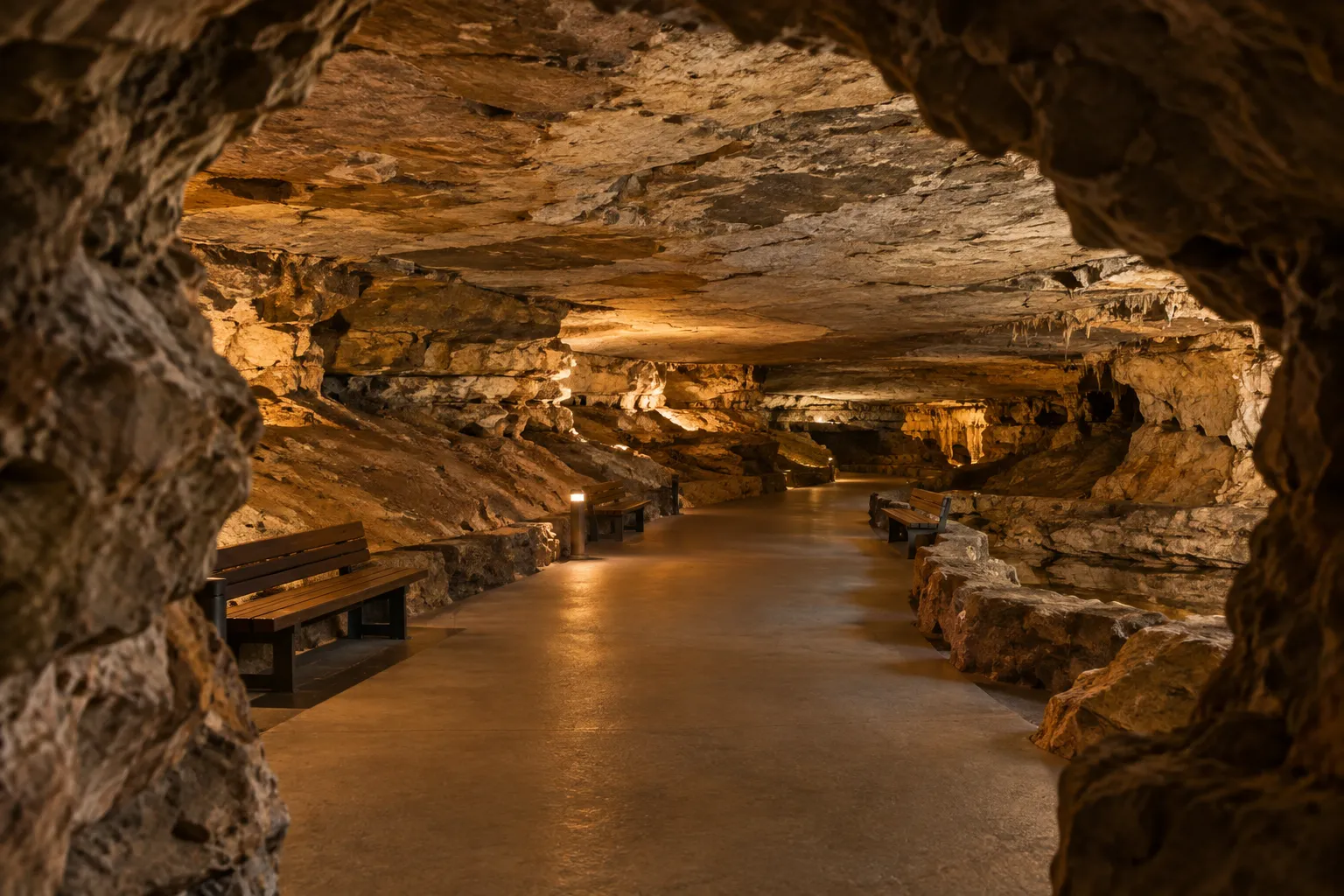
The 0.5-mile, no-stairs route and the vehicle caravan
The Accessible Tour doesn’t start at a cave entrance near the visitor center. Participants meet at the visitor center and drive their own vehicles in a caravan about 2 miles (3.2 km) to the Elevator Entrance (1). The park provides no transportation for this tour, so you need your own vehicle (1).
Staff will not transport or assist visitors or their equipment. If you need help using the accessible features, bring a companion (1). Bring your own wheelchair, walker or other device; assistive devices are allowed (1).
Plan for decontamination on exit. Assistive devices are decontaminated as you leave the cave to limit the spread of White Nose Syndrome, a disease that affects bats (1). Allow a few minutes for this, and expect wheels and tips to be cleaned.
Two lighter options sit in between the Accessible Tour and the stair-heavy tours. Frozen Niagara is relatively easy and short, at 0.25 mile (0.4 km) with 64 stairs (4). The Discovery Tour has 130 stairs over 0.75 mile (1.2 km) (2). Both involve stairs, so neither replaces the Accessible Tour for wheelchair users.
Above ground, several ranger talks and guided walks are fully accessible to people with physical and mobility disabilities (4). If you’re camping, Mammoth Cave Campground sites 37 and 38 are fully accessible, with paved access to accessible restrooms (4). As of November 2026, Mammoth Cave Campground and Maple Springs close for the season on November 30 and reopen March 1, while Houchin Ferry Campground near Brownsville stays open year-round (22). In winter, the Lodge at Mammoth Cave runs reduced services and room capacity (20). The Access Pass gives a 50% discount on cave tour tickets for the cardholder (5).
Requesting a sign-language interpreter in advance
Sign-language interpretation is free for both cave tours and surface activities, but you must contact the park at least two weeks before your visit (4). That lead time is easy to miss if you book a tour on short notice. Request the interpreter before or at the same time as you book your tickets, so the tour date and the interpreter line up.
The park also takes questions and suggestions on accessibility directly (4). If your needs don’t fit the standard tour descriptions, ask before booking rather than at check-in.
Surface Trails: South-Side Day Hikes and North-Side Backcountry
Mammoth Cave National Park has 18 miles (29 km) of south-side trails, including 7.2 miles (11.6 km) around the visitor center, plus more than 65 miles (105 km) of backcountry trails north of the Green River (17)(15). All of it is free (6). The trails are the easiest way to stretch a one-tour day into a full one.
Visitor center area trails
The visitor center trails cover 7.2 miles (11.6 km) and pass ridgetops, river views, sinkholes, cave-fed springs, cemeteries, a historic train engine, and the historic entrances to Mammoth Cave and Dixon Cave (17). Many of them link into longer hikes, so you can take a quick walk between tours or string several into a longer loop (17).
Here’s how the features rank for a short visit:
Worth the detour
- Historic entrance to Mammoth Cave. Seeing the natural opening on the surface makes the cave’s scale easier to grasp after (or before) a tour (17).
- Cave-fed springs and sinkholes. These show the karst system from above: water going down into the ground and coming back out (17)(12).
- River views. The Green River splits the park, and the ridgetop overlooks put the whole layout in context (17)(15).
Skip if short on time
- Historic train engine. Interesting for rail fans, but not worth cutting into tour time (17).
- Cemeteries. Quiet and historic, but best left for a second day (17).
- Dixon Cave entrance. It pairs well with the Mammoth Cave entrance on a longer loop, but it isn’t a reason to hike on its own (17).
The Historic Entrance Trail starts at the visitor center, where every cave tour starts and ends (17)(3), so you can hike between a morning and an afternoon tour without moving the car. Wear the same sturdy shoes you’d wear in the cave.
North-side backcountry trails
The north side of the park has more than 65 miles (105 km) of backcountry trails, open to hiking, horseback riding and mountain biking, plus backcountry camping (15). The Green River runs east to west through the park, and the north side is far less developed than the south, which holds the cave tours and most visitor services (15).
Backcountry camping permits are sold on Recreation.gov or in person on the south side, at the Mammoth Cave Campground kiosk (5). Get yours before you cross. Plan for no food or supplies once you’re north of the river.
The north side suits visitors with a second day who want a long hike or a ride. On a single-day trip it rarely makes sense, because getting there depends on the Green River Ferry, which runs on fixed hours and can shut down when the river rises or falls.
The Green River Ferry: Hours, Closures, and GPS Pitfalls
The Green River Ferry crosses the river daily from 6 a.m. to 6 p.m. Central, connecting the south side of the park to the north-side backcountry, but high or low water can halt service (14)(15). As of November 2026, the NPS lists the ferry as operational but still closed to RV and trailer traffic because of low water (19). No end date is given, and the 6 a.m. to 6 p.m. hours remain the schedule when it runs (19)(15). Plan north-side trips with a backup route in mind.
The ferry reopened on March 5, 2026, after the park repaired navigational cables and support towers damaged in a spring 2025 flood (14). The repairs replaced two 1,000-foot (305 m) navigational cables that guide the vessel across, replaced or stabilized four 20-foot (6 m) towers holding those cables, and replaced a 15.5-ton concrete anchor that the flood had dislodged from the riverbank (14). While in dry dock, the ferry got a new engine and generator and passed its US Coast Guard inspection, which is required every five years (14). The 2025 closure shows how a single flood can take the crossing out of service.
Checking ferry status before you drive
Call 270-758-2166 for current ferry status before you drive toward the crossing (15). Do this the morning of your trip, not the night before, since conditions on the Green River can change overnight.
What to do with the answer:
- Ferry running: cross within the 6 a.m. to 6 p.m. Central window, and plan to be back at the landing before 6 p.m. if you’re returning the same day (14). As of November 2026, it is closed to RVs and trailers because of low water (19).
- Ferry closed: drive around by road, or move your north-side plans to another day and fill the gap with the 18 miles (29 km) of south-side trails (17).
The return trip is the one people forget. If you hike longer than planned on the north side and reach the river after 6 p.m., you have to drive the long way around.
Why GPS apps can send you the wrong way
The National Park Service warns that mapping apps may route drivers onto ferry routes or onto narrow roads unsuitable for large vehicles (3). A phone app doesn’t know the ferry is closed. It also won’t tell you a back road is a poor fit for an RV or a boat trailer.
Use the park’s directions for the main approach: Interstate 65 to Exit 53 or Exit 48, then the Mammoth Cave Parkway to the visitor center (15)(7). Look at a park map before you set out so you know which side of the river you’re aiming for (15). If you’re driving a large vehicle, stick to the signed main roads even if your app suggests a shorter line.
Planning Your Visit: Best Time to Go and How Long to Stay
Mammoth Cave National Park works best as a one- or two-day trip. One day covers a main cave tour plus a south-side hike, and a second day adds another tour or the north-side backcountry. The best time depends on which tour you want, because schedules vary by season (1). If it is one stop on a longer trip, our guide to US national parks by region and season covers other eastern parks to pair it with.
Best season for comfortable touring
The cave itself stays cool year-round, so the season matters most for the surface and the tour schedule. Choose by what you want to do:
- Summer (mid-May to early August): the widest lineup. The Historic Tour runs seven times a day and the Wild Cave Tour runs four days a week from May 17 to August 8, 2026 (16)(18). The catch is demand: tickets can sell out weeks ahead, so book early (2). Summer in Kentucky is hot and humid on the trails, which makes the cool cave a welcome break.
- October: the best month for combining a cave tour with hiking. Surface temperatures are milder for the trails, and the self-guided Discovery Tour is scheduled on fall weekends (2)(13). Check which guided tours are running on your dates.
- Winter (mid-November to February): a smaller selection of tours and lighter crowds, and the park says tickets are generally still available days in advance (20). As of November 2026, the NPS schedule for November 15, 2026 to February 28, 2027 lists the Broadway, Domes and Dripstones, Frozen Niagara, Grand Avenue and Mammoth Passage tours (plus the Gothic Avenue and Great Onyx Lantern tours until November 28), but not the Historic, Discovery or Accessible tours (2). Confirm what’s on the schedule before you commit, because a tour listed on the park’s master page may not run (1).
The ferry runs daily when the river allows, but spring floods are what took it out of service in 2025 (14). If north-side trails are central to your plan, expect the most risk in high-water periods.
A sample one-day and two-day plan
One day: one main cave tour plus a south-side hike.
- Arrive at the visitor center at least 30 minutes before a morning tour (3).
- Take the Historic Tour for two hours, or Frozen Niagara for 1.25 hours if stairs are a concern (1).
- Eat lunch near the visitor center (15).
- Hike a loop on the 7.2 miles (11.6 km) of visitor-center trails, past the historic cave entrance, sinkholes and springs (17).
- If time and tickets allow, add a short second tour, such as the Discovery Tour on dates when it runs (13).
Two days: spread the cave across two tours and add the river.
- Day one: the Historic Tour in the morning, visitor-center trails in the afternoon (1)(17).
- Day two: call 270-758-2166 to check the ferry, cross between 6 a.m. and 6 p.m. Central, and hike the north-side backcountry, or book Frozen Niagara or the Wild Cave Tour (15)(1).
Frequently Asked Questions
- Is Mammoth Cave National Park worth visiting if I do not want a strenuous cave tour?
- Yes. Choose a lower-exertion tour or stay above ground; the park visit does not require committing to a long, stair-heavy route.
- What is the best month to visit Mammoth Cave?
- October is a good fit for pairing cave time with hiking, while summer offers more tour departures for visitors prioritizing underground options.
- How much time should I allow for a Mammoth Cave visit?
- Allow a full day to combine one cave tour with nearby trails; add a second day if you want another tour or north-side hiking.
- How much does it cost to tour Mammoth Cave?
- Cave tours are ticketed separately from park entry, which is free; adult tickets run from $12 to $79 depending on the tour, as of November 2026.
- How long is the Mammoth Cave system?
- The mapped system is 426 miles long, but that figure describes the surveyed cave network, not the distance visitors cover on a tour.
- Where is Mammoth Cave National Park?
- The park is in south-central Kentucky, spanning Edmonson, Hart and Barren counties near Brownsville.
- How can visitors access Mammoth Cave National Park?
- Most visitors drive via Interstate 65 and follow the park approach roads to the visitor center; check the park's directions rather than relying on a routing app.
- What cave tours are available at Mammoth Cave National Park?
- Options include self-guided, historic, decorated-cave, accessible and off-trail experiences; compare each tour's current listing for age rules and physical demands.
Book the Tour First, Then Plan the Rest
The right Mammoth Cave tour comes down to stairs, age limits and time, not headline mileage. The Historic Tour’s 2 miles include 540 stairs, while the Accessible Tour’s 0.5 mile has none (1). Choose that first, then book it on Recreation.gov or by phone at 877-444-6777, because reservations are the only way to guarantee your place (2). Schedules shift by season, so check tours and tickets against your exact dates (1)(5). On the day, arrive 30 minutes early, call 270-758-2166 for ferry status before heading north, and follow the park’s directions instead of your GPS (3)(14)(15).