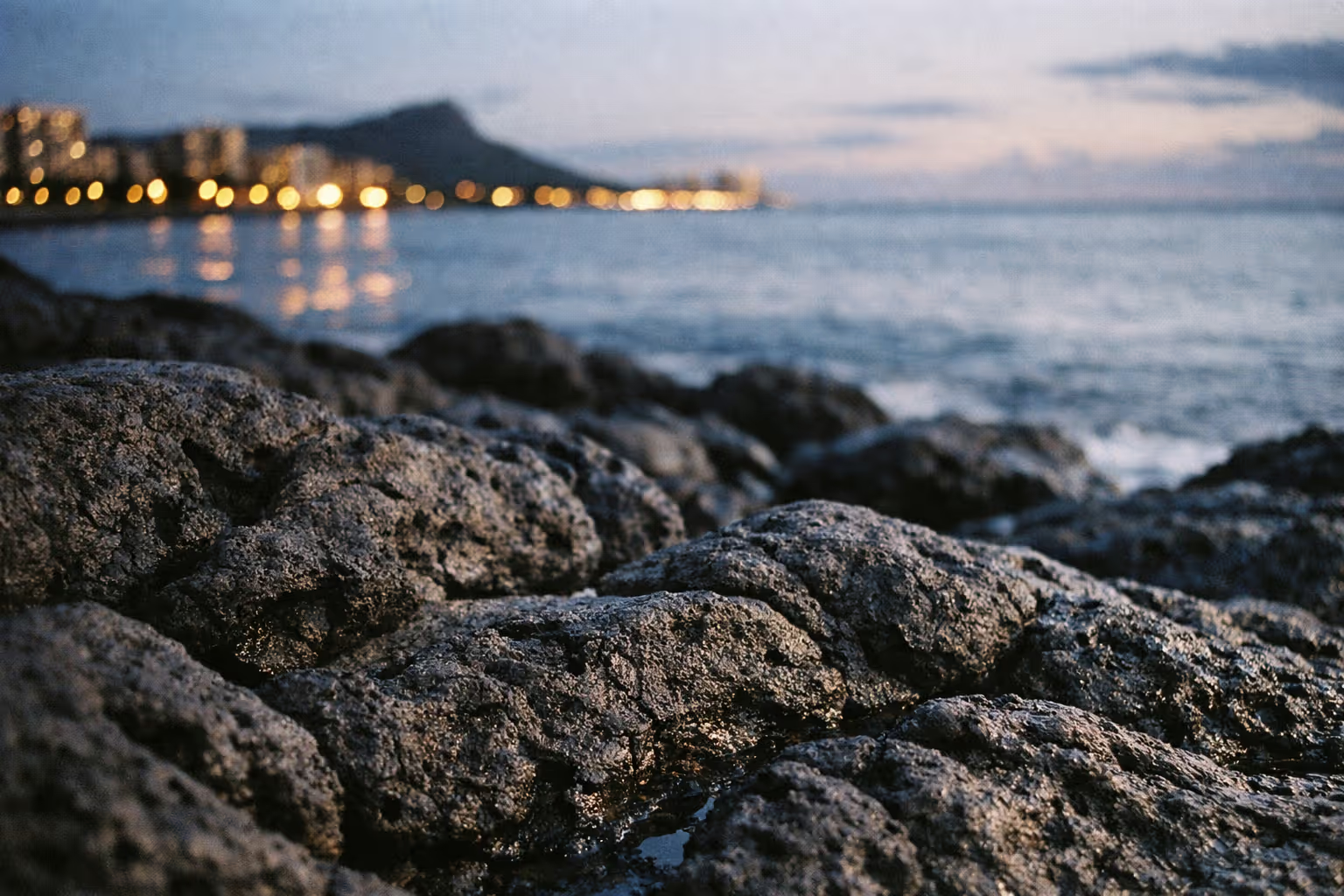
The best time to visit Hawaii, if value matters at all, is the week after Labor Day. September keeps ocean temperatures at their July highs while flights, hotels, and crowds all fall off a cliff, often 30 to 50 percent below peak. December, June, and July are the opposite: the most people paying the most money. Which island you pick shifts the calendar too. Here is how the months, islands, and budgets line up so you are not overpaying for the same beach.
Weather trends and crowds: navigating the peaks and troughs of the best time to visit Hawaii
Scope upfront: A week in Hawaii runs $2,000-$5,000+ per couple depending on island, season, and lodging tier. Shoulder months (April-May, September-October) cut that by 30-50% versus peak. If you have one week and a fixed budget, that calendar decision matters more than which island you pick.

How to get there: All major Hawaiian islands are served by Honolulu’s Daniel K. Inouye International Airport (HNL), the main hub for transpacific flights. Direct flights from the US West Coast (Los Angeles, San Francisco, Seattle) run 5-6 hours; from the East Coast, expect 10-11 hours with a connection. Inter-island flights on Hawaiian Airlines or Southwest connect Oahu to Maui (OGG), Kauai (LIH), and the Big Island (KOA/ITO) in 30-45 minutes and typically cost $60-$150 each way if booked 3-4 weeks out. Rental cars are the practical default on every island except Oahu, where TheBus covers Honolulu and Waikiki adequately. Book rental cars early for peak months - inventory on Maui and Kauai sells out weeks ahead in June-July and late December.
One thing most guides get wrong: They treat Hawaii as a single destination with a single best month. The islands have meaningfully different microclimates and demand curves. Kauai’s north shore gets 450 inches of rain per year at Mount Waialeale; Poipu on the south shore averages 35 inches. Maui’s Kihei is one of the driest spots in the state while Hana sits in near-constant mist. Picking the right coast matters more than picking the right month - and most guides skip that entirely.
Determining the best time to visit Hawaii depends largely on its tropical climate, which divides the year into two main seasons: the dry season (May to October) and the wet season (November to April). The rain rarely ruins a trip - it tends to fall in short bursts, often overnight or on the windward (northeast) side of each island, while the leeward (south and west) coasts stay sunny. If you must travel in winter, stay leeward: Waikiki on Oahu, Wailea on Maui, Poipu on Kauai (1).
The wet season also coincides with humpback whale watching, so “off-season” doesn’t mean “nothing happening.”
Peak tourist seasons align with mainland vacation timing. June, July, and December are the busiest and priciest months. Hawaii logged 9.52 million air arrivals in 2024, with December 2024 alone bringing 910,055 visitors (3) - that’s peak-season demand you’ll feel in every hotel rate and sold-out snorkel tour.
The shoulder months - April, May, September, and October - are the sweet spot. Weather stays favorable, crowds thin out, and prices drop. Multiple Hawaii-specific guides identify these as the best overall months to go (2)(10). Post-Labor Day September is the sharpest value window: mainland family travel drops off sharply, ocean temperatures stay near summer highs, and prices follow the crowds down (2)(3).
One thing worth noting for 2026: NOAA and Hawaii forecasters expect El Niño conditions to bring drier, sunnier weather June through October (9). That makes a summer 2026 beach trip less of a rain gamble than usual - though June and July crowds and prices will still be steep.
Best time for good weather in Hawaii
If your priority is reliable sun and warm water above all else, target June through September. These months deliver the driest, most dependable beach weather, especially on leeward coasts (5)(8). The tradeoff is crowds: June and July are peak season, so you’ll pay for that sunshine.
For the best time to visit Hawaii for good weather without the peak-season markup, aim for May or September. Both months sit at the edge of the dry season, ocean temperatures hover in the upper 70s to low 80s°F, and rain odds are low - but visitor numbers are meaningfully lower than midsummer.
Trade winds moderate the heat across all islands. Summer highs sit in the low 80s°F; winter highs run in the upper 70s°F (1)(6). You’re never far from comfortable. “Good weather” in Hawaii is really about timing your budget, not escaping bad conditions.
One practical note on rain: the windward (northeast) sides of every island catch the bulk of it. Oahu’s Kailua and Kaneohe average 60-70 inches per year; Waikiki, just 17 miles away on the leeward side, averages around 17 inches. That gap is bigger than the difference between any two months of the year. If your itinerary puts you on the wet side of an island during winter, expect afternoon showers most days - not trip-ruining, but worth knowing before you book a windward vacation rental for a January beach week.
Hurricane season: the risk window most guides gloss over
The Central Pacific hurricane season runs June 1 through November 30, with the highest probability in August and September (5). Direct hits on the islands are statistically rare, but the risk is real enough that it belongs in your planning.
What a storm actually disrupts isn’t usually the whole trip - it’s the outdoor pieces. Boat tours get canceled, inter-island flights get delayed, and hiking trails close after heavy rain. If you’re booking an August or September trip built around ocean activities, buy travel insurance and keep a flexible day or two in your itinerary.
The 2026 El Niño outlook softens this somewhat, with drier and more stable conditions forecast June-October (9). Treat that as a favorable tilt, not a guarantee - cyclone risk doesn’t disappear in an El Niño year.
Cultural festivals and island activities: timing your visit for the experience

Hawaii’s cultural calendar can shape when you go as much as the weather does. Timing your visit around a major event adds a dimension that a beach day can’t.

The Aloha Festivals, celebrated statewide during September, offer a genuine look at Hawaii’s indigenous culture through parades, music, dance, and traditional ceremonies. It’s a strong reason September edges out other shoulder months if you want more than beaches.
For surf, winter is the season on the North Shore of Oahu, home to the Banzai Pipeline. Big-wave surfing runs November through February, coinciding with the winter swells - and larger crowds (5).
Whale watching is the other winter draw. Humpbacks are prime off Maui and the Big Island from December through March, peaking in January and February (5). If whales top your list, winter beats every shoulder month, crowds and rain notwithstanding.
Hiking is best in the drier months, when trails are firmer and views aren’t washed out by cloud cover. I’ve turned back on windward Kauai trails in February when the mud made the descent slick and pointless - save the serious hikes for late spring through fall. If you’re planning expert-led adventure tours, private snorkeling charters, or guided hikes, the dry months give you the best odds of conditions cooperating.
Best months to visit each Hawaiian island
The islands don’t share a single best month. Here’s how they break down.
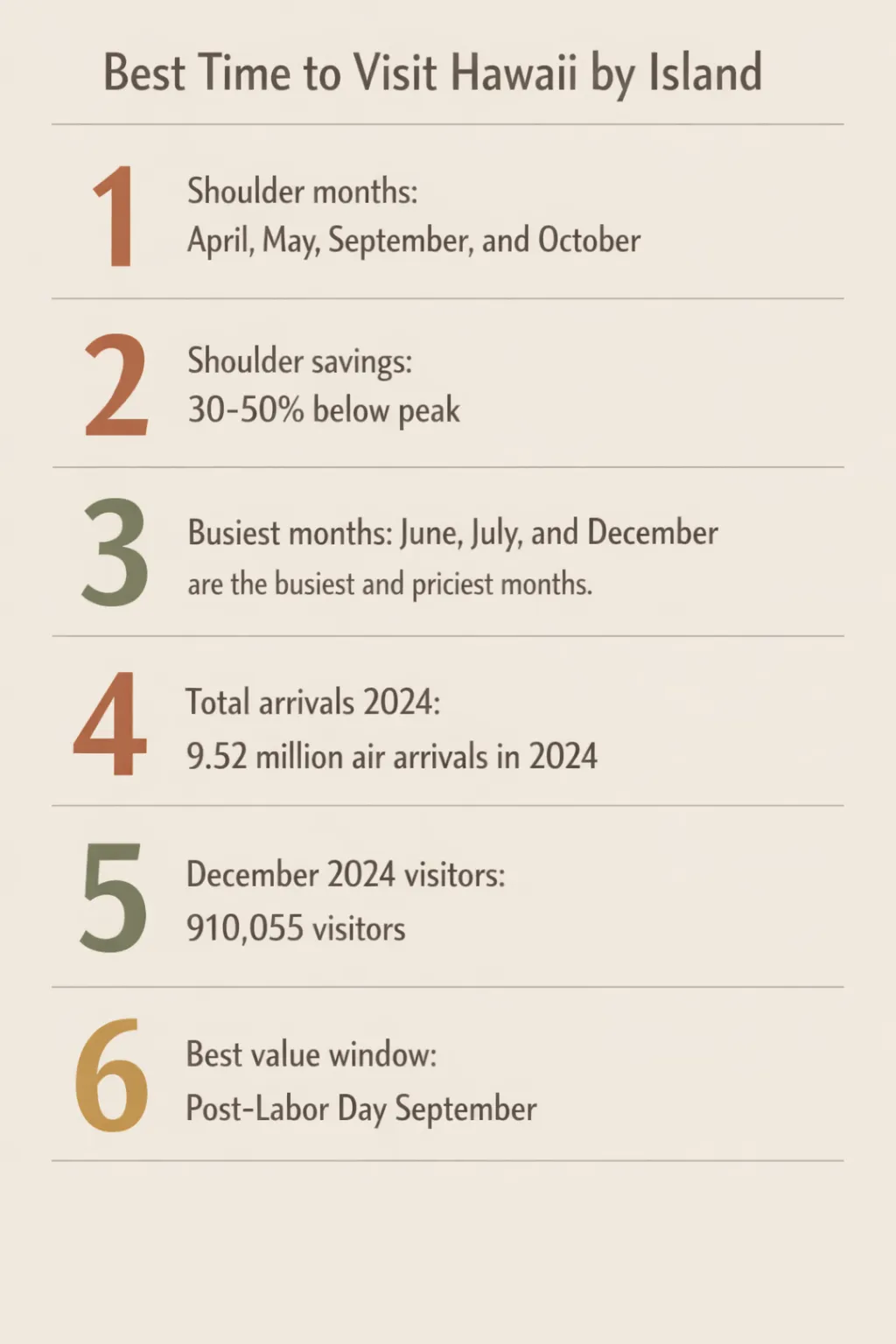 Shoulder-season months cut costs by 30-50% vs peak; total arrivals reached 9.52 million in 2024, with 910,055 visitors in December 2024.
Best time to visit Kauai, Hawaii
The best time to visit Kauai, Hawaii is May, August, September, and October - fewer people, less rain, and non-peak pricing (3). Kauai is the wettest of the main islands, so timing matters more here than anywhere else. The cheapest hotel rates specifically land September through November (6)(7).
Average daily hotel rates on Kauai often run $364 or more per night, peaking in June, with vacation rentals most expensive in July and December (7). Book fall and you’ll find promotions and open inventory that simply don’t exist in summer.
Best time to visit Honolulu, Hawaii (Oahu)
Honolulu works year-round thanks to its leeward Waikiki location and steady weather. For value, the best time to visit Honolulu, Hawaii is mid-April through early June and September through mid-November (excluding Thanksgiving week), when hotel inventory opens up and prices ease off summer and holiday peaks (5)(10). The fall shoulder window closes around mid-November as holiday demand starts building - book after that and you’re paying closer to peak rates. Skip late December unless you’re specifically there for New Year’s - you’ll pay top rates for the privilege.
Best time to visit Maui, Hawaii
The best time to visit Maui, Hawaii is April-June and September-October for beach weather and lower shoulder-season prices. Early spring also overlaps the tail end of whale season, so an April trip can catch both. Post-wildfire recovery has shifted demand patterns, and spring and fall currently offer better availability and lower rates than the busy winter weeks.
Best time to visit Big Island, Hawaii
For the best time to visit Big Island, Hawaii, target late spring (April-May) and fall (September-October) - clear conditions for volcano visits with manageable crowds. The Big Island has more vacation rental inventory than its neighbors, which keeps prices slightly more moderate, and fall sees a lower daily visitor count than December. State data showed Big Island visitor numbers down 3.6% in December 2025 versus the prior year, so even the shoulder season is loosening a bit.
When is the worst time to visit Hawaii
There’s no genuinely bad month for weather - temperatures range from the mid-70s to mid-80s°F depending on island, elevation, and season, with leeward lowlands running warmer and upcountry areas like Kula on Maui or Volcano on the Big Island running noticeably cooler (1)(2). The worst time to visit Hawaii is defined by cost and crowds, not conditions.
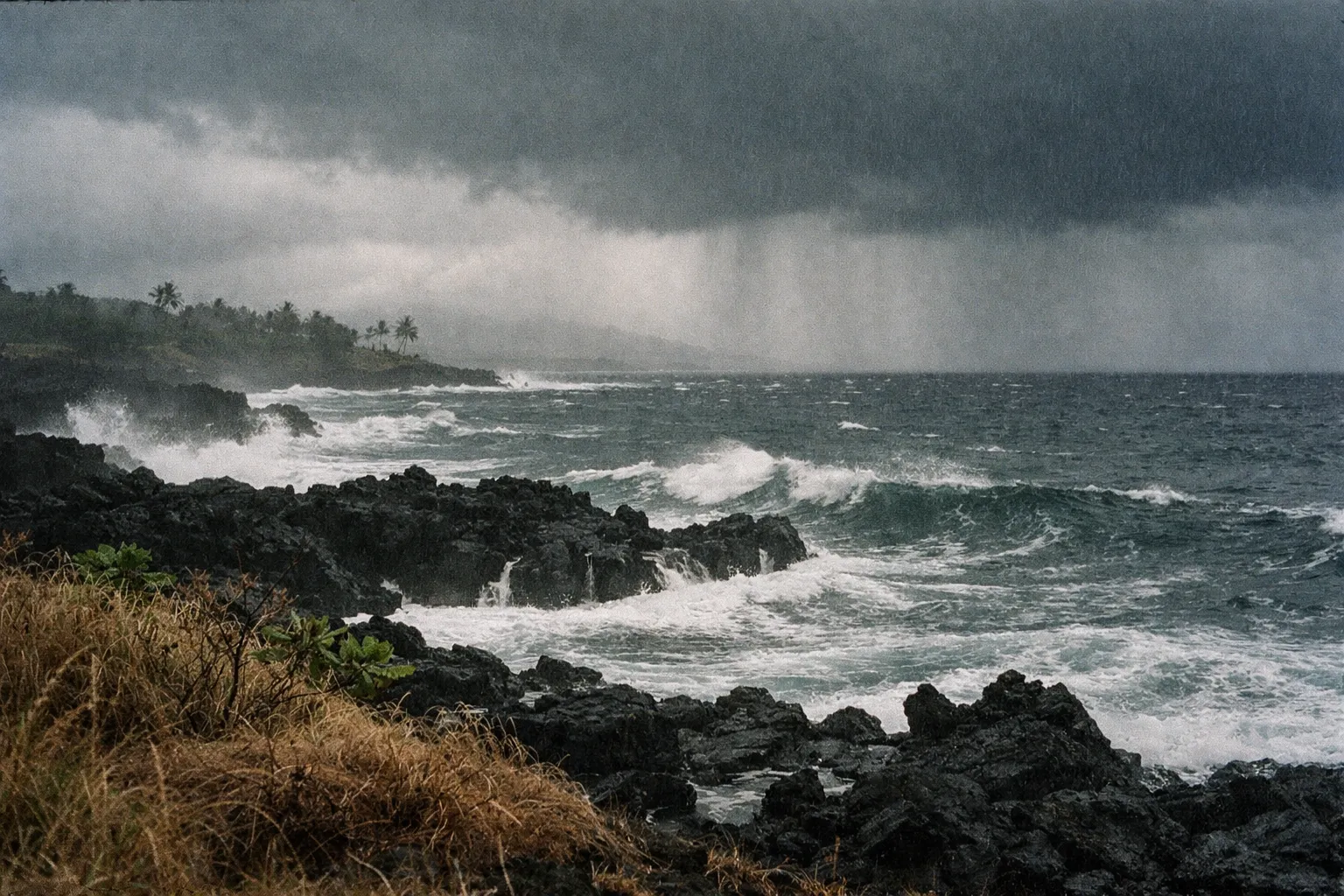
Avoid these windows if budget and elbow room matter:
- Late December (Christmas through New Year’s): The single most expensive and crowded week. December 2024 brought 910,055 visitors (3), and per-visitor spending in December 2025 rose even as arrivals dipped slightly - meaning you’ll pay premium rates on everything.
- June and July: Peak summer demand pushes hotel rates 30-50% above shoulder months (7). June is the priciest month for hotels; July ties December as the most expensive for vacation rentals (7).
- August-September for hurricane-sensitive plans: Not a “worst” for weather, but the highest cyclone-risk window if your trip hinges on boat tours or inter-island flights (5).
The real mistake isn’t picking a bad month - it’s booking June, July, or Christmas week and expecting shoulder-season prices. Those travelers hit 30-50% higher rates and sold-out tours, then feel blindsided.
One more thing worth flagging: spring break (mid-March through early April) is a secondary peak that most budget guides underweight. Hotel rates on Maui and Oahu spike noticeably the two weeks around Easter, and popular snorkel spots like Molokini Crater fill up fast. If your travel window falls in that range, book accommodation and boat tours at least 8 weeks out or shift your dates to late April, when the crowds clear and prices reset to true shoulder levels.
Cheapest time to go to Hawaii
The cheapest time to go to Hawaii is the shoulder season: April, May, September, and October. Budget and travel-finance analyses consistently put combined flight-and-hotel savings at 30-50% versus peak during these months. NerdWallet’s Hawaii budget guidance points to these same windows for the lowest overall costs (10).
A few tactics to squeeze it further:
- Fly midweek within the shoulder. Tuesday-Thursday departures in April, May, September, or October typically shave another 5-15% off airfare versus weekend travel.
- Target post-Labor Day September. Demand drops sharply the week after Labor Day while ocean temps stay near summer highs (2)(3). It’s the best price-to-conditions ratio all year.
- Book Kauai in fall. September-November is Kauai’s cheapest hotel window specifically (6)(7).
High-end beachfront properties that run $500-$700 per night in June-July and late December often drop to $250-$400 in shoulder months. That 30-50% cut is where your real savings live. For more strategies on keeping costs down, Hawaii on a budget covers the full range of money-saving approaches from flights to activities.
How much a Hawaii trip actually costs
Prices in Hawaii run high, but the range is wide depending on island, season, and how you travel. Here’s a realistic breakdown by budget tier and island.
Budget baseline by island (per couple, 7 nights, shoulder season):
- Oahu (Honolulu/Waikiki): $3,000-$4,500. Mid-range Waikiki hotels run $200-$350/night; flights from the West Coast average $400-$600 per person in shoulder months. TheBus reduces car rental costs if you’re staying in Waikiki, but a car adds $50-$80/day if you want to reach the North Shore or Kailua.
- Maui: $4,000-$6,500. Wailea resort hotels start at $400/night; Kihei condos run $200-$300/night and are the better value play. A rental car is non-negotiable - budget $60-$90/day. Paid activities (Road to Hana tour, snorkel cruise, luau) add $150-$300 per person.
- Kauai: $3,500-$5,500. Poipu vacation rentals average $250-$400/night in shoulder season, dropping to $180-$280 in September-November. A rental car is essential; the island has no meaningful public transit. Na Pali Coast boat tours run $150-$200 per person and sell out weeks ahead.
- Big Island: $3,000-$5,000. The most geographically spread island - plan on driving 2-3 hours between Kona and Hilo. Vacation rentals in Kona run $150-$250/night; volcano-area lodging near Hawaii Volcanoes National Park is cheaper but limited. Park entry is $35 per vehicle (valid 7 days).
Activity cost benchmarks (per person):
- Snorkel cruise: $80-$150
- Whale-watching tour (Maui, January-February): $50-$100; book 4-6 weeks out
- Luau: $120-$200
- Helicopter tour: $250-$450
- Hiking: free on most trails; some require advance reservations (Haiku Stairs is closed; Kalalau Trail on Kauai requires a $20/night camping permit)
Is $2,000 enough for a week in Hawaii?
Yes - but it’s tight, and it’s a solo or frugal-couple budget, not a resort trip. Community trip reports show couples managing seven days on roughly $2,000 by staying in budget hotels or hostels, using public transit instead of a rental car, eating at local plate-lunch spots and grocery stores, and building the days around free activities like beaches and hiking (4). That works out to about $285 per day total. Oahu is the most viable island at this budget - the others require a rental car that alone eats $350-$600 of a week’s spend.
Where it breaks: daily resort dining and paid tours push real spend past $300-$400 per day fast, and $2,000 won’t cover a week at that pace. Traveling in shoulder season is what makes the tight version realistic - peak-season rates will blow the budget.
Is $5,000 enough for a trip to Hawaii?
Comfortably, yes. A $5,000 budget covers two people for 7-10 days with mid-range hotels ($250-$350/night), economy flights ($500-$800 each), and daily food-and-activity budgets of $150-$250/day - especially if you travel in shoulder season. That’s enough room for a rental car, a couple of paid excursions like a snorkel cruise or a luau, and sit-down dinners without watching the tab. On Maui or Kauai, $5,000 is comfortable for 7 nights; stretch to 10 nights and you’ll need to trim the paid-activity budget or drop to a condo rental over a hotel.
Fly in April, May, September, or October and the 30-50% price drop applies to both flights and lodging, stretching that $5,000 further (10).
How much is $100 US in Hawaii?
Hawaii is a U.S. state and uses the U.S. dollar, so $100 USD is worth exactly $100 - no currency conversion. What changes is buying power. Groceries run 30-60% above mainland averages; a gallon of milk costs $6-$8, and gas on Maui and Kauai regularly tops $5/gallon. Practically, $100 covers a mid-range dinner for two with drinks, or two to three days of modest groceries for one person. The dollar amount is familiar; the price tags aren’t.
Local insights: when to score the best deals and unique experiences
Shoulder-month pricing makes a real difference on accommodation and flights - not marginal savings, but the kind that changes what you can afford to do once you’re there (10).
Beyond the savings, quieter periods make for more relaxed days on the ground. Thinner crowds mean easier restaurant reservations, less competition for trailhead parking, and more room on the beach. I’ve visited Akaka Falls State Park in April and the difference from a July crowd is noticeable - Rainbow Falls State Park Hawaii in October is the same story.
Booking mechanics matter here. Snorkel, hiking, and boat tours run year-round but sell out during June-July and the Christmas weeks - plan on 4-8 weeks of advance booking for prime dates. Whale-watching tours cluster December-March and fill up fast in January and February, so reserve early if winter is your window.
Your guide to Hawaii: matching the calendar to your priorities
The best time to visit Hawaii comes down to matching the calendar to what you actually want to do:
- Cheap beach time: April-May or September-October, statewide (5).
- Reliable sun and warm water: June-September, accepting the crowds (5)(8).
- Whale watching: January-February on Maui and the Big Island (5).
- Big-wave surf: November-February on Oahu’s North Shore (5).
- Fewest people, best value: post-Labor Day September (2)(3).
Pick the month around the one thing you most want to do, then choose your island to match. A February whale trip belongs on Maui, not Kauai. A July beach week works better leeward on Oahu than on rainy windward coasts. Get those two decisions right and the rest of the trip falls into place. If you’re still weighing which island suits you best, island hopping in Hawaii is worth considering once you’ve locked in your core dates.
Hawaii Islands: Best Month, Cost Range, Crowd Level & Weather by Season
| Oahu (Honolulu/Waikiki) | Maui | Kauai | Big Island | |
|---|---|---|---|---|
| Best Month | May or September | April-May or September-October | September-November (cheapest); May or August (weather) | April-May or September-October |
| Cost Range | $3,000-$4,500 per couple / 7 nights (shoulder) | $4,000-$6,500 per couple / 7 nights (shoulder) | $3,500-$5,500 per couple / 7 nights (shoulder) | $3,000-$5,000 per couple / 7 nights (shoulder) |
| Crowd Level | High year-round; lowest post-Labor Day September | Moderate in shoulder; high December-March and June-July | Lower than Oahu/Maui; September-November quietest | Lowest of the four main islands; December down 3.6% YoY in 2025 |
| Weather Rating | Excellent leeward; reliable sun on Waikiki coast all year | Kihei/Wailea coast is very dry; Hana side is wet year-round | Wettest main island overall; Poipu south shore stays dry | Kona coast is dry and sunny; Hilo side is wet; Volcano area is cool and misty |
| Notes | Most accessible island; TheBus reduces car rental need in Waikiki | Whale watching peaks January-February; rental car essential | Na Pali Coast boat tours sell out weeks ahead; book early | Hawaii Volcanoes NP entry $35/vehicle; plan for 2-3 hr drives between coasts |
Frequently Asked Questions
- Do I need a rental car in Hawaii?
- On Maui, Kauai, and the Big Island, yes - public transit is minimal and attractions are spread out. On Oahu, TheBus covers Honolulu and Waikiki adequately, but you'll want a car for the North Shore or Kailua. Book rental cars 3-4 weeks out for shoulder months and 6-8 weeks out for June-July or late December - inventory sells out.
- Which Hawaiian island is best for a first visit?
- Oahu is the most logistically straightforward - widest flight options, most accommodation tiers, and the only island where you can manage without a rental car. Maui is the better pick if beaches and whale watching are the priority and budget allows. The Big Island is the right call if you want Hawaii Volcanoes National Park and don't mind driving.
- How far in advance should I book a Hawaii trip?
- For shoulder months (April-May, September-October), 6-8 weeks out is workable for flights and hotels. For June-July or late December, book 3-4 months out - hotel inventory and rental cars go fast. Whale-watching tours on Maui in January-February fill up 4-6 weeks ahead.
- Which island has the best weather?
- No single island wins outright - it depends on which coast you stay on. Leeward (south and west) coasts on every island stay significantly drier than windward sides. Poipu on Kauai, Kihei/Wailea on Maui, Kona on the Big Island, and Waikiki on Oahu are the most reliably sunny spots regardless of season.
- Is inter-island travel worth it on a one-week trip?
- Generally no. Inter-island flights cost $60-$150 each way and eat half a day in transit and logistics. A week is better spent going deep on one island than skimming two. If you have 10+ days, a two-island trip makes sense - pair Oahu with Maui or the Big Island for the most contrast.
- What should I book first when planning a Hawaii trip?
- Flights first, then accommodation, then rental car. Rental car inventory on Maui and Kauai is the most constrained - it has sold out entirely during peak weeks in recent years. Lock that in before you finalize your itinerary.