Antelope Canyon and Horseshoe Bend sit about 10 to 15 minutes apart by car outside Page, Arizona (10), but they run on different rules. The canyon requires a guided tour with an authorized Navajo operator (5). The overlook is a self-guided walk with no reservation and a city parking fee at the trailhead (6)(2). You can do both in one day, and your booked canyon departure should set the schedule for everything else.
✓ Pros
- Two distinct landscapes fit into one Page day without a long transfer.
- The overlook remains an option even when canyon tours are fully booked.
✗ Cons
- The canyon requires a paid, timed guided tour.
- The overlook walk has little shade and no water along the trail.
Antelope Canyon and Horseshoe Bend: How the Two Sites Work
Antelope Canyon and Horseshoe Bend are separate attractions with different landowners and different access rules, and there is no single ticket that covers both. Treat them as two separate logistics problems.
Horseshoe Bend is not part of Antelope Canyon. Horseshoe Bend is a 270° curve of the Colorado River (10) inside Glen Canyon National Recreation Area, which the National Park Service manages. Its parking lot sits on City of Page land, and NPS notes that the trail and overlook cross Navajo Nation land (1). Antelope Canyon is a slot canyon on Navajo Nation land, entered through the Antelope Canyon Navajo Tribal Park (8). Horseshoe Bend is also not in Grand Canyon National Park, despite how often the two get lumped together (6): the park begins about nine miles downstream (1). Planning the park itself is a separate subject, covered in our guide to free things to do at Grand Canyon, and if you want to hike below the South Rim, start with our Bright Angel Trail guide.
The access rules follow from that split. According to Navajo Nation Parks, all Lake Powell-Antelope Canyon locations are accessible only by guided tour, and guides are mandatory at every Antelope Canyon location (5). You cannot walk in on your own. Horseshoe Bend works the opposite way: show up any day between sunrise and sunset and walk the trail, with no guide and no reservation (6).
Getting between them is simple, but you need a car. The Horseshoe Bend parking lot and trailhead are off US Highway 89, about 5 miles (8 km) south of the Carl Hayden Visitor Center (3). One Upper Antelope operator, Navajo Tours, checks guests in at the entrance to the tribal park, 3 miles (4.8 km) east of Page off Highway 98 (8). Other operators check in at offices in town (7), so confirm the location on your booking.
The thing most guides get wrong is presenting the pair as one combined outing. In practice, the canyon depends on an advance booking and a fixed departure time. The overlook can fit almost anywhere around it.
Upper vs Lower Antelope Canyon: Which to Choose
Choosing between Upper and Lower Antelope Canyon comes down to how you move and what you want to see. Upper Antelope Canyon is level inside, with no ladders, and gives a chance at light beams (7). Lower Antelope Canyon is more physical, with ladders, stairs, and boulders (11). Upper is known for its light beams and wide passages. Lower is known more for vivid colors and textured walls (11).
Upper Antelope Canyon: Level Walking and Light Beam Potential
Upper Antelope Canyon is entered at ground level after an off-road drive (11), and there are no ladders or stairs inside the canyon (7). With Navajo Tours, the trip starts with a 4x4 truck ride to the canyon mouth. A Navajo guide then leads what the operator calls an easy walk through the canyon, stopping at popular photo spots (8).
The way out is less gentle. Navajo Tours says guests climb down 150 stairs to return to the vehicles and does not recommend the tour for visitors with limited mobility (8). Antelope Canyon Tours, Inc. rates its walk 3 out of 10, with a hill and stairs outside the canyon that can be hard after a recent knee or hip surgery (7). Book Upper if ladders are the problem or you want to photograph light beams, and ask the operator about the exit route if knees are the problem. The beams are what Upper is known for (11), and they come with conditions covered in the booking section below.
Upper also has the longer list of authorized operators. Navajo Nation Parks lists six (5), so you have more departure times to choose from. The downside: space inside stays tight because each tour carries a lot of people (11).
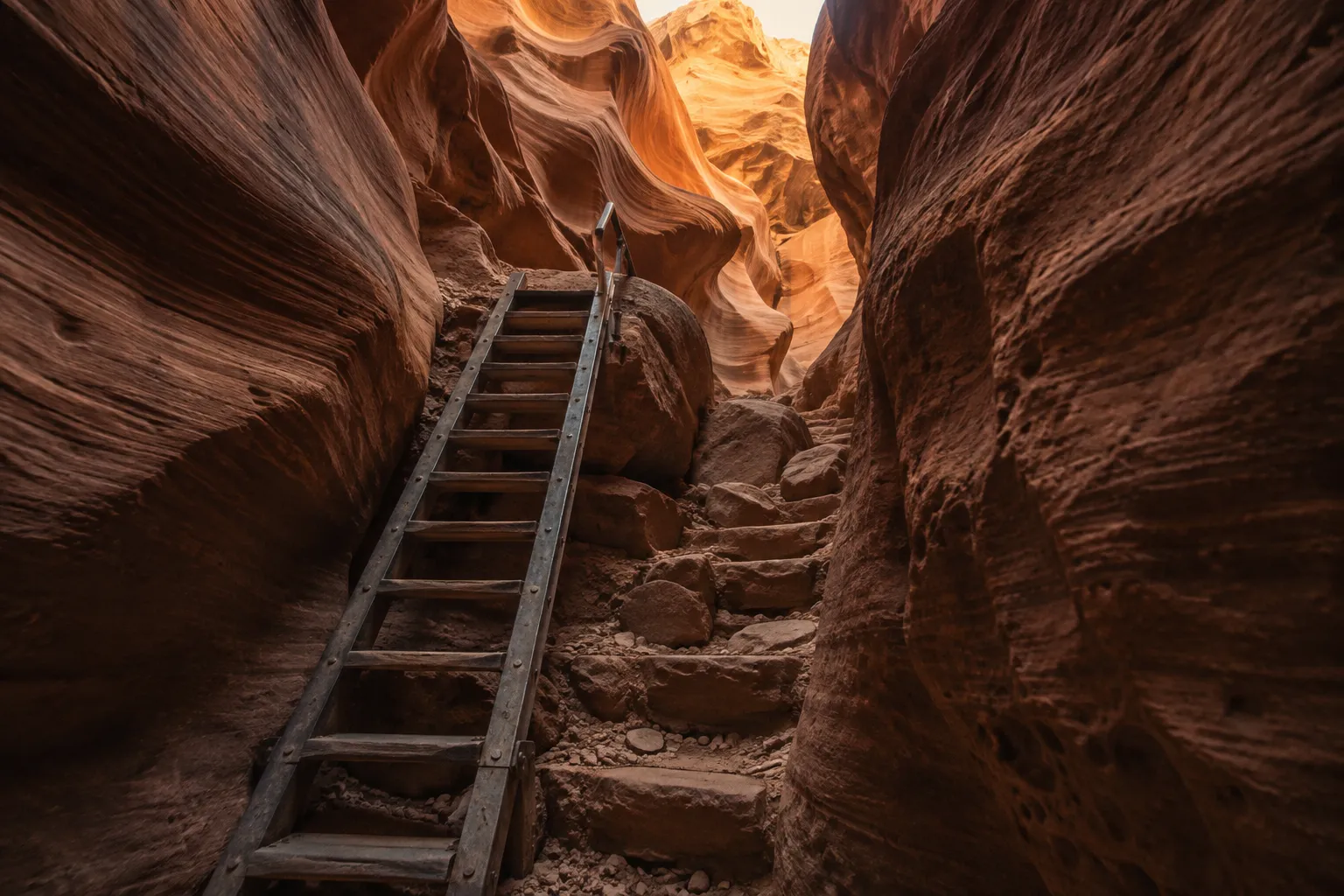
Lower Antelope Canyon: Ladders, Boulders, and Color
Lower Antelope Canyon involves several ladders and small boulders, and one listed tour runs 1 hour 30 minutes (11). The tour starts with a short 10-minute walk from the check-in booth to the canyon entrance. That descent crosses Navajo sandstone that is both rocky and sandy, so the operator advises wearing appropriate shoes (11). Inside, you climb down and up ladders and step over boulders (11).
None of this is technical, but it takes more stamina than Upper and requires stair and ladder climbing. In return, you get the vivid colors and textured walls Lower is known for (11), which can make up for missing the beams. Navajo Nation Parks lists two authorized Lower operators: Ken’s Tours Lower Antelope Canyon Tours and Dixie’s Lower Antelope Canyon Tours (5).
Here is how the three stops compare. Upper Antelope Canyon is level inside but ends with stairs on the way out (8), requires a guide, runs 90 minutes round trip on a Navajo Tours departure (8), and is the section known for light beams (11). Lower Antelope Canyon is moderate, requires a guide, runs about 1 hour 30 minutes (11), and involves ladders and boulders. The Horseshoe Bend Overlook is easy, needs no guide, and is a 1.5-mile (2.4 km) round-trip walk on a hardened path (1). It has no beams, of course, but it does have a 1,000-foot (305 m) drop to the river (3).
Booking Antelope Canyon Tours and Timing for Light Beams
Antelope Canyon tours must be booked through a Navajo-authorized operator, and if you want a chance at light beams, the departure you need is a sunny Upper Canyon slot around 11:20 a.m. (5)(7). Book the exact time slot, not just the date.
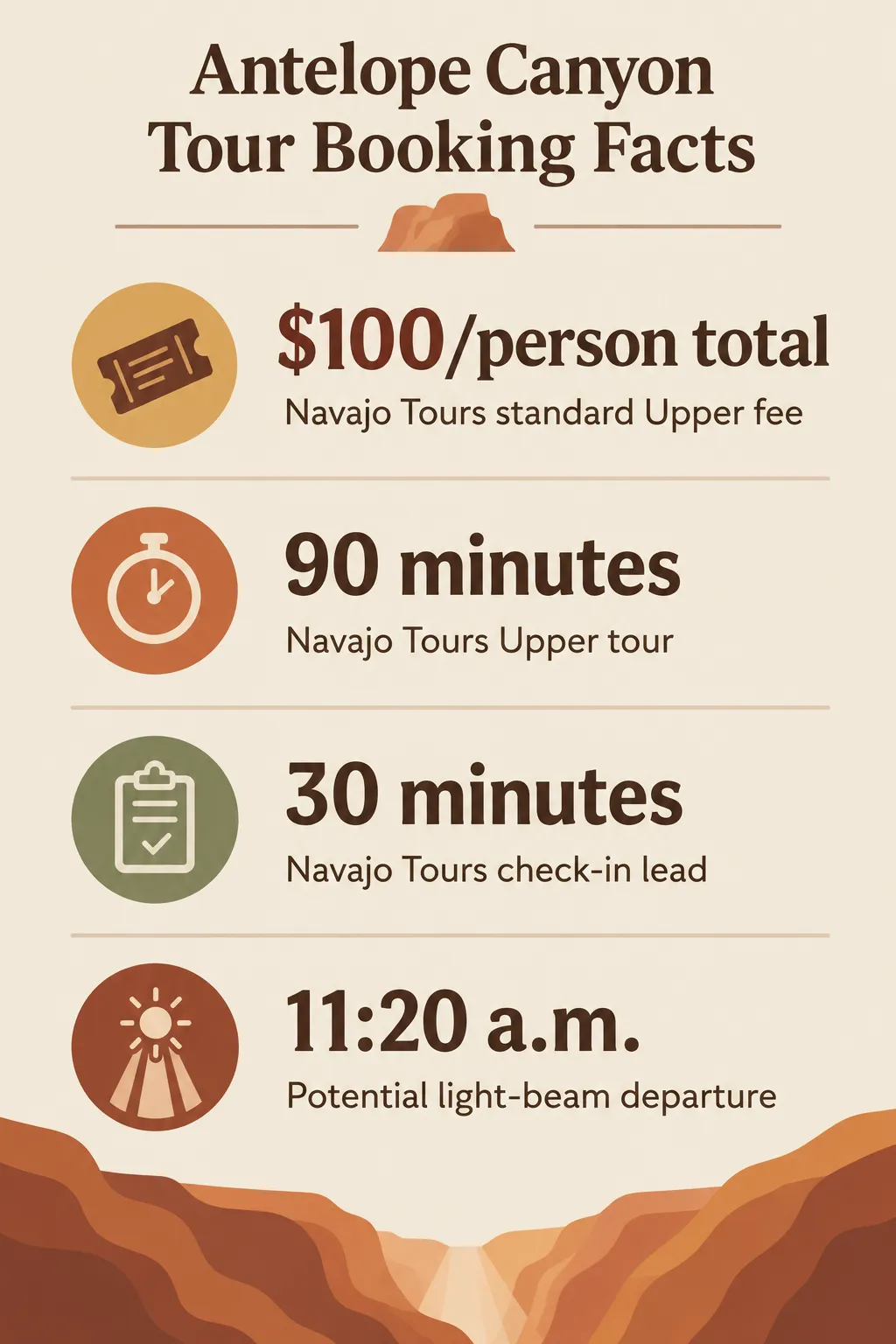 Navajo Tours lists its standard Upper Antelope tour at $100/person total, with a 90-minute round trip and check-in 30 minutes early; Antelope Canyon Tours, Inc. identifies 11:20 a.m. as a departure that can offer a chance at light beams.
Finding an Authorized Navajo Operator
Start with the Navajo Nation Parks operator list. The official page groups operators by canyon: Upper Antelope, Lower Antelope, and other Navajo slot canyons nearby (5). Operators not on that list are not authorized to take you in. Navajo Nation Parks charges an entry fee of $15 per person, per location, per day (as of November 2026), and guided tours cost extra on top of that (5). Check the official page close to your travel date, since the list can change. As of November 2026, the same page carries a banner warning that closures are possible due to inclement weather (5), and Antelope Canyon Tours, Inc. refunds in full when it cancels a tour for extreme weather (7).
Watch the booking window. Navajo Tours releases future tour slots only 1 to 2 months in advance and suggests checking back often for new dates (8). It also states that it runs on Phoenix, Arizona time (8). That matters in summer, because the Navajo Nation observes daylight saving time and the rest of Arizona does not (7), so your phone may show a different hour than your ticket.
Cancellation terms vary by operator. Antelope Canyon Tours, Inc. gives a full refund on cancellations made 48 or more hours before arrival. Bookings made inside that 48-hour window are final, and missed tours get no refund (7).
What a Standard Tour Includes
A standard Navajo Tours Upper Antelope departure runs 90 minutes round trip. That includes a 15-minute shuttle ride each way and 60 minutes at the canyon (8). You must check in 30 minutes before your tour time (8), so plan on two hours from check-in to return.
Under the pricing in effect since January 1, 2026 (still listed in November 2026), Navajo Tours charges an $85 tour fee plus a $15 Navajo permit, for $100/person total, not including processing fee and tax (8). Its 11:40 departure costs $105 plus the $15 permit, for $120/person, also before fees and tax (8). The departure list it showed in November 2026 ran 8:20 a.m., 10:40 a.m., 1:00 p.m. and 3:20 p.m., without an 11:40, so check which slots are live for your date (8). Two more rules from the same operator:
- Bags must be transparent so staff can see the contents.
- The operator takes Visa, Mastercard, Discover, and cash, and accepts walk-ins, though it recommends reservations.
Walk-ins are a gamble. If the canyon is the reason for your trip, book ahead.
Booking the Light-Beam Departure
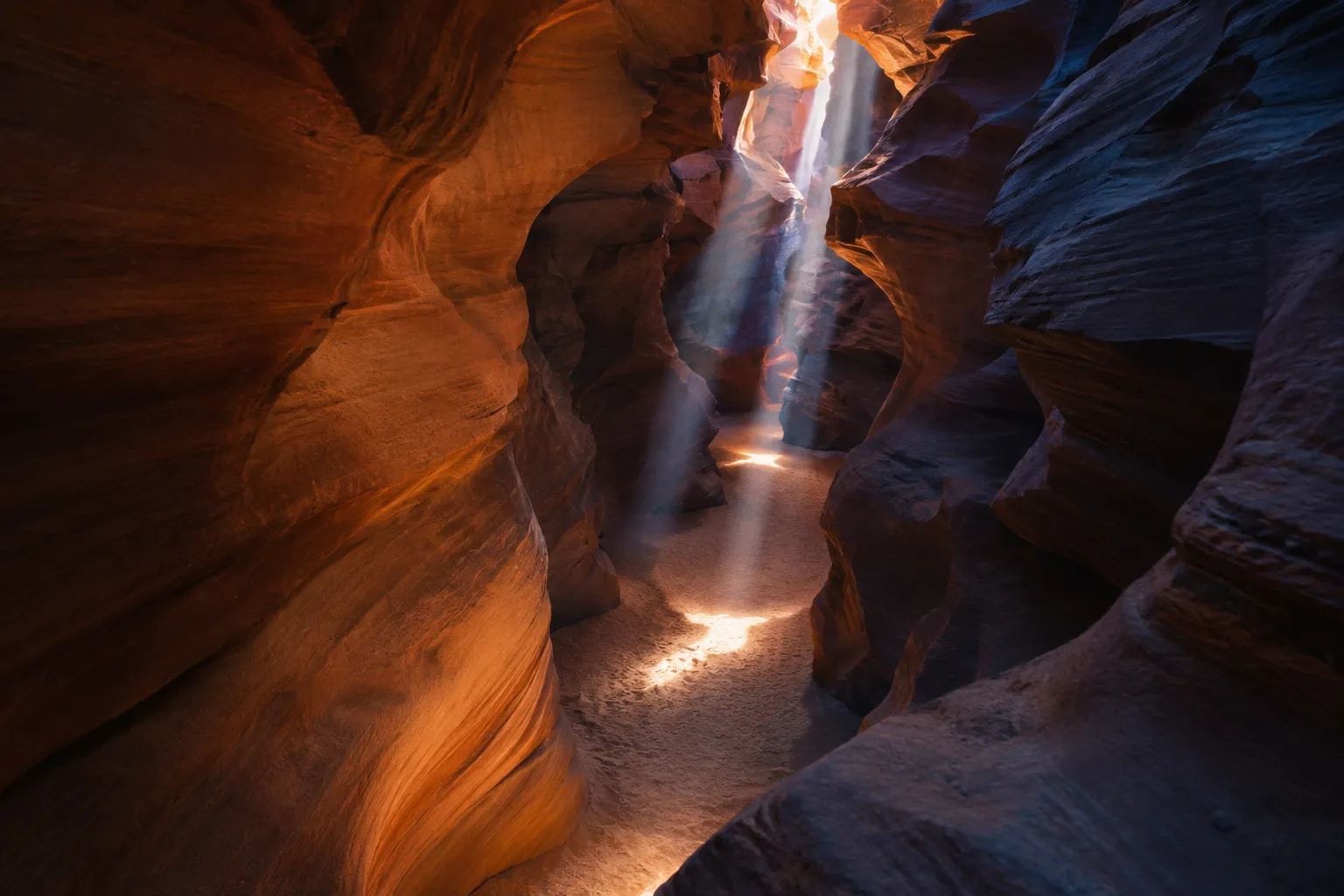
Light beams are not guaranteed on any tour. They depend on clear, sunny conditions and on the season: Antelope Canyon Tours, Inc. places them between April and September (7). It identifies 11:20 a.m. as a departure that can offer a chance at beams (7). Navajo Tours charges more for its 11:40 slot than for its other departures (8), which suggests the midday window is the one in demand.
If beams matter more than price, book an 11:20-ish Upper Canyon departure between April and September (7). If you can only travel in winter, or if the forecast turns cloudy, save the premium. An earlier or later slot, or a Lower Canyon tour, will give you the same sandstone at a lower cost and with less pressure on timing.
The Horseshoe Bend Overlook Walk
The Horseshoe Bend Overlook is a 1.5-mile (2.4 km) round-trip walk on a hardened, accessible path to an unfenced rim above a 1,000-foot (305 m) drop (1)(3). The walk is short, but it is fully exposed to the sun. The site is open sunrise to sunset every day, with no reservation required (6).
Trail Length, Shade, and Water
The trail is accessible under Architectural Barriers Act standards (3), and NPS describes it as stroller and wheelchair friendly, ending at a flat viewing deck with railings (1). Leashed pets are allowed (3). There are two shade structures along the trail but none at the overlook (1), and NPS notes that there is little shade along the route overall (2).
There are no toilets or water along the trail (3). Use the parking-lot restrooms before you start, and carry more water than seems necessary for a 1.5-mile walk. NPS advises avoiding the hottest part of the day (1). It also suggests sturdy footwear, sunscreen, and drinking water even when you’re not thirsty, since the desert dehydrates you faster than you notice (3).
NPS ran free ranger-led walks on the trail on summer Sundays in 2019, with only the parking fee to pay (4). Check the current park calendar before you plan around one. The NPS page on the site (last updated in May 2024) also mentions expanded parking and trail maintenance, so obey any construction closures (2).
Parking Fees and Pass Policy
National Park Service passes do not cover Horseshoe Bend parking. NPS states plainly that its passes don’t apply here, and the City of Page collects the fee at the trailhead instead (2). Horseshoe Bend itself is in the national recreation area, but the lot is on city land (1). As of November 2026, the city charges $10 per car, truck or RV and $5 per motorcycle, and takes cash and cards, though it may switch to cash only when its card machine fails or traffic peaks on busy weekends and holidays (14). The fee is charged per vehicle, not per person (6), so a full car pays the same as a solo driver. Don’t park on the US 89 shoulder: the city tickets and tows, and passenger drop-offs at the entrance are banned (14). On holidays and busy weekends, the city may require all visitors to use a shuttle once the lot is full (1). Your America the Beautiful pass still covers the Glen Canyon entrance fee elsewhere in the park (15). It just doesn’t work here.
Safety at the Unfenced Rim
The viewing platform at the overlook has railings. The rest of the rim along the trail does not (1). Much of the edge stays exposed to the 1,000-foot (305 m) drop, and NPS asks visitors to watch their footing and keep track of children and pets (3). The city warns that the sandstone edges can be unstable and slide or break underfoot (14). The safest photo is the one from the railed platform, and the view from there is wide enough that you don’t need to stand at the lip.
Planning a Same-Day Visit to Both Sites
A same-day visit to both sites takes roughly 3 to 4.5 hours of actual activity: a 30-minute check-in, a 90-minute Upper tour (8), a 10-to-15-minute drive (10), and 1 to 2 hours at Horseshoe Bend, including the 1.5-mile (2.4 km) walk (10). Add photo stops, lunch, and buffer, and both fit comfortably inside a day.
Sample One-Day Schedule
This plan builds around the light-beam slot and saves the overlook for later in the day, the common plan described on horseshoebend.com’s tours page (10):
- 10:50 a.m.: Check in for an 11:20 a.m. Upper Antelope departure, 30 minutes early (7)(8).
- 11:20 a.m. to about 1:00 p.m.: Shuttle, canyon, shuttle back; the operator’s tours run 90 to 100 minutes (7).
- Early afternoon: Lunch and air conditioning in Page. This keeps you off the exposed trail during peak heat, as NPS recommends (1).
- Late afternoon: Drive to the Horseshoe Bend trailhead off US 89 and walk to the overlook. Arrive before sunset, when the gate stops admitting visitors; you can stay to finish your walk (6).
If you’d rather avoid heat altogether, flip the order. Walk to Horseshoe Bend at sunrise, then take a late-morning canyon tour. As for the best month: April through September gives you the light-beam sun angle (7), but summer also makes the rim walk the hardest. If beams aren’t a priority, spring (March to May) and autumn (September to November) bring milder temperatures on the exposed trail (6).
Plan a Same-Day Visit to Antelope Canyon and Horseshoe Bend
About 4 hours of activity, before optional meals and photo stopsBuild the day around the booked canyon departure, then visit the overlook when the timing and temperature work for your group.
- 1
Book the canyon tour
Choose an authorized operator and reserve the section and departure time that fit your priorities. Check the operator's confirmation for its check-in location and time zone.
- 2
Check in before the departure
Arrive at the operator's stated check-in point with enough time to meet its check-in requirement and complete any tour procedures.
- 3
Leave time between the tour and the overlook
After the tour, allow for the drive to Horseshoe Bend and any meal or rest stop before starting the exposed walk.
- 4
Walk to the overlook in suitable conditions
Carry water, use sun protection, and choose a cooler part of the day when possible. Stay on the trail and use the railed viewing platform.
Which Site to Prioritize If Time Is Short
If you can only do one, Antelope Canyon is the bigger experience and needs the planning, because it requires a booked, guided departure (5). Horseshoe Bend is quicker and cheaper, and it needs no reservation (6), so it makes a good fallback when tours are sold out, though the lot can fill and turn cars away in peak season (6). It’s a single view at the end of a short walk, though, not a half-day outing. Plan the canyon first and fit the overlook around it. If Page is one stop on a longer parks trip, our guide to the best national parks in the USA by region and season covers the Southwest loop.
Frequently Asked Questions
- Can you visit Antelope Canyon without a guided tour?
- No. Every Antelope Canyon location requires a Navajo-authorized guide, so independent walk-in access is not an option.
- Where should I check my Antelope Canyon tour time zone?
- Use the time zone stated by your operator; Navajo Tours schedules departures on Phoenix time, which can differ from Navajo Nation time during daylight saving time.
- What should I do if the forecast is cloudy on my light-beam tour day?
- Treat light beams as unlikely in cloudy weather; the beams need direct sun and the right seasonal sun angle.
- Where do I confirm my Antelope Canyon check-in location?
- Check your booking confirmation because check-in points vary by operator; some are outside Page and others use town offices.
- Is the Horseshoe Bend walk a good choice for a hot afternoon?
- A hot afternoon is a poor time to start the exposed walk; go earlier or later, carry water, and avoid the hottest part of the day.
Book the Canyon First, Then Build Around It
Antelope Canyon and Horseshoe Bend need separate plans. The canyon requires an authorized Navajo guide and a timed departure. The overlook is a self-guided walk where you bring your own water and pay parking at the gate. Reserve your canyon slot first, since Navajo Tours releases dates only 1 to 2 months ahead (8). Choose 11:20-ish if you want beams, and fit Horseshoe Bend into the cooler part of the day.